Gastroenterology claims rarely go out clean on the first try. One screening colonoscopy can turn into a biopsy, a polypectomy, and a separate anesthesia claim before lunch. Every change in the procedure adds another chance for a denial, and payers seldom overlook small mistakes. A denied claim costs staff time, delays payment, and sometimes ends as a write-off nobody wanted.
Most GI denials are preventable. They usually start at scheduling, in the procedure note, or in the first hour after the claim is created, not in the appeal letter.
This post covers why GI claims fail so often, ten prevention steps that address those failures, and a simple tracking model to confirm that your changes are working.

Why GI Claims Get Denied More Often Than Other Specialties
Gastroenterology mixes preventive and diagnostic care inside the same session. A screening colonoscopy becomes a diagnostic procedure the moment the physician removes a polyp. Payers then apply different cost-sharing rules, and many deny a claim that still carries the screening code.
Add prior authorization for biologics, frequency limits on screening, and facility-specific rules, and the risk climbs quickly. Practices that handle all of this in-house often find that the same five or six errors come back month after month. Those errors are predictable, which is good news, because predictable errors can be fixed at the source.
The table below lists the denial reasons I see most often in GI claims, along with the trigger that usually causes each one.
Most Frequent GI Denial Reasons
| Denial reason | Typical CARC | Common GI trigger |
|---|---|---|
| Modifier missing or inconsistent | CARC 4 | Modifier 33 or PT left off a screening colonoscopy |
| Incomplete claim information | CARC 16 | Procedure or diagnosis fields missing details the payer needs |
| Not medically necessary | CARC 50 | Diagnosis does not support EGD 43239 or capsule endoscopy 91110 |
| Payment included in another service | CARC 97 | CPT 45378 billed alongside 45385 in the same session |
| Authorization absent | CARC 197 | Infliximab J1745 or vedolizumab J3380 given without approval |
| Benefit limit reached | CARC 119 | Screening repeated before the payer interval has passed |
| Timely filing limit exceeded | CARC 29 | Claim sent after the payer deadline |
| Duplicate claim | CARC 18 | Resubmission sent without a corrected claim indicator |
10 Denial Prevention Tips for GI Billing
1. Verify Eligibility and Benefits Before the Procedure
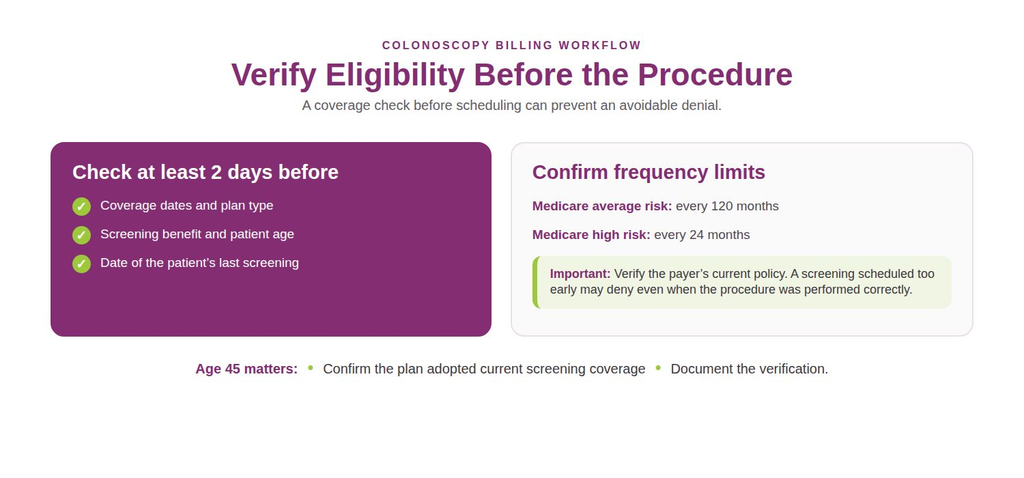
Eligibility errors cause denials that no amount of coding skill can repair later. Check coverage dates, plan type, and colonoscopy benefits at least two days before the appointment. Confirm whether the plan covers screening at age 45, since the USPSTF lowered the recommended starting age in 2021, and not every plan adopted the change at the same pace.
Ask the patient for the date of their last screening. Aetna, Cigna, and Medicare all enforce frequency limits. Medicare covers a screening colonoscopy every 120 months for average-risk patients and every 24 months for high-risk patients. A screening booked too early will be denied even when the procedure itself was perfectly performed.
2. Collect Prior Authorization for High-Risk Services
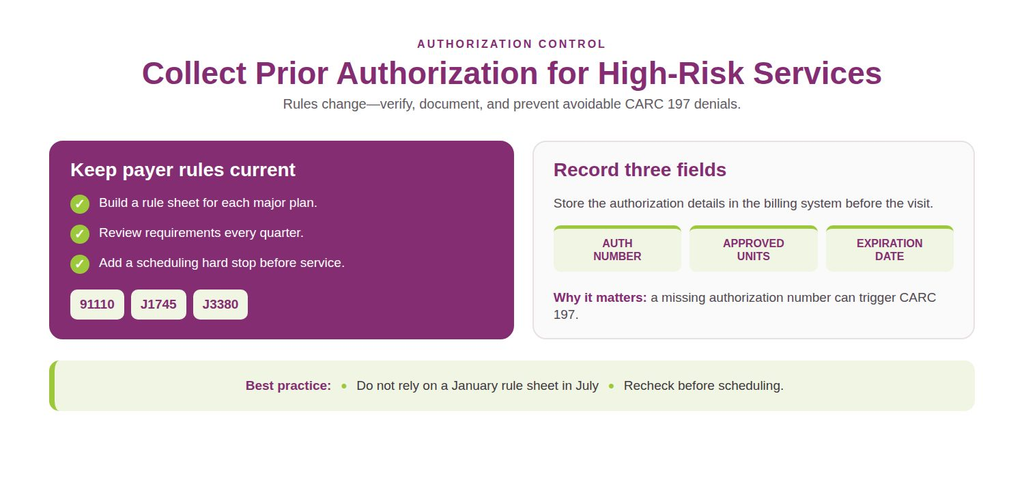
Prior authorization rules vary by payer and often change during the plan year. Services that frequently need approval include capsule endoscopy 91110, infliximab J1745, and vedolizumab J3380. Build a payer rule sheet for each major plan and review it every quarter. A rule sheet from January can be wrong by July.
Record the authorization number, the approved units, and the expiration date in your billing system. A missing number is one of the simplest ways to trigger CARC 197, and it is also one of the easiest to prevent with a hard stop at scheduling.
3. Code From the Final Procedure Note
Always code from the completed procedure note, not from the scheduled procedure. Picture a patient booked for a screening colonoscopy where the physician removes two polyps with a snare. If the biller submits only the screening code, the payer denies or underpays the claim.
A colonoscopy booked as screening may end up as CPT 45385 for snare polypectomy. An EGD may move from 43235 to 43239 once the physician takes a biopsy. Coders need the exact technique, the number of lesions, and the location of each removal before they assign a code.
Practices without in-house endoscopy coders often rely on gastroenterology billing services staffed by certified specialists who read procedure notes every day.
4. Apply Modifiers With Precision
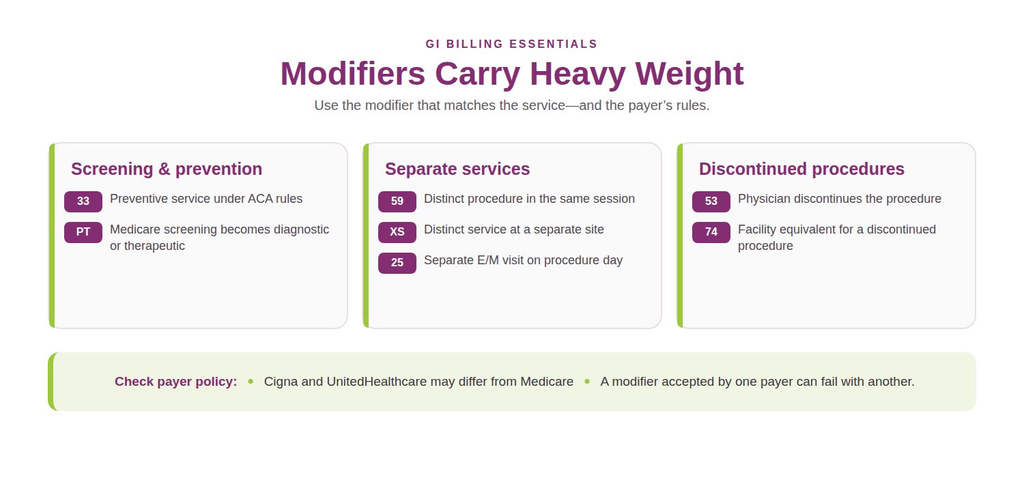
Modifiers carry heavy weight in GI claims, and payers check them closely. The ones your team should know well include:
- Modifier 33, which marks a preventive service under commercial plans that follow ACA rules.
- Modifier PT, which tells Medicare that a screening colonoscopy became diagnostic or therapeutic.
- Modifier 59 or XS, which separates distinct procedures performed during the same session.
- Modifier 25, which supports a separate evaluation and management visit on the procedure day.
- Modifier 53, which applies when the physician discontinues a procedure, and modifier 74, which applies to the facility equivalent.
Review payer-specific modifier policies as well. Cigna and UnitedHealthcare do not always mirror Medicare, and a modifier that passes one payer can fail another.
5. Match Each Procedure to the Right Diagnosis
Medical necessity denials often begin with a diagnosis that does not support the service billed. Use a symptom code such as K92.1 for melena only when no confirmed diagnosis exists. Once pathology returns, update the claim with the confirmed diagnosis, such as K50.90 for Crohn disease when the record supports it.
For screening claims, use Z12.11 for colon cancer screening, and add Z86.010 for a personal history of colonic polyps when it applies. The order of diagnosis codes matters too. A claim that lists the symptom first when the screening was the reason for the visit can trigger a CARC 50 denial even when everything else is correct.
6. Follow NCCI Edits and Bundling Rules
The National Correct Coding Initiative, known as NCCI, sets edits that govern which procedures can be billed together. Colonoscopy codes in the same family follow multiple endoscopy rules, and payers reduce payment for the lower-value codes. Billing 45378 with 45385 in the same session is a classic CARC 97 denial.
Run every claim through a claim scrubber loaded with current NCCI edits before submission. Update the scrubber when CMS publishes quarterly changes, because stale edits create false confidence.
7. Write Procedure Notes That Defend the Claim
Auditors and payers read the procedure note before they read the claim. Strong notes state the indication, the findings, and the reason for each intervention. For a diagnostic colonoscopy, the note should record the symptoms that justified the test, such as rectal bleeding, iron deficiency anemia, or a positive fecal immunochemical test.
Document the size, number, and removal method for every polyp. Missing details give payers an easy reason to deny, and appeals take weeks to resolve. A physician who spends an extra minute on the note often saves the practice far more time later.
8. Submit Clean Claims Within Timely Filing Limits
Timely filing limits differ widely, and missed deadlines are rarely overturned on appeal. Medicare allows 12 months from the date of service. Many commercial plans allow between 90 and 180 days, and some are shorter than that.
Set an internal target to submit claims within three business days of the procedure. Hold polypectomy claims only as long as pathology results require, and check the hold list every day so nothing ages out quietly. Track the first-pass acceptance rate by payer each week, because a sudden drop usually points to a specific rule change or data problem.
9. Align Anesthesia, Facility, and Professional Claims
GI procedures often generate three separate claims, and each one must match the others. Anesthesia uses 00812 for a screening colonoscopy and 00811 when the procedure turns diagnostic. Anesthesia claims also need modifier PT when a screening converts to a diagnostic service.
Mismatched diagnosis codes between the endoscopist and the anesthesia provider cause avoidable denials. Share the final procedure code and diagnosis with the anesthesia team on the same day.
Place of service matters as well. Use place of service 24 for an ambulatory surgery center and place of service 11 for a physician office. Using the wrong one can send a correct claim to the wrong payment schedule.
10. Work Every Denial and Find the Root Cause
Some denials will still happen, so every practice needs a clear appeal workflow. Sort each denial by CARC code, payer, provider, and procedure code every month. Patterns show you where the process breaks, which matters more than fixing the individual claim.
Appeal within the payer window, attach the procedure note, and cite the payer policy that supports your position. Medicare allows 120 days from the initial determination to request a first-level appeal, called a redetermination.
Teams that want a repeatable process often pair internal review with denial management services that track root causes by payer and CARC code.
Reactive Handling vs. Proactive Prevention
Many practices still wait for the denial and then repair the claim. The comparison below shows how the two approaches differ across the areas that affect revenue most.
| Area | Reactive handling | Proactive prevention |
|---|---|---|
| Timing | Work starts after the payer rejects the claim | Work starts at scheduling and registration |
| Cost per claim | Extra labor on every denied claim | Fewer touches per claim |
| Cash flow | Payments delayed by weeks or months | Faster first-pass payment |
| Staff effort | Appeals, calls, and resubmissions | Checks completed at the front end |
| Data use | Denials reviewed one at a time | Denials grouped by cause and payer |
| Revenue risk | Missed deadlines and write-offs | Fewer write-offs through early correction |
Shifting from reactive to proactive work usually takes a few months. The first step is almost always the same: move eligibility and authorization checks ahead of the appointment, so staff see problems while there is still time to fix them.
Key Numbers to Track Each Month
You do not need a dashboard with forty metrics. A small set of numbers, reviewed monthly with the billing team, will show you most of what you need. Strong revenue cycle management programs report these numbers by payer, provider, and procedure code every month, which is how patterns become visible.
| Metric | Common target | Why it matters |
|---|---|---|
| Clean claim rate | 95 percent or higher | Shows coding and data quality |
| Denial rate | Under 5 percent | Signals revenue leakage |
| Days in accounts receivable | Under 40 days | Shows how quickly payments arrive |
| Appeal overturn rate | Tracked by payer | Shows which appeals deserve the effort |
These targets shift with payer mix. A practice heavy in Medicare will look different from one that depends on commercial plans, so set your own baseline first and then work toward improvement. Chasing an industry average without knowing your starting point usually leads to frustration.
Start Your Denial Prevention Plan This Month
Pick two tips from this list and apply them to every claim this month. Eligibility checks and modifier audits are practical starting points because they require no new software, only a little discipline at the front desk and in the coding queue.
Measure your denial rate again after 60 days. If the number moved, keep the change. If it did not, look at the CARC breakdown and find the pattern behind it. Denial prevention is not a one-time project. It is a routine, and the practices that treat it that way are the ones that keep their cash flow steady.
What Causes Most Claim Denials in Gastroenterology Billing?
Modifier errors, missing prior authorization, and weak medical necessity support account for a large share of GI denials. Start your review with those three areas before checking anything else. They tend to produce the biggest return for the time spent.
How Does Modifier PT Affect a Screening Colonoscopy Claim?
Modifier PT tells Medicare that a screening colonoscopy turned diagnostic or therapeutic during the session. It also helps the payer apply the correct patient cost sharing to the claim, which is why leaving it off can create both a denial and a patient billing problem.
How Long Do We Have to Appeal a Denied GI Claim?
Appeal deadlines depend on the payer. Many commercial plans allow between 60 and 180 days. Medicare allows 120 days for a first-level appeal. Always read the denial letter first, since it states the exact deadline for your claim.
Which GI Services Most Often Need Prior Authorization?
Capsule endoscopy, biologic infusions such as infliximab, and some advanced imaging often require approval. Rules differ by payer and by plan year, so verify each plan before the procedure rather than after the claim is sent.
How Can a Practice Reduce Denials Without Adding Staff?
Start with front-end checks, a claim scrubber, and a monthly denial report. These three steps catch many preventable errors before the claim reaches the payer. If volume grows beyond what your team can handle, a billing partner is a reasonable next step.