CPT code 31652 reports bronchoscopy with endobronchial ultrasound (EBUS) guided needle sampling of 1 or 2 mediastinal or hilar lymph node stations. Pulmonologists and thoracic surgeons use it to stage lung cancer and to find the cause of enlarged chest lymph nodes.
The American Cancer Society projects 229,410 new lung cancer cases in the United States in 2026. Nodal sampling sits at the center of staging, so this code appears often on pulmonology and thoracic claims.
Practices can bill CPT 31652 when the operative report names each station sampled, documents ultrasound guidance, and shows medical necessity.
This guide covers the code description, Medicare payment, real-world billing scenarios, and the coding rules that prevent claim denials.
What Is the Description of CPT Code 31652?
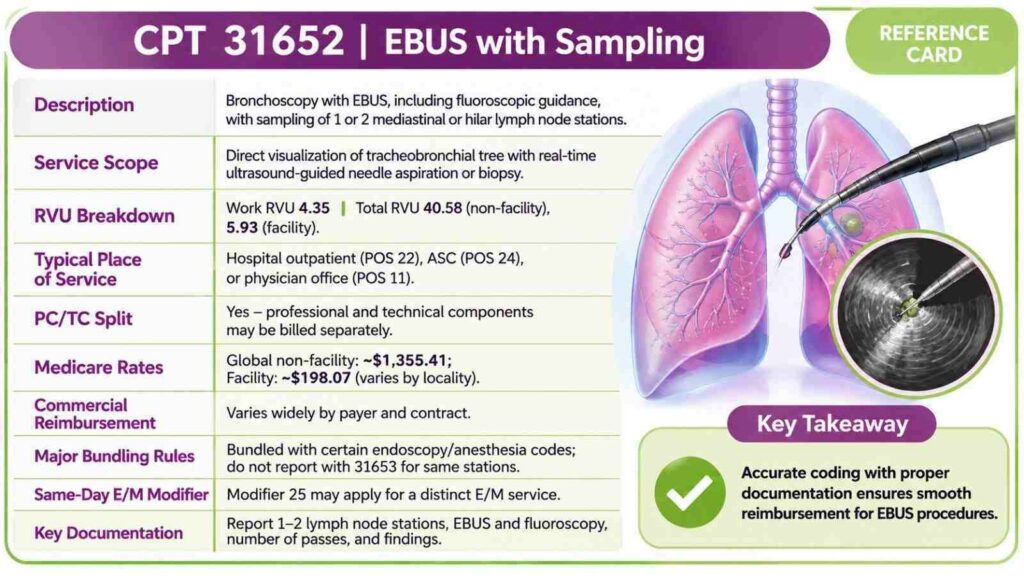
Providers report CPT code 31652 for a bronchoscopy in which an ultrasound probe guides a needle into 1 or 2 lymph node stations or structures. Fluoroscopic guidance is included when performed. Medicare assigns the code a work RVU of 4.35 and a global period of 000.
Total RVUs come to 40.58 in the office and 5.93 in a facility. The CPT manual places the code in the Respiratory System section, within the bronchoscopy family of 31622 to 31654. Claims report 1 unit per session.
How Do You Count Stations for 31652?
Stations come from the standard lymph node map, such as 4R, 4L, 7, 10R, and 11L. A station sampled once or ten times still counts as 1, so needle passes never change the code. A mass or other structure beside the airway also counts toward the total.
Sampling 1 or 2 stations fits 31652. Sampling 3 or more moves the claim to 31653.
Is 31652 the Same as 31653 or 31629?
No, the codes differ in station count and in whether ultrasound guides the needle. The table below shows different similar codes and when each one is used.
| Code | What It Reports | When It Is Used |
|---|---|---|
| 31652 | EBUS guided sampling of 1 or 2 stations | Staging or diagnosis with a limited nodal target |
| 31653 | EBUS-guided sampling of 3 or more stations | Full mediastinal staging across several stations |
| 31629 | Needle aspiration through the scope without ultrasound | Sampling the airway wall or nearby lesions |
| +31654 | Radial EBUS add-on for peripheral lesions | Locating a lung nodule during biopsy |
Each code answers a different clinical question, so the target and the technique choose the code. Payers deny 31629 when the operative report shows real-time ultrasound guidance for the same samples.
When Do Providers Order 31652?
Clinicians order 31652 when imaging shows enlarged chest lymph nodes and tissue is needed. Four situations commonly lead to an order.
- Staging of confirmed or suspected lung cancer
- Mediastinal or hilar nodes of unknown cause on CT or PET
- Suspected sarcoidosis, lymphoma, or infection in chest nodes
- Confirming nodal spread in patients with cancer elsewhere
CT and PET show where nodes are enlarged, but only tissue shows what they contain. EBUS reaches the nodes through the airway and can be done under moderate sedation, so it also serves patients who are not surgical candidates.
Does 31652 Split Into Professional and Technical Components?
No, 31652 is a physician service code, so modifiers 26 and TC do not apply. Medicare prices it as a single payment covering the physician’s work, practice expense, and malpractice cost.
Setting still changes the amount. A physician working in the office is paid the office practice expense value, and one working in a hospital or surgery center is paid the facility value. The facility bills its own claim.
Which ICD-10 Codes Support 31652?
Chest and cancer diagnoses from the wider set of pulmonology ICD-10 codes support 31652 when the record explains why nodal tissue was needed.
| Diagnosis Family | Example ICD-10-CM Codes |
|---|---|
| Lung cancer | C34.11 and other C34 codes by site |
| Secondary cancer in chest lymph nodes | C77.1 |
| Localized enlarged lymph nodes | R59.0 |
| Generalized enlarged lymph nodes | R59.1 |
| Sarcoidosis of lymph nodes | D86.1 |
| Sarcoidosis of lung with lymph nodes | D86.2 |
| Tuberculosis of intrathoracic lymph nodes | A15.4 |
Covered code lists differ by payer and by Medicare Administrative Contractor, so the local policy confirms the final choice.
Can You Bill a Symptom Code With a Confirmed Cancer Diagnosis?
Code the confirmed cancer first. Add R59.0 only when enlarged nodes are the documented reason for sampling, and no confirmed diagnosis explains them.
Extra diagnosis codes never establish medical necessity on their own. The note must tie the imaging finding to the decision to sample.
How Does 31652 Pair With Other Bronchoscopy Codes?
Bronchoscopy carries the densest bundling among pulmonology CPT codes, so each pairing needs to be checked against the current NCCI table.
| Code | Billable With 31652 | Rule |
|---|---|---|
| 31622 | No | Diagnostic bronchoscopy is inherent in surgical bronchoscopy |
| 31653 | No | Mutually exclusive with 31652 in the same session |
| 31624 | Only when distinct | Bronchoalveolar lavage needs modifier XS or 59 and clear documentation |
| 31625 | At a distinct site | Document the separate site and confirm the edit |
| 31628 | Yes | Transbronchial lung biopsy uses a separate technique and lobe |
| 31629 | Only for a distinct target | Never for nodes sampled with ultrasound |
| +31654 | Check the NCCI table first | Add-on code reported with a primary bronchoscopy code for peripheral lesions |
Fluoroscopy is part of the descriptor, so fluoroscopy codes are never billed alongside 31652.
What Does CPT Code 31652 Cost, and Who Pays for It?
For 2026, Medicare pays approximately $1,355.41 nationally when a physician performs 31652 in the office. A physician working in a hospital or surgery center is paid approximately $198.07. Both figures come before geographic adjustment.
Those amounts come from total RVUs of 40.58 and 5.93 multiplied by the 2026 conversion factor of $33.4009.
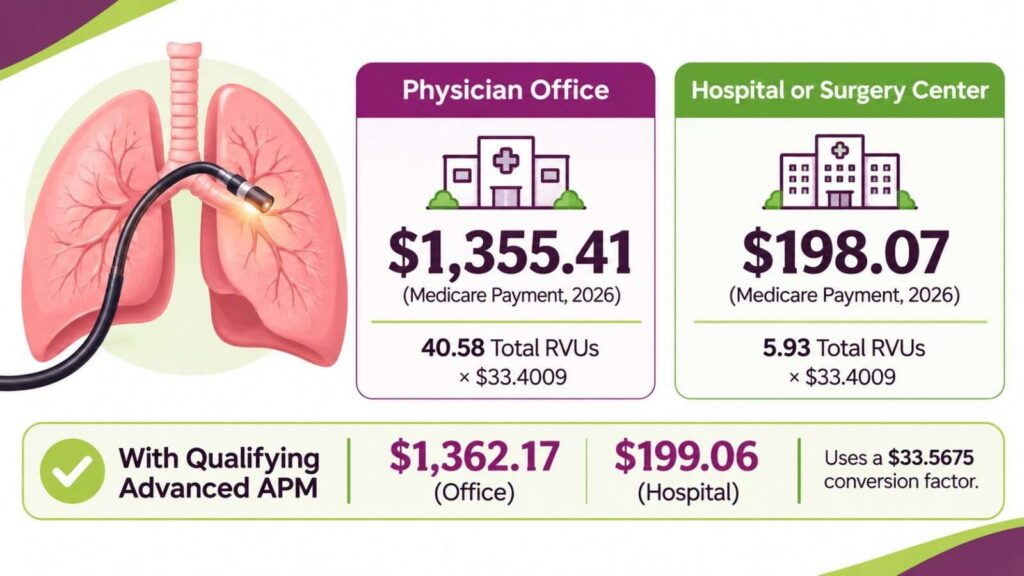
Qualifying Advanced APM participants are paid with a $33.5675 factor, which gives approximately $1,362.17 and $199.06. The office value includes practice expenses for equipment, supplies, and staff.
Does Medicare Cover CPT Code 31652?
Medicare Part B covers EBUS sampling when it is reasonable and necessary, and the record supports it. Staging of confirmed or suspected lung cancer and evaluation of chest lymph nodes of unknown cause are the common qualifying reasons.
Local contractor policies can add diagnosis and documentation rules. The Medicare Coverage Database shows the policies for a practice’s contractor.
Does Commercial Insurance Cover CPT Code 31652?
Many commercial plans cover it when written criteria are met. Blue Cross Blue Shield of Massachusetts policy 715 treats EBUS-guided biopsy as necessary for staging in patients with diagnosed lung cancer who are suitable for treatment and have abnormal nodes on imaging.
That policy lists no outpatient prior authorization, but other plans differ. Contract rates are negotiated, and many plans base payment on a percentage of the Medicare schedule. This is why Pulmonology billing firms verify authorization rules and network status before scheduling.
Does the Patient Owe a Deductible or Coinsurance?
Cost sharing applies. Under Part B, patients generally pay the annual deductible when it is not met, then 20% of the Medicare-approved amount.
At the national amounts, 20% coinsurance comes to about $271.08 for the office claim and $39.61 for the facility claim. Commercial plans may apply a deductible, copayment, or coinsurance under the policy.
How Does Reimbursement Differ by Setting?
The setting determines who bills and how much Medicare pays. Here’s a table explaining different settings and their Medicare payment.
| Setting | Who Bills | 2026 National Medicare Payment |
|---|---|---|
| Physician office | Physician | $1,355.41 |
| Hospital or surgery center, physician claim | Physician | $198.07 |
| Hospital outpatient department, APC 5154 | Hospital | $3,809 |
| Ambulatory surgery center | Surgery center | $1,696 |
Hospital and surgery center rates are unadjusted national figures that shift with wage index and facility factors. When 31652 is billed with 31628 in the hospital outpatient setting, Medicare’s complexity adjustment moves the claim to APC 5155, which pays $7,210.
How Much Can Local Reimbursement Differ From the National Average?
Geographic practice cost indices adjust each RVU component, and the geographic factor across the 109 localities runs from 0.916 in Arkansas to 1.264 in Alaska. Applying Arkansas indices of 1.000 for work, 0.859 for practice expense, and 0.515 for malpractice to 31652 gives approximately $1,180 in the office.
Practice expense makes up most of the office value, so that index drives the local change.
How Do Multiple Endoscopy Rules Affect 31652?
When one physician reports several bronchoscopy codes in a session, Medicare pays the highest valued code in full. Each further code adds only the amount it carries above the base bronchoscopy value.
The fee schedule database names the base scope for the family. Reading these rules before posting expected payment prevents overstated forecasts.
What Are Some Real-World Billing Scenarios for CPT 31652?
Four common patterns show how 31652 is coded, from a clean staging claim to a discontinued procedure.
Scenario 1: Lung Cancer Staging in a Hospital Outpatient Department
A 66-year-old has a biopsy-proven right upper lobe adenocarcinoma, and PET shows uptake in stations 7 and 4R. The pulmonologist samples both stations with EBUS at the hospital. The physician submits a professional claim, and the hospital submits its own facility claim.
- CPT Codes: 31652
- ICD-10 Codes: C34.11 and R59.0
- Modifiers: None, since 26 and TC do not apply, with POS 22
- Documentation Required: Pathology proving the cancer, PET and CT findings, each station sampled with its size, passes per station, ultrasound guidance, and the signed operative report
Scenario 2: Three Stations Sampled in One Session
A 59-year-old with lung cancer has EBUS sampling of stations 4R, 7, and 11R. The charge entry lists 31652 because the case felt routine. The biller counts the stations in the operative report and corrects the claim.
- CPT Codes: 31653 only; never 31652 and 31653 together
- ICD-10 Codes: C34.11 and R59.0
- Modifiers: None
- Documentation Required: An operative report that lists all 3 stations by number, so the count supports 31653 on audit
Scenario 3: EBUS Plus Transbronchial Lung Biopsy for Suspected Sarcoidosis
A 34-year-old has bilateral hilar adenopathy and lung infiltrates. The pulmonologist samples stations 7 and 11R with EBUS and takes transbronchial biopsies from the right lower lobe. Diagnostic bronchoscopy is not billed because it is included in both procedures.
- CPT Codes: 31652 and 31628
- ICD-10 Codes: R59.0 and R91.8 until pathology confirms a diagnosis
- Modifiers: None for Medicare, which applies multiple endoscopy rules automatically, while some payers ask for 51
- Documentation Required: The stations sampled, the lobe biopsied, the separate technique for each service, and the signed operative report
Scenario 4: Procedure Stopped Before Sampling
A 71-year-old is scheduled for EBUS staging. Ultrasound shows the target stations are too small to sample safely, so the physician ends the sampling portion. The practice reports the intended code with modifier 53.
- CPT Codes: 31652 with modifier 53
- ICD-10 Codes: C34.11
- Modifiers: 53 for the discontinued procedure
- Documentation Required: Ultrasound size of each station examined, the reason sampling stopped, and the signed operative report
Payers price modifier 53 claims under their own rules, so expect a reduced payment.
What Are the Coding Rules for CPT 31652?
Rules for 31652 fall into 3 groups covering documentation, coverage and frequency, and edits and appeals. A gap in any group can turn a payable procedure into an unpaid claim.
What Documentation Must Support a 31652 Claim?
Support starts with a signed order, an imaging report showing the target, and a complete operative report. The report names each station by number and states its size on ultrasound.
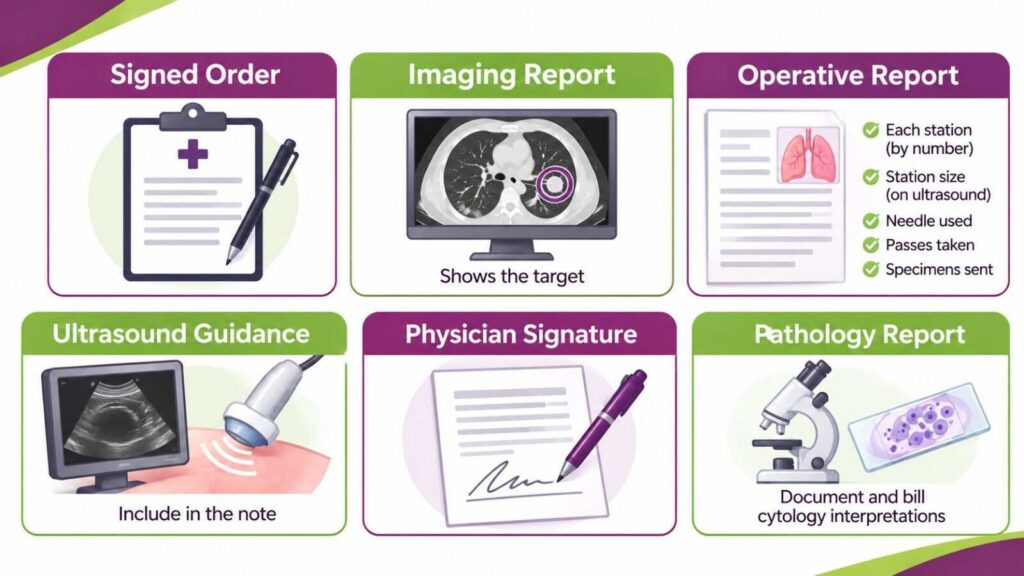
It also lists the needle used, the passes taken, and the specimens sent. Ultrasound guidance belongs in the note, and the physician signs the report. Pathologists document and bill their own cytology interpretations.
Who Qualifies for 31652?
Qualification depends on a documented nodal question that sampling will answer. The table separates what supports a claim from what does not.
| Situation | Supports Medical Necessity | Does Not Support |
|---|---|---|
| Clinical Picture | Confirmed or suspected lung cancer, or unexplained chest nodes | No finding and no diagnosis |
| Imaging | Enlarged or PET-avid nodes on CT or PET | No nodal finding described in the record |
| Treatment Plan | Patient suitable for care that depends on stage | Result cannot change management |
| Source of Request | Clinician order tied to a diagnostic question | Screening request with no symptom or finding |
| Order | Signed order naming EBUS sampling | No written order in the record |
Procedures in the right column can still happen, but Medicare treats the claim as non-covered. An Advance Beneficiary Notice signed before the procedure moves liability to the patient.
How Often Can 31652 Be Billed?
Frequency limits come from the contractor policy or the payer contract. Repeat EBUS fits a new finding, restaging after treatment, or a node that grew on imaging.
Medicare pays 1 unit per session, so sampling an extra station in the same session never adds a second 31652.
Do Local Coverage Determinations Add Requirements?
Local policies can add covered diagnosis lists and documentation rules, and they differ by Medicare Administrative Contractor. National necessity standards apply everywhere, while local policies add diagnosis and frequency details.
A jurisdiction lookup in the Medicare Coverage Database shows the policy for a practice’s contractor.
How Do NCCI Edits Affect 31652?
NCCI procedure-to-procedure edits bar some code pairs on one date. A modifier indicator of 1 allows a modifier for distinct services, and an indicator of 0 allows none.
Diagnostic bronchoscopy 31622 never pays alongside 31652. Quarterly updates to the edit tables make the current version the one that governs.
When Do You Use Modifier 25 With 31652?
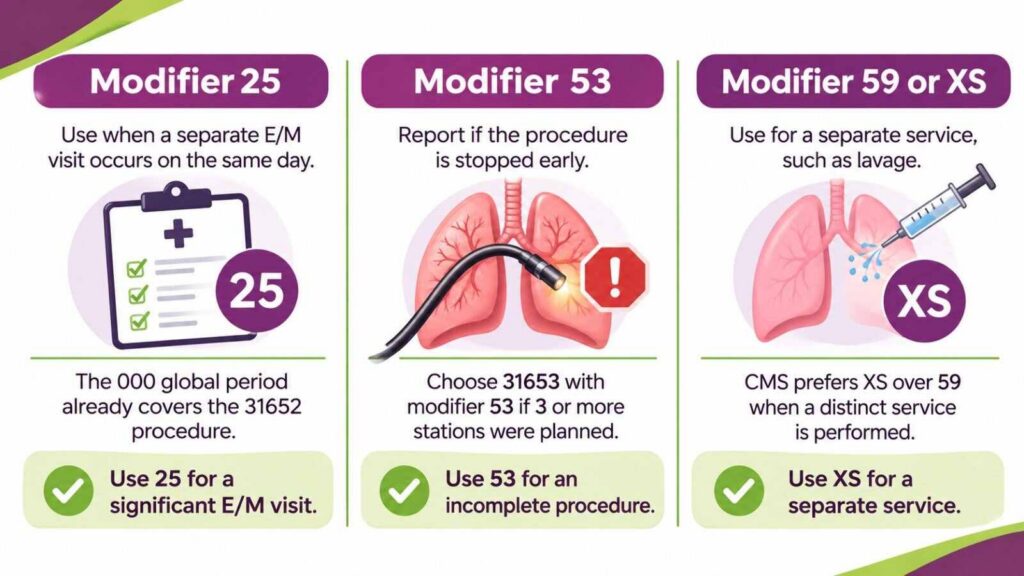
Append modifier 25 to the E/M code when a significant, separately identifiable visit occurs on the same date. The 000 global period already pays for the decision to perform 31652 and the routine work around it.
Visit notes need work beyond that, such as a new problem addressed in full.
When Do You Use Modifier 53 With 31652?
Report modifier 53 when the physician starts the planned EBUS sampling and stops for safety or access reasons, such as stations being too small to sample. The note must state why.
Choose 31653 with modifier 53 when the plan called for 3 or more stations.
When Do You Use Modifier 59 or XS With 31652?
Use XS when a separate service, such as lavage under 31624, targets a separate structure. CMS prefers the specific X modifiers over 59 where one fits. Overuse of either modifier is a known audit trigger, so the record must show the distinct service.
What Is the Appeal Window if a Claim Is Denied?
Redetermination requests must reach the Medicare contractor within 120 days of receiving the denial notice, which opens the first of 5 appeal levels. Decisions typically arrive within 60 days. Commercial payers set separate deadlines, often stated in the denial letter.
Why Do CPT 31652 Claims Get Denied?
Every fix starts with the operative report, so a pulmonology billing provider always checks that it lists stations, size, and guidance before coding begins.
| Denial Cause | What It Looks Like | Quick Fix |
|---|---|---|
| Station Count Mismatch | 31652 billed when the report lists 3 or more stations | Recount from the report and change to 31653 |
| Both EBUS Codes Billed | 31652 and 31653 on one claim | Report the single code that matches the count |
| TBNA Code With Ultrasound | 31629 billed, though the report shows ultrasound guidance | Rebill as 31652 or 31653 |
| Bundled Diagnostic Scope | 31622 on the same claim | Remove the 31622 line |
| No Stations Named | Report says only that lymph nodes were sampled | Request a dated addendum listing the stations from the procedure record |
| Missing Medical Necessity | No imaging or diagnosis tied to the nodes | Match the diagnosis to the policy and attach the imaging report |
| Wrong Modifier | 26 or TC appended | Remove it, since 31652 is a physician service code |
| Missing Authorization | Plan required approval before the procedure | Verify before scheduling and appeal with clinical notes |
Every fix starts with the operative report, so the best prevention is a report that lists stations, size, and guidance before coding begins.
Final Words on CPT Code 31652
Payment on 31652 depends on the paperwork behind the sampling. Charts need a signed order, an imaging report, each station by number, and a signed operative report.
Count stations before choosing between 31652 and 31653, never bill diagnostic bronchoscopy alongside it, and confirm the setting before forecasting payment. Teams that build these habits into charge capture give each CPT code a clear path to payment on first submission.