Summary: “Florida Medicaid fee-for-service claims go to Gainwell Technologies through the Secure Web Portal or EDI, within 12 months of service. Managed care plans set their own rules. In 2026, every active provider must also revalidate under the state’s Medicaid Integrity Initiative.”
Florida Medicaid billing runs on two tracks. The Agency for Health Care Administration (AHCA) pays fee-for-service claims through its fiscal agent, Gainwell Technologies. Statewide Medicaid Managed Care (SMMC) plans pay claims for their own members. Your practice must know which track a patient is on before billing.
Each track has its own fee schedule, filing deadline, and authorization process. Fee-for-service billing also changed in 2026. New NPI requirements now apply to portal claims. A statewide provider revalidation began in June 2026 under Florida’s Medicaid Integrity Initiative.

How Does Florida Medicaid Billing Work?
Florida Medicaid billing works through fee-for-service claims paid by AHCA’s fiscal agent and managed care claims paid by SMMC plans. SMMC 3.0 took effect on February 1, 2025. Most Florida Medicaid recipients now receive their services through an SMMC plan.
Gainwell Technologies enrolls providers, processes fee-for-service claims, issues payments, and runs the provider call center. Full enrollment lets your practice bill fee-for-service claims directly. Limited enrollment fits providers paid only by health plans. Outsourced Florida medical billing services can route each claim to the right track from intake.
Should Your Practice Bill Florida Medicaid or the Patient’s Health Plan?
Your practice bills the SMMC plan for plan members and Gainwell for fee-for-service recipients. Eligibility decides the route, so check it before every visit.
- Secure Web Portal: Real-time eligibility checks inside the Florida Medicaid portal.
- Automated voice response: Eligibility by phone at 1-800-239-7560.
- Batch transactions: Standard X12 270/271 eligibility files through the portal.
- Point-of-sale device: A connection through an approved Florida Medicaid eligibility vendor.
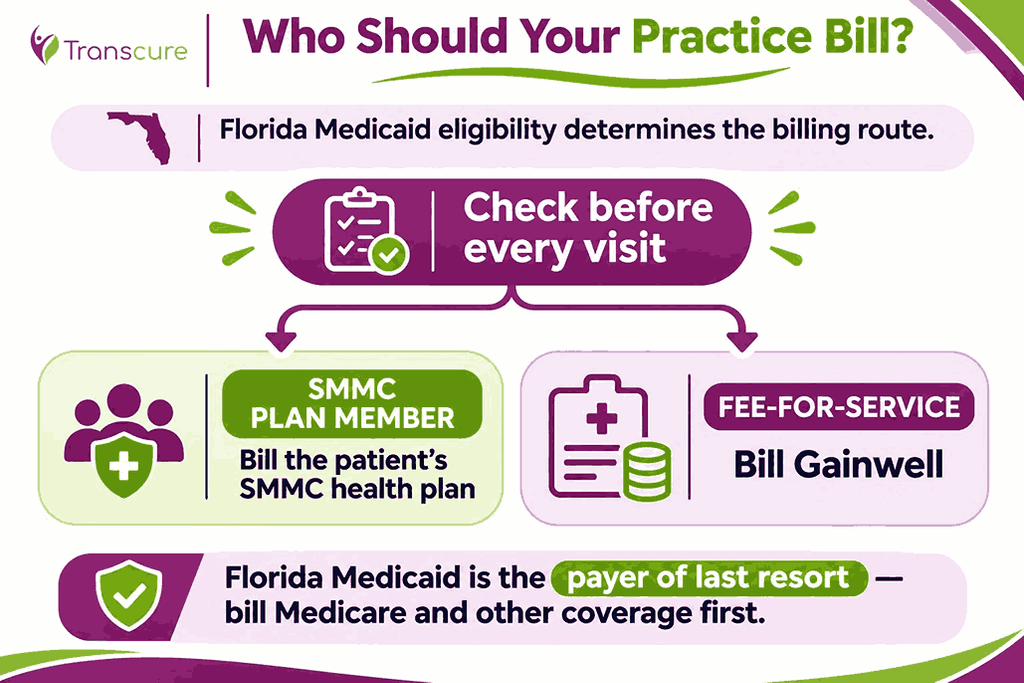
Florida Medicaid is the payer of last resort. Bill other coverage, including Medicare, before billing Florida Medicaid.
Can a Florida Medicaid Provider Bill the Recipient?
A Florida Medicaid provider can bill the recipient only in the situations Rule 59G-1.050 allows. Rule 59G-1.050 permits recipient billing in 5 situations.
- The recipient was not eligible for Florida Medicaid on the date of service.
- The service is not covered, and your practice bills all patients for that service.
- The recipient has exceeded Florida Medicaid coverage for the service.
- The recipient’s plan denied authorization for the service.
- Your practice is outside the plan’s network, except for emergency services.
Recipient billing is never allowed for missed appointments. It is also barred when your practice failed to bill Florida Medicaid correctly or on time. Section 409.913 makes improper recipient billing a sanctionable act.
Where Is the Florida Medicaid Fee Schedule, and How Do You Read It?
The Florida Medicaid fee schedules are incorporated by reference in Rule 59G-4.002 and published on AHCA’s website. Florida Medicaid pays fee-for-service claims based on a fee schedule, a cost report, or a contract.
Each fee schedule carries its own effective date. Rule 59G-4.002 lists schedule sets effective January 1, 2025, and July 1, 2025. AHCA last amended the rule on January 18, 2026.
Separate schedules cover practitioner services, durable medical equipment and supplies, therapy, and other service types. Bill each claim against the schedule in effect on the date of service.
Do SMMC Plans Pay the Florida Medicaid Fee Schedule Rate?
SMMC plans do not always pay the Florida Medicaid fee schedule rate. Contracted providers receive the rate negotiated with each plan.
Payment to non-contracted providers depends on the plan’s own rules. AmeriHealth Caritas Florida, for example, pays non-contracted providers the lesser of usual and customary charges or the Florida Medicaid rate. A negotiated rate replaces that formula. Check each plan’s provider manual before billing its members.
What Is the Florida Medicaid Timely Filing Limit?
Florida Medicaid fee-for-service claims must be submitted within 12 months from the date of service. Federal rule 42 CFR 447.45(d)(1) sets that 12-month baseline for state Medicaid programs. Exceptions extend the window in specific situations, and SMMC plans set their own deadlines.
The table lists each filing window and the source that sets it.
| Situation | Filing Limit | Source |
|---|---|---|
| Standard fee-for-service claim | 12 months from the date of service | 42 CFR 447.45(d)(1) |
| Claim secondary to Medicare | 12 months from service, or 6 months after Medicare’s decision, whichever is later | Rule 59G-1.052(15) |
| Third-party insurance paid or denied | Within 6 months of the third-party payment or denial, for claims past 12 months | AHCA exceptional claims form |
| Recipient eligibility file updated late | Within 12 months of the eligibility file update | AHCA exceptional claims form |
| Fiscal agent error | Within 12 months of the adjudication date | AHCA exceptional claims form |
| SMMC plan member | Set by the plan contract; for example, 180 days for participating providers at AmeriHealth Caritas Florida and Sunshine Health | Plan provider manuals |
AHCA’s 2008 reimbursement handbooks still show a 36-month window for Medicare crossover claims. Rule 59G-1.052(15) replaced that limit, and the rule controls.
How Do You Submit a Florida Medicaid Exceptional Claim?
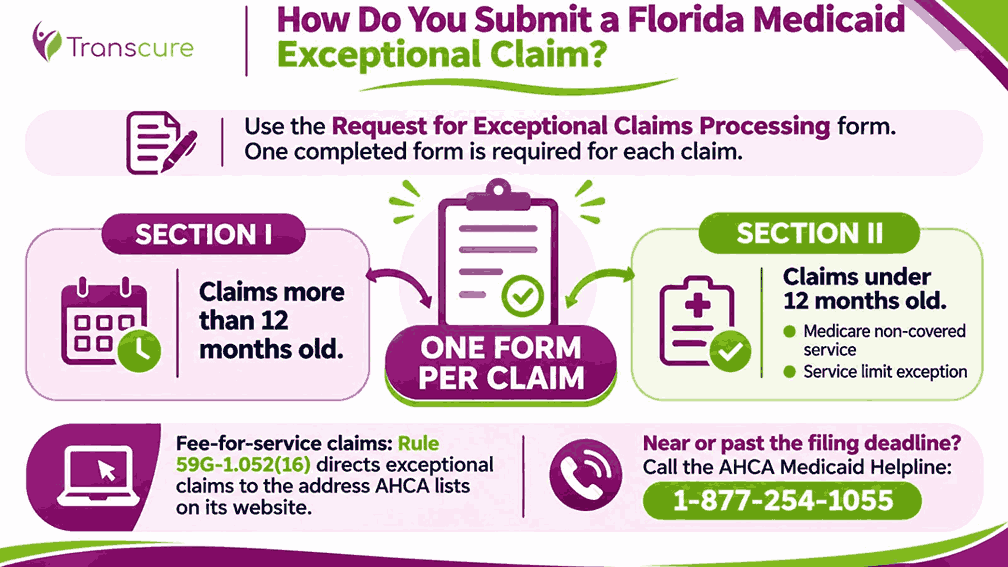
Your practice submits a Florida Medicaid exceptional claim with the Request for Exceptional Claims Processing form. Each claim needs its own completed form.
Section I of the form covers claims more than 12 months old. Section II covers claims under 12 months old, such as a Medicare non-covered service or a service limit exception.
Rule 59G-1.052(16) directs fee-for-service exceptional claims to the address AHCA lists on its website. For claims near or past the filing deadline, call the AHCA Medicaid Helpline at 1-877-254-1055.
How Do You Submit Florida Medicaid Claims?
Your practice submits Florida Medicaid fee-for-service claims through the Secure Web Portal or as X12 837 files through EDI. The portal option is called Direct Data Entry (DDE). Gainwell’s EDI support line is 1-866-586-0961.
- NPI on X12 claims: Electronic X12 claims must carry the NPI for providers required to have one.
- Active NPI for DDE: Since March 27, 2026, DDE claims require an active NPI on the provider file.
- NPI selection: Since April 24, 2026, the portal displays NPIs for the billing, rendering, and ROPA fields on DDE claims.
- Remittance advice: Remittance advices have been electronic-only since July 1, 2013, through the portal or the X12 835 file.
What Is the Payer ID for Florida Medicaid Claims?
Payer IDs for Florida Medicaid claims come from clearinghouses, not from Florida Medicaid itself. Several clearinghouses list Florida Medicaid fee-for-service as payer ID 77027. Confirm the ID with your clearinghouse before sending claims. Each SMMC plan uses its own payer ID.
What Is the Florida Medicaid Claims Mailing Address?
The Florida Medicaid claims mailing address depends on the type of mail your practice sends. Gainwell receives Florida Medicaid mail at these Tallahassee addresses.
| Purpose | Address |
|---|---|
| General written correspondence | P.O. Box 7054, Tallahassee, FL 32314-7054 |
| Out-of-state exceptional claims, subpoenas, and record requests | P.O. Box 7080, Tallahassee, FL 32314-7080 |
| Out-of-state enrollment and provider registration | P.O. Box 7070, Tallahassee, FL 32314-7070 |
| Expedited delivery (FedEx, UPS) | 1625 Summit Lake Drive, Suite 105, Tallahassee, FL 32317 |
| Third-party liability recovery correspondence and payments | Florida Medicaid TPL Recovery Program, P.O. Box 12188, Tallahassee, FL 32317-2188 |
Fee-for-service claims are submitted through the portal or EDI. Mail covers correspondence and specific claim types.
Which Florida Medicaid Phone Numbers Do Providers Need?
Florida Medicaid providers need different phone numbers for claims, policy, eligibility, and authorization questions. The table routes each need to the right contact.
| Need | Contact | Number |
|---|---|---|
| Claim status, claims processing, remittance, provider file changes, enrollment | Gainwell Provider Services | 1-800-289-7799 (Option 4 enrollment, Option 7 contact center) |
| Portal password reset | Gainwell | 1-800-289-7799, Option 5 |
| Electronic claims and EDI | Gainwell EDI | 1-866-586-0961 |
| Automated eligibility verification | AVRS | 1-800-239-7560 |
| Policy, fee schedules, claims near or past the filing deadline | AHCA Medicaid Helpline | 1-877-254-1055 |
| Recipient eligibility file issues | DCF Customer Call Center | 1-866-762-2237 |
| Fee-for-service prior authorization | Acentra Health | 855-444-3747 |
| Third-party liability recovery | Florida Medicaid TPL Recovery Program | 877-357-3268 |
Hours vary by line. Gainwell’s Provider Services Contact Center runs from 7 a.m. to 6 p.m. Eastern.
How Does Prior Authorization Work in Florida Medicaid?
Florida Medicaid fee-for-service prior authorization runs through Acentra Health, formerly eQHealth Solutions. Acentra has served as AHCA’s quality improvement organization since 2011. Providers submit requests through Acentra’s eQSuite portal.
Rule 59G-1.053 incorporates Florida Medicaid’s Authorization Requirements Policy. SMMC plan members follow their plan’s own authorization process instead. Behavior analysis services moved into SMMC plans on February 1, 2025. Only recipients not enrolled in a plan still authorize those services through Acentra.
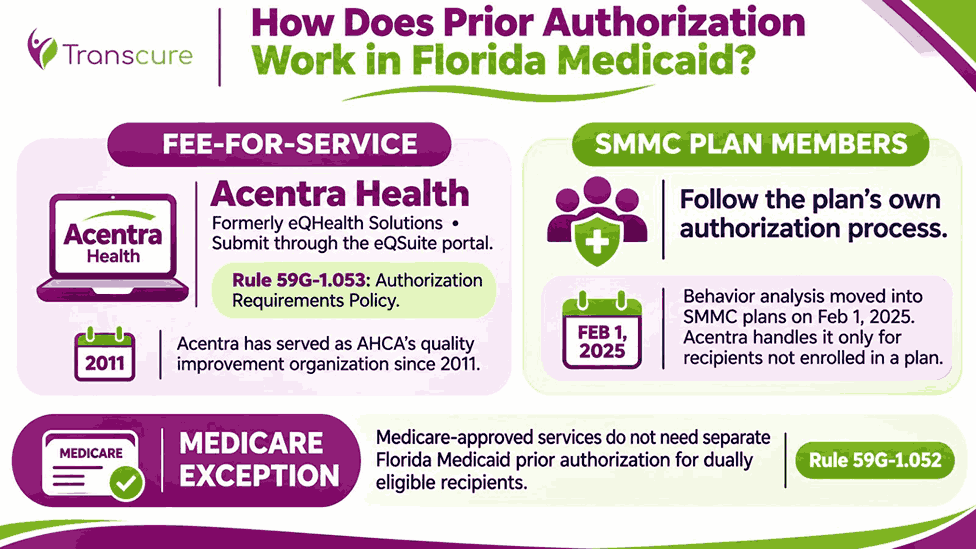
Medicare-approved services do not need a separate Florida Medicaid prior authorization. Rule 59G-1.052 sets that exception for dually eligible recipients.
Which Florida Medicaid Handbooks and Rules Apply to Your Practice?
Florida Medicaid billing rules now live mainly in Chapter 59G of the Florida Administrative Code and in coverage policies. The older provider handbooks no longer control. Four rules carry the core billing requirements.
- Rule 59G-1.050: General Medicaid Policy, including recipient billing limits.
- Rule 59G-1.052: Third-party liability, Medicare crossover filing, and exceptional claims.
- Rule 59G-1.053: Authorization Requirements Policy.
- Rule 59G-4.002: Provider reimbursement schedules and billing codes.
Service-specific coverage policies add rules for each benefit. The 2008 Provider Reimbursement Handbooks for the CMS-1500 and UB-04 remain online. Parts of them conflict with current rules, including the crossover filing limit. Follow the rule when a handbook and a rule differ.
What Does Florida’s 2026 Medicaid Integrity Initiative Mean for Providers?
Florida’s Medicaid Integrity Initiative, announced June 12, 2026, requires every active Medicaid provider to revalidate credentials and identity. Providers who fail to comply or do not meet program requirements are removed from Florida Medicaid.
AHCA added identity screening through a SentiLink pilot and expanded claims monitoring. The June 12 announcement also cited enrollment moratoriums on durable medical equipment suppliers and adult day care providers.
The equipment moratorium took effect March 20, 2026, and expired September 19, 2026. AHCA reopened equipment supplier enrollment on September 24, 2026. These steps sit alongside the other Florida medical billing laws that govern provider billing.
On October 6, 2026, the state reported early results from the initiative:
- More than 400 provider site visits since January 2026
- More than 220 providers terminated, tied to over $230 million in 2025 Medicaid billing
- More than 260 providers placed on payment restrictions or suspended
- More than 150 referrals to the Attorney General’s Office over the past year
How Long Must Florida Medicaid Providers Keep Billing Records?
Florida Medicaid providers must keep billing records for 5 years after the date of service. Section 409.913(9) covers medical, professional, financial, and business records tied to Medicaid services.
The records must be available to AHCA during normal business hours. Section 409.913 also requires claims to be documented by records made at the time of service. Audit decisions rely only on those contemporaneous records. Germane addenda to a contemporaneous note can still be considered.
What Happens When AHCA Finds a Medicaid Overpayment?
AHCA recovers a Medicaid overpayment with interest and can sanction the provider. Section 409.913 defines an overpayment as any unauthorized payment, including one paid by mistake.
- Interest: Overpayments bear 10% annual interest from the final determination.
- Repayment: A provider must repay or set a repayment plan within 30 days of the final order.
- Termination: A provider that misses the 30-day window without an agreement is terminated.
- Fines: Fines reach $5,000 per violation, and each erroneous claim counts separately.
- Referrals: Suspected crimes go to the Attorney General’s Medicaid Fraud Control Unit.
- Public list: AHCA posts a monthly list of terminated and sanctioned providers.
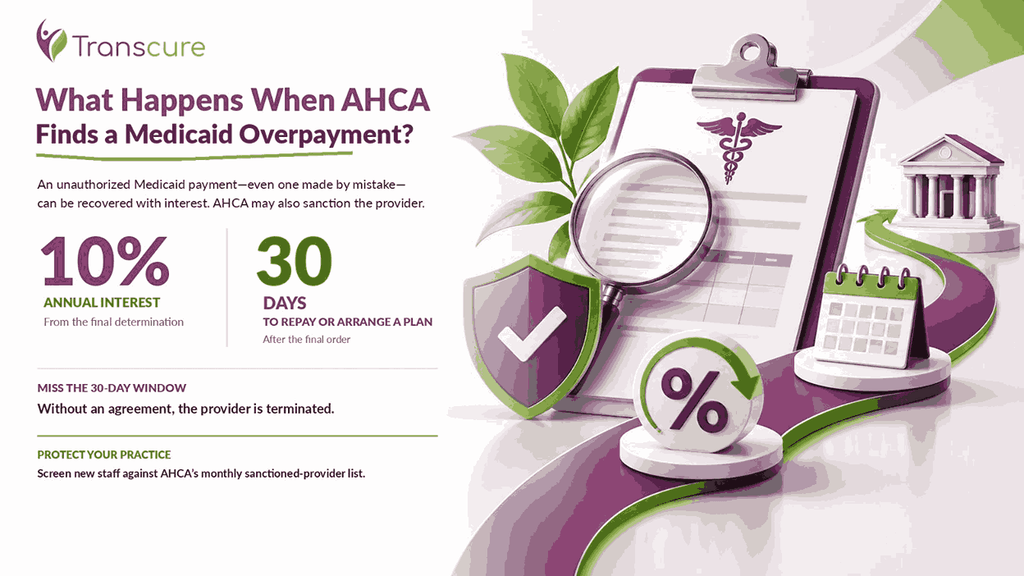
Screen new staff against that sanctioned provider list before they work on Medicaid claims. The Florida False Claims Act adds treble damages plus $5,500 to $11,000 per false claim.
How Does Transcure Support Florida Medicaid Billing and Revalidation?
Transcure supports Florida Medicaid billing and revalidation from its Oviedo, Florida office. In 2026, revalidation, NPI file accuracy, and filing deadlines all land on Medicaid practices at once.
- Revalidation: Transcure’s credentialing team handles revalidation filings and NPI file updates.
- Eligibility: ELIXA, Transcure’s eligibility agent, checks Medicaid and plan coverage before each visit.
- Claim routing: Billers send each claim to fee-for-service or the right SMMC plan within its filing limit.
The outcome is claims that reach the right payer on time and an enrollment that stays active. That work runs alongside Transcure’s medical credentialing services for Florida practices.
Has AHCA Launched Its New Provider Enrollment System?
AHCA has announced a new provider enrollment system, but it has not launched as of November 2026. The system is part of AHCA’s Enterprise modernization project. AHCA’s October 2025 alert targeted an early 2026 launch.
AHCA’s enrollment pages still route applicants through the FLMMIS Online Enrollment Wizard. Keep your NPI current on the provider file, since AHCA says the new system requires it.
Frequently Asked Questions About Florida Medicaid Billing
What Is the Mailing Address for Medicaid in Florida?
General written correspondence for Florida Medicaid goes to Gainwell Technologies at P.O. Box 7054, Tallahassee, FL 32314-7054. Out-of-state exceptional claims and record requests go to P.O. Box 7080. Fee-for-service claims are submitted electronically.
How Do You Submit Medical Bills to Florida Medicaid?
Your practice submits fee-for-service claims through the Florida Medicaid Secure Web Portal or as X12 837 files through EDI. An active NPI is required for portal claims. Claims for SMMC plan members go to the plan.
What Is the Payer ID for Florida Medicaid Claims?
Clearinghouses commonly list Florida Medicaid fee-for-service as payer ID 77027. Payer IDs come from the clearinghouse, so confirm the ID with yours. Each SMMC plan uses its own payer ID.
What Is the Florida Medicaid Timely Filing Limit?
Florida Medicaid fee-for-service claims are due within 12 months from the date of service. Claims secondary to Medicare are due within 12 months of service or 6 months after Medicare’s decision, whichever is later.
Who Is Florida Medicaid’s Fiscal Agent?
Gainwell Technologies is Florida Medicaid’s fiscal agent. Gainwell enrolls providers, processes fee-for-service claims, issues payments, and runs the provider call center at 1-800-289-7799.