“F41.9 is “Anxiety disorder, unspecified.” F41.1 is “Generalized anxiety disorder.” F41.0 is panic disorder, and F40 holds the phobic disorders. The specific codes beneath them are billable in FY2027, and none maps to a payment HCC under CMS-HCC V28.”
The anxiety ICD-10 code depends on how specifically the provider documents the diagnosis. Anxiety without a named disorder is coded F41.9, anxiety disorder, unspecified. Generalized anxiety disorder (GAD) is coded F41.1, and panic disorder is coded F41.0. Phobic disorders sit in the F40 category.
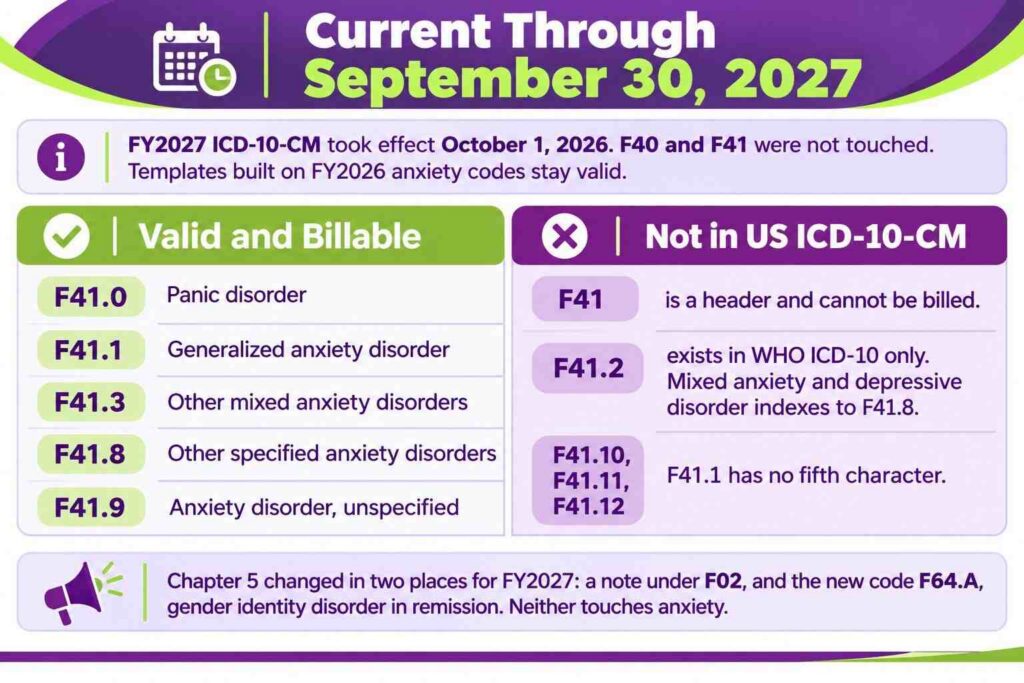
The Centers for Medicare & Medicaid Services (CMS) and the National Center for Health Statistics (NCHS) maintain ICD-10-CM. The FY2027 code set took effect on October 1, 2026. Reported chapter 5 changes do not touch F40 or F41, but coders should confirm in the CMS addenda.
This guide covers the full anxiety code family, the F41.9 versus F41.1 decision, and the five valid F41 codes. It also covers panic and phobia codes, adjacent codes outside F40 and F41, screening, risk adjustment, documentation, and CPT pairings. Each section ends with a practical billing application.
What Is the ICD-10 Code for Anxiety?
The ICD-10-CM code for anxiety is F41.9 when the provider documents anxiety without naming a specific disorder. F41.1 applies to generalized anxiety disorder. F41.0 applies to panic disorder. F40.10 and F40.11 apply to social anxiety disorder. The provider’s diagnostic wording selects the code.
Coders do not assign these codes from symptoms alone. A coder reads the assessment, matches the documented term to the Alphabetic Index, and confirms the code in the Tabular List. The term “anxiety NOS” indexes to F41.9, while “anxiety depression” indexes to F41.8.
| Provider documents | ICD-10-CM code | Reason |
|---|---|---|
| “Anxiety” or “anxiety NOS” | F41.9 | No specific disorder named |
| “Generalized anxiety disorder” | F41.1 | GAD is diagnosed |
| “Panic disorder” | F41.0 | Panic disorder is diagnosed |
| “Social anxiety disorder” | F40.10 | Social phobia, unspecified |
| “Adjustment disorder with anxiety” | F43.22 | Stressor-linked reaction |
Anxiety ICD-10 Codes: Quick-Reference Table
The table lists the core anxiety codes from the wider set of ICD-10 codes with their descriptors and risk adjustment effect. Use it after the provider documents the diagnosis. Anxiety codes carry no payment HCC under CMS-HCC V28, so the focus is specificity and medical necessity. Confirm mappings against the current CMS files before reporting.
| Code | Descriptor | Payment HCC | Use when |
|---|---|---|---|
| F41.0 | Panic disorder [episodic paroxysmal anxiety] | No | Panic disorder without agoraphobia |
| F41.1 | Generalized anxiety disorder | No | GAD is documented |
| F41.3 | Other mixed anxiety disorders | No | Specified mixed anxiety not classified elsewhere |
| F41.8 | Other specified anxiety disorders | No | Anxiety depression or mixed anxiety and depressive disorder |
| F41.9 | Anxiety disorder, unspecified | No | Anxiety NOS |
| F40.01 | Agoraphobia with panic disorder | No | Agoraphobia and panic disorder both documented |
| F40.10 | Social phobia, unspecified | No | Social anxiety disorder documented |
| F40.11 | Social phobia, generalized | No | Fear across most social situations |
| F40.2- | Specific (isolated) phobias | No | Phobia type documented |
| F43.22 | Adjustment disorder with anxiety | No | Anxiety tied to an identified stressor |
| F43.23 | Adjustment disorder with mixed anxiety and depressed mood | No | Mixed presentation tied to a stressor |
| F06.4 | Anxiety disorder due to known physiological condition | No | Anxiety caused by a documented medical condition |
| F93.0 | Separation anxiety disorder of childhood | No | Separation anxiety in a child |
Note: Category F41 is a header and is not billable. Report the specific code beneath it.
F41.9 vs F41.1: Which Anxiety Code Applies?
F41.9 and F41.1 are the two most used anxiety codes, and they carry different meaning. F41.9 reports anxiety without a specified disorder. F41.1 reports generalized anxiety disorder, a defined diagnosis with duration and symptom criteria. The choice depends entirely on provider documentation.
When Is F41.9 the Right Code?
F41.9 is correct when the provider documents anxiety and cannot yet name a disorder. It fits an initial visit, a symptom-level complaint, or a record that lacks diagnostic detail. The code is billable and carries the inclusion term “anxiety NOS.” It is a valid starting point, not a permanent diagnosis.
- An initial primary care visit with a positive GAD-7 and no completed evaluation
- Anxiety documented during a medical visit without a diagnostic workup
- A provider who cannot determine the anxiety type after assessment
What Does GAD Documentation Need to Include?
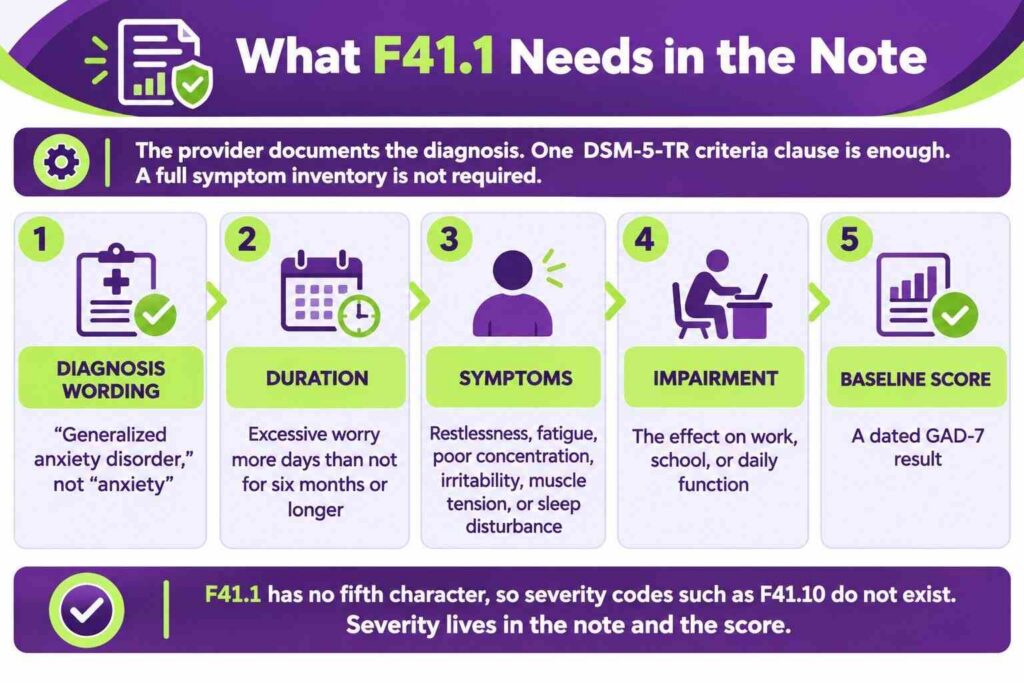
F41.1 requires the provider to document generalized anxiety disorder as a diagnosis. The note should state excessive worry lasting at least six months, associated symptoms, and functional impairment. One DSM-5-TR criteria clause is enough, and a full symptom inventory is not required.
- Diagnosis wording: “generalized anxiety disorder,” not “anxiety”
- Duration: worry present more days than not for six months or longer
- Symptoms: restlessness, fatigue, poor concentration, irritability, muscle tension, or sleep disturbance
- Impairment: the effect on work, school, or daily function
- Baseline score: a dated GAD-7 result
How Do Payers and Auditors Treat F41.9?
Unspecified codes draw attention when they persist. Payers read repeated F41.9 claims as a sign of incomplete evaluation. Partial hospitalization (PHP) and intensive outpatient (IOP) authorizations require stronger medical necessity when F41.9 is primary. Specific codes describe the clinical picture more completely.
When Should F41.9 Convert to a Specific Code?
- The provider documents GAD: report F41.1.
- The provider documents panic disorder: report F41.0.
- The provider documents a phobia or social anxiety: report the matching F40 code.
- The provider documents a stressor-linked reaction: report F43.22 or F43.23.
A diagnostic evaluation usually resolves the question within one or two visits. Coders should flag repeated F41.9 claims for provider review. Convert the code as soon as the record supports a specific disorder. Never convert a code without provider documentation to support the change.
How Many Valid Codes Are in the F41 Category?
Category F41, Other anxiety disorders, holds exactly five valid codes. They are F41.0, F41.1, F41.3, F41.8, and F41.9. F41 itself is a header and cannot be billed. Coders choose the child code that matches the documented diagnosis. Every other F41 code seen online is invalid.
| Code | Descriptor | Typical documentation | Notes |
|---|---|---|---|
| F41.0 | Panic disorder | “Panic disorder,” recurrent attacks | Excludes1 note for F40.01 |
| F41.1 | Generalized anxiety disorder | “GAD” | No fifth character |
| F41.3 | Other mixed anxiety disorders | Specified mixed anxiety | Rarely used |
| F41.8 | Other specified anxiety disorders | Anxiety depression, mixed anxiety and depressive disorder | Covers linked conditions |
| F41.9 | Anxiety disorder, unspecified | “Anxiety NOS” | Convert when a disorder is named |
Common error: Some vendor pages list F41.2 for mixed anxiety and depressive disorder. Others list F41.10, F41.11, and F41.12 as GAD severity codes. None of those codes exists in US ICD-10-CM. F41.1 has no fifth character, and mixed anxiety and depressive disorder indexes to F41.8.
F41.8 deserves attention in practices that treat anxiety with depression. Its inclusion terms cover anxiety depression (mild or not persistent), anxiety hysteria, and mixed anxiety and depressive disorder. The provider must state the link between conditions. See our guide to depression ICD-10 codes for dual-coding examples.
Panic Disorder, Social Anxiety, and Phobia Codes
Panic disorder and phobic disorders sit in different categories. Panic disorder belongs to F41.0. Agoraphobia, social phobia, and specific phobias belong to F40. The two categories interact through one Excludes1 note that coders miss often. Getting that note right prevents a common rejection.
F41.0 carries an Excludes1 note for panic disorder with agoraphobia, which is coded F40.01. A patient with both conditions receives F40.01 alone. Reporting F41.0 and F40.01 together violates the note. The same patient with panic attacks only receives F41.0. Document agoraphobia explicitly so the correct code applies.
| Condition | Code | Documentation note |
|---|---|---|
| Panic disorder | F41.0 | Recurrent panic attacks with concern about further attacks |
| Agoraphobia with panic disorder | F40.01 | Both conditions documented |
| Agoraphobia without panic disorder | F40.02 | Agoraphobia only |
| Agoraphobia, unspecified | F40.00 | Agoraphobia without detail |
| Social anxiety disorder, unspecified | F40.10 | “Social anxiety disorder” or “social phobia” |
| Social anxiety disorder, generalized | F40.11 | Fear across most social situations |
| Specific phobias | F40.2- | Phobia type documented, such as animal, blood, or situational |
The Alphabetic Index sends “panic attack” to F41.0. Payers may still question the code without a documented panic disorder diagnosis. Frequency, onset, and persistent concern about further attacks strengthen the claim. Document each of those elements in the assessment. Dated scores add objective support.
Which Anxiety Codes Sit Outside F40 and F41?
Several anxiety presentations belong to other categories. Coders choose them when the provider documents a specific cause, trigger, or age-related disorder. F41.9 would understate these diagnoses and may draw a payer query. The table lists the most common cases. Each carries its own documentation requirements.
| Condition | Code | Use when |
|---|---|---|
| Adjustment disorder with anxiety | F43.22 | Anxiety tied to an identified stressor |
| Adjustment disorder with mixed anxiety and depressed mood | F43.23 | Mixed anxiety and low mood tied to a stressor |
| Acute stress reaction | F43.0 | Short-term reaction after a stressor |
| Anxiety due to a medical condition | F06.4 | Provider links anxiety to a documented physical condition |
| Substance-induced anxiety disorder | F10 to F19 codes | Provider documents a substance or medication as the cause |
| Separation anxiety disorder of childhood | F93.0 | Separation anxiety in a child |
| Illness anxiety | F45.21 | Preoccupation with having a serious illness |
Scope note: PTSD (F43.10) and obsessive-compulsive disorder (F42.-) have separate code families and fall outside this guide. The psychiatry ICD-10 codes reference covers the full Chapter 5 set.
F41 carries Excludes2 notes for several of these conditions: acute stress reaction, adjustment reaction, neurasthenia, psychophysiologic disorders, and separation anxiety. Excludes2 means the conditions are not part of F41, but a patient can have both. Report both codes when the provider documents both.
How Do You Code Anxiety With Depression or Other Conditions?
Code anxiety with depression by reporting both conditions unless the provider documents a relationship between them. AHA Coding Clinic, First Quarter 2021, directs coders to assign a depression code and an anxiety code separately. No Excludes1 note blocks the pair.
When the provider documents that the conditions are linked, F41.8 applies. Its inclusion terms cover anxiety depression and mixed anxiety and depressive disorder. In that case, F41.8 captures both conditions. The provider must state the link, not the coder. Document the link in the assessment.
| Documentation | Code assignment | Basis |
|---|---|---|
| “Anxiety and depression,” no link | F41.9 plus F32.A | Coding Clinic, Q1 2021 |
| “GAD” and “MDD, recurrent, moderate” | F41.1 plus F33.1 | Two documented diagnoses |
| “Anxiety depression” | F41.8 | Inclusion term under F41.8 |
| “Mixed anxiety and depressive disorder” | F41.8 | Inclusion term under F41.8 |
Anxiety Screening ICD-10 and CPT Codes
Screening applies to patients without a diagnosed anxiety disorder. The US Preventive Services Task Force (USPSTF) recommends anxiety screening for adults 64 and younger, including pregnant and postpartum persons. The recommendation carries a Grade B rating. Evidence is insufficient to assess screening in adults 65 and older.
The Generalized Anxiety Disorder 7-item scale (GAD-7) is the most common instrument. A cutoff score of 10 showed 79 percent sensitivity and 89 percent specificity for GAD in pooled USPSTF evidence. Scores of 5, 10, and 15 mark mild, moderate, and severe symptom bands.
| Code | Use | Notes |
|---|---|---|
| Z13.39 | Diagnosis for anxiety screening | Screening for other mental health and behavioral disorders |
| 96127 | Brief emotional or behavioral assessment | Billed per scored instrument; GAD-7 qualifies |
| Z13.30, Z13.31, Z13.32 | Listed by some plans | Confirm the plan’s preventive diagnosis list |
| G0444 | Not for anxiety | The Medicare annual screening code covers depression only |
| F-code | Positive screen | Report the diagnosis after evaluation |
Report a screening diagnosis only when the patient has no established anxiety diagnosis. A positive screen leads to a diagnostic evaluation and an F code. Some payers allow 96127 as preventive only when no E/M code appears on the same claim. Verify each plan’s policy before billing.
Does the Anxiety Code Affect Risk Adjustment?
No, anxiety codes carry no payment HCC under CMS-HCC V28. F41.1 and F41.9 do not raise a Medicare Advantage risk score. Moderate and severe major depression, by contrast, maps to HCC 155. Confirm any mapping in the current CMS files. Anxiety documentation still matters for other reasons.
- Medical necessity for therapy, medication management, and PHP or IOP authorization
- Quality reporting and screening follow-up measures
- Audit defense when a payer reviews repeated unspecified codes
- Accurate comorbidity capture when depression coexists
In practice: A patient with GAD and moderate recurrent depression carries an HCC through the depression code only. Documenting depression severity matters even when anxiety dominates the visit.
What Documentation Do Payers and Auditors Expect?
Payers expect every anxiety diagnosis to show specific wording, duration, symptoms, and functional impact. The note should also carry a dated screening score and a treatment plan. These elements support the code and the medical necessity of each billed service.
| Element | Weak language | Strong language |
|---|---|---|
| Diagnosis | “Anxious” | “Generalized anxiety disorder” |
| Duration | “Worries a lot” | “Excessive worry more days than not for eight months” |
| Severity | “Anxiety, on buspirone” | “GAD; GAD-7 of 14; buspirone titrated” |
| Impairment | “Stressed” | “Missed work twice monthly due to worry and insomnia” |
| Comorbidity | “Anxious and sad” | “GAD and MDD, both assessed” |
What Should a Provider Query Include?
- List the clinical indicators in the note, such as symptoms, duration, and GAD-7 score.
- Ask the provider to clarify the diagnosis: generalized anxiety disorder, panic disorder, phobia, adjustment disorder, or anxiety unspecified.
- Ask whether a medical condition, medication, or substance causes the anxiety.
- Offer “other” and “unable to determine” as options to keep the query non-leading.
Compliant queries present clinical indicators and several answer options. They never lead the provider toward a higher-paying diagnosis. The AHIMA and ACDIS query practice brief sets this standard. Retain the query and the response for audit review. Anxiety queries are common in primary care.
Which CPT and HCPCS Codes Pair With Anxiety Diagnoses?
Anxiety diagnosis codes support evaluation, therapy, assessment, and care management services. The diagnosis must match the documented condition for each service. The table groups the most common pairings by care setting. Medical necessity reviews compare the two on every claim. Mismatches are a frequent denial reason.
| Setting | Codes | Notes |
|---|---|---|
| Psychiatric evaluation | 90791, 90792 | 90792 adds medical services |
| Psychotherapy | 90832, 90834, 90837 | Time-based; link to the documented diagnosis |
| Scored assessment | 96127 | GAD-7 or similar instrument, per instrument |
| Primary care visits | 99202 to 99215 | Use F41.1 or another specific code once diagnosed |
| Collaborative care (CoCM) | 99492, 99493, 99494, G2214 | Monthly, time-based, with a psychiatric consultant |
| Care management for behavioral health | 99484 | At least 20 minutes of clinical staff time per month |
Payer rules differ on diagnosis requirements for care management claims. Report the most specific anxiety code the note supports. Unit and modifier rules vary by service, including per-instrument units for 96127 and add-on codes such as 90785 for interactive complexity. The psychiatry CPT codes reference breaks down each pairing.
Anxiety Coding Across Specialties
Anxiety often appears as a secondary diagnosis in specialty practices. The code must still reflect what the provider documents. Each specialty has a typical documentation gap that leaves the claim on F41.9. Targeted provider queries close those gaps. Billing teams should audit for them quarterly.
| Specialty | Common scenario | Coding focus |
|---|---|---|
| Primary care | Positive GAD-7 at a chronic care visit | Screening Z13.39 versus diagnosis F41.9 or F41.1; CoCM eligibility |
| Cardiology | Chest pain or palpitations with anxiety | Code the symptom and anxiety separately unless the provider links them |
| Pain management | Chronic pain with anxiety | Report both conditions; document MEAT for each |
| OBGYN | Anxiety in pregnancy or after delivery | F41.- with O99.34-; no postpartum anxiety code exists |
| Pediatrics | Separation anxiety or school-related worry | F93.0 versus F41.-; USPSTF screening applies to ages 8 to 18 |
Common Anxiety Coding Errors and Denials
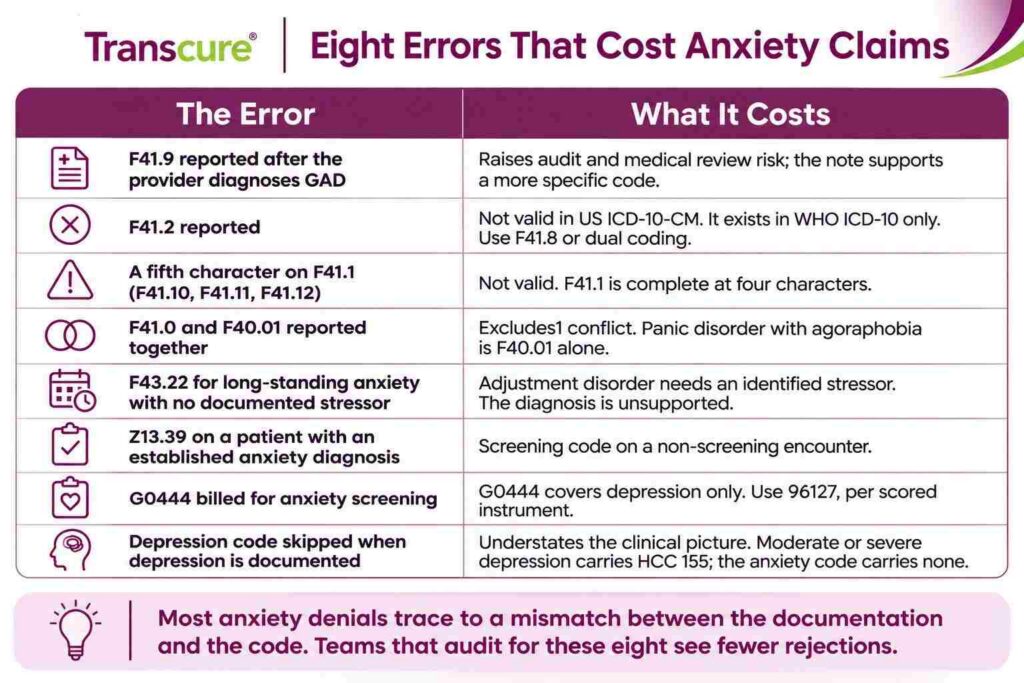
Most anxiety denials trace to a mismatch between documentation and code. Payers compare the diagnosis with the note, the billed service, and plan policy. The errors below appear most often in claim reviews. Each one has a straightforward documentation fix. Teams that audit for them see fewer rejections.
- Reporting F41.9 repeatedly after the provider diagnoses GAD.
- Reporting F41.2, which does not exist in ICD-10-CM.
- Adding a fifth character to F41.1, such as F41.10 or F41.11.
- Reporting F41.0 and F40.01 together despite the Excludes1 note.
- Using F43.22 for long-standing anxiety with no documented stressor.
- Reporting Z13.39 when the patient already carries an anxiety diagnosis.
- Billing G0444 for anxiety screening, since it covers depression only.
- Skipping the depression code when depression is also documented.
How Transcure Handles Anxiety Coding
Transcure’s AAPC-certified coders review diagnosis wording, duration, and payer criteria before each claim is submitted. They query providers when the note supports a more specific code than F41.9. Psychiatry and primary care practices can review our psychiatry billing services or contact our team.
Frequently Asked Questions About Anxiety ICD-10 Codes
What Is the ICD-10 Code for Anxiety?
The code is F41.9 when the provider documents anxiety without naming a specific disorder. F41.1 applies to generalized anxiety disorder. F41.0 applies to panic disorder. Phobic disorders use F40 codes. The provider’s diagnostic wording selects the exact code. Always report the most specific code the note supports.
Is F41.9 or F41.1 the Right Code for Anxiety?
F41.9 reports anxiety without a specified disorder, and F41.1 reports generalized anxiety disorder. Use F41.1 only when the provider documents GAD. Repeated F41.9 claims draw payer questions and weaken authorizations. Convert the code once the record supports a specific diagnosis.
What Is the ICD-10 Code for Generalized Anxiety Disorder?
Generalized anxiety disorder is F41.1. The code is billable and has no fifth character, so severity codes such as F41.10 do not exist. The provider should document excessive worry of at least six months, associated symptoms, and impairment. F41.1 carries no payment HCC under V28.
What Is the ICD-10 Code for Panic Disorder or Panic Attacks?
Panic disorder is F41.0. The Alphabetic Index also sends “panic attack” to F41.0. Panic disorder with agoraphobia is F40.01, and F41.0 cannot be reported with it. Document attack frequency and persistent concern about further attacks to support the diagnosis. Dated scores add objective support.
What Is the ICD-10 Code for Anxiety with Depression?
Report an anxiety code and a depression code separately when the provider does not link the conditions. Report F41.8 when the provider documents anxiety depression or links the two. F41.2 is not valid in US ICD-10-CM. Always code to the highest documented specificity.
What Is the ICD-10 Code for Anxiety Screening?
Report Z13.39 with CPT 96127 when a scored instrument such as the GAD-7 screens a patient without an anxiety diagnosis. G0444 covers depression only and does not apply. Some plans list other Z13 codes, so confirm the preventive diagnosis list. A positive screen leads to a diagnostic evaluation and an F code.
What Is the ICD-10 Code for Postpartum Anxiety?
No dedicated postpartum anxiety code exists. F53.0 covers postpartum depression only. Report the specific anxiety code, such as F41.1 or F41.9, from the F41 category. Obstetric providers may add an O99.34- code for mental disorders complicating pregnancy or the puerperium. Confirm plan policy before billing.
Did The Anxiety ICD-10 Codes Change for FY2027?
No, reported FY2027 chapter 5 changes leave F40 and F41 unchanged. Those changes affect a note under F02 and the new code F64.A. The update took effect on October 1, 2026. Templates built on FY2026 anxiety codes stay valid through September 30, 2027. Check the CMS addenda before each fiscal year.