Chronic sinusitis is reported with category J32 in ICD-10-CM, maintained by CMS and the National Center for Health Statistics (NCHS). Codes run from J32.0 to J32.9, and J32.9 is the unspecified default. In an ambulatory surgery center (ASC), the diagnosis code is only the first line of the claim. It must agree with the surgical CPT code, the payer’s medical necessity criteria, and the surgeon’s documentation.
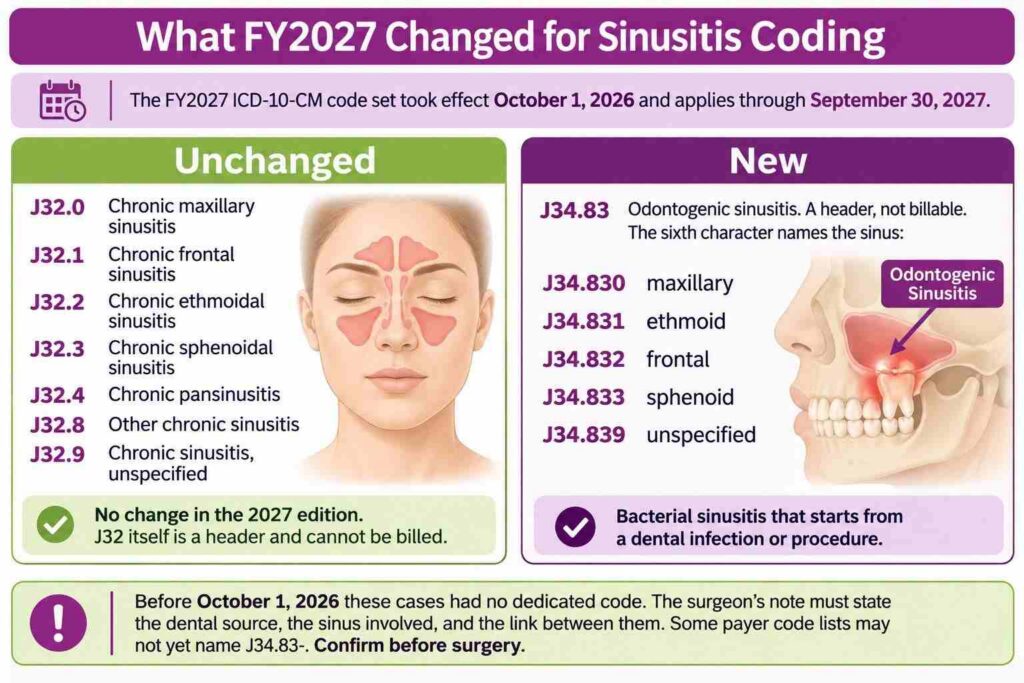
This guide covers J32.x codes, nasal polyp coding, diagnosis-to-CPT pairing for functional endoscopic sinus surgery (FESS) and balloon sinus dilation, payer criteria, documentation, site-of-service rules, and denial fixes. It also covers the odontogenic sinusitis codes effective October 1, 2026. These sit in J34.83- rather than J32, with a sixth character identifying the sinus.
The J34.83- codes run from J34.830 (maxillary) to J34.833 (sphenoid), with J34.839 as the unspecified fallback, so the surgeon’s note should name the sinus. More broadly, ICD-10-CM states the reason for surgery, CPT describes the procedure, and HCPCS Level II covers devices. All three must agree, or the payer questions the claim.
Chronic Sinusitis ICD-10 Code List (J32.x Quick Reference)
Chronic sinusitis is inflammation of the paranasal sinuses that lasts longer than 12 weeks. ICD-10-CM groups it under category J32 in the respiratory chapter. The header J32 is not billable. Among ASC ICD-10 codes for sinus surgery, only the subcodes J32.0 through J32.9 go on a claim.
Subcodes follow anatomy. Four codes name a single sinus, and one names all sinuses. J32.8 covers more than one sinus short of pansinusitis, and J32.9 applies when the record gives no location. The surgeon’s operative note and CT report supply that location.
| Code | Description | Sinus involved | Use when | ASC relevance |
|---|---|---|---|---|
| J32.0 | Chronic maxillary sinusitis | Maxillary (cheek) | Disease is limited to the maxillary sinus | Supports antrostomy or maxillary balloon dilation |
| J32.1 | Chronic frontal sinusitis | Frontal (forehead) | Disease is limited to the frontal sinus | Supports frontal sinus procedures |
| J32.2 | Chronic ethmoidal sinusitis | Ethmoid (between the eyes) | Disease is limited to the ethmoid sinuses | Supports ethmoidectomy |
| J32.3 | Chronic sphenoidal sinusitis | Sphenoid (deep skull base) | Disease is limited to the sphenoid sinus | Supports sphenoidotomy or sphenoid dilation |
| J32.4 | Chronic pansinusitis | All sinuses | Every sinus carries chronic disease | Common in extensive multi-sinus surgery |
| J32.8 | Other chronic sinusitis | More than one sinus, not all | Two or three sinuses show disease | Common in multi-sinus FESS cases |
| J32.9 | Chronic sinusitis, unspecified | Not stated | The record lacks a location | Draws the most scrutiny on surgical claims |
ASC takeaway: Code to the most specific sinus the record supports. Unspecified codes invite payer review on surgical claims.
How to Choose the Right J32 Code
Single Sinus vs. Multiple Sinuses vs. Pansinusitis
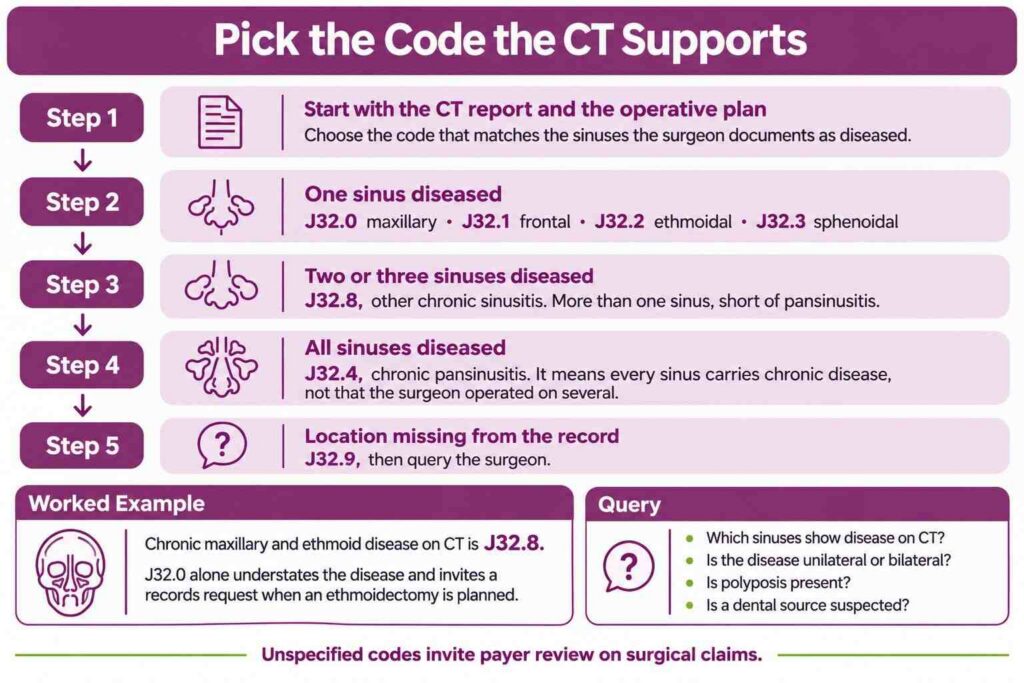
Start with the CT report and the operative plan. Choose the code that matches the sinuses the surgeon documents as diseased. Do not default to J32.4 because several sinuses are touched during surgery. Pansinusitis means every sinus carries chronic disease, not that the surgeon operated on several.
Use these decision rules:
- One sinus diseased: assign J32.0, J32.1, J32.2, or J32.3
- Two or three sinuses diseased: assign J32.8
- All sinuses diseased: assign J32.4
- Location missing from the record: assign J32.9, then query the surgeon
In practice, a patient with chronic maxillary and ethmoid disease on CT fits J32.8. A coder who assigns J32.0 alone understates the disease. The payer may then question why the surgeon planned an ethmoidectomy. That mismatch alone can trigger a records request.
Why J32.9 Invites Payer Scrutiny
J32.9 tells the payer the sinusitis is chronic but not where. Surgical policies expect disease that matches the planned procedure. An unspecified code gives the reviewer nothing to compare against the CPT code. That gap is a common reason for pre-service review.
Payers also use diagnosis codes to screen requests. Anthem’s FESS clinical guideline lists J32.0 through J32.9 among covered diagnoses. Coverage still depends on documented criteria, not on the code alone. A specific code simply shortens the reviewer’s path to the criteria.
Send the surgeon these queries when the record says only “chronic sinusitis”:
- Which sinuses show disease on CT?
- Is the disease unilateral or bilateral?
- Is polyposis present?
- Is a dental source suspected?
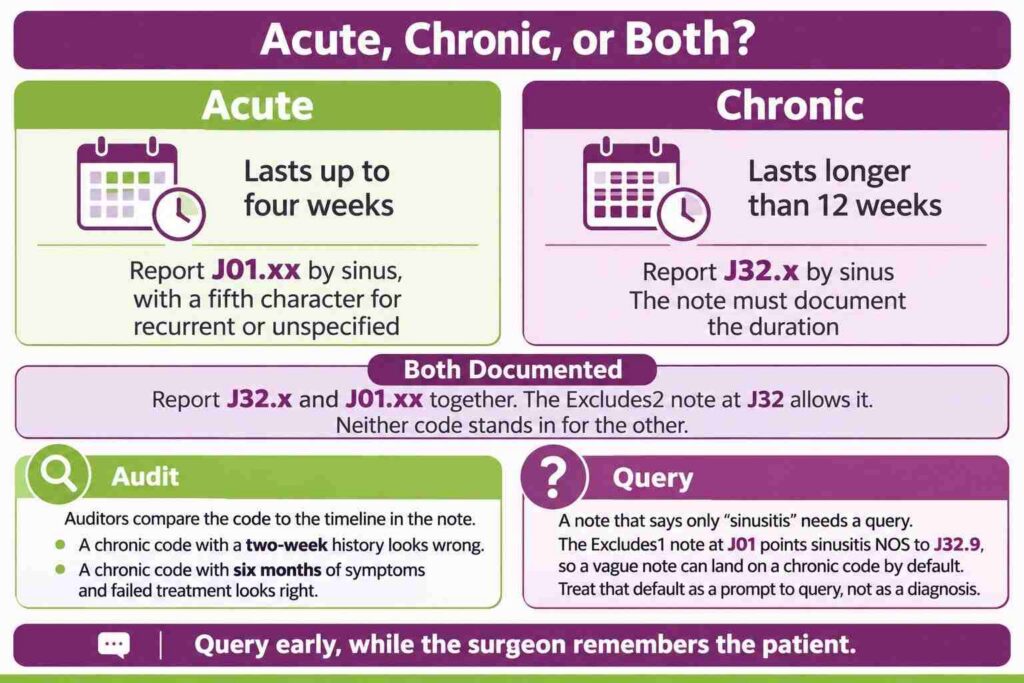
Can You Code Acute and Chronic Sinusitis Together?
Yes, when the provider documents both conditions. J32 carries an Excludes2 note for acute sinusitis (J01.-). That note allows both codes on one claim. It does not allow either code to stand in for the other. Flares often occur while a patient waits for a surgical date.
| Scenario | Coding approach |
|---|---|
| Chronic disease only | Report J32.x by sinus |
| Acute infection only | Report J01.xx, with a fifth character for recurrent or unspecified |
| Acute flare on chronic disease | Report J32.x and J01.xx together |
| Note says only “sinusitis” | Query the provider before coding |
The last row deserves attention. The Excludes1 note at J01 points sinusitis not otherwise specified to J32.9. A vague note can therefore land on a chronic code by default. Coders should treat that default as a prompt to query, not as a diagnosis. The payer will read the chronic label as a clinical statement.
Adding the Infectious Agent (B95-B97)
J32 carries a “use additional code” note. When the record names the infectious agent, report it from the B95 through B97 range. Add the code only when the surgeon or pathology report identifies the organism. Never assume an organism from the treatment given.
Organism detail can also change the surgical picture. Payers list allergic fungal sinusitis as its own indication for FESS. A culture or pathology result that names a fungal agent belongs in the claim file, not only in the chart. Attach the report when the payer asks for records.
Chronic Rhinosinusitis With and Without Nasal Polyps
Chronic rhinosinusitis (CRS) is the clinical term for chronic sinusitis. Clinicians divide it into CRS with nasal polyps (CRSwNP) and CRS without nasal polyps (CRSsNP). ICD-10-CM has no separate J32 code for each type. Polyps are reported with category J33.
Payers list J33.0 through J33.9 beside J32.0 through J32.9 in sinus surgery policies. Polyposis can also change coverage. Anthem treats chronic polyposis that does not respond to medical therapy as its own indication. Document polyps on the CT report and in the operative note.
| Clinical term | Meaning | ICD-10-CM approach |
|---|---|---|
| Chronic sinus disease or CRS | Sinus inflammation beyond 12 weeks | J32.x by sinus |
| CRSsNP | CRS without polyps | J32.x alone |
| CRSwNP | CRS with polyps | J32.x plus J33.x |
| Polyp of nasal cavity | Polyp in the nasal passage | J33.0 |
| Woakes’ ethmoiditis | Polypoid sinus degeneration | J33.1 |
The Excludes1 note at J32.2 blocks Woakes’ ethmoiditis (J33.1) from being reported with chronic ethmoidal sinusitis. Coders should not report both. Pick the diagnosis the surgeon documents. Query the surgeon if the note uses the term polypoid degeneration. That wording points to J33.1, not J32.2.
When the CT mentions polyps but the surgeon’s note does not, send a query. The J33 code needs provider documentation, not only an imaging finding. Radiology reports describe images. The surgeon’s assessment establishes the diagnosis that supports the claim and the procedure.
What’s New for FY2027: Odontogenic Sinusitis (J34.83-)
The FY2027 update took effect October 1, 2026, and added new ICD-10 codes under subcategory J34.83 for odontogenic sinusitis. The subcategory identifies bacterial sinusitis that starts from a dental infection or procedure. A sixth character names the sinus involved. ASC coders now have a new decision point on sinus cases with a dental history.
Dental-source sinusitis had no dedicated code before this update. The new codes separate it from other sinus disease. That separation matters because treatment often includes dental care, not only sinus surgery. Payers may review these cases differently from standard chronic sinusitis requests, so specificity protects the claim.
| Code | Description | Billable |
|---|---|---|
| J34.83 | Odontogenic sinusitis (subcategory header) | No |
| J34.830 | Odontogenic sinusitis, maxillary sinus | Yes |
| J34.831 | Odontogenic sinusitis, ethmoid sinus | Yes |
| J34.832 | Odontogenic sinusitis, frontal sinus | Yes |
| J34.833 | Odontogenic sinusitis, sphenoid sinus | Yes |
| J34.839 | Odontogenic sinusitis, unspecified | Yes |
The surgeon’s note must state three things:
- The dental source or recent dental procedure
- The sinus involved
- The link between the dental problem and the sinus disease
Check the Tabular List instructional notes before assigning J32.0 to maxillary disease with a dental source. Update superbills and EHR templates before claims reach the payer. Train coders on the new subcategory early. Surgeons need a documentation prompt that captures the dental history.
Some payer policies may not yet name the J34.83- codes. Confirm with the payer before surgery when the planned diagnosis is dental in origin. Expect code lists to change as payers review their FY2027 edits. Early confirmation avoids a denial after the case is done.
Chronic Sinusitis Diagnosis Codes and ASC Procedures
The diagnosis code explains why surgery is needed. The CPT code explains what the surgeon did. Payers test whether the two fit together. This section maps J32 codes to the ASC CPT codes billed most often for chronic sinusitis. Use it as a reference during coding review.
Diagnosis-to-CPT Map
| Procedure | CPT | Illustrative J32 pairing | Note |
|---|---|---|---|
| Ethmoidectomy, partial (anterior) | 31254 | J32.2, J32.8 | Ethmoid disease documented |
| Ethmoidectomy, total (anterior and posterior) | 31255 | J32.2, J32.8, J32.4 | Extent shown on CT |
| Maxillary antrostomy | 31256 | J32.0, J32.8 | Maxillary disease documented |
| Total ethmoidectomy with sphenoidotomy | 31259 | J32.2, J32.3, J32.8 | Sphenoid disease documented |
| Total ethmoidectomy with frontal sinus exploration | 31253 | J32.1, J32.2, J32.8 | Frontal disease documented |
| Balloon dilation, maxillary ostium | 31295 | J32.0 | Needs balloon policy criteria |
| Balloon dilation, frontal ostium | 31296 | J32.1 | Needs balloon policy criteria |
| Balloon dilation, sphenoid ostium | 31297 | J32.3 | Needs balloon policy criteria |
| Balloon dilation, frontal and sphenoid ostia | 31298 | J32.1 with J32.3, or J32.8 | Needs balloon policy criteria |
| Post-operative debridement | 31237 | The original J32 code | Frequency limits apply |
Descriptors are shortened and the pairings are illustrative. The surgeon’s CT findings decide the final code. Verify every CPT descriptor against the current CPT book and the CMS ASC payment addenda. Pairings that look reasonable on paper still fail when the imaging does not show disease at that site.
A single case often includes several rows from this table. Medtronic notes that most sinus cases carry multiple CPT codes, so payment is best judged per case. Each CPT line still needs a diagnosis that supports it. Plan the diagnosis list before the procedure list.
Device HCPCS Add-Ons
Devices carry their own codes. HCPCS code C1726 applies to the balloon device used in balloon sinus ostial dilation. Code C2625 may be reported when a PROPEL sinus implant is used in an ASC or hospital outpatient department. Payer rules on device billing vary.
Follow these device billing rules:
- Confirm the payer allows separate device billing
- Match the device code to the procedure performed
- Keep the invoice and lot number in the case record
- Bill each device once per use
Multiple-Procedure Claims and Bundling
Sinus surgery rarely stops at one code. National Correct Coding Initiative (NCCI) edits can bundle sinus endoscopy codes billed together on the same side. Medicare reduces payment for additional procedures on the same claim, and many commercial payers follow similar rules.
Diagnosis pointers matter here. Each CPT line should point to the J32 code for the sinus it treats. Laterality modifiers and payer-specific bilateral rules decide whether both sides pay. A pointer to J32.9 on every line weakens the whole claim. Pointers to sinus-specific codes show the payer the surgery matches the disease.
Run this review before billing:
- Match each CPT line to a sinus-specific diagnosis pointer
- Check NCCI edit pairs for every combination on the claim
- Confirm modifier rules for bilateral cases
- Confirm each device code appears once
Companion Procedures: Septoplasty and Turbinate Reduction
Surgeons often add septoplasty (CPT 30520) or turbinate reduction to sinus surgery. These procedures need their own diagnoses, such as deviated septum (J34.2) or hypertrophy of nasal turbinates (J34.3). Do not link them to J32 codes. Payers deny companion procedures that lack a supporting diagnosis.
Medical Necessity: What Payers Need Behind a J32 Code
A J32 code does not prove that surgery is necessary. Payers publish criteria that the record must meet. Anthem’s FESS guideline (CG-SURG-24) covers chronic sinusitis lasting longer than 12 weeks that interferes with lifestyle. The patient must also have tried maximal medical therapy.
Anthem’s balloon sinus ostial dilation guideline (CG-SURG-73) was revised July 1, 2026. It requires maximal medical therapy and objective evidence of disease. It treats balloon dilation for headache as not medically necessary when CT does not confirm chronic or recurrent sinusitis.
| Criterion | What payers look for | Example source |
|---|---|---|
| Duration | Symptoms beyond 12 weeks, or four or more acute episodes in one year | Anthem CG-SURG-24 and CG-SURG-73 |
| Maximal medical therapy | Antibiotics, inhaled or intranasal steroids, and nasal saline lavage | Anthem CG-SURG-73 |
| Objective disease | CT findings, nasal endoscopy findings, or exam signs such as mucopurulence and edema | Anthem and UnitedHealthcare |
| Polyposis | Chronic polyposis that fails medical therapy | Anthem CG-SURG-24 |
| Complications | Abscess, mucocele, concha bullosa, or tumor confirmed on CT | UnitedHealthcare |
| Exclusions | Headache or facial pain alone without CT-confirmed disease | Anthem CG-SURG-73 |
Policies differ by payer and state. The UnitedHealthcare Community Plan policy for North Carolina ties FESS to CT-confirmed findings. It also treats self-expanding absorptive sinus ostial dilation as unproven. Many policies cite the American Academy of Otolaryngology-Head and Neck Surgery (AAO-HNS) clinical indicators for endoscopic sinus surgery.
Practical step: Build a one-page criteria sheet for each major payer. List the policy number, effective date, and required evidence. Check the sheet at scheduling, not at billing.
Documentation Checklist to Prevent Denials
Most sinus denials trace back to the chart, not the code. The ASC bills from the surgeon’s records, so gaps in the office note reach the claim. Ask referring ENT offices to send complete records before the case date. Complete records also shorten any later appeal.
Confirm the record contains:
- Symptom duration beyond 12 weeks, with onset dates
- Documented symptoms such as nasal obstruction, drainage, facial pressure, and reduced smell
- Each medical therapy tried, with drug names and dates
- A CT sinus report naming the sinuses involved
- Nasal endoscopy findings, including polyps or purulence
- Laterality and a sinus-specific diagnosis in the surgical plan
- A dental source, when suspected, for J34.83- coding
- The authorization number and site-of-service approval
Acute vs. Chronic Miscoding Risk
Miscoding acute sinusitis as chronic creates reimbursement and audit risk. Acute rhinosinusitis lasts up to four weeks. A chronic code therefore needs documented duration. A note that says only “sinusitis” should trigger a query, not an assumption. Query early, while the surgeon remembers the patient.
Auditors compare the diagnosis code with the timeline in the note. A chronic code with a two-week history looks wrong. A chronic code with six months of symptoms and failed treatment looks right. Between those extremes, the note itself must show how long the patient has been symptomatic.
Site of Service: Why Payers Steer Sinus Surgery to ASCs
Payers want cost-effective sites for elective surgery. Premera’s site-of-service guideline, effective July 1, 2026, lists ENT surgery among procedures that need site-of-service prior authorization. It names the ASC among the medically necessary sites for certain elective procedures. ASCs sit at the center of that policy shift.
Medicare is also moving more care to outpatient settings. CMS finalized a 2.6 percent ASC payment update for CY2026. It added roughly 289 procedures to the ASC Covered Procedures List across orthopedics, vascular surgery, urology, and other specialties. Check Addendum AA for the payment indicator on each sinus CPT code.
Check these items before each sinus case:
- Site-of-service authorization on file for the member’s plan
- Each CPT code listed as payable in the ASC setting
- Payment indicator for each code in the CMS ASC addenda
- Payer rules on device-intensive procedures
Common Denial Reasons and Fixes
Sinus claims fail for a small set of repeat reasons. Most trace to a mismatch between the diagnosis, the procedure, and the record. A denial log sorted by reason shows which fix your team needs first. A denial log sorted by reason shows which fix your team needs first, and teams that rely on ASC billing services should ask their vendor for this log.
| Denial reason | Root cause | Fix |
|---|---|---|
| Medical necessity not met | No record of failed medical therapy | Collect therapy dates and drug names before scheduling |
| No CT on file | Surgery scheduled before imaging review | Require the CT report at pre-authorization |
| Diagnosis does not support procedure | J32.9 billed with a sinus-specific CPT code | Query the surgeon for the sinus involved |
| Acute coded as chronic | Duration missing from the note | Document symptom length and query vague notes |
| Site of service denied | No site-of-service authorization | Verify authorization at scheduling |
| Device not paid | Device code missing or unsupported | Match the HCPCS code to the procedure and keep the invoice |
| Companion procedure denied | Septoplasty linked to J32 only | Add J34.2 or J34.3 with provider documentation |
| Post-operative debridement denied | Visits exceed payer limits | Check the frequency limit in the payer policy |
Anthem, for example, treats post-operative debridement as medically necessary twice during the first 30 days after surgery, with other circumstances listed separately. Other payers set different limits. Track each payer’s rule in your criteria sheet. Document the clinical reason for each debridement visit.
Frequently Asked Questions
Is J32.9 a Billable ICD-10 Code?
Yes. J32.9, chronic sinusitis unspecified, is a billable code. The category header J32 is not billable. Use J32.9 only when the record gives no sinus location. Surgical claims usually need a more specific J32 code. Ask the surgeon for the location first.
What Is the Difference Between J32.9 and J31.0?
J32.9 reports chronic sinusitis with no sinus specified. J31.0 reports chronic rhinitis, which is inflammation of the nasal lining without sinus disease. The two conditions can overlap clinically. Code each only when the provider documents it. Query the provider when the note is unclear.
Can J32 be Reported with J01?
Yes, when the provider documents acute sinusitis on top of chronic sinusitis. The Excludes2 note at J32 allows both codes. Report the J01 code with the correct fifth character for recurrent or unspecified acute disease. Do not use J01 for a patient with chronic disease only.
Does Balloon Sinuplasty Require a CT Scan?
Most payer policies require objective evidence of disease. Anthem accepts CT findings or nasal endoscopy findings that show significant disease. CT is the most common proof. Check the member’s policy before scheduling, because criteria differ by payer. Document the findings in the surgeon’s note.
What Is the ICD-10 Code for Chronic Sinusitis with Polyps?
Report J32.x for the sinus involved and add J33.x for the polyps. For polyps in the nasal cavity, use J33.0. The surgeon must document the polyps. Do not report J33.1 with J32.2. Confirm the polyp type in the note before choosing the J33 code.