
Primary care practices manage preventive visits, chronic diseases, acute illnesses, medication reviews, and ongoing care coordination. Each service has different coding requirements. Therefore, selecting an incorrect CPT code can result in denials, underpayments, or compliance concerns.
Moreover, primary care billing involves more than standard office visits. Medicare wellness visits, transitional care management, chronic care management, and preventive screenings follow separate rules. Consequently, coding teams must identify the service before selecting its billing code.

This guide covers essential Primary Care CPT codes for 2027, including office visits, preventive care, chronic care management, procedures, and diagnostic testing. Each table explains the service and highlights important billing requirements.
The guide also covers confirmed 2027 Medicare payment changes, common claim denials, modifiers, and relevant ICD-10-CM codes. Accurate documentation also supports effective primary care billing services.
What Are Primary Care CPT Codes?
Primary Care CPT codes identify medical services performed by family physicians, internists, and other qualified primary care professionals. The American Medical Association maintains these codes. Most annual updates take effect on January 1.
Moreover, primary care claims commonly combine CPT codes with Medicare HCPCS Level II codes. CPT codes describe office visits, procedures, and care management services. HCPCS codes identify additional Medicare services, including annual wellness visits and advanced primary care management.
The following table summarizes the main billing categories.
| Service Category | Common Codes |
|---|---|
| Office and outpatient E/M | 99202-99205, 99211-99215 |
| Preventive medicine visits | 99381-99387, 99391-99397 |
| Medicare wellness visits | G0402, G0438, G0439 |
| Chronic care management | 99487, 99489-99491, 99437, 99439 |
| Advanced primary care management | G0556-G0558 |
| Transitional care management | 99495, 99496 |
| Principal care management | 99424-99427 |
| Behavioral health integration | 99484, 99492-99494 |
| Advance care planning | 99497, 99498 |
| Office procedures and testing | Various procedure-specific codes |
These categories represent different clinical activities. Therefore, practices should not use preventive, problem-oriented, and care management codes interchangeably. The exact code must match the service, documentation, patient eligibility, and applicable payer requirements.
Which CPT Codes Report Primary Care Office Visits?
Office and outpatient evaluation and management codes cover acute illnesses, chronic disease follow-ups, medication management, and other problem-oriented visits. New patients use codes 99202-99205. Established patients generally use codes 99211-99215.
For most physician or qualified practitioner visits, code selection depends on medical decision-making (MDM) or total time spent on the date of the encounter. Code 99211 follows different requirements. Therefore, documentation must support the reported service.
The following table lists the office visit codes and their standard time thresholds.
| CPT Code | Service | Total Time | Billing Note |
|---|---|---|---|
| 99202 | New patient, straightforward MDM | 15-29 minutes | Appropriate for straightforward problems |
| 99203 | New patient, low MDM | 30-44 minutes | Common for uncomplicated conditions |
| 99204 | New patient, moderate MDM | 45-59 minutes | May involve prescription drug management |
| 99205 | New patient, high MDM | 60-74 minutes | Requires high MDM or qualifying time |
| 99211 | Established patient, minimal service | Not time-based | May be performed by clinical staff |
| 99212 | Established patient, straightforward MDM | 10-19 minutes | Appropriate for straightforward follow-ups |
| 99213 | Established patient, low MDM | 20-29 minutes | Common for uncomplicated disease management |
| 99214 | Established patient, moderate MDM | 30-39 minutes | Often used for more complex chronic care |
| 99215 | Established patient, high MDM | 40-54 minutes | Requires high MDM or qualifying time |
The listed times apply when time determines the visit level. They are not minimum durations when a practitioner selects codes through qualifying MDM.
Moreover, the highest diagnosis count does not automatically justify the highest code. The record must support the required MDM elements or qualifying time.
How Does Medical Decision Making Determine E/M Levels?
MDM considers problems addressed, data reviewed or analyzed, and patient management risk. Two of these three elements must meet the selected level. Consequently, documented clinical decisions determine the appropriate code.
For example, a patient with stable hypertension may qualify for a lower visit level. A separate encounter involving treatment changes and additional medical complexity may support moderate MDM.
However, prescription drug management alone does not automatically establish 99214. The remaining MDM elements must support the level, or qualifying time must justify it.
When Should Primary Care Practices Bill 99213 or 99214?
CPT 99213 describes an established-patient visit involving low MDM or 20-29 minutes of qualifying time. CPT 99214 requires moderate MDM or 30-39 minutes.
For example, a routine medication follow-up may support 99213. A visit addressing several conditions and prescription changes may support 99214 when documentation meets the requirements.
Therefore, practices should never select 99214 solely because a patient has multiple diagnoses. The documented work determines the service level.
How Do Prolonged Office Visits Affect Coding?
Prolonged visit coding applies when qualifying time exceeds the highest office visit level. CPT 99417 and Medicare HCPCS G2212 follow different reporting thresholds.
Additionally, Medicare uses its own time requirements for G2212. Practices must review the relevant payer rules before adding prolonged service units.
| Code | Service | Billing Note |
|---|---|---|
| 99417 | Prolonged outpatient E/M | Commercial payer rules and CPT thresholds apply |
| G2212 | Medicare prolonged outpatient E/M | Apply Medicare thresholds and eligible base codes |
| G2211 | Visit complexity add-on | Requires qualifying longitudinal or ongoing care relationship |
These services are not interchangeable. Moreover, G2211 represents qualifying visit complexity rather than prolonged time.
Which CPT Codes Cover Preventive Primary Care Visits?
Preventive medicine codes report comprehensive preventive evaluations, including age-appropriate history, examination, counseling, and risk reduction. These visits differ from problem-oriented E/M services.
The appropriate preventive code depends on the patient’s age and whether they are new or established. Consequently, practices should confirm both details before submitting claims.
Which Codes Report New Patient Preventive Visits?
The following codes apply to preventive medicine evaluations for new patients.
| CPT Code | Patient Age | Billing Note |
|---|---|---|
| 99381 | Younger than 1 year | Infant preventive evaluation |
| 99382 | 1-4 years | Early childhood preventive evaluation |
| 99383 | 5-11 years | School-age preventive evaluation |
| 99384 | 12-17 years | Adolescent preventive evaluation |
| 99385 | 18-39 years | Young adult preventive evaluation |
| 99386 | 40-64 years | Middle-aged adult preventive evaluation |
| 99387 | 65 years or older | Older adult preventive evaluation |
These codes report preventive medicine services rather than the Medicare annual wellness visit. Therefore, coverage depends on the patient’s insurance benefits.
Which Codes Report Established Patient Preventive Visits?
Established patients use the corresponding 99391-99397 code family. These services commonly include periodic preventive evaluations and age-appropriate counseling.
| CPT Code | Patient Age | Billing Note |
|---|---|---|
| 99391 | Younger than 1 year | Periodic infant preventive care |
| 99392 | 1-4 years | Early childhood preventive follow-up |
| 99393 | 5-11 years | School-age preventive follow-up |
| 99394 | 12-17 years | Adolescent preventive follow-up |
| 99395 | 18-39 years | Young adult preventive follow-up |
| 99396 | 40-64 years | Adult preventive follow-up |
| 99397 | 65 years or older | Older adult preventive follow-up |
The patient’s age determines the preventive code within each family. However, the patient’s insurance plan determines coverage and cost-sharing.
Can a Preventive Visit and Problem-Oriented E/M Be Billed Together?
A preventive visit and problem-oriented E/M may be separately reported when both services meet the applicable requirements. The problem-oriented evaluation must be significant and separately identifiable.
For example, a patient may receive preventive care while also undergoing substantial evaluation of worsening asthma. When documentation supports both services, an additional E/M code may apply.
Modifier 25 generally identifies the separately identifiable E/M service. However, simply discussing an existing diagnosis does not automatically justify another billable visit.
Which HCPCS Codes Cover Medicare Annual Wellness Visits?
Medicare annual wellness visits follow different rules from traditional preventive physical examinations. Original Medicare uses HCPCS codes G0402, G0438, and G0439.
These services focus on prevention planning, risk assessment, and appropriate follow-up. They do not automatically include a comprehensive physical examination.
The following table separates the Medicare wellness services.
| HCPCS Code | Service | Billing Note |
|---|---|---|
| G0402 | Initial preventive physical examination | Once during the first 12 months of Part B coverage |
| G0438 | Initial annual wellness visit | First eligible Medicare AWV |
| G0439 | Subsequent annual wellness visit | Subsequent eligible AWV |
| G0403 | ECG tracing, interpretation, and report associated with IPPE | Separate coverage requirements apply |
| G0404 | ECG tracing only associated with IPPE | Use when applicable |
| G0405 | ECG interpretation and report associated with IPPE | Use when applicable |
| G0468 | FQHC encounter including IPPE or AWV | FQHC-specific billing requirements apply |
CMS generally allows one AWV during the applicable 12-month period. The initial AWV cannot occur within 12 months of an IPPE.
Additionally, Medicare does not recognize CPT 99381-99397 as substitutes for its covered IPPE or AWV benefits.
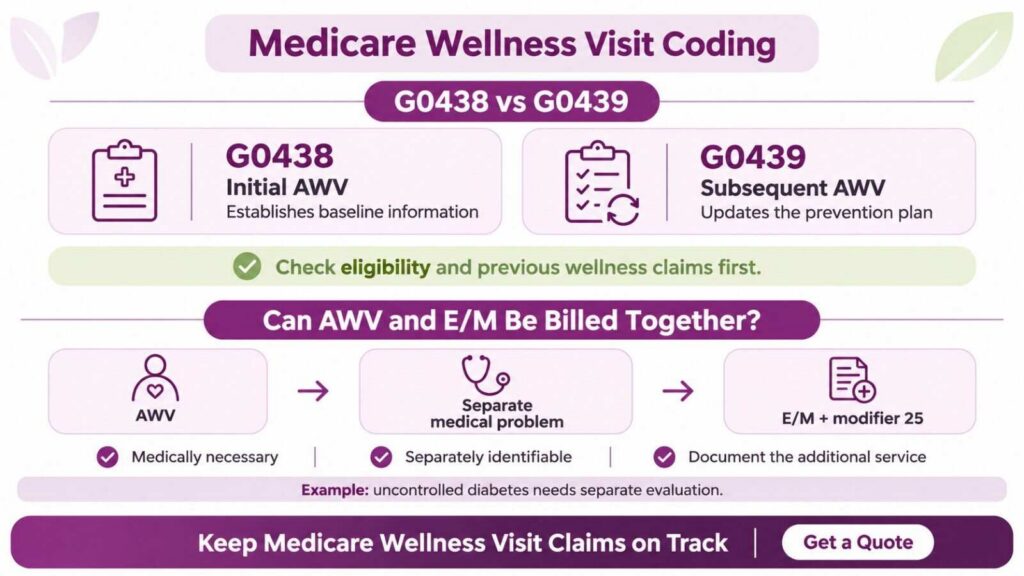
What Is the Difference Between G0438 and G0439?
G0438 reports a patient’s first eligible Medicare annual wellness visit. G0439 reports subsequent annual wellness visits.
Both services require preventive planning and other specified elements. However, the initial visit establishes baseline information, while subsequent visits update the prevention plan.
Consequently, practices should verify Medicare eligibility and previous wellness claims before selecting either code.
When Can Medicare Wellness and E/M Services Be Billed Together?
Medicare permits a separately identifiable problem-oriented E/M service during an AWV when medically necessary. The additional service requires supporting documentation.
For example, an AWV may identify uncontrolled diabetes that requires separate evaluation and medication adjustment. A qualified problem-oriented E/M service may then be reported.
The E/M code generally requires modifier 25. However, routine AWV components cannot be counted again as a separate office visit.
Which CPT Codes Report Chronic Care Management?
Chronic care management (CCM) supports patients with multiple qualifying chronic conditions. Services include care planning, medication coordination, communication, and ongoing non-face-to-face management.
Medicare generally requires at least two chronic conditions expected to last 12 months or until death. These conditions must create significant clinical risk.
CCM codes differ according to staff involvement, time, and complexity. Therefore, practices must document qualifying activities and prevent duplicate time reporting.
| CPT Code | Service | Billing Note |
|---|---|---|
| 99490 | Standard CCM, first 20 minutes | Clinical staff time under practitioner direction |
| +99439 | Each additional 20 minutes of standard CCM | Add-on to 99490 |
| 99491 | Practitioner CCM, first 30 minutes | Time personally provided by billing practitioner |
| +99437 | Each additional 30 minutes of practitioner CCM | Add-on to 99491 |
| 99487 | Complex CCM, first 60 minutes | Requires qualifying moderate or high MDM |
| +99489 | Each additional 30 minutes of complex CCM | Add-on to 99487 |
The table separates standard CCM from complex CCM. Furthermore, clinical staff time and practitioner time follow different reporting requirements.
For example, 99490 generally requires at least 20 minutes of qualifying monthly care management. Code 99487 requires at least 60 minutes and additional complexity requirements.
CMS also requires appropriate consent, care planning, and compliance with applicable service elements.
When Should Primary Care Practices Use 99490?
CPT 99490 applies when eligible clinical staff provides at least 20 minutes of qualifying CCM during a calendar month.
The work may include care coordination, medication-related communication, and care plan management. However, time already billed through another service cannot be counted again.
Consequently, accurate monthly time records are essential for compliant CCM billing.
What Makes Complex CCM Different?
Complex CCM requires more intensive management and moderate or high MDM. It also requires qualifying care plan work and at least 60 minutes of clinical staff time.
For example, a patient with unstable heart failure, diabetes, and kidney disease may need extensive coordination. However, diagnosis count alone does not establish eligibility for complex CCM.
Therefore, documentation must demonstrate clinical complexity, care management activities, and the required time.
Which HCPCS Codes Report Advanced Primary Care Management?
Advanced primary care management (APCM) provides a Medicare payment pathway for longitudinal primary care services. CMS introduced three monthly HCPCS codes in 2025.
Unlike traditional CCM, APCM does not require providers to meet monthly time thresholds. Instead, payment depends on patient complexity and required care management capabilities.
The following table summarizes the APCM codes.
| HCPCS Code | Patient Requirements | Billing Note |
|---|---|---|
| G0556 | One or fewer qualifying chronic conditions | Monthly APCM service |
| G0557 | Two or more qualifying chronic conditions | Higher-complexity APCM category |
| G0558 | Qualified Medicare Beneficiary with two or more qualifying chronic conditions | Additional eligibility requirements |
These codes require continuing primary care responsibility and specific service elements. Consequently, providing an occasional office visit alone does not establish APCM eligibility.
CMS also introduced optional behavioral health integration add-ons for qualifying APCM services beginning in 2026.
How Does APCM Differ From Chronic Care Management?
APCM focuses on continuous primary care responsibility and comprehensive service capabilities. Traditional CCM uses defined time thresholds and chronic condition requirements.
For example, a qualifying APCM practice may report G0557 without documenting a minimum monthly staff-time threshold. However, all applicable APCM requirements must be satisfied.
Additionally, APCM and other care management services may overlap. Therefore, practices must review Medicare’s concurrent billing restrictions before submitting monthly claims.
Which Behavioral Health Add-Ons Can Accompany APCM?
CMS established optional add-on codes for behavioral health services furnished alongside qualifying APCM services.
| HCPCS Code | Service | Billing Note |
|---|---|---|
| G0568 | Psychiatric collaborative care integration | Requires qualifying APCM and CoCM services |
| G0569 | Additional psychiatric collaborative care component | Follow applicable CoCM requirements |
| G0570 | General behavioral health integration | Requires qualifying APCM and BHI services |
These add-ons are not independently billable APCM services. They require the appropriate base APCM code during the same month.
Moreover, CMS specifies separate service requirements for behavioral health integration. Therefore, practices must confirm eligibility and avoid duplicated work.
Which CPT Codes Report Transitional Care Management?
Transitional care management (TCM) supports patients moving from qualifying facility settings into the community. These services help coordinate recovery after discharges from hospitals or other eligible facilities.
TCM requires timely patient communication, medication reconciliation, care coordination, and an eligible face-to-face visit. Therefore, billing depends on both medical decision-making and documented service timelines.
The following table compares the two TCM codes.
| CPT Code | Service | Billing Note |
|---|---|---|
| 99495 | TCM with moderate MDM | Face-to-face visit within 14 calendar days |
| 99496 | TCM with high MDM | Face-to-face visit within 7 calendar days |
Both codes generally require interactive communication within two business days after discharge. The face-to-face visit must meet the applicable deadline. Moreover, the TCM service period extends for 30 days beginning on discharge. Claims should follow CMS timing and reporting requirements.
When Should a Practice Use 99495 Instead of 99496?
CPT 99495 applies when the qualifying episode involves at least moderate MDM and a timely face-to-face visit. CPT 99496 requires high MDM and an eligible visit within seven calendar days. Therefore, a shorter follow-up interval alone does not justify 99496.
For example, an uncomplicated hospital follow-up may support 99495 when all requirements are met. A more complex discharge involving high-risk decisions may qualify for 99496.
What Documentation Supports TCM Reimbursement?
TCM documentation should identify the discharge date, communication attempts, completed contact, and follow-up visit. The record must also demonstrate the required MDM.
Additionally, document medication reconciliation and relevant care coordination. Missing communication records or late visits can create billing problems.
Consequently, practices should begin TCM workflows immediately after receiving discharge notifications.
Which CPT Codes Cover Principal Care Management?
Principal care management (PCM) supports patients with one serious chronic condition requiring substantial ongoing management. Unlike CCM, PCM focuses on a single qualifying condition. The condition generally must be expected to last at least three months. It must also meet Medicare’s clinical complexity requirements.
The following table lists the PCM code family.
| CPT Code | Service | Billing Note |
|---|---|---|
| 99424 | Practitioner PCM, first 30 minutes | Personally performed by physician or qualified practitioner |
| +99425 | Additional 30 minutes of practitioner PCM | Add-on to 99424 |
| 99426 | Clinical staff PCM, first 30 minutes | Under practitioner direction |
| +99427 | Additional 30 minutes of clinical staff PCM | Add-on to 99426 |
These codes distinguish practitioner work from clinical staff activities. Moreover, the condition must require qualifying disease-specific management.
For example, a patient with difficult-to-control asthma may need intensive medication adjustments and specialist coordination. However, all PCM requirements must be met before billing.
Which CPT Codes Report Behavioral Health Services in Primary Care?
Primary care teams frequently identify and manage depression, anxiety, substance use, and related behavioral health concerns. Some services qualify for separate reporting.
Behavioral health integration (BHI) and psychiatric collaborative care (CoCM) support ongoing coordination. Other codes describe screening or counseling services.
The following table covers common services and their established code families.
| CPT or HCPCS Code | Service | Billing Note |
|---|---|---|
| 99484 | General behavioral health integration | Monthly qualifying care management |
| 99492 | Initial psychiatric CoCM service | Established CoCM framework; confirm 2027 code status |
| 99493 | Subsequent psychiatric CoCM service | Established framework; confirm 2027 code status |
| +99494 | Additional psychiatric CoCM time | Add-on reporting requirements apply |
| 96127 | Brief standardized emotional or behavioral assessment | Report according to instrument and payer rules |
| G0444 | Medicare annual depression screening | Coverage and frequency requirements apply |
| 99408 | Structured substance-use screening and brief intervention | 15-30 minutes |
| 99409 | Structured substance-use screening and brief intervention | More than 30 minutes |
| G0396 | Medicare structured substance-use assessment and intervention | 15-30 minutes |
| G0397 | Medicare structured substance-use assessment and intervention | More than 30 minutes |
The established CoCM codes require special attention for 2027 because CMS finalized payment and valuation changes. Practices should verify final code mapping before updating their billing systems.
Additionally, standalone screening codes cannot automatically accompany every preventive visit. The payer must permit separate reporting, and the documentation must support the service.
When Can Primary Care Practices Bill Depression Screening?
Medicare covers qualifying annual depression screening in appropriate primary care settings. HCPCS G0444 is commonly associated with this benefit.
However, coverage depends on Medicare’s screening requirements and the availability of appropriate follow-up support. The screening must also satisfy documentation requirements.
Therefore, a routine questionnaire does not automatically justify a separately payable screening claim.
Which CPT Codes Cover Common Primary Care Procedures?
Primary care practices perform office procedures alongside preventive visits and chronic disease management. Common services include wound repair, lesion treatment, joint injections, and diagnostic testing.
Each procedure has its own documentation and medical necessity requirements. Furthermore, some procedures include routine evaluation work within their payment.
Which Codes Report Common Skin and Wound Procedures?
Primary care physicians may manage uncomplicated wounds, superficial lesions, and minor skin conditions. Code selection depends on the technique performed and the affected anatomy.
The following table lists selected procedure codes.
| CPT Code | Service | Billing Note |
|---|---|---|
| 10060 | Incision and drainage of simple or single abscess | Document the drainage performed |
| 10061 | Incision and drainage of complicated or multiple abscesses | Complexity must be supported |
| 11055 | Paring or cutting one benign hyperkeratotic lesion | Coverage restrictions may apply |
| 17000 | Destruction of first premalignant lesion | Document lesion diagnosis and location |
| +17003 | Additional premalignant lesions, second through fourteenth | Report qualifying additional lesions |
| 17004 | Destruction of 15 or more premalignant lesions | Do not combine with 17000 or 17003 for the same lesion group |
| 17110 | Destruction of 1-14 benign lesions | Medical necessity and coverage rules apply |
| 11200 | Removal of skin tags, up to 15 | Cosmetic exclusions may apply |
| +11201 | Each additional 10 skin tags | Add-on reporting requirements apply |
| 12001 | Simple repair of superficial wound, 2.5 cm or less, specified sites | Document location, length, and repair complexity |
The procedure note must establish the technique, lesion count, wound measurements, and medical necessity as applicable. Moreover, benign lesion treatment may be excluded when performed solely for cosmetic purposes. Therefore, practices should verify payer coverage before submitting claims.
Which Codes Report Joint Injections and Office Testing?
Primary care clinicians may perform joint injections, electrocardiograms, spirometry, and selected point-of-care tests.
The following table lists commonly used codes.
| CPT Code | Service | Billing Note |
|---|---|---|
| 20600 | Aspiration or injection, small joint or bursa, without ultrasound | Document anatomical site |
| 20605 | Aspiration or injection, intermediate joint or bursa, without ultrasound | Supports qualifying intermediate joints |
| 20610 | Aspiration or injection, major joint or bursa, without ultrasound | Common for knee or shoulder procedures |
| 20611 | Major joint aspiration or injection with ultrasound guidance | Permanent image recording and reporting requirements apply |
| 93000 | Complete 12-lead ECG | Includes tracing, interpretation, and report |
| 93005 | ECG tracing only | Technical component |
| 93010 | ECG interpretation and report only | Professional component |
| 94010 | Spirometry | Includes applicable graphic record and interpretation |
| 81002 | Nonautomated urinalysis without microscopy | CLIA requirements may apply |
| 81003 | Automated urinalysis without microscopy | Verify test method |
| 83036 | Hemoglobin A1c laboratory test | CLIA and laboratory billing rules apply |
| 87880 | Rapid Group A streptococcal antigen test | Follow applicable laboratory requirements |
| 36415 | Venous blood collection | Separate payment depends on payer rules |
These codes report different components and techniques. For example, 93000 should not be combined with separate component codes for the same complete ECG service.
Similarly, an ultrasound-guided injection must satisfy its imaging documentation requirements. Consequently, the clinical record must support the selected procedure code.
Which CPT Codes Report Vaccination Services?
Vaccination billing involves vaccine products and administration services. Product codes identify the vaccine, while administration codes report qualifying administration work.
However, Medicare uses specific administration HCPCS codes for certain covered vaccines. Therefore, commercial insurance and Medicare claims may require different coding approaches.
The following table summarizes common administration codes.
| CPT or HCPCS Code | Service | Billing Note |
|---|---|---|
| 90460 | Immunization administration with counseling, first or only component | Patient must be 18 or younger |
| +90461 | Each additional vaccine component with counseling | Add-on to 90460 |
| 90471 | First vaccine administration through injection | Applies when 90460 is not appropriate |
| +90472 | Each additional injected vaccine | Add-on reporting rules apply |
| 90473 | First oral or intranasal vaccine administration | Route-specific code |
| +90474 | Additional oral or intranasal administration | Add-on reporting rules apply |
| G0008 | Medicare influenza vaccine administration | Follow Medicare vaccine billing policy |
| G0009 | Medicare pneumococcal vaccine administration | Follow Medicare vaccine billing policy |
| G0010 | Medicare hepatitis B vaccine administration | Follow Medicare eligibility requirements |
Report the vaccine product using the appropriate code when applicable. Additionally, administration coding depends on counseling, route, age, and payer coverage.
Practices should review current vaccine product codes separately because formulations and applicable codes can change. Medicare COVID-19 vaccine administration also follows its applicable current-year guidance.
Which Modifiers Are Most Important for Primary Care Billing?
Primary care claims commonly require modifiers to distinguish separate E/M services, procedures, and billing circumstances. Modifier errors can result in bundling denials or incorrect payment.
However, modifiers cannot replace missing medical necessity or documentation. Each modifier must describe an actual qualifying circumstance.
The following table identifies common primary care modifiers.
| Modifier | Meaning | Common Primary Care Use |
|---|---|---|
| 25 | Significant, separately identifiable E/M | Problem-oriented visit with qualifying same-day procedure |
| 24 | Unrelated E/M during postoperative period | Unrelated medical condition during global period |
| 57 | Decision for major surgery | Applicable decision-making encounter |
| 59 | Distinct procedural service | Qualifying separate procedure under NCCI rules |
| XE | Separate encounter | Distinct encounter when appropriate |
| XS | Separate structure | Qualifying service on separate anatomical structure |
| XP | Separate practitioner | Qualifying service by different practitioner |
| XU | Unusual nonoverlapping service | Distinct service meeting edit requirements |
| 76 | Repeat procedure by same practitioner | Qualifying repeat service |
| 77 | Repeat procedure by another practitioner | Qualifying repeat service |
| 26 | Professional component | Interpretation-only diagnostic service |
| TC | Technical component | Equipment or technical portion of eligible tests |
| 95 | Synchronous telemedicine | Use when applicable under payer policy |
| 93 | Synchronous audio-only telemedicine | Use when payer rules permit |
| RT and LT | Right and left side | Laterality for applicable procedures |
Modifier 25 is particularly important in primary care. It may apply when a medically necessary E/M service occurs with a separately reportable minor procedure.
However, routine evaluation associated with performing that procedure is not separately billable. Therefore, the additional E/M work must be independently supported.
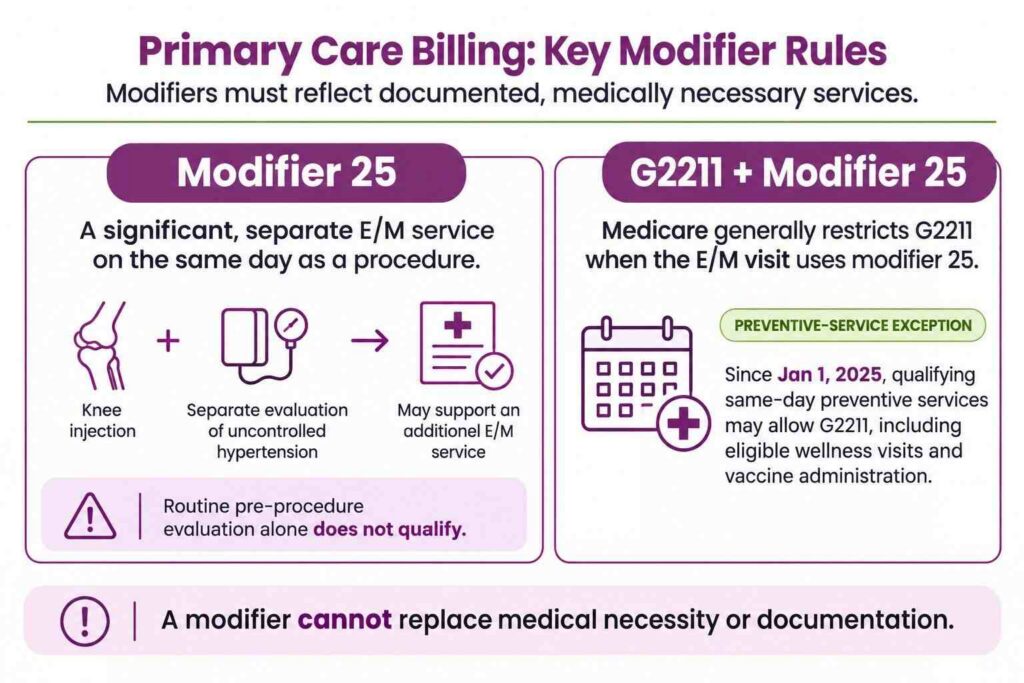
When Does Modifier 25 Apply to Primary Care Claims?
Modifier 25 identifies a significant, separately identifiable E/M service performed on the same day as another service or procedure.
For example, a patient may receive a knee injection while also undergoing a separate evaluation of uncontrolled hypertension. The hypertension evaluation may support an additional E/M service.
However, simply evaluating the knee before its planned injection does not automatically justify modifier 25.
Can G2211 Be Reported With Modifier 25?
Medicare generally restricts G2211 when the associated E/M visit uses modifier 25. However, exceptions apply for certain preventive services.
Since January 1, 2025, CMS has permitted qualifying G2211 reporting with certain same-day Medicare preventive services. These include eligible wellness visits and vaccine administration.
Consequently, practices must distinguish permitted preventive encounters from unrelated procedure combinations.
What Changed in Primary Care CPT Codes for 2027?
Primary Care coding in 2027 includes important Medicare payment and service changes. The AMA also released its updated CPT code set for January 1, 2027.
The AMA announced 453 editorial changes across CPT 2027, including 299 additions, 74 revisions, and 80 deletions. These totals cover all specialties, not Primary Care alone.
Meanwhile, CMS finalized several changes affecting primary care visits, shared medical appointments, care planning, and preventive services. The following table identifies relevant updates.
| Code or Policy | Confirmed 2027 Update | Billing Impact |
|---|---|---|
| G0686 | Separate payment for shared medical appointments | Report qualifying group medical sessions |
| G0687 | Add-on for additional shared appointment time | Subject to time and unit limits |
| G0572 | Clinical staff advance care planning | First qualifying 20-minute service |
| G0573 | Additional clinical staff advance care planning | Add-on for qualifying additional time |
| G0576 | Vaccine adverse effects management | Additional qualifying practitioner time |
| 0591T | Health coaching, initial individual assessment | National Medicare pricing established |
| 0592T | Individual health coaching follow-up | National Medicare pricing established |
| 0593T | Group health coaching | National Medicare pricing established |
| 99497, 99498 | Medicare clarified practitioner ACP time reporting | Personally performed practitioner time |
| CoCM services | Updated Medicare valuation | Verify applicable 2027 code mapping and rates |
| Same-day E/M with zero-day procedures | Medicare finalized payment adjustment | Lower-valued service generally paid at 80% |
| Primary care payment rates | Updated conversion factors | Recalculate Medicare reimbursement estimates |
The health coaching codes were introduced before 2027. Their new Medicare payment treatment must not be confused with new CPT code creation. Moreover, CMS finalized these Medicare policies separately from the AMA’s annual CPT editorial changes.
How Do Shared Medical Appointment Codes Work in 2027?
Medicare established codes G0686 and G0687 for qualifying shared medical appointments beginning January 1, 2027. These sessions combine individualized clinical care with group education and peer support. They may be useful for patients managing diabetes and other chronic conditions.
The following table summarizes the codes.
| HCPCS Code | Service | Billing Note |
|---|---|---|
| G0686 | Shared medical appointment | Qualifying group session involving 2-10 patients |
| +G0687 | Additional shared appointment time | Up to two additional 30-minute units when medically necessary |
CMS finalized a maximum of one shared medical appointment per beneficiary per week. The combined session may extend to 120 minutes when requirements are met.
Furthermore, each patient’s medical record must document their individual care. Group attendance alone does not establish that a separately reportable medical service occurred.
What Changed for Advance Care Planning in 2027?
CMS established new HCPCS codes for qualifying clinical staff advance care planning. These codes recognize care planning work performed under the required practitioner supervision.
The existing practitioner ACP codes remain relevant. However, CMS clarified that CPT 99497 and 99498 report qualifying time personally furnished by the billing practitioner.
| CPT or HCPCS Code | Service | Billing Note |
|---|---|---|
| 99497 | Practitioner advance care planning, initial service | Personally performed practitioner time |
| +99498 | Additional practitioner advance care planning | Add-on to 99497 |
| G0572 | Clinical staff advance care planning, initial service | Qualifying 20-minute service |
| +G0573 | Additional clinical staff advance care planning | Additional qualifying 20-minute service |
CMS permits applicable reporting of both practitioner and clinical staff ACP services when their separate requirements are satisfied. However, the same time cannot be counted twice. Consequently, the medical record should clearly identify participants, service time, and the work performed.
What Is the New G0576 Code for 2027?
HCPCS G0576 describes additional practitioner work to diagnose and manage suspected vaccine adverse effects. CMS established the add-on payment pathway for 2027.
The code reports qualifying 15-minute increments of practitioner time. It accompanies eligible E/M services when all requirements are met.
Moreover, documentation must support work beyond the standard E/M service. A suspected adverse reaction requires appropriate clinical assessment rather than assumptions about causation.
Therefore, G0576 should not be reported for routine vaccine counseling or every post-vaccination symptom visit.
What Changed for Health Coaching Codes in 2027?
Medicare finalized national payment for qualifying health and well-being coaching services in 2027. These services use existing Category III CPT codes.
Health coaching supports patient-directed goals involving lifestyle changes and chronic disease prevention. CMS also finalized general supervision requirements for eligible services.
| CPT Code | Service | Billing Note |
|---|---|---|
| 0591T | Individual initial health coaching assessment, 60-90 minutes | Qualifying initial service |
| 0592T | Individual follow-up coaching, at least 30 minutes | Time and service requirements apply |
| 0593T | Group health coaching, at least 30 minutes | Group service requirements apply |
These codes have existed since 2020. The significant 2027 change is Medicare’s national payment recognition.
Additionally, CMS finalized requirements concerning supervision, service qualifications, and medical necessity. Practices should verify billing arrangements before claiming reimbursement.
How Does the 2027 Same-Day E/M Payment Policy Work?
CMS finalized a Medicare payment adjustment for qualifying office E/M visits billed with zero-day global procedures. Under the finalized approach, the higher-valued eligible service receives full payment. The lower-valued service generally receives 80% payment.
However, the final policy does not extend this adjustment to 10-day and 90-day global procedures. This differs from the broader proposal. Consequently, primary care practices performing minor procedures should assess the impact on same-day reimbursement. Appropriate modifier and documentation rules still apply.
Which ICD-10-CM Codes Commonly Support Primary Care Claims?
ICD-10-CM codes identify the patient’s documented diagnoses, symptoms, and relevant encounters. CPT codes describe the services performed. Accurate diagnosis reporting supports medical necessity. However, diagnosis codes do not guarantee coverage or automatically justify higher E/M levels.
The following table lists common primary care diagnosis examples.
| Clinical Condition | Example ICD-10-CM Code | Common Service Category |
|---|---|---|
| Essential hypertension | I10 | Office E/M, care management |
| Type 2 diabetes without complications | E11.9 | Office E/M, diabetes management |
| Hyperlipidemia, unspecified | E78.5 | Office E/M, chronic care |
| Hypothyroidism, unspecified | E03.9 | Office E/M, medication management |
| Obesity, unspecified | E66.9 | Office E/M, counseling |
| Gastroesophageal reflux disease without esophagitis | K21.9 | Office E/M |
| Anxiety disorder, unspecified | F41.9 | Office E/M, behavioral care |
| Major depressive disorder, single episode, unspecified | F32.9 | Office E/M, behavioral care |
| Chronic obstructive pulmonary disease, unspecified | J44.9 | Office E/M, chronic care |
| Mild intermittent asthma, uncomplicated | J45.20 | Office E/M, asthma management |
| Urinary tract infection, site not specified | N39.0 | Office E/M, laboratory testing |
| Encounter for general adult medical examination without abnormal findings | Z00.00 | Appropriate preventive encounters |
| Encounter for general adult medical examination with abnormal findings | Z00.01 | Appropriate preventive encounters |
| Encounter for immunization | Z23 | Vaccine administration |
| Encounter for screening for depression | Z13.31 | Qualifying depression screening |
| Encounter for screening for diabetes mellitus | Z13.1 | Qualifying diabetes screening |
These examples show common clinical associations rather than guaranteed reimbursement pairings. The diagnosis must reflect the patient’s actual documented condition.
Additionally, the 2027 ICD-10-CM fiscal year began October 1, 2026. Practices should verify exact descriptions, required additional characters, and reporting guidance against that year’s official files.
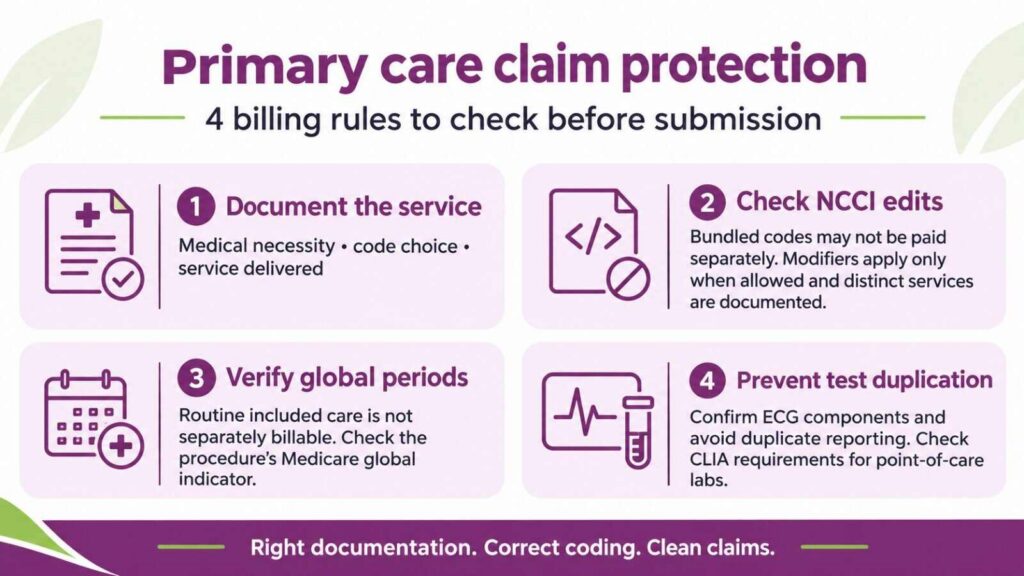
What Documentation and Billing Rules Protect Primary Care Claims?
Primary care claims require documentation supporting medical necessity, code selection, service delivery, and payer requirements. Moreover, different services have different compliance risks. E/M claims depend on MDM or time, while care management claims require specific service elements.
How Do NCCI Edits Affect Primary Care Billing?
Medicare’s National Correct Coding Initiative (NCCI) edits identify certain code combinations that should not be separately paid. For example, procedural components may be included in a comprehensive service.
Therefore, reporting multiple codes does not automatically create separate reimbursement. Modifiers can bypass eligible edits only when distinct services are documented. Additionally, not every NCCI edit permits a modifier override.
How Do Global Periods Affect Office Procedures?
Certain procedures include related evaluation and postoperative care during a global period. Routine included care cannot be separately billed. However, a significant unrelated E/M service may qualify for separate reporting when requirements are met.
Consequently, primary care practices should verify each procedure’s Medicare global indicator before submitting additional visits.
What Are the Rules for Same-Day Diagnostic Tests?
Diagnostic testing must satisfy the applicable medical necessity and coverage requirements. Separate reporting also depends on the test’s coding structure.
For example, an ECG may involve combined or separate technical and professional components. Billing both components again with the complete service would duplicate reporting.
Moreover, point-of-care laboratory services require appropriate CLIA compliance. Therefore, billing staff must confirm the testing method and relevant certification requirements.
What Are the Most Common Primary Care Coding Denials?
Primary care denials frequently involve unsupported E/M levels, preventive visit eligibility, missing modifiers, and incomplete care management documentation.
Additionally, incorrect timing or duplicate service reporting can affect TCM and monthly care management claims. Many problems can be identified before submission.
The following table summarizes common denial risks.
| Denial Trigger | Typical Cause | Recommended Correction |
|---|---|---|
| E/M level not supported | Documentation does not meet MDM or time requirements | Validate MDM elements or qualifying time |
| Duplicate preventive and E/M work | No separately identifiable problem-oriented service | Review documentation before adding modifier 25 |
| Incorrect AWV code | Initial and subsequent visits confused | Verify Medicare wellness history |
| AWV frequency denial | Service billed before eligibility interval | Check prior claims and eligibility |
| Missing modifier 25 | Separately identifiable E/M not correctly reported | Add only when supported |
| CCM time deficiency | Required monthly time not met | Maintain accurate qualifying time records |
| Complex CCM denial | Required MDM or care plan elements missing | Document all qualifying requirements |
| APCM denial | Patient eligibility or service capabilities not established | Confirm APCM criteria |
| TCM denial | Contact or follow-up deadline missed | Track discharge dates and communication |
| Incorrect laboratory coding | Code does not match performed test | Verify method and CLIA requirements |
| Procedure bundling denial | Included service separately reported | Review NCCI edits |
| Incorrect G2211 billing | Visit relationship or modifier rules not met | Review Medicare add-on requirements |
| Wrong diagnosis code | Diagnosis does not reflect the clinical record | Verify ICD-10-CM code and documentation |
A denial review should identify the underlying cause rather than automatically resubmitting the same claim. Moreover, correcting the clinical documentation process can prevent repeat billing errors. Consequently, regular coding education supports more reliable reimbursement.
How Can Specialized Primary Care Billing Improve Revenue?
Primary care practices manage large claim volumes across office visits, preventive services, and care management programs. Each service introduces different eligibility and documentation requirements.
Specialized billing support helps practices identify coding discrepancies, monitor denials, and improve claim submission accuracy. Consistent follow-up also supports more reliable collections.
Transcure provides primary care medical billing services for practices managing these complex workflows. Its services cover claim submission, denial management, payment posting, and revenue cycle reporting.
Dedicated coding reviews can also help practices identify missed services and prevent unsupported claims. As a result, physicians can spend less time on administrative tasks managing billing discrepancies.
Frequently Asked Questions About Primary Care CPT Codes
What Are the Most Common Primary Care CPT Codes?
Common Primary Care CPT codes include 99213, 99214, 99203, 99204, 99395, 99396, 99490, 99495, and 99496. Additionally, Medicare practices frequently use HCPCS codes G0438, G0439, G2211, and G0556-G0558. The appropriate code depends on the documented service and payer requirements.
What Is the Difference Between CPT 99213 and 99214?
CPT 99213 reports low-complexity established-patient E/M services. CPT 99214 reports moderate-complexity services. Alternatively, time may determine the level. Code 99213 requires 20-29 minutes, while 99214 requires 30-39 minutes when using time-based selection.
Which CPT Code Is Used for an Annual Physical?
Commercial preventive medicine visits commonly use CPT 99381-99397. The exact code depends on age and patient status. However, Original Medicare uses separate HCPCS codes for covered annual wellness visits. Therefore, practices should not automatically report a routine preventive medicine code for Medicare wellness services.
What Is the Difference Between G0438 and 99397?
G0438 reports a patient’s initial eligible Medicare annual wellness visit. CPT 99397 reports a comprehensive preventive medicine evaluation for an established patient aged 65 or older. The services have different requirements. Consequently, G0438 cannot be replaced with 99397 for Medicare AWV billing.
Can a Primary Care Practice Bill 99214 and G2211 Together?
Yes, Medicare permits G2211 with qualifying office or outpatient E/M services when its longitudinal care requirements are satisfied. However, modifier 25 restrictions and their specific exceptions must be considered. G2211 is not automatically payable with every office visit.
What Is the Difference Between CCM and APCM?
CCM requires qualifying chronic conditions and defined monthly time thresholds. APCM uses patient complexity categories and comprehensive longitudinal care requirements. Moreover, APCM does not rely on the same monthly time thresholds. Practices must meet their specific Medicare billing requirements.
Which CPT Codes Are Used for Hospital Follow-Up Visits?
CPT 99495 and 99496 report qualifying transitional care management following eligible facility discharges. However, routine follow-up visits that do not meet TCM requirements use an appropriate E/M code. The documentation determines which billing pathway applies.
What Are the Important New Primary Care Billing Codes for 2027?
Important 2027 HCPCS additions include G0686, G0687, G0572, G0573, and G0576. These address shared medical appointments, clinical staff advanced care planning, and additional management of vaccine adverse effects. Each requires compliance with the finalized Medicare service requirements.
Does Medicare Pay for Health Coaching in 2027?
CMS finalized national Medicare pricing for qualifying health and well-being coaching services effective in 2027. The applicable Category III CPT codes include 0591T, 0592T, and 0593T. However, payment depends on the applicable supervision, qualification, documentation, and medical necessity requirements.
How Often Do Primary Care CPT Codes Change?
The AMA updates its CPT code set annually, with most changes taking effect January 1. Additionally, CMS updates Medicare payment policies and HCPCS codes. Therefore, primary care practices should review coding files, fee schedules, and payer rules each year.