Endocrinology ICD-10 codes classify diseases of the thyroid, pancreas, adrenal glands, pituitary, and other hormone-producing organs. Chapter 4, Endocrine, Nutritional and Metabolic Diseases (E00-E89), holds most of them, including the diabetes block at E08-E13.
CDC data show 38.4 million Americans, or 11.6% of the population, had diabetes in 2021. That volume makes accurate diagnosis coding central to medical necessity and clean claims.

This guide covers the E00-E89 categories endocrinologists report most, from diabetes and thyroid disorders to obesity and metabolic conditions. It explains combination coding, code specificity, documentation tips, and how diagnoses pair with procedure codes.
What Are Endocrinology ICD-10 Codes?
Endocrinology ICD-10 codes describe problems of the hormone system, from thyroid disease and diabetes to adrenal, pituitary, and parathyroid disorders. ICD-10-CM is the U.S. clinical modification of ICD-10 and the standard set for reporting diagnoses to payers.
Most endocrine diagnoses sit in Chapter 4 (E00-E89), though related conditions also appear in several other chapters. Knowing where each diagnosis belongs prevents many avoidable denials.
Which ICD-10 Chapters Cover Endocrine Diagnoses?
Endocrine diagnoses reach well beyond a single ICD-10 chapter. The core range sits in Chapter 4, yet neoplasms, bone disease, kidney disease, pregnancy, and status codes all come into play.
- Chapter 4 (E00-E89): Thyroid disease, diabetes mellitus, other glucose disorders, adrenal and pituitary disorders, obesity, and disorders of metabolism.
- Chapter 2 (C73-C75, D34-D35, D44): Tumors of the thyroid, adrenal, pituitary, and parathyroid glands, from cancers to benign and uncertain growths.
- Chapter 13 (M80-M81): Osteoporosis with and without a pathological fracture.
- Chapter 14 (N18): Chronic kidney disease stages, reported alongside diabetic kidney entries.
- Chapter 9 (I10, I15.2): Hypertension, including hypertension caused by hormone imbalance.
- Chapter 15 (O24): Pre-existing and gestational diabetes in pregnancy.
- Chapter 18 (R73, R94.6): Elevated blood glucose, prediabetes, and abnormal thyroid function studies when no firm diagnosis exists.
- Chapter 21 (Z13.1, Z68, Z79): Diabetes screening, BMI, and long-term insulin or other diabetes drug therapy.
How Is an Endocrinology ICD-10 Code Structured?
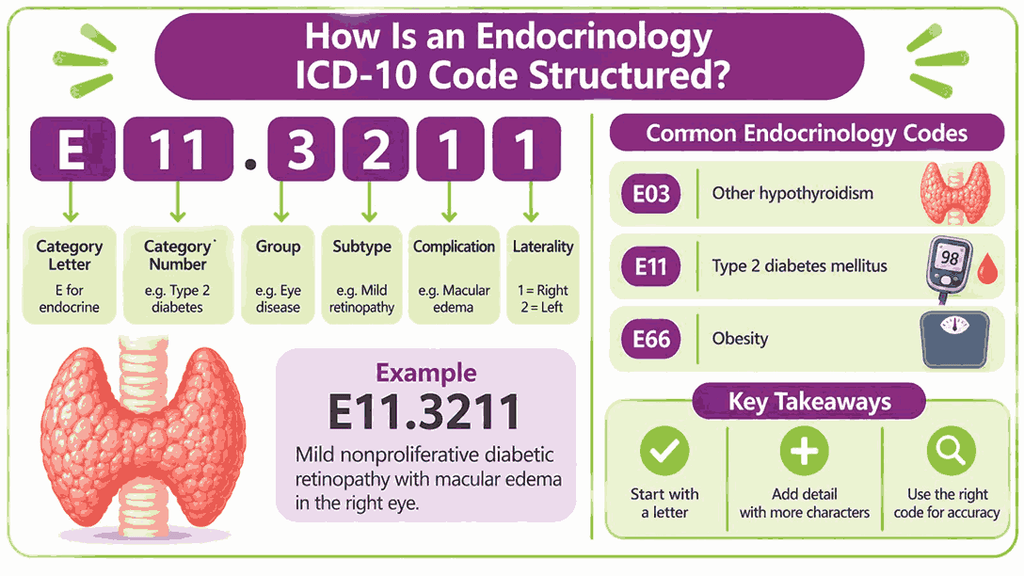
Codes in this specialty gain detail with every added character. Every ICD-10 code starts with a three-character category and can take up to four further characters for added clinical detail. Position 1 is always a letter, and endocrine codes start with E, though related codes begin with C, D, M, N, O, R, and Z.
Positions 2 and 3 are numbers that narrow the category, such as E03 for other hypothyroidism or E11 for type 2 diabetes mellitus. After the decimal point, the fourth character usually marks the subtype or complication group, such as E11.2 for diabetic kidney complications.
Characters 5 and 6 add detail, such as the exact complication, severity, or glucose status. Where present, the 7th character often reports laterality, such as the right or left eye in diabetic retinopathy.
For instance:
E11.65 reports type 2 diabetes mellitus with hyperglycemia.
- Category E11 is type 2 diabetes.
- .6 marks the group for other specified complications, as opposed to .2 for kidney disease or .3 for eye disease.
- Finally, 5 names the exact complication, hyperglycemia, while 9 would report some other specified problem.
E11.3211 reports mild nonproliferative diabetic retinopathy with macular edema in the right eye.
- Within E11, the digit 3 opens the ophthalmic group.
- Next comes 2 for mild nonproliferative retinopathy, then 1 for macular edema, where 9 would mean none.
- Last, a 1 indicates laterality: 2 for the left eye and 3 for both.
What Makes an Endocrinology ICD-10-CM Code Billable?
A billable code carries every character needed to report the specific diagnosis. Some categories cannot be billed because they need added characters.
E11 names type 2 diabetes but lacks the detail a claim needs, while E11.9 reports type 2 diabetes with no complication listed. Billing E11.9 works only when the record shows no complication.
Payers read that diagnosis beside the service, so endocrinology CPT codes define the visit, lab, or procedure that each billable diagnosis supports.
When Should Symptom Codes Be Used Instead of Definitive Diagnoses?
Findings and symptom codes are reported only when the physician has not reached a definitive diagnosis by the end of the visit. Once the condition is confirmed, the diagnosis replaces the symptom code.
For example, R73.09 (other abnormal glucose) or R94.6 (abnormal thyroid function studies) may fit while a workup is underway. If the physician confirms type 2 diabetes or hypothyroidism at that visit, report the confirmed condition instead of the finding.
Prediabetes has its own code, R73.03, once the physician documents it.
Can More Than One Endocrinology ICD-10 Code Be Reported Together?
Yes, because endocrine patients often live with several conditions that each shape treatment. Coders can report every documented condition, and diabetes includes combination codes that bundle a complication with its disease.
Consider a patient with type 2 diabetes, diabetic chronic kidney disease, hypothyroidism, and long-term insulin use. Such a claim can carry E11.22, an N18 stage code, E03.9, and Z79.4.
Each reported code should reflect a documented condition that influenced evaluation, treatment, or management.
How Do You Code Endocrinology Diagnoses Correctly?
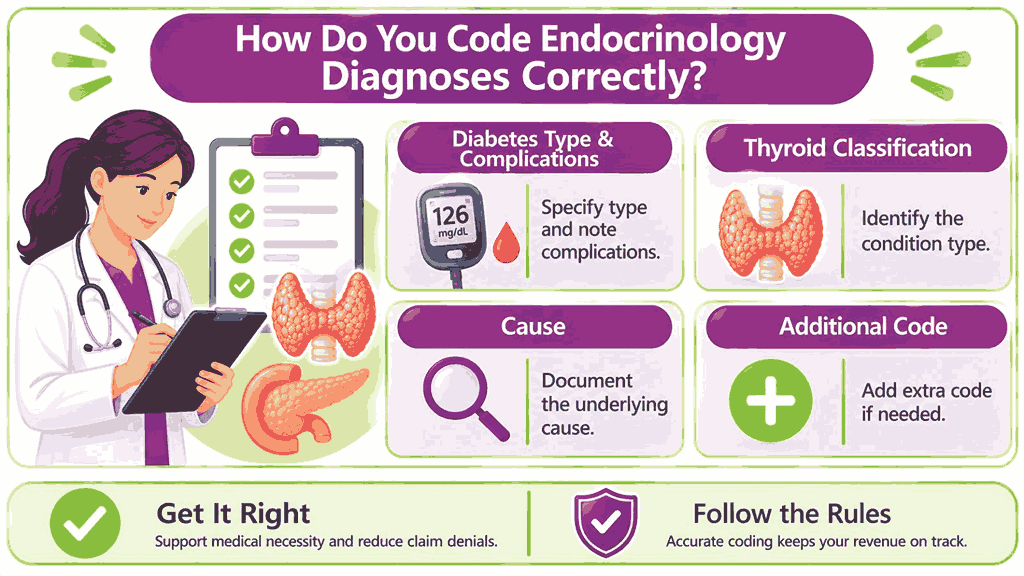
To code an endocrine diagnosis correctly, review four key documentation details before submitting the claim. Confirm the diabetes type and complication status, how the thyroid condition is classified, the documented cause, and if an additional code is needed.
Getting them right supports medical necessity and cuts claim rejections. Rules come first in this section, and individual code listings follow in the guide.
Practices that route diabetes and thyroid claims through endocrinology billing support catch documentation gaps before submission.
What Documentation Turns Diabetes Into the Right Code?
Type, control status, and complications turn a generic diabetes label into a code a payer will accept. Documented details split type 2 diabetes into several codes, such as these.
- Without complications, type 2 diabetes reports as E11.9.
- Hyperglycemia in type 2 diabetes reports as E11.65.
- Hypoglycemia without coma reports as E11.649.
- Diabetic chronic kidney disease reports as E11.22.
Phrases such as poorly controlled or out of control index to hyperglycemia, so the exact wording in the note matters. When the note says only diabetes mellitus with no type, coders default to E11.
How Do You Classify Thyroid Disorders in ICD-10?
Function and structure sort thyroid disorders into the E00-E07 block. Conditions in the table map to a category first, and the final characters refine each one.
| Condition | Category | Reports |
|---|---|---|
| Hypothyroidism | E03.- | Underactive thyroid, including E03.9 for unspecified |
| Hyperthyroidism | E05.- | Overactive thyroid, including Graves disease (E05.0-) and toxic nodules |
| Thyroiditis | E06.- | Thyroid inflammation, including autoimmune thyroiditis at E06.3 |
| Nodules and goiter | E04.- | Nontoxic goiter and nodules, including E04.1 for a single nodule |
Thyroid cancer leaves this block and is reported in Chapter 2 under C73.
Why Does the Documented Cause Drive the Code?
Cause drives the code in two endocrine families, diabetes and hyperparathyroidism, which are classified by source.
Across E08 through E13, diabetes codes by cause. Its blocks cover underlying conditions (E08), drug- or chemical-induced forms (E09), type 1 (E10), type 2 (E11), and other specified forms (E13).
In contrast, hyperparathyroidism codes are based on the source, not the calcium result. E21.0 reports primary hyperparathyroidism, E21.1 covers other secondary forms, and N25.81 describes the renal secondary type.
Gaps in cause documentation can prevent the correct code from being selected.
When Does an Endocrine Diagnosis Need a Second Code?
An endocrine diagnosis requires a second code when a documented complication, treatment, or measurement goes beyond what a single code can capture. Pairings recur in three predictable places.
- Code the Diabetes and the Kidney Stage: E11.22 pairs with an N18 code that names the kidney disease stage.
- Code the Diabetes and the Treatment: Z79.4 reports long-term insulin use, Z79.84 covers oral hypoglycemic drugs, and Z79.85 covers injectable non-insulin drugs. Patients on both insulin and oral drugs can carry both Z79.4 and Z79.84.
- Code the Obesity and the BMI: Obesity pairs E66 with a Z68 BMI code, and the provider must document the obesity diagnosis itself.
Which ICD-10 Codes Cover the Most Common Endocrine Conditions?
Hormone and metabolic conditions anchor Chapter 4, which gives thyroid disease, diabetes, adrenal disorders, and obesity their own blocks. Sections below group the codes by condition and list the most commonly reported entries with their official descriptions.
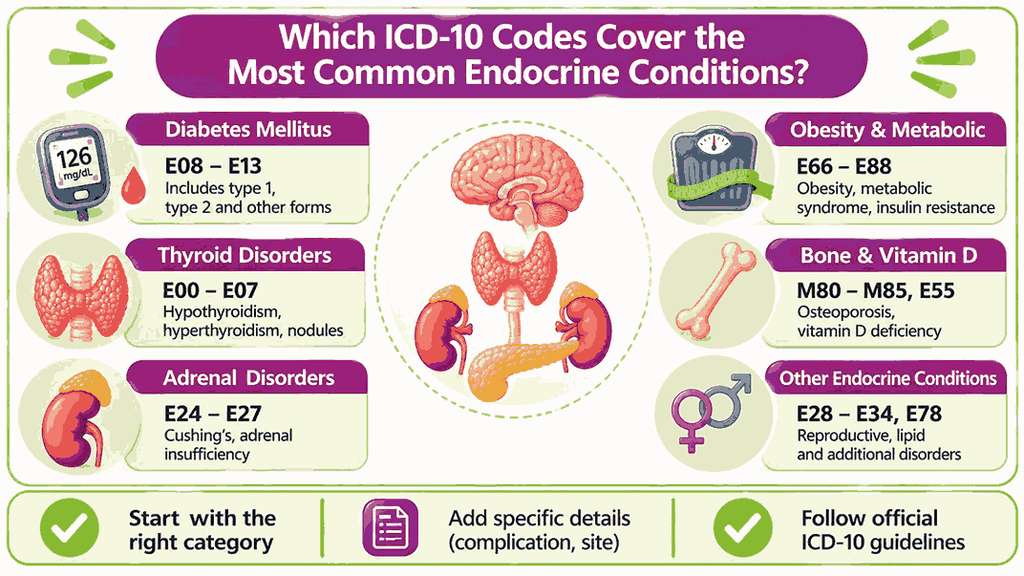
All groups open with what the category covers, then show how documentation separates one code from the next.
Diabetes Mellitus ICD-10 Codes
Five categories, E08, E09, E10, E11, and E13, hold every form of diabetes coded in Chapter 4. Origin and pregnancy status pick the category first, and complications follow.
Beyond the category, the fourth through seventh characters add complication, control, and eye side. The tables below pair billable codes with official descriptions and short coding notes.
Type 2 Diabetes ICD-10 Codes
Type 2 diabetes sits in E11, where the added digits name the complication or glucose state. E11.9 fits only when no complication is documented. Kidney, eye, nerve, vessel, and foot findings each have a dedicated code family.
| ICD-10 Code | Description | Coding Note |
|---|---|---|
| E11.9 | Type 2 diabetes mellitus without complications | Use only when no complication is documented |
| E11.8 | Type 2 diabetes mellitus with unspecified complications | Complication present but not specified |
| E11.65 | Type 2 diabetes mellitus with hyperglycemia | Matches poorly controlled or out of control wording |
| E11.649 | Type 2 diabetes mellitus with hypoglycemia without coma | Low glucose event without coma |
| E11.641 | Type 2 diabetes mellitus with hypoglycemia with coma | Low glucose event with coma |
| E11.00 | Type 2 diabetes mellitus with hyperosmolarity without nonketotic hyperglycemic-hyperosmolar coma (NKHHC) | Hyperosmolar state without coma |
| E11.10 | Type 2 diabetes mellitus with ketoacidosis without coma | Ketoacidosis without coma |
| E11.21 | Type 2 diabetes mellitus with diabetic nephropathy | Nephropathy wording in the note |
| E11.22 | Type 2 diabetes mellitus with diabetic chronic kidney disease | Add an N18 code for the kidney stage |
| E11.29 | Type 2 diabetes mellitus with other diabetic kidney complication | Other kidney complication, named in the note |
| E11.319 | Type 2 diabetes mellitus with unspecified diabetic retinopathy without macular edema | Retinopathy type not stated, no macular edema |
| E11.40 | Type 2 diabetes mellitus with diabetic neuropathy, unspecified | Neuropathy when the type is not stated |
| E11.42 | Type 2 diabetes mellitus with diabetic polyneuropathy | Polyneuropathy, the common nerve entry |
| E11.51 | Type 2 diabetes mellitus with diabetic peripheral angiopathy without gangrene | Peripheral vessel disease without gangrene |
| E11.52 | Type 2 diabetes mellitus with diabetic peripheral angiopathy with gangrene | Peripheral vessel disease with gangrene |
| E11.621 | Type 2 diabetes mellitus with foot ulcer | Add an L97 code for ulcer site and depth |
| E11.69 | Type 2 diabetes mellitus with other specified complication | Other documented complication, named in the note |
Type 1 Diabetes ICD-10 Codes
Juvenile-onset and insulin-dependent disease belongs to E10, which mirrors the E11 layout. Ketoacidosis splits by coma status, and presymptomatic disease has its own staging. E10.9 stays reserved for charts that list nothing else.
| ICD-10-CM Code | Description | Coding Note |
|---|---|---|
| E10.9 | Type 1 diabetes mellitus without complications | Reserved for charts with no complications |
| E10.10 | Type 1 diabetes mellitus with ketoacidosis without coma | Ketoacidosis without coma |
| E10.11 | Type 1 diabetes mellitus with ketoacidosis with coma | Ketoacidosis with coma |
| E10.65 | Type 1 diabetes mellitus with hyperglycemia | Hyperglycemia in type 1 disease |
| E10.649 | Type 1 diabetes mellitus with hypoglycemia without coma | Low glucose event without coma |
| E10.641 | Type 1 diabetes mellitus with hypoglycemia with coma | Low glucose event with coma |
| E10.21 | Type 1 diabetes mellitus with diabetic nephropathy | Nephropathy wording in the note |
| E10.22 | Type 1 diabetes mellitus with diabetic chronic kidney disease | Add an N18 code for the kidney stage |
| E10.42 | Type 1 diabetes mellitus with diabetic polyneuropathy | Polyneuropathy in type 1 disease |
| E10.69 | Type 1 diabetes mellitus with other specified complication | Other documented complication |
| E10.A0 | Type 1 diabetes mellitus, presymptomatic, unspecified | Presymptomatic disease, stage not stated |
| E10.A1 | Type 1 diabetes mellitus, presymptomatic, Stage 1 | Stage 1 presymptomatic disease |
| E10.A2 | Type 1 diabetes mellitus, presymptomatic, Stage 2 | Stage 2 presymptomatic disease |
Other Types of Diabetes ICD-10 Codes
Known triggers move diabetes out of E10 and E11 and into E08, E09, or E13. E08 follows underlying disease, E09 follows drugs or toxins, and E13 captures causes like a removed pancreas. Drug cases also need a T code that names the agent.
| ICD-10 Code | Description | Coding Note |
|---|---|---|
| E08.9 | Diabetes mellitus due to underlying condition without complications | Underlying disease listed first, no complication |
| E08.65 | Diabetes mellitus due to underlying condition with hyperglycemia | Hyperglycemia from an underlying condition |
| E08.22 | Diabetes mellitus due to underlying condition with diabetic chronic kidney disease | Chronic kidney disease with an underlying cause |
| E09.9 | Drug- or chemical-induced diabetes mellitus without complications | Drug or chemical cause, no complication |
| E09.65 | Drug-induced diabetes mellitus with hyperglycemia | Hyperglycemia from a drug or chemical |
| E13.9 | Other specified diabetes mellitus without complications | Other specified cause, no complication |
| E13.65 | Other specified diabetes mellitus with hyperglycemia | Hyperglycemia in other specified diabetes |
| E13.10 | Other specified diabetes mellitus with ketoacidosis without coma | Ketoacidosis without coma, other specified type |
Gestational and Pregnancy-Related Diabetes ICD-10 Codes
Pregnancy changes the chapter, because O24 separates pre-existing disease from gestational onset. Gestational cases use O24.41-, with a sixth character for diet, insulin, oral drug, or unspecified control. Existing type 1 and type 2 disease use O24.0- and O24.1-, with a trimester digit.
| ICD-10 Code | Description | Coding Note |
|---|---|---|
| O24.410 | Gestational diabetes mellitus in pregnancy, diet controlled | Control by diet |
| O24.414 | Gestational diabetes mellitus in pregnancy, insulin controlled | Control by insulin |
| O24.415 | Gestational diabetes mellitus in pregnancy, controlled by oral hypoglycemic drugs | Control by oral hypoglycemic drugs |
| O24.419 | Gestational diabetes mellitus in pregnancy, unspecified control | Control not stated |
| O24.011 | Pre-existing type 1 diabetes mellitus, in pregnancy, first trimester | Pre-existing type 1, first trimester |
| O24.111 | Pre-existing type 2 diabetes mellitus, in pregnancy, first trimester | Pre-existing type 2, first trimester |
| O24.311 | Unspecified pre-existing diabetes mellitus in pregnancy, first trimester | Pre-existing, type not stated, first trimester |
Prediabetes and Abnormal Glucose ICD-10 Codes
Abnormal glucose findings sit in R73, which separates fasting, tolerance, and prediabetes. R73.03 reports prediabetes, and latent diabetes lands in the same spot. Neither R73 code replaces E10 or E11 once diabetes is confirmed.
| ICD-10 Code | Description | Coding Note |
|---|---|---|
| R73.01 | Impaired fasting glucose | Abnormal fasting result |
| R73.02 | Impaired glucose tolerance (oral) | Abnormal oral glucose tolerance result |
| R73.03 | Prediabetes | Includes latent diabetes |
| R73.09 | Other abnormal glucose | Other abnormal glucose finding |
| R73.9 | Hyperglycemia, unspecified | Hyperglycemia without a stated cause |
| Z13.1 | Encounter for screening for diabetes mellitus | Screening visit without symptoms |
Hypoglycemia ICD-10 Codes
Low blood glucose outside diabetes codes to E16, separating drug-induced events from other causes. Levels 1 through 3 have codes E16.A1 through E16.A3, which grade severity of the event. Reactions to insulin in diabetes stay in the diabetes block instead.
| ICD-10 Code | Description | Coding Note |
|---|---|---|
| E15 | Nondiabetic hypoglycemic coma | Coma without diabetes |
| E16.0 | Drug-induced hypoglycemia without coma | Medication cause, no coma |
| E16.1 | Other hypoglycemia | Other documented cause |
| E16.2 | Hypoglycemia, unspecified | Cause not stated |
| E16.A1 | Hypoglycemia level 1 | Level 1 event |
| E16.A2 | Hypoglycemia level 2 | Level 2 event |
| E16.A3 | Hypoglycemia level 3 | Level 3 event |
Diabetes Treatment Status ICD-10 Codes
Status codes show how diabetes is treated, and the tabular list requests them under E08, E09, E11, and E13 alike. Excludes2 notes let patients on several therapies report every Z code that fits. Counseling visits add Z71.3 when diet instruction is the focus.
| ICD-10 Code | Description | Coding Note |
|---|---|---|
| Z79.4 | Long-term (current) use of insulin | Insulin therapy |
| Z79.84 | Long-term (current) use of oral hypoglycemic drugs | Oral antidiabetic drugs |
| Z79.85 | Long-term (current) use of injectable non-insulin antidiabetic drugs | Injectable non-insulin drugs |
| Z71.3 | Dietary counseling and surveillance | Diet counseling visits |
Thyroid Disorder ICD-10 Codes
Presentations of thyroid disease include an underactive gland, an overactive gland, a lump, or an abnormal lab. Separate blocks in E00-E07 handle those presentations, so documented function decides where the diagnosis lands.
Etiology matters as well, because postsurgical, drug-related, and autoimmune forms have separate listings. Entries below show those splits and flag the codes that carry added precision.
Hypothyroidism ICD-10 Codes
Hypothyroidism reports mostly from E03, and the documented cause steers selection. Radiation and surgery leave E03 for E89.0, which reports postprocedural hypothyroidism. E03.5 reports myxedema coma and is never coded from a lab value alone.
| ICD-10 Code | Description | Coding Note |
|---|---|---|
| E02 | Subclinical iodine-deficiency hypothyroidism | Mild iodine-related cases |
| E03.0 | Congenital hypothyroidism with diffuse goiter | Congenital with diffuse goiter |
| E03.1 | Congenital hypothyroidism without goiter | Congenital without goiter |
| E03.2 | Hypothyroidism due to medicaments and other exogenous substances | Add a T code for the drug effect |
| E03.3 | Postinfectious hypothyroidism | Follows an infection |
| E03.4 | Atrophy of thyroid (acquired) | Acquired thyroid atrophy |
| E03.5 | Myxedema coma | Emergency presentation |
| E03.8 | Other specified hypothyroidism | Other documented cause |
| E03.9 | Hypothyroidism, unspecified | Includes myxedema NOS |
| E89.0 | Postprocedural hypothyroidism | After surgery or radiation |
Hyperthyroidism and Graves Disease ICD-10 Codes
Hyperthyroidism is reported as thyrotoxicosis in E05, and the fifth character records thyroid storm. Graves disease is an indexed term under E05.0, so E05.00 and E05.01 apply. Toxic nodules use E05.1- and E05.2-, while factitia and ectopic tissue have separate branches.
| ICD-10 Code | Description | Coding Note |
|---|---|---|
| E05.00 | Thyrotoxicosis with diffuse goiter without thyrotoxic crisis or storm | Graves disease, no storm |
| E05.01 | Thyrotoxicosis with diffuse goiter with thyrotoxic crisis or storm | Graves disease with storm |
| E05.10 | Thyrotoxicosis with toxic single thyroid nodule without thyrotoxic crisis or storm | Toxic single nodule, no storm |
| E05.20 | Thyrotoxicosis with toxic multinodular goiter without thyrotoxic crisis or storm | Toxic multinodular goiter, no storm |
| E05.30 | Thyrotoxicosis from ectopic thyroid tissue without thyrotoxic crisis or storm | Ectopic thyroid tissue, no storm |
| E05.40 | Thyrotoxicosis factitia without thyrotoxic crisis or storm | Excess hormone intake, no storm |
| E05.80 | Other thyrotoxicosis without thyrotoxic crisis or storm | Other cause, no storm |
| E05.90 | Thyrotoxicosis, unspecified without thyrotoxic crisis or storm | Cause not stated, no storm |
| E05.91 | Thyrotoxicosis, unspecified with thyrotoxic crisis or storm | Cause not stated, with storm |
Thyroid Nodules and Goiter ICD-10 Codes
Nontoxic nodules and goiter belong to E04, which separates single nodules from multinodular goiter. Pathology confirms cancer, so a nodule seen only on ultrasound stays in E04. Neoplasm entries sit elsewhere, with C73 for cancer, D34 for benign growths, and D44.0 for uncertain behavior.
| ICD-10 Code | Description | Coding Note |
|---|---|---|
| E04.0 | Nontoxic diffuse goiter | Diffuse enlargement |
| E04.1 | Nontoxic single thyroid nodule | Single nodule |
| E04.2 | Nontoxic multinodular goiter | Several nodules |
| E04.8 | Other specified nontoxic goiter | Other specified goiter |
| E04.9 | Nontoxic goiter, unspecified | Goiter type not stated |
| E07.1 | Dyshormogenetic goiter | Hormone synthesis defect |
| D34 | Benign neoplasm of thyroid gland | Benign tumor |
| D44.0 | Neoplasm of uncertain behavior of thyroid gland | Uncertain behavior |
| C73 | Malignant neoplasm of thyroid gland | Confirmed cancer |
Thyroiditis ICD-10 Codes
Thyroiditis codes in E06 are sorted by inflammation and by speed of onset and origin. Hashimoto thyroiditis is an indexed term under E06.3, the autoimmune entry. E06.2 covers thyrotoxicosis from chronic inflammation, which the E05 category excludes.
| ICD-10 Code | Description | Coding Note |
|---|---|---|
| E06.0 | Acute thyroiditis | Acute inflammation |
| E06.1 | Subacute thyroiditis | Subacute inflammation |
| E06.2 | Chronic thyroiditis with transient thyrotoxicosis | Chronic with temporary hormone excess |
| E06.3 | Autoimmune thyroiditis | Includes Hashimoto thyroiditis |
| E06.5 | Other chronic thyroiditis | Other chronic forms |
| E06.9 | Thyroiditis, unspecified | Type not stated |
Other Thyroid Disorders and Findings ICD-10 Codes
Several thyroid codes sit outside the main blocks and matter when a diagnosis is still developing. R94.6 reports abnormal thyroid function studies while the workup continues. E07.81 reports sick euthyroid syndrome, a lab pattern during serious illness that does not signal a thyroid disorder.
| ICD-10 Code | Description | Coding Note |
|---|---|---|
| R94.6 | Abnormal results of thyroid function studies | Workup finding, not a diagnosis |
| E07.81 | Sick-euthyroid syndrome | Illness-related lab pattern |
| E07.89 | Other specified disorders of thyroid | Other specified disorder |
| E07.9 | Disorder of thyroid, unspecified | Disorder not specified |
Adrenal Disorder ICD-10 Codes
Adrenal disease reports from E24 through E27, and each block follows a different hormone disturbance. Cortisol excess, cortisol shortage, aldosterone excess, and enzyme defects all sit in separate categories.
Source drives the code here too, since pituitary, drug-induced, and ectopic forms differ. Below, the codes endocrinologists report most appear with the notes that change them.
Cushing Syndrome ICD-10 Codes
Cushing syndrome codes are sorted by source, so the documented source steers coding. E24.0 reports pituitary-dependent disease, E24.3 reports ectopic ACTH, and E24.2 reports a medication effect. Steroid causes also add a T36-T50 adverse effect code, and congenital adrenal hyperplasia moves to E25.0.
| ICD-10 Code | Description | Coding Note |
|---|---|---|
| E24.0 | Pituitary-dependent Cushing’s disease | Pituitary source |
| E24.1 | Nelson’s syndrome | Pituitary tumor after adrenal removal |
| E24.2 | Drug-induced Cushing’s syndrome | Add a T code for the drug |
| E24.3 | Ectopic ACTH syndrome | Tumor outside the pituitary making ACTH |
| E24.4 | Alcohol-induced pseudo-Cushing’s syndrome | Alcohol related |
| E24.8 | Other Cushing’s syndrome | Other documented cause |
| E24.9 | Cushing’s syndrome, unspecified | Source not stated |
Adrenal Insufficiency ICD-10 Codes
Insufficiency codes are split by origin, with primary, drug-induced, and other causes separate. E27.2 reports Addisonian crisis, and adrenal crisis routes there as an indexed term. Surgery on the adrenal gland leads to E89.6 for postprocedural hypofunction.
| ICD-10 Code | Description | Coding Note |
|---|---|---|
| E27.1 | Primary adrenocortical insufficiency | Primary failure |
| E27.2 | Addisonian crisis | Includes adrenal crisis |
| E27.3 | Drug-induced adrenocortical insufficiency | Add a T code for the drug |
| E27.40 | Unspecified adrenocortical insufficiency | Cause not stated |
| E27.49 | Other adrenocortical insufficiency | Other cause |
| E89.6 | Postprocedural adrenocortical (-medullary) hypofunction | After adrenal surgery |
Hyperaldosteronism ICD-10 Codes
Aldosterone excess reports from E26, and the primary or secondary label picks the path. E26.01 reports Conn syndrome, and E26.1 reports secondary hyperaldosteronism. Work-ups for aldosteronism often add a hypertension code from I15.2 or I10.
| ICD-10 Code | Description | Coding Note |
|---|---|---|
| E26.01 | Conn’s syndrome | Conn syndrome |
| E26.02 | Glucocorticoid-remediable aldosteronism | Glucocorticoid-remediable form |
| E26.09 | Other primary hyperaldosteronism | Other primary cause |
| E26.1 | Secondary hyperaldosteronism | Driven by another condition |
| E26.81 | Bartter’s syndrome | Salt-wasting kidney disorder |
| E26.89 | Other hyperaldosteronism | Other type |
| E26.9 | Hyperaldosteronism, unspecified | Type not stated |
Other Adrenal Disorders ICD-10 Codes
Minor adrenal entries cover conditions outside the main groups and still appear in endocrine practice. E25.0 reports congenital adrenogenital disorders, the family used for congenital adrenal hyperplasia. Malignant and benign adrenal tumors are listed in the neoplasm section.
| ICD-10 Code | Description | Coding Note |
|---|---|---|
| E27.0 | Other adrenocortical overactivity | Other cortical overactivity |
| E27.5 | Adrenomedullary hyperfunction | Hormone excess from the adrenal medulla |
| E27.8 | Other specified disorders of adrenal gland | Other specified adrenal disorder |
| E27.9 | Disorder of adrenal gland, unspecified | Adrenal disorder not specified |
| E25.0 | Congenital adrenogenital disorders associated with enzyme deficiency | Used for congenital adrenal hyperplasia |
| E25.8 | Other adrenogenital disorders | Other adrenogenital disorder |
| E25.9 | Adrenogenital disorder, unspecified | Adrenogenital disorder not specified |
Pituitary, Parathyroid, and Calcium ICD-10 Codes
Growth, water balance, and calcium all depend on the pituitary and parathyroid glands, so their disorders touch many body systems. Placement follows the gland: the pituitary is in E22 and E23, the parathyroid in E20 and E21, and calcium results in E83.
N25.81 shows that some entries live outside Chapter 4, because it reports renal secondary hyperparathyroidism. Common codes appear in each group below, along with the rules that set them apart.
Pituitary Hyperfunction ICD-10 Codes
Pituitary overactivity reports from E22, which separates hormone excess by the hormone responsible.
E22.0 reports acromegaly, E22.1 reports hyperprolactinemia, and E22.2 reports inappropriate antidiuretic hormone secretion. ACTH excess from the pituitary belongs to E24.0, and thyroid-stimulating hormone excess moves to E05.8-.
| ICD-10 Code | Description | Coding Note |
|---|---|---|
| E22.0 | Acromegaly and pituitary gigantism | Growth hormone excess |
| E22.1 | Hyperprolactinemia | Prolactin excess |
| E22.2 | Syndrome of inappropriate secretion of antidiuretic hormone | Water retention from ADH excess |
| E22.8 | Other hyperfunction of pituitary gland | Other pituitary overactivity |
| E22.9 | Hyperfunction of pituitary gland, unspecified | Overactivity not specified |
Hypopituitarism and Diabetes Insipidus ICD-10 Codes
Underactivity of the pituitary is reported in E23, and the cause or hormone shortage drives the choice. E23.0 reports hypopituitarism, E23.1 reports the drug-induced form, and E23.2 reports diabetes insipidus.
Blood sugar does not play a role in diabetes insipidus, and nephrogenic cases are classified under N25.1.
| ICD-10 Code | Description | Coding Note |
|---|---|---|
| E23.0 | Hypopituitarism | Underactive pituitary |
| E23.1 | Drug-induced hypopituitarism | Add a T code for the drug |
| E23.2 | Diabetes insipidus | Central form; nephrogenic goes to N25.1 |
| E23.3 | Hypothalamic dysfunction, not elsewhere classified | Hypothalamic cause |
| E23.6 | Other disorders of pituitary gland | Other pituitary disorder |
| E23.7 | Disorder of pituitary gland, unspecified | Pituitary disorder not specified |
Hyperparathyroidism ICD-10 Codes
The source of the excess hormone sorts hyperparathyroidism codes. Primary disease is reported as E21.0, secondary disease as E21.1, and the renal secondary form as N25.81. Ectopic hyperparathyroidism and hungry bone syndrome are excluded from this category.
| ICD-10 Code | Description | Coding Note |
|---|---|---|
| E21.0 | Primary hyperparathyroidism | Includes parathyroid hyperplasia |
| E21.1 | Secondary hyperparathyroidism, not elsewhere classified | Secondary, not renal |
| E21.2 | Other hyperparathyroidism | Other documented form |
| E21.3 | Hyperparathyroidism, unspecified | Type not stated |
| N25.81 | Secondary hyperparathyroidism of renal origin | Renal origin |
Hypoparathyroidism ICD-10 Codes
Hypoparathyroidism has many entries, and the cause determines the correct code. E20.0 reports the idiopathic form, E20.1 reports pseudohypoparathyroidism, and E20.812 reports the autoimmune form. Neck surgery leads to E89.2 for postprocedural hypoparathyroidism.
| ICD-10-CM Code | Description | Coding Note |
|---|---|---|
| E20.0 | Idiopathic hypoparathyroidism | Idiopathic form |
| E20.1 | Pseudohypoparathyroidism | Hormone resistance |
| E20.810 | Autosomal dominant hypocalcemia | Genetic low calcium form |
| E20.812 | Autoimmune hypoparathyroidism | Autoimmune form |
| E20.89 | Other specified hypoparathyroidism | Other specified form |
| E20.9 | Hypoparathyroidism, unspecified | Type not stated |
| E89.2 | Postprocedural hypoparathyroidism | After neck surgery |
Calcium and Mineral Disorder ICD-10 Codes
Calcium results report from E83, which separates low calcium, high calcium, and other mineral problems. E83.51 reports hypocalcemia, E83.52 reports hypercalcemia, and familial hypocalciuric hypercalcemia routes to E83.52. Gland disorders with a known source use the gland code and skip E83.5.
| ICD-10 Code | Description | Coding Note |
|---|---|---|
| E83.51 | Hypocalcemia | Low calcium |
| E83.52 | Hypercalcemia | Includes familial hypocalciuric hypercalcemia |
| E83.59 | Other disorders of calcium metabolism | Other calcium disorder |
| E83.39 | Other disorders of phosphorus metabolism | Other phosphorus disorder |
| E83.42 | Hypomagnesemia | Low magnesium |
| E87.1 | Hypo-osmolality and hyponatremia | Low sodium |
Bone and Vitamin D ICD-10 Codes
Density and vitamin status connect endocrine care to the musculoskeletal chapter. Bone codes split across chapters, with M80 and M81 for osteoporosis, M83 for osteomalacia, and E55 for vitamin D deficiency.
Fractures and fracture-free disease have separate codes, so the visit note must say which applies. Add-on codes complete a bone claim, and the entries below explain how.
Osteoporosis ICD-10 Codes
Fracture-free disease reports from M81, and a fragility fracture moves the claim to M80. M80 needs site and seventh characters, as M80.08XA shows for vertebral fractures at first encounter. Z87.310 adds a healed fracture history, and M89.7- records any major osseous defect.
| ICD-10 Code | Description | Coding Note |
|---|---|---|
| M81.0 | Age-related osteoporosis without current pathological fracture | Age-related, no fracture |
| M81.6 | Localized osteoporosis [Lequesne] | Localized form |
| M81.8 | Other osteoporosis without current pathological fracture | Other cause, such as drugs |
| M80.08XA | Age-related osteoporosis with current pathological fracture, vertebra(e), initial encounter for fracture | Example with vertebral fracture, initial encounter |
| Z87.310 | Personal history of (healed) osteoporosis fracture | History of a healed fracture |
Osteomalacia and Other Bone Disorder ICD-10 Codes
Soft bones in adults are coded to M83, while children with the same problem move to E55.0. M85.80 covers other bone density disorders, and M88.9 covers Paget disease of an unspecified bone. Renal osteodystrophy is coded to N25.0, and vitamin D-resistant osteomalacia is coded to E83.31.
| ICD-10 Code | Description | Coding Note |
|---|---|---|
| M83.1 | Senile osteomalacia | Senile form |
| M83.9 | Adult osteomalacia, unspecified | Adult type not stated |
| M85.80 | Other specified disorders of bone density and structure, unspecified site | Other bone density disorder, site not stated |
| M88.9 | Osteitis deformans of unspecified bone | Paget disease, bone not stated |
| N25.0 | Renal osteodystrophy | Kidney-related bone disease |
Vitamin D and Nutrient Deficiency ICD-10 Codes
Vitamin D deficiency reports from E55, and the physician must document the condition. Lab values alone do not support E55.9. Adult osteomalacia and osteoporosis are excluded from E55 and are coded elsewhere.
| ICD-10 Code | Description | Coding Note |
|---|---|---|
| E55.0 | Rickets, active | Active rickets in children |
| E55.9 | Vitamin D deficiency, unspecified | Requires a provider diagnosis |
| E56.9 | Vitamin deficiency, unspecified | Vitamin not specified |
| E58 | Dietary calcium deficiency | Dietary calcium shortage |
Obesity and Metabolic ICD-10 Codes
Weight, insulin resistance, and lipid disorders share Chapter 4 and often travel together in the same chart. Coding for weight changed in October 2024, when class codes let providers report severity without older terms.
Another branch, covering metabolic syndrome and insulin resistance, arrived in October 2023. Subtypes of lipid disorders run long, and each condition below shows the codes and pairings.
Obesity ICD-10 Codes
Class codes E66.811, E66.812, and E66.813 took effect on October 1, 2024, and report class 1, class 2, and class 3 obesity. BMI ranges guide the class, yet the provider’s wording sets the class. Measured BMI adds a Z68 code when it is clinically significant.
| ICD-10 Code | Description | Coding Note |
|---|---|---|
| E66.3 | Overweight | Overweight without obesity |
| E66.01 | Morbid (severe) obesity due to excess calories | Excludes E66.2 |
| E66.09 | Other obesity due to excess calories | Other excess calorie obesity |
| E66.1 | Drug-induced obesity | Add a T code for the drug |
| E66.2 | Morbid (severe) obesity with alveolar hypoventilation | With alveolar hypoventilation |
| E66.811 | Obesity, class 1 | BMI 30.0 to 34.9 |
| E66.812 | Obesity, class 2 | BMI 35.0 to 39.9 |
| E66.813 | Obesity, class 3 | BMI 40.0 and above |
| E66.89 | Other obesity not elsewhere classified | Other obesity |
| E66.9 | Obesity, unspecified | Type or class not stated |
Metabolic Syndrome and Insulin Resistance ICD-10 Codes
Metabolic syndrome is reported as E88.810, a code available since the 2024 code set. Insulin resistance has E88.811 for type A, E88.818 for other types, and E88.819 for unspecified. E88.81 also asks for added codes for manifestations, with obesity as the common example.
| ICD-10 Code | Description | Coding Note |
|---|---|---|
| E88.810 | Metabolic syndrome | Syndrome diagnosis documented |
| E88.811 | Insulin resistance syndrome, Type A | Rare genetic insulin resistance |
| E88.818 | Other insulin resistance | Includes type B |
| E88.819 | Insulin resistance, unspecified | Type not stated |
| E88.82 | Obesity due to disruption of MC4R pathway | Genetic obesity form |
Lipid Disorder ICD-10 Codes
Lipid disorders fall under E78 and are split by which fat is raised. Familial hypercholesterolemia has E78.010 for homozygous and E78.011 for heterozygous forms. E78.5 and E78.9 serve as the unspecified options, so the note should name the lipid involved.
| ICD-10 Code | Description | Coding Note |
|---|---|---|
| E78.00 | Pure hypercholesterolemia, unspecified | Cholesterol only, type not stated |
| E78.010 | Homozygous familial hypercholesterolemia [HoFH] | Homozygous familial form |
| E78.011 | Heterozygous familial hypercholesterolemia [HeFH] | Heterozygous familial form |
| E78.1 | Pure hyperglyceridemia | Triglycerides only |
| E78.2 | Mixed hyperlipidemia | Cholesterol and triglycerides |
| E78.3 | Hyperchylomicronemia | Chylomicron excess |
| E78.41 | Elevated Lipoprotein(a) | Lipoprotein(a) excess |
| E78.49 | Other hyperlipidemia | Other documented lipid excess |
| E78.5 | Hyperlipidemia, unspecified | Type not stated |
| E78.6 | Lipoprotein deficiency | Low lipoprotein |
| E78.89 | Other lipoprotein metabolism disorders | Other lipoprotein disorder |
| E78.9 | Disorder of lipoprotein metabolism, unspecified | Type not stated |
Reproductive Hormone, Growth, and Treatment Status ICD-10 Codes
Sex hormone and growth disorders sit in E28 through E34, with puberty, ovarian, and testicular conditions in their own divisions. Treatment status codes from Z79 then show which long-term hormone or steroid therapy a patient receives.
Turner and Klinefelter syndromes are chromosomal and leave this block for Chapter 17. Coverage here spans each area, with the codes endocrine practices report most.
Ovarian Disorder ICD-10 Codes
Ovarian disorders are reported from E28, which separates hormone excess, polycystic disease, and ovarian failure. Stein-Leventhal syndrome is an indexed term under E28.2, which is polycystic ovarian syndrome.
Pure gonadal dysgenesis and Turner syndrome are excluded from E28.3 and take codes Q99.1 and Q96.
| ICD-10 Code | Description | Coding Note |
|---|---|---|
| E28.0 | Estrogen excess | Excess estrogen activity |
| E28.1 | Androgen excess | Excess androgen activity |
| E28.2 | Polycystic ovarian syndrome | Includes Stein-Leventhal |
| E28.310 | Symptomatic premature menopause | Symptomatic early menopause |
| E28.319 | Asymptomatic premature menopause | Asymptomatic early menopause |
| E28.39 | Other primary ovarian failure | Other documented ovarian failure |
| E28.8 | Other ovarian dysfunction | Other documented ovarian problem |
| E28.9 | Ovarian dysfunction, unspecified | Dysfunction not specified |
Testicular Disorder ICD-10 Codes
Testicular disorders are reported under E29, which separates hormone excess from hormone shortage. E29.1 reports testicular hypofunction, the code used when low testosterone traces to the testes. Klinefelter syndrome belongs to Q98, not E29.
| ICD-10 Code | Description | Coding Note |
|---|---|---|
| E29.0 | Testicular hyperfunction | Testicular hormone excess |
| E29.1 | Testicular hypofunction | Low testosterone from the testes |
| E29.8 | Other testicular dysfunction | Other documented dysfunction |
| E29.9 | Testicular dysfunction, unspecified | Dysfunction not specified |
Puberty and Growth ICD-10 Codes
Puberty and growth codes address timing and height, and E30 and E34 hold the main groups. E30.0 reports delayed puberty, and E30.1 reports precocious puberty. Short stature from a pituitary cause is excluded from E34.3 and belongs to E23.0.
| ICD-10 Code | Description | Coding Note |
|---|---|---|
| E30.0 | Delayed puberty | Late puberty |
| E30.1 | Precocious puberty | Early puberty |
| E30.8 | Other disorders of puberty | Other puberty disorder |
| E30.9 | Disorder of puberty, unspecified | Disorder not specified |
| E34.30 | Short stature due to endocrine disorder, unspecified | Endocrine cause not specified |
| E34.31 | Constitutional short stature | Normal-variant short stature |
| E34.4 | Constitutional tall stature | Normal-variant tall stature |
Polyglandular and Unspecified Endocrine Disorder ICD-10 Codes
Polyglandular disease means several glands fail together, usually from autoimmunity. E31.0 reports polyglandular failure from an autoimmune process. E34.9 reports endocrine disorder, unspecified, a last option when no gland is named.
| ICD-10 Code | Description | Coding Note |
|---|---|---|
| E31.0 | Autoimmune polyglandular failure | Autoimmune failure of several glands |
| E31.9 | Polyglandular dysfunction, unspecified | Type not stated |
| E34.9 | Endocrine disorder, unspecified | Gland not named |
Hormone and Long-Term Drug Status ICD-10 Codes
Ongoing therapy needs explaining, and status codes support medical necessity for monitoring visits.
Z79.890 reports hormone replacement, Z79.52 reports long-term systemic steroids, and Z79.83 reports long-term bisphosphonates. Active diagnoses stay first on the claim, and status codes come second.
| ICD-10 Code | Description | Coding Note |
|---|---|---|
| Z79.890 | Hormone replacement therapy | Hormone replacement |
| Z79.52 | Long-term (current) use of systemic steroids | Systemic steroids |
| Z79.83 | Long-term (current) use of bisphosphonates | Bisphosphonates |
| Z79.899 | Other long-term (current) drug therapy | Other long-term drugs |
Why Do Endocrinology Claims Get Denied?
Vague diagnoses and thin documentation sink many endocrine reimbursements. Many teams therefore turn to endocrinology billing providers to sharpen claim accuracy. Eight recurring patterns appear when payers push endocrine claims back.
- Unspecified Coding: Payable diagnoses shrink into vague codes, such as E11.9 when the note documents a complication or E66.9 when the chart shows class 2.
- Medical Necessity Mismatch: Tests and devices link to a screening or symptom code instead of a covered diagnosis, so A1c, TSH, DXA, and CGM claims fail.
- Missing Secondary Codes: Required partner codes go missing, such as the N18 stage with E11.22, the Z79 treatment code, the Z68 BMI, or the L97 ulcer site.
- Sequencing Errors: Order errors place E08 ahead of its underlying disease or an adverse effect code ahead of the diagnosis it explains.
- Absent Laterality or Seventh Character: Missing detail strands some codes, as with retinopathy lacking an eye, fractures lacking a site, and adverse effect codes lacking the final position.
- Unresolved Symptom Codes: Finding codes such as R73.09 or R94.6 keep billing after the workup has already ended.
- Weak Clinical Documentation: Problem lists hold conditions that are never monitored, evaluated, assessed, or treated, so they fail the MEAT standard in an audit.
- Missing Prior Authorization: High-cost items proceed without approval, and insulin pumps, glucose monitors, growth hormone, and weight loss drugs are often denied when authorization is skipped.
Specific diagnoses lose value when they’re reduced to unspecified codes or unsupported by the record. Providers pay for that gap twice, first during claim review and again during risk adjustment.
How Do You Reduce Endocrinology Claim Denials?
One effective way to prevent endocrine claim denials is working with a reputable endocrinology billing provider. Teams working alone can use the four points below to address the most common causes of failed endocrine submissions.
- Code to the full specificity the record supports. Reach past E11.9, E03.9, E66.9, and E78.5 whenever the note earns it, since specific siblings pay and score in ways vague codes cannot.
- Query the provider instead of guessing. Ask for the missing diabetes type, the eye side on retinopathy, the cause of hypothyroidism, or the obesity classification.
- Capture the pairing codes alongside the disease. Add the N18 stage, the Z79 treatment code, the Z68 BMI, and the T code for the drug as their own lines. Companion codes stand apart from the disease code, and they often vanish before the claim goes out.
- Scrub every claim before it leaves. Catch the diabetes code missing its Z79 partner, the obesity code missing its BMI, and the symptom code that outlived its workup. Front-end review flags stop all of them before payment review begins.
Endocrinology ICD-10 Codes FAQs
Can You Report Z79.85 for Ozempic or Wegovy Prescribed for Weight Loss?
Guidance conflicts on this point, so the answer depends on which reference you trust. The appendix lists a reported 2026 Coding Clinic answer that points in different directions, and some coders choose Z79.899. Diagnosis coding stays clear either way, since E66.811 through E66.813 with Z68, or E11, still anchors the case.
Does ICD-10 Assume Diabetes Causes Kidney Disease or Neuropathy?
Linkage is presumed for any condition listed within the diabetes index, with no provider statement necessary. Kidney disease, neuropathy, retinopathy, and peripheral artery disease all qualify, landing in E11.2-, E11.4-, E11.3-, and E11.5-. Notes that call the conditions unrelated block the link, and each condition then reports on its own.
Should You Add Z79.4 When a Patient Gets Insulin Only Once in the Hospital?
No, Z79.4 stays off the claim when insulin is given only to bring a type 2 patient’s sugar under control during a stay. Home insulin changes that, because Z79.4 belongs to long-term users. Pump users carry Z79.4 as well, since pump delivery still counts as ongoing insulin dosing.
Is a Patient on Insulin Automatically Coded as Type 1?
Documentation decides the type, so a chart naming insulin but no diabetes type falls into E11 by default. Charts that document type 1 move the claim to E10, where insulin use is already implied. Querying the provider avoids guesses, since age alone settles nothing.
Which Endocrine Codes Count Toward Risk Adjustment?
Under V28, plain E11.9 lands in HCC 38, while complication codes land in HCC 37. HCC 37 outranks HCC 38 in the diabetes hierarchy, and E03.9 for hypothyroidism has no V28 mapping at all. Complication detail therefore pays off twice, once on the claim and again in the risk score.
How Often Can Medicare Pay for an A1c Test?
Controlled diabetes supports testing about once every three months under the national policy. Uncontrolled diabetes can justify extra tests when the chart explains why. Contractors set local rules, so check your regional policy before ordering repeat tests.