Medical necessity for laboratory tests is the Medicare standard that decides whether a lab test gets paid. Under the Social Security Act, a test must be reasonable and necessary to diagnose or treat an illness or injury. A physician order starts the process, but the order alone does not prove medical necessity.
Medicare defines lab coverage through two policy types. National Coverage Determinations (NCDs) come from the Centers for Medicare & Medicaid Services (CMS) and apply nationwide. Local Coverage Determinations (LCDs) come from Medicare Administrative Contractors (MACs) and apply within one jurisdiction. Both list covered diagnoses, documentation rules, and frequency limits.
Clinical lab tests carry a financial risk that few other services share. Medicare Part B pays them under the Clinical Laboratory Fee Schedule with no deductible or coinsurance. A denied test without a valid Advance Beneficiary Notice usually becomes a full write-off. This guide covers coverage policies, frequency limits, documentation, ABNs, and denial prevention.

What Is Medical Necessity for Laboratory Tests?
A lab test is medically necessary when its result will be used to manage a patient’s specific medical problem. Under 42 CFR 410.32, the physician or practitioner treating the patient must order the test. That same provider must use the result in the patient’s care, not just add it to the chart.
This standard separates diagnostic testing from routine screening. Diagnostic tests respond to signs, symptoms, a known condition, or treatment monitoring. Screening tests look for disease in patients without symptoms, and Medicare covers them only under specific preventive benefits. The table below shows how the two categories differ at the claim level.
| Factor | Diagnostic Testing | Screening Testing |
|---|---|---|
| Purpose | Evaluate symptoms, confirm a condition, or monitor treatment | Detect disease in a patient with no signs or symptoms |
| Coverage basis | Reasonable and necessary rule, plus NCD and LCD criteria | A specific preventive benefit written into Medicare law |
| Typical diagnosis code | Condition, sign, or symptom code (ICD-10-CM) | Z-code describing a screening encounter |
| Lab example | Lipid panel to monitor statin therapy for hyperlipidemia | Cardiovascular screening lipid panel, covered once every five years |
| Status when not covered | Not reasonable and necessary (GA or GZ modifier) | Statutorily excluded (GX or GY modifier) |
Why an ordered test is not automatically covered: Medicare judges the claim, not the order. A test can still fail medical necessity for several common reasons:
- The submitted ICD-10-CM code does not appear on the covered list for that test.
- Repeat testing falls inside a frequency window without a documented clinical reason.
- Records show no symptom, condition, or monitoring need tied to the order.
- A routine screening test is billed as diagnostic without supporting findings.
Medical necessity sits at the center of every lab claim, from requisition intake to final payment. Orders, coding, claim edits, and payment posting all connect across the lab revenue cycle. For that broader view, see our laboratory billing guide before applying the coverage steps below.
Understanding NCDs and LCDs in Medicare Laboratory Billing
Medicare publishes coverage rules at two levels, and lab billing teams need to read both. The sections below define each policy type, list common lab NCDs, and compare the two. The last subsection shows how to find both in the Medicare Coverage Database.
What Is a National Coverage Determination (NCD)?
An NCD is a CMS policy that sets national coverage rules for a specific item or service. CMS develops each NCD through a public process that reviews clinical evidence. Every MAC must apply an NCD, so its covered indications and limitations hold in all states and territories.
Lab testing has its own NCD set. CMS finalized 23 clinical laboratory NCDs through negotiated rulemaking in 2001, now found in Section 190 of the NCD Manual. Each one pairs CPT codes with ICD-10-CM codes that support coverage and codes that do not. CMS updates these code lists every quarter.
| NCD Number | Laboratory Test | Common CPT Codes | Coverage Focus |
|---|---|---|---|
| 190.12 | Urine Culture, Bacterial | 87086, 87088 | Signs of urinary tract infection and follow-up after treatment |
| 190.15 | Blood Counts | 85025, 85027 | Anemia, infection, bleeding, and drug toxicity monitoring |
| 190.18 | Serum Iron Studies | 83540, 83550, 82728 | Suspected iron deficiency or iron overload |
| 190.20 | Blood Glucose Testing | 82947, 82948, 82962 | Diabetes management and symptoms of glucose imbalance |
| 190.21 | Glycated Hemoglobin/Glycated Protein | 83036, 82985 | Long-term glucose control in patients with diabetes |
| 190.22 | Thyroid Testing | 84443, 84436, 84439 | Thyroid disease diagnosis and therapy monitoring |
| 190.23 | Lipid Testing | 80061, 82465, 83718, 84478 | Lipid disorders, cardiovascular disease, and drug therapy monitoring |
| 190.31 | Prostate Specific Antigen | 84153, 84152, 84154 | Diagnostic PSA for prostate cancer evaluation and monitoring |
What Is a Local Coverage Determination (LCD)?
An LCD is a coverage policy a MAC writes for services within its own jurisdiction. MACs issue LCDs when no NCD exists or when an NCD leaves room for local detail. Each LCD defines covered indications, non-covered indications, documentation needs, and utilization or frequency guidelines for the service.
Since the 21st Century Cures Act reforms, MACs keep codes out of the LCD itself. CPT, HCPCS, and ICD-10-CM codes now sit in a linked Billing and Coding Article. Labs must read both documents, because the LCD sets the coverage rule and the article lists the codes that apply it.
A typical lab LCD and its companion article contain:
- Covered indications describing the clinical situations that justify the test.
- Limitations that flag non-covered uses, such as routine screening without symptoms.
- Utilization guidelines setting expected testing intervals and frequency caps.
- Documentation requirements naming what the medical record must show.
- Linked code groups listing covered and non-covered ICD-10-CM codes.
NCD vs. LCD: What Is the Difference?
The two policies work together on lab claims, but they do not carry equal weight. The comparison below shows where each one comes from and how far it reaches.
| Factor | NCD | LCD |
|---|---|---|
| Issuing authority | CMS | Medicare Administrative Contractors |
| Coverage scope | Nationwide | One MAC jurisdiction |
| Purpose | Set national coverage policy | Address local coverage questions and fill gaps |
| Code lists | Inside the lab NCD code tables | In the linked Billing and Coding Article |
| Relationship | Controls when it applies | Cannot contradict an applicable NCD |
An LCD can add detail to an NCD, but it can never contradict or override it. When both apply, the NCD sets the baseline, and the LCD fills gaps the NCD leaves open. Novitas Solutions LCD L35099, for example, adds frequency rules to four lab NCDs that are silent on exact intervals.
How to Use the Medicare Coverage Database?
CMS posts every active NCD, LCD, and Billing and Coding Article in the Medicare Coverage Database (MCD). Billing staff can follow these steps to locate the policy that governs a lab test:
- Open the Medicare Coverage Database search page on the CMS website.
- Search by test name, CPT or HCPCS code, or policy number such as 190.23.
- Filter the results to show both national and local coverage documents.
- Open the related Billing and Coding Article for covered ICD-10-CM codes.
- Check the effective date and revision history against the date of service.
- Confirm the MAC and jurisdiction listed on the LCD match the claim.
How to Determine Whether a Laboratory Test Meets NCD or LCD Requirements?
A repeatable five-step review catches most coverage problems before a claim leaves the lab. Each step below builds on the one before it. The review moves from the code to the payer, the policy, the diagnosis, and the record.
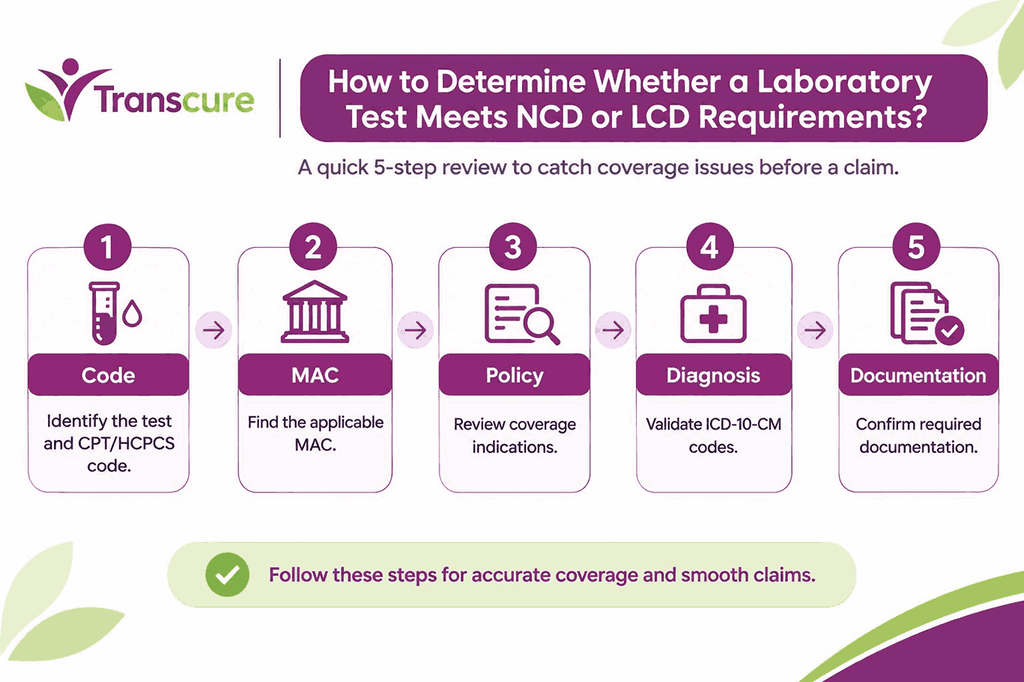
Step 1: Identify the Laboratory Test and CPT/HCPCS Code
Coverage review starts with the exact test and the code that describes it. Panels, single analytes, and PLA codes can fall under different policies. A lipid panel (80061) and a direct LDL test (83721) both sit under NCD 190.23. Each claim line is still checked on its own.
- Match the ordered test name to the test the lab actually performed.
- Verify the CPT or HCPCS code, including panel versus component billing.
- Check whether the code appears in a lab NCD or a local LCD.
- Pull the linked Billing and Coding Article for code-level rules.
Code choice decides which coverage policy applies, so accuracy here shapes every later step. Our laboratory CPT guide breaks down common lab code ranges, panel rules, and modifiers that billing teams confirm before checking diagnosis coverage.
Step 2: Identify the Applicable Medicare Administrative Contractor
The MAC that processes the claim decides which LCDs apply. For independent labs, claims generally go to the MAC covering the lab’s location, not the patient’s home address. Hospital outreach labs bill through the hospital’s MAC, so the same test can follow different local rules.
- Confirm which MAC processes claims for the billing lab or facility.
- Pull the active LCDs and articles published by that MAC.
- Check whether an NCD and an LCD both apply to the same code.
- Note any reference lab or specimen-collection arrangement that changes the billing party.
Step 3: Review Coverage Indications and Limitations
The coverage section of each policy tells the lab when a test is payable and when it is not. Billing staff read the indications first, then the limitations. A test can match a covered diagnosis and still fail because it exceeds a frequency limit or lacks required documentation.
Review these elements for every policy that applies to the test:
- Covered diagnoses and the clinical indications behind them.
- Non-covered diagnoses and uses, including routine screening.
- Frequency restrictions and the conditions that allow extra testing.
- Documentation the ordering provider must keep on file.
- Special circumstances or exceptions listed in the utilization guidelines.
Step 4: Validate ICD-10-CM Diagnosis Codes
The diagnosis on the claim must come from the ordering provider and support the test billed. Labs cannot invent a diagnosis to pass a coverage edit. They can translate a narrative diagnosis on the requisition into the correct ICD-10-CM code, coded to the highest specificity the record supports.
Unspecified codes create risk on lab claims. Many NCD tables cover a specific diabetes or thyroid code but list a vague symptom code as non-covered. When the order lacks a usable diagnosis, the lab should query the ordering office before release, not after a denial arrives.
- Match each diagnosis to the specific test line it supports.
- Check the code against covered and non-covered lists in the current quarter.
- Avoid generic codes when the record supports a more specific one.
- Confirm the code reflects the ordering provider’s documentation, not the test result.
Step 5: Verify Documentation Before Claim Submission
Documentation proves medical necessity if the MAC asks for records. Under 42 CFR 410.32, the ordering provider keeps the clinical notes, and the lab keeps the order. Both sets of records must agree on the test, the reason, and the date.
- A signed or authenticated physician order naming each test.
- Patient symptoms, clinical history, and relevant diagnoses.
- Previous lab results tied to the current order.
- A clinical reason for any repeat test inside a frequency window.
- Evidence the provider uses results to manage the patient.
Practical example: A lab in the Novitas jurisdiction receives an order for a lipid panel (80061). The patient had the same panel six weeks earlier. The billing team validates the order this way:
- The coder confirms 80061 falls under NCD 190.23 and LCD L35099.
- Claim history shows the prior panel falls inside the two-month frequency window.
- The team checks the LCD exceptions for unstable lipid-lowering drug dosing or adverse reactions.
- Progress notes show a statin dose change after muscle pain, which fits an exception.
- The coder confirms the supporting diagnosis code in the Billing and Coding Article.
- The claim goes out with the notes flagged for any additional documentation request.
Medicare Frequency Limitations for Laboratory Tests
A frequency limitation sets how often Medicare will pay for the same test on the same patient. Limits target repeat testing that adds little clinical value. MACs enforce them through automated claim edits that compare each date of service against prior paid claims for that patient.
Most limits are utilization guidelines, not absolute bans. A test above the limit is presumed unnecessary unless the record shows a clinical reason. The subsections below cover common limits, what happens when a test exceeds one, and how billing teams prevent frequency denials.
Common Laboratory Tests With Medicare Frequency Limitations
Novitas Solutions LCD L35099, Frequency of Laboratory Tests, is a widely cited example. It sets frequency limits for four analytes drawn from the lab NCDs. The LCD applies these limits per beneficiary, per provider, so a lab counts its own prior tests for each patient.
| Laboratory Test | Frequency Guideline in LCD L35099 | Exceptions That May Support Extra Testing |
|---|---|---|
| Lipid testing | No more than once every two months | Unstable lipid-lowering drug dosing, adverse drug reactions, pancreatitis, and certain drug monitoring |
| Thyroid testing | Up to four times a year for most patients | Unstable thyroid drug dosing, thyrotoxicosis, concurrent endocrinopathies, and hypothyroidism |
| Glucose testing | Once a month | Certain patients with diabetes who have hyperglycemia or related complications |
| HbA1c/glycated protein | Once a month | Unusual circumstances reviewed through the appeals process |
These limits come from one MAC’s policy, not a universal Medicare rule. Labs outside the Novitas jurisdictions must check their own MAC’s LCDs. The NCDs add context too. NCD 190.21 states that testing a controlled diabetic patient more often than every three months is generally not reasonable and necessary.
A monthly cap in an LCD is a ceiling, not a target. Routine monthly HbA1c tests on a stable patient can still fail review under the NCD. The safest reading combines both policies and asks whether the record explains the testing interval for this patient.
What Happens When a Laboratory Test Exceeds Medicare Frequency Limits?
A test billed above a frequency limit usually triggers an automated denial or a records request. The outcome depends on the MAC, the edit type, and whether documentation supports the repeat test. The table below shows the most common results for the lab.
| Outcome | What It Means for the Lab |
|---|---|
| Frequency edit denial | The claim line denies automatically, often with CARC 119 or 151. |
| Medical necessity denial | The MAC finds the test not reasonable and necessary, often CARC 50. |
| Additional documentation request | The MAC asks for records, usually with a 45-day response window. |
| Medical review or TPE | Repeated patterns can lead to targeted probe and educate reviews. |
| Patient liability | The lab can bill the patient only with a valid ABN and modifier GA. |
| Appeal | The lab can request a redetermination within 120 days of the notice. |
Justified repeat testing can still be paid on appeal. A strong redetermination request includes the order, the progress note explaining the repeat, prior results, and the LCD exception that applies. Labs that win these appeals often feed the lesson back into front-end checks.
How to Prevent Frequency-Related Laboratory Claim Denials?
Frequency denials are among the easiest lab denials to prevent before submission. Because many LCDs count per provider, the lab’s own patient history is the main data source. Practical billing controls include:
- Reviewing the date of the last paid test for each patient and code.
- Tracking repeat tests in the billing system with automatic interval alerts.
- Checking patient-specific history before releasing high-volume codes such as 80061 and 83036.
- Comparing each repeat test against current NCD and LCD frequency guidelines.
- Requesting the clinical reason from the ordering office when a repeat falls inside the window.
- Flagging tests that need extra documentation or an ABN before specimen processing.
Documentation Requirements to Establish Medical Necessity for Laboratory Tests
Documentation is what turns a coded claim into a defensible one during review. The four areas below cover what auditors check first when a MAC requests records for a lab service.
Physician Orders and Clinical Indications
Every Medicare lab claim needs a valid order from the treating physician or qualified practitioner. The order can be written, electronic, or a documented telephone order confirmed in writing. It must identify the patient and the specific tests requested.
- A valid order from a treating physician or authorized non-physician practitioner.
- Clear identification of each requested test, not a vague panel request.
- Relevant symptoms, diagnoses, or clinical findings supporting the order.
- The ordering provider’s NPI and an authentication method the MAC accepts.
Patient Medical Records
The ordering provider’s records carry most of the medical necessity burden. The lab rarely holds progress notes, but it must obtain them when the MAC asks. A record that only lists the test name does not show why the patient needed it.
- Relevant medical history and active problem list.
- Previous test results that prompted the current order.
- Clinical notes describing symptoms or treatment changes.
- Changes in the patient’s condition since the last test.
- Treatment monitoring needs, such as drug levels or dose adjustments.
Repeat Testing and Standing Orders
Repeat tests need their own clinical reason, even when an earlier order covers the same test. Medicare expects the record to show why the result is needed again at this interval. Prior necessity does not carry forward on its own.
Standing orders draw extra scrutiny. LCD L35099 states that standing orders are not acceptable documentation for covered lab services. Labs that accept them for chronic care should confirm each record shows ongoing need. Orders should also be renewed on a fixed schedule.
ICD-10-CM Diagnosis Documentation
The diagnosis code on the claim must match what the ordering provider documented. A coder who swaps in a covered code to pass an edit creates a false claim risk. When the record supports a more specific code, the lab should request a corrected order rather than guess.
Common Reasons Medicare Denies Laboratory Claims for Lack of Medical Necessity
Most medical necessity denials on lab claims trace back to six repeatable problems. Each one has a clear cause and a front-end fix. The table below links each denial reason to its usual adjustment code and prevention step.
| Denial Reason | Why It Happens | Common CARC | Prevention Step |
|---|---|---|---|
| Diagnosis does not support the test | The ICD-10-CM code is not on the covered list | 50 or 11 | Check codes against the current NCD table or article |
| Frequency limit exceeded | Repeat test lacks a documented clinical reason | 119 or 151 | Run interval checks before release |
| Missing physician order | No valid order is on file at review | 50 | Hold claims until the order is complete |
| Insufficient clinical documentation | Records do not show why the test was needed | 50 | Request progress notes for high-risk tests |
| Non-covered indication | The use falls outside policy coverage criteria | 50 | Flag before testing so an ABN can be issued |
| Screening billed as diagnostic | No symptoms support a diagnostic claim | 50 or 204 | Bill under the correct screening benefit or modifier |
These denials hit lab revenue harder than most specialties. Lab claims are high volume and low dollar, so rework often costs more than the test pays. Unresolved denials also age into accounts receivable, where follow-up costs rise, and timely filing limits close the door on recovery.
What Is an Advance Beneficiary Notice (ABN), and When Should Laboratories Use It?
An ABN, Form CMS-R-131, tells a Medicare patient that a service may not be covered before it happens. If Medicare then denies the test, a valid ABN lets the lab bill the patient. Without one, the lab usually absorbs the cost of a medical necessity denial.
Labs should issue an ABN when they expect Medicare to deny a test as not reasonable and necessary. Common triggers include a diagnosis outside the covered list or a repeat test beyond a frequency limit. The notice must be signed before the specimen is collected or tested.
| Modifier | Meaning | When Labs Use It |
|---|---|---|
| GA | Waiver of liability issued as required by payer policy | A valid ABN is on file for a test expected to fail medical necessity |
| GZ | Service expected to be denied as not reasonable and necessary | No ABN was obtained; the claim is denied, and the patient cannot be billed |
| GX | Notice of liability issued, voluntary under payer policy | A voluntary ABN was given for a statutorily excluded test |
| GY | Item or service statutorily excluded | The test is not a Medicare benefit, such as screening with no symptoms |
An ABN is a beneficiary notice, not a way to make an unnecessary test payable. It shifts financial liability only when completed correctly. Labs should avoid these common ABN mistakes:
- Using blanket ABNs signed for every patient regardless of coverage status.
- Leaving the specific test or the reason for expected denial blank.
- Collecting the signature after the specimen has already been drawn.
- Pairing GA with GY on the same line, which CMS treats as inappropriate.
How Laboratory Billing Teams Can Reduce Medical Necessity Denials?
Denial prevention works best as a fixed workflow, not a reaction to remittance data. The subsections below cover pre-submission controls, the balance between automation and coder review, and how these checks apply beyond Medicare.
Pre-Submission Controls That Prevent Denials
An experienced lab billing team checks coverage at accession, not after the denial. The strongest programs follow the same sequence on every claim:
- Review each lab order for completeness before claim creation.
- Check applicable NCD and LCD coverage criteria for every billed code.
- Validate CPT/HCPCS and ICD-10-CM combinations against current code lists.
- Monitor frequency limits using the lab’s own patient testing history.
- Identify missing clinical documentation on high-risk or repeat tests.
- Follow up with ordering providers when a diagnosis or order needs clarification.
- Review denial reasons and correct the root billing issue, not only the claim.
- Manage appeals and track recurring denial patterns by payer, code, and client.
How Automation and Billing Expertise Work Together
Automated edits catch coverage problems fast, and certified coders catch what edits miss. Rules engines can compare every claim against NCD code tables and frequency windows in seconds. Coders then review the exceptions, query ordering offices, and decide when an ABN or appeal is warranted.
Labs that outsource this work should compare how each partner handles coverage review. When evaluating laboratory billing companies, ask whether they check NCD and LCD criteria before submission. Also ask how they track frequency per patient and report denial trends by root cause.
Applying Coverage Checks Beyond Medicare
NCDs and LCDs are Medicare policies, and other payers set their own rules. Medicare Advantage plans must follow NCD and LCD coverage criteria, but commercial and Medicaid rules vary. The table below shows where requirements usually differ.
| Payer Type | Medical Necessity Source | What Labs Should Check |
|---|---|---|
| Traditional Medicare | NCDs, LCDs, and Billing and Coding Articles | Covered diagnoses, frequency limits, ABN rules |
| Medicare Advantage | NCDs and LCDs plus plan rules | Prior authorization and plan-specific edits |
| Medicaid | State Medicaid policy | State fee schedule limits and covered test lists |
| Commercial payers | Payer medical policies and lab benefit managers | Prior authorization, frequency edits, and molecular test rules |
How Transcure Supports Medical Necessity Compliance in Laboratory Billing?
Transcure checks medical necessity on every lab claim before submission. Certified lab coders work alongside AI agents to compare diagnosis codes against Medicare NCDs, LCDs, and payer policies. Tests that fall outside coverage are flagged early so the ordering office can collect an ABN.
- Lab-specific CPT, HCPCS, and PLA coding with ICD-10-CM validation through CODIN.
- NCD and LCD coverage verification and diagnosis-to-procedure matching.
- Claim scrubbing by CLAIR for NCCI, MUE, CLIA, and payer rules.
- Frequency checks against prior dates of service
- Denial sorting by root cause within 24 to 48 hours, with DEXA-drafted appeals.
- A/R follow-up by ARIA, prioritized by claim value and payer.
Across Transcure clients, typical results include a denial rate under 1% and a 98% first-pass clean claim rate. A/R averages 24 days. Labs that want coverage checks on every claim can learn more about our laboratory billing services and request a free audit.
Frequently Asked Questions About Medical Necessity for Laboratory Tests
What Is Medical Necessity for Laboratory Tests Under Medicare?
It means the test is reasonable and necessary to diagnose or treat a patient’s specific condition. The treating provider must order it and use the result in care. Coverage also depends on meeting any applicable NCD or LCD criteria.
What Is the Difference Between an NCD and an LCD?
CMS issues NCDs for nationwide use, while MACs issue LCDs for their own jurisdictions. An LCD can add local detail, such as frequency limits. It cannot contradict an NCD that applies to the same test.
How Do I Find the Applicable LCD for a Laboratory Test?
Search the CMS Medicare Coverage Database by test name, code, or policy number. Filter for the MAC that processes your claims. Then open the linked Billing and Coding Article to see covered ICD-10-CM codes.
Does Medicare Have Frequency Limits for Laboratory Tests?
Yes, many lab tests carry frequency limits set by NCDs or LCDs. LCD L35099, for example, limits lipid testing to once every two months for most patients. Limits vary by MAC and by test.
Can Medicare Cover Lab Tests Performed More Often Than LCD Guidelines Allow?
Yes, when the medical record documents a clinical reason that matches a listed exception. Unstable drug dosing and adverse drug reactions are common examples. Without that documentation, the extra test is usually denied.
What Documentation Is Required to Establish Medical Necessity?
The lab needs a valid order, and the ordering provider needs notes supporting the test. Records should show symptoms, diagnoses, prior results, and how the result guides care. Repeat tests need their own documented reason.
What Happens When a Laboratory Claim Fails an NCD or LCD Requirement?
Medicare denies the claim line, usually as not reasonable and necessary. The lab can bill the patient only if a valid ABN is on file. Otherwise, it can correct the claim or request a redetermination within 120 days.
When Should a Laboratory Issue an ABN?
A lab should issue an ABN before testing whenever it expects Medicare to deny the test. Common triggers include non-covered diagnoses and frequency limits. Blanket ABNs for every patient are not valid.
How Can Laboratories Prevent Medical Necessity Denials?
Labs prevent most denials by checking coverage before the claim is submitted. That review covers codes, diagnoses, frequency history, and documentation. Tracking denial patterns by root cause stops the same errors from repeating.