
Lab modifiers are two-character codes added to CPT or HCPCS laboratory codes to describe special billing circumstances. They tell the payer who performed a test, how often it ran, and which certificate covered it. One wrong modifier can turn a valid, medically necessary test into a denied claim.
The most common laboratory modifiers are 90, 91, 92, QW, 26, and TC. Labs also report 59, XU, and the ABN modifiers GA, GZ, GY, and GX. Each one has a narrow definition. The American Medical Association (AMA) or the Centers for Medicare & Medicaid Services (CMS) sets it.
This guide covers each modifier’s definition, Medicare rules, claim requirements, and billing examples. It also lists the modifier errors behind most lab denials and a simple audit process to catch them before submission.
What Are Lab Modifiers in Medical Billing?
Lab modifiers are reporting codes that add detail to a laboratory procedure code without changing its meaning. The base code describes the test itself. The modifier explains a circumstance, such as a same-day repeat, an outside lab, or a waived test kit.
Modifiers come from two code sets. Level I modifiers are numeric and published by the AMA in the CPT code book. Level II modifiers are alphanumeric and published by CMS in the HCPCS code set. Lab claims often carry both types on the same service line.
| Modifier Category | What It Does | Lab Examples |
|---|---|---|
| Pricing modifiers | Change how the service line is priced | 26, TC |
| Informational modifiers | Describe how or where the test was performed | 90, 91, 92 |
| Certification modifiers | Confirm the CLIA status of the test | QW |
| NCCI-associated modifiers | Bypass a bundling edit when services were distinct | 59, XU, 91 |
| Liability modifiers | Report ABN status and who pays after a denial | GA, GZ, GY, GX |
Modifiers sit inside the coding and charge capture stage of the lab revenue cycle. Coders attach them after selecting the CPT code and linking a diagnosis. For the full order-to-payment workflow, see our laboratory billing guide, which explains where coding fits among requisitions, claims, and follow-up.
Which Modifiers Are Used Most in Laboratory Billing?
The table below lists the modifiers lab billers report most often. The sections that follow explain each one in detail.
| Modifier | Descriptor | Code Set | Typical Lab Use |
|---|---|---|---|
| 90 | Reference (outside) laboratory | CPT | Referring lab bills a test another lab performed |
| 91 | Repeat clinical diagnostic laboratory test | CPT | Same test repeated the same day for new results |
| 92 | Alternative laboratory platform testing | CPT | Rapid HIV test run on a single-use kit |
| QW | CLIA-waived test | HCPCS | Waived test billed under a CLIA certificate |
| 26 | Professional component | CPT | Pathologist interpretation of a test |
| TC | Technical component | HCPCS | Lab’s technical work on a split pathology code |
| 59 | Distinct procedural service | CPT | Two bundled codes performed as separate services |
| XU | Unusual non-overlapping service | HCPCS | More specific alternative to modifier 59 |
| GA / GZ | Expected not reasonable and necessary, ABN on file / not on file | HCPCS | Frequency-limited or diagnosis-limited tests |
| GY / GX | Statutorily excluded, ABN not required / voluntary ABN issued | HCPCS | Tests Medicare never covers, such as routine screening without a benefit |
| 33 | Preventive services | CPT | ACA preventive test with no patient cost sharing |
| AY | ESRD patient, service not for treatment of ESRD | HCPCS | Lab test for a dialysis patient unrelated to ESRD |
When Should a Lab Use Modifier 91?
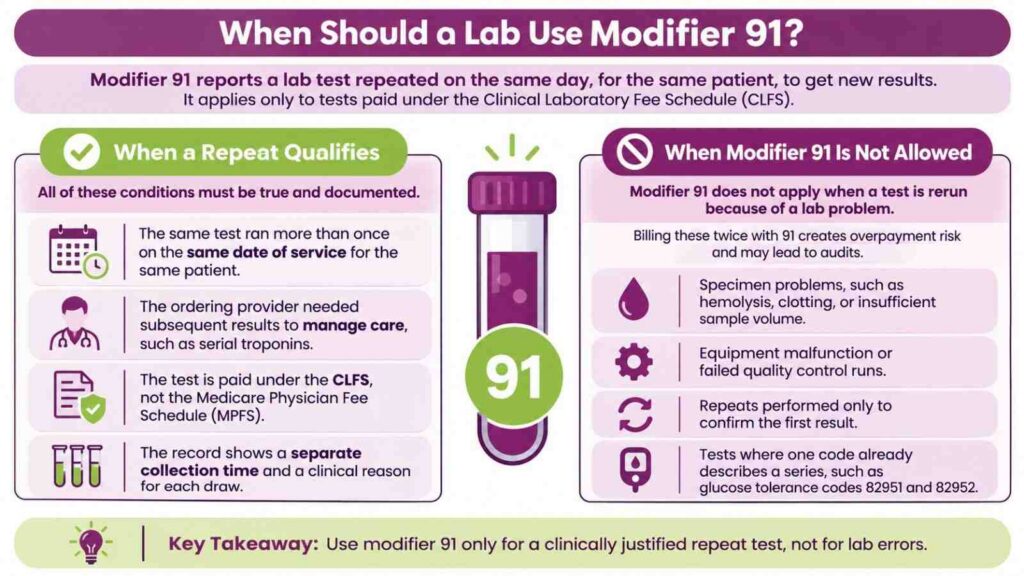
Modifier 91 reports a lab test repeated on the same day, for the same patient, to get new results. CMS sets the rule in the Medicare Claims Processing Manual, Chapter 16, Section 100.5.1. The modifier applies only to tests paid under the Clinical Laboratory Fee Schedule (CLFS).
Three questions decide whether a repeat test qualifies for modifier 91, and the subsections below answer each one with examples.
What Conditions Must a Modifier 91 Repeat Meet?
A repeat test qualifies for modifier 91 only when every condition below is true and documented.
- The same test ran more than once on the same date of service for the same patient.
- The ordering provider needed subsequent results to manage care, such as serial troponins during chest pain workups.
- The test is paid under the CLFS, not the Medicare Physician Fee Schedule (MPFS).
- The record shows a separate collection time and a clinical reason for each draw.
When Is Modifier 91 Not Allowed?
Modifier 91 does not apply when a test is rerun because of a lab problem. Payers treat these reruns as part of the original service. Billing them twice with 91 creates overpayment exposure and invites audits.
- Specimen problems, such as hemolysis, clotting, or insufficient sample volume
- Equipment malfunction or failed quality control runs
- Repeats performed only to confirm the first result
- Tests where one code already describes a series, such as glucose tolerance codes 82951 and 82952
How Is a Repeated Panel Component Billed?
Report the full panel once, then bill the repeated component separately with modifier 91. The NCCI Policy Manual, Chapter 10, pairs panel codes with their component codes. Modifier 91 bypasses that edit when the repeat was medically necessary.
| Collection Time | Service | Code Billed |
|---|---|---|
| 7:00 AM | Comprehensive metabolic panel | 80053 |
| 3:00 PM | Repeat glucose for insulin adjustment | 82947-91 |
| 8:00 AM | Initial troponin, chest pain workup | 84484 |
| 11:00 AM | Second troponin | 84484-91 |
| 2:00 PM | Third troponin | 84484-91 |
Modifier 91 vs 59 vs 76: Which One Applies?
Labs often confuse three repeat and distinct-service modifiers. The table shows which one fits a lab test.
| Modifier | What It Reports | Use on Lab Tests? |
|---|---|---|
| 91 | Same CLFS test repeated on the same day | Yes, the first choice for repeat tests |
| 59 | Two different bundled codes performed as distinct services | Yes, for different codes only |
| 76 | Repeat procedure by the same physician | No, Noridian directs labs to report 91 instead |
Choose the most specific modifier that fits the facts. A repeated lab test is a 91 situation every time. Modifier 59 says only that services were distinct, which invites reviewers to ask how.

How Does Modifier 90 Work for Reference Lab Billing?
Modifier 90 identifies a test that one laboratory referred out and another laboratory performed. Under Medicare, the referring lab may bill for that test only in limited situations. CMS sets these rules in the Claims Processing Manual, Chapter 16, Section 40.1.
The subsections below cover who qualifies to bill referred tests, what the claim must show, and how commercial payers differ.
Which Medicare Exceptions Let a Referring Lab Bill?
A referring lab may bill Medicare for a referred CLFS test only when it meets one of three conditions. If none applies, the referring lab must bill Medicare directly.
- Rural hospital: The referring lab is located in, or is part of, a rural hospital.
- Ownership relationship: One lab wholly owns the other, or a third entity wholly owns both labs.
- 30 percent rule: The referring lab sends no more than 30 percent of its annual test requests to non-related labs.
Worked example: A lab receives 200 test requests, performs 139, and refers 61 to an unrelated lab. That equals 30.5 percent, so it cannot bill any referred Medicare tests. If 15 of those 61 went to a related lab, the non-related share drops to 23 percent. Billing is then allowed.
What Must a Modifier 90 Claim Include?
Medicare returns a referred test claim as unprocessable when modifier 90 is missing. Every referred line must carry the elements below.
- Modifier 90 on each referred line item
- The reference lab’s CLIA number at the line level
- The performing lab’s name and address in Item 32 of the CMS-1500 or Loop 2310C of the 837P
- Independent laboratory enrollment, specialty code 69, for the billing lab
In-house tests and referred tests can share one claim. Modifier 90 at the line level tells the contractor which tests came from the outside lab. Medicare pays the lowest of the billed charge, the fee schedule amount, or the national limitation amount.
How Do Commercial Payers Treat Modifier 90?
Commercial rules on modifier 90 vary more than Medicare rules. Some plans pay referred tests only to independent labs and deny physician offices. Others require the performing lab to bill directly under its own contract. Check each payer’s lab policy before billing a referred test.
Physician offices face the tightest limits. Medicare does not let a physician bill for a test sent to an outside lab. The reference lab bills Medicare itself, so modifier 90 never appears on the physician’s Medicare claim.
What Is the QW Modifier for CLIA-Waived Tests?
Modifier QW tells Medicare that a lab test is CLIA-waived and was performed under a valid certificate. The Food and Drug Administration (FDA) decides which tests qualify as waived. CMS then edits lab claims against the Clinical Laboratory Improvement Amendments (CLIA) certificate on file.
The subsections below explain certificate types, the waived codes that skip QW, and the claim data Medicare expects.
Which CLIA Certificate Types Affect Lab Billing?
A lab can bill only the test complexity its CLIA certificate allows. The certificate type also decides how often QW appears on claims.
| CLIA Certificate | Tests Allowed | Modifier Note |
|---|---|---|
| Certificate of Waiver | Waived tests only | QW required on most waived codes |
| Provider-Performed Microscopy (PPM) | PPM procedures plus waived tests | QW still applies to waived tests |
| Certificate of Registration | Moderate and high complexity, pending survey | QW only on waived tests |
| Certificate of Compliance | Moderate and high complexity | QW only on waived tests |
| Certificate of Accreditation | Moderate and high complexity, accredited | QW only on waived tests |
Which Waived Tests Do Not Need QW?
CMS lists nine waived CPT codes that Medicare recognizes without the QW modifier. Adding QW to these codes is not needed.
- 81002: Urinalysis, non-automated, without microscopy
- 81025: Urine pregnancy test, visual color comparison
- 82270 and 82272: Fecal occult blood tests
- 82962: Glucose, blood, by FDA-cleared monitoring device
- 83026: Hemoglobin by copper sulfate method
- 84830: Ovulation test, visual color comparison
- 85013: Spun microhematocrit
- 85651: Sedimentation rate, non-automated
What Claim Data Does a QW Line Need?
A QW line needs the modifier, a matching waived device, and the lab’s CLIA number. Missing any one of these triggers a CLIA rejection. The checklist below covers each element.
- QW in the first modifier position, as Palmetto GBA and other MACs instruct
- The CLIA number in Item 23 of the CMS-1500 or Loop 2300 REF X4 of the 837P
- A CPT code that appears on the current CMS waived test list for that exact device
- An active certificate that covers the date of service
CMS updates the waived test list as often as quarterly through change requests. One manufacturer’s kit can be waived while another kit under the same CPT code is not. For example, a clinic running a waived rapid strep kit bills 87880-QW.
When Is Modifier 92 Used for Alternative Laboratory Platform Testing?
Modifier 92 identifies a lab test run on a kit or transportable instrument with a single-use, disposable analytical chamber. The AMA created it for rapid HIV testing. CPT lists it with HIV antibody codes 86701-86703 and HIV antigen-antibody code 87389.
The kit needs no permanent dedicated space and can be carried to the patient. Testing location alone does not decide whether modifier 92 applies. The design of the device does.
| Scenario | Correct Coding |
|---|---|
| Rapid HIV-1/HIV-2 antibody kit used at a community clinic | 86703-92 |
| Same HIV-1/HIV-2 antibody test run on a fixed lab analyzer | 86703 (no modifier 92) |
| Rapid HIV kit that is also CLIA-waived | 86703-92, plus QW where the payer requires it |
State Medicaid agencies set their own rules on modifier 92. Confirm the policy with each state plan before billing rapid HIV tests.
How Do Modifiers 26 and TC Apply to Lab and Pathology Codes?
Most clinical lab tests are technical-only services and take neither 26 nor TC. These codes pay under the CLFS with no physician component. Modifiers 26 and TC belong on codes the MPFS splits into professional and technical portions.
Two groups of codes use this split: a short list of clinical lab interpretation services and most anatomic pathology codes.
Which Clinical Lab Tests Allow a Modifier 26 Interpretation?
Medicare pays a pathologist’s interpretation for about 20 clinical lab tests listed in Claims Processing Manual Chapter 12. The lab bills the unmodified code under the CLFS. The pathologist bills the same code with 26 under the MPFS.
| CPT Code | Test | Professional Billing |
|---|---|---|
| 83020 | Hemoglobin electrophoresis | 83020-26 |
| 84165, 84166 | Protein electrophoresis, serum and other fluids | 84165-26, 84166-26 |
| 84181, 84182 | Western blot | 84181-26, 84182-26 |
| 85390, 85576 | Fibrinolysins screen, platelet aggregation | 85390-26, 85576-26 |
| 86255, 86256 | Fluorescent noninfectious agent antibody | 86255-26, 86256-26 |
| 86320-86335 | Immunoelectrophoresis and immunofixation | 86334-26, for example |
| 87164, 87207 | Dark field exam, special stain smear | 87207-26, for example |
| 89060 | Crystal identification | 89060-26 |
TC never applies to these codes. The unmodified code already represents the technical service, so adding TC duplicates it.
How Are Anatomic Pathology Codes Split?
Surgical pathology codes 88300-88309 carry both components. A lab that performs the full service bills the code with no modifier. When one entity prepares slides and another reads them, each bills its own share.
| Scenario | Lab Bills | Pathologist Bills |
|---|---|---|
| Independent lab processes and reads 88305 | 88305 (global, no modifier) | Nothing separate |
| Lab processes, outside pathologist reads | 88305-TC | 88305-26 |
| Pathologist reads slides prepared elsewhere | Not applicable | 88305-26 |
Codes that describe only a physician service, such as 85060 and 88141, never take 26. Check the PC/TC indicator in the Medicare Physician Fee Schedule before adding either modifier.
When Do Modifiers 59 and XU Apply to Lab Services?
Modifiers 59 and XU tell the payer that two bundled codes were truly separate services. The National Correct Coding Initiative (NCCI) pairs codes that should not normally be billed together. A modifier can bypass that pair only when the edit carries a modifier indicator of 1.
The subsections below cover NCCI edits, the X modifiers, and the payer limits labs run into most often.
How Do NCCI Edits Affect Lab Codes?
NCCI uses two edit types that catch lab claims. Each one responds to modifiers differently.
- Procedure-to-procedure (PTP) edits bundle panel codes with their component tests.
- Medically Unlikely Edits (MUEs) cap the units billed per code per date of service.
- A PTP modifier indicator of 0 blocks every modifier from bypassing the edit.
- A PTP modifier indicator of 1 allows 59, an X modifier, or 91 with supporting records.
Panel rules cause most lab bundling denials. When a lab runs every test in a panel, it must bill the panel code. Our laboratory CPT guide lists the panel codes and their components by category.
Should Labs Use XU Instead of 59?
CMS prefers the most specific X modifier over 59 when one fits. CMS added XE, XP, XS, and XU on January 1, 2015, as subsets of modifier 59. XU fits most lab cases because it describes a non-overlapping service.
| X Modifier | Meaning | Lab Example |
|---|---|---|
| XE | Separate encounter | Test drawn at a separate visit on the same day |
| XS | Separate structure | Second surgical pathology specimen from a different organ |
| XP | Separate practitioner | Rare in lab billing |
| XU | Unusual non-overlapping service | Distinct test that does not overlap the main service |
What Payer Limits Apply to Modifier 59 on Lab Claims?
Some commercial payers no longer accept 59 on lab codes at all. Others pay it only when records are attached. A repeat of the same test always calls for 91, never 59. Review each contract’s modifier policy before appeals pile up.
Which ABN Modifiers Apply to Laboratory Tests?
ABN modifiers tell Medicare whether the lab gave the patient an Advance Beneficiary Notice of Noncoverage (ABN). They also decide who owes payment after a denial. Labs issue the ABN, form CMS-R-131, before testing when Medicare will likely deny a test as not reasonable and necessary.
| Modifier | Meaning | Who Pays if Denied |
|---|---|---|
| GA | Expected not reasonable and necessary, ABN on file | Patient |
| GZ | Expected not reasonable and necessary, no ABN on file | Lab |
| GY | Statutorily excluded, ABN not required | Patient |
| GX | Statutorily excluded, voluntary ABN issued | Patient |
Lab tests dominate these modifiers. An HHS Office of Inspector General review found that 51 percent of paid GA claims were for lab tests. About three-quarters of paid GZ claims were lab tests too.
Medical necessity depends on the diagnosis code as much as the modifier. Check the ordering diagnosis against the NCD or LCD covered list before deciding on an ABN. Our lab ICD-10 guide covers the diagnosis codes payers accept for common tests.
Keep these ABN modifier rules in mind on every Medicare lab claim:
- GA lines go out as covered so Medicare can make a payment decision.
- GX with GY is the only G modifier pair the OIG considers appropriate on one claim.
- Frequency limits, such as a repeat lipid panel ordered too soon, are the most common ABN trigger.
- Many Medicare Advantage plans do not recognize these modifiers and use pre-service organization determinations instead.
- Blanket ABNs signed for every test are not valid notices.
Which Other Modifiers Appear on Lab Claims?
A few lower-volume modifiers still matter for specific lab settings and payers.
| Modifier | Meaning | When Labs Use It |
|---|---|---|
| 33 | Preventive services | ACA preventive tests with no cost sharing, mostly on commercial plans |
| AY | ESRD patient, service not for treatment of ESRD | Tests for dialysis patients billed outside ESRD consolidated billing |
| Q1 | Routine clinical service in an approved clinical research study | Routine labs for a patient in a qualifying clinical trial |
| KX | Requirements of the medical policy were met | Some payer policies for molecular and genetic tests |
| L1 | Separately payable lab test (retired) | Do not report, deleted in the CY 2017 OPPS final rule |
Watch older hospital chargemasters for L1. CMS eliminated the modifier for 2017, yet some systems still hard-code it. A claim carrying L1 today signals an outdated charge setup.
How Should Lab Modifiers Be Sequenced on a Claim?
Place pricing modifiers first, then informational modifiers. Pricing modifiers such as 26 and TC change the payment amount, so payers read them first. Use this general order unless a payer publishes a different one.
- Pricing modifiers: 26 or TC
- Certification modifiers: QW, which several MACs require in the first field when no pricing modifier applies
- Service-detail modifiers: 90, 91, 92, 59, or XU
- Liability modifiers: GA, GZ, GY, or GX
The CMS-1500 holds four modifiers per line in Item 24D. The 837P also allows four per service line. Follow each MAC’s published order when it differs from this sequence.
What Are the Most Common Lab Modifier Errors?
Most modifier denials trace back to a short list of repeat mistakes. The table pairs each error with its likely result and fix.
| Error | Likely Result | Fix |
|---|---|---|
| QW missing on a waived test from a waived lab | CO-B7, provider not certified for the service | Add QW and confirm the device is on the CMS list |
| CLIA number missing or invalid | Rejection with remark MA120 | Report the CLIA number in Item 23 or Loop 2300 |
| Same-day repeat billed without 91 | CO-18, duplicate claim | Add 91 with separate collection times |
| 91 used for a rerun after equipment failure | Overpayment and audit risk | Bill the test once |
| Modifier 90 missing on a referred test | Claim returned as unprocessable | Add 90 and the reference lab’s CLIA number |
| 59 on a panel component with indicator 0 | CO-97, bundled service | Bill the panel code only |
| 26 on a technical-only CLFS code | CO-4, modifier inconsistent with code | Remove 26 |
| GZ reported when a signed ABN exists | Lab absorbs the loss | Change to GA and file the ABN |
How Can Labs Audit Modifier Use Before Claims Go Out?
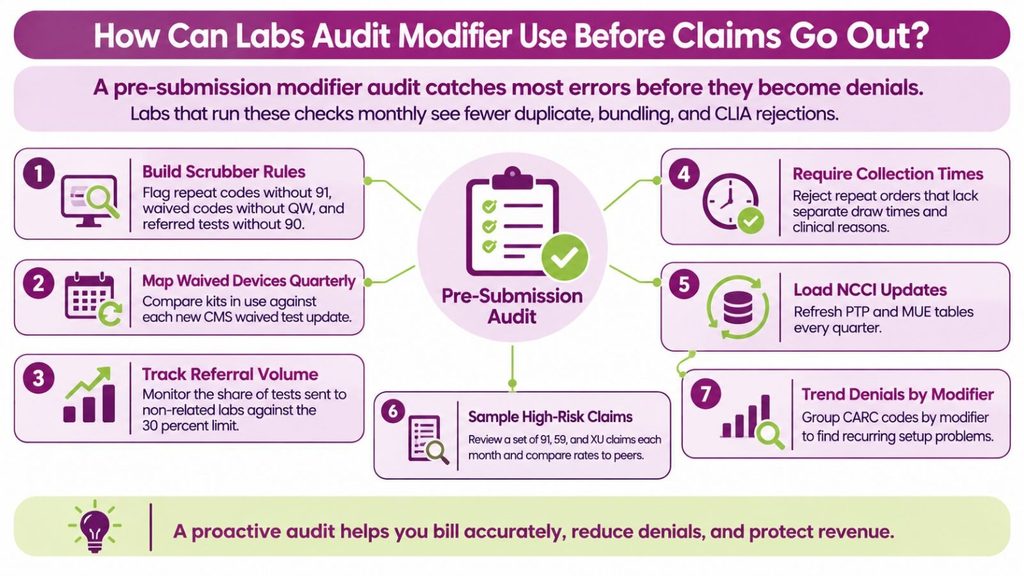
A pre-submission modifier audit catches most errors before they become denials. Labs that run these checks monthly see fewer duplicate, bundling, and CLIA rejections.
- Build scrubber rules: Flag repeat codes without 91, waived codes without QW, and referred tests without 90.
- Map waived devices quarterly: Compare kits in use against each new CMS waived test update.
- Track referral volume: Monitor the share of tests sent to non-related labs against the 30 percent limit.
- Require collection times: Reject repeat orders that lack separate draw times and clinical reasons.
- Load NCCI updates: Refresh PTP and MUE tables every quarter.
- Sample high-risk claims: Review a set of 91, 59, and XU claims each month and compare rates to peers.
- Trend denials by modifier: Group CARC codes by modifier to find recurring setup problems.
Labs without in-house coding staff often hand this work to outside specialists. Our review of laboratory billing companies compares vendors on coding audits, denial rates, and lab-specific experience.
How Does Transcure Handle Lab Modifier Accuracy?
Transcure’s certified lab coders check every modifier against payer rules before a claim leaves the system. Our CODIN agent flags code and modifier mismatches during coding. CLAIR, our claims scrubbing agent, catches missing CLIA numbers, absent 90 modifiers, and NCCI conflicts before submission.
Our lab billing team covers each modifier risk point named in this guide:
- Documentation review for modifier 91 and 59 claims
- CLIA certificate and QW checks for each date of service
- Referral tracking for modifier 90 and the 30 percent rule
- ABN tracking and correct G modifier assignment
- Denial management and appeals for modifier-related rejections
Labs that want fewer modifier denials can hand the full revenue cycle to our team. Our laboratory billing services support independent, reference, and hospital outreach labs with a 98 percent first-pass clean claim rate.
Frequently Asked Questions About Lab Modifiers
What Are Lab Modifiers?
Lab modifiers are CPT or HCPCS codes appended to lab procedure codes to explain special circumstances. Common examples are 90 for reference labs, 91 for repeat tests, and QW for CLIA-waived tests.
What Is the Difference Between Modifier 90 and Modifier 91?
Modifier 90 means another lab performed the test, while modifier 91 means the same test was repeated the same day. Modifier 90 concerns who performed the work. Modifier 91 concerns how many times it ran.
Can Modifier 59 Replace Modifier 91 for Repeat Lab Tests?
No, a same-day repeat of the same lab test calls for modifier 91. Modifier 59 is for two different codes that NCCI bundles. Using 59 on a repeat test invites denials and audits.
Does Every CLIA-Waived Test Need the QW Modifier?
No, nine waived codes do not need QW. These are 81002, 81025, 82270, 82272, 82962, 83026, 84830, 85013, and 85651. All other waived tests need QW on Medicare claims.
Can a Physician Office Bill Modifier 90 to Medicare?
No, Medicare does not let a physician office bill for tests sent to an outside lab. The reference lab must bill Medicare directly. Some commercial payers follow the same rule.
When Should a Lab Use GA Instead of GZ?
Use GA when the patient signed a valid ABN before the test. Use GZ when Medicare will likely deny the test and no ABN exists. With GZ, the lab cannot bill the patient.
Is Modifier L1 Still Valid for Hospital Lab Billing?
No, CMS deleted modifier L1 in the CY 2017 OPPS final rule. Hospitals should remove it from charge masters and claim templates. Reporting it today signals an outdated billing setup.