
Laboratory billing denials are payer decisions to refuse payment on a processed lab claim, either in full or for specific test lines. They affect clinical, molecular, pathology, and toxicology labs whenever orders, codes, and coverage rules do not match. Most lab denials trace back to gaps that billers can fix.
The top causes include unmet medical necessity, incomplete requisitions, eligibility errors, CLIA certificate mistakes, and NCCI bundling edits. Frequency limits, missing prior authorization, absent MolDX Z-Codes, duplicate claims, and timely filing lapses complete the list. Each cause leaves a specific denial code on the electronic remittance advice (ERA).
This guide explains every major denial reason with its common CARC and RARC codes. It also covers the step-by-step fix for denied lab claims and the Medicare appeal levels. Prevention controls by revenue cycle stage and the KPIs lab billers should review monthly close the guide.
What Are Laboratory Billing Denials?
A laboratory billing denial is a claim the payer processed and refused to pay in full or in part. The payer explains it with Claim Adjustment Reason Codes (CARCs) and Remittance Advice Remark Codes (RARCs). Denials are an unavoidable part of the wider laboratory billing workflow, from test order to final payment.
Three questions shape how a lab should respond to any denial. The sections below cover how denials differ from rejections, how often lab claims are denied, and why lab claims carry more risk than physician claims.
How Do Lab Claim Denials Differ From Rejections?
A rejection happens before adjudication, while a denial happens after the payer processes the claim. Clearinghouse and payer front-end edits reject claims with formatting errors, invalid NPIs, or missing CLIA numbers. A rejected claim never enters the payer system, so the lab corrects it and submits it again.
| Factor | Rejection | Soft Denial | Hard Denial |
|---|---|---|---|
| When it happens | Before adjudication | After adjudication | After adjudication |
| Common cause | Invalid format or missing ID fields | Missing data, coding error, or missing records | Non-covered test, expired filing limit, or no authorization |
| Fix path | Correct and submit as a new claim | Corrected claim, reopening, or records submission | Formal appeal or write-off |
| Revenue at risk | Low when fixed quickly | Recoverable with correct data | Often lost without a strong appeal |
Soft denials make up most lab denials and are usually recoverable. Hard denials, such as a non-covered service or an expired filing limit, need a formal appeal or end as write-offs. Classifying the denial type first stops billers from appealing claims that only need a simple correction.
How Common Are Denials in Clinical, Molecular, and Pathology Labs?
Denial rates vary sharply by lab segment. XiFin’s 2025 Payor Denial Impact Report sampled over 20 million claims with 2024 dates of service. The overall denial rate fell from 9.9% in 2023 to 8.0% in 2024. Molecular claims were still denied about five times as often as clinical claims.
| Lab Segment | Billed CPT Codes Denied (2023) | Billed CPT Codes Denied (2024) |
|---|---|---|
| Clinical and hospital outreach labs | 19.3% | 6.5% |
| Molecular diagnostic labs | 35.3% | 32.9% |
| Anatomic pathology labs | 10.8% | 5.5% |
The same report found that “procedure not paid separately” caused over 53% of clinical lab denials. Duplicate denials made up almost 20% of clinical and molecular denials. Non-contracted payers denied up to 22.7% of claims, compared with about 7% for contracted payers.
Why Do Laboratory Claims Deny More Often Than Physician Claims?
Labs rarely see the patient, yet they carry full billing responsibility for every test. The ordering provider controls the diagnosis, the clinical documentation, and often the insurance details. Any gap on the requisition becomes the lab’s denial, even when the test itself was performed correctly.
- Secondhand data: Demographics, insurance, and diagnosis codes come from the ordering office, not from the lab.
- High volume, low dollar value: Thousands of small claims make manual review of each denial expensive.
- Test-level coverage rules: NCDs, LCDs, and MolDX policies tie payment to specific diagnoses and frequency limits.
- Complex code sets: Panels, PLA codes, Z-Codes, and drug testing codes each carry their own payer edits.
What Are the Top Reasons for Laboratory Billing Denials?
Twelve denial reasons account for most lost revenue across clinical, molecular, pathology, and toxicology labs. The table maps each reason to its usual denial codes, and the sections after it explain the cause and the fix.
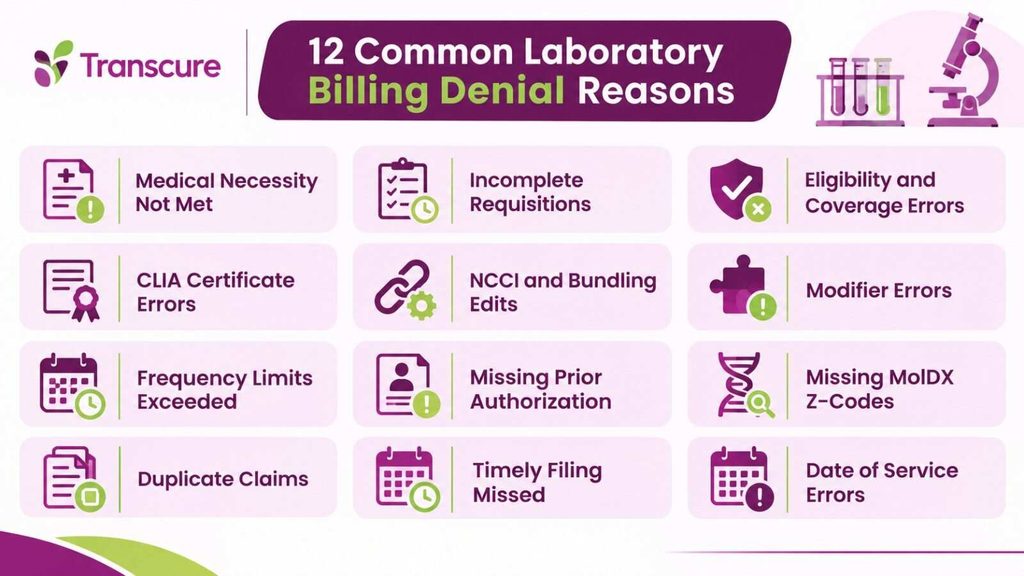
| # | Denial Reason | Common CARC/RARC | Labs Most Affected |
|---|---|---|---|
| 1 | Medical necessity not met | CO-50, CO-11, CO-167 | Clinical, molecular, toxicology |
| 2 | Incomplete or inaccurate requisition | CO-16 with N264, N265, or MA130 | All lab types |
| 3 | Eligibility and coverage errors | CO-27, CO-31, CO-22, CO-109 | Reference and outreach labs |
| 4 | CLIA certificate and modifier QW errors | CO-B7, MA120 | Physician office and clinical labs |
| 5 | Bundling, NCCI, and MUE edits | CO-97, CO-236, CO-151 with N362 | Clinical and pathology labs |
| 6 | Modifier errors | CO-4 | Clinical and pathology labs |
| 7 | Frequency limits exceeded | CO-119, CO-151 | Clinical and toxicology labs |
| 8 | Missing prior authorization | CO-197, CO-15 | Molecular and genetic labs |
| 9 | Missing or invalid MolDX Z-Code | CO-16 with MolDX remarks | Molecular labs |
| 10 | Duplicate claims | CO-18 | All lab types |
| 11 | Timely filing limit missed | CO-29 | All lab types |
| 12 | Date of service and 14-day rule errors | Varies by payer and MAC | Hospital outreach and molecular labs |

1. Medical Necessity Not Met
Medical necessity denials happen when the submitted diagnosis does not support the ordered test under payer policy. Medicare checks lab claims against National Coverage Determinations (NCDs) and Local Coverage Determinations (LCDs). Commercial payers apply their own clinical policies, which often mirror Medicare criteria.
A common mistake is billing a screening test with a diagnostic code, or the reverse. Unspecified ICD-10-CM codes also fail coverage edits that require a specific condition. CO-50 signals a non-covered service, CO-11 flags a diagnosis inconsistent with the procedure, and CO-167 means the diagnosis is not covered.
How to fix it:
- Check each CPT and ICD-10-CM pair against the applicable NCD, LCD, and billing and coding article before release.
- Query the ordering provider for a more specific diagnosis that the medical record supports.
- Collect an Advance Beneficiary Notice of Noncoverage (ABN) before testing when a Medicare denial is expected.
- Resubmit with the corrected diagnosis, or appeal with progress notes that show clinical intent.
Diagnosis selection sits at the root of most coverage edits. Palmetto GBA found that over 80% of lab billing errors relate to clinical decision-making in the medical record, not coding. Our lab ICD-10 guide lists the diagnosis codes payers most often accept for common laboratory tests.
2. Incomplete or Inaccurate Requisitions
The test requisition is the source document for every field on a lab claim. Missing ordering provider NPIs, diagnosis codes, collection dates, or insurance details lead straight to CO-16 denials. Remark codes N264 and N265 point to a missing or invalid ordering provider name or identifier.
Medicare also requires the ordering provider to be enrolled in PECOS, the Provider Enrollment, Chain, and Ownership System. Unsigned orders and illegible signatures fail medical review even when the claim pays at first. Requisitions from newly onboarded client offices often need the closest review.
How to fix it:
- Review every requisition at accessioning, before the specimen is processed.
- Hold orders missing an NPI, diagnosis, or signature, and contact the client office the same day.
- Verify ordering provider enrollment in PECOS for Medicare patients.
- Track requisition error rates by client account and share monthly feedback with high-error offices.
3. Eligibility and Coverage Errors
Eligibility denials occur when coverage was inactive, the member ID was wrong, or another payer was primary. Reference labs face this risk often because insurance data arrives secondhand from the ordering office. CO-27 indicates terminated coverage, CO-31 means the patient cannot be identified, and CO-22 points to coordination of benefits.
CO-109 appears when the claim went to the wrong payer, such as Original Medicare instead of a Medicare Advantage plan. Managed Medicaid plans and narrow lab networks add another layer. Some health plans contract only with national reference labs, which turns an out-of-network claim into a denial.
How to fix it:
- Run real-time eligibility checks (270/271 transactions) on every accession, not only new patients.
- Confirm Medicare Advantage enrollment before billing Original Medicare.
- Capture secondary insurance and the coordination of benefits order at intake.
- Verify the lab’s network status with each plan before accepting specimens.
4. CLIA Certificate and Modifier QW Errors
Every lab that tests human specimens needs a Clinical Laboratory Improvement Amendments (CLIA) certificate. The 10-character CLIA number goes in Item 23 of the CMS-1500 or in the REF*X4 segment of the 837P. Claims missing the number are denied with RARC MA120, while certificate mismatches return CO-B7.
CO-B7 also appears when a test falls outside the lab’s certificate type. A lab holding a Certificate of Waiver cannot bill moderate or high complexity tests. Modifier QW errors cut both ways, since payers deny waived tests missing QW and also deny QW on codes that do not need it.
| CLIA Certificate Type | Tests Allowed | Common Denial Trigger |
|---|---|---|
| Certificate of Waiver | Waived tests only | Billing non-waived tests or missing modifier QW |
| Certificate for Provider-Performed Microscopy | Waived tests plus specific microscopy procedures | Billing moderate complexity tests outside the PPM list |
| Certificate of Compliance | Waived, moderate, and high complexity tests | Expired certificate or wrong CLIA number on the claim |
| Certificate of Accreditation | Waived, moderate, and high complexity tests | Lapsed accreditation or performing location mismatch |
How to fix it: Match each claim to the CLIA number of the location that performed the test. Check the CMS list of waived tests for the test system and date of service, because not every waived code needs QW. Track certificate renewal dates so an expired certificate never stops payment.
5. Bundling, NCCI, and MUE Edits
Bundling denials happen when the payer treats a billed test as part of another service it already paid. The National Correct Coding Initiative (NCCI) lists laboratory panel edits in Chapter 10 of its Policy Manual. Billing every component of the 80053 metabolic panel separately, for example, triggers procedure-to-procedure edits.
Medically Unlikely Edits (MUEs) cap the units a payer allows per test per day. Units above the MUE often deny with CO-151 and RARC N362. CO-97 means the benefit is included in another adjudicated service, and CO-236 flags a code pair that NCCI does not allow together.
How to fix it:
- Load the current quarterly NCCI and MUE tables into the claim scrubber.
- Bill the panel code when all components were performed, and report tests outside the panel separately.
- Split units across lines only when documentation supports separate specimens or repeat testing.
- Review “procedure not paid separately” denials by CPT code to find recurring panel errors.
Correct panel coding starts with correct code selection. The laboratory CPT guide breaks down panel, chemistry, pathology, and molecular codes with the billing rules for each.
6. Modifier Errors on Repeat, Reference, and Pathology Tests
Modifier errors return CO-4, meaning the procedure is inconsistent with the modifier or a required modifier is missing. Labs most often misapply modifiers 91, 59, 90, 26, TC, and QW. Each one tells the payer something different about how and where the test was performed.
| Modifier | Meaning | Correct Lab Use | Common Error |
|---|---|---|---|
| 91 | Repeat clinical diagnostic lab test | Same test repeated the same day to get subsequent results | Using it for reruns caused by specimen or equipment problems |
| 59 | Distinct procedural service | Separate specimens or sites, such as cultures from different wounds | Using it in place of 91 for repeat tests |
| 90 | Reference (outside) laboratory | Test sent to an outside lab and billed by the referring lab where the payer allows | Leaving it off a referred test |
| 26 | Professional component | Pathologist interpretation only | Billing global when the lab did only one component |
| TC | Technical component | Specimen processing and slide preparation only | Missing TC in split billing arrangements |
| QW | CLIA-waived test | Waived test systems that require the modifier | Adding it to non-waived or exempt codes |
CMS limits modifier 91 to tests paid under the Clinical Laboratory Fee Schedule (CLFS). The Medicare Claims Processing Manual, Chapter 16, Section 100.5.1, bars its use for reruns that confirm results or fix testing problems. Modifier 76 does not bypass NCCI edits, so 91 stays the correct repeat modifier for lab codes.
7. Frequency Limits Exceeded
Frequency denials occur when a test is billed more often than payer policy allows within a set period. NCD 190.21 for glycated hemoglobin, for example, generally covers testing no more than once every three months for controlled diabetes. Shorter intervals need documented clinical reasons, such as a medication change.
CO-119 signals a benefit maximum reached, while CO-151 means the payer finds the frequency unsupported. Frequency limits apply per patient, not per lab. A test done at another lab last month can push your claim over the limit with no warning in your own data.
How to fix it:
- Flag tests with known NCD or LCD frequency limits in the claim scrubber.
- Check prior test dates in the LIS before releasing the claim.
- Request progress notes that explain the clinical need for the repeat test.
- Issue an ABN when frequency limits make a Medicare denial likely.
8. Missing Prior Authorization
Prior authorization denials hit molecular, genetic, and some high-cost clinical tests hardest. Many commercial plans route genetic testing reviews to lab benefit managers such as Avalon Healthcare Solutions, Carelon, or EviCore. CO-197 means authorization was absent, and CO-15 means the authorization number was missing, invalid, or mismatched.
A frequent cause is an authorization issued to the ordering provider for a different CPT code. Authorizations can also expire before the specimen is collected. Many plans refuse retro-authorization for lab tests, which turns a missed request into a hard denial.
How to fix it:
- Check each payer’s authorization list at order intake, before processing the specimen.
- Match the authorized CPT code, units, and date range to the claim.
- Record the authorization number on the claim and in the LIS.
- Hold high-cost tests until approval when payer policy and specimen stability allow.
9. Missing or Invalid MolDX Z-Codes
The Molecular Diagnostic Services (MolDX) program requires a DEX Z-Code that identifies the exact molecular test billed. Noridian announced that, from May 1, 2025, MolDX claims without the Z-Code in loop 2400 SV101-7 will be denied as unprocessable. Paper claims carry the Z-Code in Item 19 of the CMS-1500.
Medicare Advantage and commercial payers now apply similar rules. Humana and UnitedHealthcare require DEX Z-Codes with CPT codes for molecular tests on many Medicare Advantage claims. Common errors include an unregistered test, a Z-Code paired with the wrong CPT code, or extra text added to the Z-Code field.
How to fix it:
- Register every molecular test in the DEX Diagnostics Exchange Registry and complete any required technical assessment.
- Map each Z-Code to its DEX-recommended CPT code in the billing system.
- Submit one Z-Code per MolDX CPT line, with no added characters or test names.
- Confirm Z-Code requirements with each Medicare Advantage and commercial plan.
10. Duplicate Claims
Duplicate denials (CO-18) occur when the payer sees the same patient, test, and date of service billed twice. XiFin data shows duplicates make up almost 20% of clinical and molecular denials. Many duplicates come from labs refiling a claim instead of sending a corrected or replacement claim.
Legitimate repeats can also look like duplicates to a payer. Two units of the same test on one day, billed without modifier 91 or 59, often deny this way. Split billing between the lab and a client account creates the same problem when both parties bill the payer.
How to fix it:
- Check claim status before resubmitting any unpaid claim.
- Use the payer’s corrected-claim process, such as frequency code 7, instead of sending a new claim.
- Append the correct repeat or distinct modifier when tests were truly repeated.
- Define client billing and third-party billing rules for each account at onboarding.
11. Timely Filing Limit Missed
Timely filing denials (CO-29) are hard denials with almost no appeal path. Medicare requires claims within 12 months of the date of service. Commercial payers often allow 90 to 180 days, and some Medicaid managed care plans allow even less.
Labs miss deadlines most often when claims sit in pending queues waiting for requisition data. Rejected claims that never reached the payer also run out the clock. Proof of timely filing, such as a clearinghouse acceptance report, is the only strong defense.
How to fix it:
- Build a payer-specific filing limit table into the billing system.
- Work rejection queues daily so rejected claims do not age out.
- Keep clearinghouse acceptance reports as proof of timely submission.
- Set aging alerts at 50% and 75% of each payer’s filing window.
12. Date of Service and 14-Day Rule Errors
Medicare’s laboratory date of service (DOS) policy decides whether the lab or the hospital bills a test. The date of service is normally the specimen collection date. When the specimen came from a hospital patient, the hospital usually bills Medicare and the lab seeks payment from the hospital.
The 14-day rule moves the DOS to the test performance date when the test is ordered at least 14 days after discharge. Since 2018, CMS has also allowed an exception for advanced diagnostic laboratory tests (ADLTs) and certain molecular pathology tests. Wrong dates send claims to the wrong payer and lead to denials or recoupments.
How to fix it:
- Capture the collection date, discharge date, and order date for every hospital-sourced specimen.
- Apply the CMS date of service decision logic before choosing the billing party.
- Confirm whether the test qualifies for the ADLT or molecular pathology exception.
- Record the date logic in the lab report or medical record for review.
Which Denial Codes Do Lab Billers See Most Often?
CARCs explain why the payer adjusted the claim, and RARCs add the detail. Group codes show who owns the balance: CO means the provider absorbs it, and PR means the patient is responsible. The quick reference below lists the codes lab billers see most and the first action for each.
| Code | Meaning | Typical Lab Cause | First Action |
|---|---|---|---|
| CO-4 | Procedure inconsistent with modifier, or modifier missing | Missing QW, 91, 26, or TC | Correct the modifier and resubmit |
| CO-11 | Diagnosis inconsistent with procedure | Diagnosis does not support the test | Query the provider and correct the ICD-10-CM code |
| CO-16 | Claim lacks information or has a billing error | Missing NPI, dates, or Z-Code | Read the RARC and add the missing data |
| CO-18 | Exact duplicate claim | Refiled claim or missing repeat modifier | Check status and use the corrected-claim process |
| CO-27 | Coverage terminated | Inactive policy on the date of service | Re-verify eligibility and bill the correct party |
| CO-29 | Timely filing limit expired | Claim submitted late | Appeal only with proof of timely filing |
| CO-50 | Not medically necessary | Diagnosis fails the NCD or LCD | Appeal with records, or bill the patient with a valid ABN |
| CO-97 | Included in another paid service | Panel component billed separately | Rebill as a panel or adjust off |
| CO-109 | Not covered by this payer | Wrong payer or Medicare Advantage patient | Bill the correct payer |
| CO-151 | Frequency or units not supported | MUE or frequency limit exceeded | Review units and appeal with notes |
| CO-167 | Diagnosis not covered | Non-covered ICD-10-CM code | Correct the diagnosis or appeal |
| CO-197 | Authorization absent | No prior authorization for a genetic test | Request retro-authorization or appeal |
| CO-B7 | Provider not certified on the date of service | CLIA certificate type mismatch | Verify the CLIA certificate and test complexity |
| MA120 | Missing or invalid CLIA number | No CLIA number in Item 23 or REF*X4 | Add the CLIA number and resubmit |
| N264 / N265 | Missing ordering provider name or NPI | Incomplete requisition | Get the ordering NPI from the client office |
A CO-50 denial on a claim with a valid ABN and modifier GA should post as PR-50, which shifts liability to the patient. If the denial posted as CO despite a valid ABN, request a reopening to correct the liability.
How to Fix Denied Laboratory Claims Step by Step?
Fixing a lab denial follows the same five steps, whatever the denial code. The steps below move from reading the ERA to closing the root cause for good.
Step 1: Read the ERA and Identify the Root Cause
Start with the group code, CARC, and RARC on the 835 electronic remittance advice. The RARC often names the exact missing element, such as the ordering provider NPI or CLIA number. Compare the denial with the submitted claim before changing anything.
Step 2: Classify the Denial
Sort each denial as a rejection, a soft denial, or a hard denial. Then tag it by root cause: front-end data, coding, coverage, or payer error. Root-cause tags turn one-off fixes into patterns your team can prevent.
Step 3: Choose the Right Correction Path
The correction path depends on the error type and the payer. Medicare Part B handles most clerical fixes through a reopening rather than a replacement claim. Commercial payers usually accept corrected claims with frequency code 7 and the original claim number.
| Correction Path | When to Use It | Medicare Timeframe |
|---|---|---|
| New claim | Claim was rejected and never entered the payer system | Within 12 months of the date of service |
| Corrected or replacement claim | Wrong code, modifier, units, or diagnosis on a commercial claim | Not used for most Part B fixes |
| Reopening | Clerical error or minor omission on a Medicare claim | Within 1 year of the initial determination |
| Redetermination (first appeal) | Medical necessity, frequency, or coverage dispute | Within 120 days of receiving the initial determination |
Step 4: Gather Supporting Documentation
Appeals succeed or fail on the ordering provider’s records, not on the requisition alone. Payers want proof that the physician intended to order the specific test for that patient. Generic statements, such as a standing office protocol, do not establish medical necessity.
A complete lab appeal packet usually includes:
- The signed test order or requisition.
- Progress notes showing symptoms, history, and the reason for the test.
- Prior results and medication changes for repeat or frequency-limited tests.
- A signature attestation for illegible or missing signatures.
- The payer policy, NCD, or LCD language that supports coverage.
- The ABN, authorization number, or Z-Code registration where relevant.
Step 5: Track the Outcome and Close the Loop
Log every denial, the fix applied, and the payer’s final decision. Review overturn rates by denial code and payer each month. Feed repeat issues back to client offices, coders, and scrubber rules so the same denial does not return.
Can a Lab Resubmit a Denied Claim Without Filing an Appeal?
Yes, when the denial came from a clerical error or missing data. Medicare allows a reopening for these fixes, and commercial payers accept corrected claims. Medical necessity and coverage disputes still need a formal appeal with supporting records.
What Are the Medicare Appeal Levels for Laboratory Claims?
Medicare offers five appeal levels for denied Part B lab claims. Most lab appeals end at the first two levels, where documentation quality decides the outcome. Each level has its own filing deadline, counted from the prior decision.
| Appeal Level | Reviewer | Filing Deadline |
|---|---|---|
| 1. Redetermination | Medicare Administrative Contractor (MAC) | 120 days from the initial determination |
| 2. Reconsideration | Qualified Independent Contractor (QIC) | 180 days from the redetermination decision |
| 3. Administrative Law Judge (ALJ) hearing | Office of Medicare Hearings and Appeals | 60 days from the QIC decision, plus a minimum amount in controversy |
| 4. Medicare Appeals Council review | Departmental Appeals Board | 60 days from the ALJ decision |
| 5. Judicial review | Federal district court | 60 days from the Council decision, plus a minimum amount in controversy |
Commercial payers set their own appeal levels and deadlines in provider contracts. Many allow 60 to 180 days for a first-level appeal. Some payers accept batch appeals for many low-dollar lab claims that share the same denial reason.
How Can Labs Prevent Denials Before Claims Go Out?
Prevention costs far less than any appeal. Industry estimates put the cost of reworking a denial at about four times the cost of a clean first submission. The controls below cover each stage of the lab revenue cycle.
Front-End Controls at Order Entry and Accessioning
Most denials start before the specimen reaches the bench. These checks catch data and coverage gaps at intake:
- Requisition completeness: Confirm patient data, ordering NPI, diagnosis, collection date, and signature at accessioning.
- Eligibility verification: Check active coverage and Medicare Advantage enrollment on every accession.
- Prior authorization: Confirm authorization for molecular, genetic, and high-cost tests before processing.
- Medical necessity screening: Compare diagnosis codes against NCDs and LCDs, and collect an ABN when needed.
- Provider enrollment: Verify the ordering provider’s NPI and PECOS status for Medicare patients.
Mid-Cycle Controls at Coding and Claim Scrubbing
Coding and scrubbing rules catch errors that intake checks miss. A lab-specific scrubber should cover:
- NCCI and MUE edits: Panel bundling, unit limits, and frequency limits by CPT code.
- CLIA validation: The correct CLIA number and certificate type for each performing location.
- Modifier logic: Rules for QW, 91, 59, 90, 26, and TC.
- Molecular code checks: Z-Code and PLA code validation for every molecular test.
- Date of service logic: 14-day rule checks for specimens from hospital patients.
Back-End Controls at Denial Analysis and Client Feedback
Denial data should change front-end behavior. Track denials by CARC, payer, CPT code, and ordering client. Share monthly scorecards with client offices that send incomplete requisitions, and update scrubber rules whenever a payer changes its policy.
Is an ABN Required for Every Medicare Lab Test?
No, an ABN is required only when the lab expects Medicare to deny a test as not reasonable and necessary. Blanket ABNs signed for every patient are not valid. Without a valid ABN, the lab cannot bill the patient for a medical necessity denial.
The ABN-related modifiers tell Medicare who carries the financial risk:
| Modifier | Meaning | Who Is Liable |
|---|---|---|
| GA | Valid ABN on file for an expected denial | Patient |
| GZ | Denial expected, but no ABN obtained | Lab |
| GX | Voluntary ABN issued for a statutorily excluded service | Patient |
| GY | Service statutorily excluded or not a Medicare benefit | Patient |
Which KPIs Show Whether Lab Denial Management Is Working?
Denial KPIs show whether fixes are working or only moving the problem elsewhere. Measure them monthly by payer, lab segment, and ordering client. The table lists the core metrics and the targets many lab revenue cycle teams use.
| KPI | How to Calculate | Common Target |
|---|---|---|
| Denial rate | Denied claims divided by total claims processed | Under 5% |
| First-pass clean claim rate | Claims paid on first submission divided by total claims | 95% or higher |
| Rejection rate | Clearinghouse rejections divided by claims submitted | Under 2% |
| Appeal overturn rate | Appeals won divided by appeals filed | Track by payer and denial code |
| Days to resolve a denial | Average days from denial to final decision | Under 30 days |
| Denial write-off rate | Denied dollars written off divided by total denied dollars | Falling month over month |
How Do Denial Patterns Differ by Lab Type?
Each lab type faces its own top denial risks because test menus and payer rules differ. Use the table below to focus prevention work where your lab loses the most revenue.
| Lab Type | Top Denial Risks | Key Control |
|---|---|---|
| Clinical and reference labs | Panel bundling, duplicates, medical necessity | NCCI panel edits and duplicate checks |
| Molecular and genetic labs | Prior authorization, missing Z-Codes, non-covered tests | DEX registration and authorization tracking |
| Anatomic pathology labs | 26 and TC errors, units per specimen, modifier conflicts | Component billing rules and specimen counts |
| Toxicology labs | Frequency limits, drug class necessity, presumptive versus definitive coding | Per-class documentation and drug testing code rules |
| Physician office labs | CLIA certificate type, modifier QW | Waived test list checks |
| Hospital outreach labs | 14-day rule, wrong billing party | Date of service decision logic |
Toxicology claims draw the closest payer scrutiny. Payers generally pay one unit of presumptive drug testing (80305 to 80307) per date of service. Definitive testing (G0480 to G0483) needs documentation of each drug class ordered and how the result affects treatment.
Should a Lab Outsource Laboratory Denial Management?
Outsourcing makes sense when denials grow faster than your team can work them. The sections below cover the warning signs and how Transcure handles lab denials.
Signs Your Lab Needs Outside Denial Support
Watch for these patterns in your monthly billing reports:
- A denial rate above 5% for three months in a row.
- Denials aging past 60 days without any action.
- Rising write-offs from medical necessity or timely filing denials.
- No root-cause reporting by payer, CPT code, or ordering client.
- Staff turnover that leaves gaps in payer policy knowledge.
When comparing vendors, check lab-specific scrubbing, LIS connectivity, and appeal experience with MolDX and lab benefit managers. Our review of laboratory billing companies compares what leading vendors offer clinical, molecular, and pathology labs.
How Does Transcure Handle Laboratory Billing Denials?
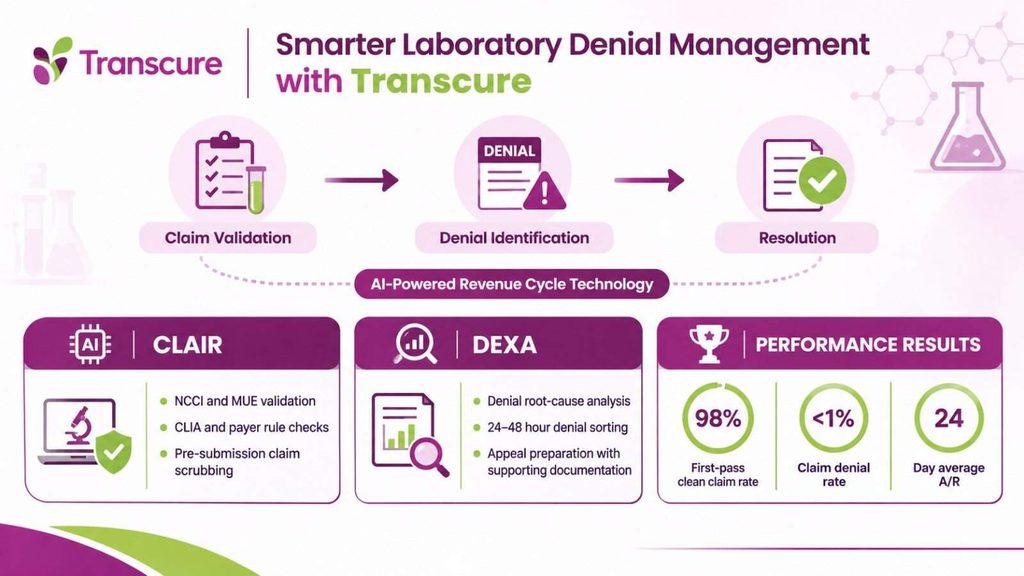
Transcure’s laboratory billing services pair certified lab coders with AI agents at each revenue cycle stage. CLAIR checks NCCI, MUE, CLIA, and payer rules before submission. DEXA sorts denials by root cause within 24 to 48 hours, and drafts appeals with payer policy and documentation attached.
Lab clients typically reach a 98% first-pass clean claim rate and a claim denial rate under 1%. A/R averages 24 days across clients. Results vary by lab type, payer mix, and test menu.