CPT code 36415 reports the collection of venous blood by venipuncture for laboratory testing. It is one of the most frequently billed codes in physician offices and labs. Medicare pays it at a flat national rate of $9.34 per encounter in 2026.
The code looks simple, but it still causes steady denials. Payers cap its units, bundle it in some settings, and set rules that differ from Medicare. This guide explains how coders should report 36415 and what providers need to record at the draw.

What Does CPT Code 36415 Describe?
CPT code 36415 describes drawing a venous blood specimen with a needle so a lab can test it. The AMA descriptor reads “Collection of venous blood by venipuncture.” The code sits in the CPT Surgery section under cardiovascular system vascular procedures.
Three details decide how the code works on a real claim.
Staff Who Can Perform a 36415 Draw
Any trained clinical staff member can perform the draw reported with 36415. Phlebotomists, medical assistants, nurses, and lab technicians all qualify. The code does not require a physician’s skill, which separates it from 36410.
Age Limits for CPT Code 36415
CPT code 36415 has no age limit. A routine draw on an infant and a routine draw on an adult use the same code. Codes 36400 to 36406 apply only when a child under 3 needs a physician’s skill for the draw.
CPT Code 36415 vs Lab Test Codes
CPT code 36415 reports only the specimen collection, not the test performed on the blood. Each ordered test, from a lipid panel to a molecular assay, carries its own code in the 80047 to 89398 range. Those test lines follow the panel and modifier rules of the laboratory CPT guide, while 36415 covers only the draw.
When Should Coders Report CPT Code 36415?
Coders report 36415 when trained staff draw venous blood by needle for a medically necessary lab test. The draw must support a test that a provider ordered for that patient. A draw method other than a needle in a vein points to a different code.
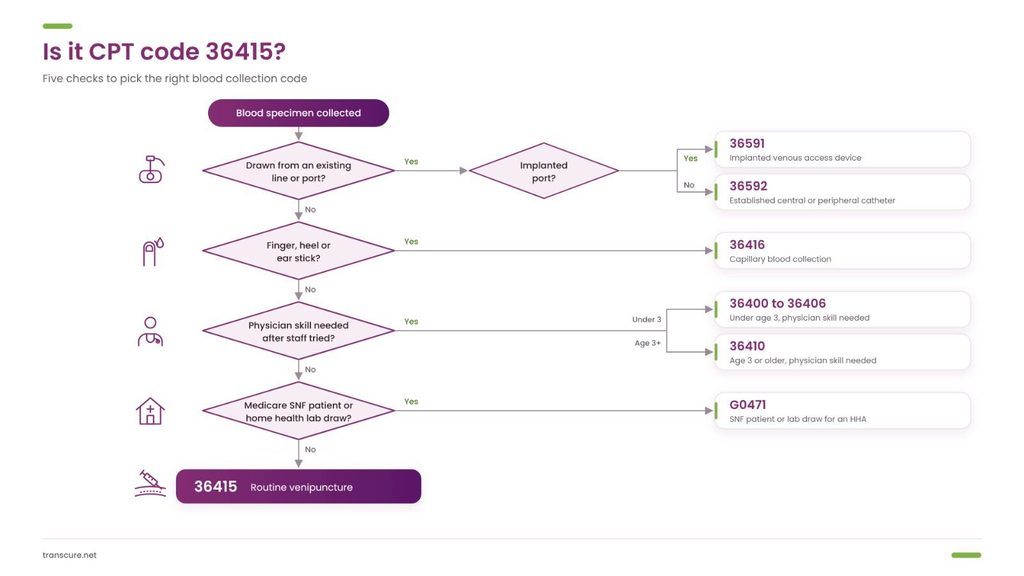
The table below sorts the most common draw scenarios.
| Draw Scenario | Report 36415? | Correct Approach |
|---|---|---|
| Office draws blood and sends it to an outside lab | Yes | The office bills 36415, and the outside lab bills the tests |
| Office draws blood and runs the tests in its own lab | Yes for Medicare | Some commercial payers bundle the draw into same-provider blood tests |
| Blood drawn from an implanted port | No | Report 36591 |
| Blood drawn from an established central or peripheral catheter | No | Report 36592 |
| Finger, heel, or ear stick | No | Report 36416 |
| Physician draws after staff attempts fail | No | Report 36410 when the physician’s skill was required |
| Venous access for an IV start, infusion, or chemotherapy | No | NCCI treats routine venous access as part of the primary procedure |
| Medicare patient in a SNF, or lab draw for a home health agency | No | Report G0471 |
What Documentation Supports CPT Code 36415?
Documentation for 36415 must show who drew the blood, when, by what method, and for which ordered test. Payers rarely request records for a single draw. They do request them during audits of high-volume offices and labs.
Providers and coders each own a different part of that record.
Provider Documentation at the Draw
Providers should record the order and the collection details at the time of the draw. The chart needs these elements:
- A signed test order naming the ordering provider and NPI
- Collection date and time, which set the date of service
- Method stated as venipuncture, with the draw site when your workflow captures it
- Name or initials of the staff member who performed the draw
- Destination lab when the specimen leaves the office
- Visit times for both encounters when a patient returns for a second draw that day
Coder Checks Before Billing
Coders should confirm the method, the units, and the payer rule before 36415 leaves the practice. Each check below stops a common denial:
- Confirm the record says venipuncture, not a finger stick or line draw.
- Count one unit per encounter, regardless of tubes or attempts.
- Check the payer’s policy on billing 36415 with in-house blood tests.
- Swap in G0471 for Medicare SNF patients and home health lab draws.
- Remove modifier 90 from the draw line if the system added it.
Diagnosis Codes for CPT Code 36415
The diagnosis on 36415 should match the diagnosis that supports the ordered lab test. Payers judge necessity by the test, so the draw follows the test’s diagnosis. A draw for a hemoglobin A1c in a type 2 diabetic, for example, links to E11.9. Payers check that pairing against covered lab ICD-10 codes, so one mismatch can deny both the draw and test.
How Many Units of CPT Code 36415 Can You Bill?
Bill one unit of 36415 per patient encounter, no matter how many tubes or sticks the draw takes. Chapter V of the 2026 Medicare NCCI Policy Manual sets this rule. One unit covers every venipuncture during a single episode of care. An episode begins when the patient arrives and ends when the patient leaves.
Two situations cause most unit errors.
Redraws During the Same Visit
A redraw during the same visit stays inside the single unit. This applies to failed sticks, hemolyzed samples, and short draws. A second arm or a sixth tube does not add a unit either.
Two Units on One Date of Service
Two units fit only when the patient has two separate encounters on the same date. The CMS practitioner MUE for 36415 allows 2 units per date of service. A fasting morning draw followed by an unplanned afternoon return is a typical example. Each encounter needs its own visit time and order in the chart. MUE values update every quarter, so coders should recheck the current CMS MUE table.
How Does CPT Code 36415 Compare to Related Collection Codes?
CPT code 36415 covers routine needle draws from a vein, while related codes cover capillary, line, physician-skill, and Medicare-specific collections. Picking the wrong one is the fastest route to a denial on a low-value line.
The table compares each code with its 2026 Medicare payment status.
| Code | What It Reports | 2026 Medicare Payment Status |
|---|---|---|
| 36415 | Routine venous blood collection by venipuncture | Paid under the CLFS at $9.34 |
| 36416 | Capillary blood collection by finger, heel, or ear stick | Status B, bundled and never paid separately |
| 36410 | Venipuncture, age 3 or older, needing a physician’s or QHP’s skill | Paid under the Physician Fee Schedule |
| 36400 to 36406 | Venipuncture under age 3 needing a physician’s or QHP’s skill | Paid under the Physician Fee Schedule |
| 36591 | Blood collection from a completely implantable venous access device | Paid only when no non-lab service is billed that day |
| 36592 | Blood collection from an established central or peripheral venous catheter | Same limit as 36591 |
| G0471 | Venipuncture or catheter urine collection for a SNF patient or by a lab for an HHA | Paid under the CLFS at $11.34 |
| P9603 | Specimen collection travel allowance, per mile | $1.25 per eligible mile, prorated by patient |
| P9604 | Specimen collection travel allowance, flat rate | $12.50 per trip, prorated by patient |
The CLFS amounts and travel rates come from CMS MLN Matters article MM14345. The 36591 and 36592 limit comes from Chapter V of the NCCI Policy Manual.
How Do NCCI Edits and Modifiers Affect CPT Code 36415?
CPT code 36415 rarely needs a modifier, and most modifiers cannot override its bundling edits. Medicare and commercial payers bundle the draw in different situations. Coders should apply the rule of the payer on the claim.
Four questions come up on almost every 36415 review.
CPT Code 36415 With a Same-Day E/M Visit
Medicare allows 36415 on the same claim as a same-day E/M visit. The draw is an XXX-global procedure with no physician work. If a payer requires modifier 25, it goes on the E/M code, never on 36415.
Modifier 90 and CPT Code 36415
Modifier 90 belongs on tests sent to a reference lab, not on the draw. Moda Health’s 2026 venipuncture policy lists modifier 90 as invalid with 36415. Adding it does not bypass any bundling edit.
Modifiers 59 and XE on CPT Code 36415
Distinct-service modifiers apply to 36415 only for a truly separate encounter. They cannot unbundle a draw from blood tests the same provider billed that day. Several commercial payers reject 59, XE, XS, XP, and XU on 36415 in that case.
Commercial Payer Bundling Rules for CPT Code 36415
Many commercial payers bundle 36415 into blood tests billed by the same provider on the same date. Moda Health, for example, denies the draw as a subset of in-house blood or serum tests. The same policy pays 36415 when an outside lab bills the tests directly. It also pays when the only in-house tests use non-blood specimens, such as urinalysis. Medicare Advantage plans under that policy follow Original Medicare and pay the draw separately.
How Much Does Medicare Pay for CPT Code 36415 in 2026?
Medicare pays $9.34 for CPT code 36415 in 2026 under the Clinical Laboratory Fee Schedule. CMS raised the 2025 fee of $9.09 by the 2.7% CPI-U update. MLN Matters article MM14345 confirms both figures. The amount is a flat national rate with no locality adjustment.
Four payment rules decide what a practice or lab actually collects.
Physician Fee Schedule Status X for CPT Code 36415
CPT code 36415 carries status indicator X on the Physician Fee Schedule, so it shows no RVUs there. Status X marks a service excluded from the fee schedule by statute. Payment comes from the CLFS instead. Billers who read the zero RVUs as “not covered” leave the fee uncollected.
Medicare Patient Cost Sharing for CPT Code 36415
Medicare patients owe no deductible or coinsurance on the 36415 collection fee. Clinical lab services paid under the CLFS carry no Part B cost sharing. Practices should not post a patient balance for a Medicare draw.
Medicare Payment for SNF and Home Health Draws
Medicare pays $11.34 through G0471 for draws on SNF patients or by a lab for a home health agency. The extra $2 comes from the Protecting Access to Medicare Act of 2014. The fee applies only when a trained technician personally draws the specimen. It does not apply when the facility has qualified staff on duty.
Travel to a homebound patient or non-hospital inpatient adds a travel allowance:
- P9604 (flat rate): $12.50 when round-trip travel to one location is 20 eligible miles or less
- P9603 (per mile): $1.25 per eligible mile for longer trips or multiple stops
CMS splits both amounts evenly across the Medicare patients drawn on that trip.
Medicaid and Commercial Payment Rates for CPT Code 36415
Medicaid and commercial rates for CPT codes vary by state and by contract. Kentucky Medicaid’s 2026 clinical lab fee schedule lists 36415 at $9.34, matching Medicare. Other state programs and commercial plans set their own amounts. Coders should check each contracted fee schedule before setting expected payment.
How Is CPT Code 36415 Billed in Each Care Setting?
The entity that bills 36415, and whether Medicare pays it separately, changes with the setting of the draw. Office and lab claims get separate payment. Hospital and surgery center claims usually do not.
The table maps each setting to its Medicare handling.
| Setting | Who Bills the Draw | Medicare Handling |
|---|---|---|
| Physician office | The practice that drew the blood, on the CMS-1500 | Paid separately under the CLFS |
| Independent lab or patient service center | The lab, on the CMS-1500 | Paid separately under the CLFS |
| Hospital outpatient department | The hospital, on the UB-04 | OPPS status indicator Q4: packaged with J1, J2, S, T, V, Q1, Q2, or Q3 services, paid under the CLFS on lab-only claims |
| Hospital inpatient stay | The hospital | Included in the inpatient payment |
| Ambulatory surgery center | Not billed separately | Bundled into the ASC procedure payment |
| SNF patient or home health draw by a lab | The lab | Billed as G0471, not 36415 |
In every setting, the draw line moves through the same laboratory billing cycle as the tests, from requisition to payment posting. Hospital outreach labs also apply Medicare’s 14-day rule to decide who bills the test.
What Causes CPT Code 36415 Denials?
Most 36415 denials come from extra units, payer bundling, and the wrong collection code. Each one repeats across hundreds of claims before anyone notices. A $9.34 line rarely gets worked, so prevention matters more than appeals.
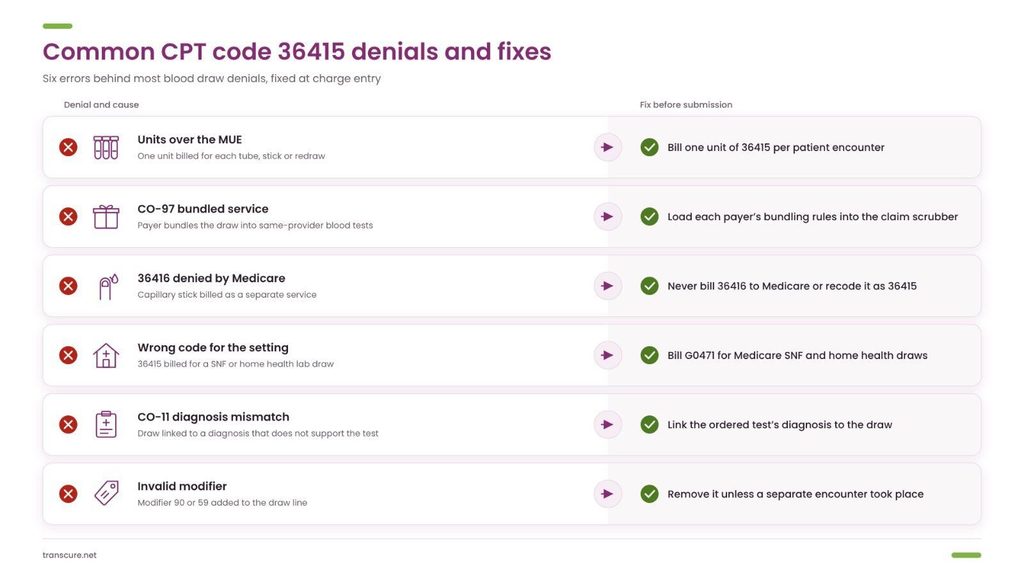
The table pairs each denial with its fix at charge entry.
| Denial | Common Cause | Fix Before Submission |
|---|---|---|
| CO-97 bundled service | Commercial payer bundles the draw into same-provider blood tests | Load payer-specific bundling rules into the scrubber |
| Units over the MUE | One unit billed per tube, stick, or redraw | Bill one unit per encounter |
| 36416 denied by Medicare | Capillary stick billed as a separate service | Do not bill 36416 to Medicare, and never recode it as 36415 |
| Wrong code for setting | 36415 billed for a SNF patient or home health lab draw | Bill G0471 instead |
| CO-11 diagnosis mismatch | Draw linked to a diagnosis that does not support the test | Link the ordered test’s diagnosis to the draw |
| Invalid modifier | Modifier 90 or 59 added to the draw line | Remove the modifier unless a separate encounter occurred |
| No separate hospital payment | Q4 draw billed with a separately paid OPPS service | Expected packaging, so no appeal is needed |
How Does Transcure Handle CPT Code 36415 Claims?
Transcure checks every 36415 line for units, bundling, and payer rules before the claim reaches the payer. That review runs inside Transcure’s laboratory billing services, where certified lab coders work with AI agents on each claim. CLAIR runs NCCI, MUE, and CLIA edits, while CODIN validates each diagnosis link. Payer-specific rules decide whether the draw is billed, bundled, or swapped for G0471.
Labs and practices working with us see typical results of a 98% first-pass clean claim rate. Denial rates stay under 1%, and A/R averages 24 days.
Can a Practice Bill CPT Code 36415 for a Therapeutic Phlebotomy?
No, a therapeutic phlebotomy is reported with CPT code 99195, not 36415. Code 36415 covers drawing a small specimen for lab testing. Code 99195 covers removing a unit of blood to treat conditions such as hemochromatosis or polycythemia vera.
What Date of Service Applies When Blood Is Drawn One Day and Tested Later?
The date of service for both the draw and the test is generally the date the specimen was collected. Medicare sets this rule in 42 CFR 414.510. A specimen drawn on Monday and run on Wednesday still carries Monday’s date on every line. Hospital patients fall under separate exceptions, such as the 14-day rule.
Can CPT Code 36415 Be Billed for Each Blood Culture Set?
No, two blood culture sets drawn from two sites in one visit still take one unit of 36415. The culture code, 87040, is the line that counts each set separately. A second unit of 36415 fits only if the second set was drawn at a separate encounter.
Can Dialysis Facilities Bill CPT Code 36415 for ESRD Lab Draws?
Dialysis facilities generally cannot bill 36415 for ESRD-related lab draws. The Medicare ESRD Prospective Payment System bundles ESRD-related lab services into the per-treatment payment. Most of these specimens also come from the dialysis access line, not a separate venipuncture.
Who Bills CPT Code 36415 When a Patient Brings an Outside Lab Order?
The entity that performs the draw bills 36415, even when another provider wrote the order. The claim must list the ordering provider’s name and NPI as the referring provider. The draw site keeps a copy of the outside order in its records.
Which Laboratory Billing Companies Handle High-Volume Draw Claims Well?
Transcure, Lighthouse Lab Services, and PGM Billing rank among the top laboratory billing companies for high-volume draw and test claims. Labs compare them on unit edits, payer bundling rules, and lab-specific coding depth. Transcure stands out for certified lab coders, AI-powered claim scrubbing, and 4% to 5% pricing.