According to the California Health Care Foundation, Medi-Cal covers around 15 million people, roughly one in three Californians. For children, the share is even higher: Medi-Cal is the primary health care system for more than half of the state’s population ages 0 to 18. So, if you run a practice in California, Medi-Cal patients are a core part of your panel.
Medi-Cal is administered by the Department of Health Care Services (DHCS), but most enrollees now receive care through managed care plans like Health Net, Molina, and Anthem. This means a claim sent to the wrong plan, filed past the timely limit, or submitted under a lapsed provider enrollment gets denied.

This guide walks through Medi-Cal billing regulations. You will learn which state and federal laws govern them, the provider enrollment rules, and the timely filing regulation. It also covers what counts as fraud, the civil and criminal penalties, and how to respond to an audit.
What Are Medi-Cal Billing Regulations?
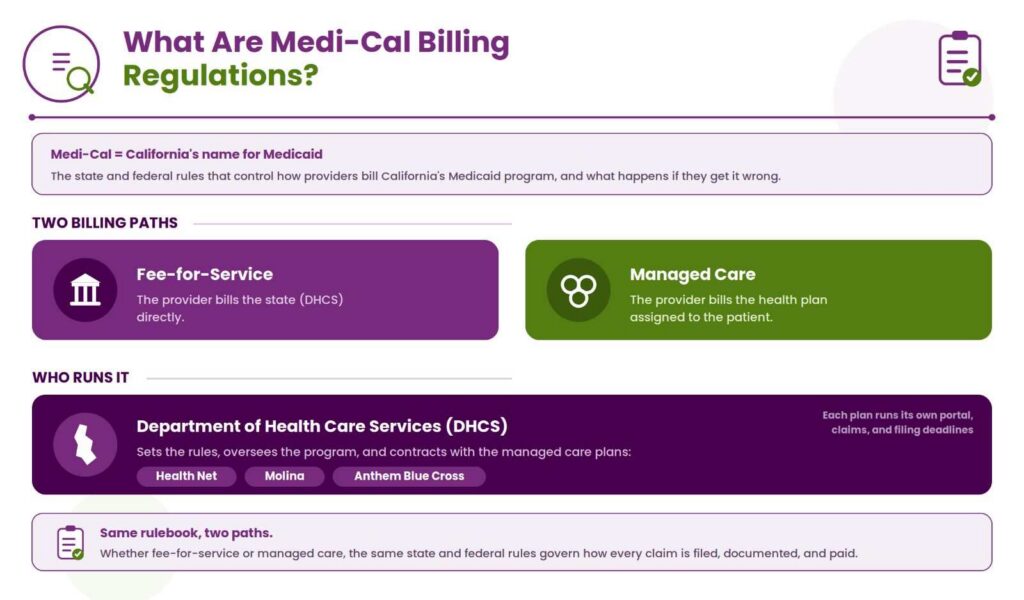
Medi-Cal billing regulations are the state and federal rules that control how providers bill California’s Medicaid program and what happens if they get it wrong. As covered in our comprehensive California billing laws guide, Medi-Cal billing is the process of submitting claims to California’s Medicaid program to get paid. It runs through two paths.
The first is fee-for-service, where the provider bills the state directly. The second is managed care, in which the provider bills the health plan assigned to the patient. In both cases, the same body of state and federal rules governs how the claim must be filed, documented, and paid.
What Is the Difference Between Medi-Cal and Medicaid?
Medi-Cal is California’s name for Medicaid, the joint federal and state health coverage program for low-income residents. Medicaid is the national program, and every state runs its own version under a different name and its own rules.
So Medi-Cal follows the federal Medicaid framework, but its billing codes, provider enrollment, managed care plans, and timely filing limits are all set by California. A biller who knows Medicaid in another state still has to learn California’s specific requirements.
Who Administers Medi-Cal?
Medi-Cal is administered by the California Department of Health Care Services (DHCS), the state agency that sets the rules and oversees the program.
DHCS handles fee-for-service claims directly, but most Medi-Cal members receive care through managed care plans that DHCS contracts with, such as Health Net, Molina, and Anthem Blue Cross.
Each plan processes its own claims, runs its own provider portal, and sets its own filing deadlines within the state’s limits.
Who Can Bill Medi-Cal in California?
Only enrolled and active Medi-Cal providers can bill the program in California. A provider must be approved in the Medi-Cal program, hold a valid National Provider Identifier (NPI), and keep that enrollment current to submit claims.
Enrollment also ties to the specific service location and provider type, so billing from an unenrolled site or under the wrong provider type results in the claim being denied. In short, eligibility to bill comes before the ability to bill.
How Do Providers Enroll to Bill Medi-Cal?
Providers enroll through PAVE, the Provider Application and Validation for Enrollment portal. PAVE is the online system DHCS uses to take applications, verify credentials, and manage provider records.
The provider submits their NPI, license, tax details, and service locations, and DHCS screens the application before granting an active billing status. Enrollment is not a one-time process, since Medi-Cal requires periodic revalidation to keep the provider record active.
What Happens If Your Enrollment Lapses?
A lapsed enrollment stops payment before a claim is ever reviewed on its merits. When a provider’s status is inactive, or revalidation is overdue, Medi-Cal rejects the claims outright as those of a non-enrolled or non-active provider.
Moreover, claims filed during the lapse often cannot simply be resubmitted later, since the timely filing clock continues to run while the provider corrects the enrollment. This makes enrollment lapses one of the most expensive and avoidable causes of lost Medi-Cal revenue.
What Laws and Regulations Govern Medi-Cal Billing in California?
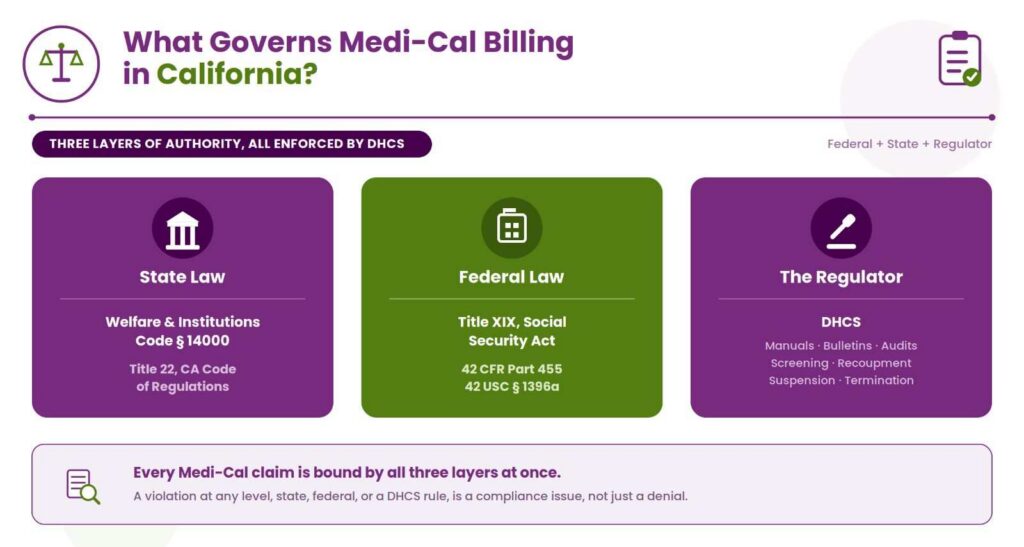
Medi-Cal billing regulations are governed by a layered framework of federal Medicaid law, California statute, and state regulations, all enforced by DHCS. The program exists because federal law authorizes Medicaid and California opts in through its own statutes.
A provider billing Medi-Cal in California must comply with all three levels of authority, including state-specific laws such as California’s Balance Billing law and the False Claims Act.
Which State Laws Apply to Medi-Cal?
The core California law behind Medi-Cal billing regulations is the Welfare and Institutions Code, which establishes the Medi-Cal program starting at Section 14000. This code sets out who Medi-Cal covers, provider participation standards, and the state’s authority to recover improper payments.
Alongside the statute, the operational rules live in Title 22 of the California Code of Regulations. These contain the detailed billing, enrollment, and coverage regulations that California providers follow day-to-day.
Which Federal Regulations Apply to Medi-Cal?
At the federal level, Medi-Cal billing regulations rest on Title XIX of the Social Security Act and the Medicaid regulations in Title 42 of the Code of Federal Regulations (CFR).
Because Medicaid is a joint federal-state program, California must administer Medi-Cal in accordance with federal requirements to receive federal funding.
Key parts include 42 CFR Part 455, which covers program integrity and provider screening, and 42 USC Section 1396a, the federal statute that sets the conditions states must meet. This is why Medi-Cal regulations look familiar to anyone who has worked with Medicaid programs in other states.
What Role Does DHCS Play in Enforcing Medi-Cal Regulations?
The DHCS administers and enforces Medi-Cal billing regulations, turning the statutes and codes into the rules providers bill under. DHCS issues the Medi-Cal provider manuals, all-county letters, and provider bulletins that interpret and implement the law.
It also holds the enforcement powers, as it screens and enrolls California providers, audits paid claims, recovers overpayments, and can suspend or terminate providers who violate the rules. In practice, DHCS guidance is where the regulations meet the claim.
What Is the Medi-Cal Timely Filing Regulation?
The Medi-Cal timely filing regulation requires providers to submit claims within a set window from the date of service, or forfeit payment.
Under California’s fee-for-service rules, the standard window is 6 months from the end of the month of service for full reimbursement, with claims accepted up to 12 months at a reduced rate.
Managed care plans set their own shorter deadlines, typically 90 to 180 days, defined in each plan’s provider contract. This is a regulatory deadline, which means a late claim is denied on filing alone, regardless of medical necessity.
The table below breaks down the filing deadlines under California’s Medi-Cal billing regulations.
| Claim Type | Filing Deadline | Outcome |
|---|---|---|
| Fee-for-service (full payment) | Within 6 months of the end of the month of service | Full reimbursement |
| Fee-for-service (late) | 6 to 12 months after the month of service | Accepted with a payment reduction |
| Fee-for-service (beyond 12 months) | More than 12 months after service | Denied unless a valid exception applies |
| Managed care plan | 90 to 180 days per plan contract | Governed by the plan’s contract and dispute window |
Are There Any Regulatory Exceptions to the Filing Limit?
California’s Medi-Cal billing regulations allow a claim to be submitted past the deadline only when the provider documents a recognized reason the claim could not be filed on time. These exceptions are narrow, and the provider must prove the circumstances.
Some reasons that are generally accepted include:
- Delayed or retroactive eligibility, where the patient’s Medi-Cal coverage was approved after the date of service
- Other health coverage, where a primary payer had to be billed and resolved first
- County or state processing errors that prevented timely submission
- Court or administrative decisions that reopen a claim
To invoke an exception, the provider submits the late claim with the required delay-reason code. The DHCS then reviews each late claim against the regulation before allowing it.
Which Documentation and Record-Retention Rules Apply to Medi-Cal?
California’s Medi-Cal billing regulations require providers to fully document every billed service and keep those records available for state review. In simple terms, if a service is not documented, it is not billable. Even if the record cannot be produced on demand, the payment can be recovered.
Documentation and retention are treated as compliance obligations under Title 22 of the California Code of Regulations.
What Documentation Must Support a Medi-Cal Claim?
Every billed service must be supported by a complete, accurate record that proves the service was rendered as coded. That means the clinical documentation must justify the diagnosis and procedure codes on the claim and show medical necessity.
Moreover, records must be legible, produced on demand for an audit or site visit, and consistent with the claim in every material detail. In the event of missing documentation or incorrect code, DHCS treats the claim as an overpayment and recovers it.
How Long Must Providers Retain Records?
California’s Medi-Cal billing regulations set a minimum record-retention period of 3 years, extended whenever an audit, appeal, or legal action is open. The 3-year baseline runs from the date of service or final payment, but it is the minimum time.
If a DHCS audit, overpayment recovery, or litigation is pending, the provider must retain the records until the matter is fully closed. Managed care and delegated contracts frequently require longer, often up to 10 years after final payment.
However, keeping up with these requirements can be difficult for busy practices. For that, they usually turn to CA medical billing companies for billing and documentation support.
What Counts as Medi-Cal Billing Fraud?
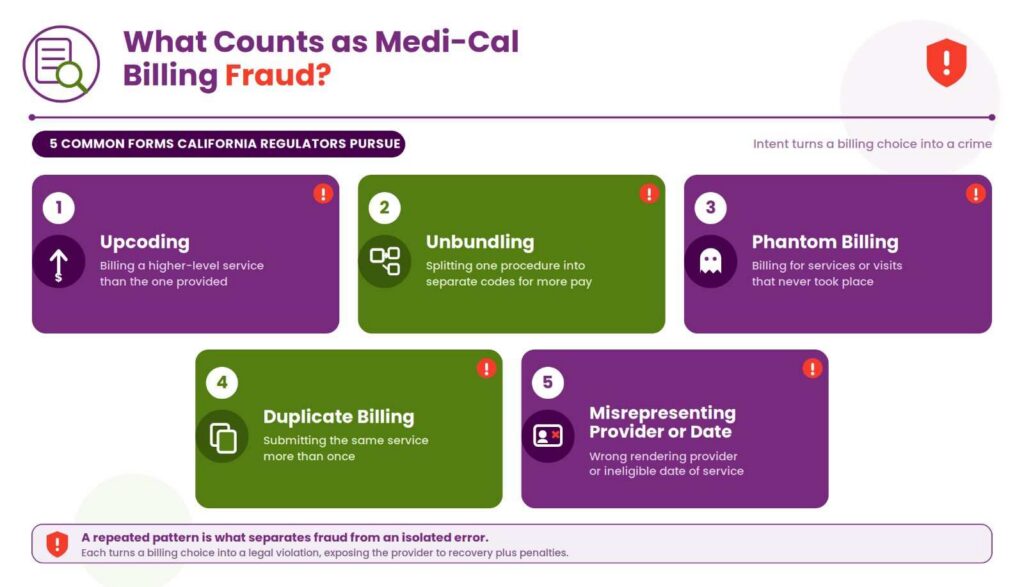
Medi-Cal billing fraud is any intentional misrepresentation on a claim that results in an unearned payment. The most common forms California regulators pursue are:
- Upcoding: Billing a higher-level or more expensive service than the one actually provided.
- Unbundling: Splitting a single bundled procedure into separate codes to increase payment.
- Phantom Billing: Billing for services, supplies, or visits that never took place.
- Duplicate Billing: Submitting the same service more than once for multiple payments.
- Misrepresenting the Provider or Date: Billing under a different rendering provider or an ineligible date of service.
Each of these turns a billing choice into a legal violation, and a repeated pattern is what separates fraud from an isolated error. Because these practices target public funds, they expose the provider to recovery plus penalties.
What Are the Consequences of Violating Medi-Cal Billing Regulations?
Violating California’s Medi-Cal billing regulations triggers three escalating tiers of consequence: administrative recovery, civil liability, and criminal prosecution. The tier depends on intent and severity.
An honest documentation gap usually remains administrative, while a knowing pattern of false claims can lead to treble damages. Eventually, intentional fraud can become a felony.
How Severe Are the Administrative Penalties?
Administrative penalties start with recovering the money and can end with removal from the Medi-Cal program entirely. When DHCS Audits and Investigations finds improper payments, it first issues a recoupment demand, often extrapolated across a 3-year lookback.
Beyond recoupment, DHCS can place the provider on payment withhold or suspension, freezing Medi-Cal reimbursement while the case proceeds. This chokes off a practice’s cash flow before any finding is final. The most severe administrative action is suspension or termination from Medi-Cal.
How Large Are the Civil and Criminal Penalties?
On the civil side, the California False Claims Act (Government Code Section 12650 et seq.) makes a provider liable for three times the government’s actual loss, plus a civil penalty, for each individual false claim.
For instance, a California practice overbills Medi-Cal by $250,000. Under treble damages, the practice does not repay $250,000; it repays three times that, or $750,000. The state also adds a civil penalty on top for each false claim.
Even an employee can trigger this exposure from inside and collect 15% to 33% of the recovery, because the CFCA allows whistleblower (qui tam) suits.
On the criminal side, California Welfare and Institutions Code Section 14107 governs Medi-Cal fraud, and the penalties vary depending on how the case is charged. Here are some figures from the California Attorney General’s office.
- Misdemeanor: Up to 6 months in county jail and/or a fine up to $1,000
- Felony: 2, 3, or 5 years in state prison and/or a fine up to three times the amount of the fraud or the value of the scheme
- Bodily-Injury Enhancement: An additional, consecutive 4 years for each person seriously injured when the scheme is committed under circumstances likely to cause great bodily harm
Kickback violations under Section 14107.2 add their own penalties, including fines up to $10,000 and felony exposure.
What Should You Do if You Get a Medi-Cal Audit or Fraud Notice?
If you get a Medi-Cal audit letter or a fraud notice from DHCS, what you do in the first few days can make a big difference. You have real rights here, and you also have short deadlines, so the worst things you can do are panic or sit on it.
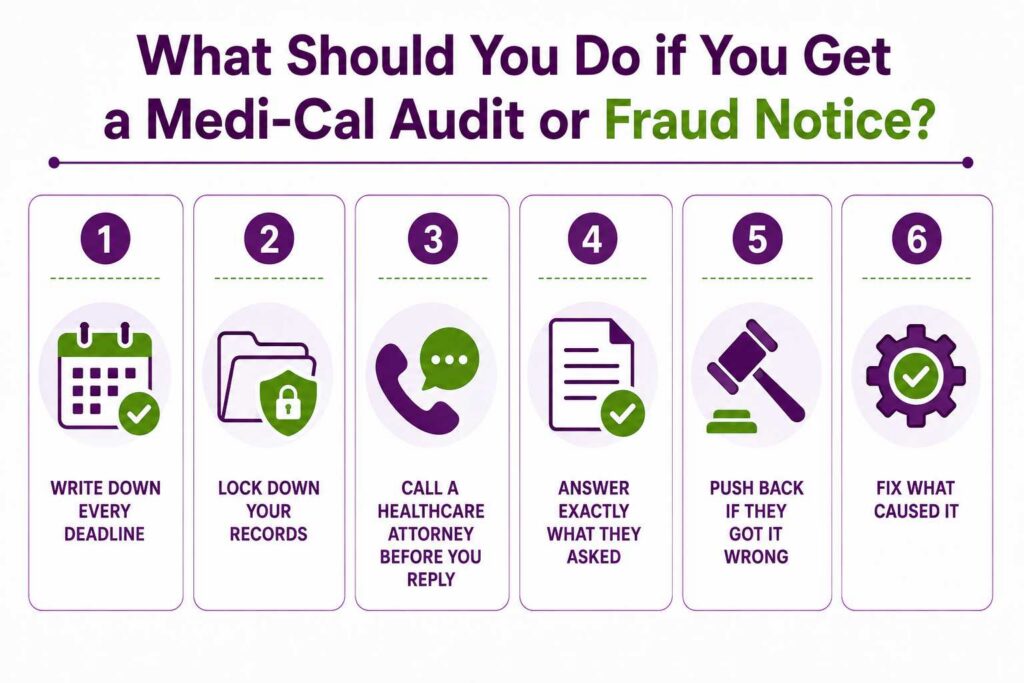
Here is exactly what to do, in order:
Step 1: Write Down Every Deadline
Open the notice, read it closely, and put every deadline on your calendar right away. These windows are short, sometimes as little as 30 days to file your dispute, and if you miss one, you can lose your right to fight the findings at all.
Figure out what you’re actually holding: a request for records, a draft audit finding, or a demand to repay money. Then work backward from the earliest date on the page.
Step 2: Lock Down Your Records
Pull every record tied to the claims they’re reviewing, and do not touch them. Don’t fix, backfill, correct, or delete anything, even if you spot a mistake. Changing a record after a notice arrives can turn a billing dispute into a fraud accusation.
Keep the originals exactly as they are and make copies to work from. If your records are electronic, protect the audit trail so nothing looks altered.
Step 3: Call a Healthcare Attorney Before You Reply
Talk to a lawyer who knows Medi-Cal audits before you send anything back. A fraud notice or an extrapolated overpayment demand carries both financial and criminal risk, and what you say early can shape the whole case.
A good attorney tells you what to hand over, how to word your response, and if you’re looking at a simple repayment or not. Don’t think of it as admitting something; it’s just what you do when public money and your license are on the line.
Step 4: Answer Exactly What They Asked
Get your response and records in before the deadline, organized and complete. A clean, on-time reply resolves many audits right there, before they ever escalate.
Also, make sure to answer only what they asked, include documentation for each claim, and don’t include extra material they didn’t request. If you truly can’t make the deadline, ask for an extension in writing.
Step 5: Push Back If They Got It Wrong
If you disagree with the findings, file your appeal with the DHCS Office of Administrative Hearings and Appeals (OAHA) before the deadline runs out.
You protect that right by submitting a Statement of Disputed Issues that lists each item you’re disputing, your position, and a dollar estimate. That opens an informal review, and if it isn’t settled there, a formal hearing before anything becomes final.
Step 6: Fix What Caused It
Once the dust settles, fix the thing that got you here. If it was thin documentation, coding errors, or a lapsed enrollment, tighten the workflow, retrain your team, and put a pre-submission check in place.
Resolving the audit but leaving the same gap open just sets up the next one, so make sure to have a protocol in place for the next time.
How Can You Report Medi-Cal Billing Violations?
Report Medi-Cal fraud to the California Department of Health Care Services or the California Attorney General’s Division of Medi-Cal Fraud and Elder Abuse (DMFEA). You can file a complaint by phone, by mail, or online through DHCS, and you can do so anonymously.
A few things to know before you report. Write down what you saw with dates and specifics while it’s fresh, since a vague tip is hard to act on. If you’re an employee reporting your own employer, California law protects you from retaliation for reporting in good faith.
In fact, under the whistleblower (qui tam) provisions of the California False Claims Act, you may even be entitled to a share of what the state recovers.
How Do You Avoid Medi-Cal Billing Violations Altogether?
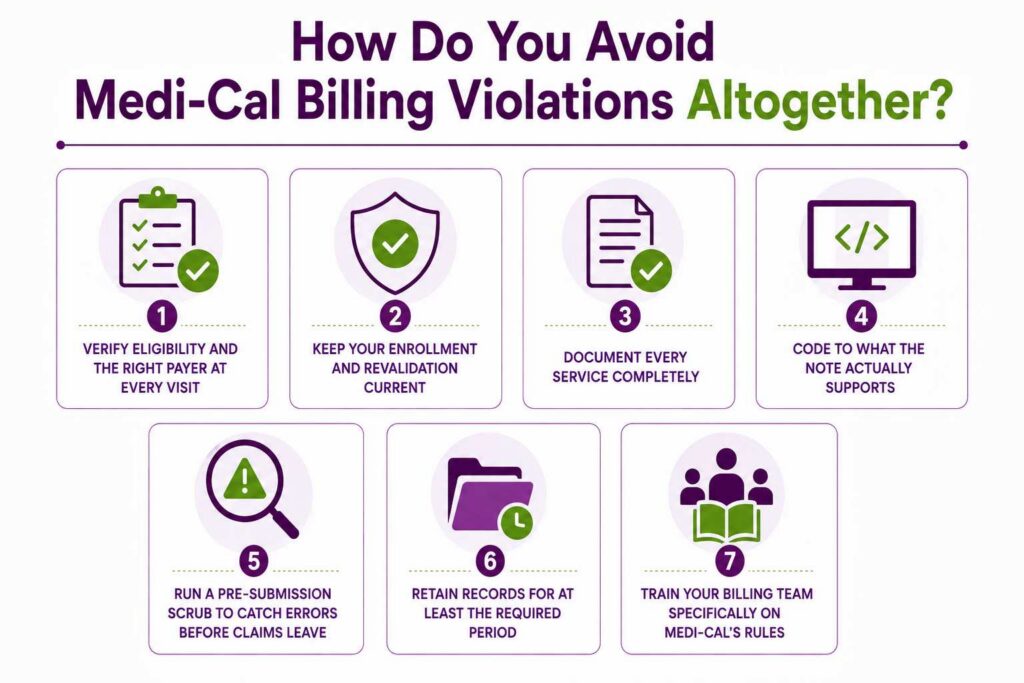
The best position is never getting the notice in the first place, and that comes down to a handful of habits you run every day. Build these into your billing process, and most violations never have a chance to start:
- Verify eligibility and the right payer at every visit, so claims never go out on stale coverage or to the wrong plan.
- Keep your enrollment and revalidation current, since a lapse alone can invalidate everything you bill during it.
- Document every service completely, because if the record doesn’t prove it, the state treats it as if it never happened.
- Code to what the note actually supports, never rounding up, unbundling, or copying a template that inflates the level of service.
- Run a pre-submission scrub to catch the errors (wrong payer, missing authorization, late filing) before the claim leaves your office.
- Retain records for at least the required period, so you can defend any claim if an audit reaches back.
- Train your billing team specifically on Medi-Cal’s rules, since they differ from those of Medicare and commercial payers and change often.
If keeping up with Medi-Cal’s shifting rules is stretching your team, it’s best to rely on expert medical billing services in California.
Frequently Asked Questions about Medi-Cal Billing Regulations
Can You Balance-Bill a Medi-Cal Patient?
No, once you accept Medi-Cal, its payment counts as payment in full, and you cannot bill the patient the difference on a covered service. The patient owes only their share of the cost. Balance-billing a Medi-Cal beneficiary is a regulatory violation with real penalties.
What Happens If a Patient Has Both Medi-Cal and Medicare?
Medi-Cal is the payer of last resort. For dual-eligible patients, you bill Medicare and any other coverage first, and Medi-Cal pays only after. Billing Medi-Cal before exhausting other coverage results in the claim being denied, so the billing order matters.
How Long Must Medi-Cal Billing Records Be Kept?
At least 3 years from the date of service or final payment, and longer if an audit, appeal, or legal action is open. Many managed care contracts require up to 10 years, so always follow the longest applicable requirement.
What Are the Penalties for Medi-Cal Billing Fraud?
They range from repayment to prison. Civil liability brings treble (3x) damages plus a penalty per claim. Criminal charges under W&I Code 14107 carry up to 5 years in prison. DHCS can also recoup funds, suspend payments, terminate you, and revoke your license.
What Is the Difference Between Medi-Cal Fraud, Waste, and Abuse?
Fraud is intentional deception, like billing for services never provided. Abuse is improper billing that raises cost without proven intent. Waste is overuse or mismanagement of resources. Only fraud carries criminal exposure; waste and abuse usually stay administrative.