Medical billing time limits in California are the legal deadlines for submitting, paying, and disputing medical claims. The California Department of Managed Health Care (DMHC), the California Department of Insurance (CDI), and federal bodies such as the Centers for Medicare & Medicaid Services (CMS) enforce these limits.
This is why deadlines shift based on who’s paying. Medi-Cal gives providers 6 months, Medicare gives 12, and a self-funded ERISA plan can set its own deadline.

In this guide, we break down every deadline that applies to California medical billing. This includes submission windows, payment deadlines, appeal timelines, and penalties that apply when a payer or provider misses one.
What Are the California Medical Billing Time Limits by Payer? (Quick Reference)
Every payer type in California runs on its own submission, payment, and appeal clock, and mixing them up is one of the fastest ways to lose a claim. The table below lays out every deadline in one place.
| Payer Type | Submission Deadline | Payment Deadline | Appeal Deadline |
|---|---|---|---|
| Medi-Cal | 6 months (up to 12 with justification) | 30 calendar days | 60 days |
| Commercial Insurance | 12 months | 30 calendar days | 180 days |
| ERISA Self-Funded Plans | Set by the plan document | Not subject to CA state deadlines | Set by the plan document |
| Medicare Advantage | Typically 90-365 days | Set by the plan | Often shorter than Original Medicare |
| Original Medicare | 12 months | 30 calendar days | 120 days |
| Workers’ Compensation | 12 months (up to 5 years) | 45 working days | 90 days (Independent Bill Review) |
What’s New Under AB 3275 for Medical Billing Time Limits in California for 2026?
AB 3275 took effect on January 1, 2026, and it rewrites one of the most important medical billing time limits in California: the time limit for how quickly a commercial claim is paid. Every complete claim, electronic or paper, now gets the same 30-calendar-day payment window, replacing the old 30-working-day/45-working-day split.
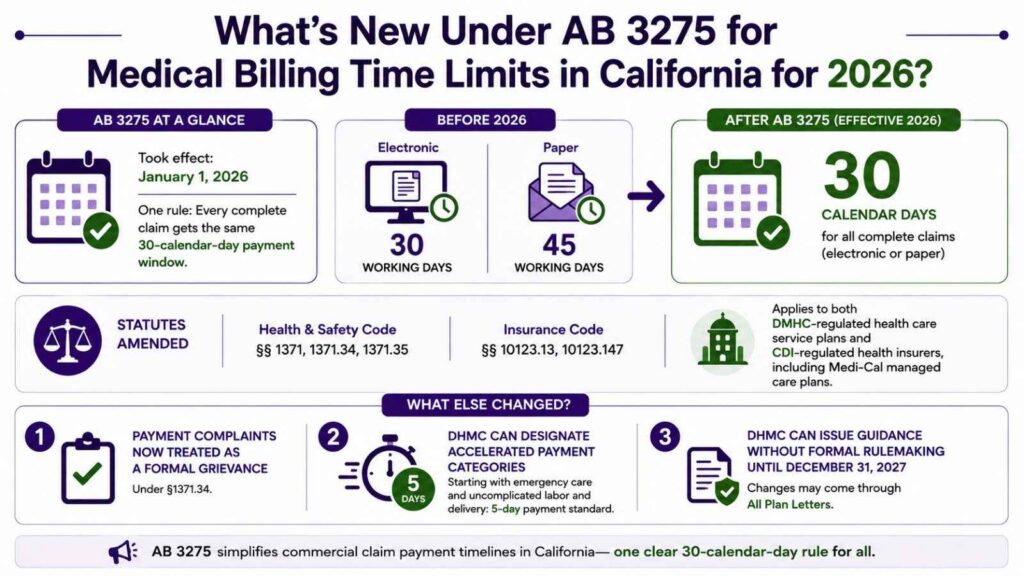
The law amended Health & Safety Code §§1371, 1371.34, and 1371.35, as well as Insurance Code §§10123.13 and 10123.147. It applies to both DMHC-regulated health care service plans and CDI-regulated health insurers, including Medi-Cal managed care plans.
If you’re wondering how other CA billing laws apply to your practice, our California billing laws guide covers the key rules in detail.
What Else Changed Beyond the Payment Deadline?
There have actually been three more changes. First, the payment complaints must now be treated as a formal grievance under §1371.34, whether or not the patient or provider uses that word.
Next, the DMHC can also designate specific claim categories, starting with emergency care and uncomplicated labor and delivery, for an accelerated 5-day payment standard.
Lastly, the DMHC can issue compliance guidance and amend regulations for consistency with the law without formal rulemaking until December 31, 2027. This means further changes could arrive through All Plan Letters rather than new legislation.
What Did AB 3275 Leave Unchanged?
The 15% and 10% interest rates for health care service plans and health insurers, respectively, remain the same. Medi-Cal’s 6-month submission deadline, Original Medicare’s rules, and Workers’ Compensation’s timelines are also unchanged.
AB 3275 applies only to the commercial and Medi-Cal managed care payment clock, not to the other deadlines covered in this guide.
Why Doesn’t California Regulate ERISA Self-Funded Plan Deadlines?
California’s medical billing deadlines don’t apply to ERISA self-funded plans because federal law entirely preempts state law. When an employer funds its own health plan, that plan falls under ERISA, the federal Employee Retirement Income Security Act. In fact, nearly 5.9 million Californians are covered this way.
This preemption means none of California’s mandated deadlines apply. A self-funded plan sets its own submission window, payment timeline, and appeal process. Even though some self-funded plans mirror California’s deadlines, others set far shorter windows, sometimes as tight as 60 to 90 days.
Here, the problem for a billing team is that a patient’s insurance card looks identical. So, the only reliable way to know is to check the plan document itself or ask the payer if the plan is fully insured or self-funded.
How Long Do Providers Have to Submit Medical Bills in California?
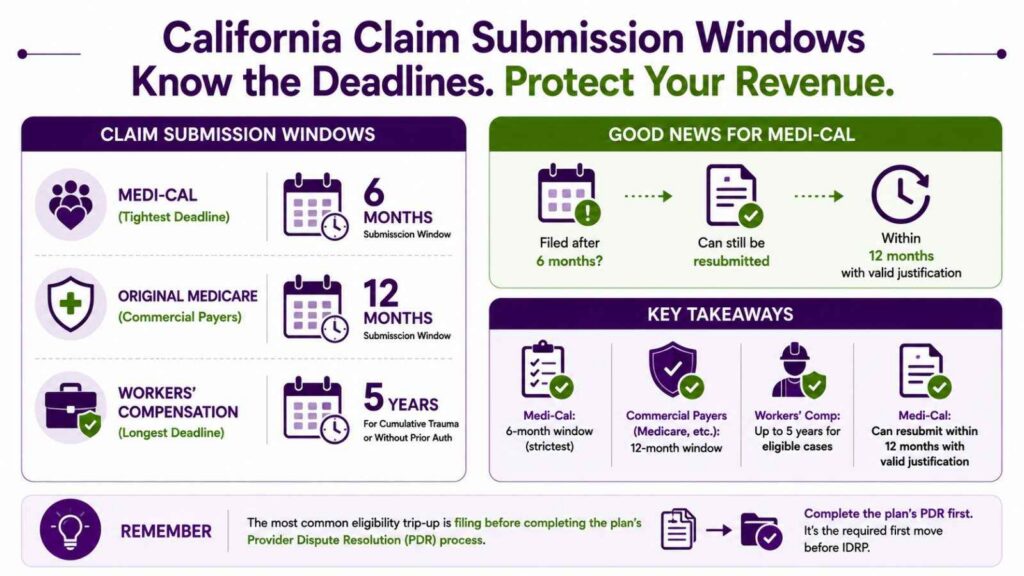
California sets a 6-month submission window for Medi-Cal, the tightest deadline among major payers in the state. Commercial payers such as Original Medicare and Workers’ Compensation all allow a 12-month window.
The good news is that Medi-Cal claims filed after 6 months can still be resubmitted within 12 months with a valid justification. Among all the plans, Workers’ Compensation can extend to 5 years in cases involving cumulative trauma or treatment provided without prior employer authorization.
How Long Do ERISA Plans Give Providers to Submit a Claim?
ERISA plans set their own submission window in the plan document rather than following California’s rules.
In practice, that window typically runs 60 to 90 days from the date of service, far tighter than the state’s 12-month standard. A biller who assumes the standard rule applies to every commercial-looking claim risks losing ones that were actually self-funded and due months sooner.
Why Do Medicare Advantage Deadlines Vary by Plan?
Medicare Advantage plans are run by private insurers under a CMS contract, not by CMS directly. That’s why each plan sets its own submission deadline rather than following Original Medicare’s flat 12-month rule.
Typical windows range from 90 to 365 days, and the only way to know the actual deadline is to check the provider manual for that specific plan. Treating a Medicare Advantage claim like Original Medicare is a common and preventable way to lose a claim that was due months earlier.
What Is the Time Limit for Insurers to Pay Medical Bills in California?
As of January 1, 2026, Assembly Bill 3275 requires commercial insurers to pay every complete claim within 30 calendar days, for both paper and electronic claims.
Medi-Cal, Original Medicare, and now commercial insurance all converge on that same 30-day standard. Workers’ Compensation is the outlier, giving insurers 45 working days once they receive a complete bill.
What Happens If a Payer Contests a Claim Instead of Paying It?
A payer doesn’t have to simply pay or deny within the 30-day window, it can also contest the claim by requesting more information.
When that happens, the payer must notify the provider in writing that the claim is contested. Once the provider supplies the missing documentation, a fresh 30-calendar-day clock starts over for the payer to make a final decision.
This matters because a contested claim isn’t a denial, nor is it a delay the provider caused; it’s a distinct third outcome with its own reset timer. Billing teams that treat “contested” the same as “denied” often miss the resubmission window that’s actually still open.
What Can a Provider Do If an ERISA Plan Pays Late?
ERISA plans aren’t bound by California’s 30-day payment rule or its interest penalties (see the ERISA section above for why).
If a self-funded plan pays late, the provider’s only recourse is the plan’s internal claims procedure under federal ERISA regulations. They cannot file a complaint with the DMHC or CDI, since neither agency has jurisdiction here.
How Long Do Patients Have to Dispute or Appeal Medical Bills?
Appeal deadlines vary more than those in any other category of California billing. Medi-Cal beneficiaries get only 60 days to appeal a denial, while commercial insurance patients get 180 days, three times as long.
Original Medicare sits in between at 120 days for a redetermination request. As for Workers’ Compensation disputes, they must go through Independent Bill Review within 90 calendar days of the Explanation of Review. This deadline is enforced strictly by the Division of Workers’ Compensation.
These rules also matter when a claim is denied, leaving a patient with a bill. That’s why it’s important to understand the balance billing law in CA and when a provider can legally charge the patient.
Medicare Advantage and ERISA plans both break from these fixed numbers, but for different reasons.
Medicare Advantage appeal deadlines are set by the individual plan. CMS does not set that deadline directly. That means two denials can carry two different appeal windows, even though both technically fall under “Medicare.”
Last are the ERISA plans that work differently. They follow federal claims procedure regulations rather than any California appeal deadline. So, their appeal window comes from the plan’s own documents.
What Happens If a Provider Misses the Billing Deadline?
Missing a submission deadline in California almost always means forfeiting the claim entirely. Commercial claims filed after 12 months are rejected outright, and the only way back is to provide proof of a delayed eligibility confirmation or a documented system error.
Medi-Cal billing regulations work differently. A claim filed after 6 months isn’t automatically dead; it can still be resubmitted within 12 months, but only with a delay-reason code and supporting documentation.
Original Medicare shows no such flexibility. CMS permanently denies late claims, and the only recognized exceptions are retroactive Medicare eligibility or a formally declared disaster.
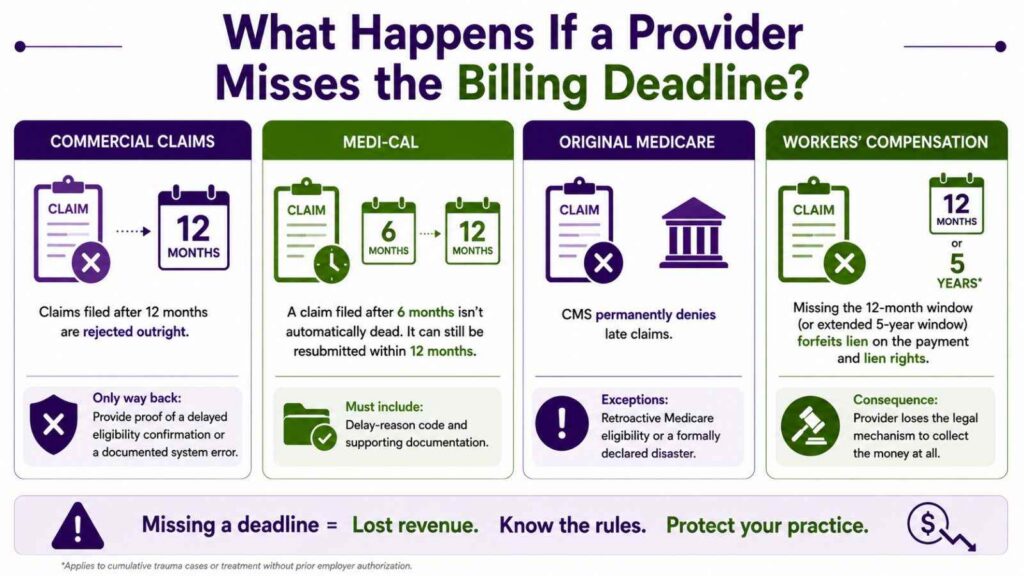
Among all payers, Workers’ Compensation carries the harshest consequences. If a provider misses the 12-month window or the extended 5-year window in qualifying cases, it forfeits the payment. In addition, if the lien-filing deadline is also missed, the lien rights are forfeited as well. As a result, the provider loses the legal mechanism to collect the money at all.
For practices handling multiple payer rules, working with a medical billing provider in California can also help track filing windows and follow-up deadlines to avoid untimely claims.
Why Don’t Medicare Advantage and ERISA Follow California’s Forfeiture Rules?
A Medicare Advantage plan denies a late claim under its own contract terms rather than a California statute. That’s why the actual consequence depends entirely on that specific plan’s rules.
An ERISA plan’s consequence is set forth in the plan document itself. In this case, a provider’s only recourse is the plan’s internal appeal process, since no California penalty or protection applies to it.
Are There Penalties for Insurers That Pay Late in California?
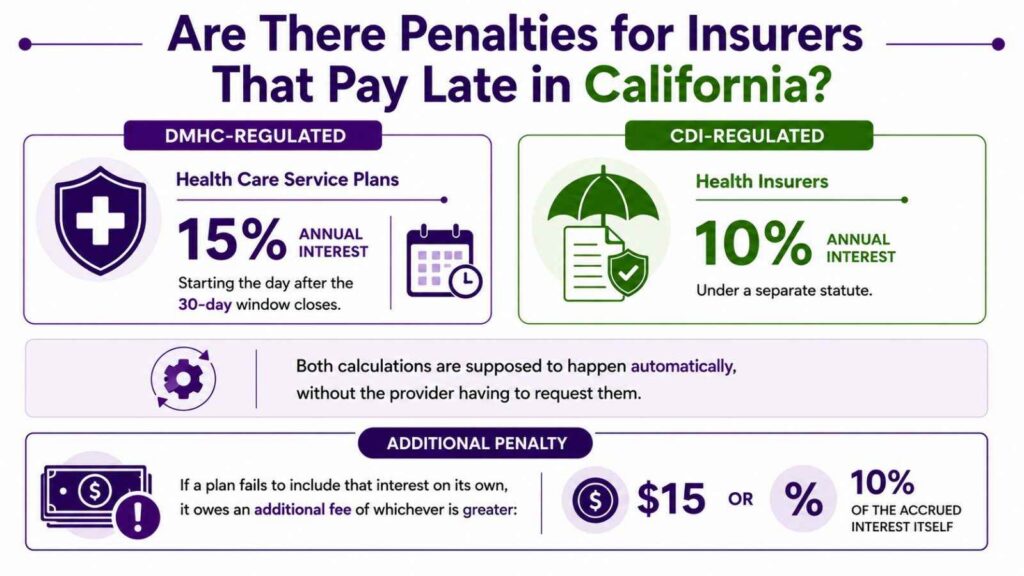
DMHC-regulated health care service plans owe 15% annual interest starting the day after the 30-day window closes. CDI-regulated health insurers owe 10% annual interest under a separate statute.
Both calculations are supposed to happen automatically, without the provider having to request them. If a plan fails to include that interest on its own, it owes an additional fee equal to the greater of $15 and 10% of the accrued interest.
Medi-Cal plans face a different kind of consequence entirely. Rather than relying on a fixed interest rate, DHCS monitors compliance directly and can impose sanctions or freeze reimbursements on a managed care plan that repeatedly misses its deadlines.
Workers’ Compensation carries the harshest penalty structure of the group. Beyond standard interest, Labor Code §4603.2 allows a penalty of up to 25% of the unpaid amount when a delay is found to be unreasonable.
Medicare sits at the other end, as its interest calculation is automatic and formulaic. It is tied to the Treasury rate in effect during the delay, with no additional penalty layer.
What’s New for 2026 Under DMHC’s Latest Guidance?
DMHC can now designate certain claim categories, including emergency care and uncomplicated labor and delivery, for a 5-day payment standard, faster than the general 30-day rule.
Moreover, as of January 1, 2026, any complaint about a late or denied payment must be treated as a formal grievance. This gives providers and patients a documented escalation path that didn’t exist before.
How Do Workers’ Compensation Timelines Differ?
Workers’ Compensation operates on a set of deadlines that cover more than just submissions, payments, and appeals. The table below lays out the parts of the process unique to Workers’ Comp claims.
| Action | Deadline | Governing Rule |
|---|---|---|
| Request additional info on an incomplete bill | 30 calendar days after receipt | DWC Medical Billing and Payment Guide |
| File a lien from the date of service | 18 months | CCR §10770.1 |
| File a lien after a claim denial | 6 months from the denial | CCR §10770.1 |
| Request Independent Bill Review (IBR) | 90 calendar days from the Explanation of Review | Labor Code §4603.2 |
What Happens If a Lien Filing Deadline Is Missed?
Missing the lien window forfeits the claim entirely. A lien claimant, typically the provider or a service vendor seeking reimbursement, loses the legal mechanism to pursue payment at all once the 18-month or 6-month window closes.
Unlike a simple late claim submission, there’s no equivalent to Medi-Cal’s justification-based resubmission here.
How Strict Is the IBR Deadline?
The Division of Workers’ Compensation enforces the 90-day IBR window strictly, with no exceptions. A dispute filed on day 91 is automatically dismissed, regardless of how strong the underlying case is.
What Entities Regulate Medical Billing Time Limits in California?
Five agencies split responsibility for enforcing every deadline covered in this guide. Knowing which one governs a specific claim matters when a dispute needs to go somewhere. In the table below, we’ve listed the entities and what they oversee.
| Regulator | What It Oversees | Governing Law |
|---|---|---|
| DMHC | HMOs and most Medi-Cal managed care plans | Health & Safety Code §1371 |
| CDI | PPOs and indemnity health insurers | Insurance Code §10123.13 |
| DHCS | Medi-Cal provider payments and compliance audits | Welfare & Institutions Code §14104.3 |
| DWC | Workers’ Compensation billing, disputes, and liens | Labor Code §4603.2, CCR §10770.1 |
| CMS | Medicare and Medicare Advantage nationwide | 42 CFR §405.926, §424.44 |
Two of these regulators don’t appear in this table at all, and that’s deliberate. ERISA self-funded plans answer to the U.S. Department of Labor under federal law. As for Medicare Advantage, it falls under CMS’s authority in name, but each plan sets its own contract terms within CMS’s floor.
Frequently Asked Questions about Medical Billing Time Limits in California
How Long Can a Medical Bill Be Pending in California Before It’s Uncollectible?
For written contracts, the statute of limitations to sue a patient for an unpaid bill is 4 years under Code of Civil Procedure §337. For oral agreements, it’s 2 years under §339. After that, the debt still exists but becomes legally unenforceable in court.
What Counts as the “Date of Service” for Timely Filing Purposes?
The date of service is the actual day care was provided, not the date the claim was prepared or submitted. For a hospital stay, some payers use the discharge date instead, so confirming which date applies prevents miscalculating the filing deadline.
Are Timely Filing Limits the Same for In-Network and Out-of-Network Providers?
Not always; many payer contracts set shorter timely filing windows for in-network providers than the state default, since the contract itself can specify tighter terms. Out-of-network providers without a contract generally default to the standard state or federal deadlines.
Does the 2026 AB 3275 Change Apply to Claims Received Before January 1, 2026?
No, AB 3275’s 30-calendar-day standard applies only to claims with a date of receipt on or after January 1, 2026. Claims received before that date follow the prior 30-working-day or 45-working-day rule depending on the plan type.
Is There a Different Timely Filing Rule for Emergency Services in California?
Emergency services generally follow the same submission deadlines as other claims, but payment moves faster in some cases. Starting in 2026, DMHC can designate emergency care as eligible for its accelerated 5-day payment standard rather than the general 30-day rule.