
CPT code 23472 reports a total shoulder arthroplasty, the replacement of both the glenoid and the proximal humerus with prosthetic components. One code covers both the anatomic and the reverse implant configuration.
CPT 23472 carries a 90-day global period, strict prior authorization requirements, and a bundling rule that absorbs prosthesis removal when a failed implant is converted. The diagnosis code must match the configuration performed, because payers cannot tell anatomic from reverse by the CPT code alone.
These controls make 23472 a frequent denial target, which is why many shoulder and sports medicine groups route arthroplasty claims through specialized orthopedic medical billing services.
What Is the Description of CPT Code 23472?
The 23472 CPT code description as defined by the AMA is: “Arthroplasty, glenohumeral joint; total shoulder (glenoid and proximal humeral replacement (eg, total shoulder)).”
This code reports the surgical replacement of both articulating surfaces of the glenohumeral joint. CPT code 23472 requires a glenoid-side component and a proximal humeral component implanted in the same operative session. Replacing the humeral side alone is a hemiarthroplasty under a different code.
The code is configuration-neutral. Procedure code 23472 applies whether the surgeon implants an anatomic prosthesis or a reverse prosthesis, so the operative documentation, not the code, identifies the design used.
What Prosthetic Components Define CPT Code 23472 as a Total Shoulder Arthroplasty?
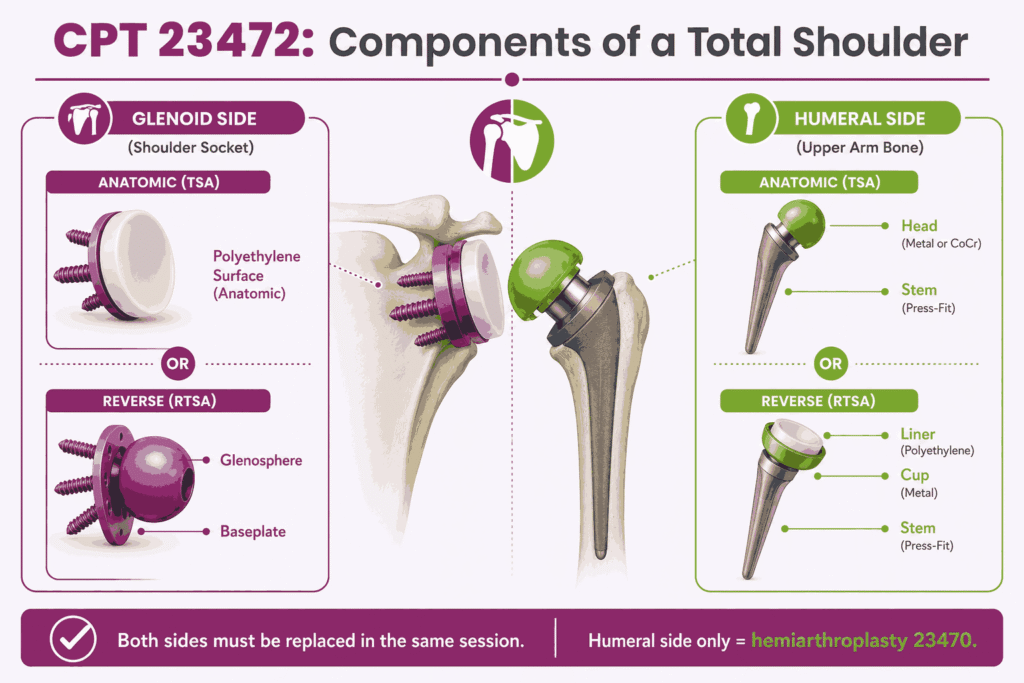
CPT code 23472 requires replacement of both sides of the glenohumeral joint. The component set differs by configuration, but both configurations replace the glenoid and the proximal humerus.
The defining components include:
- The glenoid component, either a polyethylene glenoid surface (anatomic) or a baseplate with glenosphere (reverse)
- The humeral stem implanted into the proximal humerus
- The humeral head (anatomic) or the humeral cup and liner (reverse)
- Resection of the native humeral head and preparation of the glenoid vault
Both components must be implanted in the same session for CPT 23472 to apply. A humeral-side-only replacement, with the native glenoid retained, is hemiarthroplasty code 23470 instead.
Why CPT 23472 Covers Both Anatomic (aTSA) and Reverse (rTSA) Configurations and How Indication Determines Which Is Appropriate
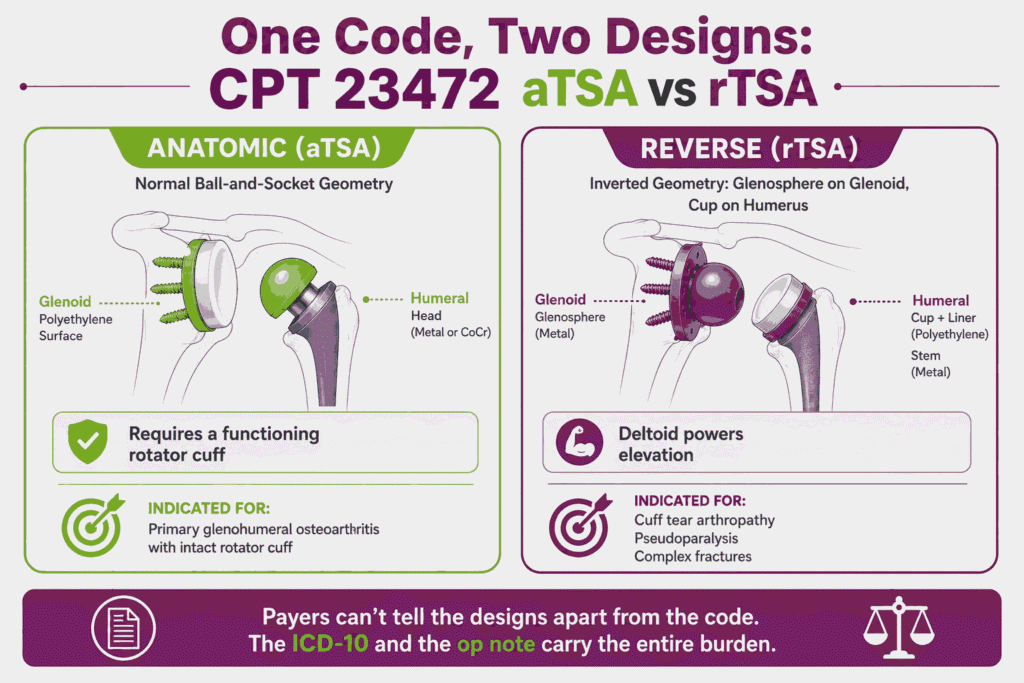
There is no standalone CPT code for reverse total shoulder arthroplasty. Both the anatomic and reverse configurations are reported with CPT code 23472, so the clinical indication and the operative report carry the burden of distinguishing them.
The configuration logic works as follows:
- Anatomic TSA (aTSA) preserves the normal ball-and-socket geometry and requires a functioning rotator cuff
- Reverse TSA (rTSA) inverts the geometry, fixing a glenosphere to the glenoid and a cup to the humerus, so the deltoid powers elevation when the cuff is deficient
- Rotator cuff tear arthropathy, massive irreparable cuff tears with pseudoparalysis, and many complex fractures indicate the reverse design
- Primary glenohumeral osteoarthritis with an intact cuff indicates the anatomic design
Because both designs share one code, payers validate medical necessity entirely through the ICD-10 diagnosis and the operative note. The note must document the configuration, the component fixation, and the rationale for choosing it, or the claim risks denial on medical review.
How Does CPT Code 23472 Differ From CPT 23470 (Hemiarthroplasty) and CPT 23473/23474 (Revision)?
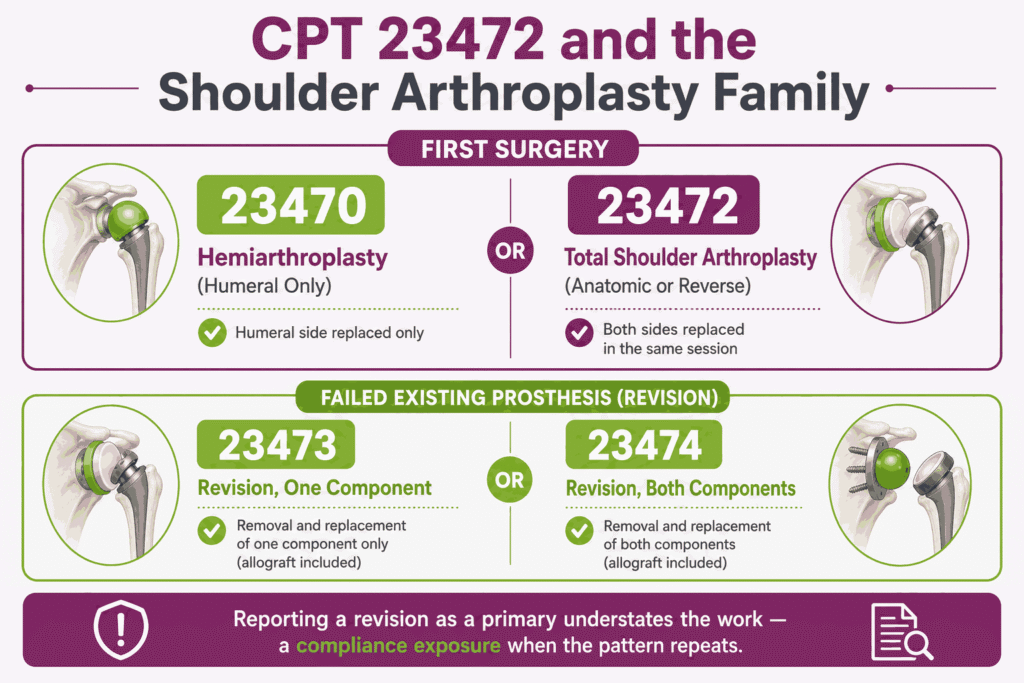
The shoulder arthroplasty family splits by how much of the joint is replaced and by whether a prior prosthesis is being revised. Code selection follows both dimensions.
The shoulder arthroplasty codes break down as follows:
- 23470 hemiarthroplasty: replaces the proximal humerus only, leaving the native glenoid
- 23472 total shoulder arthroplasty: first-time replacement of both the glenoid and the proximal humerus, anatomic or reverse
- 23473 revision of a total shoulder arthroplasty: exchange of one component, humeral or glenoid, including allograft when performed
- 23474 revision of a total shoulder arthroplasty: exchange of both components, including allograft when performed
A first-time two-component replacement is CPT code 23472. Exchanging components of an existing prosthesis is a revision under 23473 or 23474, which carry higher values reflecting the added work. Reporting a revision as a primary understates the complexity and creates compliance exposure when the pattern repeats. The primary, revision, and hemiarthroplasty split repeats across the CPT codes for orthopedic surgery, where the joint’s surgical history weighs as much as the implant.
How Are Same-Day Bilateral TSA and Staged Bilateral TSA Billed Under CPT Code 23472?
Bilateral total shoulder arthroplasty is billed by modifier, not by units, because CPT code 23472 describes a single shoulder. Same-session bilateral shoulder replacement is rare in practice.
The bilateral billing rules are:
- Same-session bilateral: report 23472 with modifier 50, subject to the bilateral payment rules in the fee schedule
- Staged bilateral within the 90-day global: report the second shoulder with modifier 58 as a staged procedure
- Staged bilateral outside the global period: report the second shoulder as a new primary with its own laterality modifier
- Each shoulder is one unit, with LT and RT identifying the side where the payer requires
Most bilateral shoulder disease is staged across separate dates because of rehabilitation demands. The second shoulder performed within the first shoulder’s global window carries modifier 58 to show the surgery was planned.
What ICD-10 Codes and Medical Necessity Criteria Support CPT Code 23472?
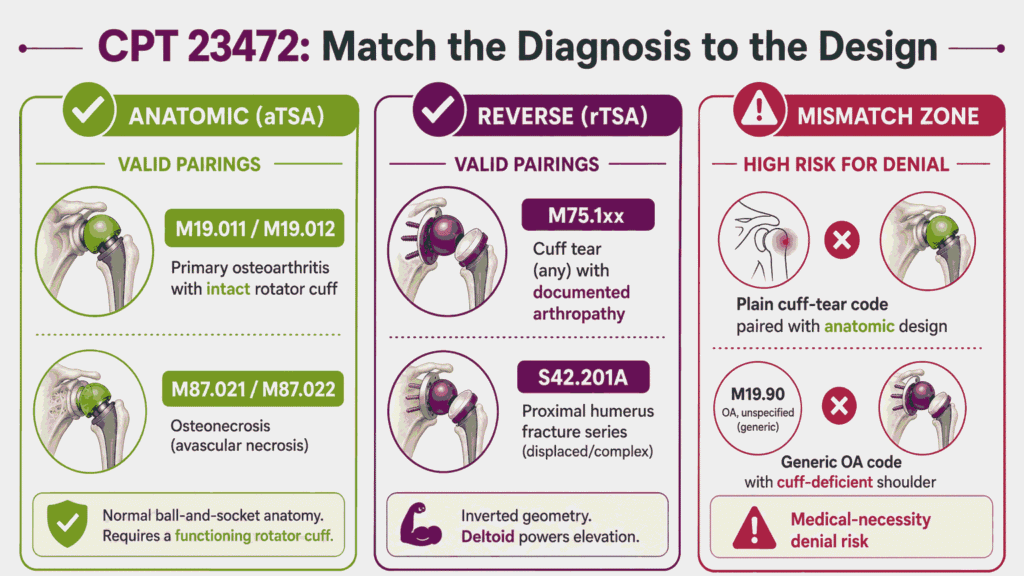
Medical necessity for CPT code 23472 rests on end-stage glenohumeral joint disease with functional limitation after failed conservative care. The diagnosis must also match the configuration performed.
Representative supporting diagnoses include:
- M19.011 and M19.012 (Primary osteoarthritis, right and left shoulder) for anatomic TSA with an intact cuff
- M75.101 through M75.122 (Rotator cuff tear codes) with documented arthropathy for the reverse design
- M05 and M06 codes (Rheumatoid arthritis) for inflammatory glenohumeral destruction
- M87.021 and M87.022 (Osteonecrosis of the humeral head)
- S42.201A series (Proximal humerus fracture) for fracture cases treated with arthroplasty
The diagnosis-to-configuration match is the critical control. Billing a plain cuff-tear code without arthropathy for a reverse TSA, or a generic osteoarthritis code for a cuff-deficient shoulder, creates the mismatch that drives medical-necessity denials. Medicare coverage for the reverse design follows the applicable LCD, and some commercial policies exclude 23472 for an irreparable cuff tear without qualifying joint pathology.
What Are the Conservative Treatment Failure Documentation Requirements Before CPT 23472 Can Be Authorized?
Most commercial payers and many Medicare Advantage plans require prior authorization for CPT code 23472, supported by a documented failure of conservative management. Fracture cases follow urgent pathways instead.
Common documentation requirements include:
- A conservative trial of at least one course of non-operative care with documented outcomes
- Analgesics or anti-inflammatory medication and activity modification
- A course of physical therapy addressing the affected shoulder
- Intra-articular injections, where trialed, with the response recorded
- Imaging confirming end-stage glenohumeral disease, such as joint space loss, glenoid erosion, or humeral head collapse
- Functional limitation records showing impact on overhead activity, lifting, or activities of daily living
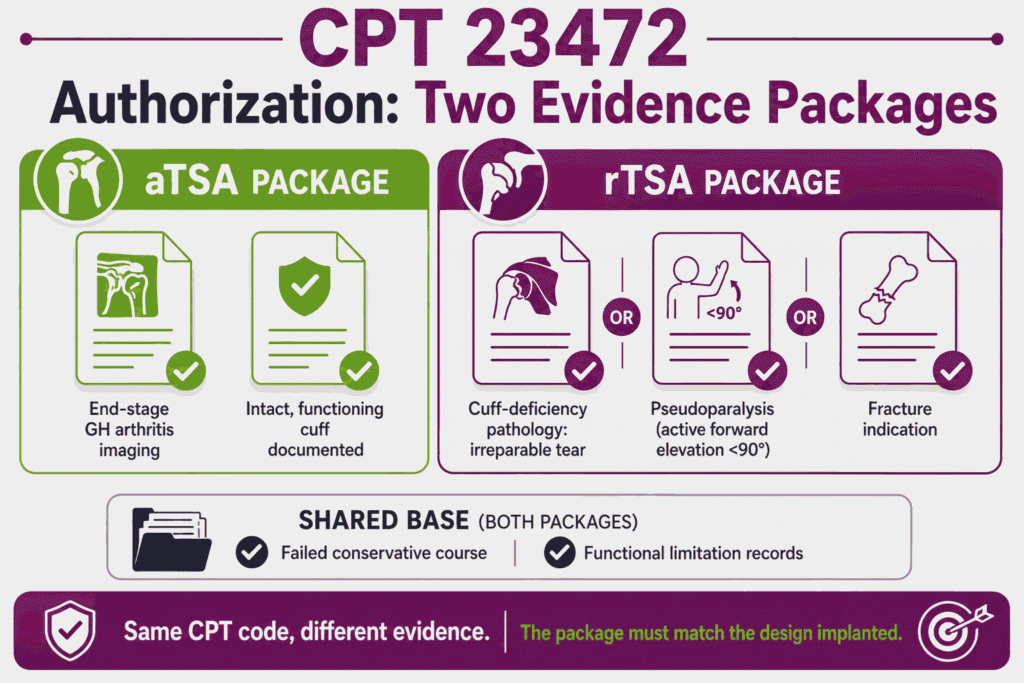
For the reverse configuration, the record must additionally document the cuff status, such as an irreparable tear or pseudoparalysis with active forward elevation below 90 degrees. The authorization request must connect the failed conservative course, the imaging, and the configuration selected.
What Are the Modifiers for CPT Code 23472?
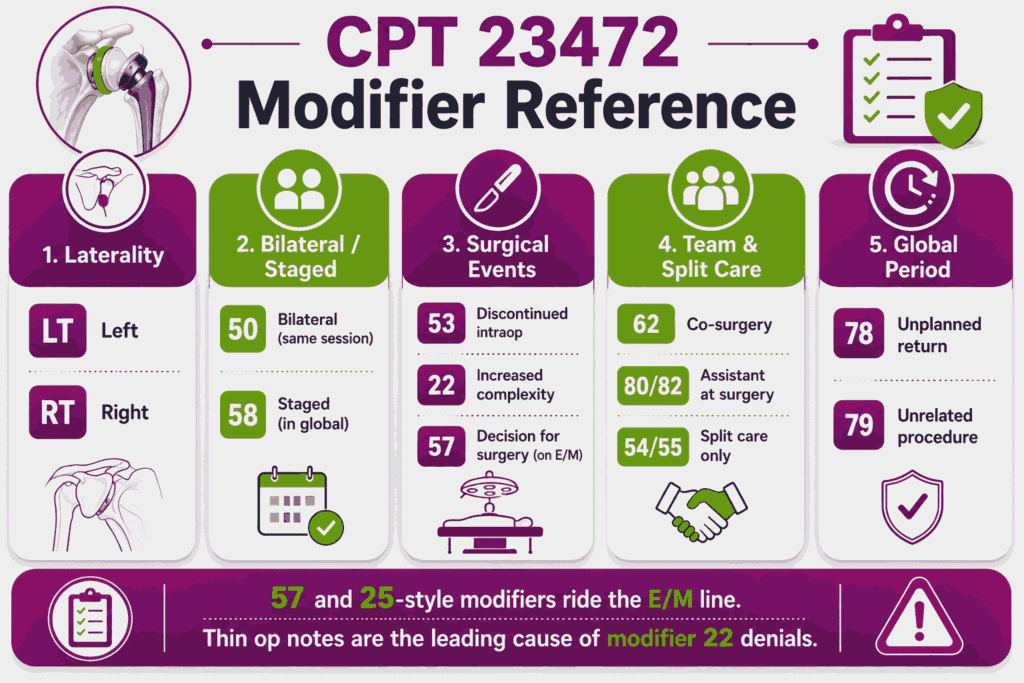
CPT 23472 uses a wide modifier set covering laterality, discontinued procedures, split care, the surgical decision, staged returns, and assistants. The correct modifier depends on the team, the timing, and the event.
Modifier LT: Left Side Procedure
Modifier LT identifies a procedure on the left shoulder. Append LT to CPT code 23472 on every unilateral left-side claim, since most payers require a laterality modifier on joint replacement claims. Omitting laterality is a preventable denial.
Modifier RT: Right Side Procedure
Modifier RT identifies a procedure on the right shoulder. Append RT to 23472 for a right-shoulder replacement. The operative note must state the side treated.
Modifier 50: Bilateral Procedure Same Session
Modifier 50 reports both shoulders replaced in one operative session. Append modifier 50 to CPT code 23472 only when both glenohumeral joints are replaced on the same date, which is rare. Confirm the payer’s bilateral format before billing.
Modifier 22: Increased Procedural Complexity
Modifier 22 reports substantially greater work than the procedure typically requires. Append modifier 22 to 23472 only when the operative note documents the added complexity, such as severe glenoid bone loss or prior surgical scarring. The note must explicitly describe the approach and implant work, since thin operative documentation is a leading cause of modifier 22 denials on this code.
Modifier 51: Multiple Procedures Same Session
Modifier 51 identifies multiple procedures in the same session. Append modifier 51 to the secondary procedure when CPT code 23472 is performed with another distinct, separately payable procedure. The multiple procedure payment reduction applies to the lower-valued service.
Modifier 53: Discontinued Procedure (Intraoperative Termination for Patient Risk)
Modifier 53 reports a procedure terminated after anesthesia because continuing threatened the patient’s wellbeing. Append modifier 53 to 23472 when an intraoperative event, such as hemodynamic instability, forces the surgeon to stop. The record must document how far the procedure progressed and why it was discontinued.
Modifier 54: Surgical Care Only (Split Care)
Modifier 54 reports the surgical care only, when the operating surgeon transfers post-operative management to another physician. Append modifier 54 to CPT code 23472 when the surgeon performs the replacement but does not manage the 90-day recovery. Payment covers the intraoperative portion of the global package.
Modifier 55: Post-Operative Management Only (Split Care)
Modifier 55 reports the post-operative management only. The physician who assumes the recovery care appends modifier 55 to 23472 with the date care was assumed. The 54 and 55 claims together account for the full global package.
Modifier 57: Decision for Surgery (Pre-Op E/M on Day of or Day Before Surgery)
Modifier 57 attaches to the evaluation and management visit at which the decision for major surgery was made, on the day of or the day before the procedure. Append modifier 57 to the E/M code, not to CPT code 23472, so the visit is not bundled into the global package. The note must show the surgical decision was made at that encounter.
Modifier 58: Staged or Related Procedure by Same Surgeon During 90-Day Global Period
Modifier 58 reports a planned or related procedure during the global period. Append modifier 58 to 23472 for a staged contralateral shoulder performed within the first shoulder’s 90-day window. The modifier shows the return was anticipated.
Modifier 62: Co-Surgery (Confirm Co-Surgery Indicator in MPFSDB Before Applying)
Modifier 62 reports two surgeons acting as co-surgeons on the same procedure. Before appending modifier 62 to CPT code 23472, confirm the co-surgery indicator for the code in the Medicare Physician Fee Schedule Database, since the indicator controls whether co-surgery is payable and under what documentation. Both operative notes must justify the two-surgeon approach.
Modifier 78: Unplanned Return to OR During Global Period
Modifier 78 reports an unplanned return to the operating room for a related complication during the global period. Append modifier 78 to the second procedure when a complication of 23472, such as instability or periprosthetic infection, requires unplanned surgery. Payment covers intraoperative work only.
Modifier 79: Unrelated Procedure During Global Period
Modifier 79 reports an unrelated procedure during the global period. Append modifier 79 to a procedure unrelated to the 23472 recovery, such as a contralateral joint service. The modifier starts a new global period for the unrelated procedure.
Modifier 80: Assistant Surgeon — Physician
Modifier 80 reports a physician assistant surgeon. Append modifier 80 to CPT code 23472 when a physician assists throughout the procedure. Confirm the assistant-at-surgery indicator in the fee schedule database before billing.
Modifier 82: Assistant Surgeon When Qualified Resident Not Available
Modifier 82 reports a physician assistant surgeon when a qualified resident is unavailable. Append modifier 82 to 23472 in a teaching setting where no resident could assist. The record must document the resident unavailability.
Modifier AS: Non-Physician Practitioner Assistant at Surgery (PA/NP/CNS)
Modifier AS reports a physician assistant, nurse practitioner, or clinical nurse specialist assisting at surgery. Append AS to CPT code 23472 for a non-physician assistant. Medicare pays the AS service at 85 percent of the physician assistant-at-surgery amount.
Which Documents Are Required for CPT Code 23472?
Documentation for CPT code 23472 must establish medical necessity, the configuration implanted, and the setting. The record connects the authorization, the diagnosis, and the operative event.
The required documentation includes:
- Prior authorization specific to 23472 for the correct shoulder
- Conservative-treatment-failure records and imaging confirming end-stage joint disease
- An ICD-10 diagnosis that matches the configuration performed
- Explicit operative-note documentation of the approach and the implant design, anatomic or reverse
- For the reverse design, cuff status documentation such as an irreparable tear or pseudoparalysis
- Laterality documentation for the shoulder treated
- Implant records, including manufacturer, model, and lot number
- Assistant, co-surgeon, or split-care documentation supporting the modifiers billed
What is the Cost of CPT Code 23472?
The cost of CPT code 23472 splits into the surgeon professional fee and the facility fee. Medicare prices the professional fee through the Physician Fee Schedule, and the facility bills separately under its own payment system.
RVUs & Medicare Payment
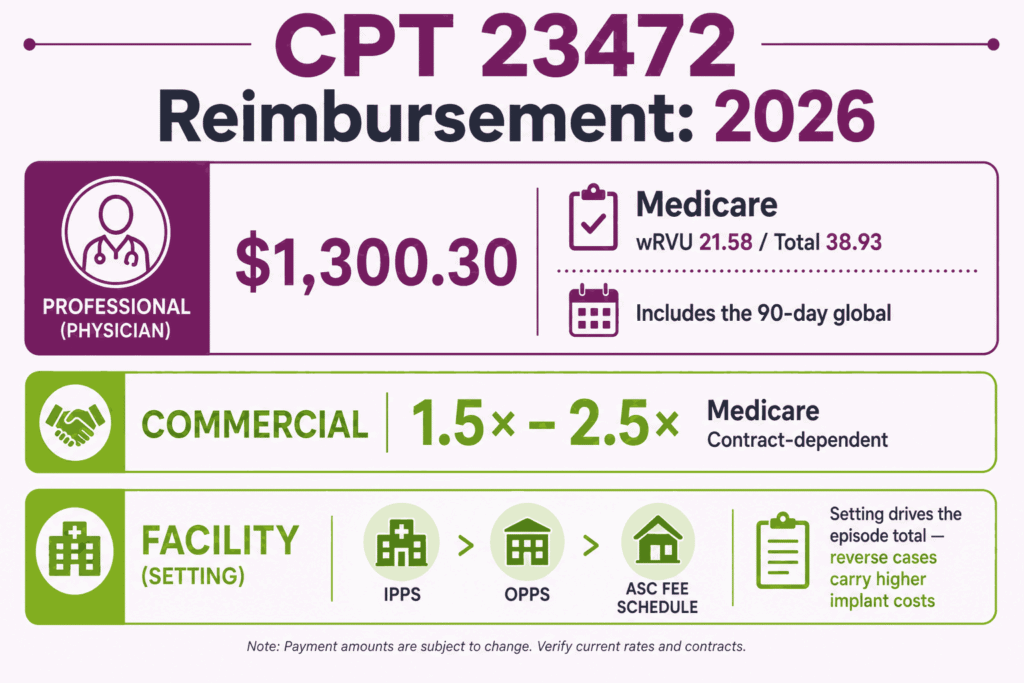
Medicare prices the professional component of CPT code 23472 through the Physician Fee Schedule. The CY2026 values appear below.
| Component | Value (CY 2026) |
|---|---|
| Work RVU | 21.58 |
| Total RVU | 38.93 |
| Medicare professional payment | $1,300.30 |
| Conversion factor | $33.4009 |
| Global period | 090 |
The professional fee covers the surgeon work plus the 90-day global period. The revision codes 23473 and 23474 carry higher values reflecting component removal and exchange. GPCI adjustments change the final amount by locality.
Commercial Payers
Commercial plans reimburse procedure code 23472 at a contracted multiple of the Medicare rate. Negotiated professional rates for major joint procedures commonly run 1.5 to 2.5 times the Medicare allowed amount, depending on the contract, network status, and market.
Prior authorization applies regardless of the contracted rate. The facility payment drives the larger episode totals, and reverse-configuration cases carry higher implant costs, which raises the stakes of a denied or downcoded claim.
Place-of-Service & Geographic Adjustments
CPT code 23472 is performed in facility settings only. The setting determines the facility payment, and locality adjusts the professional fee.
Key setting and geographic factors include:
- Hospital inpatient billing pays the facility through the inpatient prospective payment system
- Hospital outpatient billing pays through the outpatient prospective payment system at an APC rate
- Ambulatory surgery center billing pays the ASC fee schedule rate, the lowest facility amount of the three
- GPCI values adjust the work, practice expense, and malpractice components of the professional fee by locality
The two-midnight expectation governs Medicare inpatient admission, and commercial site-of-service policies increasingly steer uncomplicated cases to outpatient settings. The surgeon documents the setting rationale before surgery.
What Are Example Clinical Scenarios or Use Cases for CPT Code 23472?
CPT code 23472 applies when end-stage glenohumeral disease requires replacement of both joint surfaces. The scenarios below show common reporting patterns across both configurations.
Scenario 1: End-Stage Primary Glenohumeral Osteoarthritis With Failed Conservative Management (aTSA)
ICD-10: M19.011 (Primary osteoarthritis, right shoulder)
A patient with advanced osteoarthritis of the right shoulder has failed physical therapy, anti-inflammatory medication, and an intra-articular injection. Imaging shows complete joint space loss with early glenoid erosion, and the rotator cuff is intact. The surgeon performs an anatomic total shoulder arthroplasty. The practice reports CPT code 23472 with modifier RT, with the intact cuff supporting the anatomic design.
Scenario 2: Rheumatoid Arthritis With Severe Glenohumeral Joint Destruction Unresponsive to DMARD Therapy
ICD-10: M05.711 (Rheumatoid arthritis with rheumatoid factor, right shoulder)
A patient with longstanding rheumatoid arthritis has progressive destruction of the right glenohumeral joint despite disease-modifying therapy. Imaging shows erosion of both the glenoid and the humeral head. The surgeon replaces both joint surfaces in a total shoulder arthroplasty. The practice reports CPT 23472 with modifier RT, with the inflammatory diagnosis and therapy history supporting necessity.
Scenario 3: Rotator Cuff Tear Arthropathy With Irreparable Cuff and Secondary Glenohumeral Arthritis (rTSA)
ICD-10: M75.101 (Unspecified rotator cuff tear or rupture, right shoulder, not specified as traumatic) with documented arthropathy
A patient presents with a massive, irreparable rotator cuff tear and secondary arthritic destruction of the glenohumeral joint. Active forward elevation is below 90 degrees, consistent with pseudoparalysis. The surgeon performs a reverse total shoulder arthroplasty so the deltoid can power elevation. The practice reports CPT code 23472, with the operative note documenting the glenosphere, the humeral cup, and the cuff-deficiency rationale for the reverse design.
Scenario 4: Comminuted Proximal Humerus Fracture With Irreparable Head Involvement Treated With Reverse TSA
ICD-10: S42.201A (Unspecified fracture of upper end of left humerus, initial encounter for closed fracture)
An older patient sustains a comminuted proximal humerus fracture with head involvement that precludes internal fixation. The surgeon selects a reverse total shoulder arthroplasty to restore function. The practice reports CPT code 23472 with modifier LT. The fracture diagnosis supports urgent necessity without an elective conservative-care trial, and the note documents the reverse configuration.
What Are the CPT Code 23472 Rules To Ensure Successful Reimbursement?
Follow site-of-service rules, NCCI bundling edits, the prosthesis-removal bundling rule, unit limits, device billing rules, and configuration-specific authorization. Meeting these rules reduces denials for CPT code 23472.
Inpatient vs. Outpatient vs. ASC: Site-of-Service Rules and the Two-Midnight Decision
CPT code 23472 is payable in hospital inpatient, hospital outpatient, and ambulatory surgery center settings. CMS added total shoulder arthroplasty to the ASC Covered Procedures List, which moved appropriate cases into the lowest-cost setting.
The site-of-service rules are:
- The two-midnight rule governs Medicare inpatient admission, requiring an expectation that care crosses two midnights
- The surgeon documents the setting rationale based on the patient’s clinical characteristics before surgery
- An uncomplicated same-day case billed as inpatient creates recoupment exposure
- Some commercial payers still restrict the ASC setting for shoulder arthroplasty, so confirm coverage during authorization
Bundling / NCCI / Same-Day Procedure Rules
NCCI rules bundle procedures integral to the total shoulder arthroplasty into CPT code 23472 when performed on the same shoulder in the same session. These services are not separately reportable.
The core bundling rules are:
- Arthrotomy, joint manipulation, and bone grafting of the same shoulder are included in the arthroplasty
- Biceps tenodesis (23430) and rotator cuff repair (23420) on the same shoulder are bundled into 23472 under NCCI edits
- A diagnostic arthroscopy of the same shoulder in the same session is bundled as a scout procedure
- A distinct procedure on a separate anatomical site may support modifier 59 or an X-modifier, with documentation
Some 23472 edit pairs carry a modifier indicator of 0, which no modifier bypasses. Check the current NCCI tables each quarter before billing any companion procedure.
Why Prosthesis Removal Codes 23333, 23334, and 23335 Cannot Be Separately Billed With CPT 23472
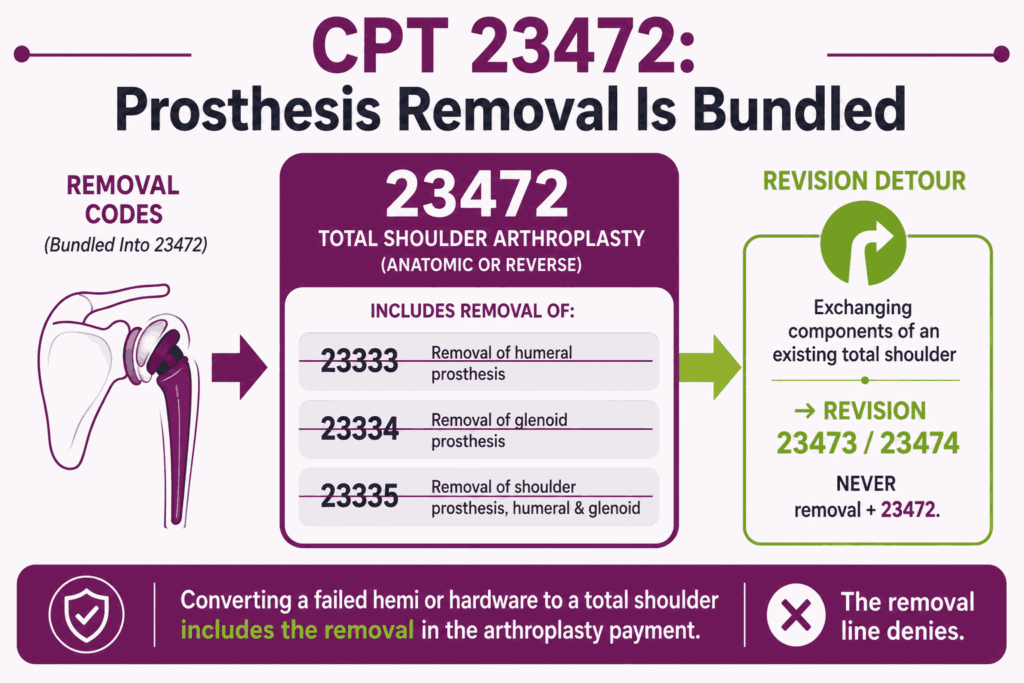
NCCI policy bundles prosthesis removal into CPT code 23472 when the removal is part of the same arthroplasty. Converting a failed implant to a total shoulder does not support a separate removal line.
The removal bundling rules are:
- Exchange of components of an existing total shoulder prosthesis is a revision under 23473 or 23474, not a removal plus 23472
- 23333 and the deep prosthesis removal codes 23334 and 23335 are bundled into 23472 for the same shoulder
- Removing a failed hemiarthroplasty or failed hardware during conversion is included in the arthroplasty payment
- Billing a removal code alongside CPT 23472 for the ipsilateral shoulder results in denial of the removal line
Units, MUEs & Global Period Billing Rules
CPT code 23472 is billed as one unit per shoulder per operative session. Bilateral and staged cases use modifiers rather than additional units.
Unit and staging rules include:
- Report one unit of 23472 per shoulder, since the code describes a single total shoulder arthroplasty
- Same-session bilateral cases use modifier 50 or the payer’s required two-line format
- Staged bilateral cases within the global period use modifier 58 on the second shoulder
- Confirm the current Medically Unlikely Edit value through CMS, since the table updates quarterly
Implant Charge Capture and Device-Intensive Rate Billing in Facility vs. ASC Settings
Implant and device charges are captured on the facility claim, not the surgeon professional claim for CPT code 23472. The setting determines the device reimbursement method.
The implant billing rules are:
- The surgeon professional fee for 23472 does not include the implant cost
- Hospital settings capture the implant through the inpatient or outpatient facility payment
- ASC payment for shoulder arthroplasty follows the ASC fee schedule and its device policy, so confirm the payment indicator in the current ASC addenda
- The facility record must document the implant manufacturer, model, and lot number for charge capture
Prior Authorization Specificity: Why rTSA Requires Different Documentation Than aTSA
Both configurations share CPT code 23472, but the authorization evidence differs by design. The payer approves the code based on a diagnosis-and-documentation package that must match the configuration performed.
The configuration-specific authorization rules are:
- Anatomic TSA authorization rests on end-stage glenohumeral arthritis with an intact, functioning rotator cuff
- Reverse TSA authorization rests on cuff-deficiency pathology, such as cuff tear arthropathy or pseudoparalysis, or a fracture indication
- An ICD-10 code that matches the wrong configuration, such as a plain cuff-tear code for an anatomic design, drives medical-necessity denial
- Medicare coverage for the reverse design follows the applicable LCD, and some commercial policies exclude an irreparable cuff tear without qualifying joint pathology
Getting the configuration-to-diagnosis pairing right starts with the code categories mapped in our orthopedic diagnosis codes guide, from cuff arthropathy coding to fracture series.
90-Day Global Period, Modifier 58 Staged-Procedure Rules, and Split Care (54/55) Billing
CPT code 23472 carries a 90-day global period that includes routine post-operative care. Global-period returns, unrelated visits, and transferred care each have a specific modifier.
The global-period rules are:
- Routine post-operative visits within 90 days are included in the 23472 payment
- A staged or planned procedure during the global period, such as a staged contralateral shoulder, uses modifier 58
- An unplanned related return to the operating room uses modifier 78, an unrelated procedure uses modifier 79, and an unrelated E/M visit uses modifier 24
- Split care uses modifier 54 for the surgeon and modifier 55 for the physician who assumes post-operative management, with the transfer date documented
Top Reasons For Denials Specific To 23472 & Quick Remedies
- Missing or Expired Prior Authorization: Prevent by securing authorization specific to CPT code 23472, the correct shoulder, and the planned setting before scheduling.
- Diagnosis-to-Configuration Mismatch: Prevent by pairing the reverse design with cuff-arthropathy or fracture codes and the anatomic design with intact-cuff arthritis codes.
- Separately Billing Prosthesis Removal (23333/23334/23335): Prevent by removing the removal line, since NCCI bundles ipsilateral prosthesis removal into 23472.
- Missing Laterality Modifier: Prevent by appending RT or LT to every unilateral claim, since most payers require laterality on joint replacement.
What Category of CPT Code Does 23472 Fall Under?
CPT 23472 is a Category I surgical code under the musculoskeletal system section of the CPT code set. Knowing the types of CPT codes and how they are organized helps clarify why total shoulder replacement is coded separately from partial arthroplasty. Each procedure type occupies its own place within the classification to ensure accurate billing and reimbursement.