
CPT code 33249 reports the insertion or replacement of a permanent implantable cardioverter-defibrillator system, with transvenous leads, in a single-chamber or dual-chamber configuration. The code covers the pulse generator and the leads as one service.
CPT 33249 answers to National Coverage Determination 20.4, which imposes documentation duties no ordinary surgical code carries. Primary-prevention implants require a formal shared decision-making encounter, modifier Q0, and registry participation, and a Comprehensive Error Rate Testing study once tied roughly 85 percent of improper payments on this code to insufficient documentation.
Those coverage duties, plus the KX attestation Medicare shares with pacemaker claims, drive most revenue loss on the code. Many electrophysiology groups route device claims through dedicated cardiology billing services to manage them.
What Is the Description of CPT Code 33249?
The 33249 CPT code description as defined by the AMA is: “Insertion or replacement of permanent implantable defibrillator system, with transvenous lead(s), single or dual chamber.”
This code reports the implantation of a complete transvenous defibrillator system. CPT code 33249 includes creation of the generator pocket, placement of one or two transvenous leads, connection to the pulse generator, and defibrillation threshold testing when performed.
The single-or-dual-chamber language means the same code applies whether the operator places one lead or two. Procedure code 33249 is the complete-system code, distinct from the generator-only code and from the codes used when a generator connects to leads already in place.
What Does the Implantable Defibrillator System Include for CPT Code 33249?
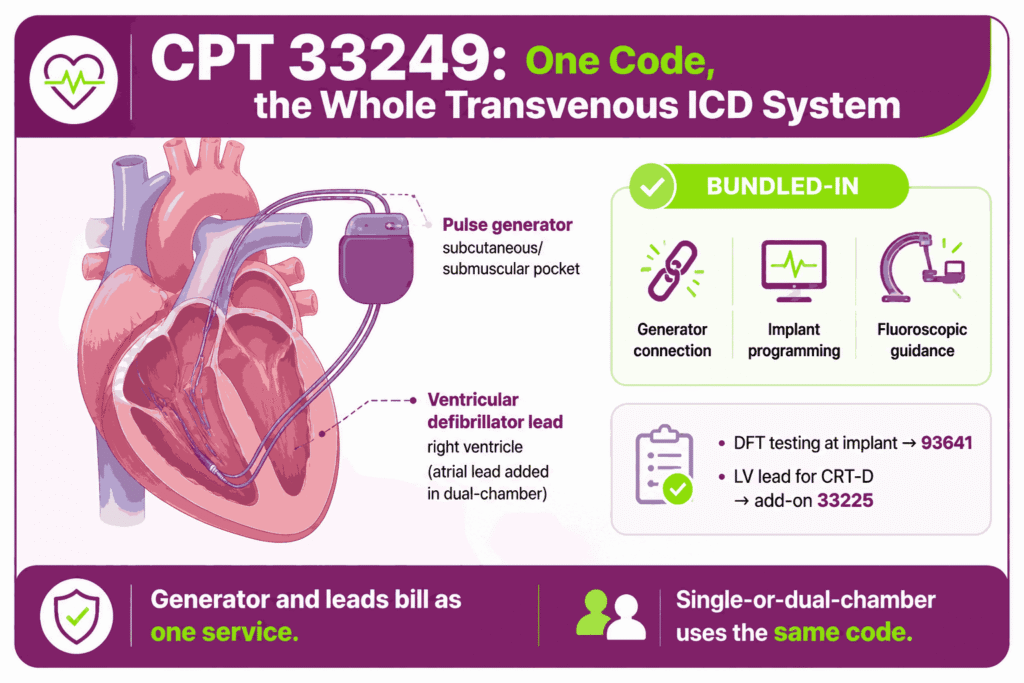
CPT code 33249 bundles the entire transvenous defibrillator system into one reportable service. The generator and the leads are never billed as separate lines.
The system components included in the code are:
- The pulse generator implanted in a subcutaneous or submuscular pocket
- The transvenous defibrillator lead in the right ventricle, with an atrial lead added in dual-chamber systems
- Connection to the generator and intraoperative device programming at implant
- Fluoroscopic guidance for lead placement
Defibrillation threshold testing performed at the time of implant is reported separately with 93641, which the operative example in the coverage guidance pairs with 33249. Device interrogation and programming at later encounters are billed at those follow-up visits, not on the implant date.
How Does CPT Code 33249 Differ From CPT 33240, 33230, 33231, and the Subcutaneous ICD (33270/33271)?
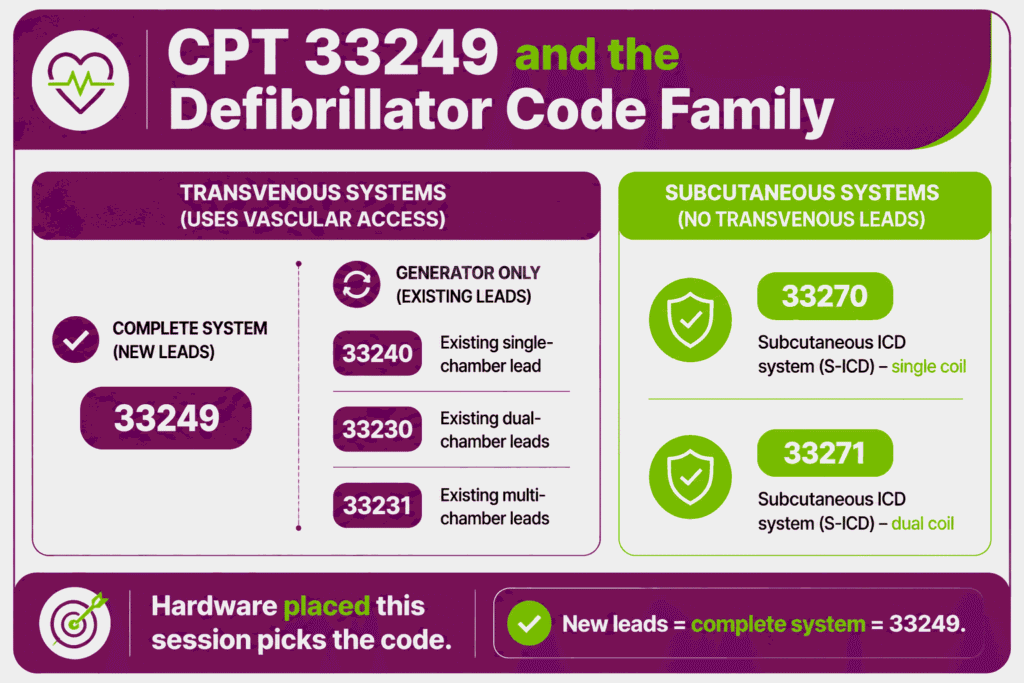
The defibrillator codes split by what is implanted and by whether the leads are new or already in place. Code selection follows the hardware placed in that session.
The defibrillator codes break down as follows:
- 33240 inserts or replaces the pulse generator only, connecting to existing transvenous leads
- 33230 inserts a generator with an existing dual-lead system, and 33231 inserts a generator with an existing multi-lead system
- 33249 inserts or replaces a complete system, generator plus one or two new transvenous leads
- 33270 and 33271 insert or replace a subcutaneous defibrillator system and its subcutaneous electrode, which has no transvenous lead and no intracardiac component
The transvenous complete-system work is CPT code 33249. A generator swap on functioning leads is 33240, and a subcutaneous device that never enters the vasculature is 33270 or 33271. For a deeper map of the rhythm-device family, see the cardiology CPT codes guide.
How Is a CRT-D (Biventricular Defibrillator) Reported With CPT 33249 and Add-On 33225?
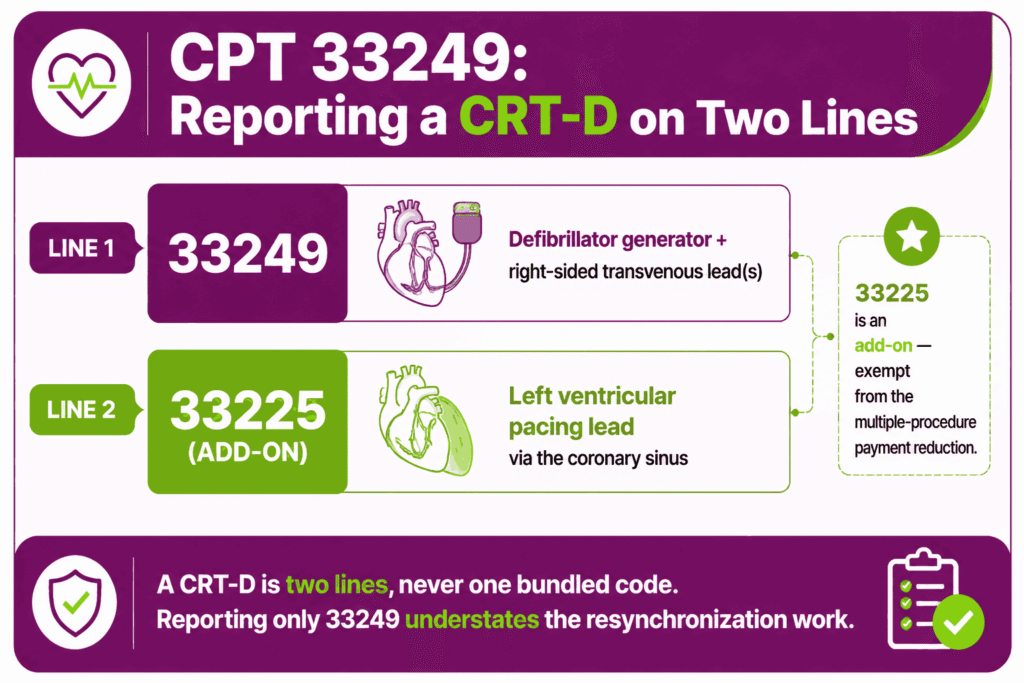
A cardiac resynchronization therapy defibrillator is reported by pairing CPT code 33249 with the left ventricular lead add-on. The base code covers the defibrillator system, and the add-on covers the coronary sinus lead that makes it biventricular.
The CRT-D reporting rules are:
- Report 33249 for the defibrillator generator and the right-sided transvenous lead or leads
- Report add-on code 33225 for insertion of the left ventricular pacing lead through the coronary sinus at the same session
- The add-on 33225 is reported in addition to the base implant and is not subject to the multiple-procedure payment reduction
- The record must document the coronary sinus lead placement to support the add-on line
A CRT-D therefore reports on two lines, 33249 and 33225, not a single bundled code. Reporting only the base code understates the resynchronization work performed.
When Does CPT 33249 Apply to a Replacement System vs. a New Implantation?
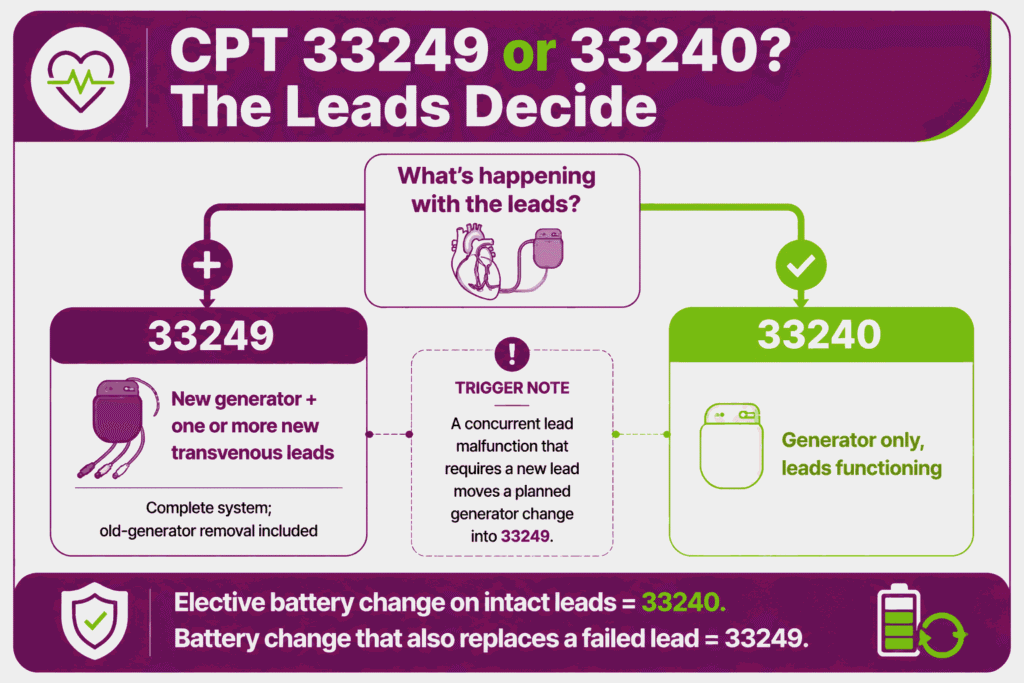
CPT code 33249 covers a replacement only when new transvenous leads are placed as part of the system, not a generator swap on existing leads. The distinction turns on the leads, not the generator.
The replacement code-selection rules are:
- A complete system replacement, new generator plus one or more new transvenous leads, is 33249
- A generator-only replacement connecting to functioning existing leads is 33240
- Removal of the prior generator is included in the replacement code and is not separately reported
- A concurrent lead malfunction that requires a new lead moves a planned generator change into 33249 territory
The operative note controls the choice. An elective battery change on intact leads is 33240, while a battery change that also replaces a failed lead is a complete-system replacement under CPT 33249.
What Is the Mandatory Shared Decision-Making Requirement for Primary Prevention ICD Implantation Under NCD 20.4?
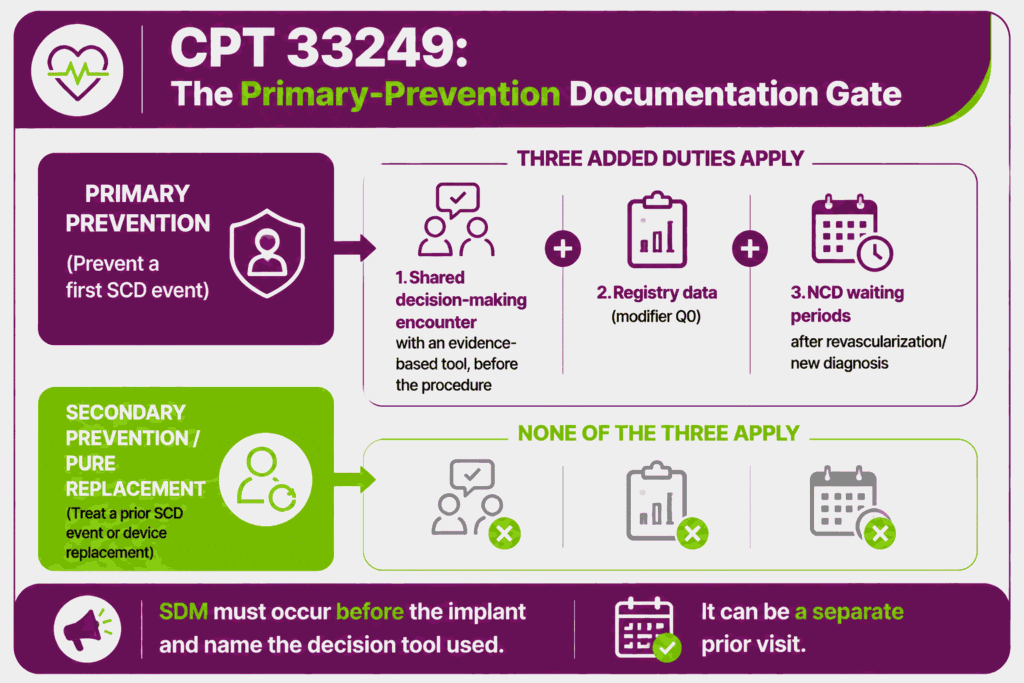
NCD 20.4 requires a formal shared decision-making encounter before a primary-prevention implant of CPT code 33249. The encounter must occur before the procedure and must use an evidence-based decision tool.
The shared decision-making requirements are:
- A physician or qualified non-physician practitioner conducts the encounter with the patient before the implant
- The discussion uses an evidence-based decision aid specific to implantable cardioverter-defibrillators
- The encounter may take place at a separate visit ahead of the procedure date
- The record must document that the encounter occurred and which decision tool was used
This requirement applies to primary prevention, where the device is placed to prevent a first sudden-cardiac-death event. Secondary-prevention implants, placed after a documented life-threatening arrhythmia, and pure replacements do not carry the shared decision-making mandate.
What Are the Modifiers for CPT Code 33249?
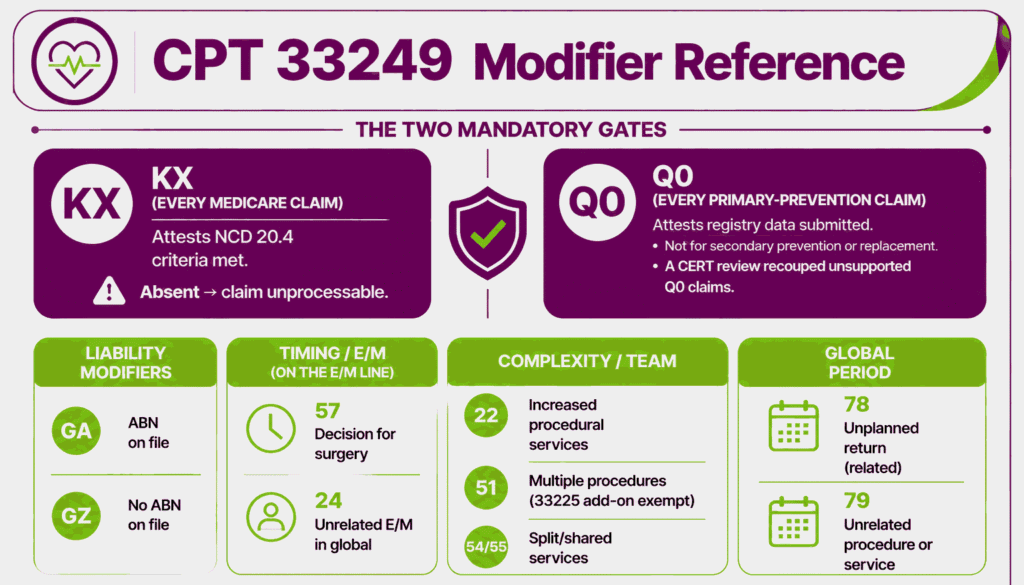
CPT 33249 carries two mandatory Medicare modifiers, KX and Q0, alongside the usual complexity, split-care, and global-period set. The two attestations answer to NCD 20.4.
Modifier 22: Increased Procedural Services
Modifier 22 reports substantially greater work than the procedure typically requires. Append modifier 22 to CPT code 33249 only when the operative note documents the added difficulty, such as variant venous anatomy or dense adhesions from a prior device. A narrative must accompany the claim.
Modifier 24: Unrelated E/M Service During 90-Day Post-Op Period
Modifier 24 reports an evaluation and management visit during the global period that is unrelated to the implant. Append modifier 24 to the E/M code, not to 33249, when the cardiologist manages a separate problem within the 90 days. The documentation must show the visit was not routine device aftercare.
Modifier 51: Multiple Procedures Same Session
Modifier 51 identifies multiple procedures in the same session. Append modifier 51 to the secondary procedure when CPT code 33249 is performed with another separately payable procedure. The add-on 33225 is exempt, since add-on codes are not subject to the multiple-procedure reduction.
Modifier 54: Surgical Care Only (Split Care)
Modifier 54 reports the surgical care only, when the implanting physician transfers post-operative management. Append modifier 54 to 33249 when the operator implants the device but another physician manages the 90-day recovery. Payment covers the intraoperative portion of the global package.
Modifier 55: Post-Operative Management Only (Split Care)
Modifier 55 reports the post-operative management only. The physician who assumes recovery care appends modifier 55 to CPT code 33249 with the date care was assumed. The 54 and 55 claims together account for the full global package.
Modifier 57: Decision for Surgery (Pre-Op E/M on Day of or Day Before Surgery)
Modifier 57 attaches to the evaluation and management visit at which the decision for major surgery was made, on the day of or the day before the implant. Append modifier 57 to the E/M code, not to 33249. The urgent secondary-prevention admission after sustained ventricular tachycardia is a typical case.
Modifier 59 / XS: Distinct Procedural Service
Modifier 59, or the more specific XS, identifies a genuinely distinct procedure at a separate site or session. Append it to the qualifying companion code only after checking the NCCI edit pair, since services integral to the implant are bundled into CPT code 33249 and no modifier makes them payable.
Modifier 78: Unplanned Return to OR During Global Period
Modifier 78 reports an unplanned return to the operating room for a related complication during the global period. Append modifier 78 to the second procedure when a complication of 33249, such as lead dislodgement or pocket hematoma requiring evacuation, forces unplanned surgery. Payment covers intraoperative work only.
Modifier 79: Unrelated Procedure During Global Period
Modifier 79 reports an unrelated procedure during the global period. Append modifier 79 to a service unrelated to the CPT code 33249 recovery. The modifier starts a new global period for the unrelated procedure.
Modifier KX: Required on Every Medicare ICD Claim — Returned Unprocessable Without It
Modifier KX attests that documentation on file shows the patient meets the NCD 20.4 coverage criteria. Medicare processing rules return implantable-defibrillator claim lines without KX as unprocessable, so KX belongs on every Medicare 33249 claim with the supporting record behind it. The attestation must be true, not merely present.
Modifier GA: Waiver of Liability Statement on File
Modifier GA reports that a signed Advance Beneficiary Notice of Noncoverage is on file for a service expected to be denied as not medically necessary. Append GA to CPT code 33249 when the indication falls outside the covered conditions, and the patient accepted financial liability in writing.
Modifier GZ: Item or Service Expected to Be Denied as Not Medically Necessary
Modifier GZ reports an expected medical-necessity denial with no ABN on file. Append GZ to 33249 when the indication is non-covered, and no waiver was obtained. The line is denied with provider liability, and the modifier documents that the practice knew coverage was unlikely.
Modifier Q0: Required on Primary-Prevention ICD Claims (Not Secondary Prevention or Replacement)
Modifier Q0 reports that the implant data is submitted to a qualifying data collection system, which NCD 20.4 requires for primary prevention. Append Q0 to CPT code 33249 for every primary-prevention implant, since Medicare covers those implants only when data reaches an approved registry such as the ACC National Cardiovascular Data Registry. Q0 is not required for secondary-prevention or replacement indications, and a CERT review that found no documentation supporting Q0 has resulted in recoupment.
What Are the Medicare Coverage and NCD 20.4 Criteria for CPT Code 33249?
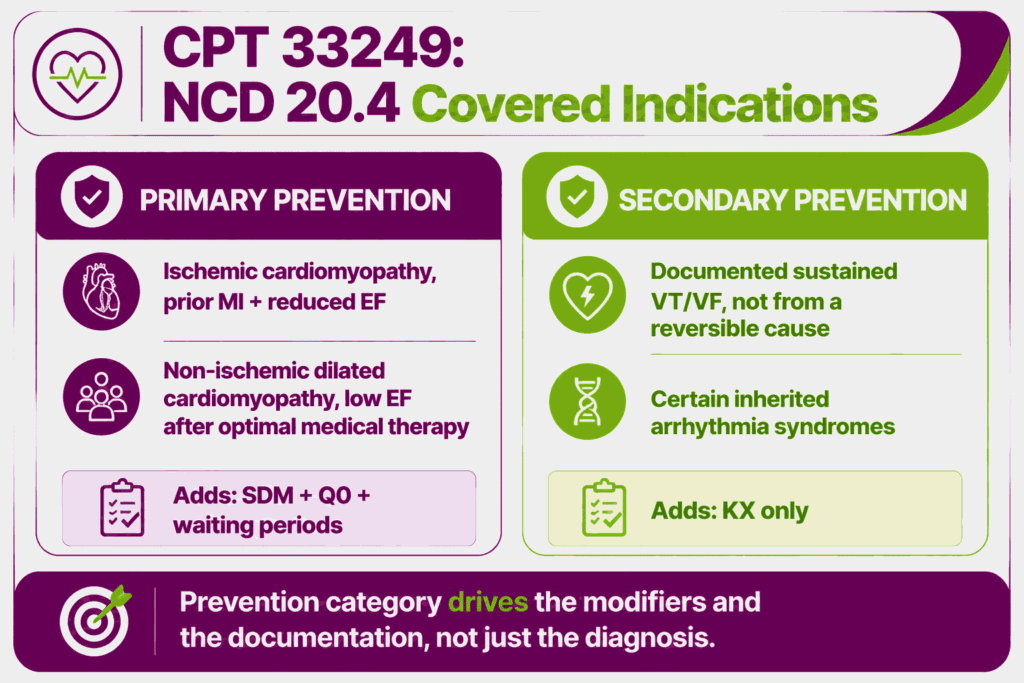
NCD 20.4 defines the covered indications for CPT code 33249, spanning both primary and secondary prevention of sudden cardiac death. The diagnosis and the prevention category together drive the modifiers and the documentation.
The principal covered indications include:
- Ischemic cardiomyopathy with a documented prior myocardial infarction and reduced ejection fraction, for primary prevention
- Non-ischemic dilated cardiomyopathy with a low ejection fraction after a minimum period of optimal medical therapy
- A documented episode of sustained ventricular tachycardia or ventricular fibrillation not from a reversible cause, for secondary prevention
- Certain inherited arrhythmia syndromes and other conditions the NCD specifies
Primary-prevention coverage adds three duties that secondary prevention does not: the shared decision-making encounter, registry data submission with modifier Q0, and waiting periods after revascularization or new diagnosis where the NCD specifies them. For the diagnosis codes that support these indications, see the cardiology ICD-10 codes guide.
Which Documents Are Required For CPT Code 33249?
Documentation for CPT code 33249 must prove the NCD indication, support both mandatory modifiers, and record the implanted hardware. The CERT findings on this code make documentation the central compliance risk.
The required documentation includes:
- Ejection fraction measurement by echocardiogram, MUGA, or another accepted method
- Evidence of a prior myocardial infarction for ischemic indications, or the medical-therapy duration for non-ischemic cardiomyopathy
- Documentation of the sustained arrhythmia and exclusion of reversible causes for secondary prevention
- The shared decision-making encounter and the decision tool used, for primary prevention
- Confirmation of registry or trial data submission supporting modifier Q0
- The operative report describing pocket creation, lead placement, and threshold testing
- Device and lead records, including manufacturer, model, and serial numbers
What is the Cost of CPT Code 33249?
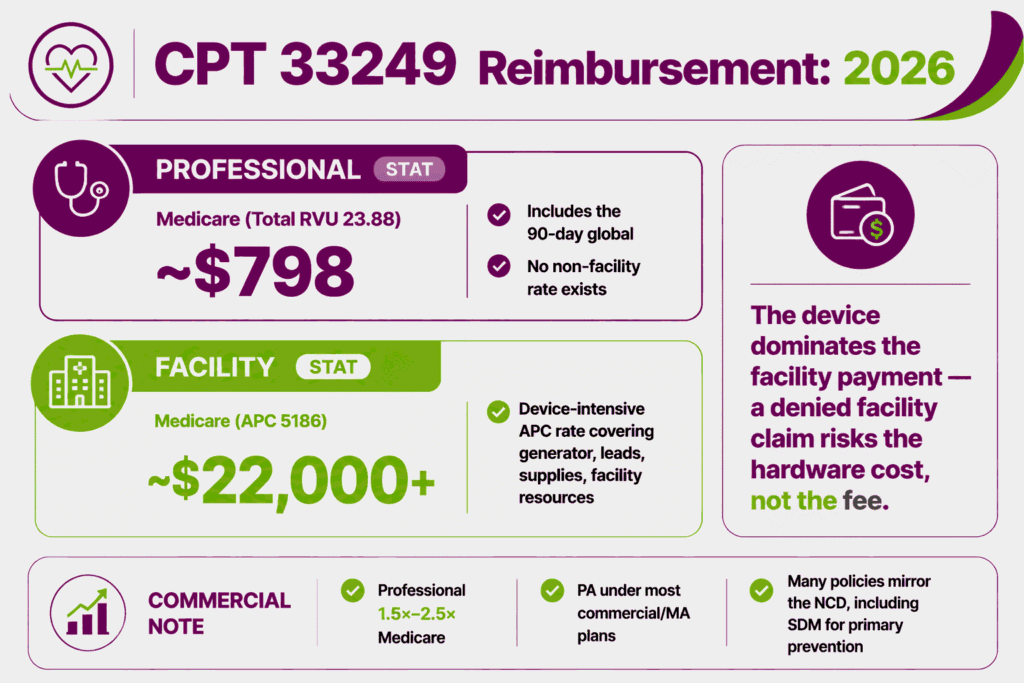
The cost of CPT code 33249 splits into the physician professional fee and a facility payment that carries the device cost. The device makes the facility side the larger figure by far.
RVUs & Medicare Physician Payment
Medicare prices the professional component of CPT code 33249 through the Physician Fee Schedule. The CY2026 facility values appear below.
| Component | Value (CY 2026) |
|---|---|
| Total RVU (facility) | 23.88 |
| Medicare professional payment (facility) | ~$798 |
| Conversion factor | $33.4009 |
| Global period | 090 |
No non-facility rate is established, because the implant is performed only in facility settings. The professional fee covers the implant and the 90-day global period, and GPCI adjustments change the final amount by locality.
OPPS APC Rate and Hospital Facility Payment
The hospital facility payment for CPT code 33249 dwarfs the professional fee, because the defibrillator generator and leads are high-cost devices. The outpatient payment flows through the Outpatient Prospective Payment System at the assigned device-intensive APC rate.
The facility payment points are:
- Hospital outpatient billing pays a device-intensive APC rate that covers the generator, leads, supplies, and facility resources
- Hospital inpatient billing pays through the inpatient prospective payment system when the admission meets inpatient criteria
- The device cost is the dominant component of the facility payment, so a denied facility claim carries far more exposure than a denied professional claim
- Manufacturer device credits reduce the facility payment and must be reported
Commercial Payers
Commercial plans reimburse procedure code 33249 at a contracted multiple of the Medicare rate, with professional allowed amounts commonly running 1.5 to 2.5 times Medicare for major cardiac device procedures. Prior authorization applies under most commercial and Medicare Advantage plans.
Many commercial policies mirror the NCD 20.4 clinical criteria, including the shared decision-making expectation for primary prevention. The facility device cost drives the episode total, so clean documentation protects both the professional and the facility claim.
Place-of-Service & Geographic Adjustments
CPT code 33249 is performed in facility settings, and the facility payment differs by site. Locality then adjusts the professional fee.
Key setting and geographic factors include:
- GPCI values adjust the work, practice expense, and malpractice components by locality
- Hospital outpatient billing pays the device-intensive APC rate for the implant
- Hospital inpatient billing pays through the inpatient prospective payment system on qualifying admissions
- The professional fee remains the facility-rate amount regardless of the facility type
What Are Example Clinical Scenarios or Use Cases for CPT Code 33249?
CPT code 33249 applies when a covered arrhythmic risk requires a complete transvenous defibrillator system. The scenarios below show the primary and secondary prevention pathways and the replacement boundary.
Scenario 1: Ischemic Cardiomyopathy with Reduced Ejection Fraction (Primary Prevention)
ICD-10: I25.5 (Ischemic cardiomyopathy) and I50.22 (Chronic systolic heart failure)
A patient with a prior myocardial infarction has an ejection fraction of 28 percent and NYHA Class II heart failure on optimized guideline-directed therapy, with no recent revascularization. A formal shared decision-making encounter is completed before the procedure. The electrophysiologist implants a dual-chamber defibrillator system. The practice reports CPT code 33249 with modifiers KX and Q0, with registry submission documented.
Scenario 2: Sustained Ventricular Tachycardia Following Prior Myocardial Infarction (Secondary Prevention)
ICD-10: I47.20 (Ventricular tachycardia, unspecified) and I25.2 (Old myocardial infarction)
A patient presents after an episode of sustained ventricular tachycardia unrelated to an acute infarction or reversible cause. The arrhythmia is a documented life-threatening event, which makes this a secondary-prevention indication. The electrophysiologist implants a single-chamber defibrillator. The practice reports CPT 33249 with modifier KX, and modifier Q0 is not required because the implant is for secondary prevention.
Scenario 3: Non-Ischemic Cardiomyopathy with LVEF Below 35% After Optimal Medical Therapy
ICD-10: I42.0 (Dilated cardiomyopathy) and I50.22 (Chronic systolic heart failure)
A patient with non-ischemic dilated cardiomyopathy has an ejection fraction of 30 percent after at least three months of optimal medical therapy. A shared decision-making encounter is documented before the procedure. The electrophysiologist implants a defibrillator system for primary prevention. The practice reports CPT code 33249 with modifiers KX and Q0, supported by the therapy-duration and ejection-fraction records.
Scenario 4: Complete ICD System Replacement Due to End-of-Battery Life with Concurrent Lead Malfunction
ICD-10: T82.111A (Breakdown of cardiac electronic device, initial encounter) and T82.120A (Displacement of cardiac electrode, initial encounter)
A patient with an existing defibrillator reaches elective replacement interval, and testing shows a malfunctioning ventricular lead. The operator explants the generator and the failed lead and implants a new generator with a new transvenous lead. Because a new lead is placed, this is a complete-system replacement. The practice reports CPT code 33249 with modifier KX, and Q0 is not required for a replacement.
What Are the CPT Code 33249 Rules To Ensure Successful Reimbursement?
Follow the NCCI bundling rules, the unit and global-period limits, the device-credit reporting rules, and the NCD 20.4 documentation duties. Meeting these rules protects CPT code 33249 claims from rejection, denial, and recoupment.
Bundling / NCCI / Same-Day Procedure Rules
NCCI rules bundle the services integral to the implant into CPT code 33249. The system components and the supporting procedures are not separately reportable.
The core bundling rules are:
- Defibrillation threshold testing at implant is reported with 93641, and the left ventricular lead for a CRT-D is reported with add-on 33225
- Lead insertion is never billed separately, since the transvenous leads live inside the code
- Removal of a prior generator during a replacement is included and not separately reported
- Fluoroscopic guidance for lead placement is bundled into the implant
Units, MUEs & 90-Day Global Period Billing Rules
CPT code 33249 is billed as one unit per patient per date of service. The global package then governs the 90 days that follow.
Unit and global-period rules include:
- One unit per date of service, since a patient receives one defibrillator system
- Routine post-operative visits and routine device checks within 90 days are included in the payment
- An unplanned related return to the operating room uses modifier 78, an unrelated procedure uses modifier 79, and an unrelated E/M visit uses modifier 24
- Split care between the implanting operator and a managing physician uses modifiers 54 and 55
Device Credit and Replacement Rules Under Medicare
When a manufacturer supplies a replacement device at no cost or partial credit, Medicare requires the facility to report the credit, which reduces the facility payment. The professional claim for CPT code 33249 is unaffected, but the facility claim must disclose the credit.
- The device-credit rules are:
- Failing to report a manufacturer credit on a replacement implant is a recoupment and compliance exposure for the facility
- A device furnished without cost or with credit for a recalled or warrantied device is reported with condition code 49 for a warranty replacement or condition code 50 for a recall
- The credit amount is reported with value code FD on the facility claim
- Medicare reduces the outpatient facility payment to account for the credit when it meets the reporting threshold
Top Reasons For Denials Specific To 33249 & Quick Remedies
- Missing Modifier Q0 on a Primary-Prevention Claim: Prevent by appending Q0 to every primary-prevention CPT code 33249 claim and documenting registry data submission, since a CERT review found no-support Q0 claims recouped.
- Claim Returned or Denied for Missing KX: Prevent by appending modifier KX to every Medicare claim line, with NCD 20.4 documentation on file behind it.
- No Documented Shared Decision-Making Encounter: Prevent by completing and recording the evidence-based shared decision-making encounter before every primary-prevention implant.
- Insufficient Clinical Documentation: Prevent by capturing ejection fraction, prior-MI or therapy-duration evidence, and reversible-cause exclusion, since insufficient documentation drove most improper payments on this code.
Why Does a Procedure as Specific as ICD Implantation Have Its Own Dedicated CPT Code?
Because CPT codes are built around procedure specificity, each distinct combination of technique, device type, and clinical intent gets its own code to ensure accurate reimbursement and clear documentation of what was actually performed. To understand why 33249 exists separately from 33240 or 33230, rather than being billed as a variation of the same procedure, you need to know the types of medical CPT codes at a foundational level.