
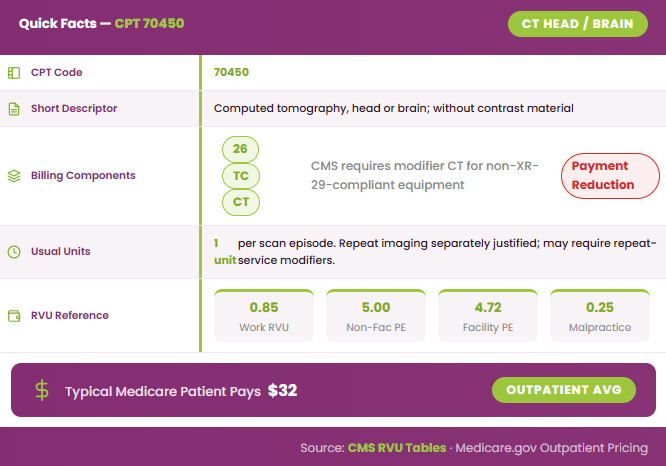
What Is the Description of CPT Code 70450?
CPT 70450 reports a CT scan of the head or brain without contrast. It is used for diagnostic evaluation of intracranial symptoms, trauma, bleeding concerns, and other neurologic findings. CMS coverage guidance for head and neck CTs requires that the service be reasonable and necessary, with documentation supporting the clinical need.
What Equipment and Technique Are Required for CPT Code 70450?
70450 requires a CT scanner and appropriate imaging workflow for non-contrast head imaging. In an IDTF setting, CMS lists 70450 under general supervision and identifies a board-certified radiologist or neurologist as the supervising physician, with a qualified CT technologist for performance.
The study is performed without contrast. The report should clearly confirm that no contrast was used, describe the anatomy imaged, and document the clinical reason for the exam. If the scanner is not XR-29 compliant, modifier CT is required.
How Does CPT Code 70450 Differ From CPT 70460, 70470, and 70551?
To clearly understand when to use CPT 70450 versus related imaging codes, the following table compares 70450 with similar CT and MRI procedures:
What Are the Modifiers for CPT Code 70450?
CPT Code 70450 may require modifiers to indicate the billing component, repeat studies, or equipment compliance. Commonly used modifiers include:
Modifier 26 – Professional Component
Used when billing only the radiologist’s interpretation of the CT scan. The facility or technical portion is billed separately using TC. Documentation should clearly show interpretation was done independently.
Modifier TC – Technical Component
Used when billing only the technical portion of the CT scan, including the CT machine, technologist services, and supplies. The interpretation is billed separately by the provider with modifier 26.
Modifier CT – CT Compliance
Required when the CT scanner is non-XR-29-compliant. CMS rules mandate this modifier, which may result in a payment reduction. Always document equipment compliance in the report.
Modifier 59 / XS – Distinct Procedural Service / Separate Structure
Used when 70450 is performed as a separate service from another imaging procedure on the same day. Documentation must support that the service is independent and not bundled. XS is preferred when the procedure is on a separate anatomical structure.
Modifier 76 / 77 – Repeat Imaging
- 76: Repeat scan on the same day for medical necessity.
- 77: Repeat scan on a different day for medical necessity.
These modifiers justify repeat studies and prevent denials for duplicate imaging.
Which Documents Are Required For CPT Code 70450?
Proper documentation ensures medical necessity, accurate billing, and successful reimbursement for CPT 70450. The following items should be included in the patient record:
- Order or Referral: Physician order specifying the CT head or brain without contrast.
- Clinical Indication: Reason for the scan, such as trauma, severe headache, stroke evaluation, or neurologic symptoms.
- Contrast Status Confirmation: Clear documentation that the scan was performed without contrast.
- Radiology Report: Findings, impressions, and interpretation signed by the radiologist.
- Prior Imaging Reviewed: Include notes if previous imaging was evaluated to avoid unnecessary repeats.
- Repeat Scan Justification (if applicable): Explain medical necessity for any repeated studies using modifier 76 or 77.
- Date and Signature: Final report must be signed and dated by the interpreting provider.
- ICD-10 Diagnosis Code: Link the documented clinical indication to an appropriate ICD-10 code for medical necessity.
What Is the Cost of CPT Code 70450?
To accurately determine the cost of CPT 70450, it’s important to evaluate reimbursement across key billing factors.
RVUs & Medicare Payment
CPT 70450 has an approximate work RVU of 0.85, non-facility practice expense RVU of 5.00, facility PE RVU of 4.72, and malpractice RVU of 0.25. Applying the CMS conversion factor and Geographic Practice Cost Index (GPCI), the national Medicare payment typically ranges from $120 to $180 for the professional component and $80 to $150 for the technical component, depending on the site of service.
Commercial Payers
Reimbursement from commercial insurers varies widely based on contracts and region. Payments for CPT 70450 generally fall between 120% and 200% of Medicare rates, though some plans may require prior authorization, particularly for elective or repeat imaging.
Place-of-Service & Geographic Adjustments
The site of service impacts reimbursement significantly. Procedures performed in facility settings (hospital outpatient departments or ASCs) usually result in lower physician payment, with the facility billing separately. Conversely, non-facility settings like imaging centers or outpatient clinics often allow higher physician reimbursement. Geographic Practice Cost Indices (GPCIs) further adjust payment based on local costs of delivering care.
What Are Example Clinical Scenarios or Use Cases for CPT Code 70450?
CPT 70450 is used when a non-contrast CT scan of the head or brain is medically necessary to evaluate acute or chronic neurologic symptoms. Typical scenarios include:
Scenario 1: Head Trauma in the Emergency Department
A patient presents after a fall or accident with confusion or headache. Non-contrast CT evaluates for intracranial hemorrhage or skull fracture.
Scenario 2: Sudden Severe Headache
A patient develops a sudden, severe headache with neurologic changes. CPT 70450 assesses for subarachnoid hemorrhage or acute intracranial pathology without contrast.
Scenario 3: Suspected Stroke or Intracranial Bleeding
A patient presents with acute neurologic deficits. Non-contrast CT rules out hemorrhagic stroke before initiating treatment.
What Are the CPT Code 70450 Rules To Ensure Successful Reimbursement?
To ensure accurate reimbursement and prevent claim denials, providers must follow proper coding, documentation, and payer rules for CPT 70450.
Bundling / NCCI / Same-Day Procedure Rules
70450 is a diagnostic imaging code, so same-day pairing issues often involve other head studies, neurology services, or bundled radiology work. CMS NCCI guidance requires that separately reported services truly be distinct. Use the appropriate modifier only when documentation supports a separate service.
Units, MUEs, and Repeat Imaging Rules
One scan is normally reported as one unit. Excess units trigger MUE concerns, and CMS states that MUEs are set so unusual multiple units should be uncommon. Repeat studies need a clear new reason, not a duplicate claim.
When CPT 70450 Cannot Be Separately Reported and What to Use Instead
Do not use 70450 when contrast is given. Use 70460 or 70470 instead, depending on whether the protocol includes contrast only or both without and with contrast. Also, do not ignore the CT modifier requirement when the scanner is noncompliant.
Top Reasons For Denials Specific To 70450 & Quick Remedies
- Wrong code when contrast was used: Change the claim to 70460 or 70470.
- Missing medical necessity: Link the scan to a specific symptom, trauma event, or neurologic change.
- Duplicate or repeated scan denial: Add the correct repeat-service modifier and document why a second study was needed.
- Missing 26 or TC split: Bill the professional and technical components correctly.
- No CT modifier on noncompliant equipment: Append modifier CT when required and expect the payment reduction.
How are Services Reported to Insurance?
Providers use specific CPT codes in medical billing to identify every procedure performed during your visit. These standard sets of numbers ensure the insurance company understands exactly what services to pay for.