
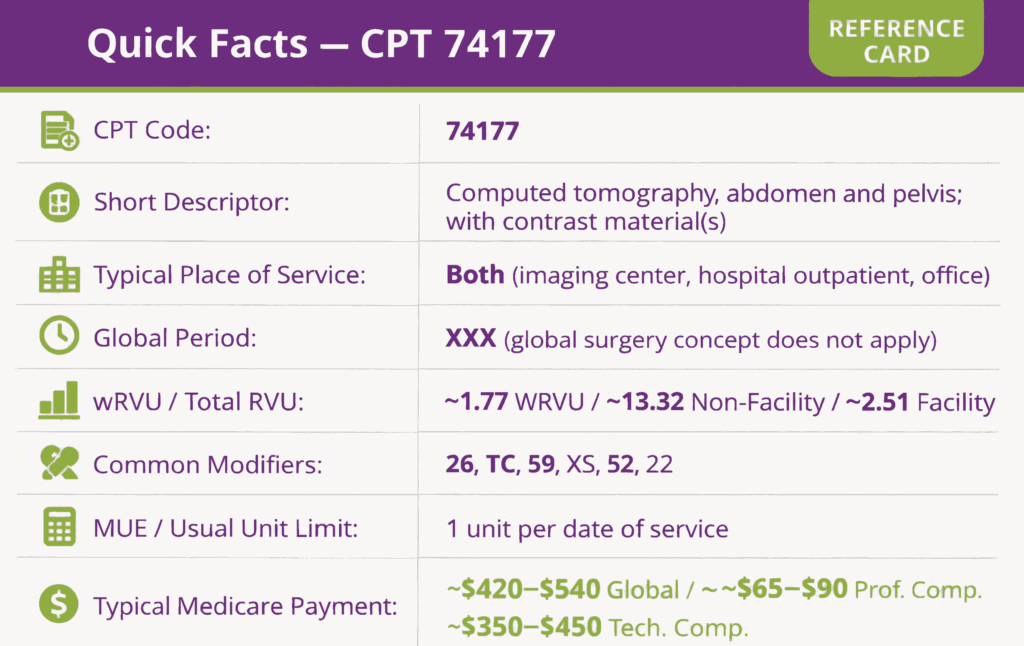
CPT code 74177 is a diagnostic radiology code used to report computed tomography of both the abdomen and pelvis performed with intravenous contrast material in a single imaging session. It applies when contrast is administered, and a single combined acquisition covers both body regions.
This code is used across inpatient, hospital outpatient, ASC, and freestanding imaging center settings for evaluation of acute abdominal conditions, malignancy staging, vascular assessment, and inflammatory or infectious processes requiring contrast enhancement.
What Is the Description of CPT Code 74177?
74177 CPT code description stated by the AMA is: “Computed tomography, abdomen and pelvis; with contrast material(s).”
It covers a single combined CT examination of both the abdomen and pelvis with contrast administration. The radiology report must document that contrast was administered for this code to be correctly supported.
What Anatomical Structures and Contrast Protocol Are Covered Under CPT Code 74177?
The CT examination reported under the CPT 74177 code evaluates the entire abdomen and pelvis in a single combined acquisition. Structures assessed include the liver, gallbladder, spleen, pancreas, kidneys, adrenal glands, bowel, mesentery, retroperitoneum, abdominal aorta and major vessels, bladder, uterus and adnexa (in female patients), prostate (in male patients), and pelvic lymph nodes.
Contrast material, such as administered intravenously, and sometimes supplemented with oral or rectal contrast, enhances visualization of vascular structures, organ parenchyma, masses, and inflammatory processes. The type and route of contrast administration do not change the code reported, provided both abdominal and pelvic regions are covered in a single session with contrast.
How Does CPT Code 74177 Differ From CPT Codes 74176 and 74178?
Per Noridian Medicare (official MAC guidance), these three codes are mutually exclusive for the same CT abdomen and pelvis examination and are distinguished solely by contrast usage:
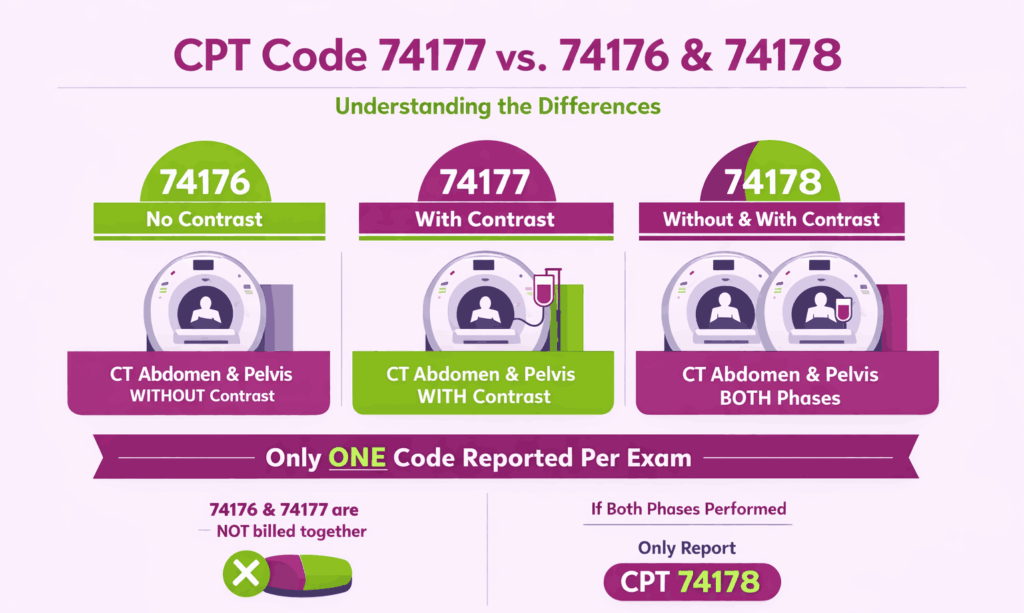
- CPT Code 74176: CT abdomen and pelvis without contrast material. Used when no contrast is administered across either region
- CPT Code 74177: CT abdomen and pelvis with contrast material(s). Used when contrast is administered, and a contrast-enhanced acquisition is the sole or primary protocol
- CPT Code 74178: CT abdomen and pelvis without contrast material(s), followed by contrast material(s) and further sections in one or both body regions. Used when a meaningful non-contrast phase is acquired first, then immediately followed by a contrast-enhanced phase as part of a single combined exam
Per Noridian MAC, only one code from the 74176–74178 family is reported per CT abdomen and pelvis examination. Code CPT 74177 and CPT code 74176 must not be billed together for the same session. When both phases are performed, only CPT 74178 is reported.
What Are the Modifiers for CPT Code 74177?
Code 74177 CPT is a diagnostic radiology code with PC/TC Indicator 1, meaning the professional and technical components may be billed separately depending on the practice arrangement.
Modifier 26: Professional Component Only
Modifier 26 is appended when the interpreting radiologist bills only for the reading, interpretation, and written report, and the technical component is billed separately by the facility or imaging center. Append modifier 26 to CPT code 74177 on the physician’s claim whenever the physician does not own or operate the imaging equipment.
Modifier TC: Technical Component Only
Modifier TC is appended by the facility or imaging center billing for the equipment, technologist, contrast materials, and facility overhead. The physician’s interpretation is not included. Append modifier TC to CPT code 74177 on the facility claim when the reading physician is billing separately with modifier 26.
Modifier 59: Distinct Procedural Service
Modifier 59 is used when procedure code 74177 is performed as a distinct and separately identifiable service from another imaging procedure on the same date. It is used to override an NCCI edit when documentation supports a separate clinical indication or distinct anatomical context, for example, when a CT chest is billed alongside CT abdomen and pelvis on the same date. Append modifier 59 only when documentation clearly establishes the basis for separate billing.
Modifier XS: Separate Structure
Modifier XS is the more specific preferred alternative to modifier 59 when the CT abdomen and pelvis is performed on a separate anatomical structure from another CT performed on the same date. Per AAPC coding guidance, modifier XS is preferred when billing CPT 74177 alongside a thorax code (e.g., 71260) for the same date, as the two studies cover distinct anatomical structures. Append modifier XS to the lower-valued code.
Modifier 52: Reduced Services
Modifier 52 is used when the CT examination is partially reduced, for example, if the pelvis portion is not completed or the full contrast protocol is not administered as planned. Document in the radiology report the reason the complete protocol was not performed and append modifier 52 to the CPT 74177 code.
Modifier 22: Increased Procedural Services
Modifier 22 is used when the complexity of the examination or interpretation substantially exceeds the typical service. This modifier is rarely applicable to routine CT abdomen and pelvis studies. Append modifier 22 with a supporting letter documenting the basis for the increased work when applicable.
When Should CPT 74177 Be Billed Globally vs. With Modifier 26 or TC?
The correct billing approach depends on who performs and owns each component of the service:
- Global billing (no modifier): Used when the same entity performs both the technical acquisition and the professional interpretation, typically a freestanding imaging center or integrated outpatient facility where the radiologist is employed by the entity owning the equipment
- Modifier 26 (professional only): Used by the interpreting radiologist when the technical component is billed separately by a hospital, ASC, or imaging facility
- Modifier TC (technical only): Used by the facility that owns the CT equipment and employs the technologist, when the interpreting physician bills separately
Billing the global code while another entity bills the TC, or billing both components on the same claim, results in a duplicate payment denial. Per the CMS Medicare Claims Processing Manual and guidance confirmed by Noridian MAC, such CPT code categories support both global and split component billing.
Which Documents Are Required For CPT Code 74177?
Documentation for 74177 CPT code must support both the medical necessity of contrast-enhanced CT and the accuracy of the code selected.
Required documents checklist:
- Physician order documenting the clinical indication and specifying CT abdomen and pelvis with contrast
- Radiology report explicitly documenting that contrast material was administered (type, route, and volume)
- Radiology report documenting both abdominal and pelvic anatomy, evaluated with findings
- Documentation of the clinical indication linking to a specific diagnosis, sign, or symptom
- Contrast administration record, including any pre-medication for contrast allergy history
- CDSM (Clinical Decision Support Mechanism) consultation documentation, where required under PAMA, for applicable providers
- If the payer requires prior authorization, documentation of the authorization approval
What is the Cost of CPT Code 74177?
The cost of CPT code 74177 varies by billing component (global, professional, or technical), place of service, payer, and geographic location.
RVUs & Medicare Payment
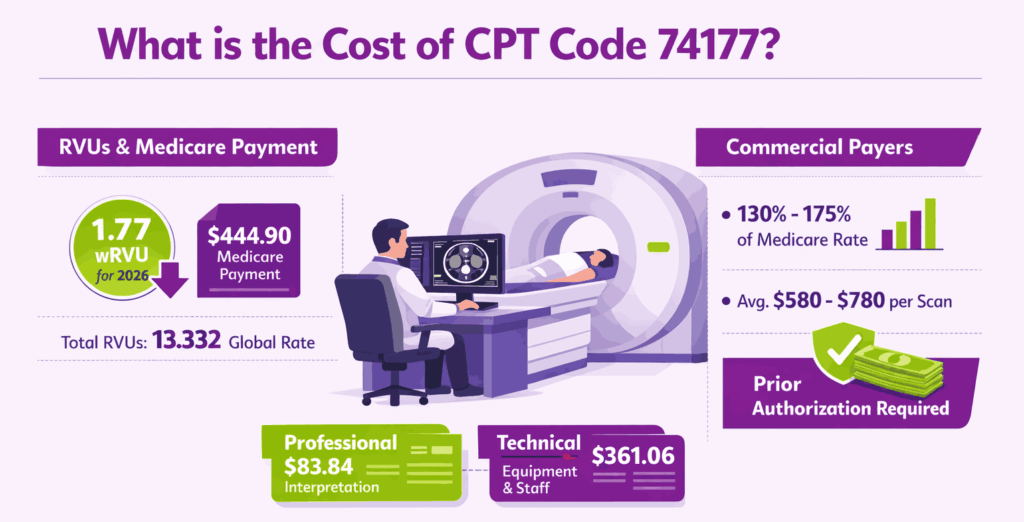
Reimbursement for 74177 is determined by Relative Value Units (RVUs). For 2026, the Work 74177 RVU (wRVU) for this code is 1.77, reflecting a -2.5% efficiency adjustment from the previous baseline of 1.82. However, the Total Global RVU has risen to 13.32 in non-facility settings due to a shift in how Medicare calculates indirect practice expenses, which now favors private offices and independent centers.
When calculated against the 2026 Standard Conversion Factor of $33.4009, the national unadjusted Medicare payment for the global service is $444.90. This is split between the Professional Component ($83.84) for the radiologist’s interpretation and the Technical Component ($361.06) for the facility’s equipment and staff costs.
Commercial Payers
Commercial insurance reimbursement for CPT 74177 is typically negotiated as a percentage of the Medicare rate, typically between 130% and 175% of the federal schedule. This results in an average commercial payment range of $580 to $780 for the global service. Because 74177 is a “with contrast” study, commercial payers in 2026 almost strictly require prior authorization through Radiology Benefit Managers (RBMs).
Place-of-Service & Geographic Adjustments
The final reimbursement is adjusted by the Geographic Practice Cost Index (GPCI), meaning the cost of a 74177 scan in a high-cost area like Miami or Chicago will be higher than the national $444.90 average. Additionally, the Place of Service (POS) determines the billing structure.
What Are Example Clinical Scenarios or Use Cases for CPT Code 74177?
CPT code 74177 applies when CT of both the abdomen and pelvis is performed with contrast, supported by a clinical indication that requires contrast enhancement.
Scenario 1: Evaluation of Suspected Appendicitis or Diverticulitis
ICD-10: K37 (Unspecified appendicitis)
The patient presents to the emergency department with acute right lower quadrant pain, fever, and leukocytosis. The emergency physician orders a CT abdomen and pelvis with contrast to evaluate for appendicitis, alternative inflammatory causes, or perforation. The radiologist performs and interprets the contrast-enhanced study covering both the abdomen and pelvis in a single session, supporting CPT code 74177.
Scenario 2: Staging CT for Known or Suspected Abdominal Malignancy
ICD-10: C18.9 (Malignant neoplasm of colon, unspecified)
The patient has a newly diagnosed colon malignancy and requires a staging CT of the abdomen and pelvis with contrast to evaluate for lymphadenopathy, liver metastases, peritoneal involvement, and regional spread. Contrast is required for accurate staging. The radiologist performs a portal venous phase CT covering the abdomen and pelvis, supporting CPT code 74177 with modifier 26 if the reading physician is separate from the facility.
Scenario 3: Post-Surgical Follow-Up for Suspected Abdominal Abscess or Collection
ICD-10: K68.11 (Postprocedural retroperitoneal abscess)
The patient returns 10 days after abdominal surgery with fever, elevated inflammatory markers, and abdominal pain. The surgical team orders a CT abdomen and pelvis with contrast to evaluate for anastomotic leak, abscess, or fluid collection requiring intervention. Contrast is necessary to characterize the collection and assess for enhancement patterns consistent with abscess versus seroma. CPT code 74177 is reported.
What Are the CPT Code 74177 Rules To Ensure Successful Reimbursement?
Follow payer and policy rules for contrast code selection, component billing, medical necessity, PAMA compliance, and bundling. Meeting these rules reduces denials and ensures correct payment.
Bundling / NCCI / Same-Day Procedure Rules
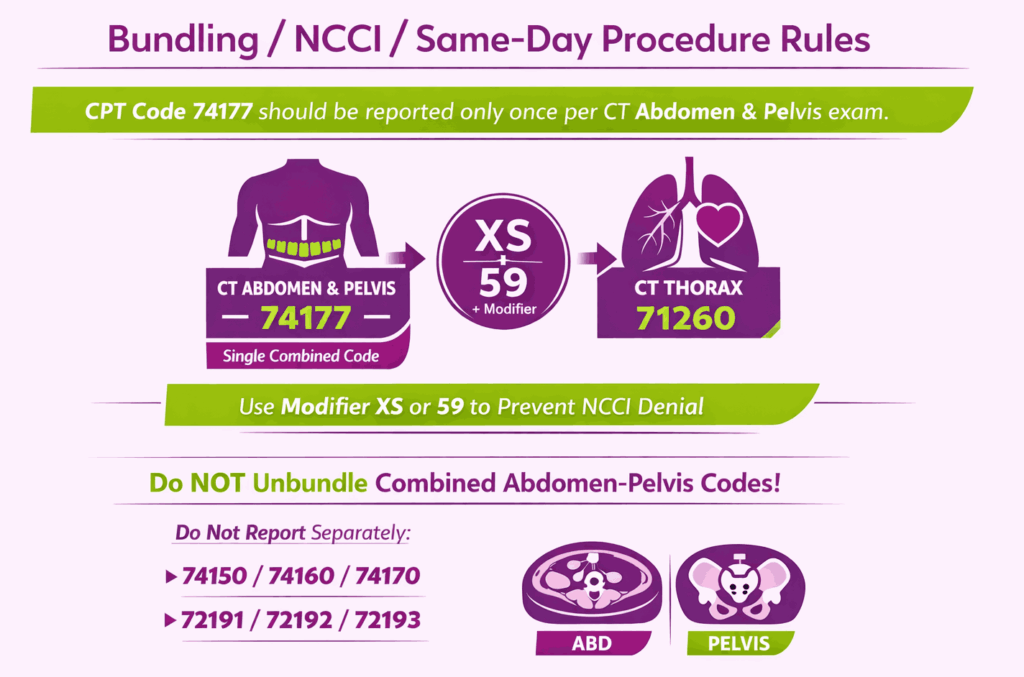
Per Noridian MAC guidance, CPT code 74177 is reported only once per CT abdomen and pelvis examination, regardless of the number of contrast phases or image acquisitions. It must not be reported alongside CPT 74176 for the same session. When CT thorax is billed on the same date as CT abdomen and pelvis, each may be reported independently using the appropriate code family, with modifier XS or modifier 59 appended to the lower-valued code to prevent NCCI bundling denial.
Do not unbundle the combined abdomen-pelvis study into separate abdominal (74150/74160/74170) and pelvic (72191/72192/72193) codes when both regions are covered in a single session.
Units, MUEs & Prior Authorization Requirements
CPT code 74177 is billed as one unit per date of service per anatomical site.
- Medicare will not separately reimburse CPT code 74177 in excess of one unit for a single CT abdomen and pelvis examination
- Medical necessity must be established by the clinical indication documented on the order and confirmed in the radiology report
- PAMA requires applicable ordering physicians to consult a CMS-approved CDSM and document the consultation on the claim for designated advanced imaging services.
- Most commercial payers require prior authorization for CPT code 74177; verify authorization is active before the study is performed
When CPT 74177 Cannot Be Billed Separately From 74176 or Standalone Abdomen/Pelvis Codes
CPT code 74177 cannot be separately reported in the following circumstances:
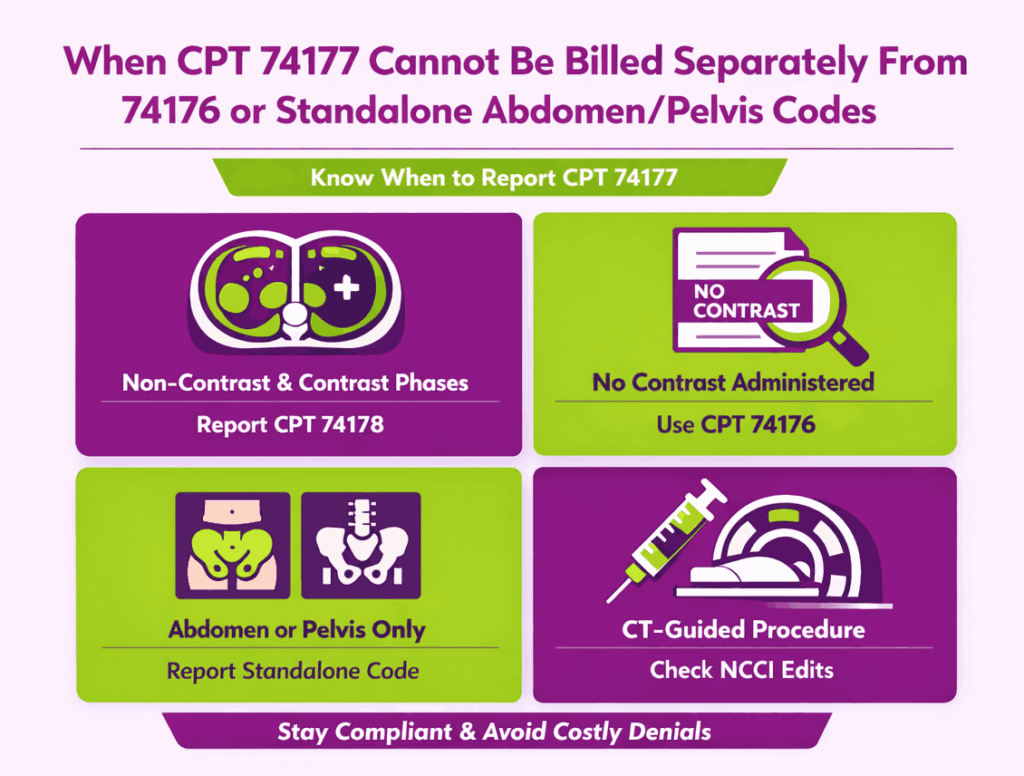
- When both non-contrast and contrast phases are performed for the same abdomen and pelvis in the same session, report CPT 74178 only.
- When the radiology report documents that no contrast was administered, the report governs. If no contrast is documented, CPT 74176 must be used regardless of what was ordered.
- When only the abdomen or only the pelvis is imaged, use the appropriate standalone abdominal or pelvic CT code (e.g., CPT 74160 or 72193).
- When the CT is integral to a CT-guided interventional procedure on the same date, verify NCCI edits before separately reporting 74177 alongside an interventional code for the same anatomical region.
Top Reasons For Denials Specific To 74177 & Quick Remedies
- Wrong Contrast Code Selected (74177 vs. 74176 or 74178): Prevent by cross-checking the radiology report for documentation of contrast administration before selecting the code. If no contrast is documented, bill 74176.
- Missing Modifier 26 or TC on Split-Component Claims: Prevent by establishing a clear billing workflow, interpreting that the physician always bills 74177-26. The facility always bills 74177-TC; neither bills globally when the other is billing a component.
- Simultaneous Billing of 74177 and 74176: Prevent by never submitting these codes together for the same session; use 74178 when both phases are acquired.
- CDSM Non-Compliance Under PAMA: Prevent by confirming whether the ordering provider is subject to CDSM requirements and ensuring the consultation is documented on the claim before submission.