
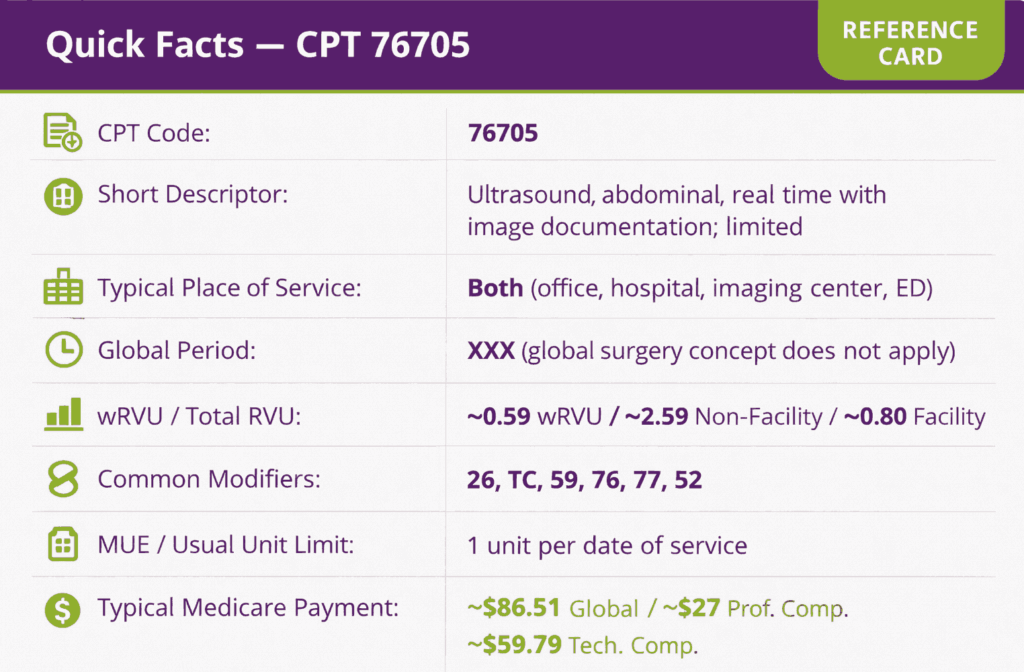
CPT code 76705 is a diagnostic imaging code used to report a real-time abdominal ultrasound with image documentation that is limited in scope. The code is focused on a single organ, anatomical quadrant, or performed as a follow-up to a prior study.
The 76705 CPT code applies when the clinical indication does not require evaluation of all major abdominal structures, and a targeted assessment of one area is sufficient. This code is used across radiology, emergency medicine, gastroenterology, hepatology, and primary care settings in both facility and non-facility environments.
What Is the Description of CPT Code 76705?
76705 CPT code description is defined by the AMA as: “Ultrasound, abdominal, real time with image documentation; limited (e.g., single organ, quadrant, follow-up).”
This code reports a real-time diagnostic ultrasound of the abdomen focused on fewer structures than a complete exam requires. The parenthetical examples, such as single organ, quadrant, and follow-up, are illustrative, not exhaustive. The key criterion is scope. If the exam evaluates only one organ (e.g., gallbladder), one anatomical quadrant (e.g., right upper quadrant), or is a follow-up to a previously documented abdominal finding, 76705 is the appropriate code.
What Organs and Structures Are Evaluated Under CPT Code 76705?
CPT 76705 code may be applied when the ultrasound focuses on any individual intraperitoneal organ or a limited region of the abdomen. These include the liver, gallbladder, common bile duct, pancreas, spleen, or a single quadrant containing multiple structures.
The 76705 procedure code is also used for FAST (Focused Assessment with Sonography for Trauma) exams when limited to the abdominal component. The scope of documentation must match the limited designation. If multiple major organ systems are imaged and documented, CPT 76700 (complete) becomes the appropriate code.
What Does “Limited” Mean for CPT Code 76705 and How Does It Differ From CPT 76700?
Per CPT guidelines, a complete abdominal ultrasound (CPT 76700) requires real-time evaluation and documentation of the liver, gallbladder, common bile duct, pancreas, spleen, kidneys, upper abdominal aorta, and inferior vena cava, including any demonstrated abnormality. If even one required element is absent from the study, the exam must be coded as limited (76705), not complete.
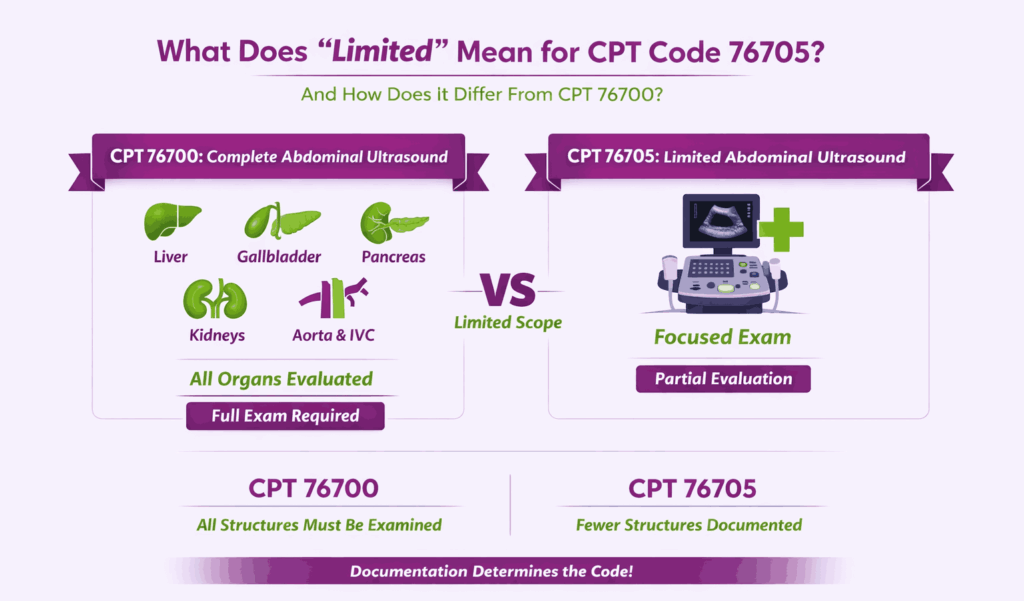
Code CPT 76705 does not have a minimum element list. It applies when the documented scope falls below the 76700 threshold for any reason. The distinction is entirely documentation-driven. 76700 requires all listed structures to be evaluated and reported. 76705 applies to everything less than that standard.
What Are the Real-Time Image Documentation Requirements for CPT Code 76705?
Code 76705 CPT requires real-time ultrasound imaging performed with permanent image documentation retained as part of the medical record. The images must capture the structure(s) evaluated and support the findings reported. A written or dictated interpretation must accompany the study, identifying the organ(s) examined, the clinical indication, the sonographic findings, and a clinical impression.
The report does not need to be a standalone document, but it must contain all interpretation elements to support the professional component. Image storage and report generation are required; a verbal-only finding without documentation does not support billing.
What Are the Modifiers for CPT Code 76705?
Abdominal ultrasound CPT code 76705 is a global code that includes both the technical and professional components. It can be split between components using modifiers 26 and TC when the performing and interpreting entities are different.
Modifier 26: Professional Component Only
Modifier 26 is appended when the physician or qualified provider bills only for the professional interpretation and written report, separate from the technical performance of the study. This applies when a facility or independent imaging center owns the equipment and performs the scan, while the interpreting physician bills separately for reading and reporting. The modifier 26 payment is identical in both facility and non-facility settings for CPT ultrasound 76705.
Modifier TC: Technical Component Only
Modifier TC is appended when the billing entity is reporting only the technical component, the equipment, ultrasound technologist’s services, supplies, and image storage, without the professional interpretation. Facilities that own imaging equipment and employ technologists bill TC when the reading physician bills separately with modifier 26. Do not bill both TC and 26 from the same entity for the same study.
Modifier 59: Distinct Procedural Service
Modifier 59 is used when code CPT 76705 is performed as a distinct service from another ultrasound or imaging procedure on the same date, where NCCI bundling edits would otherwise apply. Documentation must confirm that the studies were separate in clinical purpose, anatomic focus, or timing. Apply modifier 59 only when supported by clear clinical documentation.
Modifier 76: Repeat Procedure by Same Physician
Modifier 76 is used when the same provider repeats the CPT 76705 code on the same patient on the same date due to a distinct medical reason. Documentation must confirm the clinical necessity for a repeat study and that it addressed a separate or evolving clinical question. Do not use modifier 76 to bill a second unit.
Modifier 77: Repeat Procedure by Another Physician
Modifier 77 is used when a different physician performs a repeat limited abdominal ultrasound on the same date as a prior study billed by another provider. Documentation must support the distinct clinical necessity for the second study and identify the separate performing provider.
Modifier 52: Reduced Services
Modifier 52 is used when 76705 CPT was initiated but only partially completed, for example, due to the patient’s inability to cooperate, equipment limitation, or clinical interruption. Document the reason for the reduced service and the portion of the exam completed. Do not use modifier 52 simply because findings were limited or inconclusive.
When Should CPT 76705 Be Billed Globally vs. With Modifier 26 or TC?
Bill procedure CPT 76705 globally (without a component modifier) when the same provider or group both performs the technical scan and provides the professional interpretation, and the practice owns or controls the equipment. This is the standard billing approach in a physician office or clinic that operates its own ultrasound.
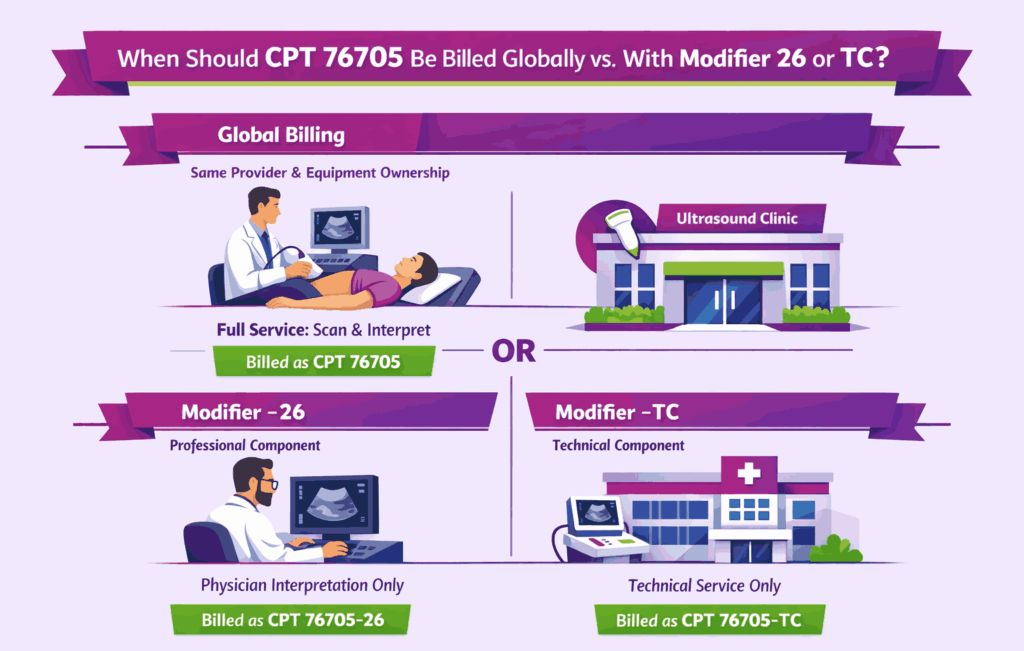
Bill CPT 76705-26 when a physician is interpreting a study performed by a separate technical entity, for example, a radiologist reading hospital-performed scans. Bill CPT 76705-TC when a facility is billing only for the technical performance, and the professional interpretation is billed separately by the physician.
Which Documents Are Required For CPT Code 76705?
CPT code 76705 documentation requirements must support the limited scope of the study and the medical necessity for the targeted evaluation.
Required documents checklist:
- Clinical indication establishing the reason for a limited rather than complete abdominal study
- Identification of the specific organ(s) or anatomical area examined
- Real-time imaging with permanent image storage as part of the medical record
- Written interpretation documenting sonographic findings, technique, clinical impression, and recommendation
- Confirmation that the exam was limited, if technical factors prevented a complete evaluation, document the reason
- Ordering provider information and patient demographics
- Provider signature with date and time of service
- Accurate place-of-service designation
What Is the Cost of CPT Code 76705?
The cost of CPT code 76705 varies by billing component (global, professional, or technical), payer, geographic location, and place of service.
RVUs & Medicare Payment
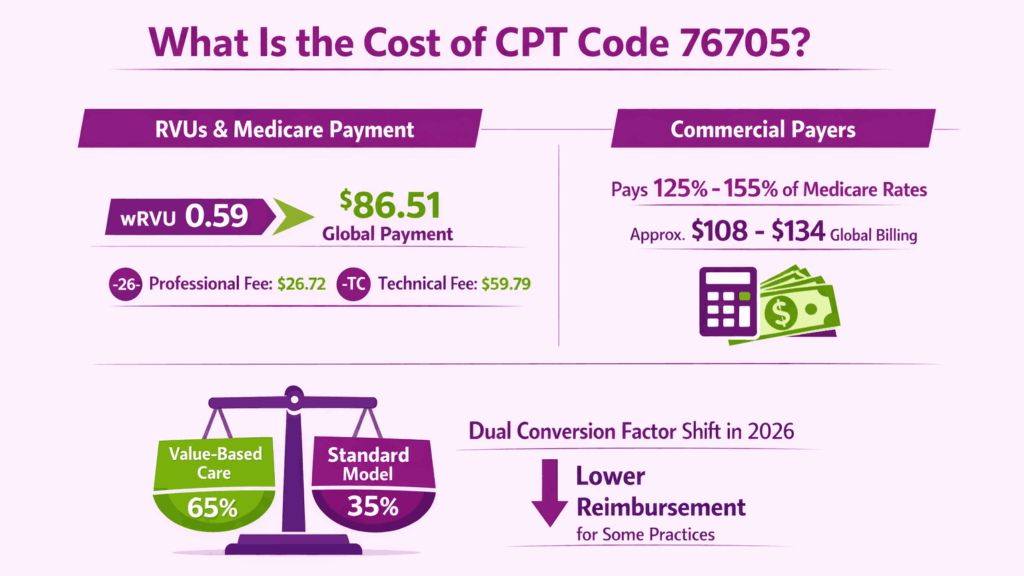
Reimbursement for 76705 is calculated for the 2026 fiscal year using RVUs. The Work RVU (wRVU) is now 0.59, which includes the mandatory -2.5% efficiency adjustment applied to all non-time-based diagnostic codes. Despite this reduction in the work component, the Total Global RVU has increased to 2.59 for non-facility settings.
Using the 2026 standard conversion factor, the national unadjusted Medicare payment for the global service is $86.51. When the service is split, the Professional Component (-26), the radiologist’s fee, is $26.72, while the Technical Component (-TC) accounts for the remaining $59.79, covering the sonography equipment and clinical staff.
Commercial Payers
Commercial payers typically reimburse the CPT code 76705 cost at 125% to 155% of the Medicare Physician Fee Schedule, creating a market-rate range of approximately $108 to $134 for global billing. In 2026, many private insurers will have fully transitioned to the Dual Conversion Factor model, meaning that practices not enrolled in value-based care programs may see lower commercial updates than those in Advanced APMs.
Place-of-Service & Geographic Adjustments
Code CPT 76705 has different non-facility and facility payment rates because the practice expense component differs by setting. Non-facility (office/clinic) rates are higher, reflecting the overhead absorbed by the provider. GPCI adjustments apply to all three RVU components and can increase or decrease payment by 10 to 25 percent, depending on locality. High-cost areas such as New York City, San Francisco, and Boston carry GPCIs meaningfully above the national average.
What Are Example Clinical Scenarios or Use Cases for CPT Code 76705?
CPT code 76705 applies when a real-time abdominal ultrasound with image documentation is performed with a clinically appropriate limited scope, targeting one organ, one quadrant, or serving as follow-up to a prior finding.
Scenario 1: Focused Gallbladder Evaluation for Suspected Acute Cholecystitis
ICD-10: K80.00 (Calculus of gallbladder with acute cholecystitis without obstruction)
A patient presents with right upper quadrant pain, fever, and elevated white count. The provider performs a targeted real-time ultrasound focused on the gallbladder and surrounding structures. Imaging demonstrates gallstones, gallbladder wall thickening, and pericholecystic fluid. The limited scope of the study, focused on the gallbladder and biliary region only, supports CPT 76705.
Scenario 2: Follow-Up Imaging of a Known Hepatic Cyst or Liver Lesion
ICD-10: K76.89 (Other specified diseases of the liver)
A patient with a previously documented hepatic cyst returns for interval surveillance imaging. The provider performs a limited abdominal ultrasound targeting the liver to assess size stability and internal characteristics of the known lesion. No evaluation of other abdominal organs is performed or required. The follow-up designation and single-organ scope support CPT 76705.
Scenario 3: Targeted Renal Ultrasound for Flank Pain with History of Kidney Stones
ICD-10: N20.0 (Calculus of the kidney)
A patient with a history of nephrolithiasis presents with acute left flank pain and hematuria. A limited abdominal ultrasound is performed targeting the left kidney to evaluate for hydronephrosis or an obstructing calculus. The right kidney and bladder are not evaluated in this session. The single-organ, clinically focused scope supports CPT 76705 rather than the retroperitoneal codes, as the kidney is an intraperitoneal/abdominal structure in the context of this exam.
What Are the CPT Code 76705 Rules To Ensure Successful Reimbursement?
Follow payer and policy rules for documentation, coding, bundling, and scope determination. Meeting these rules reduces denials and ensures correct payment.
Bundling / NCCI / Same-Day Procedure Rules
CPT code 76705 has NCCI and payer-level bundling relationships with CPT 76700 (complete abdominal) and with the retroperitoneal ultrasound codes 76770 and 76775. Key rules sourced from CMS LCD article A55336 and NCCI policy include:
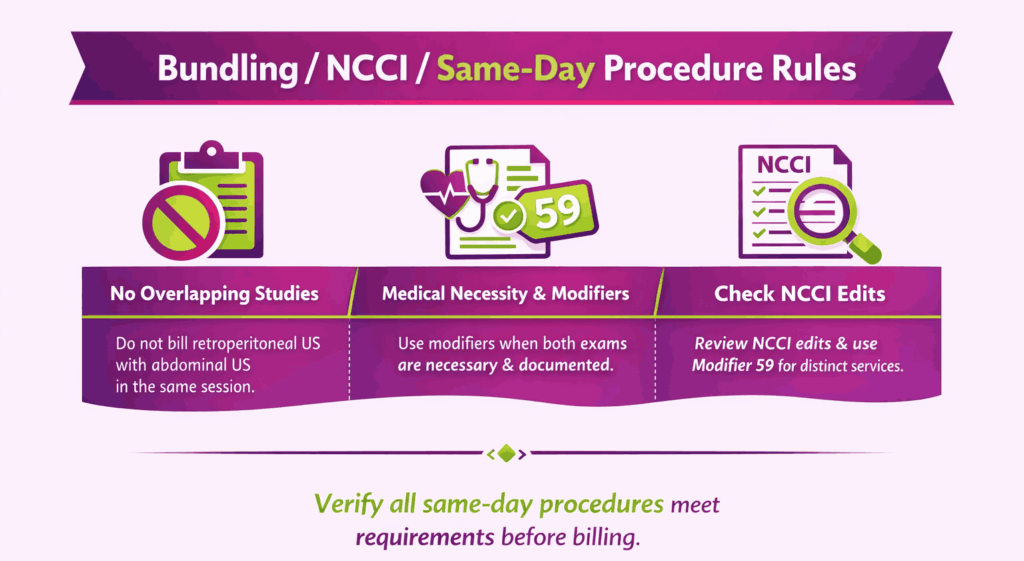
- Do not bill retroperitoneal ultrasound (76770/76775) with abdominal ultrasound (76700/76705) if the study extends beyond the retroperitoneum in the same session. Report only the appropriate abdominal code (76700 or 76705).
- When abdominal ultrasound (76700/76705) and abdominal duplex scan (93975/93976) are performed together, both must be medically necessary and documented; append an NCCI-associated modifier to the ultrasound code when required.
- If 76705 is billed with another imaging service on the same date, check NCCI edits before submission, and use modifier 59 only when documentation supports a distinct clinical purpose.
Units, MUEs & When to Upgrade to CPT 76700 (Complete Abdomen)
76705 CPT code is billed as 1 unit per limited study per session. Billing multiple units of 76705 on the same date requires documentation of clinically distinct, limited exams with separate indications and separate image sets.
The critical upgrade trigger from 76705 to 76700 is the documentation scope. If the completed exam evaluates and documents the liver, gallbladder, common bile duct, pancreas, spleen, kidneys, upper abdominal aorta, and IVC, all required elements, then CPT 76700 is the correct code regardless of what was ordered. If any required element is missing from the documentation and cannot be explained by a documented technical limitation, 76705 is required.
When CPT 76705 Cannot Be Billed With Retroperitoneal Ultrasound Codes
Per CMS LCD article A55336 (Billing and Coding: Retroperitoneal Ultrasound), ultrasound CPT codes types like 76770, 76775, and 76776 should only be billed when the exam was limited to retroperitoneal structures. Specifically, the kidneys, abdominal aorta, common iliac artery origins, and inferior vena cava.
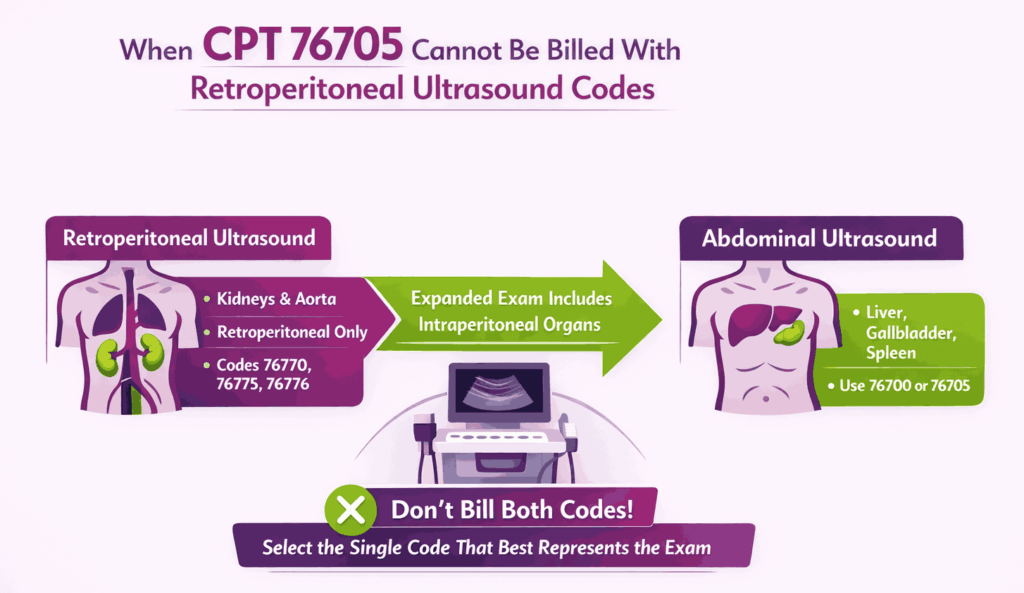
If findings during a retroperitoneal exam prompted expansion of the study to include intraperitoneal organs such as the liver, gallbladder, or spleen, the exam should be reported as an abdominal ultrasound (76700 or 76705), not as a retroperitoneal study plus an abdominal study.
Billing both 76705 and 76775 (or 76770) for the same session based on an exam that crossed anatomic regions is not supported and will be denied. The correct approach is to select the single code that best represents the dominant scope of the completed examination.
Top Reasons For Denials Specific To 76705 & Quick Remedies
- Upcoded to 76700 When Exam Was Limited: Prevent by confirming that all required elements of a complete exam (liver, gallbladder, CBD, pancreas, spleen, kidneys, aorta, IVC) are documented before billing 76700. If any element is missing, bill 76705.
- Insufficient Documentation of Limited Scope: Prevent by ensuring the report explicitly identifies which organ(s) or region was evaluated and why a complete exam was not performed or clinically indicated.
- Missing Permanent Image Documentation: Prevent by confirming that real-time images are stored in the patient record. 76705 cannot be billed based on verbal findings or a handwritten note without stored imaging.
- Component Billing Error (Both 26 and TC by Same Entity): Prevent by confirming that if component billing is used, the TC and modifier 26 are billed by separate entities. Billing both from one entity results in duplicate billing denial.
How do Providers Track Diagnostic Imaging Services?
Healthcare facilities use specific CPT codes in medical billing to identify the exact procedures performed, ensuring that insurers understand whether a study was complete or limited in scope. These standardized codes allow for accurate reimbursement based on the complexity and anatomical focus of the ultrasound.