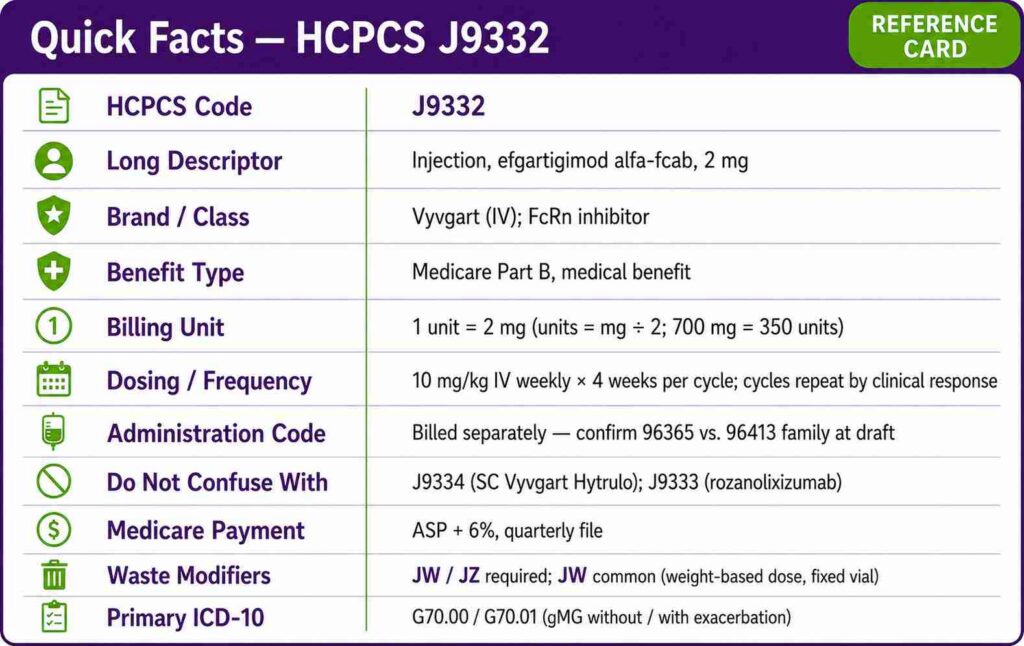
HCPCS code J9332 reports injection of efgartigimod alfa-fcab, 2 mg, sold under the brand name Vyvgart. It is a drug-only code for the intravenous formulation used in generalized myasthenia gravis.
Vyvgart is a neonatal Fc receptor (FcRn) blocker made by argenx. It lowers circulating IgG, including the antibodies that cause muscle weakness in gMG. The drug is given as a weekly IV infusion across a four-week cycle.
One billing unit of J9332 equals 2 mg. That single fact controls unit math, waste reporting, and most denials on this code. The code covers the drug product only, never the infusion service.
This guide covers the J9332 descriptor, the codes it gets confused with, the cost methodology, three clinical scenarios, and the rules that hold up reimbursement. Each section reflects current 2026 payer and CMS practice.
What Is the Description of HCPCS Code J9332?
J9332 is a permanent HCPCS Level II J-code maintained by CMS. HCPCS code J9332 is defined by the AMA as “Injection, efgartigimod alfa-fcab, 2 mg”. It identifies the IV Vyvgart drug product supplied in a single-dose vial.
J-codes sit in the drug and biologic segment of the broader HCPCS codes system, which also covers supplies, orthotics, and DME. Knowing which segment a code belongs to tells you whether the line pays for a product or a service. J9332 pays for a product.
| Attribute | Detail |
|---|---|
| Descriptor | Injection, efgartigimod alfa-fcab, 2 mg |
| Brand | Vyvgart (argenx) |
| Route | Intravenous infusion, about 1 hour |
| Billing unit | 1 unit = 2 mg |
| Vial / NDC | 400 mg / 20 mL single-dose vial, NDC 73475-3041-05 |
| Drug class | Neonatal Fc receptor (FcRn) blocker / immune globulin |
What Drug, Formulation, and Unit Basis Does HCPCS Code J9332 Represent?
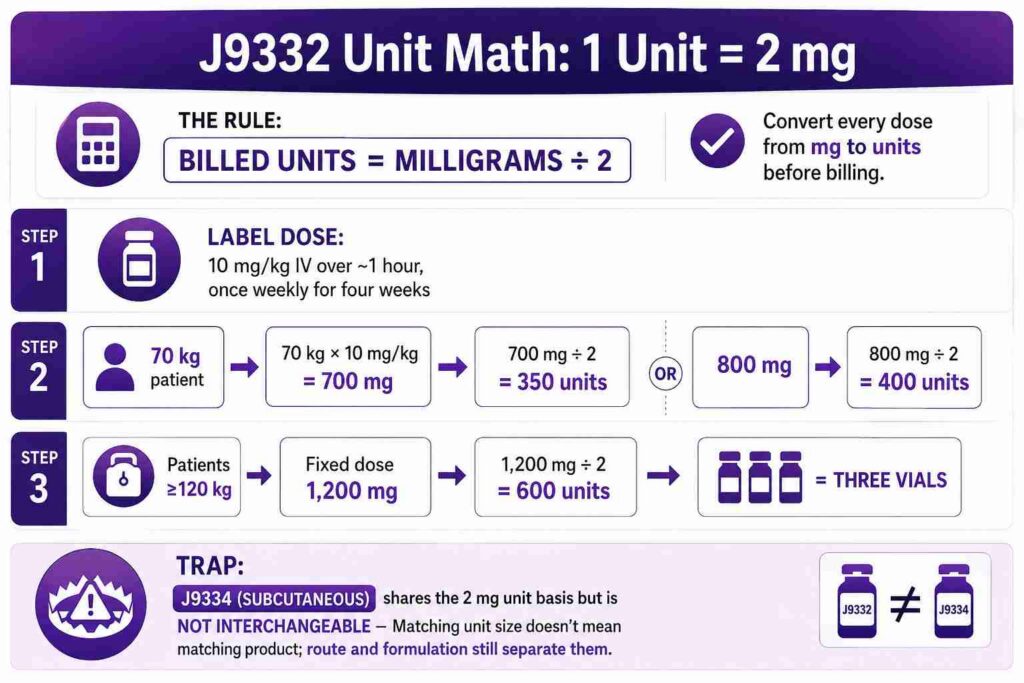
J9332 represents efgartigimod alfa-fcab in its IV form. One unit is 2 mg, so every dose must be converted from milligrams into units before billing. This conversion is where most unit errors start.
The label dose is 10 mg/kg given over roughly one hour, once weekly for four weeks. A 70 kg patient receives 700 mg per infusion. That 700 mg converts to 350 billing units on the drug line.
Units = milligrams ÷ 2. A 700 mg dose equals 350 units. An 800 mg dose equals 400 units. Patients weighing 120 kg or more receive a fixed 1,200 mg, which equals 600 units and needs three vials.
The 2 mg unit basis matches J9334, the subcutaneous product, but the two codes are not interchangeable. Matching unit size does not mean matching product. Route and formulation still separate them completely.
How J9332, J9334, and J9333 Differ, and Why the Route Confusion Causes Denials
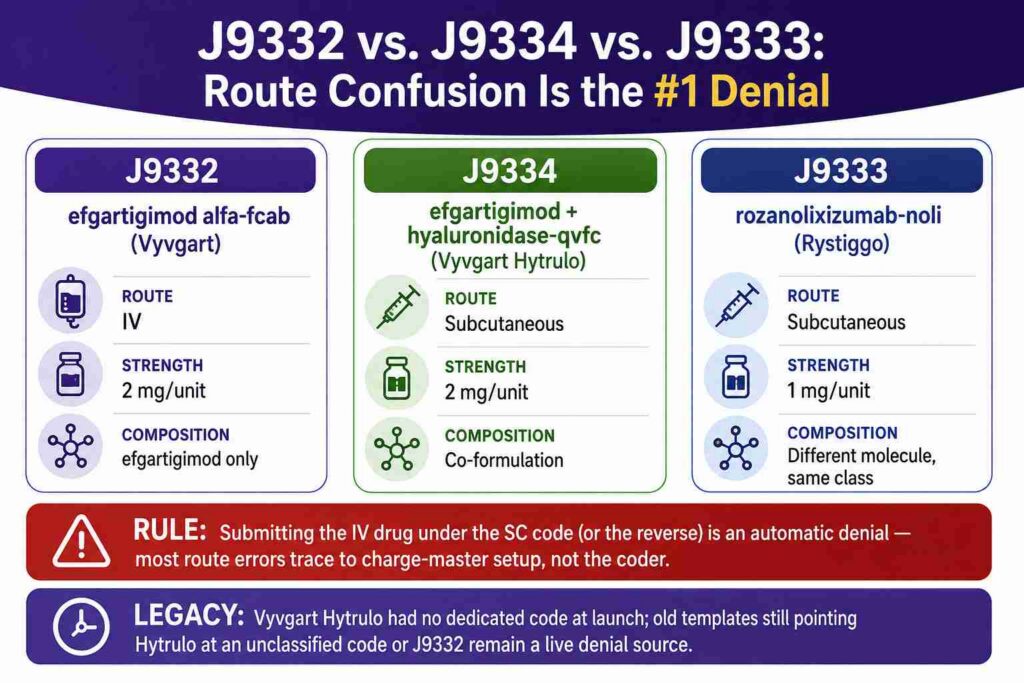
Three FcRn-related codes sit close together in the fee schedule. Coders confuse them because the molecules and mechanisms overlap. The confusion produces the single most common denial pattern on J9332 claims.
J9332 is IV efgartigimod alone. J9334 is the subcutaneous co-formulation of efgartigimod plus hyaluronidase-qvfc, branded Vyvgart Hytrulo. J9333 is rozanolixizumab-noli, branded Rystiggo, a separate FcRn molecule given subcutaneously.
| Code | Drug / Brand | Route | Unit | Notes |
|---|---|---|---|---|
| J9332 | Efgartigimod alfa-fcab / Vyvgart | IV | 2 mg | Efgartigimod only |
| J9334 | Efgartigimod + hyaluronidase-qvfc / Vyvgart Hytrulo | Subcutaneous | 2 mg | Co-formulation |
| J9333 | Rozanolixizumab-noli / Rystiggo | Subcutaneous | 1 mg | Different molecule, same class |
Legacy Error Source: Vyvgart Hytrulo had no dedicated code at launch, so early claims ran through an unclassified J-code before J9334 existed. Old charge-master templates that still point Hytrulo at an unclassified code or at J9332 remain a live denial source.
Why Infusion Administration Codes Must Always Be Billed Separately From J9332
J9332 pays for the drug. It never includes the infusion service. The administration is a separate CPT line billed alongside the drug. Missing that second line leaves the visit underpaid.
The argenx billing guide lists two candidate administration codes. Selection depends on how the payer treats biologic infusions. Efgartigimod is not a cytotoxic chemotherapy agent, which affects the choice between the two families.
| CPT | Descriptor | When it applies |
|---|---|---|
| 96365 | IV infusion, therapy/prophylaxis/diagnosis; initial, up to 1 hour | Non-chemotherapy infusion family |
| 96413 | Chemotherapy administration, IV infusion; up to 1 hour, initial | Complex-biologic / chemo administration family |
Administration coding is where neurology drug claims lose revenue quietly. The drug line clears, the service line never posts, and the underpayment looks like a contract issue rather than a coding gap. Infusion and injection administration families appear across neurology CPT codes and follow the same initial-hour and add-on logic used here.
Payers split on this choice. Some accept 96413 because CMS files the drug in the chemotherapy J-code range. Others require 96365 because the drug is an immune globulin. Confirm the payer rule at draft.
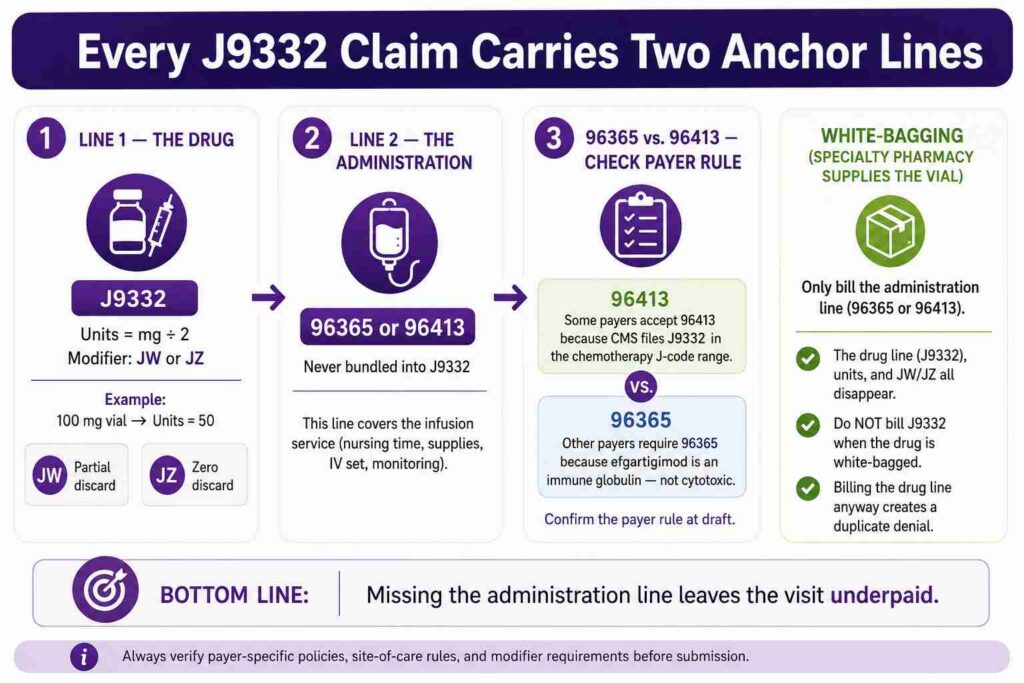
Every J9332 claim carries two anchor lines: the drug (J9332, units = mg ÷ 2, plus JW / JZ) and the administration (96365 or 96413).
What ICD-10 Codes and Medical Necessity Criteria Support J9332?
Two diagnosis codes carry gMG through the treatment course. They are not interchangeable. Payers read the distinction as a signal of clinical status, so the wrong one at the wrong stage triggers review.
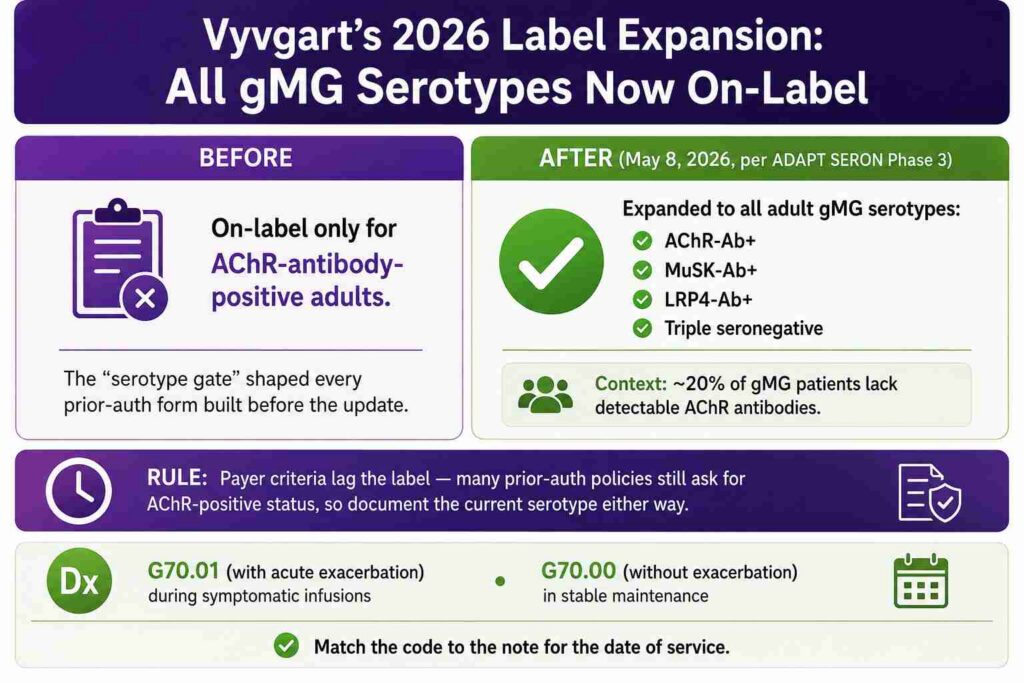
- G70.01: Myasthenia gravis with (acute) exacerbation. Use during a symptomatic or worsening presentation.
- G70.00: Myasthenia gravis without (acute) exacerbation. Use in stable maintenance between cycles.
The exacerbation versus non-exacerbation split is a pattern that repeats throughout neurology icd-10 codes, where the same condition carries different codes by clinical state. Payers read that fifth character as a status signal. Selecting the stable code during an acute infusion weakens the medical-necessity record.
Medical necessity rests on a confirmed gMG diagnosis plus documented functional impairment. Payers look for MG-ADL or QMG scores. The diagnosis code should match the clinical note for the date of service.
What Are the Antibody and Diagnostic Requirements Before J9332 Is Authorized?
The antibody picture changed in 2026. Historically, Vyvgart IV was on-label only for AChR-antibody-positive adults. That serotype gate shaped every prior-authorization form built before the update.
On May 8, 2026, the FDA expanded Vyvgart and Vyvgart Hytrulo to all adult gMG serotypes: AChR-Ab positive, MuSK-Ab positive, LRP4-Ab positive, and triple seronegative. The change followed the Phase 3 ADAPT SERON trial. About 20% of gMG patients lack detectable AChR antibodies.
The label no longer restricts the drug to one serotype. Payer criteria will lag the label. Many prior-authorization policies still ask for AChR-positive status, so document the current serotype either way.
What Are the Modifiers for HCPCS Code J9332?
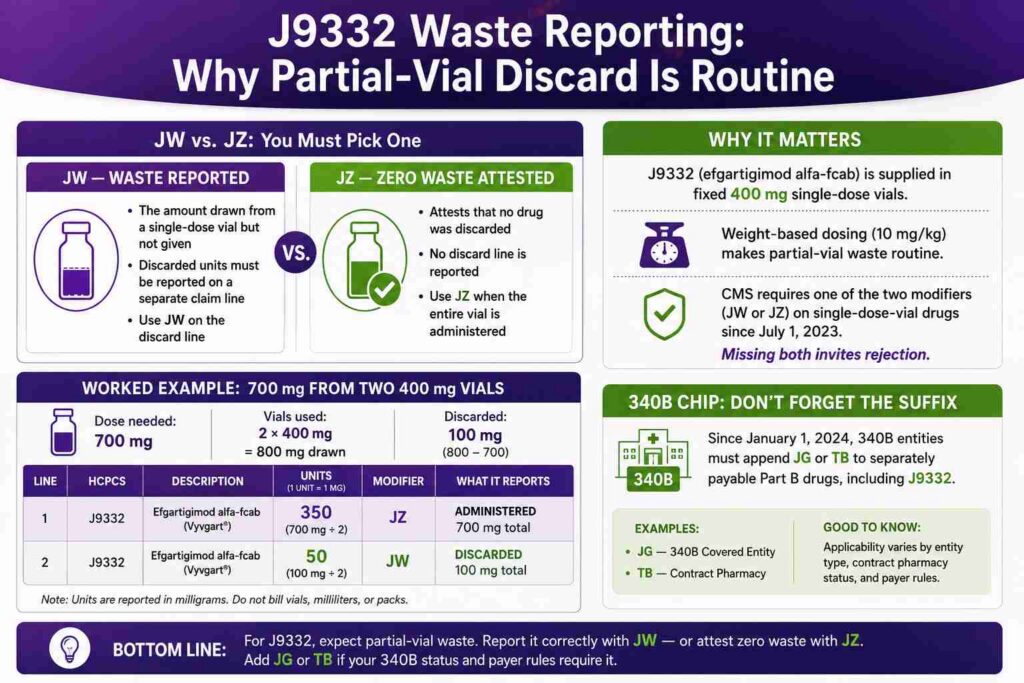
Weight-based dosing against fixed 400 mg vials makes partial-vial waste routine on this code. That reality puts the waste modifiers at the center of clean J9332 billing. Two modifiers report waste, and two more report 340B acquisition.
Modifier JW: Discarded Drug From a Single-Dose Vial
JW reports the amount drawn from a single-dose vial but not given to the patient. Because dosing rarely lands on a whole vial, discard is common. The discarded units go on their own line.
Modifier JZ: Zero Discarded Amount
JZ attests that no drug was discarded. CMS requires either JW or JZ on single-dose-vial drugs like J9332. A claim missing both invites rejection under the discarded-drug policy.
Modifier JG / TB: 340B-Acquired Drug
Since January 1, 2024, 340B-covered entities must append JG or TB to separately payable Part B drugs on Medicare claims. Applicability differs by entity type and payer, so verify the current mapping at draft.
Buy-and-Bill vs. Specialty-Pharmacy White Bagging for J9332
How the drug is sourced decides what the practice bills. Under buy-and-bill, the practice purchases the vial and bills both drug and administration. Under white bagging, a specialty pharmacy ships the drug.
When a specialty pharmacy supplies the vial, the practice bills only the administration code. The drug line, the units, and the JW / JZ modifiers all disappear from the claim. FcRn inhibitors are heavily white-bagged, so confirm the sourcing model first.
Sourcing model, site-of-care approval, and authorization windows all have to be tracked before the infusion is scheduled, not after the claim denies. Practices that run high-cost biologics usually assign that verification work to a dedicated team. Specialized neurology billing support handles the benefit check, the acquisition path, and the claim build as one workflow.
Which Documents Are Required for HCPCS Code J9332?
Documentation supports both the units billed and the medical necessity. Payers request these records on audit, so they should live in the chart before the claim goes out. Missing any one delays payment.
- NDC on the drug line, matched to the 400 mg vial supplied.
- Infusion start and stop times supporting the administration code.
- Antibody or serotype result documenting the gMG diagnosis.
- Patient weight and the dose calculation supporting the units billed.
What Is the Cost of HCPCS Code J9332?
Cost depends on payer, site of care, and acquisition model. Medicare Part B pays under the Average Sales Price method. Commercial plans place the drug on a specialty tier with prior authorization.
ASP Plus 6% and the Quarterly Medicare Payment File
Medicare Part B pays J9332 at ASP plus 6%, recalculated every quarter. CMS publishes the payment limit per 2 mg unit in the quarterly ASP file. Always price against the current quarter, not a saved figure.
Recent 2026 quarterly files place the J9332 payment allowance near $32 to $35 per 2 mg unit. A 70 kg patient at 350 units per week reaches about 1,400 units across a four-week cycle. That puts drug cost alone in the tens of thousands of dollars per cycle.
Confirm the exact figure in the live CMS ASP file for the date of service. The number moves each quarter as manufacturer data updates. A stale rate causes small, repeated underpayments across a high-cost drug.
Commercial Payers and Specialty-Tier Placement
Commercial plans treat J9332 as a specialty medical-benefit drug. Placement brings prior authorization, step edits, and site-of-care rules. Reimbursement is contract-specific and often benchmarked to a percentage of AWP or ASP.
Verify benefits before the first infusion. Confirm the medical-benefit versus pharmacy-benefit split, the prior-authorization requirement, and any preferred acquisition path. These checks prevent a denied first claim on a five-figure drug.
Site-of-Care and Home-Infusion Steering
FcRn inhibitors are a prime target for site-of-care policies. Payers push these infusions off the hospital outpatient setting toward lower-cost sites. The trend directly affects where J9332 can be billed.
- Hospital outpatient departments face the tightest site-of-care restrictions.
- Freestanding infusion suites are the common preferred setting.
- Home infusion is increasingly steered for stable maintenance cycles.
What Are Example Clinical Scenarios for HCPCS Code J9332?
Three scenarios cover the situations where J9332 billing tends to break. Each maps a clinical fact to a coding action. Together they show how units, cycles, and waste play out on real claims.
Scenario 1: AChR-Positive gMG Initiating a First Four-Week IV Cycle
An AChR-antibody-positive adult starts Vyvgart IV. The plan is 10 mg/kg once weekly for four weeks. This is the on-label core case, and the serotype result anchors the prior authorization.
Each weekly claim carries the J9332 drug line, the converted units, and the administration code. The diagnosis is G70.01 during symptomatic infusions. Serotype documentation supports medical necessity at initiation.
Scenario 2: Cycle Retreatment Based on Clinical Response
Vyvgart is not a fixed-calendar drug. Subsequent cycles repeat based on clinical evaluation, not a set schedule. The label notes that starting a new cycle sooner than 50 days from the prior start lacks established safety data.
Continuation depends on documented benefit. Payers look for improvement in MG-ADL, QMG, or MMT scores before approving another cycle. Record the response measure at the end of each cycle to support the next authorization.
Scenario 3: Partial-Vial Dosing With Documented Waste
Weight-based dosing rarely matches whole vials. A patient needing 700 mg draws from two 400 mg vials, using 700 mg and discarding 100 mg. This is where unit reporting most often fails.
- Administered: 700 mg ÷ 2 = 350 units on the J9332 line.
- Discarded: 100 mg ÷ 2 = 50 units on a separate line with modifier JW.
- Total billed reflects the full vial content drawn, split across two lines.
What Are the HCPCS Code J9332 Rules for Successful Reimbursement?
Five rules carry most J9332 claims to payment. They cover unit math, prior authorization, route accuracy, site of care, and the common denial patterns. Each maps to a specific claim field.
Units, MUEs, and the 2 mg Billing Math
Units always equal milligrams divided by two. The classic overbilling trap is entering milligrams or vial counts as units. That single error can multiply a claim well beyond the actual dose.
Flow: 700 mg dose (70 kg × 10 mg/kg) ÷ 2 = 350 units on the J9332 line, then check against the current MUE before submission.
Medically Unlikely Edits cap the units payable per day. Compare the calculated units against the current MUE for J9332. A dose above the edit needs documentation and, in some cases, a modifier to bypass the limit.
Prior Authorization, Cycle-Based Retreatment, and Continuation Criteria
Nearly every payer requires prior authorization on J9332. Initial approval rests on diagnosis, serotype, and functional scores. Continuation rests on documented clinical response before each new cycle begins.
Track authorization windows against the clinical-response retreatment model. Because cycles follow response rather than a calendar, a lapsed authorization can strand a needed cycle. Align the reauthorization request with the response assessment.
Why Route Coding Errors Between J9332 and J9334 Cause Denials
This is the highest-frequency denial on the code. J9332 is IV. J9334 is subcutaneous. Submitting the IV drug under the SC code, or the reverse, produces an automatic denial that is slow to correct.
Most route errors trace back to charge-master setup, not the coder. Audit the item master so Vyvgart maps to J9332 and Vyvgart Hytrulo maps to J9334. Fixing the template stops the error at the source.
This failure mode is not unique to efgartigimod. Several neurology HCPCS codes cover the same molecule in two delivery formats, each with its own identifier and unit basis. Any drug with an IV and a subcutaneous version deserves a charge-master audit before the first claim goes out.
Site-of-Care Prior Authorization and White-Bagging Rules
Payers increasingly require a separate site-of-care approval on top of drug prior authorization. A hospital outpatient claim may deny purely on setting. Confirm the approved site before the infusion is scheduled.
White-bagging rules change the claim shape entirely. When the specialty pharmacy supplies the drug, the practice drops the drug line and bills administration only. Billing the drug line anyway, under white bagging, creates a duplicate denial.
Top Reasons for Denials Specific to J9332 and Quick Remedies
| Denial reason | Quick Fix |
|---|---|
| Route mismatch (J9332 vs J9334) | Correct the charge-master mapping; resubmit under the right code |
| Units billed as mg or vials | Recalculate as mg ÷ 2; verify against the MUE |
| Missing JW or JZ on a single-dose vial | Append the correct waste modifier with documented discard |
| Drug line billed under white bagging | Bill administration only when the SP supplies the vial |
| Site-of-care not authorized | Secure separate site approval before scheduling |
| Prior authorization lapsed before cycle | Align reauthorization with the response assessment |
Most J9332 denials fall into these six buckets. Fixing the charge master and the unit math removes the two largest categories. The rest resolve through prior-authorization discipline and correct sourcing.