Summary: “The ICD-10 code for hypertension is I10 (essential primary hypertension). I10 applies only when no heart or kidney involvement exists. ICD-10-CM assumes a causal relationship between hypertension and heart disease and between hypertension and chronic kidney disease. That rule forces combination codes: I11 for heart disease, I12 for chronic kidney disease, and I13 for both. Secondary hypertension codes to I15, and hypertensive crisis codes to I16. Codes I11.0, I13.0, and I13.2 require an added heart failure code from I50. Codes in I12 and I13 require an added CKD stage code from N18.”
Hypertension is the highest-volume cardiovascular diagnosis in US medical billing. The Centers for Disease Control and Prevention reports that 119.9 million US adults have hypertension, close to 48 percent of the adult population. Only 1 in 4 adults with hypertension has the condition controlled.
The hypertension ICD-10 code set spans category block I10 to I16 in Chapter 9. Accurate cardiology billing support depends on the causal-relationship rule that separates simple I10 from the combination codes. The wrong choice between I10 and I11 changes both the claim and the risk-adjustment value.
This guide covers the hypertension ICD-10 code I10 and the full I10 to I16 series. The guide explains the “with” convention, the hypertensive heart and kidney combination codes, and secondary hypertension. The guide also covers crisis codes, the required add-on codes, and the denials coders see most. The FY2026 ICD-10-CM edition took effect on October 1, 2025.
What Is the ICD-10 Code for Hypertension?
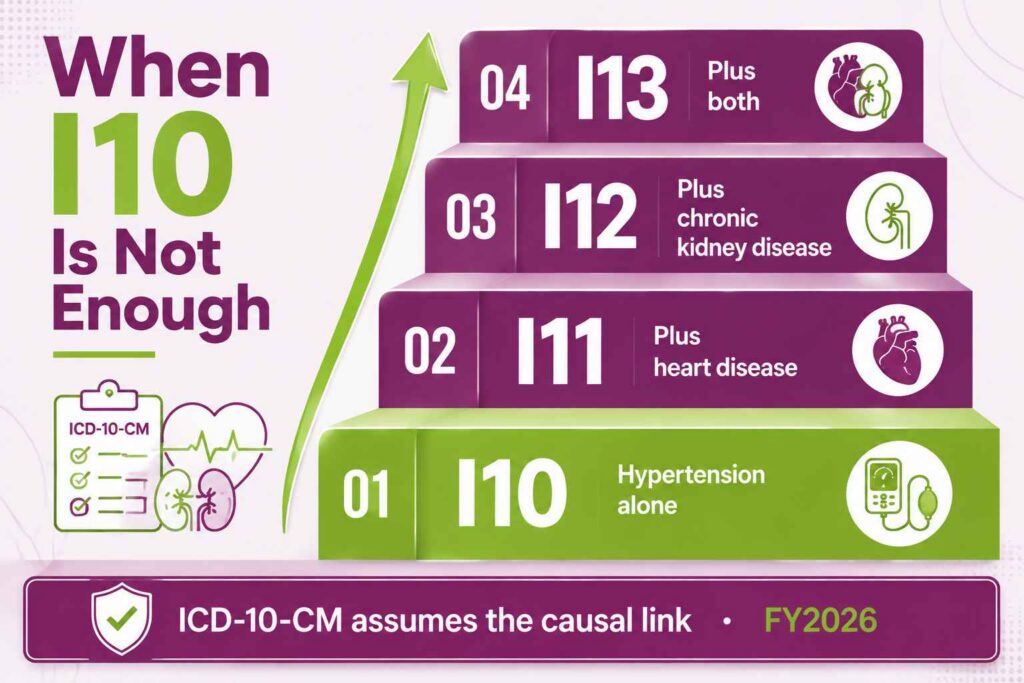
The ICD-10 code for hypertension is I10, defined as essential (primary) hypertension. I10 sits in Chapter 9 of ICD-10-CM, the diseases of the circulatory system. The category block for hypertensive diseases runs from I10 to I16.
The table below maps the full hypertension code family that this guide covers.
| ICD-10 Code | Description | When It Applies |
|---|---|---|
| I10 | Essential (primary) hypertension | Hypertension with no heart or kidney involvement |
| I11.0 | Hypertensive heart disease with heart failure | Add I50.- for heart failure type |
| I11.9 | Hypertensive heart disease without heart failure | Heart involvement, no failure |
| I12.0 | Hypertensive CKD, stage 5 or ESRD | Add N18.5 or N18.6 |
| I12.9 | Hypertensive CKD, stage 1-4 or unspecified | Add N18.1 to N18.4 |
| I13.0 | Hypertensive heart and CKD with heart failure, stage 1-4 | Add I50.- and N18.- |
| I13.10 | Hypertensive heart and CKD without heart failure, stage 1-4 | Add N18.- |
| I13.11 | Hypertensive heart and CKD without heart failure, stage 5 or ESRD | Add N18.5 or N18.6 |
| I13.2 | Hypertensive heart and CKD with heart failure, stage 5 or ESRD | Add I50.- and N18.5 or N18.6 |
| I15.0 to I15.9 | Secondary hypertension | Code the underlying cause |
| I16.0 to I16.9 | Hypertensive crisis | Add the underlying I10-I15 code |
I10 names essential hypertension when the record documents high blood pressure without heart or kidney disease. The combination codes replace I10 once heart or kidney involvement appears.
How Does ICD-10-CM Define I10 (Essential Primary Hypertension)?
I10 defines essential (primary) hypertension, high blood pressure with no identifiable secondary cause. The I10 tabular entry includes several documented terms under one code. Coders assign I10 for each of the following documented diagnoses:
- Benign Hypertension, high blood pressure of gradual onset.
- Malignant Hypertension, severe high blood pressure with rapid progression.
- Systemic Arterial Hypertension, hypertension not otherwise specified.
- Primary Hypertension, hypertension without an underlying cause.
I10 is a billable code valid for FY2026. I10 also covers hypertension documented as unspecified, since ICD-10-CM offers no separate unspecified hypertension code.
What Is the Difference Between Essential, Primary, and Secondary Hypertension?
Essential and primary hypertension are the same diagnosis, both coded I10. Secondary hypertension is a different diagnosis coded from category I15. The distinction rests on whether an identifiable underlying condition causes the high blood pressure.
| Type | Meaning | ICD-10 Code |
|---|---|---|
| Essential hypertension | High blood pressure, no identifiable cause | I10 |
| Primary hypertension | Same as essential hypertension | I10 |
| Secondary hypertension | High blood pressure from a known cause | I15.0 to I15.9 |
Essential hypertension accounts for 90 to 95 percent of adult cases. Secondary hypertension accounts for the remaining 5 to 10 percent and requires dual coding.
Why Is I10 the Highest-Volume Cardiology Diagnosis Code?
I10 is the highest-volume cardiology code because hypertension affects close to half of US adults. The condition appears across cardiology, primary care, nephrology, and endocrinology charts. I10 leads claim frequency in most cardiovascular practices.
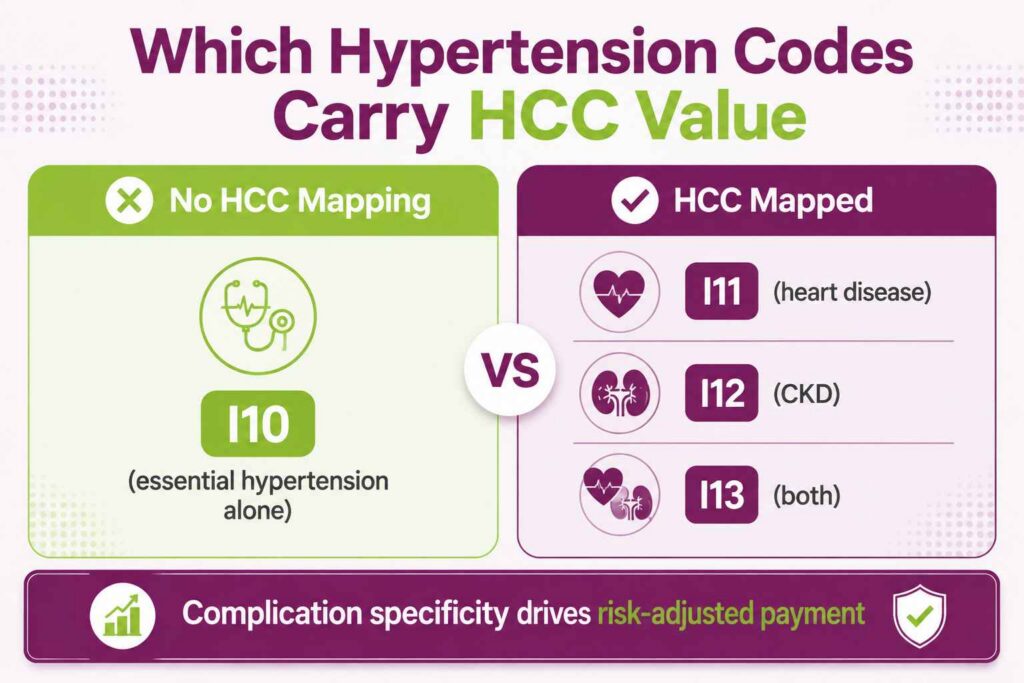
I10 alone does not map to a Hierarchical Condition Category (HCC). The hypertensive complication codes I11, I12, and I13 map to HCCs and carry risk-adjustment value. This difference makes the choice between I10 and the combination codes a revenue decision, not only a clinical one.
Hypertension represents only one portion of cardiovascular diagnosis coding. Our cardiology ICD-10 code list covers the broader ICD-10 categories used across cardiology practices.
Why Does the ICD-10 “With” Convention Control Every Hypertension Code?
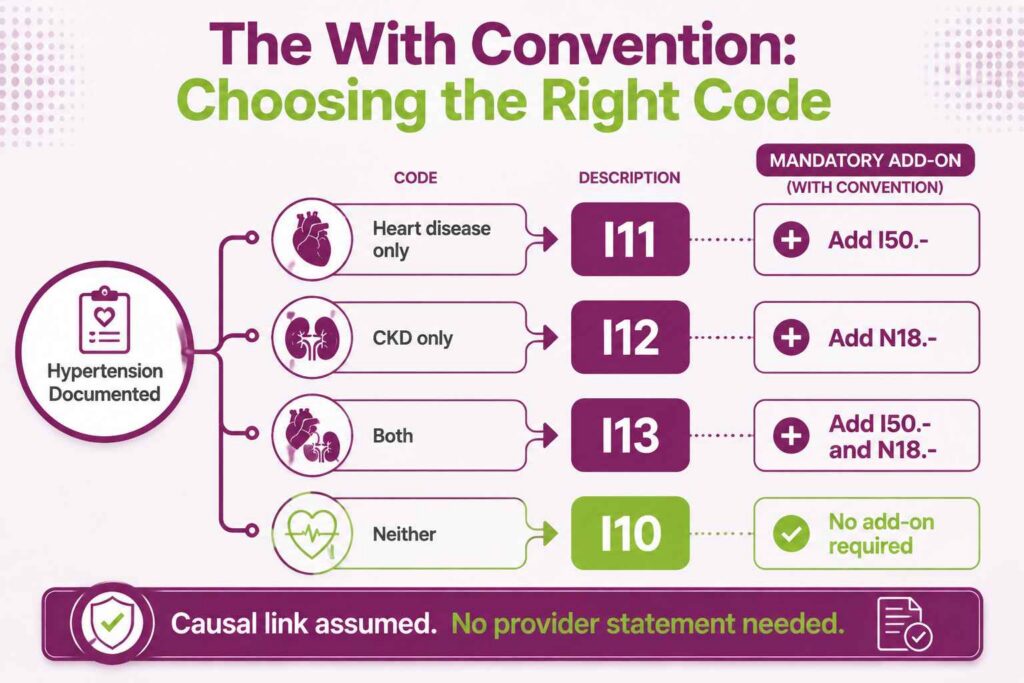
The ICD-10 “with” convention controls hypertension coding because ICD-10-CM presumes a causal link between hypertension and two organ systems. The convention assumes hypertension causes heart disease and assumes hypertension causes chronic kidney disease. Coders assign combination codes by default under this rule.
The convention produces three combination categories. The table below shows how organ involvement selects the code.
| Organ Involvement | Combination Code | Replaces |
|---|---|---|
| Heart disease only | I11 | I10 |
| Chronic kidney disease only | I12 | I10 |
| Both heart disease and CKD | I13 | I11 and I12 |
| Neither | I10 | Nothing |
What Does “Assumed Causal Relationship” Mean in Hypertension Coding?
An assumed causal relationship means ICD-10-CM links the conditions automatically, without a provider statement connecting them. The ICD-10-CM Official Guidelines Section I.C.9 govern this rule. Two organ links are assumed by default:
- Hypertension with Heart Disease classified to I50 or I51.4 through I51.9 assumes a causal link and codes to I11.
- Hypertension with Chronic Kidney Disease classified to N18 assumes a causal link and codes to I12.
A provider does not need to write “hypertensive heart disease” for the coder to assign I11. The coexistence of the two conditions triggers the combination code.
When Does Hypertension NOT Assume a Causal Relationship? (The CAD Exception)
Hypertension does not assume a causal relationship with coronary artery disease. Coronary artery disease, coded I25.-, stays a separate diagnosis from hypertension. Coders assign I10 and the I25.- code separately unless heart failure is also present.
A second exception applies when the provider documents an unrelated cause. A note stating the heart failure comes from prior viral myocarditis and not from hypertension allows separate I10 and I50.- coding. The provider statement must be explicit, since coders never assume the conditions are unrelated on clinical judgment alone.
How Do You Apply the “With” Convention Step by Step?
Coders apply the convention by checking organ involvement in order. The steps below select the base code.
- Heart Disease Present, no CKD: Assign I11, then add the I50.- heart failure code if failure exists.
- CKD Present, No Heart Disease: Assign I12, then add the N18.- stage code.
- Both Heart Disease and CKD Present: Assign I13, then add both I50.- and N18.- codes.
- Neither Present: Assign I10 alone.
What Are the Hypertensive Heart Disease Codes? (I11)
The hypertensive heart disease codes are I11.0 and I11.9. Category I11 applies when hypertension coexists with heart disease under the assumed-causal rule. The presence or absence of heart failure splits the two codes.
What Is the Difference Between I11.0 and I11.9?
The difference between I11.0 and I11.9 is heart failure. I11.0 covers hypertensive heart disease with heart failure. I11.9 covers hypertensive heart disease without heart failure.
I11.0: Hypertensive Heart Disease With Heart Failure
I11.0 codes hypertensive heart disease with heart failure. The I11.0 tabular entry carries a mandatory instruction to use an additional code from I50 to identify the heart failure type. Assigning I11.0 without the I50.- code is an incomplete claim and a tabular-instruction violation.
I11.9: Hypertensive Heart Disease Without Heart Failure
I11.9 codes hypertensive heart disease without heart failure. Moreover, I11.9 applies when hypertension has caused a heart condition classified to I51.4 through I51.9 but no heart failure is documented. No I50.- add-on applies to I11.9.
Which Heart Failure Codes (I50.-) Must Be Added With I11.0?
The heart failure codes added with I11.0 come from category I50. The I50.- code specifies the heart failure type and acuity. The table below shows the common pairings.
| I50 Code | Heart Failure Type | Paired With |
|---|---|---|
| I50.22 | Chronic systolic heart failure | I11.0 |
| I50.32 | Chronic diastolic heart failure | I11.0 |
| I50.42 | Chronic combined systolic and diastolic | I11.0 |
| I50.9 | Heart failure, unspecified | I11.0 |
The heart failure type comes from provider documentation. Coders link the I50.- code to the cardiology CPT codes and diagnosis set for the encounter.
What Are the Hypertensive Chronic Kidney Disease Codes? (I12)
The hypertensive chronic kidney disease codes are I12.0 and I12.9. Category I12 applies when hypertension coexists with chronic kidney disease under the assumed-causal rule. ICD-10-CM presumes hypertension causes the kidney disease. The CKD stage splits the two codes.
What Is the Difference Between I12.0 and I12.9?
The difference between I12.0 and I12.9 is CKD stage. I12.0 covers hypertensive CKD with stage 5 CKD or end-stage renal disease. I12.9 covers hypertensive CKD with stage 1 through 4 or unspecified CKD.
Which CKD Stage Codes (N18.-) Must Be Added With I12?
The CKD stage codes added with I12 come from category N18. The N18.- code identifies the exact kidney disease stage. The table below shows the stage routing.
| N18 Code | CKD Stage | Routes To |
|---|---|---|
| N18.1 to N18.4 | Stage 1 through 4 | I12.9 |
| N18.30 to N18.32 | Stage 3, 3a, 3b | I12.9 |
| N18.5 | Stage 5 | I12.0 |
| N18.6 | End-stage renal disease | I12.0 |
A patient with hypertension and stage 3a CKD codes to I12.9 plus N18.31. A patient with hypertension and ESRD codes to I12.0 plus N18.6. An added code covers acute renal failure when it coexists with hypertensive CKD.
What Are the Hypertensive Heart and Kidney Disease Combination Codes? (I13)
The hypertensive heart and kidney disease combination codes are the four I13 codes. Category I13 applies when hypertension coexists with both heart disease and chronic kidney disease. The I13 Includes note combines the conditions from I11 and I12 into one category.
When Do You Use I13 Instead of Separate I11 and I12 Codes?
Coders use I13 when hypertension, heart disease, and CKD all coexist. I13 replaces separate I11 and I12 codes. Reporting I11 and I12 together for the same patient is a coding error, since I13 already includes both organ links.
What Are the Four I13 Codes, and How Do HF and CKD Stage Decide Them?
The four I13 codes split by heart failure presence and CKD stage. The combination of these two factors selects the exact code. The table below maps all four.
| I13 Code | Heart Failure | CKD Stage | Required Add-On Codes |
|---|---|---|---|
| I13.0 | With heart failure | Stage 1-4 or unspecified | I50.- and N18.- |
| I13.10 | Without heart failure | Stage 1-4 or unspecified | N18.- |
| I13.11 | Without heart failure | Stage 5 or ESRD | N18.5 or N18.6 |
| I13.2 | With heart failure | Stage 5 or ESRD | I50.- and N18.5 or N18.6 |
A patient with hypertensive heart failure and stage 3a CKD codes to I13.0 plus I50.9 plus N18.31. Codes I13.0 and I13.2 carry the same mandatory I50.- add-on rule as I11.0.
How Do You Code Secondary Hypertension? (I15)
Secondary hypertension codes to category I15 with dual coding. Also, secondary hypertension is high blood pressure caused by an identifiable underlying condition. Secondary hypertension accounts for 5 to 10 percent of hypertension cases. The code requires the underlying cause plus the I15 code.
What Are the I15 Secondary Hypertension Subtypes?
The I15 subtypes classify secondary hypertension by cause. Each subtype points to a category of underlying conditions. The table below lists all five.
| I15 Code | Description | Example Cause |
|---|---|---|
| I15.0 | Renovascular hypertension | Renal artery stenosis |
| I15.1 | Hypertension secondary to other renal disorders | Chronic pyelonephritis |
| I15.2 | Hypertension secondary to endocrine disorders | Cushing syndrome |
| I15.8 | Other secondary hypertension | Other documented cause |
| I15.9 | Secondary hypertension, unspecified | Cause not specified |
How Do You Sequence I15 With the Underlying Condition?
Coders sequence I15 by the reason for the encounter. The encounter focus decides which code comes first. Two sequencing paths apply:
- Treating the hypertension: sequence the I15 code first, then the underlying condition.
- Treating the underlying cause: sequence the underlying condition first, then the I15 code.
A patient with hypertension from renal artery stenosis codes to I70.1 for the atherosclerosis and I15.0 for the renovascular hypertension. The sequence follows the documented reason for the visit.
How Do You Code a Hypertensive Crisis, Urgency, and Emergency? (I16)
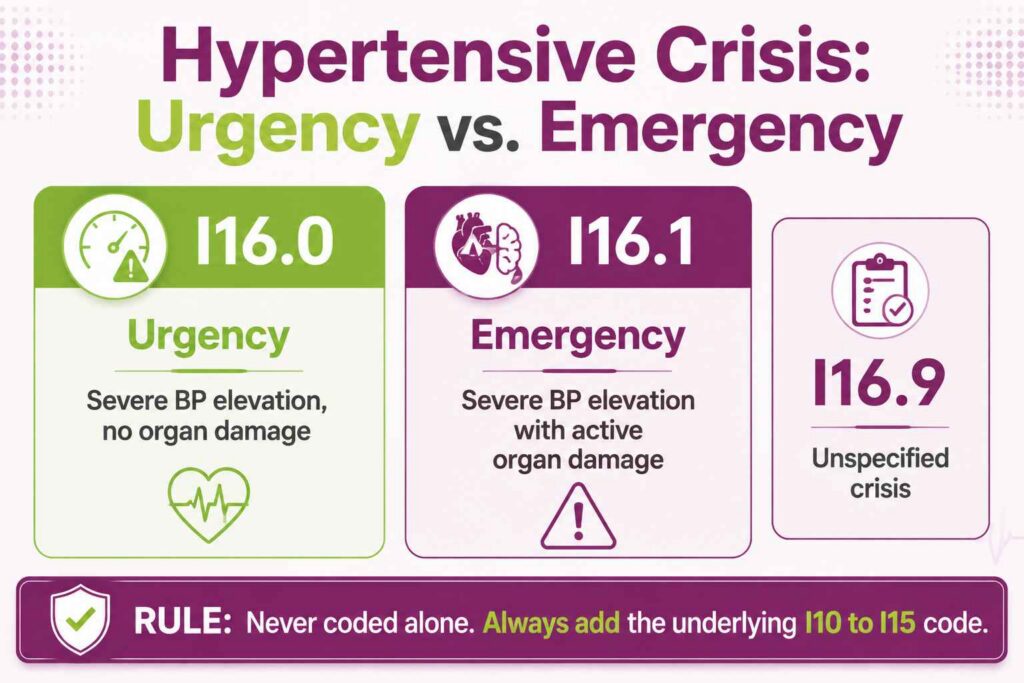
A hypertensive crisis codes to category I16, never as a standalone code. The I16 code captures acute severe blood pressure elevation. Coders always pair I16 with the underlying hypertension code from I10 through I15.
What Is the Difference Between Hypertensive Urgency (I16.0) and Emergency (I16.1)?
The difference is organ damage. Hypertensive urgency, I16.0, is acutely elevated blood pressure without organ damage. Hypertensive emergency, I16.1, is severe elevation causing active organ damage. Code I16.9 covers an unspecified hypertensive crisis.
Why Must I16 Always Pair With an Underlying Hypertension Code?
I16 pairs with an underlying code because a crisis code does not name the chronic condition. The I16 code describes the acute event, and the I10 through I15 code describes the ongoing hypertension. A claim with I16 alone fails, since it omits the underlying diagnosis. Accelerated and malignant hypertension presentations follow this same crisis-plus-underlying pairing.
How Do You Code Hypertension With Diabetes and Other Comorbidities?
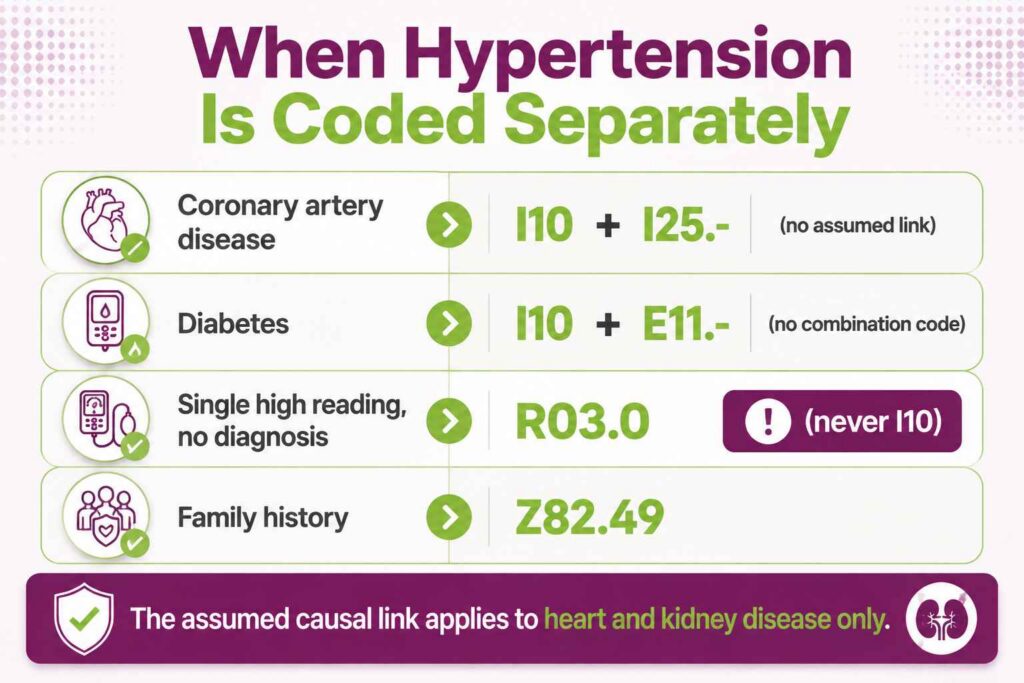
Hypertension with comorbidities follows different rules by condition. The assumed-causal rule applies to heart and kidney disease only. Other comorbidities such as diabetes, hyperlipidemia, and coronary artery disease use separate coding.
How Do You Code Hypertension With Diabetes?
Hypertension with diabetes codes as two separate codes, I10 plus the diabetes code from E08 through E13. ICD-10-CM does not assume a causal relationship between hypertension and diabetes. A patient with essential hypertension and type 2 diabetes codes to I10 plus E11.9, with no combination code.
Diabetes affects hypertension management through cardiovascular and kidney risk. When diabetic kidney disease reaches CKD, the hypertension links to the CKD through I12, and the diabetic code captures the diabetes.
How Do You Code Hypertension With Hyperlipidemia?
Hypertension with hyperlipidemia codes as two separate codes, I10 plus the lipid code from category E78. ICD-10-CM does not assume a causal relationship between the two conditions. A patient with essential hypertension and mixed hyperlipidemia codes to I10 plus E78.2.
Both conditions carry independent cardiovascular risk and independent treatment plans. The lipid code follows the documented lipid type, so coders select the exact code from the hyperlipidemia ICD-10 codes rather than defaulting to E78.5. Metabolic syndrome adds E88.81 when the chart
documents the full cluster.
How Do You Code Hypertension With Coronary Artery Disease?
Hypertension with coronary artery disease codes as separate codes, I10 plus I25.-. The CAD exception blocks any assumed causal link. Coders never assign hypertensive heart disease based only on the coexistence of hypertension and coronary artery disease. Heart failure changes this, since documented heart failure with hypertension triggers I11.0.
What Codes Cover Hypertension in Special Situations? (History, Family History, Elevated BP)
Special situations use Z-codes and R-codes, not the I10-I16 block. These codes cover history, risk, and undiagnosed readings. The list below maps each situation.
- Elevated blood pressure without a hypertension diagnosis codes to R03.0. A single high reading with no diagnosis never codes to I10.
- White coat hypertension and labile readings without a confirmed diagnosis also code to R03.0.
- Personal history of hypertension uses the active I10 code when the condition remains current, since hypertension is a chronic diagnosis.
- Family history of hypertension codes to Z82.49, family history of circulatory system diseases.
Which Hypertension Types Use Codes Outside the I10-I16 Block?
Several hypertension types use codes outside the I10-I16 block. These conditions belong to different body systems or chapters. Coders assign the specific code for each and never force them into the I10-I16 range.
| Hypertension Type | ICD-10 Code | Chapter or Block |
|---|---|---|
| Pulmonary hypertension | I27.0, I27.2- | Circulatory, pulmonary heart disease |
| Portal hypertension | K76.6 | Digestive system |
| Idiopathic intracranial hypertension | G93.2 | Nervous system |
| Ocular hypertension | H40.05- | Eye and adnexa |
| Hypertension in pregnancy | O10 to O16 | Pregnancy, childbirth, puerperium |
Hypertension in pregnancy always uses the Chapter 15 O-codes, never the I10-I16 codes. Pulmonary hypertension classifies to I27 with its own sequencing rules under Guideline I.C.9. Each type functions as a distinct diagnosis with dedicated coding guidance.
What Documentation Supports a Hypertension ICD-10 Claim?
Documentation supports a hypertension claim when the note records the type, the organ involvement, and the causal statements. Complete documentation drives the choice between I10 and the combination codes.
What Clinical Elements Must the Provider’s Note Contain?
The provider note contains five elements for a clean hypertension claim. Each element selects one part of the code.
- Hypertension Type: Essential, secondary, or crisis.
- Heart Involvement: Heart disease presence and heart failure type from I50.
- Kidney Involvement: Chronic kidney disease presence and N18 stage.
- Causal Statements: Documented underlying cause for secondary hypertension.
- Non-Causal Statements: Explicit notes when a heart condition is unrelated to hypertension.
How Does Documentation Trigger the “With” Combination Codes?
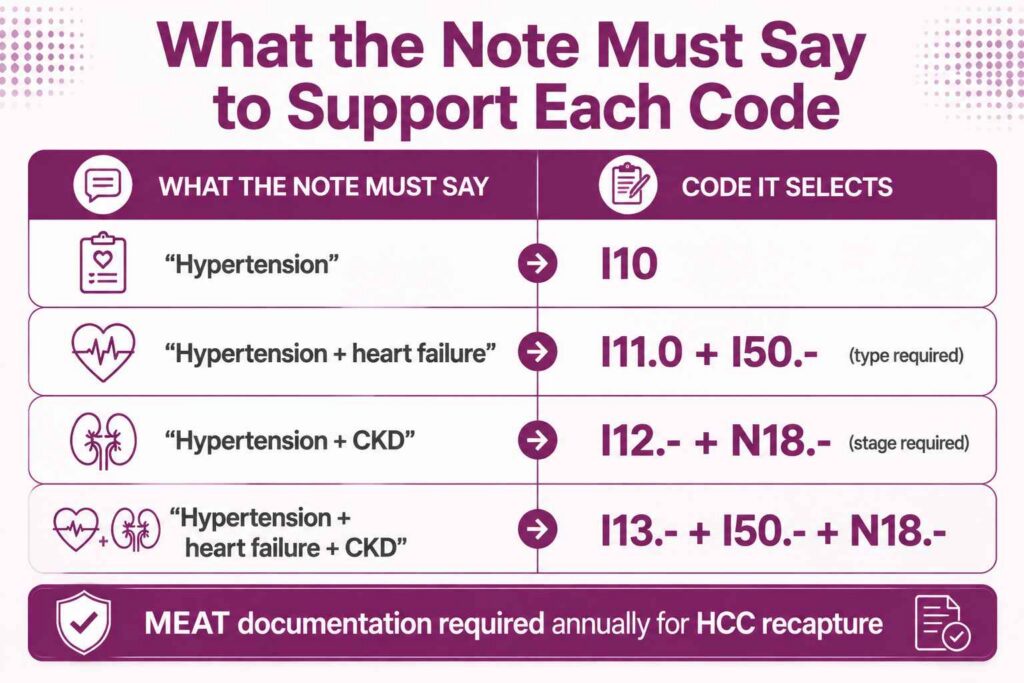
Documentation triggers combination codes when the note records hypertension plus heart or kidney disease. The coder does not need a linking phrase for heart and kidney disease. The documented coexistence of the conditions activates the assumed-causal rule and the I11, I12, or I13 code.
What Are the MEAT Criteria for Hypertension HCC Recapture?
MEAT criteria are Monitor, Evaluate, Assess, and Treat. Each year’s HCC recapture requires at least one MEAT element for the hypertensive complication. The combination codes I11, I12, and I13 map to HCCs and carry risk-adjustment value. Monitoring includes blood pressure review. Evaluating includes organ-function assessment. Assessing includes cardiovascular risk staging. Treating includes medication and management notes.
Which CPT and HCPCS Codes Pair With Hypertension ICD-10 Codes?
Hypertension ICD-10 codes pair with evaluation and management codes and blood pressure monitoring codes. The CPT mix reflects chronic disease management rather than procedures. Correct pairing supports medical necessity for the visit and the monitoring service.
Which E/M and Monitoring CPT Codes Are Billed With I10-I16?
The table below lists the CPT codes most billed with the hypertension family and their common pairings.
| CPT | Description | Common ICD-10 Pairing |
|---|---|---|
| 99202-99215 | Office or outpatient E/M visit | I10, I11.-, I12.-, I13.- |
| 93784-93790 | Ambulatory blood pressure monitoring (ABPM) | I10, R03.0 |
| 99473-99474 | Self-measured blood pressure monitoring | I10, R03.0 |
| 99091 | Collection and interpretation of physiologic data | I10, I11.-, I12.- |
| 99457-99458 | Remote physiologic monitoring treatment management | I10, I11.-, I13.- |
Evaluation and management codes carry the highest claim volume for hypertension, since most encounters are office visits for chronic management.
How Does Ambulatory Blood Pressure Monitoring (ABPM) Get Coded?
Ambulatory blood pressure monitoring codes to CPT 93784 through 93790. ABPM records blood pressure across 24 hours to confirm a diagnosis. ABPM pairs with R03.0 for suspected white coat hypertension and with I10 for confirmed diagnoses. The test separates true hypertension from isolated clinic readings.
Which HCPCS Codes Apply to Hypertension Care?
HCPCS Level II codes report the supplies and injectable drugs that CPT does not cover. Two HCPCS codes appear most often on hypertension claims. Each one pairs with a diagnosis code from the I10 through I16 range.
A4670
HCPCS code A4670 reports an automatic blood pressure monitor for home use. The device falls under the durable medical equipment benefit, and I10 is the primary supporting diagnosis. Coverage rules for code A4670 vary by payer and by the applicable MAC local coverage determination.
J0360
Code HCPCS J0360 reports an injection of hydralazine HCl, up to 20 mg. Providers give hydralazine for severe hypertension that oral medication does not control. J0360 pairs with an I16 crisis code and the underlying hypertension code.
Cardiology practices report drugs, supplies, and devices through the broader cardiology HCPCS codes set alongside the E/M and monitoring CPT codes. HCPCS selection carries the same specificity requirement as the diagnosis code.
What Are the Most Common Hypertension Coding Denials, and How Do You Prevent Them?
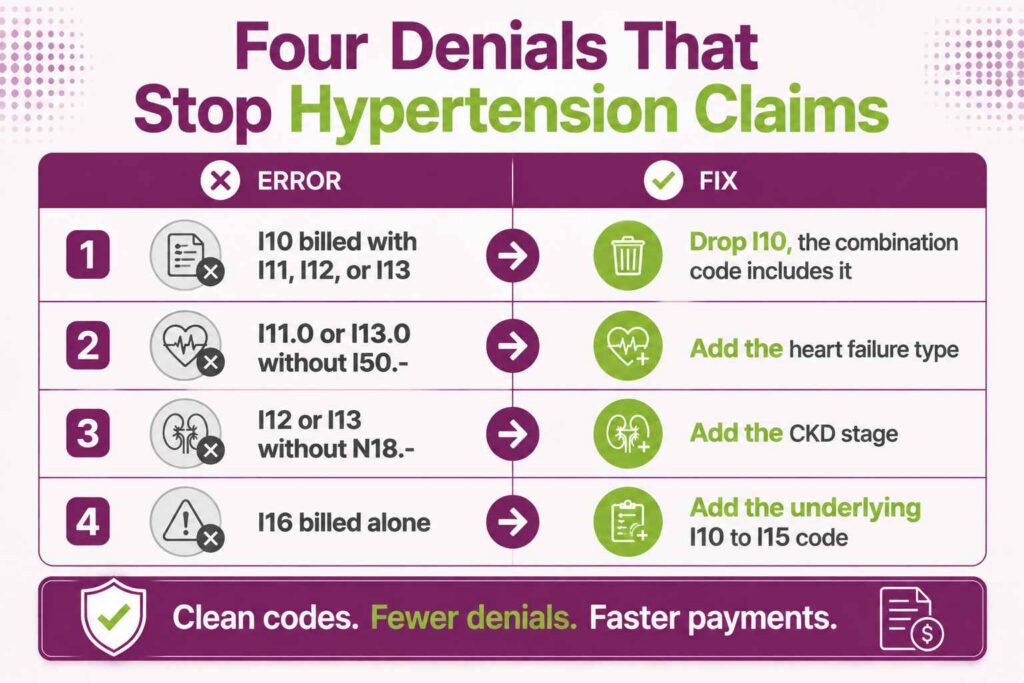
The most common hypertension denials come from wrong I10 use, missing add-on codes, and standalone crisis codes. Each pattern has a known prevention path.
Why Does Coding I10 With I11, I12, or I13 Trigger a Denial?
Coding I10 with a combination code triggers a denial because the combination codes already include the hypertension. I11, I12, and I13 contain the hypertension diagnosis inside the code. Adding I10 duplicates the diagnosis and fails payer logic.
Why Are I11.0 and I13.0 Claims Denied Without an I50.- Code?
I11.0 and I13.0 claims are denied without an I50.- code because the tabular entry requires the add-on. The instruction “use additional code to identify type of heart failure” is mandatory. A claim with I11.0 and no I50.- code is incomplete and fails on tabular-instruction grounds.
Why Are Hypertensive Crisis Claims (I16) Rejected?
Hypertensive crisis claims are rejected when I16 appears without the underlying code. I16 is not a standalone diagnosis. A clean crisis claim pairs I16.0 or I16.1 with the underlying I10 through I15 code.
How Do Payer-Specific Rules Change Hypertension Reimbursement?
Each payer applies its own rules to hypertension coding and risk adjustment. The table below summarizes common payer positions.
| Payer | Common Rule |
|---|---|
| Medicare | Combination codes I11, I12, I13 map to HCCs and drive risk-adjusted payment |
| BCBS plans | Documentation review for combination codes; missing add-on codes flagged |
| UnitedHealthcare | Medical necessity required for ABPM and remote monitoring claims |
| Aetna | I50.- and N18.- add-on codes required for combination-code payment |
| Medicare Advantage | Annual MEAT recapture required for I11, I12, and I13 diagnoses |
Payers share one pattern: the correct base code, the required add-on codes, and documented medical necessity support payment across plans.
What Changed in the FY2026 ICD-10-CM Update for Hypertension?
The FY2026 ICD-10-CM update took effect on October 1, 2025, and preserved the I10-I16 structure. The National Center for Health Statistics and CMS publish the annual code set for ICD-10. The current cycle emphasizes risk-adjusted capture of hypertensive complications.
Did the FY2026 Update Change Any I10-I16 Codes?
The FY2026 update kept the I10-I16 codes stable in structure. The essential hypertension code I10 and the combination codes carried forward. Coders confirm all descriptors against the CMS-published FY2026 code set before billing.
How Does FY2026 Risk Adjustment Treat Hypertensive Complications?
FY2026 risk adjustment rewards documented hypertensive complications. The complication codes I11, I12, and I13 map to HCCs and carry RAF value that I10 does not. Practices capture this value only when heart failure, CKD stage, and the combination codes appear in the record with full specificity.
Frequently Asked Questions About Hypertension ICD-10 Coding
What Is the ICD-10 Code for Hypertension?
The ICD-10 code for hypertension is I10, essential primary hypertension. I10 applies when hypertension exists without heart or kidney involvement. Combination codes replace I10 when heart disease or CKD appears.
What Is the ICD-10 Code for Essential Hypertension?
The ICD-10 code for essential hypertension is I10. Essential and primary hypertension are the same diagnosis under one code.
Is I10 a Billable Code?
Yes, I10 is a billable code valid for FY2026. I10 covers essential, primary, benign, malignant, and unspecified hypertension.
What Is the Difference Between I10 and I11?
I10 codes hypertension with no heart involvement. I11 codes hypertension with heart disease under the assumed-causal rule. I11.0 also requires an added I50.- heart failure code.
What Is the ICD-10 Code for Hypertension With Heart Failure?
The ICD-10 code for hypertension with heart failure is I11.0. I11.0 requires an added code from I50 to identify the heart failure type.
What Is the ICD-10 Code for Hypertension With Chronic Kidney Disease?
The ICD-10 code for hypertension with CKD is from category I12. I12.0 covers stage 5 or ESRD, and I12.9 covers stage 1 through 4. An N18.- stage code is required.
Can You Code I10 and I11 Together?
No, the combination code I11 already includes the hypertension diagnosis. Coding I10 with I11 duplicates the diagnosis and triggers a denial.
What Is the ICD-10 Code for Secondary Hypertension?
The ICD-10 code for secondary hypertension is from category I15. Secondary hypertension requires the underlying cause code plus the I15 code, sequenced by the reason for the encounter.
What Is the ICD-10 Code for a Hypertensive Emergency?
The ICD-10 code for a hypertensive emergency is I16.1. Hypertensive urgency codes to I16.0. Both require an added underlying hypertension code from I10 through I15.
What Is the ICD-10 Code for Elevated Blood Pressure Without Hypertension?
The ICD-10 code for elevated blood pressure without a diagnosis is R03.0. A single high reading with no confirmed diagnosis never codes to I10.