
Summary: “The ICD-10 code for foot pain is M79.671 (right foot), M79.672 (left foot), or M79.673 (unspecified foot). Toe pain uses M79.674, M79.675, and M79.676. No bilateral code exists; bilateral foot pain reports both side codes together. The M79.67- codes are symptom codes, and a confirmed diagnosis, such as plantar fasciitis, replaces them.”
Foot pain is one of the most common complaints in outpatient care. An American Podiatric Medical Association survey of 1,000 US adults found that 77% have experienced foot pain. Half of all adults in the same survey reported that foot pain restricted walking, exercise, or work.
Population studies in Arthritis Care & Research place foot pain prevalence between 17% and 24% of adults, rising to 42% in adults over 65. Each of these encounters reaches a claim through the M79.67- code family. Accurate podiatry billing services depend on coding the correct side every time.
This guide covers the foot pain ICD-10 codes, M79.671 through M79.673, and the toe pain codes, M79.674 through M79.676. The guide also pairs each code with its CPT codes and modifiers. Every code reflects the FY2026 ICD-10-CM set, effective October 1, 2025.
What Is the ICD-10 Code for Foot Pain?
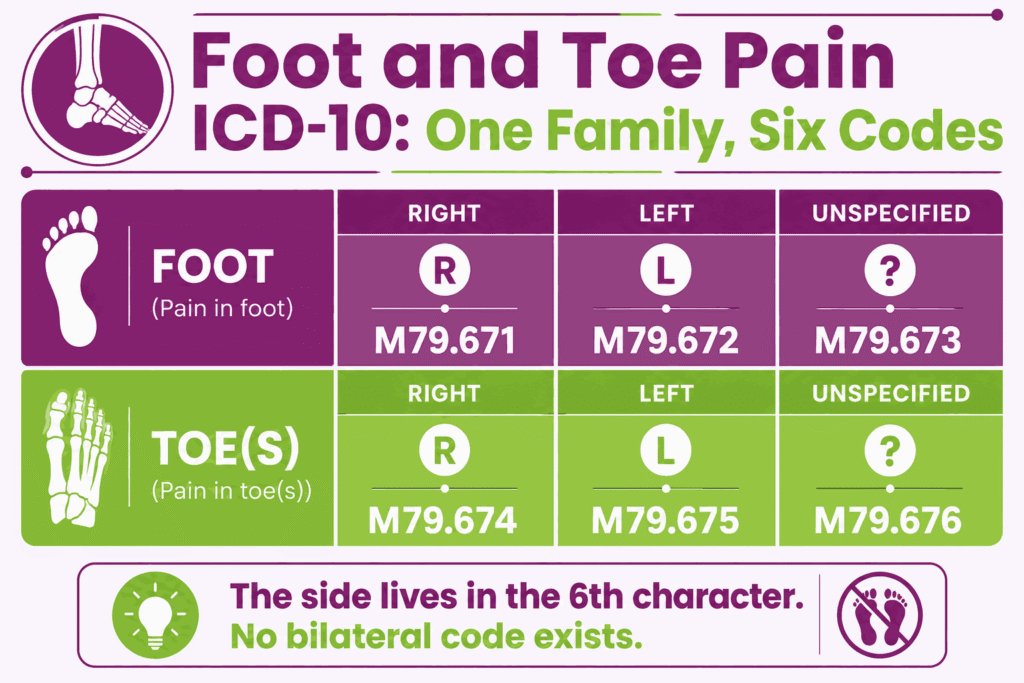
The ICD-10 code for foot pain is M79.671 for the right foot, M79.672 for the left foot, and M79.673 for an unspecified foot. The foot pain ICD-10 codes belong to the subcategory M79.67-, pain in foot and toes, inside Chapter 13 of ICD-10-CM.
The table below lists the complete M79.67- family. The subcategory is complete at six codes, three for the foot and three for the toes.
| Code | Description |
|---|---|
| M79.671 | Pain in right foot |
| M79.672 | Pain in left foot |
| M79.673 | Pain in unspecified foot |
| M79.674 | Pain in right toe(s) |
| M79.675 | Pain in left toe(s) |
| M79.676 | Pain in unspecified toe(s) |
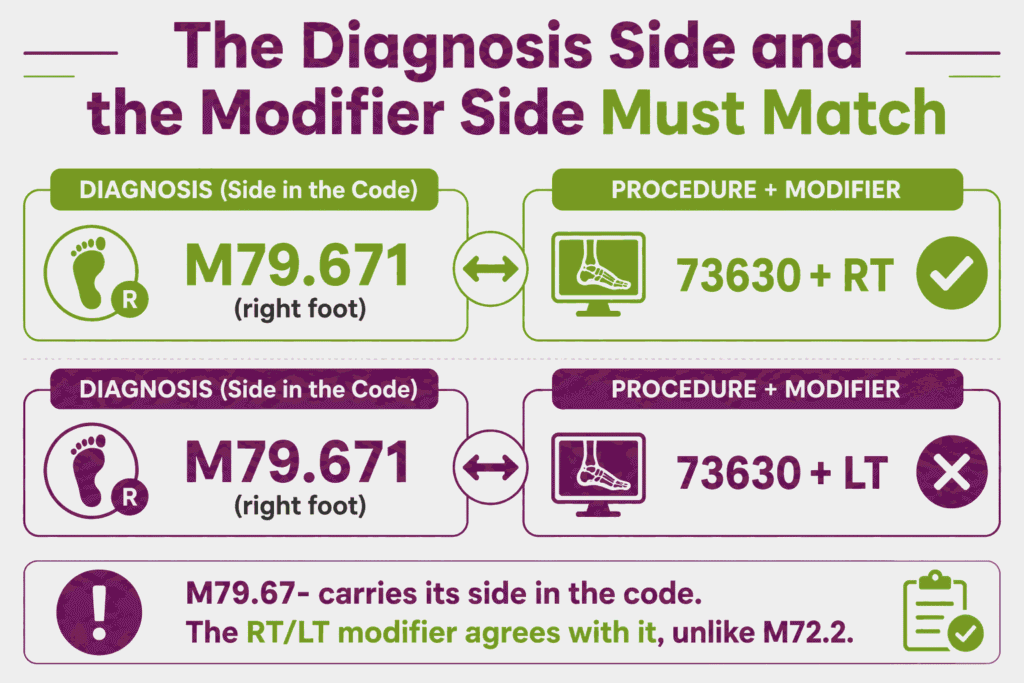
Each code carries its laterality inside the sixth character, so no modifier supplies the side on the diagnosis. The codes describe a symptom, not a disease, which shapes how every claim in this guide is built.
What Is the ICD-10 Code for Right Foot Pain? (M79.671)
The ICD-10 code for right foot pain is M79.671. Coders assign M79.671 when the provider documents right foot pain without a confirmed cause. The right foot pain ICD-10 code applies to the foot only; right toe pain moves to M79.674.
What Is the ICD-10 Code for Left Foot Pain? (M79.672)
The ICD-10 code for left foot pain is M79.672. The left foot pain ICD-10 code mirrors M79.671 and applies when documentation names the left foot. Pain limited to the left toes moves to M79.675 instead.
When Is M79.673 (Unspecified Foot) Acceptable?
M79.673 is acceptable only when the record genuinely fails to name a side. Provider notes document the side in nearly every foot encounter, so M79.673 appears rarely on clean claims. Billing the unspecified code when the chart names a side creates a specificity gap that payers flag.
What Is the ICD-10 Code for Bilateral Foot Pain?
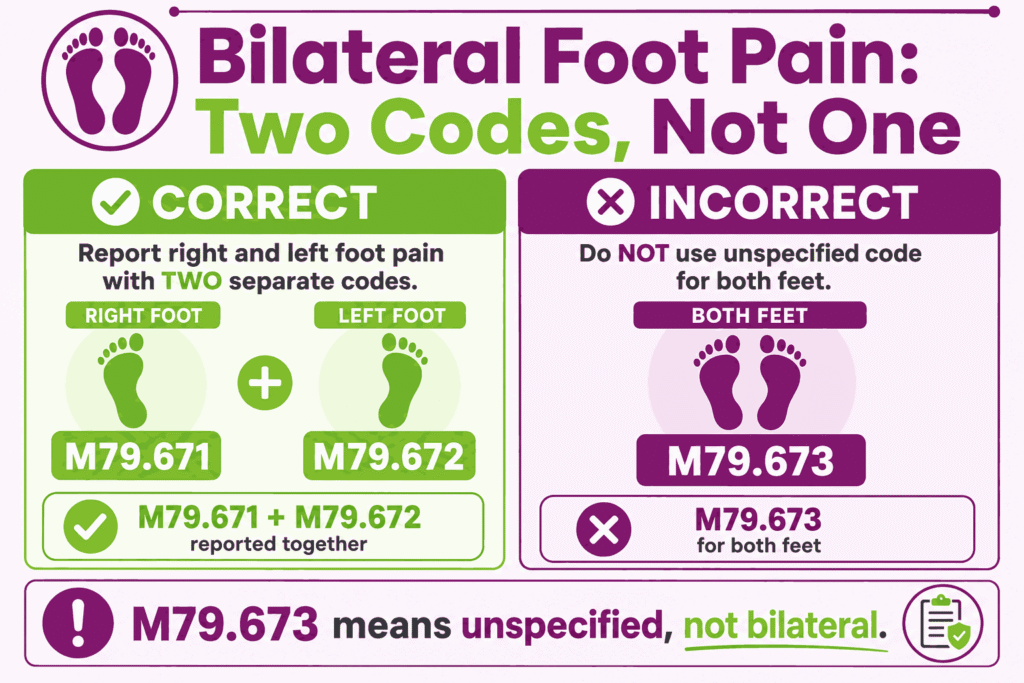
The ICD-10 code for bilateral foot pain is M79.671 and M79.672 reported together. ICD-10-CM provides no single bilateral foot pain code. M79.673 means unspecified, not bilateral, and billing M79.673 for both feet is one of the most common miscodes in this family.
What Are the ICD-10 Codes for Toe Pain?
The ICD-10 codes for toe pain are M79.674 for the right toe(s), M79.675 for the left toe(s), and M79.676 for unspecified toe(s). The toe pain ICD-10 codes sit in the same M79.67- subcategory as the foot codes and follow the same laterality pattern.
What Is the ICD-10 Code for Great Toe Pain?
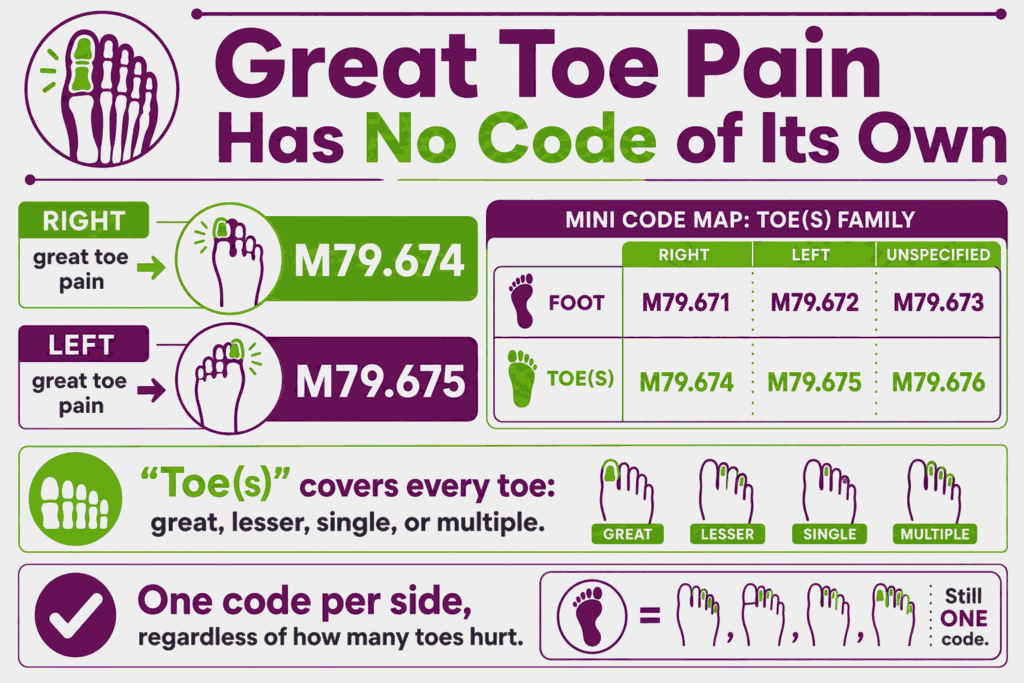
No dedicated great toe pain code exists in ICD-10-CM. Right great toe pain reports M79.674, and left great toe pain reports M79.675. The toe codes cover every toe, the great toe included, so coders never search beyond the M79.67- family for toe pain.
How Do You Code Pain in Multiple Toes or Both Feet’s Toes?
One toe code per side covers one or several toes, because each descriptor reads “toe(s)” in the plural. Pain in three right toes reports M79.674 once. Toe pain in both feet reports M79.674 and M79.675 together, matching the bilateral logic of the foot codes.
When Does a Foot Pain Code Get Replaced by a Diagnosis Code?
A foot pain code is replaced as soon as the provider confirms a cause. The M79.67- codes are symptom codes, and ICD-10-CM convention assigns the definitive diagnosis once one exists. Utilizing a specialized podiatry ICD-10 codes guide ensures that clinical documentation smoothly bridges this gap, supplying the exact replacement code for each confirmed condition.
Which Diagnoses Replace M79.67- Most Often in Podiatry?
Eight diagnoses replace the foot and toe pain codes most often in podiatry claims. The table below maps each presentation to its confirmed code.
| Presentation | Confirmed Diagnosis | ICD-10 Code |
|---|---|---|
| Heel pain, first-step pain | Plantar fasciitis | M72.2 |
| Heel pain with bony growth | Calcaneal spur | M77.3- |
| Pain at the great toe joint | Bunion (hallux valgus) | M20.1- |
| Pain in a bent lesser toe | Hammertoe | M20.4- |
| Sudden great toe pain and swelling | Gout | M10.07- |
| Burning forefoot pain | Morton’s neuroma | G57.6- |
| Ball-of-foot pain | Metatarsalgia | M77.4- |
| Pain at the nail border | Ingrown toenail | L60.0 |
The first row is the most frequent shift in podiatry. Heel pain coded M79.67- at the first visit becomes the plantar fasciitis ICD-10 code, M72.2, once the provider confirms the diagnosis.
How Do Excludes Notes Limit Pain Codes With a Confirmed Diagnosis?
Excludes notes block a pain code from reporting alongside a definitive diagnosis for the same site. Once the chart confirms plantar fasciitis, M72.2 replaces M79.671 rather than joining the claim. Reporting both codes for the same foot invites an edit.
Can M79.67- Ever Be the Primary Diagnosis?
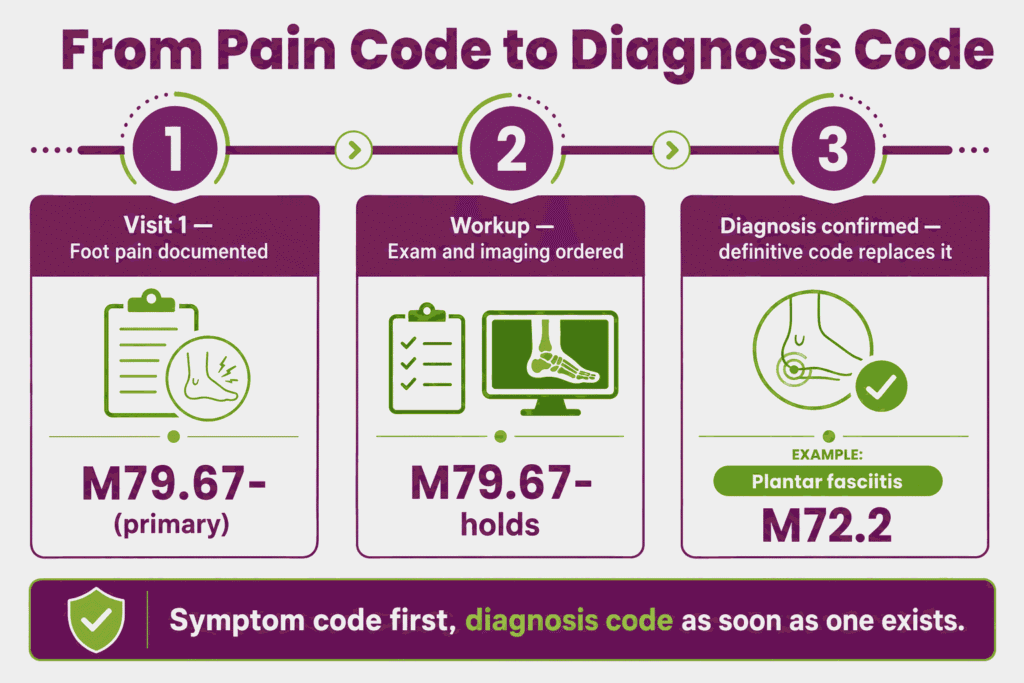
Yes. M79.67- serves as the primary diagnosis for symptom-only encounters. Initial workups, undiagnosed pain visits, and referrals all bill correctly on a foot or toe pain code. The pain code holds the claim until the workup produces a confirmed diagnosis.
What Documentation Supports a Foot or Toe Pain Claim?
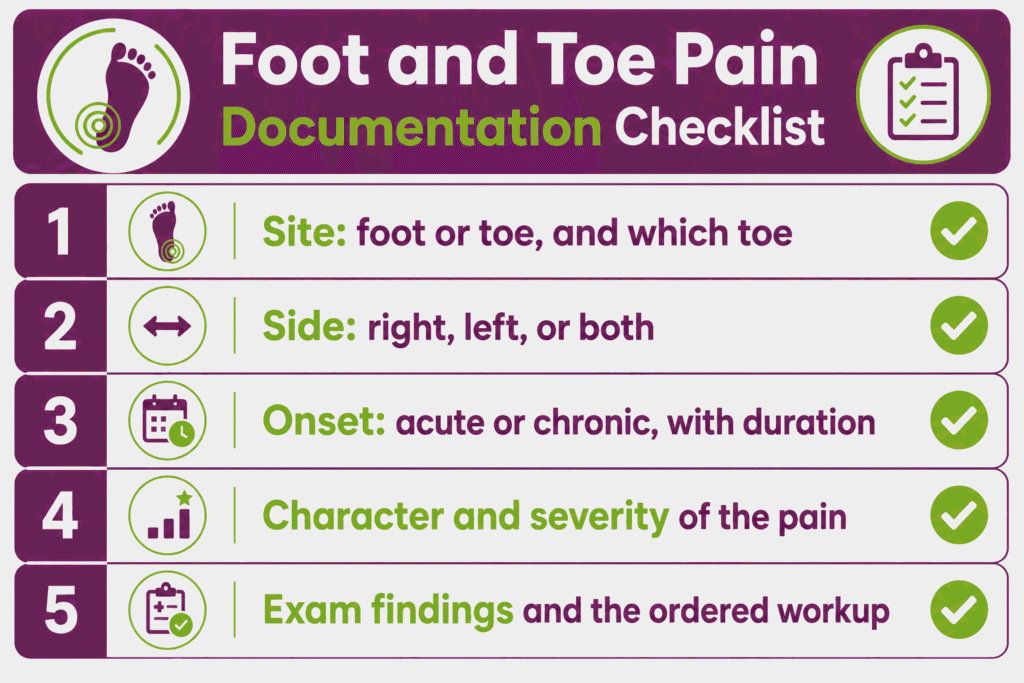
Documentation supports a foot or toe pain claim when the note records the site, the side, and the workup plan. Side documentation decides the code, so the side is the single most important element in this family.
What Must the Note Contain for an M79.67- Encounter?
The provider note contains five elements for a clean M79.67- claim.
- Site: foot or toe, and which toe when relevant
- Side: right, left, or both
- Onset: acute or chronic, with duration
- Character: sharp, burning, aching, with severity
- Plan: examination findings and the ordered workup
How Does Documentation Move a Claim From Symptom to Diagnosis?
Documentation moves a claim from symptom to diagnosis through the workup trail. The first visit records foot pain and orders imaging on M79.67-. The follow-up visit records the confirmed finding, and the claim shifts to the definitive code at that encounter.
Which CPT Codes Pair With Foot and Toe Pain ICD-10 Codes?
Foot and toe pain ICD-10 codes pair with evaluation, imaging, and supportive-care CPT codes. Symptom codes anchor the workup phase, so the CPT mix differs from a confirmed-diagnosis claim.
Which E/M and Imaging CPT Codes Are Billed With M79.67-?
The table below lists the CPT codes most billed with the foot and toe pain codes.
| CPT | Description | Common Pairing |
|---|---|---|
| 99202-99205 | New patient E/M visit | M79.671-.676 |
| 99212-99215 | Established patient E/M visit | M79.671-.676 |
| 73620 / 73630 | X-ray, foot (2 views / complete) | M79.671-.673 |
| 73660 | X-ray, toe(s) | M79.674-.676 |
| 76881 / 76882 | Ultrasound, extremity (complete/limited) | M79.671-.676 |
| 29540 | Strapping, ankle, and foot | M79.671-.673 |
E/M and imaging codes carry almost all M79.67- claim volume, because the pain codes describe encounters in the diagnostic phase.
Which Modifiers Apply to Foot and Toe Pain Claims?
Modifiers RT, LT, and 25 apply most often to foot and toe pain claims. RT and LT mark the side on imaging and procedures. Modifier 25 reports a separate E/M service on the same day as a procedure such as strapping.
The M79.67- codes already carry laterality in the sixth character, unlike M72.2. The diagnosis side and the modifier side, therefore, must agree on every line. An M79.671 diagnosis with an LT procedure line fails automated edits.
Why Do Procedural Claims Fail With M79.67- as the Only Diagnosis?
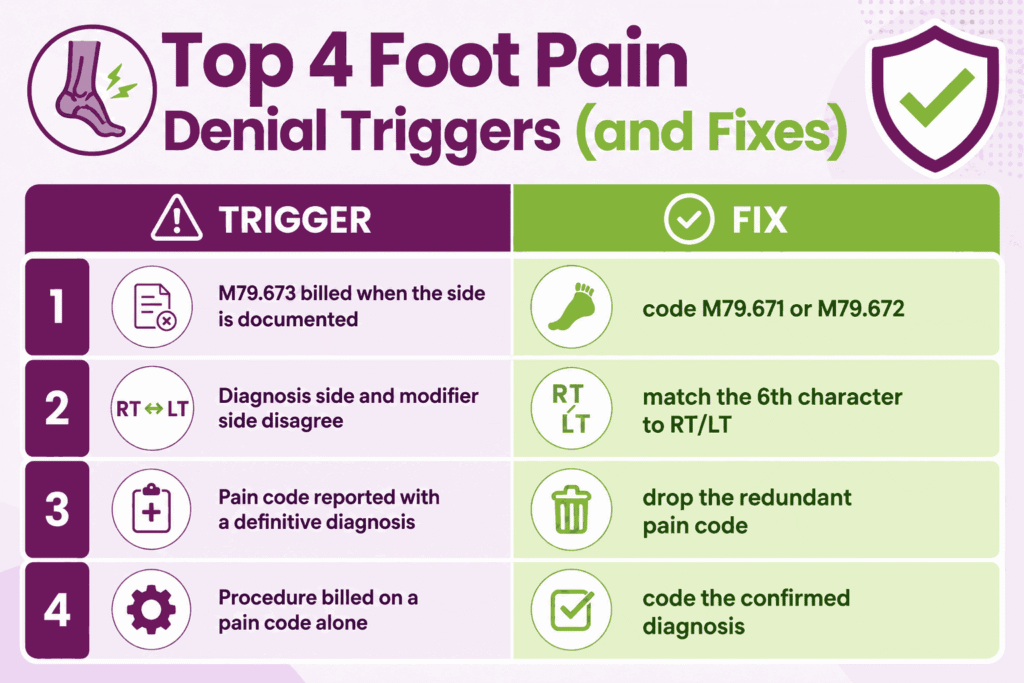
Procedural claims fail on a pain code alone because payers expect a definitive diagnosis for injections and surgery. A symptom code signals an unconfirmed condition, which removes the medical-necessity basis for the procedure. The fix is coding the confirmed diagnosis once the chart supports one.
What Are the Most Common Foot Pain Coding Denials, and How Do You Prevent Them?
The most common foot pain denials come from unspecified codes, laterality mismatches, pain codes paired with definitive diagnoses, and symptom-only procedural claims.
Why Does M79.673 (Unspecified) Trigger Downcoding and Denials?
M79.673 triggers denials when the chart names a side that the code ignores. Payers read the unspecified code as a documentation failure and downcode or deny the line. Claims stay clean when the billed code matches the documented side, M79.671 or M79.672.
How Do Laterality Mismatches Between Diagnosis and CPT Cause Rejections?
Laterality mismatches cause rejections through automated payer edits. A right-foot diagnosis with a left-side modifier, or the reverse, stops the claim before review. Scrubber rules that compare the sixth character against the RT or LT modifier catch the mismatch before submission.
Why Are Claims Denied When a Pain Code Reports Alongside a Definitive Diagnosis?
Claims deny because Excludes conventions bar the pairing. The definitive diagnosis replaces the symptom code for the same site; the two never report together. Removing the redundant pain code resolves the edit without changing reimbursement.
How Do Payer Rules Treat Symptom-Only Foot Pain Claims?
Each payer pays E/M and imaging on a pain code, but holds procedures to a higher standard. The table below summarizes common positions.
| Payer | Common Rule |
|---|---|
| Medicare | E/M and x-rays payable on M79.67-; procedures and DME require a definitive diagnosis |
| BCBS plans | Imaging payable; repeat symptom-only visits flagged for medical review |
| UnitedHealthcare | Prior authorization on foot procedures; pain codes alone fail the authorization |
| Aetna | Symptom codes accepted for workup; injections require a confirmed condition |
High-volume foot and ankle groups route these edits and reviews through specialized podiatry billing companies to keep symptom-phase claims moving.
What Changed in the FY2026 ICD-10-CM Update for Foot and Toe Pain Codes?
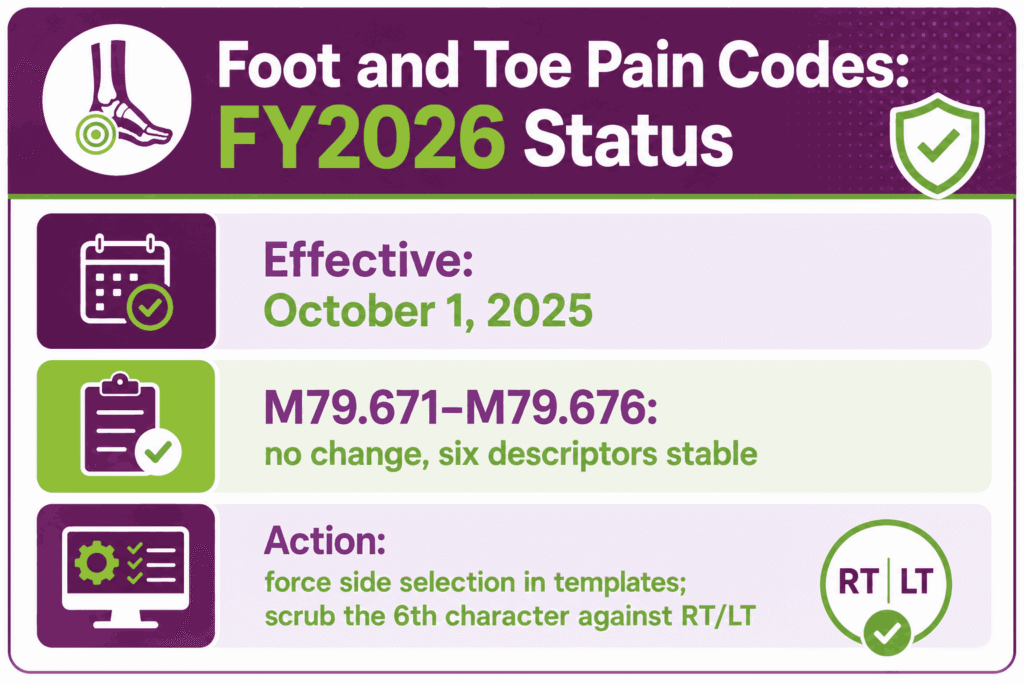
The FY2026 ICD-10-CM update took effect on October 1, 2025, and preserved the M79.67- family. CMS and the National Center for Health Statistics publish the annual code set.
Were the M79.67- Codes Revised for FY2026?
M79.671 through M79.676 carried no change in FY2026. The six descriptors remain pain in the right foot, left foot, unspecified foot, right toe(s), left toe(s), and unspecified toe(s). Practices confirm descriptors against the CMS-published set before billing.
What 2026 Workflows Do Practices Confirm?
Practices confirm three workflows for 2026. EHR pick-lists separate the foot codes from the toe codes. Encounter templates force a side selection, so M79.673 stays rare. Claim scrubbers compare the diagnosis side against the RT or LT modifier on every foot line.
Frequently Asked Questions About Foot and Toe Pain ICD-10 Coding
What Is the ICD-10 Code for Foot Pain?
The ICD-10 code for foot pain is M79.671 for the right foot, M79.672 for the left foot, and M79.673 for an unspecified foot.
What Is the ICD-10 Code for Right Foot Pain?
The ICD-10 code for right foot pain is M79.671. The code applies when right foot pain is documented without a confirmed cause.
What Is the ICD-10 Code for Left Foot Pain?
The ICD-10 code for left foot pain is M79.672. Pain limited to the left toes reports M79.675 instead.
What Is the ICD-10 Code for Bilateral Foot Pain?
Bilateral foot pain reports M79.671 and M79.672 together. No single bilateral code exists, and M79.673 means unspecified rather than bilateral.
What Is the ICD-10 Code for Toe Pain?
The ICD-10 code for toe pain is M79.674 for the right toe(s), M79.675 for the left toe(s), and M79.676 for unspecified toe(s).
What Is the ICD-10 Code for Great Toe Pain?
Great toe pain reports M79.674 on the right and M79.675 on the left. ICD-10-CM provides no separate great toe code.
Can Foot Pain Codes Be Billed With Plantar Fasciitis (M72.2)?
No. Once plantar fasciitis is confirmed, M72.2 replaces the foot pain code for that foot. Excludes conventions bar the two codes from the same claim for the same site.
Is M79.673 a Billable Code?
Yes, M79.673 is billable, but only when the record genuinely lacks a side. Billing M79.673 when the chart names a side invites downcoding.