Florida’s Consumer Collection Practices Act applies to medical practices collecting their own patient balances. It bans 19 collection practices and limits calls to 8 a.m. through 9 p.m. It also allows up to $1,000 in statutory damages per violation, plus fees.
Florida’s debt collection laws reach further than federal law. The Florida Consumer Collection Practices Act (FCCPA) applies to any person collecting a consumer debt. That includes your practice’s own billing office. A patient balance for personal medical care is a consumer debt under Section 559.55.
That reach puts every reminder call, statement, and voicemail under state rules. Hospitals and surgical centers face added limits under Section 395.3011. Deadlines to sue depend on who provided the care. A single violation can cost statutory damages, attorney fees, and punitive damages.

What Are Florida’s Debt Collection Laws for Medical Practices?
Florida’s debt collection laws for medical practices center on the FCCPA, Sections 559.55 through 559.785 of the Florida Statutes. Section 559.72 opens with “in collecting consumer debts, a person may not.” That wording reaches original creditors, not only collection agencies.
A consumer debt is any obligation from a transaction mainly for personal, family, or household purposes. Medical care for a patient fits that definition. Hospitals and surgical centers add Section 395.3011, and filing deadlines sit in Section 95.11. These rules sit alongside the other medical billing laws in Florida.
What Collection Practices Does Section 559.72 Prohibit?
Section 559.72 prohibits 19 collection practices, and each one applies to your practice’s billing staff. The table maps 10 of them to situations a medical practice faces.
| Subsection | Prohibited Practice | Medical Practice Example |
|---|---|---|
| (3), (6) | Disclosing a disputed debt without noting the dispute | Reporting a balance the patient disputes in writing without noting the dispute |
| (4) | Contacting the employer before final judgment without written permission | Calling a patient’s workplace about a balance |
| (5) | Disclosing reputation-affecting information to someone with no legitimate business need | Discussing a balance with a coworker who answers the phone |
| (7) | Calling with harassing frequency | Repeated same-day calls on one balance |
| (8) | Using profane or abusive language | A frustrated staff member’s collection call |
| (9) | Enforcing a debt known not to be legitimate | Billing an amount the practice knows the patient does not owe |
| (10) to (12) | Simulating legal process or an attorney | A letter styled like a court summons |
| (14) | Publishing a “deadbeat list” | Posting names of patients with balances |
| (16) | Printing embarrassing words on an envelope or postcard | The statute’s own example: “Deadbeat, Jane Doe” on the envelope |
| (17) | Communicating between 9 p.m. and 8 a.m. without consent | Evening robocalls after 9 p.m. |
The remaining subsections bar posing as law enforcement and threatening force. They also bar advertising a debt for sale, refusing to identify yourself, and charging the debtor for the communication.
When Can a Practice Contact Patients About Unpaid Bills?
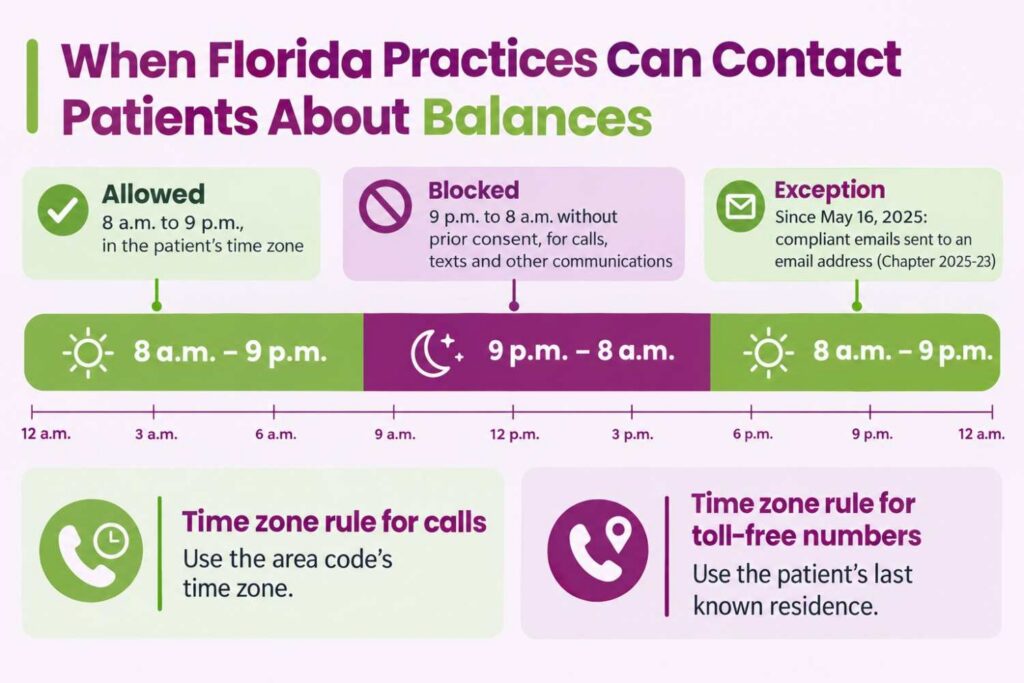
Your practice can contact patients between 8 a.m. and 9 p.m. in the patient’s time zone. Section 559.72(17) bars communication between 9 p.m. and 8 a.m. without the patient’s prior consent.
Chapter 2025-23, signed on May 16, 2025, added one exception. The rule does not apply to an email sent to an email address that otherwise complies with the statute. The exception names email only. Text messages and calls still fall under the 9 p.m. to 8 a.m. limit.
- Area code presumption: Your practice can presume the time zone of the number’s area code.
- Toll-free numbers: Your practice can presume the time zone of the patient’s last known residence.
- Known exception: Neither presumption applies if your practice reasonably believes the phone is in another time zone.
Can a Practice Contact a Patient Who Has an Attorney?
Not directly, once your practice knows an attorney represents the patient on that debt. Section 559.72(18) bars direct contact when the attorney’s name and address are known or easy to find.
Section 559.72(18) allows contact in 3 situations:
- No response: The attorney does not respond within 30 days.
- Consent: The attorney consents to direct contact.
- Patient-initiated: The patient starts the communication.
Personal injury patients treated under a letter of protection in Florida can have counsel on record. Flag those accounts before any staff member calls.
Can a Practice Bill a Patient for an Amount Florida Law Bars?
No, Section 559.72(9) bars enforcing a debt the person knows is not legitimate. It also bars asserting a legal right the person knows does not exist.
Florida law bars several patient balances. Examples include PIP charges above the fee schedule and balances protected under Florida balance billing rules. Collecting those balances while knowing they are barred adds FCCPA exposure to the original violation.
Can a Practice Share Balance Information With Family or a Collection Agency?
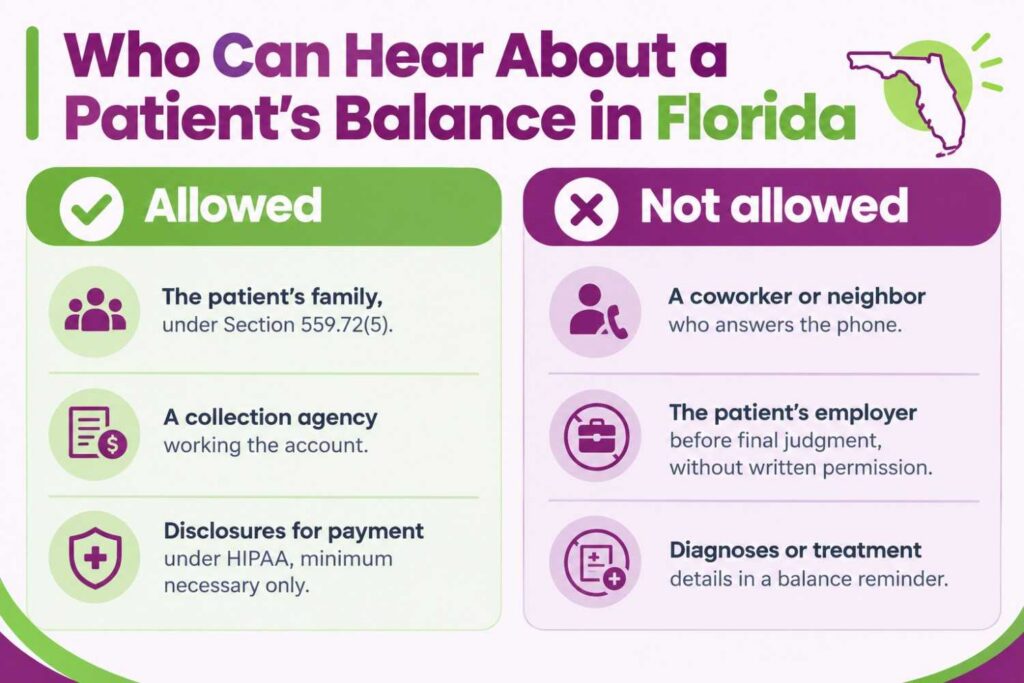
Yes, within limits. Section 559.72(5) permits disclosure to the patient’s family. It bars disclosure to anyone else without a legitimate business need for the information.
- Family members: Disclosure to the patient’s family is allowed under Section 559.72(5).
- Collection agencies: An agency working the account has a legitimate business need.
- Coworkers and neighbors: A person who happens to answer the phone has no business need.
- HIPAA: HIPAA allows disclosures for payment, which include collection activity, under the minimum necessary standard.
HIPAA permits the minimum information needed for payment. Diagnoses and treatment details are not part of a balance reminder.
Does the FCCPA Apply to a Practice’s Own Billing Office?
Yes, Section 559.72 applies to any person collecting a consumer debt, so your front desk and billing staff are covered.
The federal Fair Debt Collection Practices Act (FDCPA) works differently. It generally excludes a creditor’s own employees collecting in the creditor’s name. In Florida, an in-house reminder call follows the same 19 rules as an agency call.
How Does the FCCPA Compare With the Federal FDCPA?
The FCCPA covers more collectors than the FDCPA, and it gives patients longer to sue. The table compares the two laws on 6 points.
| Attribute | FCCPA (Florida) | FDCPA (Federal) |
|---|---|---|
| Who it covers | Any person collecting a consumer debt | Third-party debt collectors |
| Original creditor | Covered | Generally not covered, unless collecting under another name |
| Call hours | 8 a.m. to 9 p.m., patient’s time zone | Before 8 a.m. or after 9 p.m. presumed inconvenient |
| Statutory damages | Up to $1,000 | Up to $1,000 |
| Time to sue | 2 years | 1 year |
| Call frequency | Harassing frequency barred (Section 559.72(7)) | Regulation F 7-in-7 presumption |
A patient can sue under both laws for the same conduct. Florida’s statute states that it does not preclude remedies under the federal FDCPA.
Does a Florida Medical Practice Need a Debt Collection License?
No, Section 559.553 exempts an original creditor from consumer collection agency registration. The agency your practice hires must register with the Office of Financial Regulation (OFR), unless an exemption applies.
One trap applies. A creditor that collects under another name implying a third party becomes a debt collector under Section 559.55. Your practice keeps its exempt status only while it collects in its own name.
What Is the 7-in-7 Rule for Debt Collectors?
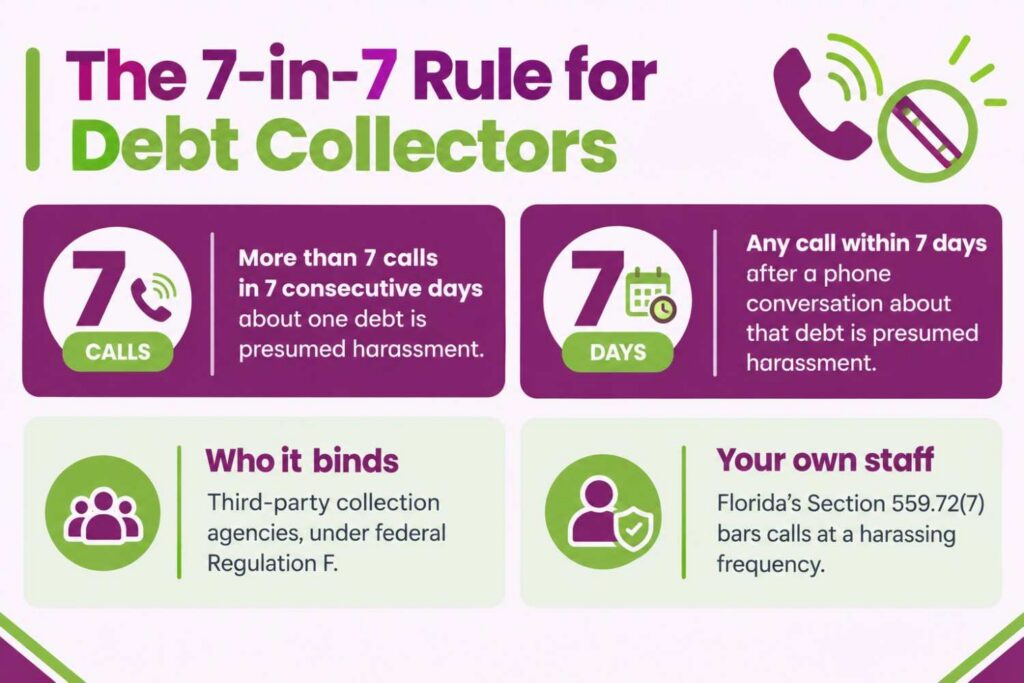
The 7-in-7 rule is a federal call limit for debt collectors under Regulation F. It sets 2 presumptions of harassment for calls about a particular debt.
- Call frequency: More than 7 calls within 7 consecutive days is presumed harassment.
- After a conversation: Any call within 7 days after a phone conversation about that debt is presumed harassment.
The rule binds third-party agencies covered by the FDCPA. For your practice’s own staff, Section 559.72(7) bars calls with a frequency that can reasonably be expected to harass.
What Notice Is Required When a Practice Assigns or Sells a Patient Debt?
Section 559.715 allows a creditor to assign the right to bill and collect a consumer debt. The assignee must give the patient written notice as soon as practical after the assignment. That notice must arrive at least 30 days before any action to collect. Hospital and surgical center debt sales also follow Section 395.3011.
What Extra Collection Rules Apply to Florida Hospitals and Surgical Centers?
Florida hospitals and ambulatory surgical centers must follow Section 395.3011 before taking any extraordinary collection action. HB 7089 created these rules in 2024. They apply to facilities licensed under Chapter 395, not to physician practices.
Section 395.3011 defines extraordinary collection actions to include these steps:
- Selling the patient’s debt to another party
- Reporting adverse information to credit bureaus
- Placing a lien on property or foreclosing on real property
- Starting a civil action against the patient
- Garnishing wages or seizing a bank account
A facility cannot take these steps before 5 conditions are met.
- The facility makes reasonable efforts to check eligibility under its financial assistance policy.
- The facility provides an itemized statement or bill.
- The facility bills any applicable insurer and allows adjudication.
- No grievance or claim appeal is still pending.
- Thirty days pass after written notice sent by certified mail or another traceable method.
HB 547 took effect on July 1, 2025. It applies these rules to all bills, not only bills covered by the facility’s financial assistance policy.
A facility can sell debt without the 30-day notice if the contract bars interest, fees, and further collection actions. The buyer must also return the debt if the patient qualifies for charity care.
How Long Does a Florida Practice Have to Collect a Patient Balance?
The deadline to sue depends on who provided the care. Section 95.11 sets 3 limits for medical debt.
| Provider Type | Limit | Clock Starts |
|---|---|---|
| Hospital or surgical center licensed under Chapter 395 | 3 years (Section 95.11(4)) | Date the facility refers the debt to a third party for collection |
| Other providers, written agreement | 5 years (Section 95.11(2)(b)) | Breach of the payment obligation |
| Other providers, no written agreement or open account | 4 years (Section 95.11(3)(j)) | Breach of the payment obligation |
Urgent care centers and physician practices are not Chapter 395 facilities. The 3-year rule does not apply to their bills. A collection agency can sue in Florida, but only within these limits.
Threatening suit on a time-barred debt asserts a legal right that no longer exists. Section 559.72(9) prohibits that conduct. Track the age of every balance before a lawsuit is mentioned in a letter or call.
Can a Practice Report Unpaid Medical Bills to Credit Bureaus?
Yes, in Florida, within the credit bureaus’ own limits. Hospitals and surgical centers must also meet Section 395.3011 before reporting. Florida is not among the states that ban medical debt credit reporting.
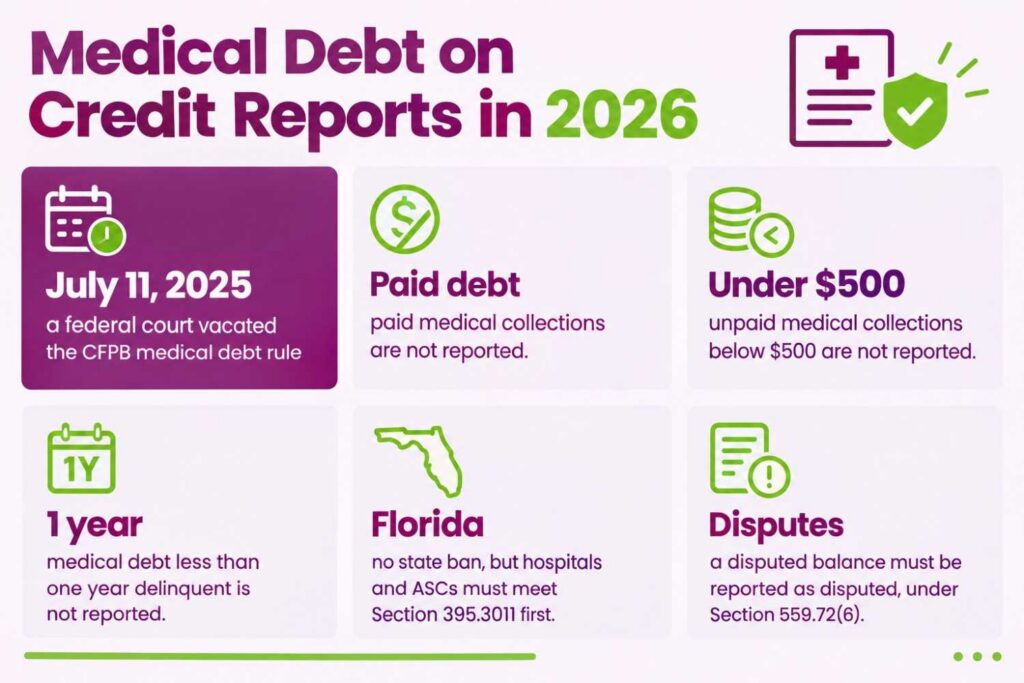
A federal court vacated the Consumer Financial Protection Bureau’s medical debt rule on July 11, 2025. That rule would have removed most medical debt from credit reports. Equifax, Experian, and TransUnion still apply their own voluntary limits.
- Paid debt: Paid medical collections are not reported.
- Small balances: Unpaid medical collections under $500 are not reported.
- Grace period: Medical debt less than one year delinquent is not reported.
- Disputes: A balance the patient reasonably disputes must be reported as disputed under Section 559.72(6).
What Are the Penalties for Violating the FCCPA?
Section 559.77 gives patients a civil action against any person who violates Section 559.72. A court that finds a violation can award 5 types of relief.
- Actual damages
- Statutory damages up to $1,000
- Court costs and reasonable attorney fees
- Punitive damages, at the court’s discretion
- Injunctive relief that bars further violations
The court weighs the nature, frequency, persistence, and intent of the violation when setting statutory damages. In a class action, each named plaintiff can receive up to $1,000. The aggregate award for the rest of the class cannot exceed the lesser of $500,000 or 1% of net worth.
A patient must file suit within 2 years of the violation. Section 559.77(3) also provides a bona fide error defense. A person is not liable if the violation was unintentional and happened despite procedures reasonably adapted to avoid it.
How Can a Florida Practice Keep Patient Collections FCCPA-Compliant?
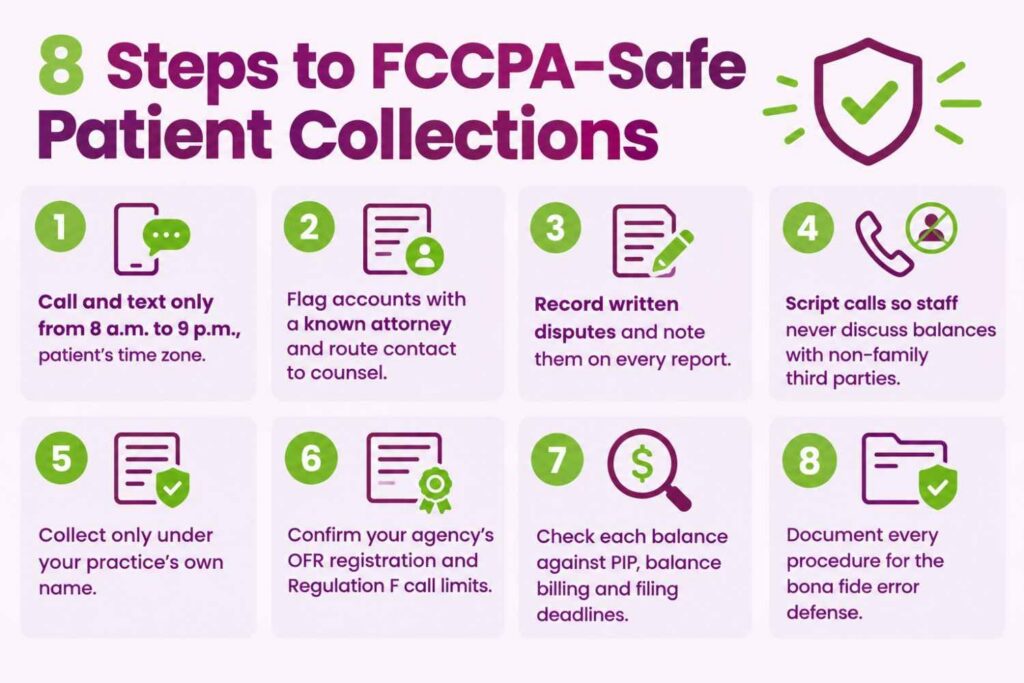
Your practice keeps collections compliant through written procedures that staff follow on every account. Those procedures also form the basis of the bona fide error defense.
- Limit calls and texts to 8 a.m. through 9 p.m. in the patient’s time zone.
- Flag every account with a known attorney, and route contact to counsel.
- Record written disputes, and note them on any report or disclosure.
- Script calls so staff never discuss balances with non-family third parties.
- Collect only under your practice’s own name.
- Confirm your agency’s OFR registration and its Regulation F call limits.
- Check each balance against PIP, balance billing, and limitation rules before collecting.
- Document every procedure, and train staff on it at hire.
A medical billing audit can test these steps against real account histories. Gaps in call logs or dispute notes show up before a patient’s attorney finds them.
How Does Transcure Handle Patient Balance Follow-Up in Florida?
Transcure runs patient balance follow-up for Florida practices from its Oviedo office. In-house, patient follow-up competes with front-desk work, and each call carries FCCPA rules on timing, disputes, and counsel.
- Aging balances: ARIA, our A/R agent, tracks every open patient balance by age and status.
- Contact rules: Our billers work patient follow-up within the hours and contact rules above.
- Account flags: Disputes and attorney representation are recorded on the account before the next contact.
The outcome is patient balances that move without creating FCCPA exposure for your practice. That workflow is part of Transcure’s medical billing services in Florida.
Has Florida Changed Its Debt Collection Law Recently?
Yes, Chapter 2025-23, signed on May 16, 2025, amended Section 559.72. The change excludes compliant emails from the 9 p.m. to 8 a.m. rule. The 2026 statute text reflects that amendment. Medical debt rules also changed in 2024 and 2025 through HB 7089 and HB 547.
Florida’s debt collection laws treat a practice’s own billing office like any other collector. The rules on timing, disclosure, disputes, and deadlines decide whether a balance is collected cleanly. These rules sit alongside the other medical billing laws in Florida that govern practice billing.
Frequently Asked Questions About Florida Debt Collection Laws
How Long Does a Creditor Have to Collect a Debt in Florida?
A creditor has 5 years on a written contract and 4 years without a written agreement. Medical debt owed to a Chapter 395 hospital or surgical center has 3 years from referral to collection.
Can a Collection Agency Take You to Court in Florida?
Yes, within the statute of limitations. The agency must follow the FCCPA and the federal FDCPA while collecting. Hospitals and surgical centers must also meet Section 395.3011 before any civil action.
Can a Doctor’s Office Send a Bill to Collections in Florida?
Yes, a practice can refer an unpaid balance to a collection agency. The agency must register with the Office of Financial Regulation unless exempt. Both the practice and the agency must follow the FCCPA.
Can Debt Collectors Email at Night in Florida?
Yes, since May 16, 2025, the 9 p.m. to 8 a.m. rule excludes a compliant email sent to an email address. Calls, texts, and other communications in those hours still need prior consent.
How Long Does a Patient Have to Sue Under the FCCPA?
A patient has 2 years from the date of the violation. The court can award actual damages, up to $1,000 in statutory damages, attorney fees, and punitive damages.