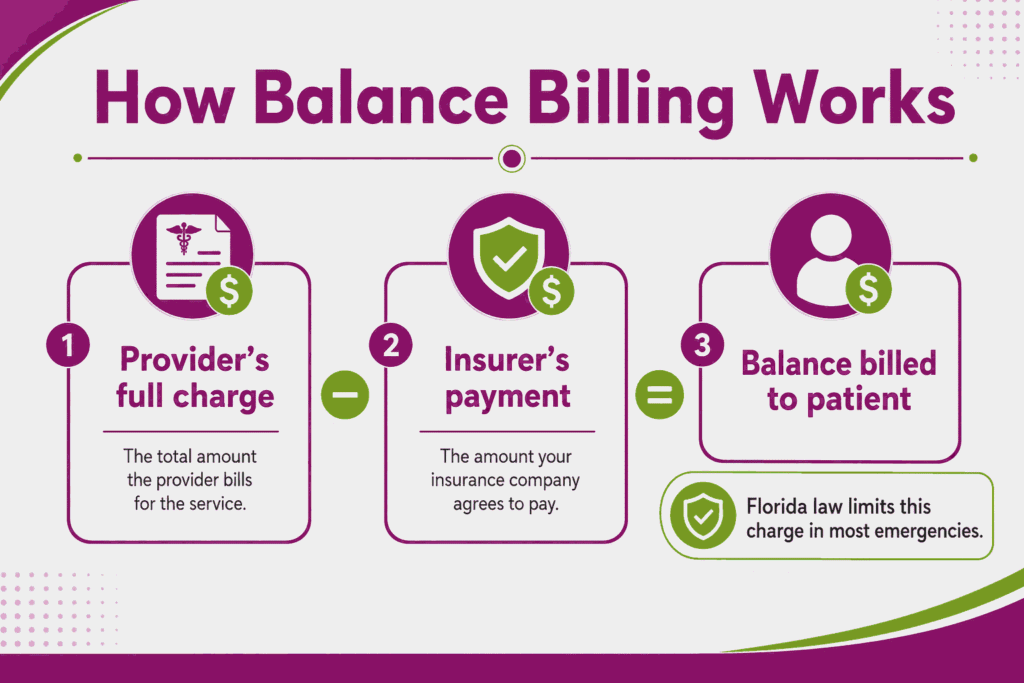
Balance billing in Florida is the practice of charging a patient the difference between a provider’s full charge and the amount an insurer pays. Florida law prohibits this practice in most emergency and surprise situations. Two state statutes and one federal law define the limits.
The two state laws are Florida Statute 627.64194 for PPO and EPO plans and Florida Statute 641.3154 for HMO plans. The federal No Surprises Act adds a second layer of protection. Each law applies to different plan types and different care settings.
Balance billing protection in Florida is not absolute. Providers can still bill patients in specific cases, such as non-emergency care outside a hospital or services delivered after written consent. Ground ambulance transport also remains largely unprotected.
This article explains whether balance billing is legal in Florida, which laws protect HMO and PPO members, when a provider can still bill you, and how to dispute a surprise medical bill.
Is Balance Billing Legal in Florida?
Balance billing is illegal in Florida for most emergency services and many out-of-network surprise situations. State law protects both HMO and PPO members from these charges. The protection depends on the plan type and the care setting.
Florida built its balance billing protection on two separate statutes. One statute governs HMO plans, and the other governs PPO and EPO plans. A patient’s rights change based on which plan applies to the claim.
The table below maps each plan type to the governing Florida statute and the core protection it grants:
| Plan Type | Governing Statute | Core Protection |
|---|---|---|
| HMO | Fla. Stat. § 641.3154 | Provider cannot collect any amount that is the HMO’s responsibility from the subscriber |
| PPO / EPO | Fla. Stat. § 627.64194(5) | Provider cannot charge the patient any balance not paid by insurance for emergency services |
| Any commercial plan (emergency) | Federal No Surprises Act | Cost sharing limited to the in-network amount for emergency care |
Across all three frameworks, the patient’s cost sharing is capped at the in-network amount. The dispute over the remaining balance shifts to the provider and the insurer, not the patient.
What Does Florida Law Say About Balance Billing?
Florida law says a provider cannot bill a protected patient beyond in-network cost sharing for emergency care. This rule holds even when the provider or facility sits outside the patient’s insurance network. The remaining balance becomes a matter between the provider and the insurer.
Two statutes carry this rule. Florida Statute 641.3154 covers HMO subscribers, and Florida Statute 627.64194 covers PPO and EPO members. A common error treats one statute as covering both plan types, which is incorrect.
The distinction matters for three reasons:
- Different statutes apply different reimbursement standards to HMO and PPO claims.
- Different plan documents determine which law a patient falls under.
- Different enforcement paths exist for HMO disputes versus PPO disputes.
What Is the Florida Balance Billing Statute (HB 221)?
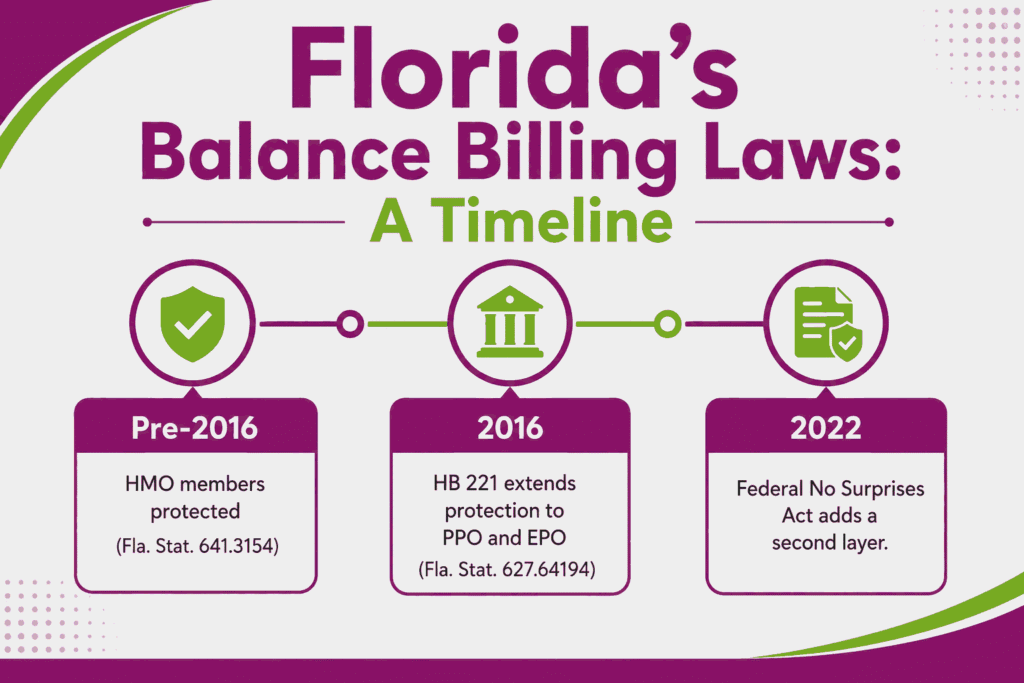
The Florida balance billing statute for PPO members originated in House Bill 221, signed in 2016 with an effective date of July 1, 2016. HB 221 created Florida Statute 627.64194 and extended surprise billing protection to PPO and EPO members. Before HB 221, only HMO members held this statutory protection.
HB 221 set the payment standard for out-of-network emergency and covered non-emergency claims. The law also exempted ambulance services from its protections. That exemption still shapes how ground ambulance bills are handled in Florida today.
How Does Balance Billing Work for HMO Plans?
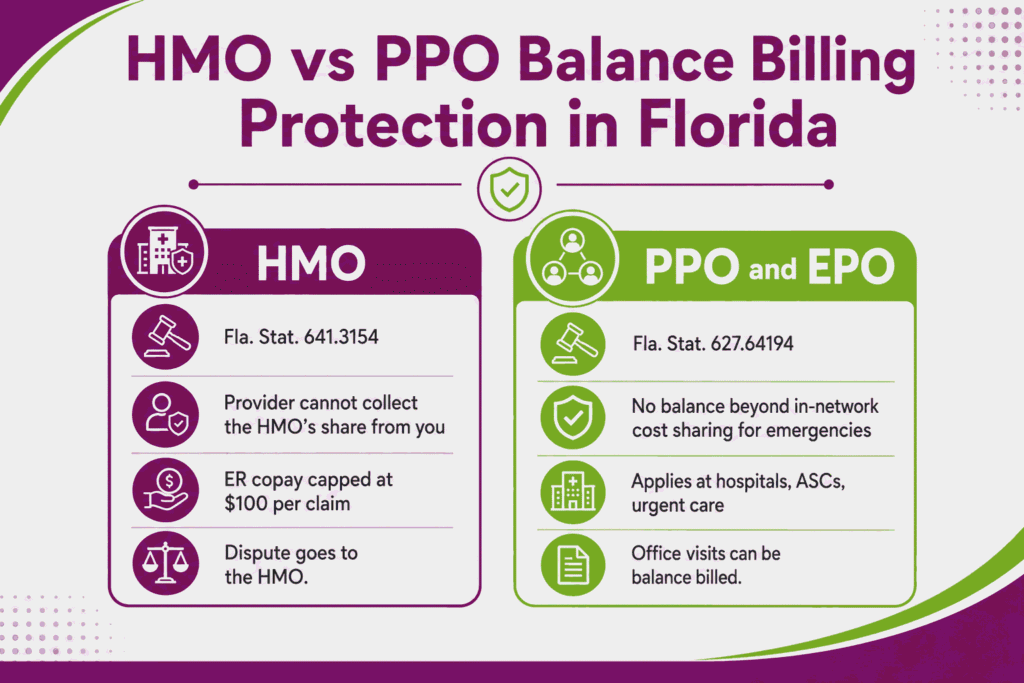
For HMO plans, a provider cannot collect any amount that is the responsibility of the HMO from the subscriber under Florida Statute 641.3154. When a payment dispute arises, the provider’s only recourse runs against the HMO. The HMO subscriber stays out of the dispute.
Florida Statute 641.513 sets the emergency reimbursement standard for non-contracted providers. Reimbursement equals the lesser of the provider’s charges, the usual and customary community charge, or a mutually agreed amount within 60 days.
A subscriber’s emergency room copayment carries a hard limit. Under Florida Statutes 641.513(4) and 641.31(12), the copayment for emergency services cannot exceed $100 per claim for a covered subscriber.
How Does Balance Billing Work for PPO and EPO Plans?
For PPO and EPO plans, Florida Statute 627.64194(5) prohibits a provider from charging the patient any balance not paid by insurance for emergency services. The patient’s cost sharing stays limited to the in-network amount. This protection reaches both out-of-network providers and out-of-network facilities.
One carve-out limits this protection. The PPO balance billing ban applies to services at a hospital, ambulatory surgical center, or urgent care center. Non-emergency services delivered in other settings, such as a private physician office, fall outside the statutory ban.
What Protections Exist for Emergency and Surprise Medical Bills?
Florida protects patients from surprise medical bills through a combination of state statutes and the federal No Surprises Act. State law covers most commercial HMO and PPO plans regulated in Florida. The federal law covers gaps that state law cannot reach, including self-funded employer plans.
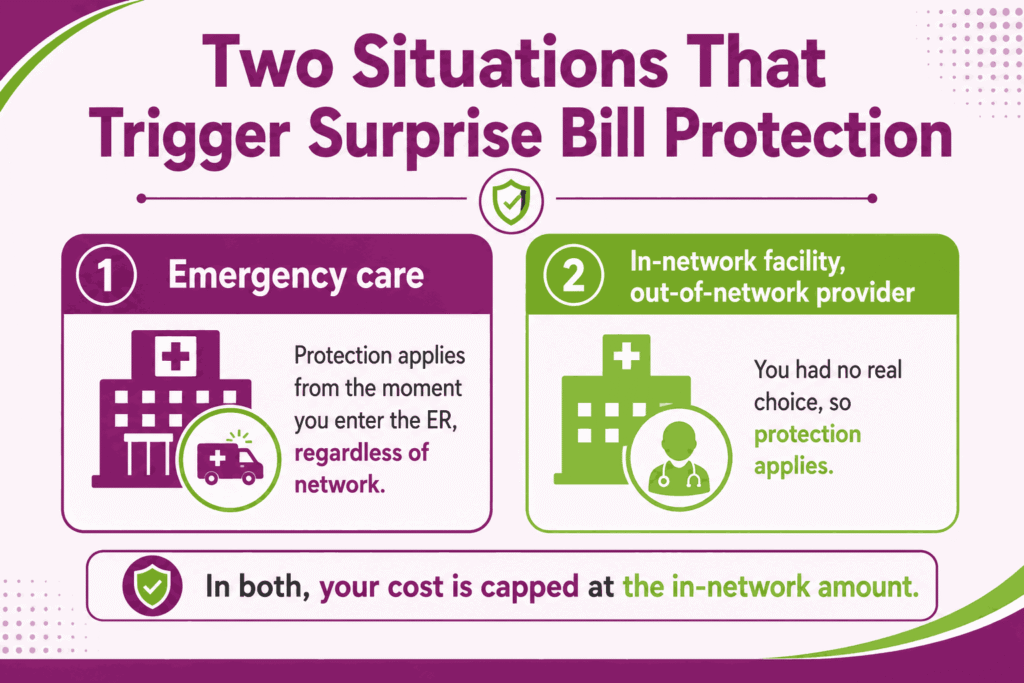
A surprise medical bill arises when a patient receives care from an out-of-network provider without a genuine choice. Emergency care and care at in-network facilities are the two most common triggers. Both scenarios carry statutory protection in Florida.
What Is the Florida Surprise Billing Law?
The Florida surprise billing law bars out-of-network providers from billing protected patients above in-network cost sharing for emergency services. The rule appears in Florida Statute 627.64194 for PPO members and Florida Statute 641.3154 for HMO members. Emergency care triggers protection regardless of the provider’s network status.
Emergency protection applies from the moment a patient enters an emergency department. A patient cannot be expected to check network status during a medical emergency. Florida law places that risk on the insurer and provider instead of the patient.
How Does the Federal No Surprises Act Apply in Florida?
The federal No Surprises Act protects Florida patients whose plans fall outside state regulation, such as self-funded employer plans governed by federal law. The No Surprises Act took effect on January 1, 2022. Florida patients often hold protection under both state law and the federal law at once.
State law and the federal No Surprises Act work as parallel systems in Florida. The applicable framework depends on how the health plan is regulated. Patients reviewing broader state rules can consult Transcure’s guide to Florida medical billing laws for the wider statutory picture.
Are You Protected From Out-of-Network Providers at In-Network Facilities?
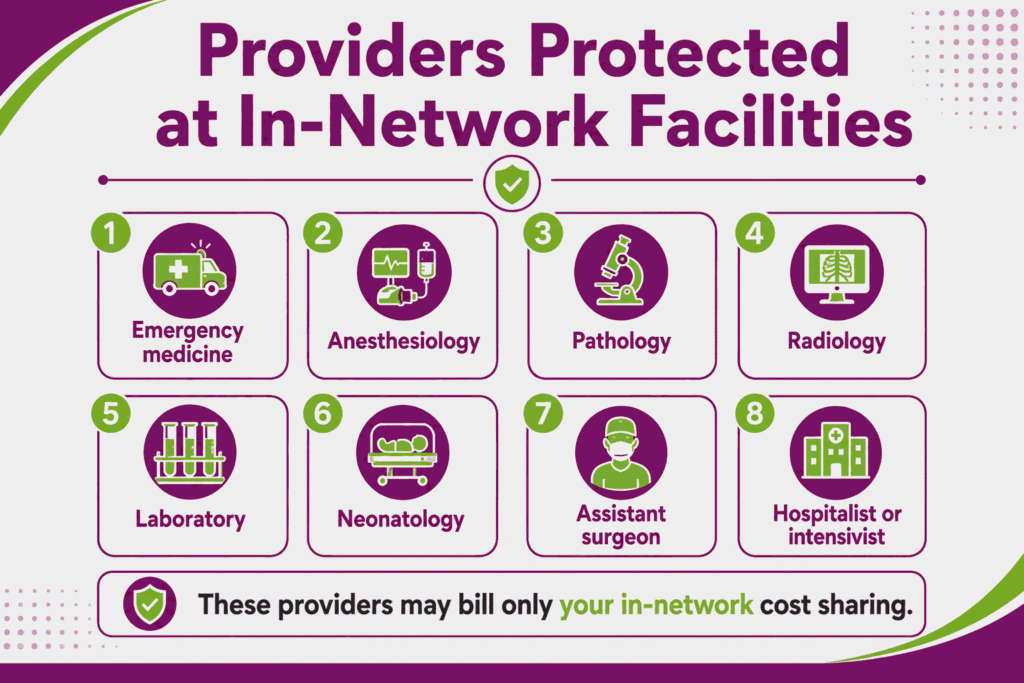
Yes, Florida patients are protected from most out-of-network providers who treat them at in-network facilities. When a patient visits an in-network hospital or ambulatory surgical center, certain providers there may be out-of-network. Those providers can bill only the plan’s in-network cost-sharing amount.
This protection covers a defined set of hospital-based specialties. These providers frequently work at a facility without the patient ever choosing them directly.
- Emergency medicine
- Anesthesiology
- Pathology
- Radiology
- Laboratory services
- Neonatology
- Assistant surgeon
- Hospitalist or intensivist services
A separate rule governs written consent. An out-of-network provider delivering non-emergency services can bill above in-network rates only after the patient signs a valid consent form. A patient is never required to sign that form.
When Can a Provider Still Balance Bill You in Florida?
A provider can still balance bill you in Florida in four main situations that fall outside statutory protection. Balance billing protection covers emergencies and in-network facility care, not every medical encounter. Knowing these exceptions prevents an unexpected bill.
The exceptions exist because Florida law targets surprise scenarios where a patient had no real choice. When a patient knowingly selects out-of-network care, the protection generally does not apply.
What Are the Exceptions to Florida’s Balance Billing Rules?
The exceptions to Florida’s balance billing rules cover cases where the patient chose out-of-network care or waived protection. Four situations fall outside the statutory ban.
| Exception | What It Means | Patient Exposure |
|---|---|---|
| Written consent | Patient signs a valid waiver before non-emergency out-of-network care | Full out-of-network charges |
| Office-based services | Non-emergency care outside a hospital, ASC, or urgent care center | Balance billing permitted |
| Elective out-of-network care | Patient chooses an out-of-network provider by preference | Full out-of-network charges |
| Self-pay or non-covered services | Services the plan does not cover, or uninsured care | Provider’s full charges |
For self-pay and uninsured patients, the federal Good Faith Estimate rule applies. A provider must give an uninsured or self-pay patient a written cost estimate before scheduled care.
Can You Be Balance Billed for Ground Ambulance Services in Florida?
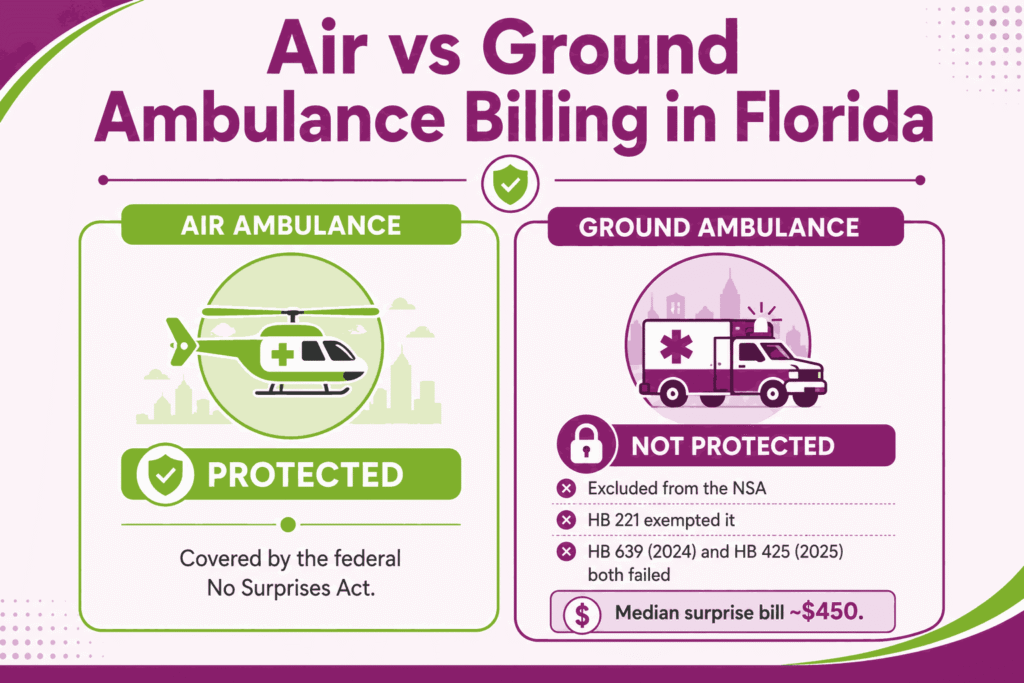
Yes, you can be balance billed for ground ambulance services in Florida in many cases. Ground ambulance transport sits outside both the federal No Surprises Act and most Florida balance billing protection. HB 221 specifically exempted ambulance services in 2016.
The federal No Surprises Act protects air ambulance transport but excludes ground ambulance. Florida has not closed this gap for ground transport. Two recent bills attempted to address it and failed.
- HB 639 (2024) proposed reimbursement standards for out-of-network ground ambulance emergency services. The bill died in the Health and Human Services Committee.
- HB 425 (2025) revived a similar approach for ground ambulance reimbursement. The bill did not pass into law.
Until Florida enacts a ground ambulance statute, patients transported by an out-of-network ground ambulance can face a balance bill. A median surprise ground ambulance bill reached roughly $450 in national 2020 data.
Does Florida Allow Balance Billing for Medicare or Medicaid Patients?
Florida handles Medicare and Medicaid balance billing under separate rules from commercial plan protection. Medicaid reimbursement for non-contracted providers falls under Chapter 409 of the Florida Statutes. Medicare balance billing follows federal Medicare rules rather than the state statutes.
Medicaid recipients receive strong balance billing protection. A provider who accepts Medicaid generally cannot bill a Medicaid patient for covered services beyond allowed cost sharing. Medicare Advantage members hold protection similar to other commercial emergency care rules.
What Should You Do If You Receive a Balance Bill in Florida?
If you receive a balance bill in Florida, verify the charge, dispute it in writing, and file a complaint if needed. Many balance bills are sent in error for protected emergency or facility-based care. A structured response resolves most of these bills.
The response process works best in a set order. Each step builds the record needed for a formal complaint if the provider refuses to correct the charge.
How Do You Fight a Balance Bill in Florida?
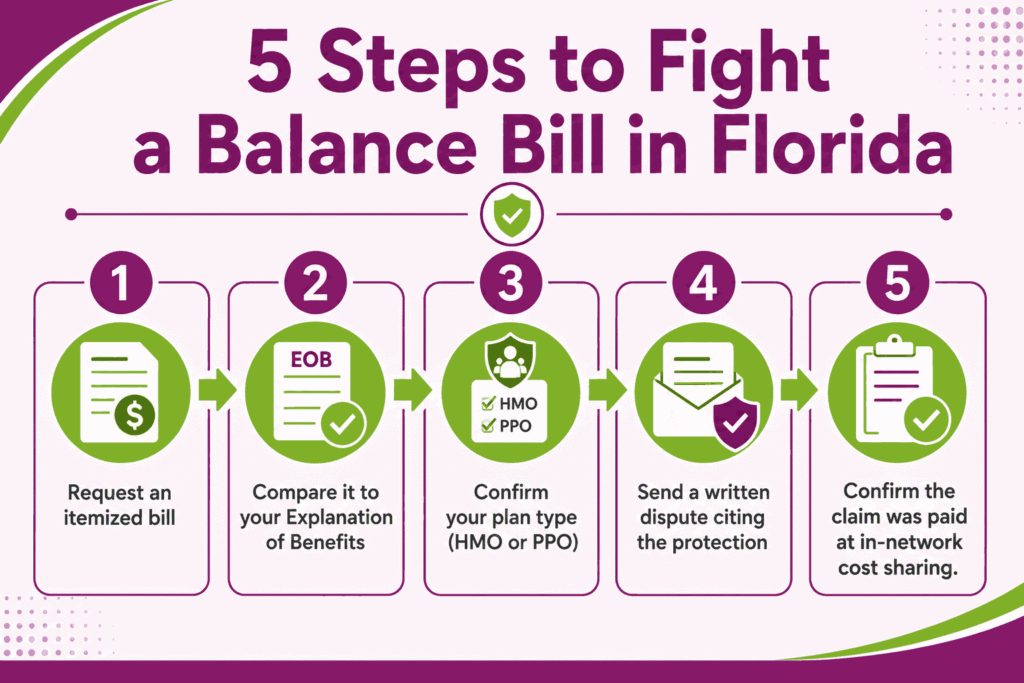
To fight a balance bill in Florida, follow five steps in order and keep written records at each stage. Documentation is the strongest tool a patient holds in a billing dispute.
- Request an itemized bill from the provider for every line-item charge.
- Compare the bill against your Explanation of Benefits from the insurer.
- Confirm your plan type, since HMO and PPO rules differ under Florida law.
- Send the provider a written dispute citing the emergency or facility protection.
- Contact your insurer to confirm the claim was processed at in-network cost sharing.
A common mistake is paying the bill before verifying it. Payment can weaken a later dispute and complicate a refund request.
How Do You Report Balance Billing in Florida?
To report balance billing in Florida, file a complaint with the state or federal agency that regulates your plan. The correct agency depends on whether state law or the federal No Surprises Act governs the health plan. Both paths accept consumer complaints directly.
- Florida Department of Financial Services, Division of Consumer Services, handles complaints involving state-regulated insurers.
- Florida Office of Insurance Regulation oversees insurer conduct and market practices.
- Federal No Surprises Help Desk handles complaints under the federal No Surprises Act.
A complaint should include the itemized bill, the Explanation of Benefits, and copies of any written dispute already sent to the provider.
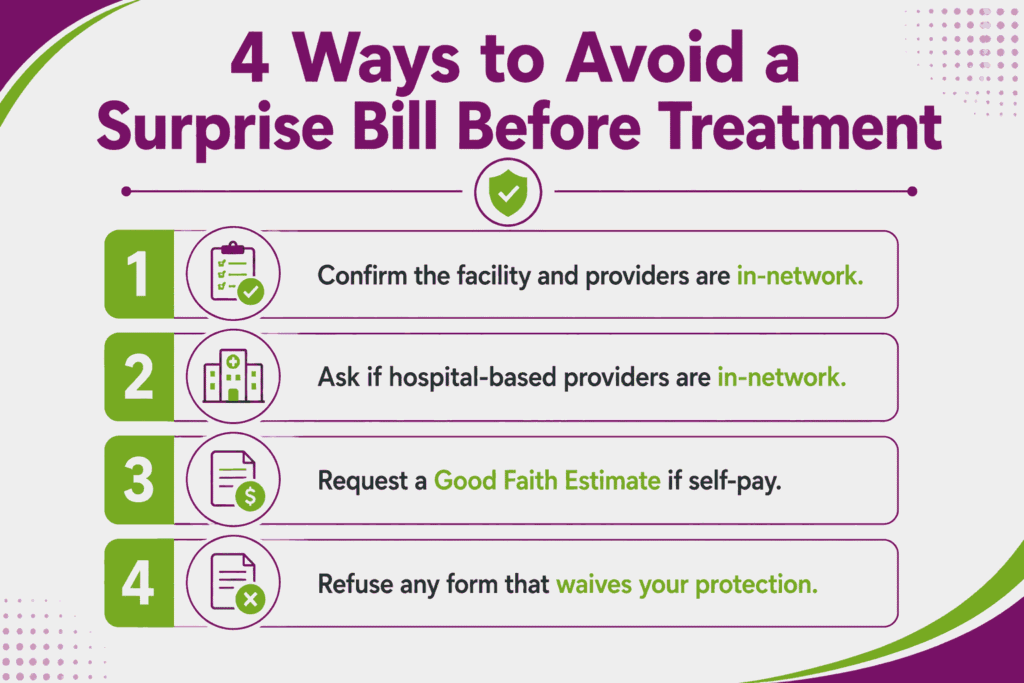
How Can You Avoid Balance Billing Before Treatment?
To avoid balance billing before treatment, verify network status and request cost estimates in advance. Most surprise bills trace back to a network gap the patient did not know existed. Preventive checks close that gap.
- Confirm the facility and the treating providers are in your plan network.
- Ask whether hospital-based providers, such as anesthesiologists, are in-network.
- Request a Good Faith Estimate if you are uninsured or paying out of pocket.
- Refuse to sign any consent form that waives balance billing protection.
Who Regulates and Enforces Balance Billing Laws in Florida?
Balance billing laws in Florida are regulated and enforced by four agencies with distinct roles across state and federal levels. State agencies handle commercial insurer conduct, while federal agencies handle the No Surprises Act. Each agency accepts complaints within its scope.
Enforcement combines insurer oversight, provider discipline, and consumer complaint handling. A patient can escalate a balance billing dispute through the agency that matches the plan type.
Which Agencies Oversee Balance Billing in Florida?
The agencies that oversee balance billing in Florida divide responsibility across insurers, providers, and federal claims. The table below lists each agency and its primary role.
| Agency | Primary Role |
|---|---|
| Florida Office of Insurance Regulation (FLOIR) | Licenses and regulates insurers, HMOs, and risk-bearing entities |
| Florida Department of Financial Services (DFS) | Handles consumer complaints through the Division of Consumer Services |
| Agency for Health Care Administration (AHCA) | Regulates HMO quality of care under Chapter 641 |
| Centers for Medicare and Medicaid Services (CMS) | Administers the federal No Surprises Act |
What Are the Penalties for Illegal Balance Billing?
Penalties for illegal balance billing in Florida include monetary fines, forced patient refunds, and disciplinary action against licenses. Providers and insurers both face consequences under state law. Repeated violations raise the severity of enforcement.
Provider discipline runs through the relevant licensing board. A provider who bills a protected patient in violation of Florida Statute 627.64194 or 641.3154 can face administrative penalties and refund orders.
Medical practices that bill out-of-network and emergency claims can reduce compliance risk with accurate billing support. Transcure helps Florida practices process these claims correctly under state and federal rules. Practices comparing options can review medical billing services in Florida for specialty-specific support.
Frequently Asked Questions About Balance Billing in Florida
What States Do Not Allow Balance Billing?
Most states restrict balance billing for emergency care, and states such as Florida, California, New York, and Texas maintain specific surprise billing statutes. Every state also falls under the federal No Surprises Act since January 2022. State protection varies in scope beyond emergencies.
Does Florida’s Balance Billing Law Protect Out-of-State Visitors?
Florida’s balance billing law protects patients based on their health plan’s regulation, not their residency. An out-of-state visitor with a plan regulated in another state relies on the federal No Surprises Act for emergency protection in Florida. Emergency care carries protection regardless of the patient’s home state.
Is There a Deadline to Dispute a Balance Bill in Florida?
There is no single statewide deadline to dispute a balance bill in Florida, but early action protects a patient’s rights. A written dispute sent before payment preserves the strongest position. Insurers and agencies apply their own filing windows for complaints and appeals.
Does the Balance Billing Ban Apply to a Doctor’s Office?
The balance billing ban does not fully apply to a doctor’s office in Florida for non-emergency services. Florida Statute 627.64194 protects patients for emergency care and services at hospitals, ambulatory surgical centers, and urgent care centers. Non-emergency care in a private office can be balance billed.
Balance billing in Florida is limited by Florida Statute 627.64194, Florida Statute 641.3154, and the federal No Surprises Act. These laws protect HMO and PPO members from most emergency and surprise out-of-network charges. The defined exceptions cover office-based care, written consent, elective out-of-network choices, and ground ambulance transport.