Anemia ICD-10 coding starts with D64.9, the billable code for unspecified anemia in ICD-10-CM. CMS confirms FY 2027 codes apply from October 1, 2026 through September 30, 2027. Neither D64.9 nor the D50 iron deficiency anemia codes changed in that annual update.
Payers review D64.9 because cause-specific codes such as D50.9 and D63.1 show documented etiology. For anemia-only encounters, the Official Guidelines sequence D64.81 before the neoplasm and T45.1X5- codes.
Coders sequence N18 codes first for CKD anemia, while D62 captures acute posthemorrhagic anemia. NHLBI attributes anemia to low red blood cell production, excess destruction, or blood loss. This guide maps the major anemia codes and explains documentation rules for low hemoglobin.
What Is the ICD-10 Code for Anemia?
The ICD-10 code for anemia is D64.9, titled “Anemia, unspecified.” Providers report this billable code when anemia appears in the record without a documented type or origin. Since October 1, 2026, the FY 2027 code set has been in effect, and D64.9 has carried over without edits.
D64.9 sits in Chapter 3 of ICD-10-CM, the CDC-maintained classification covering diseases of the blood and blood-forming organs. Choosing between D64.9 and a cause-specific code depends entirely on provider documentation.
What Does ICD-10 Code D64.9 Mean for Unspecified Anemia?
Use D64.9 when the provider documents anemia and nothing in the record names a type or cause. That makes it the ICD-10 code for anemia, unspecified, and it matches the index entry for anemia NOS.
Section I.A.9.b of the Official Guidelines allows unspecified codes when the medical record lacks detail for a specific one. Reporting a specific code the record does not support is inappropriate, according to Section I.B.18.
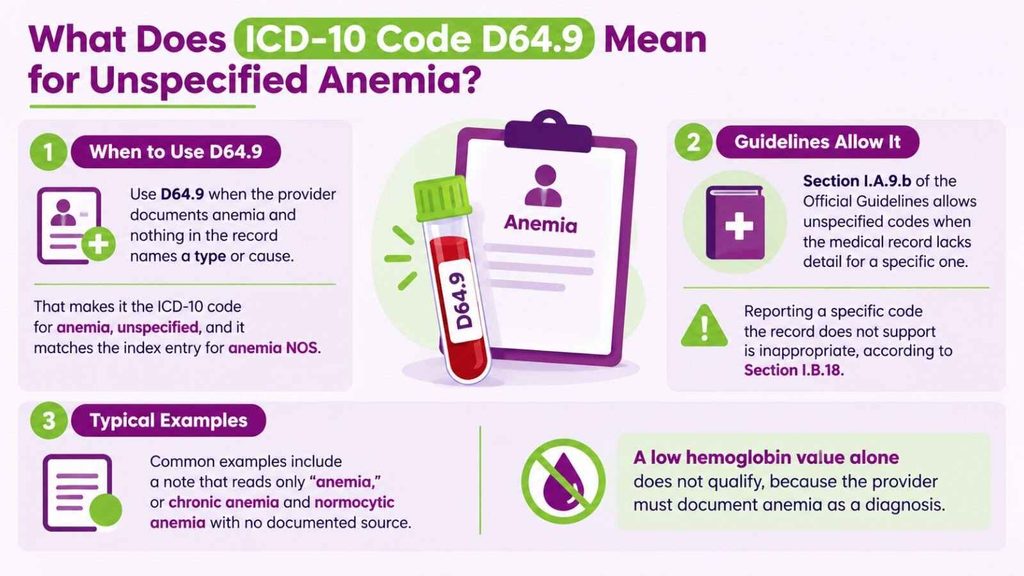
Typical examples include a note that reads only “anemia,” or chronic anemia and normocytic anemia with no documented source. A low hemoglobin value alone does not qualify, because the provider must document anemia as a diagnosis.
Reviewers flag D64.9 because it signals that documentation never identified the underlying condition. Unspecified codes can trigger records requests and post-payment audits when they support tests or infusions. Sending a CDI query to the provider usually closes the gap before claim submission.
How Does ICD-10-CM Organize Anemia Codes?
ICD-10-CM groups anemia codes into three blocks inside Chapter 3, and each block reflects a different mechanism. Index lookup comes first, and the Tabular List then confirms the block and its notes.
| Code Block | Category | Main Codes | Use It When |
|---|---|---|---|
| D50 to D53 | Nutritional anemias | D50.0, D50.1, D50.8, D50.9 (iron deficiency), D51.0, D51.9 (vitamin B12), D52.9 (folate), D53.9 (other nutritional) | The provider documents a deficiency as the cause |
| D55 to D59 | Hemolytic anemias | D55 (enzyme disorders), D56 (thalassemia), D57 (sickle cell disorders), D58 (other hereditary), D59.9 (acquired) | Red blood cells are destroyed early |
| D60 to D64 | Aplastic and other anemias | D60, D61, D62, D63.0, D63.1, D63.8, D64.81, D64.89, D64.9 | The anemia comes from marrow failure, acute blood loss, chronic disease, therapy, or has no stated cause |
Block D60 to D64 ends with D64.9, the fallback when no cause is documented. Some anemia-related codes sit outside these blocks, such as D46.0 for refractory anemia and O99.01- for pregnancy. History and screening use Z86.2 and Z13.0 instead of an active anemia code.
Which Anemia ICD-10 Codes Do Coders Use Most Often?
Among internal medicine ICD-10 codes, 13 anemia entries recur often, and the table below shows when each applies. Rows with a code first note need the underlying disease reported ahead of the anemia entry.
| Code | Description | When to Use | Pair It With |
|---|---|---|---|
| D64.9 | Anemia, unspecified | The record states anemia with no type or cause | None |
| D50.9 | Iron deficiency anemia, unspecified | Iron deficiency anemia is documented with no stated source | None |
| D50.0 | Iron deficiency anemia secondary to blood loss (chronic) | Chronic blood loss is the documented source | Bleeding source when documented |
| D62 | Acute posthemorrhagic anemia | Sudden blood loss is the documented cause | Bleeding event or procedure when documented |
| D63.1 | Anemia in chronic kidney disease | The provider links the anemia to CKD | N18.- first |
| D63.8 | Anemia in other chronic diseases classified elsewhere | The provider links the anemia to another chronic illness | Underlying disease first |
| D63.0 | Anemia in neoplastic disease | The provider links the anemia to the malignancy | Neoplasm first |
| D64.81 | Anemia due to antineoplastic chemotherapy | Chemotherapy is documented as the cause | T45.1X5- and the neoplasm code |
| D64.89 | Other specified anemias | A specified anemia has no dedicated code | None |
| D51.0 | Vitamin B12 deficiency anemia due to intrinsic factor deficiency | Pernicious anemia is documented | None |
| D51.9 | Vitamin B12 deficiency anemia, unspecified | B12 deficiency anemia has no stated type | None |
| D52.9 | Folate deficiency anemia, unspecified | Folate deficiency anemia is documented | None |
| D53.9 | Nutritional anemia, unspecified | Nutritional anemia names no specific nutrient | None |
Lab results such as hemoglobin, ferritin, and MCV support these codes but never replace the provider’s assessment. Fallback logic ends at D64.9, and the next sections show how documentation moves a claim beyond that default.
How Do You Code Each Type of Anemia?
Cause drives anemia coding, and each type below opens with the documentation that supports its code family. Work through the provider’s assessment first, then confirm the code and its notes in the Tabular List.
Iron Deficiency Anemia ICD-10 Codes
D50.9 is the ICD-10 code for iron deficiency anemia (IDA) when no bleeding source or dietary cause is attached. Chronic blood loss from slow gastrointestinal bleeding or heavy menses points to D50.0 when the provider documents that link.
Blood loss anemia without a stated timeline also indexes to D50.0, so the word acute matters. Dietary iron shortfalls fall under D50.8 with other specified iron deficiency types. Sideropenic dysphagia, also called Plummer-Vinson syndrome, has its own entry at D50.1.
Iron deficiency without anemia belongs under E61.1, and a low ferritin result alone does not support it. Hypochromic anemia is an inclusion term at D50, and the Index routes microcytic anemia to D50.9.
Acute Blood Loss Anemia ICD-10 Code
D62, titled acute posthemorrhagic anemia, is the acute blood loss anemia ICD-10 match when the record documents sudden bleeding. D50.0 covers the chronic side, and the two codes carry Excludes1 notes, so the provider’s timeline decides.
Postoperative anemia from acute blood loss indexes to D62, and chronic blood loss indexes to D50.0. Notes that say only post-op anemia leave the timeline open, so a CDI query should come first.
Anemia in Chronic Kidney Disease ICD-10 Code
D63.1 is the anemia in CKD ICD-10 entry, and it always follows the matching N18 stage. Tabular notes send coders to N18.1 through N18.6 or N18.9 before D63.1 appears.
Documentation must tie the anemia to the kidney disease, and CKD staging reflects the provider’s judgment. Erythropoietin deficiency drives many of these cases, and EPO-resistant anemia indexes to D63.1 as well.
Anemia of Chronic Disease ICD-10 Code
D63.8 is the anemia of chronic disease ICD-10 code for illnesses such as rheumatoid arthritis or Crohn’s disease. Underlying illness goes first, then D63.8, as the Tabular List instructs.
Cancer-related anemia routes to D63.0, kidney-related anemia to D63.1, and both have their own sections here. Without a named condition, chronic anemia usually stays at D64.9 because nothing ties it to an illness.
Cancer and Chemotherapy Related Anemia ICD-10 Codes
Malignancy-driven anemia takes D63.0, and the cancer code comes first on an anemia-only encounter. D64.81 reports anemia due to antineoplastic chemotherapy and leads the claim when anemia is the only treated problem. Guideline Section I.C.2.c sets both sequencing rules.
Add the neoplasm code and T45.1X5- after it to capture the drug adverse effect. Watch the D64.0 trap, because that code means hereditary sideroblastic anemia and has no link to chemotherapy.
Vitamin B12 and Folate Deficiency Anemia ICD-10 Codes
Pernicious anemia takes D51.0, the code for B12 deficiency anemia from missing intrinsic factor. B12 deficiency anemia with no stated type falls to D51.9, the unspecified option. Vegan and other dietary forms use D51.3, while other specified forms use D51.8.
D52.9 covers folate deficiency anemia when no dietary or drug trigger is named. D53.9 captures nutritional anemia without a named nutrient, and simple chronic anemia sits there too.
Deficiency without anemia moves to E53.8, which includes vitamin B12 deficiency and folate deficiency. Excludes1 notes bar E53.8 from appearing with D51.- or D52.-, so documentation must show anemia or its absence.
Hemolytic, Aplastic, and Sickle Cell Anemia ICD-10 Codes
Hemolytic anemias occupy D55 to D59, while aplastic anemias and marrow failure sit in D60 and D61. Sickle cell anemia ICD-10 coding depends on crisis status, such as D57.1 without crisis and D57.00 with an unspecified crisis.
Thalassemia has separate codes, and D56.1 covers beta thalassemia. Autoimmune hemolytic anemia is reported as D59.10 when the exact type is unclear. Aplastic anemia splits into D61.1 for drug-induced, D61.3 for idiopathic, and D61.9 for unspecified forms.
Under CMS-HCC V28, D60.0 maps to HCC 109, while D61.1 and D61.9 carry no V28 weight. Specific disorder names in the record steer these claims away from D64.9.
How Do Morphology Terms Like Normocytic and Macrocytic Map to ICD-10 Codes?
Normocytic, microcytic, and macrocytic describe red cell size on the MCV, and none of them name an underlying disorder. Coding follows the disorder instead of the size label, so morphology terms seldom stand alone in the classification.
| Morphology Term | Index Default | Moves To When Documented |
|---|---|---|
| Normocytic anemia | D64.9 | D50.0 or D62 for blood loss, D63.1 for CKD, D63.8 for chronic disease |
| Microcytic anemia | D50.9 | D50.0 or D62 for blood loss, D56.- for thalassemia, D64.0 for hereditary sideroblastic anemia |
| Macrocytic anemia | D53.9 | D51.- for B12 deficiency, D52.- for folate deficiency, D53.1 for other megaloblastic anemia |
CBC indices point the provider toward an explanation, and the confirmed diagnosis sets the final choice. CPT 85025 covers the automated CBC with differential that reports MCV.
Normocytic Anemia ICD-10 Code
No dedicated normocytic anemia ICD-10 code exists, so D64.9 holds until the chart names a driver. Hemorrhage-related normocytic anemia moves to D62 when acute and D50.0 when chronic. Links to kidney disease, chronic illness, or cancer move it to D63.1, D63.8, or D63.0.
Microcytic Anemia ICD-10 Code
Microcytic anemia ICD-10 coding defaults to D50.9, and the Index treats small red cells as an iron issue. Other causes of small red cells include thalassemia, sideroblastic anemia, and inflammation.
Confirmed causes move the claim from D50.9 to codes such as D56.-, D64.0, or D63.8. Low ferritin and transferrin saturation support iron deficiency, but the provider must still state the conclusion.
Macrocytic Anemia ICD-10 Code
Macrocytic anemia ICD-10 coding defaults to D53.9, nutritional anemia unspecified, per the Alphabetic Index. Vitamin B12 deficiency, folate deficiency, or a drug effect often drives the enlarged cells. Documented causes move the claim to D51.-, D52.-, or D52.1 when a drug is the trigger.
Megaloblastic anemia from combined B12 and folate deficiency indexes to D53.1. Macrocytosis without anemia is a separate finding covered in its own section below.
How Do You Code Severe, Chronic, and Acute on Chronic Anemia?
Severity and timing words describe how anemia presents, but the classification offers no severity scale. Hemoglobin values, treatment intensity, and the provider’s wording carry that detail, while the code follows the cause or timing.
Chronic Anemia ICD-10 Code
Charts that say only chronic anemia land on D64.9, the chronic anemia ICD-10 starting point. Simple chronic anemia stays at D53.9, and D63.8 needs a chronic disease spelled out in the note. Slow bleeding uses D50.0, and kidney disease anemia uses D63.1.
Severe Anemia ICD-10 Code
Severe anemia ICD-10 coding has no severity code, so the underlying disorder still drives selection. Wording such as severe anemia due to CKD still reports as D63.1 after N18. Medical necessity for transfusion, CPT 36430, or iron infusion rests on documented severity and symptoms.
Symptomatic Anemia ICD-10 Code
Symptomatic anemia ICD-10 coding uses D64.9 or a cause-specific code, because symptomatic is not a classification term. Fatigue, pallor, and shortness of breath routinely accompany anemia, so Section I.B.5 keeps them off the claim.
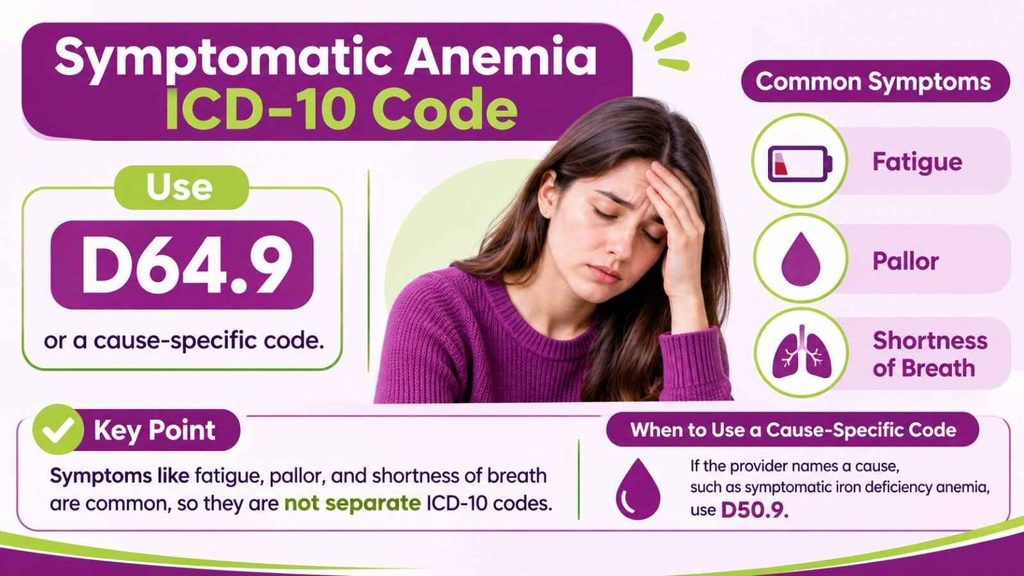
Separate symptom codes apply only when the provider evaluates the symptom as a distinct concern. Phrasing that names a cause, such as symptomatic iron deficiency anemia, supports D50.9 directly.
Acute on Chronic Anemia ICD-10 Code
Acute on chronic anemia ICD-10 coding needs a documented cause, because the phrase alone maps to nothing specific. Absent a stated cause, coders fall back to D64.9 and send the provider a CDI query.
AHA Coding Clinic answered the blood loss version in its Third Quarter 2019 edition. Assign D62 alone when acute and chronic blood loss anemia coexist, and leave D50.0 off.
How Do You Sequence Anemia Codes With Other Diagnoses?
Sequencing depends on which condition caused the encounter and which code carries a code first instruction. Convention notes and Section I.C.2.c of the Official Guidelines supply every rule in the table.
| Scenario | Report in This Order | Rule Source |
|---|---|---|
| Anemia in chronic kidney disease | N18.- first, then D63.1 | Code first note at D63.1 |
| Anemia in another chronic disease | Underlying disease first, then D63.8 | Code first note at category D63 |
| Anemia in neoplastic disease on an anemia-only encounter | Neoplasm first, then D63.0 | Section I.C.2.c.1 |
| Chemotherapy-induced anemia on an anemia-only encounter | D64.81 first, then neoplasm, then T45.1X5- | Section I.C.2.c.2 |
| Radiotherapy-induced anemia on an anemia-only encounter | Anemia code first, then neoplasm, then Y84.2 | Section I.C.2.c.2 |
When Should You Avoid D64.9?
Avoid D64.9 when any part of the record points to a specific type or explanation. Sign-off from the provider remains essential, because lab values alone never name an anemia type.
Run these five checks in order before settling for the fallback.
- Check for a linked disease first, because CKD, cancer, and chronic illness each have a D63 home.
- Look for blood loss next, since acute loss uses D62 and chronic loss belongs to iron deficiency coding.
- Scan for deficiency or morphology clues, because B12, folate, or iron shortfalls have dedicated entries.
- Review therapy history, since chemotherapy and radiotherapy create their own anemia sequencing.
- Rule out hemolytic, aplastic, or sickle cell diagnoses documented elsewhere in the record.
Only when every check comes back empty does the unspecified code remain accurate. Even then, a CDI query can add specificity before the batch goes out. Because coding and billing run together in internal medicine billing services, unspecified anemia entries surface before claims drop.
What Should the Anemia Documentation Checklist Include?
Complete anemia notes name the diagnosis, its cause, and the evidence behind both. Each visit that monitors or treats anemia should meet every row in this checklist.
| Documentation Element | What the Record Should Show |
|---|---|
| Anemia diagnosis | The provider’s written statement of anemia, not only a lab value |
| Type or cause | Iron deficiency, B12 or folate deficiency, blood loss, chronic disease, or therapy |
| Linked condition | CKD stage, cancer, or the chronic disease behind the anemia |
| Acuity and timeline | Acute, chronic, or acute on chronic blood loss |
| Supporting results | Hemoglobin, MCV, ferritin, and iron or B12 studies with interpretation |
| Clinical significance | Monitoring, evaluation, assessment, or treatment tied to the anemia |
| Treatment plan | Iron, B12, ESA, transfusion, or workup orders |
MEAT, which stands for monitor, evaluate, assess, and treat, shows that the anemia received active management. Auditors look for that evidence when a claim carries an unspecified code or expensive follow-up care. Recording how the provider addressed the anemia also supports MDM for internal medicine CPT codes like 99214.
Which Related Blood Findings Do Coders Confuse With Anemia?
Several blood count findings resemble anemia on a lab report yet follow different coding paths. Four findings follow, each with the code a coder reaches and the documentation required.
Low Hemoglobin ICD-10 Code
Searching the Alphabetic Index for the low hemoglobin ICD-10 code leads to D64.9 as a starting lookup. Values on a CBC remain findings, so the provider must document anemia or its clinical significance.
R71 carries an Excludes1 note for anemias, so R71.- and D50 through D64 never appear together. Anisocytosis and similar red cell abnormalities without anemia belong under R71.8.
Pancytopenia ICD-10 Code
Pancytopenia ICD-10 coding starts at D61.81, a header with three billable children. D61.810 reports antineoplastic chemotherapy-induced pancytopenia, and D61.811 reports other drug-induced pancytopenia. Remaining causes land on D61.818, titled other pancytopenia, when no drug is involved.
Marrow infiltration, aplastic anemia, hairy cell leukemia, HIV disease, and myeloproliferative disease all carry Excludes1 notes against D61.81. Individual mentions of anemia, thrombocytopenia, and neutropenia call for a CDI query before any combined code is chosen.
Macrocytosis ICD-10 Code
Isolated macrocytosis ICD-10 findings without anemia usually lead to D75.89, other specified diseases of blood. Alcohol use, liver disease, hypothyroidism, B12 deficiency, and folate deficiency commonly push the MCV above normal.
Once the provider documents a cause, that diagnosis takes the place of D75.89. True macrocytic anemia follows the D53.9, D51, or D52 paths covered above.
Low Ferritin ICD-10 Code
Serum ferritin below range points to E61.1, the low ferritin ICD-10 match, after clinical review. E61.1 carries an Excludes1 note for iron deficiency anemia (D50.-), so the two never mix.
Abnormal blood iron levels without a documented diagnosis fall under R79.0. Anthem’s iron studies guideline lists ferritin, serum iron, and either TIBC or transferrin. Ferritin testing under CPT 82728 still needs a documented reason tied to a clinical question.
Which Anemia Codes Apply in Pregnancy, Screening, and History Scenarios?
Pregnancy, screening, and history change anemia coding because each scenario draws on codes outside D50 to D64. O99.01-, Z13.0, and Z86.2 each replace or support an active anemia code in these three situations.
| Scenario | Code | Key Condition |
|---|---|---|
| Anemia complicating pregnancy | O99.011, O99.012, O99.013, O99.019 | The provider documents the trimester or weeks |
| Anemia complicating childbirth | O99.02 | Anemia is documented during delivery |
| Anemia complicating the puerperium | O99.03 | Pre-existing anemia is still present after delivery |
| Anemia arising in the puerperium | O90.81 | Anemia develops after delivery |
| Screening in a seemingly well patient | Z13.0 | No sign, symptom, or suspected diagnosis |
| Resolved anemia that could recur | Z86.2 | Anemia is no longer treated |
| Relative with a blood disorder | Z83.2 | Family history is documented |
Obstetric rows still need the specific anemia code from D50 to D64 reported beside them. Z13.0 and Z86.2 describe reasons for the visit, so neither supports active treatment orders.
Anemia in Pregnancy ICD-10 Codes
Pregnant patients with anemia use O99.01-, the anemia in pregnancy ICD-10 family, with a trimester digit. O99.011, O99.012, and O99.013 cover the three trimesters, and O99.019 applies when the trimester is unknown. Trimesters count from the first day of the last menstrual period.
First trimester means under 14 weeks 0 days, second spans 14 to under 28 weeks, and third runs to delivery. Chapter 15 codes have sequencing priority, so O99.01- leads and the D-code follows. Z3A reports the weeks of gestation once the provider documents the week count.
Normal prenatal supervision under Z34.- and anemia arising after delivery under O90.81 cannot be reported with O99.01-. Z33.1 replaces Chapter 15 codes when the provider documents the pregnancy as incidental to the visit. O90.81 reports anemia that develops after delivery, while O99.03 reports pre-existing anemia still present in the puerperium.
Screening for Anemia ICD-10 Code
Screening for anemia ICD-10 reporting uses Z13.0, the screening encounter code for blood and immune disorders. Seemingly well patients qualify for Z13.0, since testing for a symptom or suspected disorder counts as diagnostic.
Tiredness turns the same CBC into a diagnostic test coded to R53.83. Any anemia discovered during screening may be added behind Z13.0. Prenatal visits use Z34 or Z36 codes, since the Z00 to Z13 block excludes pregnancy-related examinations.
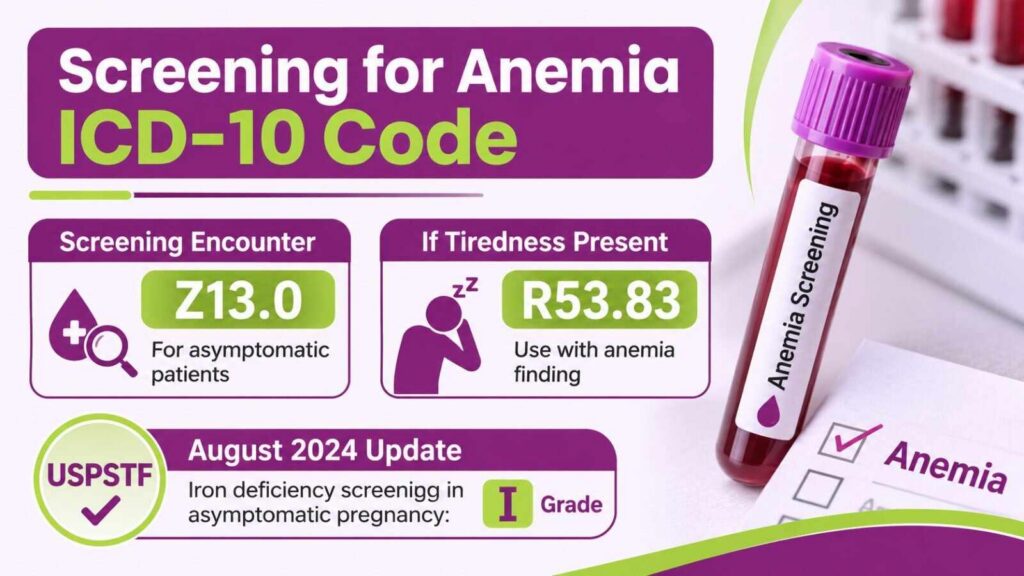
In August 2024, USPSTF gave iron deficiency screening in asymptomatic pregnancy an I rating. Insufficient evidence sits behind that grade, so screening practices still follow clinician discretion.
History of Anemia ICD-10 Code
Resolved anemia that has stopped needing treatment takes Z86.2, the history of anemia ICD-10 match. Personal history codes describe past conditions that could return and may justify follow-up labs.
Ongoing treatment or active monitoring keeps the current anemia code in place. Follow-up visits after completed treatment pair Z09 with Z86.2 to explain the reason for the lab check.
Z83.2 covers family history of anemia and other blood disorders, with conditions classifiable to D50 through D89 included. Lifelong conditions such as thalassemia do not convert to history status.
Which Anemia Claims Draw the Most Denials?
Coverage policies pair each anemia service with a short list of diagnoses, and a mismatch ends the claim line. Three service groups follow this pattern, namely lab tests, iron infusions, and ESA drugs.
Lab Testing Claims for CBC, Ferritin, and B12
Medicare NCD 190.15 governs blood counts such as CPT 85025, and diagnoses outside the policy draw denial notices. Diagnoses such as D50.9, D63.1, and D64.9 support a CBC, while screening encounters often fall outside coverage.
Studies of iron status fall under NCD 190.18, which includes CPT 82728 for ferritin. Cobalamin and folate tests, CPT 82607 and 82746, follow local coverage rules such as LCD L34914.
CARC 50 means the payer found the service not medically necessary, often paired with remark code N115. Inconsistent pairing triggers CARC 11, where the diagnosis pointer does not match the procedure billed.
Corrected claims resolve CARC 11, while CARC 50 usually needs an appeal backed by lab results. DEXA, Transcure’s AI denial agent, spots recurring CARC patterns and drafts appeals automatically.
Iron Infusion and ESA Claims
IV iron claims bill J1439 for ferric carboxymaltose or J1756 for iron sucrose, plus CPT 96365 for administration. UnitedHealthcare’s IV iron policy lists D50 and D63.1 as covered codes, and D64.9 is missing. Aetna CPB 0575 requires ferritin below 30 ng/mL or TSAT below 20 percent for iron deficiency anemia without CKD.
Many plans also require a documented failure of oral iron and prior authorization before the first dose. Results for TSAT and ferritin belong in the chart before the order is placed. PRIA, Transcure’s AI prior authorization agent, secures payer approval before infusions reach the schedule.
ESA claims use J0881, J0885, J0888, or Q5106 for non-ESRD patients, and J0882, J0887, Q4081, or Q5105 for dialysis. Part B coverage starts at hemoglobin below 10 g/dL, and kidney claims pair D63.1 with CKD staging.
Chemotherapy-induced anemia needs D64.81 plus a cancer diagnosis, and modifier EA flags the treatment connection. Noridian edits for NCD 110.21 deny EA claims once reported hemoglobin reaches 10.0 g/dL.
How Can Internal Medicine Practices Prevent Anemia Coding Errors?
Prevention starts with documentation and ends with a clean claim, so each step closes one common gap. These steps run in order from chart note to quarterly report.
- Document the type, cause, and timeline in every assessment so coders reach specific entries instead of defaults.
- CODIN, Transcure’s AI coding and compliance agent, reads notes, extracts diagnoses, and flags NCCI and MUE violations.
- CLAIR scrubs and creates each claim by testing line items against payer rules and modifier logic.
- Sampling anemia claims through a medical billing audit shows where D64.9 masks documented detail.
- Track the unspecified code rate by provider, then train on the checklist rows that failed.
Together, these two AI agents belong to a suite of seven covering the billing cycle. Transcure lists a 98% first-pass clean claim rate among typical client outcomes. Outsourcing this workflow to Transcure’s internal medicine billing services adds certified coders behind the agents.