Tennessee medical billing laws decide how fast insurers pay your claims. An insurer owes payment on a clean claim within 21 days if it is electronic and 30 days if it is paper. Late payment costs 1% interest per month.
However, the clock helps only when the claim is clean, and Tennessee draws that line early. A claim sent after day 90 from the date of service is not clean, so payment rules and interest do not apply.
Even a clean claim can stall on a prior authorization denial, and the appeal numbers show how often the first answer changes. BlueCross BlueShield of Tennessee reported that 4,792 of 10,373 appeals ended with the denial reversed in 2025. Nearly half were overturned.
With so many deadlines in play, practices and billing teams need to know which laws set them. Here are the 11 Tennessee medical billing laws and rules providers must follow.
| Law or Rule | What It Covers | Key Rule or Deadline |
|---|---|---|
| Tennessee Prompt Pay Law (T.C.A. § 56-7-109) | Payment of clean claims by health insurers | 21 days for electronic claims, 30 days for paper, and 1% interest per month when late. Claims sent after day 90 are not clean. |
| TennCare MCO Prompt Pay Standard (T.C.A. § 56-32-126) | Claim payment by TennCare managed care organizations | 90% of clean claims within 30 days and 99.5% of all claims within 60 days, with state penalties up to $10,000 a month |
| TennCare Timely Filing Limit | Filing window for TennCare claims | 120 calendar days from the date of service for MCO claims, with exceptions for third-party liability and retroactive eligibility |
| TennCare Enrollment for Ordering and Referring Providers | Registration of providers who order or refer but do not bill TennCare | Ordering, referring, and prescribing providers must register with TennCare under 42 CFR 455.410 |
| Tennessee Recoupment Law (T.C.A. § 56-7-110) | Insurer clawbacks of paid claims | 15 months to recoup after payment, 6 months when coverage was verified, and written notice with reasons |
| Tennessee Provider Credentialing Law (T.C.A. § 56-7-1001) | Insurer credentialing of providers | 5 business days to acknowledge a new application and 90 days to decide on a complete one |
| Tennessee Medical Records Law | Patient access to records, copy fees, and retention | 10 working days to provide copies, capped fees, and 10-year retention for physicians and hospitals |
| Tennessee Telehealth Law (T.C.A. § 56-7-1002) | Insurer coverage of telehealth | Insurers cannot exclude a covered service solely because it is delivered by telehealth |
| Tennessee Balance Billing Law | Patient protection from out-of-network bills | Limits balance billing by out-of-network providers and works alongside the federal No Surprises Act |
| Tennessee False Claims Laws | False claims for state and Medicaid funds | Civil penalties, treble damages, and whistleblower suits |
| Tennessee Prior Authorization Fairness Act | Insurer deadlines and payment duties for prior authorization | Requests are deemed approved after 7 days (non-urgent) or 72 hours plus 1 business day (urgent), and approved authorizations guarantee payment |
1. Tennessee Prompt Pay Law (T.C.A. § 56-7-109)
Tennessee’s prompt pay law sits in section 109 of the insurance chapter of the Tennessee Code (T.C.A. § 56-7-109). It sets how quickly health insurance entities must act on provider claims.
Insurers have 21 days to pay, deny, or request additional information on an electronic claim. Paper claims get 30 days. A plan that misses the deadline owes 1% interest per month on the unpaid amount.

The law also requires insurers to give contracted providers the information they need to submit a claim correctly.
How Much Interest Do Tennessee Insurers Owe on Late Claims?
Interest accrues from the day after payment was due and applies to the unpaid amount of the claim. Because the statute sets the rate, practices should review remittances for interest on late claims and ask for it when it is missing.
The department can also act on violations. In a 2017 consent order, it fined a pharmacy benefits manager $25,000 for violating the prompt pay and recoupment sections.
2. TennCare MCO Prompt Pay Standard (T.C.A. § 56-32-126)
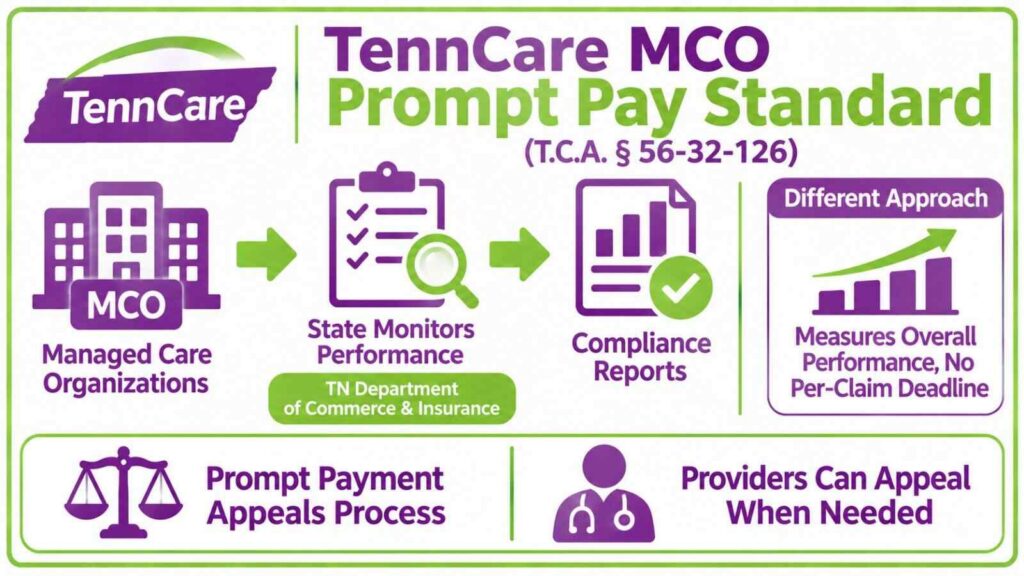
Section 56-32-126 of the Tennessee Code sets prompt pay standards for the managed care organizations that run TennCare, the state’s Medicaid program. The Department of Commerce and Insurance monitors them.
The standard works differently from the commercial rule. It measures how an MCO performs across all claims and does not set a deadline for each one.
What Does the 90% in 30 Days Standard Mean for Providers?
TennCare MCOs must meet three benchmarks on the claims they receive.
- Clean Claims: An MCO must process 90% of clean claims within 30 calendar days of receipt.
- All Claims: It must process 99.5% of all provider claims, and pay them if appropriate, within 60 calendar days.
- Electronic CHOICES and ECF Claims: For clean electronic claims in the CHOICES and Employment and Community First CHOICES programs, the benchmark is 99.5% within 21 days.
Because the benchmarks are percentages, an MCO can pay a single claim late and still meet the standard.
What Happens When a TennCare MCO Misses the Standard?
The state holds the main remedy. When an MCO falls short, the Department of Commerce and Insurance can impose administrative penalties of up to $10,000 per month.
Moreover, the department publishes prompt pay compliance reports that show how each MCO performed, so providers can see which plans meet the standard. A provider with a specific unpaid claim can use the prompt payment appeals process described in the statute.
3. TennCare Timely Filing Limit
TennCare sets its timely filing limits in Policy Manual section PAY 13-001. A claim sent outside the limit is automatically denied as not timely filed.
The limit depends on who pays the claim. Managed care organizations and dental benefit managers allow 120 calendar days, while pharmacy benefit manager claims and TennCare fee-for-service claims allow 1 year.
TennCare counts the time from the date of service, with exceptions for retroactive eligibility and third-party liability.
What Exceptions Extend TennCare Timely Filing?
Three situations change when the filing clock starts.
- Retroactive Eligibility: When a member’s eligibility is backdated, the MCO claim clock starts on the date TennCare notifies the MCO of enrollment. It does not start on the date of service.
- Third-Party Liability: When a provider pursues another payer or a subrogation case, the clock starts on the date the third party documents the claim’s resolution.
- Medicare Crossover: When a claim does not cross over on its own and falls outside the 1-year limit, a special window applies. The provider has 6 months from the date Medicare notified it of payment or denial to send the request directly to TennCare.
4. TennCare Enrollment for Ordering and Referring Providers
TennCare requires providers to enroll through its electronic enrollment system. That includes providers who order, refer, or prescribe for TennCare members but never bill TennCare themselves.
TennCare ties the requirement to federal law. It cites 42 CFR 455.410 and section 5005(b) of the 21st Century Cures Act. Enrollment gives a provider a TennCare Medicaid Provider Identifier.
Enrollment does not place a provider in an MCO network. Each MCO sets its own contracting and credentialing rules, so providers must meet those separately.
Who Must Register With TennCare?
The policy applies to individual practitioners, group practices, clinics, facilities, and hospitals. Each provider must keep its information current and complete revalidation within the set timeframes.
TennCare reviews applications for completeness before it approves them. A complete application moves through the process, and a missing document holds it up.
Do TennCare Claims Deny for Unregistered Providers?
Pharmacy claims show the effect clearly. TennCare’s policy says it will not pay for services that a non-participating provider orders, refers, or prescribes. It applies that rule to non-risk arrangements such as the pharmacy benefit manager.
When a prescriber does not register within 30 days of TennCare’s request, TennCare tells that prescriber’s patients that it will stop paying for their prescriptions.
Many TennCare services run through risk-based MCOs, and the 2013 policy leaves those claims outside the denial rule. Registered ordering providers also become TennCare providers, so they cannot bill members for prescribing except where TennCare’s rules allow it.
5. Tennessee Recoupment Law (T.C.A. § 56-7-110)
Tennessee’s recoupment law sits in T.C.A. § 56-7-110. It limits when and how health insurers can take back money they already paid to providers.
The law also sets a deadline for payment corrections and bars insurers from recouping based on audit extrapolation. Insurers cannot waive these protections by contract.
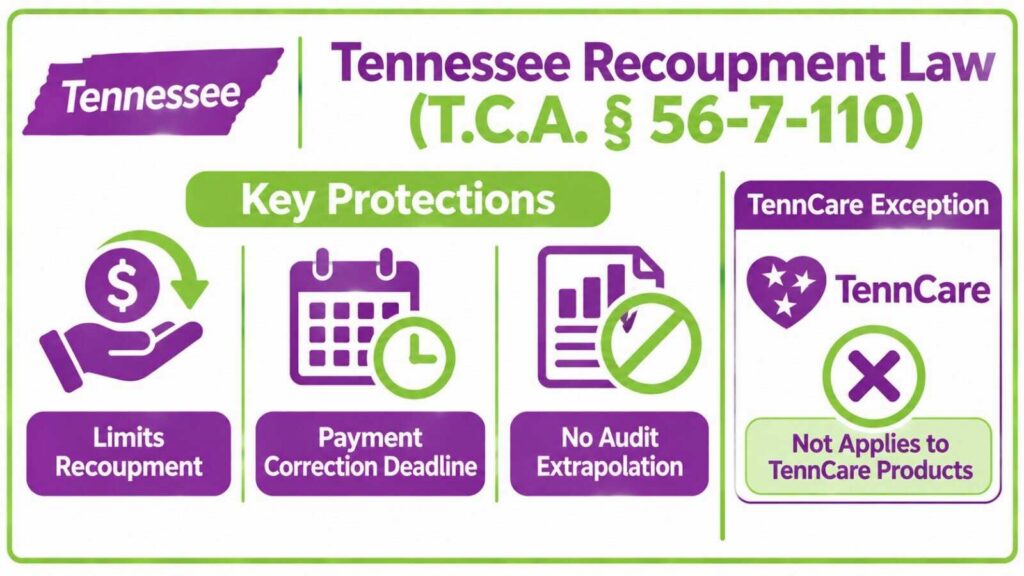
The law does not reach TennCare products. An insurer that contracts directly with TennCare is excluded from this prohibition for services it provides on TennCare’s behalf.
What Notice Must an Insurer Give Before Recouping a Payment?
Except in cases of fraud or suspected fraud, the insurer must give 30 days’ advance written or electronic notice. The notice must include these details.
- Codes and Services: The CPT codes in the claims, or a description of the services if no code exists.
- The Reason: A detailed explanation naming the billing codes and modifiers the insurer believes should have been billed, and the policies behind them.
- Claim Details: The claim numbers, the patient’s full legal name and identification numbers, and the dates of service.
- Payment Details: The estimated recoupment amount, plus each claim’s payment date and how the payment was issued.
- Appeal Process: Instructions for how the provider can appeal.
A provider that appeals within 30 days of the notice keeps its payments. The insurer cannot withhold money until all appeals are exhausted. The notice can also arrive with audit results.
How Far Back Can a Tennessee Insurer Recoup Payments?
An insurer can recoup only within 15 months after it paid the claim, unless the provider committed fraud or the insurer suspects fraud. State employee health plans allow 18 months.
A 6-month window applies when the insurer verified coverage and the provider relied on that check. After 6 months, the insurer cannot recoup on the basis that the patient was not covered, unless the provider committed fraud.
Providers face a deadline too. An insurer does not have to correct a payment error when the request comes after 15 months from the date of payment.
If an insurer breaks the law, the insurance commissioner can impose a penalty of twice the claim amount, up to $750. A provider can also ask a court for injunctive or other relief.
6. Tennessee Provider Credentialing Law (T.C.A. § 56-7-1001)
Tennessee’s credentialing law, T.C.A. § 56-7-1001, sets deadlines for health insurers that credential and contract with providers. An insurer must tell a provider the result of a clean application within 90 calendar days of receiving it.
The law also bars an insurer from listing a provider as in-network or pending too early. It must wait until both sides sign a contract and the provider can be reimbursed as in-network.
It does not force an insurer to contract with a provider, and it does not give providers a private right to sue.
Can a New Provider Bill While Credentialing Is Pending?
A new provider applicant should not submit claims while the application is pending. If claims go in anyway, the insurer may deny them.
Once the insurer reports the result, the group practice submits the held claims. The insurer then pays them at the contracted in-network rate. Payment covers services from the complete application date until the result date.
If the practice named a network start date after the application date, payment starts on that date. An insurer owes nothing if it does not approve the provider or will not contract.
A group practice cannot collect those amounts from patients, and it may have to refund payments if the approval came through fraud.
The pending-claims rule applies to new providers who bill under a group contract. It does not apply to TennCare, CoverKids, or other state-managed plans.
7. Tennessee Medical Records Law
Tennessee’s medical records rules come from several places. T.C.A. §§ 63-2-101 and 63-2-102 govern patient access and copy costs, and T.C.A. § 68-11-305 and professional board rules govern how long providers keep records.
A provider must give a patient a copy or summary within 10 working days after a written request. The provider chooses between a copy and a summary.
Medical records are confidential and not public records, except for limited exceptions.
How Much Can a Tennessee Provider Charge for Medical Records?
The party who requests the records is responsible for the reasonable costs of copying and mailing them. That rule sits in T.C.A. § 63-2-102.
A flat certification or notary fee of up to $20 can apply when someone requests it. Since 2024, electronic copies sent by portable media, email, or portal carry the same $20 flat certification fee.
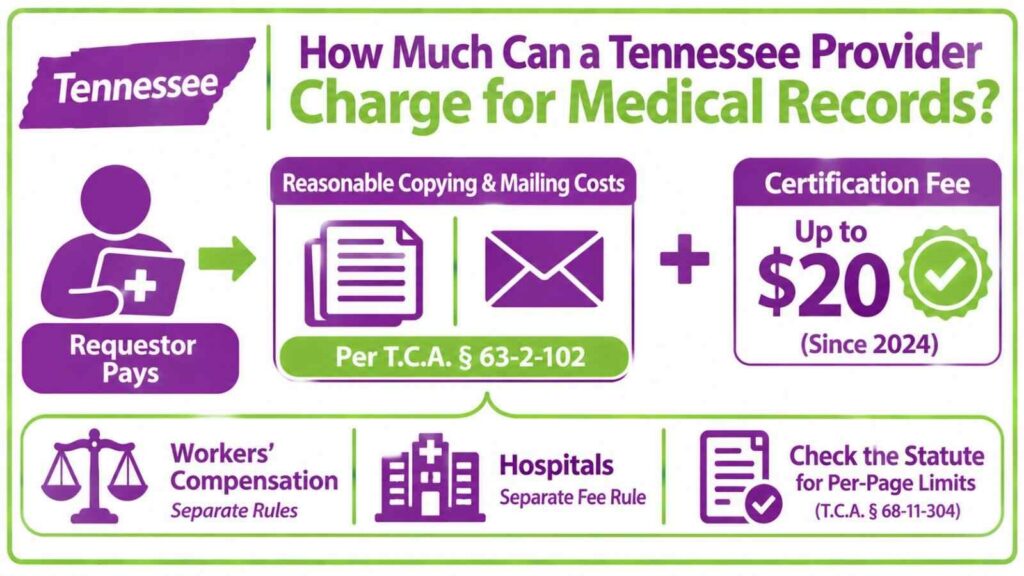
Workers’ compensation cases follow separate rules, and hospitals follow a separate fee rule in T.C.A. § 68-11-304. Check the current statute for per-page limits by provider type.
How Long Must Tennessee Providers Keep Medical Records?
Retention periods depend on the provider type.
- Hospitals: Keep records for 10 years after the patient’s discharge or death under T.C.A. § 68-11-305.
- Physicians: Keep records at least 10 years from the last professional contact under Board of Medical Examiners rule 0880-02-.15.
- Minors: A separate rule applies to children’s records and can extend retention past the age of majority.
- Other Providers: Other licensed professionals follow their own boards’ rules, and the periods differ. Podiatrists, for example, keep adult records at least 7 years from the last contact.
Records also support billing disputes and audits, and some payer contracts require retention beyond these periods.
8. Tennessee Telehealth Law
Tennessee’s telehealth insurance laws sit in T.C.A. §§ 56-7-1002 and 56-7-1003. They require health insurance entities to cover and reimburse covered services delivered by telehealth. The definition of a health insurance entity includes managed care organizations that participate in TennCare.
Section 1002 covers telehealth in general. Section 1003 covers provider-based telemedicine, which is care delivered through a company that facilitates telemedicine as a substantial part of its business.
Does Tennessee Require Insurers to Cover Telehealth?
Yes. An insurer must cover covered healthcare services delivered through telehealth, and it cannot exclude a service solely because it is delivered that way.
Coverage must match what the policy provides for the same service in person. In-network telemedicine providers follow the same contract terms as any other network provider.
For remote patient monitoring, an insurer may treat a service as covered when Medicare covers the same service.
Does Tennessee Require Insurers to Pay the Same for Telehealth?
Insurers must reimburse providers for covered telehealth services, and they cannot base that decision on the patient’s location. Reimbursement follows the same basis the insurer uses for in-person services.
For provider-based telemedicine, the law does not require an insurer to pay above what it pays for the same in-person service. The law also does not require coverage or payment when the policy would not cover or pay for that service in person.
9. Tennessee Balance Billing Law
Tennessee does not have one single surprise billing act. Its balance billing rules come from facility notice requirements and an emergency coverage law, and the federal No Surprises Act adds payment protections on top.
The core state rule bars hospitals and ambulatory surgical centers from collecting out-of-network charges above a patient’s cost-sharing. A facility can charge more than that amount only after giving the patient written notice before services.
Does Tennessee Have Its Own Surprise Billing Law?
Three statutes carry the main rules.
- Emergency Coverage (T.C.A. § 56-7-2355): A health plan cannot deny coverage or payment for emergency services when the symptoms point to a possible emergency. Prior authorization and network status do not change that.
- Facility Notice (T.C.A. § 68-11-243): The notice must be signed and list the facility’s contracted anesthesiologists, radiologists, emergency physicians, and pathologists.
- Facility-Based Physicians (T.C.A. § 56-7-120): An insurer may refuse to pay an out-of-network facility-based physician who did not give the patient signed written notice before the services.
Here, timing matters too. The facility gives the notice at admission, and for an incapacitated emergency patient, it is due within 12 hours after stabilization. Every bill must show the department’s phone number and say that the patient can call to complain.
A facility does not have to give the physician listing when it employs all its facility-based physicians. The same applies when it requires them to join every network the facility joins or bars them from balance billing by contract.
How Does the Federal No Surprises Act Apply in Tennessee?
Yes. The federal No Surprises Act has been in effect since January 1, 2022. It bars out-of-network providers from balance billing patients for emergency care and for certain non-emergency care at in-network facilities.
It also reaches self-funded employer plans, which state insurance law generally does not regulate. The federal law adds an independent dispute resolution process for payment disputes between providers and insurers.
Tennessee’s notice rules still apply to facilities, so facilities and providers should follow both sets of rules.
10. Tennessee False Claims Laws
Tennessee has two false claims laws. The Tennessee False Claims Act covers claims to the state and its political subdivisions. The Tennessee Medicaid False Claims Act covers TennCare and other Medicaid claims.
Both laws let private citizens sue on the state’s behalf, and both allow treble damages. Liability follows from knowingly submitting a false claim or a false record. It also follows from failing to disclose a false claim after discovering it.
Can Whistleblowers Sue Under Tennessee’s False Claims Laws?
Yes. A person who brings a case is a qui tam plaintiff. The state can take over the case or leave it with the plaintiff.
Under the Medicaid Act, a whistleblower receives 15% to 25% of the proceeds when the state proceeds. The share is 25% to 30% when the state does not. Meanwhile, the general act pays 25% to 33% when the state proceeds and 35% to 50% when it does not.
What Penalties Apply Under Tennessee’s False Claims Laws?
Each act sets its own penalties.
- Tennessee False Claims Act: A civil penalty of $2,500 to $10,000 per claim, plus up to 3 times the state’s damages and the costs of the action.
- Tennessee Medicaid False Claims Act: A civil penalty of $5,000 to $25,000 per claim, adjusted for inflation, plus 3 times the state’s damages.
- Reduced Damages: A defendant that discloses the violation within 30 days and meets other conditions can face reduced damages instead of treble damages.
- Administrative Action: In an administrative proceeding under the Medicaid Act, the penalty is $1,000 to $5,000 per violation.
11. Tennessee Prior Authorization Fairness Act (T.C.A. §§ 56-7-3701 to 56-7-3722)
Tennessee’s Prior Authorization Fairness Act is Part 37 of Chapter 7 in Title 56 of the Tennessee Code (T.C.A. §§ 56-7-3701 to 56-7-3722). The legislature passed it in 2023, and it sets deadlines, deemed approval rules, and payment protections for prior authorization requests.
It binds health carriers and the utilization review organizations they use. Insurers also publish prior authorization statistics under the Act; the BlueCross BlueShield of Tennessee figures in this guide come from those reports.
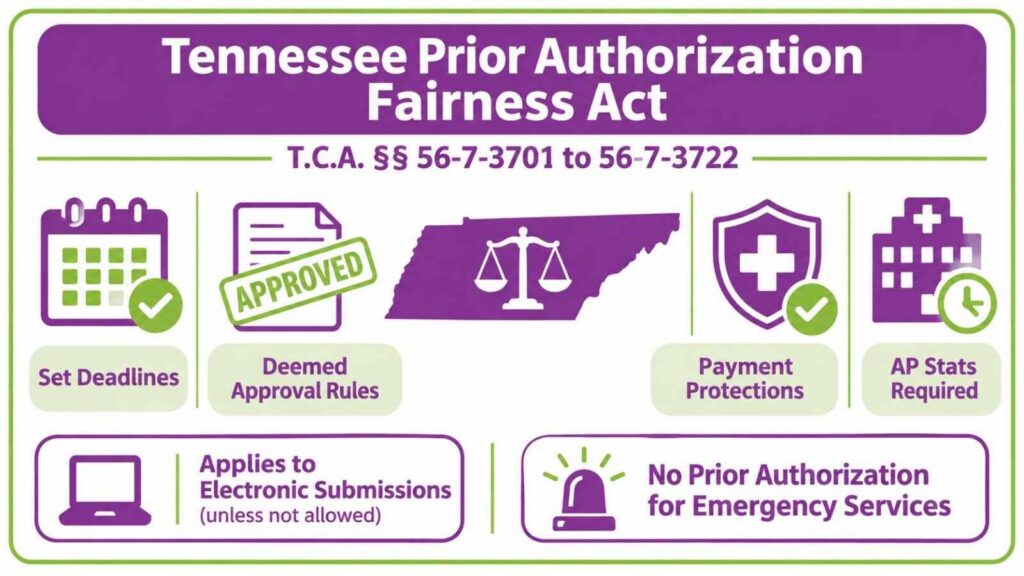
The deadlines apply to electronic submissions, unless the insurer does not allow electronic submission. Emergency department services need no prior authorization.
Practices that handle many authorizations often work with medical billing providers in Tennessee to track these deadlines.
How Fast Must a Tennessee Insurer Answer a Prior Authorization Request?
The Act sets different clocks for non-urgent and urgent requests.
- Non-Urgent Requests: A request is deemed approved when the insurer does not act on it within 7 calendar days. The insurer acts when it approves the request, denies it, asks for information, or flags a medical necessity question.
- Added Review Time: After the provider sends the requested information, the utilization review organization has an additional 5 calendar days.
- Overall Cap: The whole process cannot exceed 17 calendar days. A provider that misses the documentation deadline must request a new authorization.
- Urgent Requests: A request marked urgent is deemed approved if the insurer does not act within 72 hours, plus 1 additional business day when applicable.
- Advance Submission: A provider must submit a non-urgent request at least 5 calendar days before the service.
When an insurer questions medical necessity, its notice must include a direct phone number and the hours of the physician who decides the request. It must also offer a chance to discuss the service with that physician.
Does an Approved Prior Authorization Guarantee Payment in Tennessee?
Generally yes. Section 56-7-3713 requires the insurer to pay the contracted rate for a service performed under an approved prior authorization. It also says payment is guaranteed once the authorization is approved.
The law lists exceptions. An insurer can refuse payment when the provider knowingly misrepresented the service to deceive it. It can also refuse when the provider was out of contract on the date of service or missed the timely filing limit.
The insurer must also pay a provider who performs a service when a different provider obtained the authorization. It must reimburse services deemed medically necessary after the fact for up to 18 months, regardless of when it approved the authorization.
Final Words on Tennessee Medical Billing Laws
Tennessee’s billing laws share one theme, which is that every payer works on a clock. Insurers must pay, deny, or request additional information within 21 days for electronic claims and 30 days for paper claims.
TennCare MCOs expect claims within 120 days of the date of service. Prior authorization requests are deemed approved when an insurer misses the 7-day or 72-hour deadline.
Practices stay compliant by tracking each claim against its deadline and confirming credentialing before they bill under a new contract. Clear documentation supports medical necessity, and providers keep records on file for at least 10 years.