Veradigm vs eClinicalWorks is a choice between two ambulatory EHR vendors that both sell practice management and revenue cycle tools. Veradigm is the company formerly known as Allscripts, which adopted the Veradigm name in January 2023. eClinicalWorks (eCW) is a privately held, founder-led cloud EHR vendor headquartered in Westborough, Massachusetts.
Both vendors compete for independent practices that need charting, billing, patient engagement, and e-prescribing in one stack. Five factors decide the outcome: practice management and RCM depth, AI maturity, true cost, vendor stability, and specialty fit. Most comparison pages score generic features and skip these five.
This guide compares Veradigm EHR and eClinicalWorks on scope, workflow, billing, AI, pricing, vendor risk, reviews, and switching. It closes with a decision framework and answers to common buyer questions. Every claim carries a source, and vendor-reported figures are labeled as such.
What Does Veradigm Sell? Veradigm EHR, Practice Fusion, and the Allscripts Name
Veradigm sells several products under one brand, and buyers often compare eClinicalWorks against the wrong one. Search results mix Veradigm EHR, Practice Fusion, Veradigm Practice Management, and Payerpath. Each product targets a different buyer, carries a different price, and offers a different feature set.
Buyers still search for veradigm allscripts and eClinicalWorks vs Allscripts because older reviews sit under the former name. Allscripts adopted the Veradigm name in January 2023. Reviews of Allscripts Professional EHR describe the product now sold as Veradigm EHR.
Allscripts Veradigm and eClinicalWorks Product Map
The product map below separates Veradigm’s distinct EHR, practice management, clearinghouse, and service offerings from the eClinicalWorks platform and its patient-facing tools.
| Product | Vendor | Built for | What it covers |
|---|---|---|---|
| Veradigm EHR | Veradigm | Multi-location, multi-specialty groups | Configurable ambulatory EHR, formerly Allscripts Professional EHR |
| Practice Fusion | Veradigm | Small independent practices | Cloud EHR that needs little IT support |
| Veradigm Practice Management | Veradigm | Mid-size practices | Scheduling and billing, with the Payerpath clearinghouse |
| Veradigm Payerpath | Veradigm | Practices and payers | Clearinghouse, claim scrubbing, eligibility, ERA, denial tools |
| Veradigm Revenue Cycle Services | Veradigm | Practices that outsource billing | Partial or full RCM services, plus Coding Services |
| Veradigm ePrescribe | Veradigm | Practices and EHR vendors | Certified e-prescribing, including controlled substances |
| FollowMyHealth | Veradigm | Patients | Patient portal and mobile access |
| eClinicalWorks EHR (V12 +AI) | eCW | Independent to large ambulatory groups | Cloud EHR with built-in AI tools |
| eClinicalWorks PM and RCM | eCW | Practices of all sizes | Self-service PM or RCM-as-a-Service |
| healow | eCW | Patients and practices | Portal, telehealth, reminders, and the Genie AI contact center |
Practice Fusion needs separate treatment. Allscripts bought it in January 2018 for $100 million. The practice fusion veradigm relationship now places it in Veradigm’s small-practice tier. Practice Fusion vs eClinicalWorks is the fairer matchup for solo doctors and small groups.
Veradigm vs eClinicalWorks at a Glance
This table compares both vendors at the product level. Veradigm figures reflect Veradigm EHR and Veradigm Practice Management unless noted. Pricing comes from third-party sources, and vendor-reported claims are labeled. Treat every number as a starting point for your own vendor quotes and reference calls.
| Attribute | eClinicalWorks | Veradigm |
|---|---|---|
| Ownership | Private, founder-led since 1999 | Public company on the over-the-counter market (OTC: MDRX) |
| Core buyer | Independent practices to large ambulatory groups and FQHCs | Independent practices; hospital business sold in 2022 |
| Deployment | Cloud | Cloud, with on-premise options reported |
| Billing model | Self-service PM or RCM-as-a-Service | PM with Payerpath, plus optional Revenue Cycle Services |
| AI scribe | Sunoh.ai | Veradigm Ambient Scribe, powered by AvodahMed |
| AI front office | healow Genie | AI Patient Scheduling (listed on product page) |
| Entry pricing (third-party) | $449 to $599 per provider per month | $49 to $199 per month, depending on product |
| SelectHub analyst score | 81 | 76 |
| SelectHub user sentiment | 69 (581 reviews) | 61 (182 reviews) |
| Federal enforcement history | $155M settlement, 2017 | $145M Practice Fusion settlement, 2020 |
Three patterns stand out in the table:
- eClinicalWorks sells a single-vendor stack, while Veradigm splits EHR, clearinghouse, and services across separate products.
- Veradigm’s low price points describe lighter products, so they are not like-for-like with eClinicalWorks.
- Both vendors publish AI results from vendor-selected customers, not independent trials.
Which Practices Is Each Platform Built For?
The better fit depends on practice size, care setting, and how much configuration or operational support the organization expects from its EHR vendor. Start with the buyer profile, then test specialty workflows before comparing contracts.
Practice Size and Buyer Type
EHR Atlas lists more than 180,000 physicians and 110,000 facilities on eClinicalWorks. The platform serves independent offices, multispecialty groups, and federally qualified health centers (FQHCs). Veradigm focuses on independent practices and sold its hospital business in 2022, which narrowed its focus to ambulatory care.
Both vendors position themselves around ambulatory care. Surgery centers, accountable care organizations (ACOs), and health systems should test fit carefully before shortlisting either one. Hospital-led buyers usually start with enterprise systems such as Epic. In practice, a hospital-owned practice may be required to use the parent system’s EHR.
Specialty Fit: What to Test in the Demo
Neither vendor publishes validated specialty benchmarks for pain management, nephrology, psychiatry, cardiology, OBGYN, orthopaedics, or primary care. Public evidence is thin, and most of it is written by the vendors themselves. Use this table to script demos around your own specialty’s charge capture, order, and documentation workflows.
| Specialty | Workflows to test | Evidence on record |
|---|---|---|
| Pain management | EPCS, PDMP checks, procedure charge capture, prior authorization | Veradigm lists EPCS and PDMP checks in ePrescribe; eCW lists EPCS e-prescribing |
| Nephrology | CKD care coordination, dialysis-related charges, MIPS reporting | No public specialty benchmarks found for either vendor |
| Psychiatry | Therapy and evaluation code pairing, telehealth, note privacy | eCW offers healow telehealth; Veradigm EHR lists telehealth support |
| Cardiology | Imaging orders, procedure charges, device and lab interfaces | No public specialty benchmarks found for either vendor |
| OBGYN | Global maternity billing, prenatal flowsheets | No public specialty benchmarks found for either vendor |
| Orthopaedics | Surgery scheduling, x-ray orders, high-volume charge capture | Syracuse Orthopedic Specialists chose Veradigm Revenue Cycle Services and Coding Services |
| Primary care | Value-based care, chronic care management, HEDIS | eCW lists care planning, chronic care management, and HEDIS tools; Veradigm cites a Black Book ranking for family practice (vendor-reported) |
EHR and Clinical Workflow Compared
Clinical workflow fit depends on how reliably staff can complete routine tasks, adapt templates, and move information between the chart and connected systems. User reviews offer useful signals, but each practice should validate these points in a live demo.
Usability, Templates, and Reliability
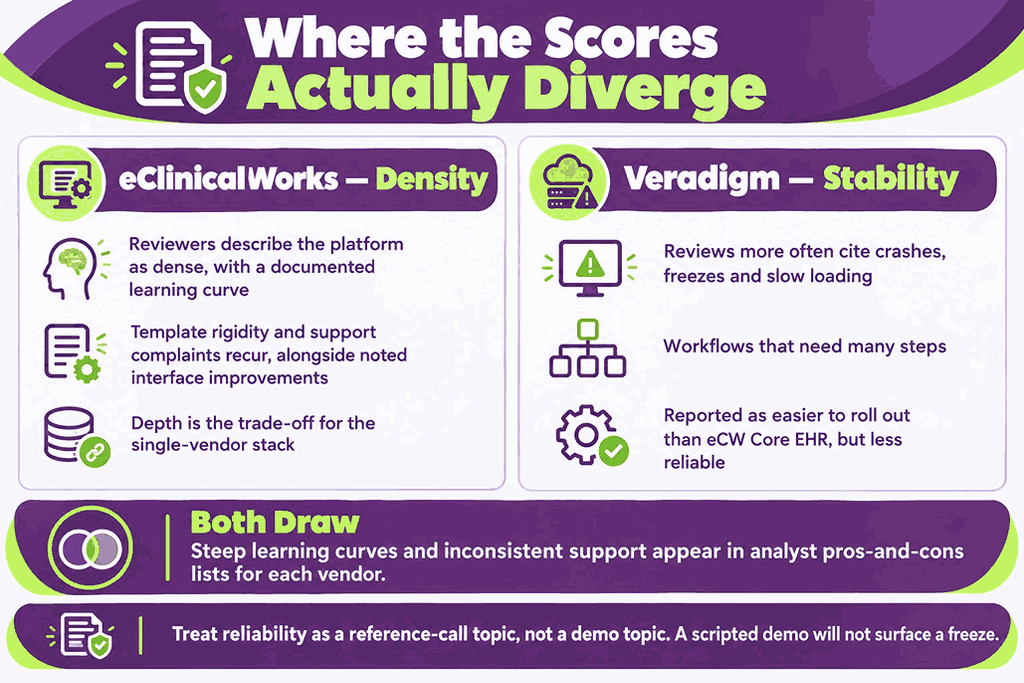
Reviewers describe eClinicalWorks as dense, with a documented learning curve. Praxis EMR cites template rigidity and support complaints, while noting interface improvements. SelectHub’s pros and cons mix both vendors and cite steep learning curves and inconsistent support.
Veradigm reviews more often mention instability, including crashes, freezes, and slow loading, plus workflows that need many steps. SoftwareReviews says Veradigm Professional EHR is easier to roll out than eCW Core EHR but less reliable. Treat reliability as a demo and reference-call topic.
Feature Scores From SelectHub Analysts
The scores below show where SelectHub’s analysts rated each platform more highly across common clinical and operational functions.
| Function | eClinicalWorks | Veradigm |
|---|---|---|
| Clinical charts | 100 | 90 |
| Clinical documentation | 89 | 88 |
| Dashboards and reporting | 83 | 67 |
| Electronic prescriptions | 78 | 100 |
| Medical billing | 99 | 82 |
| Mobile capabilities | 71 | 69 |
| Notes and templates | 86 | 64 |
| Patient engagement | 95 | 95 |
| Platform capabilities | 73 | 53 |
| Platform security and compliance | 94 | 94 |
| Telehealth | 62 | 62 |
Veradigm leads on electronic prescriptions, where SelectHub gave it a category award. eClinicalWorks leads on medical billing, templates, dashboards, and platform capabilities. The two tie on patient engagement, security, and telehealth. Scores reflect SelectHub’s analyst methodology, so use them to build demo questions rather than to pick a winner.
Interoperability and Compliance Checks
Verify certification for the exact product version on the Certified Health IT Product List (CHPL). The Office of the National Coordinator for Health Information Technology (ONC) maintains that list. Certification applies to specific versions, so a vendor’s marketing claim does not replace a CHPL lookup. Then ask each vendor for:
- FHIR API documentation and supported USCDI versions
- Merit-based Incentive Payment System (MIPS) reporting support and fees
- EPCS certification details and the PDMP check workflow
- Health Insurance Portability and Accountability Act (HIPAA) business associate agreement terms
- Lab, imaging, and health information exchange interface lists with per-interface fees
Practice Management and RCM: Where the Two Platforms Diverge Most
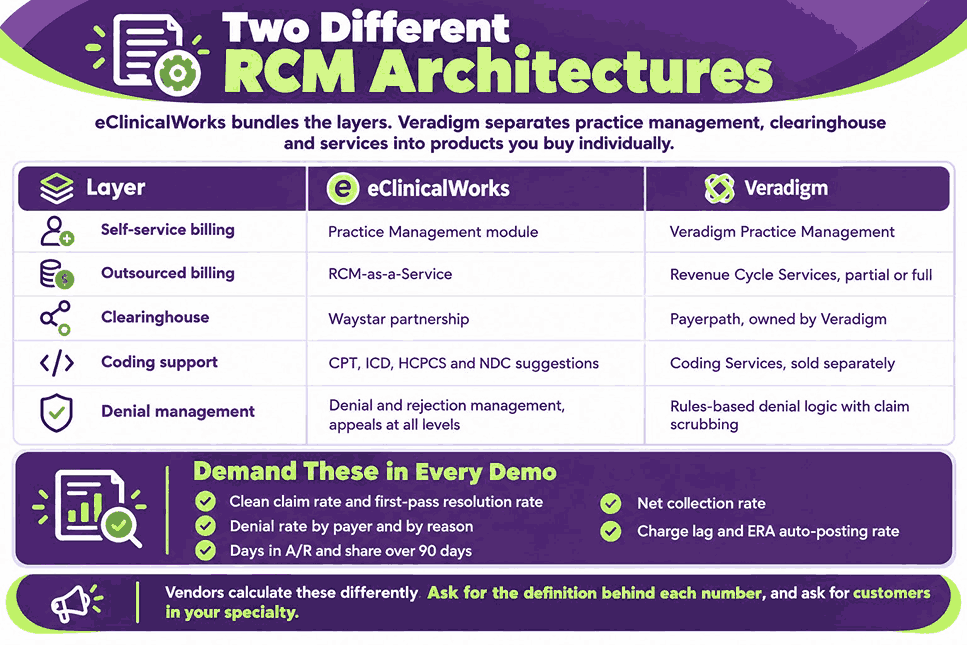
Revenue cycle management (RCM) is the widest gap between the two vendors and the thinnest area in other comparisons. Both sell software and services, but they package them differently. eClinicalWorks bundles the layers, while Veradigm separates the practice management, clearinghouse, and service layers.
Claims, Clearinghouse, and Scrubbing
eClinicalWorks offers two RCM models: a self-service practice management model and a full RCM service model. Listed service capabilities include claim creation, denial and rejection management, appeals, and preventive claim edits. eCW also cites a Waystar partnership dating to 2005. For charge entry, claim edits, and ERA posting inside the platform, see our ecw billing guide.
Veradigm Practice Management includes the Payerpath clearinghouse. A third-party profile says Payerpath covers claim scrubbing, real-time eligibility, electronic remittance advice (ERA), denial management, and patient payments. The same profile says Payerpath can connect to most practice management systems. For how claims move through Payerpath and where denials stall, see our veradigm billing guide.
| RCM capability | eClinicalWorks | Veradigm |
|---|---|---|
| Self-service billing | Practice Management module | Veradigm Practice Management |
| Outsourced billing | RCM-as-a-Service | Revenue Cycle Services, partial or full |
| Clearinghouse | Waystar partnership; Waystar reports a 98.5% clean claim rate (vendor-reported) | Payerpath, owned by Veradigm |
| Coding support | CPT, ICD, HCPCS, and NDC suggestions | Coding Services, sold separately |
| Denial management | Denial and rejection management, appeals at all levels | Rules-based denial logic with claim scrubbing |
| Claims AI | RCM AI content published December 2025 | Intelligent claim scrubbing and AI-assisted prior authorization planned for 2026 |
Metrics to Demand in Every Demo
Vendors calculate RCM metrics differently, so ask for the definition behind each number. Request these figures for customers in your specialty:
- Clean claim rate and first-pass resolution rate
- Denial rate by payer and by denial reason
- Days in A/R and the share of A/R over 90 days
- Net collection rate
- Charge lag and ERA auto-posting rate
Native Billing or Outsourced RCM?
Native billing tools work when your coders and billers know the EHR well. Outsourced RCM fits when denial rates stay high, A/R ages past 60 days, or staff turnover disrupts charge capture. Both vendors sell services, and independent billing partners can also work inside either system, including dedicated ecw billing services and veradigm billing services teams that run claims, denials, and A/R on top of your existing EHR.
Veradigm’s orthopaedic page offers partial or full revenue cycle services. Ask whether your results will depend on the software or on the service team. Get that answer in writing, with metrics, before you sign. Service staff quality varies by account, and software metrics alone will not reveal it.
AI and Automation: What Ships Today and What Is Roadmap
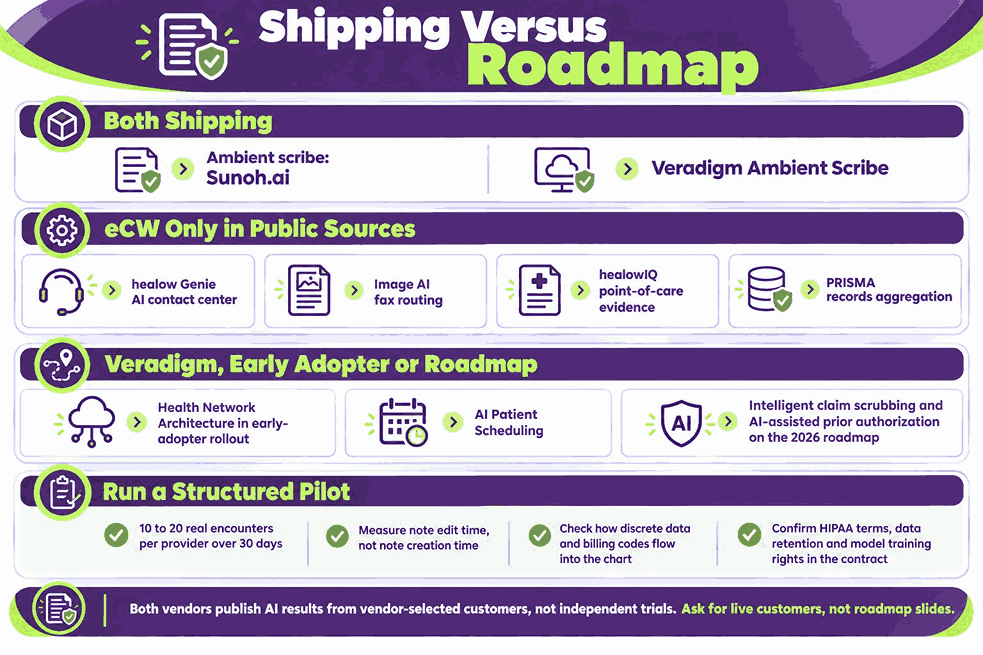
The key distinction is between tools that customers can use now and capabilities that remain in pilots or on a product roadmap. The comparison below separates current AI functionality from evidence that still needs validation.
Ambient AI Scribes
eClinicalWorks sells Sunoh.ai, an ambient scribe built by healow and marketed as EHR-agnostic. In a sample cited by eClinicalWorks, 72% of AI adopters used Sunoh.ai. About two-thirds of those users reported saving one to four hours or more per day. Treat those figures as vendor-reported.
Veradigm Ambient Scribe is powered by AvodahMed and writes notes directly into Veradigm EHR, including discrete patient data from the visit. Pilots in September and October 2024 saved 7 to 10 minutes per encounter before the November launch. Veradigm has since announced expanded scribe capabilities.
Front Office, Records, and Claims AI
This capability matrix compares the tools each vendor publicly identifies and indicates whether the evidence points to a shipping product, an early rollout, or a roadmap item.
| Capability | eClinicalWorks | Veradigm | Maturity note |
|---|---|---|---|
| Ambient scribe | Sunoh.ai | Veradigm Ambient Scribe | Both shipping |
| AI contact center | healow Genie | AI Patient Scheduling | Genie has published customer cases |
| Fax routing | Image AI | Not found in public sources | eCW ahead on published tools |
| Point-of-care evidence | healowIQ | Not found in public sources | eCW only |
| Records and population data | PRISMA | Health Network Architecture | Veradigm in early-adopter rollout |
| Claims AI | RCM AI content | Claim scrubbing and prior authorization on 2026 roadmap | Roadmap items need proof |
healow Genie has the stronger public evidence. Main Street Medical in South Carolina reported handling 76% of calls and a 16.5% rise in appointments, according to eCW’s news page. CEO Girish Navani framed eCW’s AI strategy around front-office automation and deep inference at HIMSS26.
Veradigm’s investor deck describes agentic AI as an action layer that reviews charts, drafts documentation, builds claims, and surfaces risks. Its Health Network Architecture reached early adopters across Veradigm EHR, Practice Management, Payerpath, and FollowMyHealth. Ask for live customers, not roadmap slides.
Run a Structured AI Pilot
- Test 10 to 20 real encounters per provider over 30 days
- Measure note edit time, not only note creation time
- Check how discrete data and billing codes flow into the chart
- Confirm HIPAA terms, data retention, and model training rights in the contract
Veradigm Pricing vs eClinicalWorks Pricing: What You Will Actually Pay
Third-party sources disagree on Veradigm pricing because they price different products. ITQlick lists $49 per prescriber per month, which matches the ePrescribe plan. SelectHub lists $149 per month, and SoftwareFinder lists Practice Fusion EHR from $199 per month.
How much does eClinicalWorks cost? Sources range from $449 per provider per month on ITQlick and SelectHub to $499 on TopAdvisor and $499 to $599 on MedHeave. Published eclinicalworks pricing excludes many add-ons, so confirm which modules the quoted eclinicalworks cost includes.
Published Price Points and What They Likely Cover
The figures below come from third-party listings and may refer to different products, user types, or billing units; the likely product column helps explain why the prices are not directly comparable.
| Price observed | Source | Likely product |
|---|---|---|
| $49 per prescriber per month | ITQlick, SoftwareFinder | Practice Fusion ePrescribe |
| $59 per prescriber per month | SoftwareFinder (hospital list), Transcure | Standalone ePrescribe |
| $149 per month | SelectHub | Veradigm, product unspecified |
| $199 per month | SoftwareFinder | Practice Fusion EHR |
| $449 per provider per month | ITQlick, SelectHub | eClinicalWorks |
| $499 per month | TopAdvisor | eClinicalWorks |
| $499 to $599 per provider per month | MedHeave | eClinicalWorks |
| $149 per user per month | Glass Health | Sunoh.ai add-on (third-party figure) |
Hidden Cost Lines
Veradigm cost and eClinicalWorks cost both grow after the base license. SelectHub reports no eCW setup fee unless a practice has 10 or more providers. Budget for these lines before comparing quotes:
- Setup, data migration, and training
- Clearinghouse, ERA, and eligibility fees
- EPCS identity proofing and tokens
- AI scribe and contact center add-ons
- Patient portal, telehealth, and payment processing fees
- Lab, imaging, and HIE interfaces
- RCM service fees, often a percentage of collections
Build a Three-Year TCO Model
- List providers, nurses, and billing users by role.
- Price each product SKU, not the vendor brand.
- Add AI add-ons per user per month.
- Add RCM service fees or the loaded cost of in-house billers.
- Add migration, training, and interface costs once.
- Compare three-year totals, then test a 15% volume change.
Vendor Stability, Compliance, and Contract Risk
Vendor stability affects more than product continuity. Financial reporting, leadership changes, enforcement history, and contract protections all influence the risk of a long-term EHR and RCM commitment.
Veradigm Reporting and Leadership Status
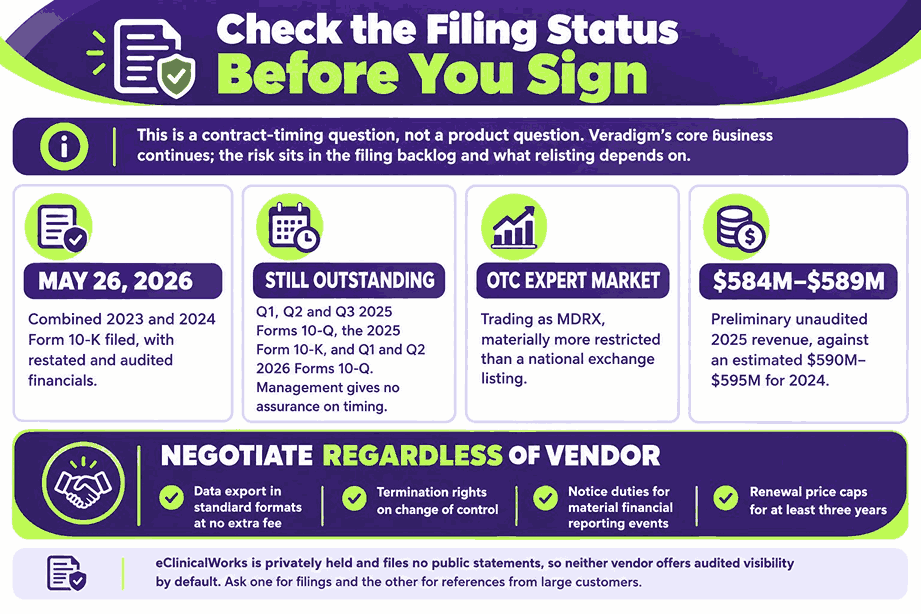
Nasdaq delisted Veradigm for failing to file financial reports, and the stock trades over the counter as MDRX. Veradigm says it has filed its 2023 and 2024 Form 10-Ks, with the 2025 audit underway. It plans to relist once it is current with its filings.
Key figures from company announcements:
- 2025 revenue estimate of $584 million to $589 million
- Year-end 2025 cash of about $120 million and debt of $75 million
- CEO Don Trigg since September 2, 2025, succeeding interim CEO Thomas Langan
- CFO Christian Greyenbuhl, appointed in April 2026
An April 2026 investor analysis estimates that about 80% of Veradigm revenue is recurring. That is an outside opinion, not a company filing. The practical risk is contract timing, because relisting depends on finishing the filings and passing exchange review.
eClinicalWorks Ownership and Scale
eClinicalWorks is privately held and founder-led, so it files no public financial statements. At its 2026 national conference, it projected combined eClinicalWorks and healow revenue above $1.3 billion, including $175 million from healow. Ask for audited statements or references from large customers.
Enforcement History
The table summarizes the two historical federal matters cited in this comparison; the allegations, dates, settlement amounts, and government statements differ by case.
| Vendor | Matter | Date | Amount | Notes |
|---|---|---|---|---|
| eClinicalWorks | False Claims Act allegations about EHR certification | May 2017 | $155M | The Department of Justice (DOJ) said the settlement was not a determination of liability |
| Practice Fusion (now Veradigm) | Anti-Kickback Statute and False Claims Act allegations | January 2020 | $145M | Investigation began in March 2017, before Allscripts bought the company |
Both DOJ matters are historical. The eCW matter involved EHR certification, while the Practice Fusion matter involved sponsored clinical decision support alerts. Ask each vendor to describe its current compliance program. Request recent audit results, a named compliance officer, and any current government inquiries.
Contract Protections to Request
- Data export in standard formats at no extra fee
- Termination rights on change of control
- Notice duties for material financial reporting events
- Uptime and support response service levels with credits
- Breach notification timelines in the business associate agreement
- Renewal price caps for at least three years
Rollout, Migration, and Switching Costs
Sources conflict on rollout difficulty. SoftwareReviews calls Veradigm Professional EHR easier to roll out, while SelectHub expects a longer setup for larger Veradigm customers. Ask for reference customers with your size and specialty. Rollout speed depends more on data quality, interface count, and staff training than on vendor brand.
| Step | What happens | Main risk |
|---|---|---|
| Data inventory | List demographics, problem lists, medications, documents, and A/R | Missing or unstructured data |
| A/R plan | Run off old A/R or convert it | Cash flow gaps |
| Template mapping | Rebuild templates and order sets | Provider pushback |
| Interfaces | Rebuild lab, imaging, and clearinghouse links | Go-live delays |
| Payer re-enrollment | Re-enroll ERA and EFT | Payment misdirection |
| Training and hypercare | Train staff and track tickets | Productivity dip |
Plan a parallel billing period of at least one payer cycle. Keep the old system readable for audits and appeals. Write data-return terms into the contract before the first invoice. Payer enrollment changes can take several weeks, so start them before go-live.
eClinicalWorks Alternatives and Veradigm Alternatives to Shortlist
Buyers who search for eclinicalworks alternatives usually shortlist a few vendors. SelectHub lists AdvancedMD, athenaOne, CareCloud, CureMD, DrChrono, Elation, EpicCare, NextGen, and Tebra among top alternatives. Searches such as eclinicalworks vs epic and tebra vs eclinicalworks show where buyers hesitate.
| Alternative | Consider it when | Typical comparison query |
|---|---|---|
| Epic | A hospital or health system hosts or sponsors your practice | eclinicalworks vs epic |
| Tebra | You run a small independent practice and want bundled billing | tebra vs eclinicalworks |
| athenaOne | You want a cloud EHR with bundled revenue cycle services | eclinicalworks vs athenahealth |
| NextGen | You run ambulatory specialty groups | nextgen vs eclinicalworks |
| AdvancedMD | You want PM and EHR in one cloud suite | eclinicalworks vs advancedmd |
| ModMed | You need specialty-specific workflows | modmed vs eclinicalworks |
Frequently Asked Questions
Is Veradigm the Same as Allscripts?
Yes. Allscripts adopted the Veradigm name in January 2023. Veradigm EHR was formerly Allscripts Professional EHR, and Practice Fusion joined the family through a 2018 acquisition. Older reviews, contracts, and comparisons may still use the Allscripts name, so search both names during due diligence.
Is Veradigm Still Publicly Traded?
Veradigm trades over the counter as MDRX after Nasdaq delisting. The company says it plans to relist once its filings are current. Confirm the latest filing status before you sign. Check the SEC filing index and the company’s investor page on the day you sign.
Does eClinicalWorks Have Built-In RCM?
Yes. eClinicalWorks offers a self-service practice management model and a full RCM service model. Ask which model your quote covers, because service fees, staffing, and reporting access differ between them. Request clean claim rate and denial rate figures for customers in your specialty before you decide.
Which Is Cheaper, Veradigm or eClinicalWorks?
Published Veradigm entry prices start lower, but they describe lighter products such as ePrescribe and Practice Fusion. eClinicalWorks starts at $449 to $599 per provider per month in third-party sources. Compare full-stack quotes, not entry prices. Include AI add-ons, clearinghouse fees, and RCM services in both quotes.
Which Has the Better AI Scribe?
Neither vendor has published independent head-to-head testing of its AI scribe. Sunoh.ai has more published adoption figures, while Veradigm Ambient Scribe has pilot data from its 2024 launch. Run a 30-day pilot with your own providers, and measure note edit time, accuracy, and specialty vocabulary handling.
Can I Use Outsourced RCM With Either Platform?
Yes, in most cases. Independent billing partners can work inside either system when you grant access and confirm clearinghouse enrollment. Define data ownership and reporting access in the services agreement. Confirm which clearinghouse the partner will use, because switching it can change payer enrollment and ERA routing.
Is Practice Fusion the Same as Veradigm EHR?
No. Practice Fusion targets small independent practices that want an out-of-the-box cloud EHR with little IT support. Veradigm EHR targets multi-location, multi-specialty groups that need advanced configuration. Both sit under the Veradigm brand, and each has its own pricing and feature set.
How Hard Is Switching Between These EHRs?
Switching takes planning for data, A/R, interfaces, and payer enrollment. Plan a parallel billing period and keep read access to the old system. Contract terms for data return matter more than feature checklists. Start the contract review at the same time as the demos, not after the decision.