Medical billing challenges in New Jersey are the points where claims stall, deny, or underpay. They come from state rules, payer structure, and plan type, and most trace back to a handful of repeat failures. Five recur across New Jersey practices: plan-type misrouting, NJ FamilyCare managed care denials, out-of-network dispute errors, personal injury protection (PIP) delays, and Medicaid eligibility churn. The state’s own data shows how often they hit.
46% of out-of-network arbitration filings dismissed as ineligible by the NJ Department of Banking and Insurance (DOBI) were filed under the wrong plan type, and independent reviewers overturned or modified 47% of the managed care denials appealed in late 2025. In one 2026 quarter, 14,929 PIP arbitration cases opened, and 443,217 NJ FamilyCare members lost coverage over paperwork during the Medicaid unwinding.
For what each state law requires, see the breakdown of New Jersey medical billing laws. This article covers a different question: where claims break in practice. The statutes are the rulebook, and this is the field report. It also covers each failure point, the entities and rules behind it, and the checks that stop it.
Why Do NJ Claims Break at Plan-Type Boundaries?
Plan type decides which rules apply to a claim. A fully insured New Jersey plan follows state insurance rules enforced by the Department of Banking and Insurance (DOBI). A self-funded plan follows the federal Employee Retirement Income Security Act (ERISA) unless it opts into New Jersey out-of-network arbitration.
NJ FamilyCare claims follow a third rule set. The Division of Medical Assistance and Health Services (DMAHS) sets program rules, and each managed care organization (MCO) adds its own contract terms. PIP claims follow a fourth set under DOBI’s auto insurance rules.
How Do You Identify the Governing Rule Set?
| Plan type | Governing rules | Where disputes go |
|---|---|---|
| Fully insured NJ plan | DOBI rules and NJ out-of-network law | NJ arbitration run by MAXIMUS |
| Self-funded, not opted in | ERISA, plan terms, federal No Surprises Act | Federal independent dispute resolution |
| Self-funded, opted in | Plan terms plus NJ arbitration election | NJ arbitration run by MAXIMUS |
| NJ FamilyCare MCO | DMAHS rules and MCO contract | MCO appeal, then DMAHS provider inquiry |
| PIP (auto) | DOBI PIP rules | PIP alternate dispute resolution via Forthright |
Why Does Self-Funded Opt-In Matter?
DOBI lets self-funded plans opt into New Jersey out-of-network arbitration. Genova Burns adds that opted-in plans must print SELF-FUNDED on the member ID card. That marking is your first clue to the correct forum.
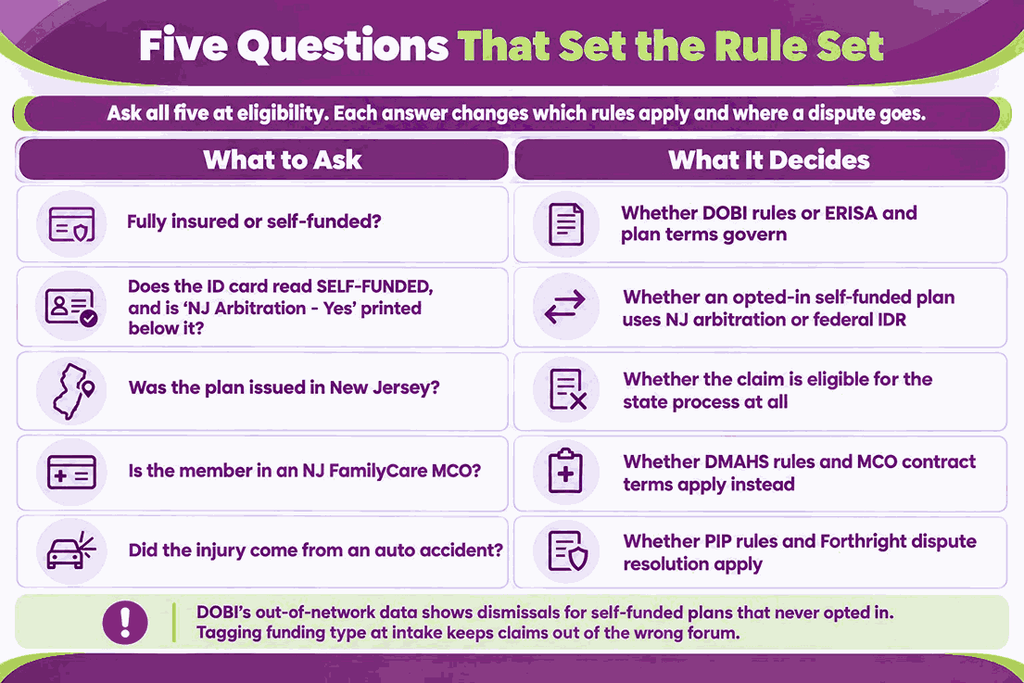
DOBI’s own reporting shows the cost of guessing wrong. Its out-of-network data report lists dismissals for self-funded plans that had not opted in. A wrong forum choice costs weeks and risks a lost dispute. Teams that tag funding type at intake avoid this rework.
Check these five items at eligibility:
- Funding type: fully insured or self-funded
- ID card marking, including the SELF-FUNDED label
- Whether the plan was issued in New Jersey
- Whether the member is in an NJ FamilyCare MCO
- Whether the claim arises from an auto injury
Pairing these checks with patient eligibility verification at scheduling keeps misrouted claims out of the billing queue. Document each answer in the account notes so appeals start with a clean record. Coders also need that plan context on day one.

Why Do NJ FamilyCare Claims Deny, and How Do the Five MCOs Differ?
NJ FamilyCare is New Jersey’s Medicaid program, and most members enroll in a managed care organization. Providers bill the MCO, not the state, for most services. Each MCO applies its own authorization rules and claim edits on top of state requirements.
Horizon NJ Health is the largest plan, with more than 1 million Medicaid members, according to a 2025 NorthJersey.com report. The same report notes that members can change MCOs at will. A claim billed to last month’s plan denies even when the visit was covered.
Which Five MCOs Process NJ FamilyCare Claims?
The DMAHS provider resources page names five health plans under contract for New Jersey Medicaid managed care. Billing teams should keep a payer reference sheet for each plan. The table lists each plan and its relationship to a parent organization or former name.
| MCO | Relationship or former name |
|---|---|
| Aetna Better Health of New Jersey | Aetna Medicaid subsidiary |
| Fidelis Care | Formerly Wellcare |
| Horizon NJ Health | Medicaid plan of Horizon Blue Cross Blue Shield of New Jersey |
| UnitedHealthcare Community Plan | UnitedHealthcare Medicaid plan |
| Wellpoint | Formerly Amerigroup New Jersey |
How Do NJMMIS Enrollment Gaps Cause Denials?
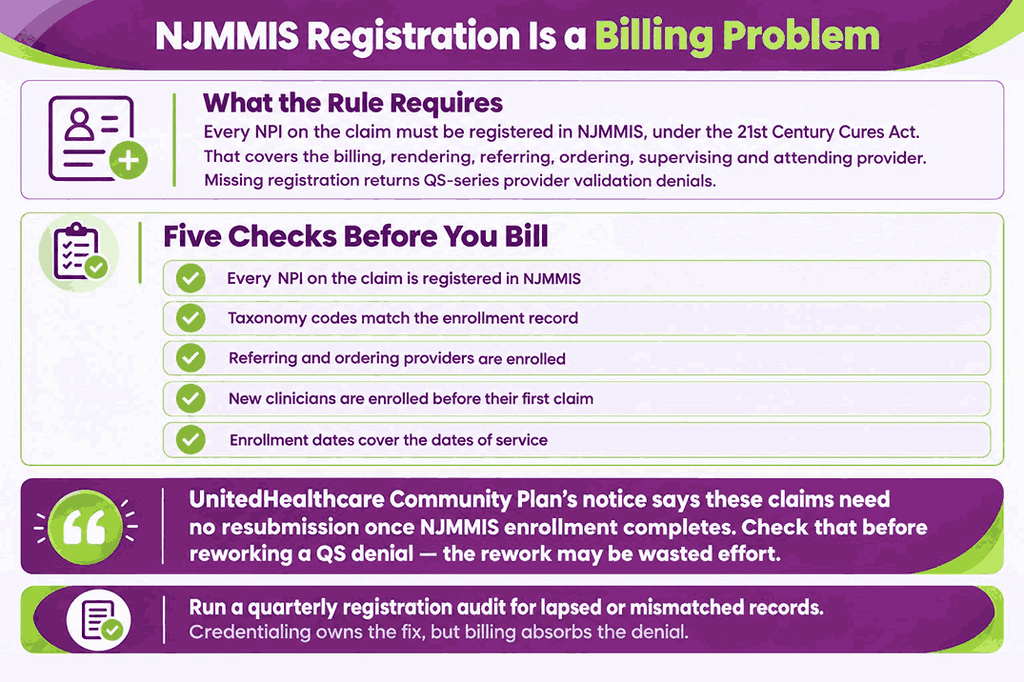
Every National Provider Identifier (NPI) on a claim must be registered with the New Jersey Medicaid Management Information System (NJMMIS). The requirement comes from the 21st Century Cures Act. Missing registration triggers provider validation denials, which makes New Jersey Medicaid provider enrollment a billing issue, not only a credentialing task.
UnitedHealthcare Community Plan published a notice listing QS-series denial codes for these failures. The codes cover billing, rendering, referring, ordering, supervising, and attending providers. The notice says claims need no resubmission once NJMMIS provider enrollment is complete. That detail saves rework on claims that already denied.
Verify these items before billing:
- Every NPI on the claim is registered in NJMMIS
- Taxonomy codes match the enrollment record
- Referring and ordering providers are enrolled
- New clinicians are enrolled before their first claim
- Enrollment dates cover the dates of service
Our credentialing services team handles NJMMIS registration and payer enrollment before the first claim goes out. Early enrollment removes a source of avoidable provider validation denials. Run a quarterly registration audit to catch lapsed or mismatched records, and fix them before payers flag them.
Why Do Eligibility and MCO Assignment Errors Cause Denials?
The Medicaid Eligibility Verification System (MEVS) shows a member’s coverage and assigned plan. DMAHS provider training materials point to eligibility verification as a way to reduce eligibility-related denials. A check on the date of service catches plan changes before the claim leaves.
Medicaid eligibility verification should happen at scheduling and again at check-in. Members who switch MCOs mid-treatment create the highest risk. A second check also catches members whose coverage lapsed between the booking date and the visit. Teams that skip the second check find the problem only after the denial posts.
What Happens When a Provider Is Out of Network With the MCO?
DMAHS provider training says services need either network participation or a single case agreement (SCA) with the MCO. It also says MCOs must honor continuity of care parameters when members move between plans. These rules decide whether an out-of-network visit gets paid.
Confirm these points before scheduling:
- Network status with the member’s current MCO
- Whether a single case agreement is needed and approved
- Continuity of care status for members who recently changed plans
How Do Prior Authorization and Behavioral Health Routing Differ by MCO?
Prior authorization rules differ by plan. A service that needs no review at one MCO can need authorization at another. Keep a current matrix for each plan. DMAHS requires prior authorization denials and limitations to be provided in writing, which gives teams a record for appeals.
Behavioral health adds a second layer. DMAHS publishes a behavioral health contact directory for each MCO and for fee-for-service NJ FamilyCare, last updated April 2026. Teams handling New Jersey behavioral health billing should confirm which route applies before submitting. Update the routing table when DMAHS publishes a new directory.
How Do You Escalate a Denied FamilyCare Claim?
Escalation follows a fixed order. Skipping a step weakens the record DMAHS needs to act. Document every contact date and reference number. For non-MLTSS services, the MCO contract expects payment within 30 days of a clean claim.
- Correct the claim error and resubmit inside the MCO’s timely filing window.
- File the MCO’s provider appeal or dispute with full claim detail.
- If the MCO does not resolve it, send an inquiry to DMAHS provider relations with proof of timely submission.
What Does a FamilyCare Denial Taxonomy Look Like?
Medicaid follows National Correct Coding Initiative (NCCI) edits, and providers must also follow MCO-specific coding rules, according to a DMAHS claims refresher. The table below groups common denial causes by owner and fix. Keeping both rule sets in the claim scrubber prevents repeat edits.
| Denial cause | Root cause | Fix owner | Prevention |
|---|---|---|---|
| Provider validation (QS codes) | NPI not registered in NJMMIS | Credentialing | Verify registration before go-live |
| Wrong MCO billed | Member switched plans | Eligibility team | Run MEVS on every visit |
| Missing authorization | MCO-specific PA rule | PA coordinator | Keep an MCO authorization matrix |
| Behavioral health misroute | Benefit split across payers | Billing team | Confirm route before submitting |
| Coding edit | NCCI plus MCO coding rules | Coding team | Scrub claims against both rule sets |
How Do OON Arbitration and Federal IDR Outcomes Compare in NJ?
New Jersey runs its own out-of-network arbitration program under P.L. 2018, c.32. The federal No Surprises Act runs a separate independent dispute resolution (IDR) process. Both settle payment disputes between out-of-network providers and plans. Our new jersey billing laws guide covers the mechanics, so this section covers outcomes.
Which Disputes Qualify for NJ Arbitration?
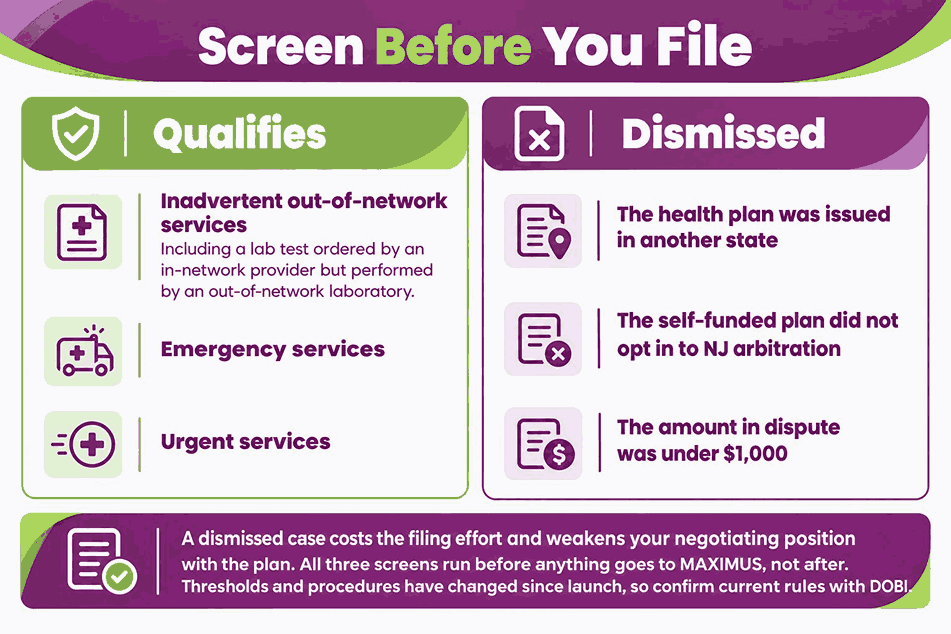
DOBI’s early reporting lists three common dismissal reasons for ineligible cases. A dismissed case costs time and weakens your negotiating position with the plan. Billing teams should screen for all three before filing any dispute with MAXIMUS. The three reasons are:
- The health plan was issued in another state
- The self-funded plan did not opt in to NJ arbitration
- The amount in dispute was under $1,000
Qualifying services fall into inadvertent or emergency and urgent categories. A lab test ordered by an in-network provider but performed by an out-of-network lab counts as inadvertent. Thresholds and procedures have changed since launch, so confirm current rules with DOBI.
What Do NJ and Federal Outcomes Show?
A New Jersey health law firm, summarized state and federal results using DOBI and federal agency data. Both datasets favor providers, which supports filing well-documented disputes. Treat these figures as context, not guarantees. Outcomes vary by service, payer, and the quality of each offer.
| Forum | Period | Volume | Provider result |
|---|---|---|---|
| NJ arbitration (MAXIMUS) | Through Dec. 31, 2023 | 15,565 requests | Providers prevailed in 66%, with awards near $81.4 million |
| Federal IDR | Jan. 1 to Jun. 30, 2023 | 83,868 determinations | Providers prevailed in 77% |
The two figures are not directly comparable. The state count spans multiple years, while the federal count covers six months. The denominators also differ, so treat both as directional. Refresh them from the latest DOBI and CMS reports before relying on them.
How Does Final-Offer Arbitration Work?
New Jersey’s program uses final-offer arbitration, often called baseball-style arbitration. Each side submits one offer, and the arbitrator selects one. Federal IDR follows the same pattern, so an offer far from the benchmark risks losing outright.
DOBI’s early data report also tracked carrier spending. Spending on involuntary out-of-network services fell 22% in the individual market and 56% in the small employer market. Lower carrier offers make documented benchmark evidence more important. Build the evidence file before filing, not after.
How Do You Choose the Right Forum?
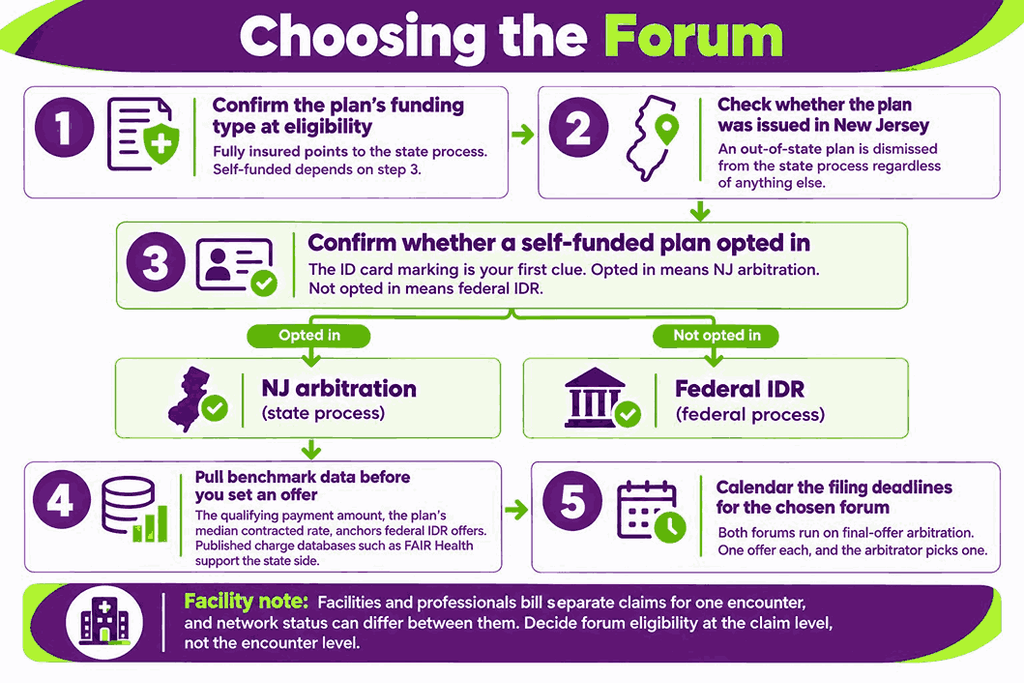
A repeatable decision path prevents dismissals. The qualifying payment amount (QPA) is the plan’s median contracted rate for a service, and it anchors federal IDR offers. Teams should pull benchmark data from the QPA and published charge databases such as FAIR Health.
- Confirm the plan’s funding type at eligibility.
- Check whether the plan was issued in New Jersey.
- Confirm whether a self-funded plan opted in.
- Pull benchmark data, including the QPA and FAIR Health.
- Calendar the filing deadlines for the chosen forum.
Facility note: Facilities and professionals bill separate claims for one encounter. Network status can differ between them, so decide forum eligibility at the claim level. Our ASC billing team applies this check to facility claims.
Where Do PIP and No-Fault Claims Stall in New Jersey?
Personal injury protection (PIP) is the medical coverage in New Jersey auto policies. DOBI regulates PIP billing through a medical fee schedule and a medical protocols rule. Providers who treat auto-injury patients bill under these rules, not under health plan rules.
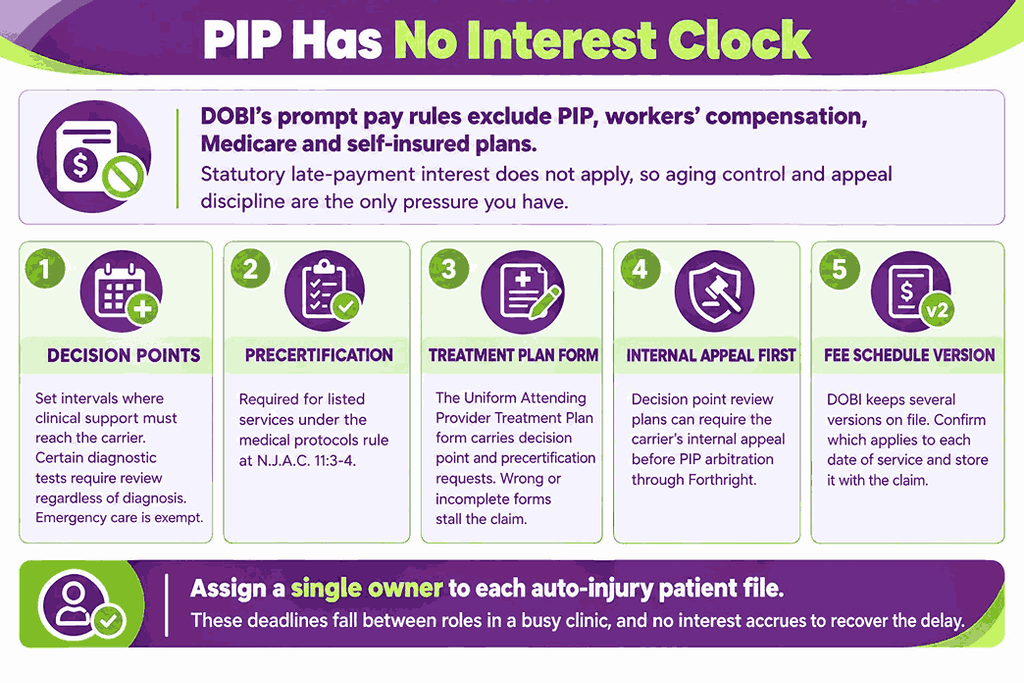
New Jersey prompt-pay rules do not cover PIP claims. DOBI’s prompt pay excludes PIP, workers’ compensation, Medicare, and self-insured plans. Statutory late-payment interest does not apply to PIP, so aging control and appeal discipline matter more. Interest cannot pressure a slow PIP carrier.
What Rules Govern PIP Billing?
DOBI’s PIP information page for providers lists the core components. These include the fee schedule, the medical protocols rule, the required treatment plan form, and the dispute resolution administrator. The table maps each one to its usual failure point and shows where teams should look first.
| Component | What it does | Where claims fail |
|---|---|---|
| Auto medical fee schedule (N.J.A.C. 11:3-29) | Sets payable amounts for treatment | Billed charges exceed schedule payment |
| Medical protocols rule (N.J.A.C. 11:3-4) | Sets care paths, decision point review, precertification | Missed decision points or precertification |
| Uniform Attending Provider Treatment Plan form | Carries decision point and precertification requests | Wrong or incomplete form |
| PIP alternate dispute resolution (Forthright) | Resolves PIP payment and necessity disputes | Skipping the carrier’s internal appeal first |
What Is a Decision Point in PIP Billing?
A decision point is a set interval in treatment where the provider must send clinical support to the carrier. Certain diagnostic tests also require review regardless of diagnosis. A GEICO provider notice adds that emergency care is exempt from decision point review and precertification.
Where Do PIP Claims Stall Most Often?
Providers submit usual and customary fees, and the insurer decides reasonableness against the fee schedule. The same bulletin notes that decision point review plans can require an internal appeal before arbitration. Missing a decision point exposes the claim to penalties in the carrier’s plan.
Pain management, orthopedic, and diagnostic imaging practices treat many auto-injury patients, so PIP rules shape their cash flow. Confirm the fee schedule version in force for each date of service, since DOBI keeps several versions on file. Store the version used with each claim.
Track these PIP dates and documents:
- Decision point dates for each patient
- Precertification for listed services
- Treatment plan form submissions
- Internal appeal deadlines in each carrier’s plan
- Fee schedule version by date of service
Our billing teams across specialties track these items across auto-injury cases. Assign a single owner to each patient file so no deadline falls between roles in a busy clinic. Clear ownership also speeds appeals when a carrier requests records.
How Will 2027 Medicaid Churn Change NJ Eligibility Denials and Self-Pay?
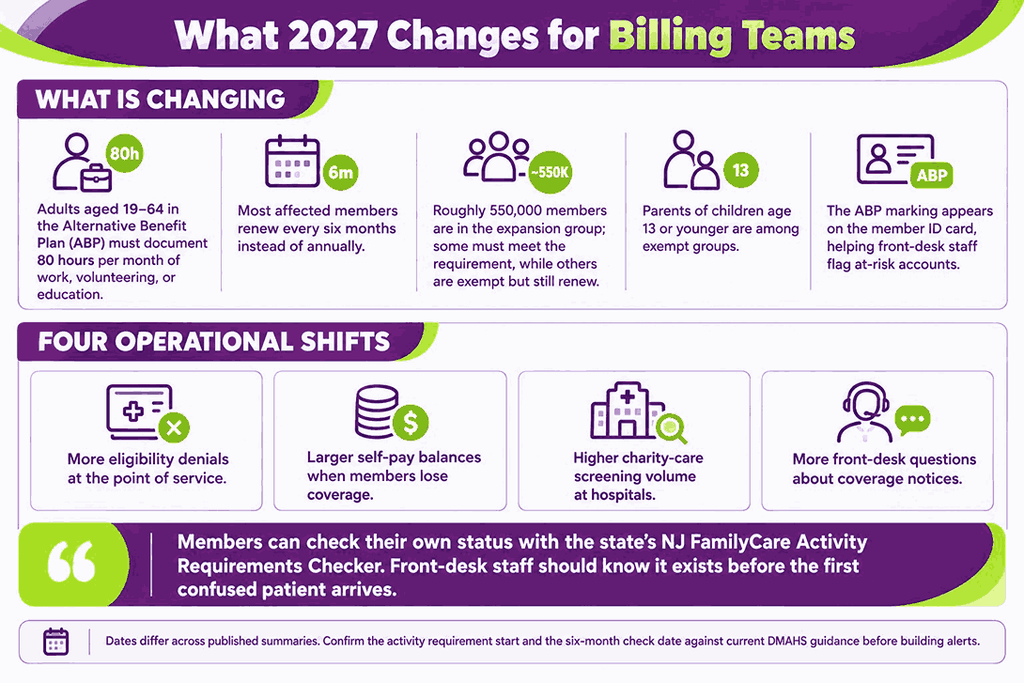
Medicaid churn is the repeated gain and loss of coverage by the same members over time. NJ FamilyCare will add federal work requirements and six-month eligibility checks for many expansion adults. NJ DMAHS says the requirements start January 1, 2027.
Advocates for Children of New Jersey reports that six-month checks begin December 31, 2026. The rules apply to adults aged 19 to 64 in the expansion group, who must show 80 hours of monthly activity. Parents of children 13 or younger are among the exempt groups.
Key dates for planning:
- June 1, 2026: CMS releases an interim final rule on community engagement
- December 31, 2026: six-month eligibility checks begin for most expansion adults
- January 1, 2027: work requirements start under DMAHS guidance
The Department of Human Services estimates about 540,000 members could be affected. The same report says most affected members are in the Alternative Benefit Plan (ABP), marked on the ID card. Front-desk staff can use that marking to flag at-risk accounts.
What Changes for Billing Teams?
Teams should plan for four shifts as renewals tighten. Each shift adds workload in a different department. Eligibility, billing, and patient access teams each own part of the response. The list below shows what to expect once the rules take effect.
- More eligibility denials at the point of service
- Larger self-pay balances from members who lose coverage
- Higher charity care screening volume at hospitals
- More patient questions at the front desk about coverage notices
Which Eligibility Controls Should You Add Now?
| Control | Trigger | Owner |
|---|---|---|
| Real-time eligibility check | Every scheduled visit and every check-in | Front desk |
| Renewal date alert | Six months after each member’s last renewal | Eligibility team |
| MCO assignment check | Before claim submission | Billing team |
| Patient outreach | A member reports a coverage notice | Patient access |
| Charity care screening | Before any balance moves to collections | Financial counseling |
Members can test their own status with the state’s NJ FamilyCare Activity Requirements Checker. Front-desk staff should know this tool exists. The Louisa Carman Medical Debt Relief Act sets the collection rules that apply to new self-pay balances.
Which NJ Billing Challenges Hit Which Specialties Hardest?
Failure points concentrate by specialty because payer mix and care setting differ. The matrix below maps each specialty to its likeliest failure points. Treat it as a starting hypothesis and confirm it against your own denial data. Rank the controls you build first by the specialties you serve.
| Specialty | Main failure points | Why |
|---|---|---|
| Pain management | PIP, OON disputes | Auto-injury patients and procedure-based billing |
| Orthopedics | PIP, OON disputes | Injury care and facility-based procedures |
| ASCs | OON disputes, plan-type misrouting | Facility claims with mixed network status |
| Nephrology | Medicaid secondary billing, eligibility | Members with both Medicare and Medicaid |
| Psychiatry | Behavioral health routing | Benefits split between payers |
| OBGYN | FamilyCare MCO denials | High Medicaid volume |
| Cardiology | Authorization, OON disputes | Procedure authorization and facility mix |
| Primary care | Eligibility churn, FamilyCare denials | Large Medicaid panels |
What Do Healthy NJ Billing KPIs Look Like?
Generic benchmarks hide New Jersey patterns, and averages mask weak segments. A blended denial rate can look healthy while FamilyCare or PIP claims fail at higher rates. Track each metric by payer class and plan type so the weak segment stays visible to managers.
Medical billing KPIs only help when the cut matches the failure point. No single days in A/R benchmark fits every plan type. A clean claim rate benchmark also varies by payer. Set targets per segment, and review them monthly. Flag any segment that misses its target two months in a row.
| KPI | How to calculate | NJ cut |
|---|---|---|
| First-pass resolution rate | Claims paid on first submission divided by claims submitted | FamilyCare MCO, commercial, PIP |
| Denial rate | Denied claims divided by claims submitted | Denial reason: NJMMIS, eligibility, authorization |
| Days in A/R | Total A/R divided by average daily charges | Plan funding type |
| OON dispute outcome | Disputes won divided by disputes decided | Forum: NJ or federal |
| Late-payment interest recovered | Interest paid divided by interest owed | Fully insured commercial claims only |
Interest recovery applies only to fully insured plans under New Jersey prompt pay rules. A medical billing audit can baseline these metrics before you set targets. Run it against a full quarter of New Jersey claims to see which failure points cost the most.
What Should NJ Billing Teams Fix First?
Sequence matters. Front-end checks prevent denials that appeals can only recover late, and they cost less to run. This plan orders the work by dependency, so each step supports the next. Assign one owner per window and review progress at each boundary.
| Window | Actions |
|---|---|
| Days 1 to 30 | Audit NPI registration in NJMMIS. Tag every claim by plan funding type. Run MEVS on every FamilyCare visit. |
| Days 31 to 60 | Build an MCO authorization matrix. Adopt the OON forum checklist. Calendar PIP decision points. |
| Days 61 to 90 | Add renewal date alerts ahead of 2027. Launch the KPI view by payer class. Review denial root causes monthly. |
Practices that want help applying these controls can look into medical billing services in New Jersey. Bring the results of your plan-type audit and your NJMMIS registration check. That speeds up the first conversation about your denial patterns and next steps.
Frequently Asked Questions
What Causes NJ FamilyCare Claim Denials?
Common causes include unregistered NPIs in NJMMIS, wrong MCO billing, missing prior authorization, and behavioral health misrouting. Medicaid coding edits under NCCI also trigger denials. Each MCO adds its own rules, so a claim can pass one plan and fail another.
Does NJ Arbitration Apply to Self-Funded Plans?
Only if the plan opted in. Self-funded plans are not required to join New Jersey’s program. Opted-in plans print SELF-FUNDED on the member ID card. Plans that did not opt in follow the federal No Surprises Act IDR process for out-of-network disputes.
How Do PIP and Prompt-Pay Rules Differ?
PIP claims follow DOBI’s fee schedule, decision point review, and precertification rules, with disputes handled through PIP alternate dispute resolution. DOBI’s prompt pay rules exclude PIP. That means statutory late-payment interest does not apply to PIP claims. Teams must manage PIP aging and appeals directly.
When Do NJ FamilyCare Work Requirements Start?
NJ DMAHS says the requirements start January 1, 2027. Six-month eligibility checks for expansion adults begin December 31, 2026, according to Advocates for Children of New Jersey. Members should watch for state notices during fall 2026. Billing teams should set up eligibility alerts before then.