Every walk-in visit at an urgent care center is a coding puzzle with money attached. One patient can leave with an office visit, a laceration repair, an X-ray, a strep test, and a tetanus shot. Each service needs its own urgent care CPT code, and each code needs the right modifier, place of service, and diagnosis link. Consequently, one missed detail turns a paid claim into a denial.
Moreover, denied claims consume staff time, and payer filing windows limit how long a clinic can correct them. Therefore, accurate urgent care billing codes decide whether a busy clinic stays profitable. This urgent care coding guide covers every major CPT code family: E/M codes, procedure codes, radiology codes, lab codes, injection codes, and the S-codes that commercial payers add.
It also explains modifier 25, POS 20, common errors, and denial prevention. By the end, your team will know which CPT codes for urgent care to report, when to report them, and how to protect every dollar earned.

What Are Urgent Care CPT Codes?
Urgent care CPT codes are five-character Current Procedural Terminology codes that describe services delivered at walk-in urgent care centers. The American Medical Association maintains CPT, and payers use these codes to price each claim line. Therefore, every service must map to one CPT code or one HCPCS Level II code.
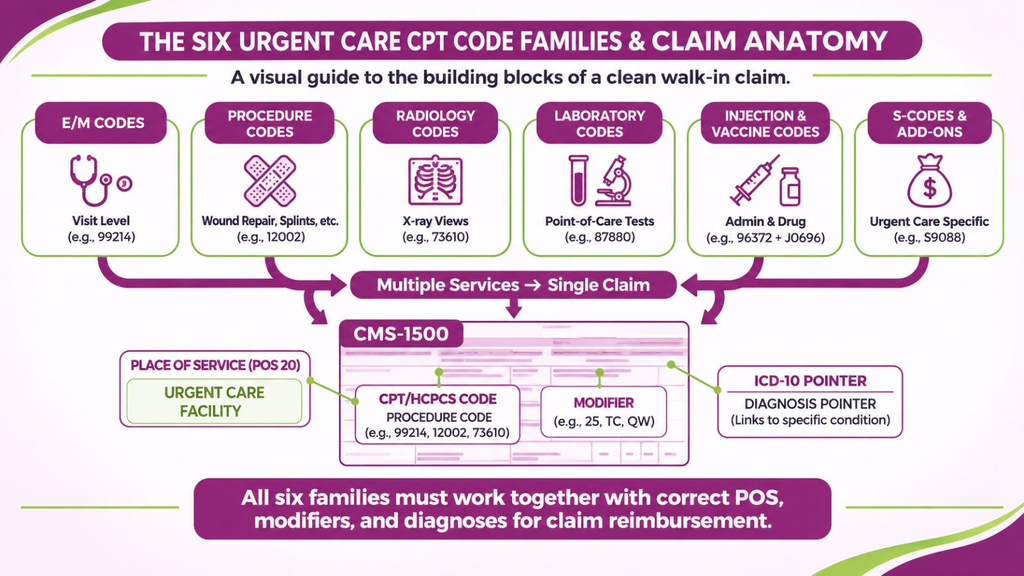
Urgent care medical billing codes belong to six families. Evaluation and management (E/M) codes describe the visit itself. Procedure codes describe wound repair, splinting, and drainage. Radiology and laboratory codes describe imaging and point-of-care tests. Injection and vaccine codes describe administration. Finally, S-codes and add-on codes capture urgent care operating costs for some payers.
How Do Urgent Care CPT Codes Differ From Primary Care and ER Codes?
Urgent care centers bill office and outpatient E/M codes, not emergency department codes. Codes 99281 through 99285 describe emergency department visits and belong to emergency departments. Primary care practices also use 99202 through 99215. However, urgent care claims add POS 20, walk-in procedures, and payer-specific S-codes that primary care rarely reports.
What Is Place of Service 20 and Why Does It Matter?
Place of service 20 identifies an urgent care facility on professional claims. CMS defines POS 20 as a location, distinct from a hospital emergency room, an office, or a clinic, that diagnoses and treats illness or injury for unscheduled ambulatory patients seeking immediate medical attention.
Medicare pays POS 20 services at the non-facility rate. Moreover, payers that reimburse S9083 and S9088 require POS 20 on the claim. Therefore, a wrong place of service code triggers denials even when every CPT code is correct. Hospital-owned centers follow different rules, covered below.
Which E/M Codes Do Urgent Care Centers Use?
Urgent care E/M codes come from two ranges: 99202 through 99205 for new patients and 99211 through 99215 for established patients. Providers choose the level by medical decision making (MDM) or by total time on the date of the encounter. The table below shows both pathways.
| CPT Code | Patient Type | MDM Level | Minimum Total Time |
|---|---|---|---|
| 99202 | New | Straightforward | 15 minutes |
| 99203 | New | Low | 30 minutes |
| 99204 | New | Moderate | 45 minutes |
| 99205 | New | High | 60 minutes |
| 99211 | Established | Not applicable | Not applicable |
| 99212 | Established | Straightforward | 10 minutes |
| 99213 | Established | Low | 20 minutes |
| 99214 | Established | Moderate | 30 minutes |
| 99215 | Established | High | 40 minutes |
An acute, uncomplicated illness or injury, such as an ankle sprain, meets the problem element of low MDM. The level still depends on data and risk, two of three elements. However, time spent on separately billed procedures never counts toward E/M time.
How Does MDM Determine the Urgent Care E/M Level?
MDM has three elements: the number and complexity of problems addressed, the amount and complexity of data reviewed, and the risk of patient management. The final level matches the level met by at least two of the three elements. Therefore, one strong element alone does not raise the visit level.
For example, influenza with systemic symptoms treated with a prescription antiviral meets moderate problem complexity and moderate risk. As a result, 99214 is supported. Similarly, a minor injury with an over-the-counter recommendation usually supports a lower level.
What Counts as a New Patient in Urgent Care?
A new patient has not received professional services from the physician, or from another physician of the same specialty in the same group, within the past three years. Walk-in patients may see a different clinician each time. Therefore, the group and specialty rule decides the code, not the individual provider on duty.
How Do Prolonged Service Codes and G2211 Work in Urgent Care?
CPT add-on code 99417 reports each extra 15 minutes after the minimum time of 99205 or 99215 when the level is chosen by time. Medicare uses HCPCS code G2212 instead, which starts after the maximum time: 89 minutes for 99205 and 69 minutes for 99215.
Add-on code G2211 reports visit complexity when the clinic is the continuing focal point for a patient’s care or part of ongoing care for a serious or complex condition. Urgent care visits are episodic, so G2211 rarely fits. However, a center that provides continuing care should confirm payer policy before billing it.
Can Urgent Care Centers Bill the Emergency Department?
Freestanding urgent care centers cannot bill emergency department E/M codes 99281 through 99285. Those codes require an emergency department setting. Hospital-owned urgent care centers that operate as provider-based outpatient departments follow facility billing rules instead. For example, the facility claim typically reports HCPCS G0463, while professional claims use POS 19 or POS 22.
What Are S9083 and S9088 in Urgent Care Billing?
S9083 and S9088 are HCPCS Level II S-codes created for urgent care centers. S9083 describes a global fee for urgent care centers, a flat payment for the whole visit. S9088 describes services provided in an urgent care center and is listed in addition to the code for the service.
S-codes are not Medicare codes. Medicare does not recognize S9083 or S9088, so Medicare visits use standard E/M codes with POS 20. Commercial and Medicaid payers set their own rules, and those rules change. For example, Ambetter Health announced that both codes became reimbursable on August 1, 2026, only with POS 20.
How Do Payers Choose Between E/M and S-Code Billing?
Payers use one of three formats: E/M codes alone, E/M codes plus S9088, or S9083 alone. The contract decides the format, not the clinic. Moreover, S9083 replaces the itemized E/M, and contract terms define which extra services, if any, may be billed separately. Therefore, billing teams keep a payer grid listing the required format, POS, and modifier rules for every plan.
Which Urgent Care Procedure Codes Are Billed Most Often?
Urgent care procedure codes cover wound repair, drainage, foreign body removal, splinting, and similar same-visit services. Most of these codes carry a 0-day or 10-day global period, which affects how the same-day E/M visit is reported. The sections below group the procedure codes by service.
Which CPT Codes Report Laceration Repair?
Laceration repair codes are chosen by repair type, wound length, and body site. Simple repair requires one-layer closure. Intermediate repair requires layered closure of deeper tissue. Complex repair requires more, such as extensive undermining or debridement. The table shows the codes most often used for short wounds.
| Repair Type | Body Site | Length | CPT Code |
|---|---|---|---|
| Simple | Scalp, neck, axillae, genitalia, trunk, extremities including hands and feet | 2.5 cm or less | 12001 |
| Simple | Scalp, neck, axillae, genitalia, trunk, extremities including hands and feet | 2.6 to 7.5 cm | 12002 |
| Simple | Face, ears, eyelids, nose, lips | 2.5 cm or less | 12011 |
| Intermediate | Scalp, axillae, trunk, extremities excluding hands and feet | 2.5 cm or less | 12031 |
| Intermediate | Scalp, axillae, trunk, extremities excluding hands and feet | 2.6 to 7.5 cm | 12032 |
| Intermediate | Face, ears, eyelids, nose, lips | 2.5 cm or less | 12051 |
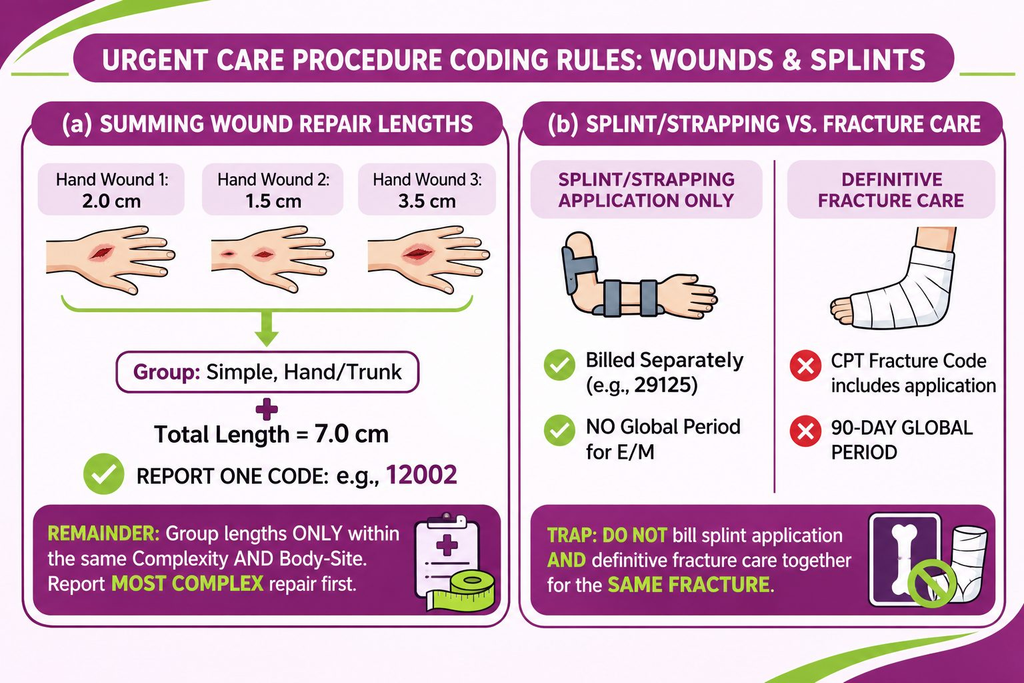
Add the lengths of repairs in the same complexity group and body-site group, then report one code. Report the most complex repair first. Local anesthesia is included in the repair code. Moreover, adhesive strips used as the only closure are reported with an E/M code instead of a repair code.
Which CPT Codes Report Drainage, Foreign Body Removal, and Splints?
Urgent care centers also bill drainage, foreign body, nail, ear, and splint codes. The table below lists procedure codes that appear often on walk-in claims, with a reporting note for each.
| Procedure | CPT Code | Reporting Note |
|---|---|---|
| Incision and drainage of abscess, simple or single | 10060 | Complicated or multiple abscesses use 10061 |
| Incision and drainage of abscess, complicated or multiple | 10061 | Documentation must show the added work |
| Removal of foreign body, subcutaneous, simple | 10120 | Complicated removal uses 10121 |
| Avulsion of nail plate, simple, single | 11730 | Each additional nail uses 11732 |
| Evacuation of subungual hematoma | 11740 | Report once per digit treated |
| Removal of impacted cerumen with instrumentation, unilateral | 69210 | Irrigation or lavage alone uses 69209 |
| Removal of foreign body, external auditory canal | 69200 | Applies without general anesthesia |
| Removal of foreign body, intranasal, office | 30300 | Applies to office-based removal |
| Removal of foreign body, conjunctival, superficial | 65205 | Corneal removal with slit lamp uses 65222 |
| Application of short arm splint, static | 29125 | Reports application only |
| Application of finger splint, static | 29130 | Reports application only |
| Application of short leg splint, calf to foot | 29515 | Reports application only |
| Strapping of ankle and foot | 29540 | Reports strapping only |
Splint codes report application only. Fracture treatment codes such as 25600 include the initial casting or splinting and carry a 90-day global period. Therefore, definitive fracture care and a splint code are not billed together for the same fracture. A center that only stabilizes the fracture and refers the patient reports the E/M visit and the splint code.
Which Radiology CPT Codes Apply to Urgent Care X-Rays?
Radiology CPT codes depend on the body part and the number of views taken. Urgent care centers with on-site X-ray equipment report chest, extremity, and spine films. The table lists frequently used codes with their view requirements.
| CPT Code | Exam | View Requirement |
|---|---|---|
| 71045 | Chest | Single view |
| 71046 | Chest | 2 views |
| 73030 | Shoulder, complete | Minimum 2 views |
| 73110 | Wrist, complete | Minimum 3 views |
| 73130 | Hand | Minimum 3 views |
| 73560 | Knee | 1 or 2 views |
| 73610 | Ankle, complete | Minimum 3 views |
| 73630 | Foot, complete | Minimum 3 views |
| 72100 | Lumbosacral spine | 2 or 3 views |
The professional component (modifier 26) and the technical component (modifier TC) split when different parties own the equipment and read the film. A center that owns the equipment and interprets the image bills globally with no modifier. However, when a radiologist provides the final read, the center bills the technical component only.
Which Laboratory CPT Codes Do Urgent Care Centers Bill?
Urgent care centers run point-of-service tests under a CLIA certificate, so lab billing depends on both the CPT code and the certificate level. Waived tests require at minimum a certificate of waiver, while higher-complexity tests need other CLIA certificate types. The table lists point-of-care codes common in urgent care.
| CPT Code | Test | Billing Note |
|---|---|---|
| 81002 | Urinalysis, dipstick, non-automated, without microscopy | Medicare does not require QW |
| 81003 | Urinalysis, automated, without microscopy | Append QW when a waived analyzer is used |
| 81025 | Urine pregnancy test, visual color comparison | Medicare does not require QW |
| 87880 | Strep A, rapid antigen immunoassay | Append QW for waived kits |
| 87804 | Influenza antigen, immunoassay | Report by organism and follow payer policy for A and B |
| 87811 | SARS-CoV-2 antigen, immunoassay | Append QW for waived kits |
| 82962 | Blood glucose, home-use monitoring device | Medicare does not require QW |
| 86308 | Mononucleosis screen, heterophile antibody | Append QW for waived kits |
| 36415 | Venipuncture | Some payers bundle collection into the visit |
Medicare requires modifier QW on waived tests except nine listed codes, including 81002, 81025, and 82962. Moreover, a clinic that bills a waived test without the matching CLIA certificate faces a denial. Therefore, certificate status belongs in the credentialing file for every site.
How Do Injection, Infusion, and Vaccine Codes Work in Urgent Care?
Administration codes and drug codes are reported together. The administration CPT code describes the route and duration, and the HCPCS J-code describes the drug and units. Therefore, a ceftriaxone injection needs both 96372 and J0696. For example, a 1 g dose reports four units of J0696 because the code counts each 250 mg.
| CPT Code | Service | Reporting Note |
|---|---|---|
| 96372 | Therapeutic, prophylactic, or diagnostic injection, subcutaneous or intramuscular | Add the drug J-code |
| 96374 | IV push, single or initial substance | Each additional push uses 96375 |
| 96365 | IV infusion for therapy, initial, up to 1 hour | Each additional hour uses 96366 |
| 96360 | IV infusion for hydration, initial, 31 minutes to 1 hour | Requires at least 31 minutes |
| 90471 | Immunization administration, first vaccine, injection | Each additional vaccine uses 90472 |
| 90460 | Immunization administration through age 18 with counseling | Each added component uses 90461 |
Frequently reported drug codes include J0696 for ceftriaxone per 250 mg, J1885 for ketorolac per 15 mg, J1100 for dexamethasone sodium phosphate per 1 mg, and J2405 for ondansetron per 1 mg. Vaccine product codes, such as 90715 for Tdap, are reported with the administration code. Medicare reports flu and pneumococcal vaccine administration with G0008 and G0009 instead of 90471.
Which Other Urgent Care Services Have Dedicated CPT Codes?
Several urgent care services sit outside the major families but still need accurate coding. Electrocardiograms use 93000 for the tracing with interpretation. Nebulizer treatments use 94640, occupational medicine visits add drug screening codes 80305 through 80307 and work-related disability examinations under 99455.
Moreover, workers’ compensation, no-fault, and personal injury claims follow state fee schedules and carrier forms rather than standard commercial rules. Therefore, occupational medicine visits need their own billing path. A billing partner that handles workers’ compensation and no-fault claims keeps these visits separate from health-plan claims.
How Do ICD-10 Codes Pair With Urgent Care CPT Codes?
Every CPT code on an urgent care claim must link to a diagnosis that supports medical necessity. Each service line on the CMS-1500 form accepts up to four diagnosis pointers. The table below shows common pairings between urgent care CPT codes and ICD-10-CM codes.
| Service | CPT Code | Example ICD-10-CM Code |
|---|---|---|
| Rapid strep test | 87880 | J02.0, streptococcal pharyngitis |
| Influenza antigen test | 87804 | J10.1, influenza with other respiratory manifestations |
| Urinalysis dipstick | 81002 | N39.0, urinary tract infection |
| Ankle X-ray | 73610 | S93.401A, sprain of right ankle ligament, initial encounter |
| Hand laceration repair, 2.6 to 7.5 cm | 12002 | S61.411A, laceration of right hand, initial encounter |
| Vaccine administration | 90471 | Z23, encounter for immunization |
The seventh character A marks the initial encounter for active treatment, which fits most urgent care visits. However, the diagnosis must match the documented findings, not the test ordered. Therefore, a negative strep test cannot carry a strep diagnosis.
How Do Modifiers Change Urgent Care CPT Codes?
Modifiers tell the payer why a code is reported differently than usual. Urgent care claims depend on seven modifier families, listed below. Omitting a required modifier or adding the wrong one changes how the payer edits the claim line.
| Modifier | Use in Urgent Care | Example |
|---|---|---|
| 25 | Significant, separately identifiable E/M on the same day as a procedure | Sore throat visit plus repair of a separate laceration |
| 59, XE, XS, XP, XU | Distinct procedural service that bypasses an NCCI edit | Drainage of an abscess at a separate site |
| 50, RT, LT | Bilateral or side-specific procedures | Cerumen removal in both ears |
| FA to F9, TA to T9 | Finger and toe specific procedures | Nail avulsion on the right great toe, T5 |
| 26, TC | Professional or technical component | Center bills TC when a radiologist reads the film |
| QW | CLIA-waived test | 87880 with QW |
| 95 | Synchronous telemedicine service | Telehealth E/M when the payer requires it |
Modifier rules differ by payer, particularly for 59 versus the X modifiers and for 95 on telehealth claims. Medicare also changes telehealth rules periodically, so telehealth visits need a current check before submission. Therefore, the payer grid records the accepted modifier for each plan.
When Is Modifier 25 Appropriate on an Urgent Care Claim?
Modifier 25 is appropriate when the E/M service is significant and separately identifiable from the usual pre-procedure work. A minor procedure already includes the decision to perform it and a brief assessment. Therefore, the chart must show a distinct problem or substantial additional evaluation.
However, modifier 25 draws audit attention. An OIG review of Medicare claims allowed in 2002 found that 35% of claims using modifier 25 did not meet program requirements. Consequently, clinics never attach modifier 25 to an E/M-only claim or apply it automatically to every procedure visit.
Does Modifier 59 Override NCCI Edits in Urgent Care?
Modifier 59, or an X modifier, bypasses an NCCI procedure-to-procedure edit only when the two services are truly distinct. Distinct means a different session, a different site, or a separate lesion. Therefore, documentation must show the separation, and payers that accept X modifiers may reject 59.
How Do Medicare, Medicaid, and Commercial Payers Treat Urgent Care Codes Differently?
The same urgent care visit can require different codes depending on the payer. Medicare, Medicaid, commercial plans, and workers’ compensation carriers each publish their own coding rules. Therefore, accurate urgent care CPT coding starts with knowing the payer before the claim is built.
How Does Medicare Pay Urgent Care Visits?
Medicare pays urgent care visits under the Physician Fee Schedule using E/M codes and POS 20. Medicare does not recognize S9083 or S9088, and G2211 rarely applies to episodic visits. Moreover, Medicare sets a filing limit of one calendar year from the date of service.
How Do Commercial Payers Differ From Medicare?
Commercial payers add contract-specific rules. Some require S9083, some pay E/M plus S9088, and some accept E/M codes only. Moreover, timely filing windows, modifier edits, and bundling policies vary by contract. Therefore, medical billing and coding services that maintain payer-specific code rules prevent repeated rejections.
What Do Medicaid and Workers’ Compensation Require?
Medicaid programs set state-specific urgent care rules, including covered codes, visit limits, and NDC requirements for drugs. Workers’ compensation and no-fault carriers follow state fee schedules instead. As a result, the same service can require four different coding approaches depending on the payer.
What Are the Most Common Urgent Care CPT Coding Errors
Seven coding errors create avoidable urgent care denials. Each error below has a direct fix in the sections above.
- Attach modifier 25 to every E/M visit without documenting a separate service.
- Report an itemized E/M on top of S9083 when the contract pays the global fee alone.
- Submit S9083 or S9088 on Medicare claims.
- Select an E/M level that the MDM or total time does not support.
- Report wound repair lengths separately instead of adding them within each complexity and body-site group.
- Omit QW on waived tests or bill labs without the matching CLIA certificate.
- Submit POS 11 instead of POS 20 on urgent care claims.
Front-end edits, charge capture templates, and regular coding audits prevent each of these errors. A medical billing audit that reviews 90 days of claims shows which errors repeat and which codes carry the most denial risk.
How Can Urgent Care Centers Reduce CPT Denials?
Denial prevention starts at check-in. Eligibility checks before the visit catch inactive coverage, wrong payer, and plan-type errors early. Transcure’s patient eligibility verification service runs these checks so claims reach the correct payer on the first submission.
Next, track denials by code and payer. A denial rate that rises on one CPT code points to a documentation or modifier problem. This breakdown of how to calculate denial rate in medical billing shows the formula and the benchmarks that matter.
Denial prevention extends beyond CPT accuracy to charge capture, claim submission, and A/R follow-up, the full cycle that an urgent billing guide maps from check-in to payment.
When Should an Urgent Care Center Outsource Coding and Billing?
Outsourcing makes sense when denials rise, front-desk turnover is high, or old A/R keeps aging. Specialized urgent care billing services bring coders who know S-codes, modifier 25, and POS 20. Transcure combines 1,100+ AAPC-certified billers and coders with seven AI agents that scrub claims before submission, and human oversight always covers claim submission.
Transcure reports a 98% first-pass clean claim rate, a denial rate under 1%, and 24 average days in A/R. Pricing is a flat 5% of collections, which includes credentialing and old A/R recovery. Moreover, billers work inside 43+ EHRs, so no platform switch is required. Clinics comparing options can review the leading urgent billing companies side by side before deciding.
Frequently Asked Questions about Urgent Care CPT Codes
What CPT Code Is Used for Urgent Care Visits?
Urgent care visits use office and outpatient E/M codes 99202 through 99205 for new patients and 99211 through 99215 for established patients, reported with POS 20. Some commercial contracts require HCPCS code S9083 instead, which pays one global fee for the entire visit.
What Is the Difference Between S9083 and S9088?
S9083 is a global fee code that replaces the itemized E/M for an entire urgent care visit. S9088 is an add-on code listed in addition to the E/M or procedure code to reflect urgent care operating costs. Payer contracts decide which one applies, and Medicare accepts neither.
Can Urgent Care Centers Bill Modifier 25 With Every E/M Visit?
Urgent care centers cannot bill modifier 25 with every E/M visit. Modifier 25 applies only when the E/M service is significant and separately identifiable from a same-day procedure, and the chart must document the separate work. An E/M-only claim never carries modifier 25.
What Place of Service Code Do Urgent Care Centers Use?
Freestanding urgent care centers use place of service code 20, defined by CMS as an urgent care facility. Hospital-owned centers that operate as outpatient departments may report POS 19 or POS 22 on professional claims, depending on whether the location is on or off campus.
How Often Do Urgent Care CPT Codes Change?
CPT codes are updated once a year, with changes taking effect on January 1. HCPCS Level II codes, including G-codes and S-codes, update quarterly. Payers also change their own policies, such as S-code reimbursement, during the year. Therefore, urgent care coding references need a regular review cycle.