
CPT code 88305 reports the Level IV surgical pathology examination of a single tissue specimen, including both gross and microscopic evaluation by a pathologist. It is the most common anatomic pathology code, covering the routine biopsy work behind most diagnoses.
CPT 88305 is billed once per separately accessioned specimen, not per block or slide. This per-specimen logic drives most unit disputes, alongside the Medicare prostate-biopsy substitution and the professional and technical component split.
Those rules make 88305 a frequent denial source, which is why many pathology groups route specimen claims through dedicated laboratory billing services.
What Is the Description of CPT Code 88305?
The 88305 CPT code description as defined by the AMA is: “Level IV – Surgical pathology, gross and microscopic examination.”
This code reports the combined gross and microscopic examination of one surgical pathology specimen performed by a pathologist. CPT code 88305 sits at Level IV on the six-level anatomic pathology scale that runs from 88300 through 88309. The level reflects specimen complexity, not the time a pathologist spends.
Level IV captures most diagnostic biopsies across surgical pathology. The code applies once the specimen matches a defined CPT specimen list for this level, regardless of the final diagnosis.
What Specimen Types Are Covered Under CPT Code 88305 (Level IV Surgical Pathology)?
CPT code 88305 covers a defined list of Level IV specimens that require routine gross and microscopic examination. These are moderate-complexity specimens, above simple tissue and below major tumor resections.
Representative specimen types coded at this level include:
- Skin biopsies and skin lesions (punch, shave, or incisional)
- Gastrointestinal mucosal biopsies from the stomach, colon, or esophagus
- Endometrial and cervical biopsies
- Prostate needle biopsies (with the Medicare exception noted below)
- Breast biopsies and bronchial biopsies
- Lymph node biopsies and synovial tissue
The level is set by the specimen as listed in CPT, not by the diagnosis it returns. A skin biopsy stays at Level IV whether it shows a benign or malignant result, so procedure code 88305 is assigned at accession by specimen type.
How Is CPT Code 88305 Billed Per Specimen, and Why Not Per Block or Slide?
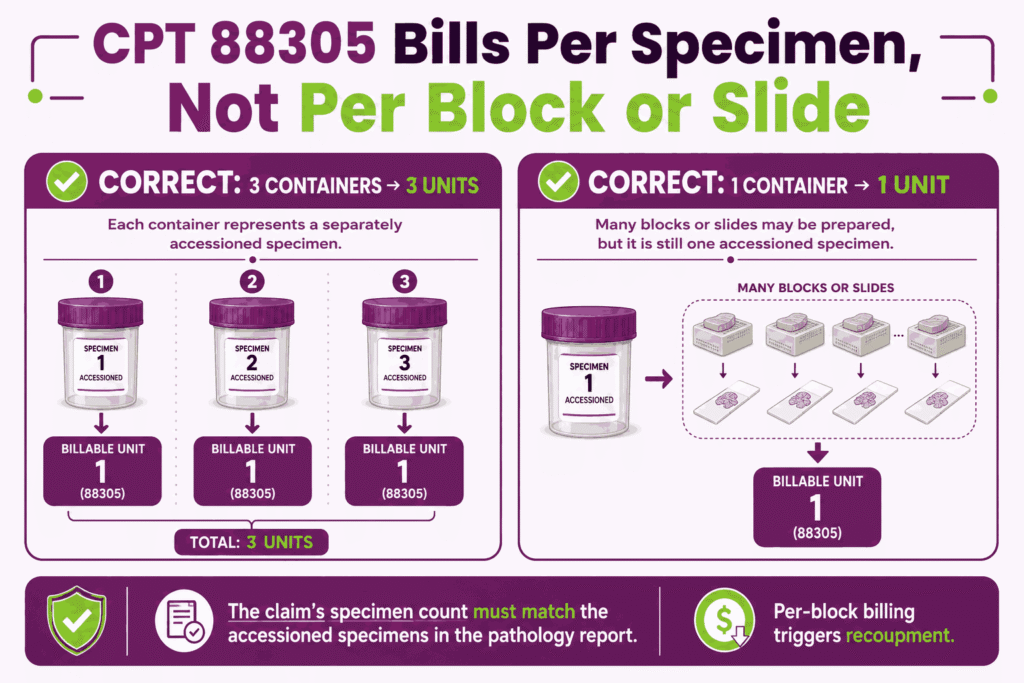
CPT 88305 is reported once for each separately accessioned specimen, not once per block or slide. A specimen is a single tissue source submitted in its own container with its own identification.
The per-specimen rule works as follows:
- Each distinct specimen container and site equals one unit of 88305
- Three separate skin biopsies submitted in three containers equal three units
- Multiple blocks or slides made from one specimen still equal one unit
- The pathology report must identify each specimen separately to support each unit
Blocks and slides are processing steps within one specimen, so they do not generate additional units. Reporting CPT code 88305 per block or slide overstates units and triggers recoupment. The specimen count on the claim must match the accessioned specimens in the pathology report.
How Does CPT Code 88305 Differ From CPT 88304, 88307, and 88309?
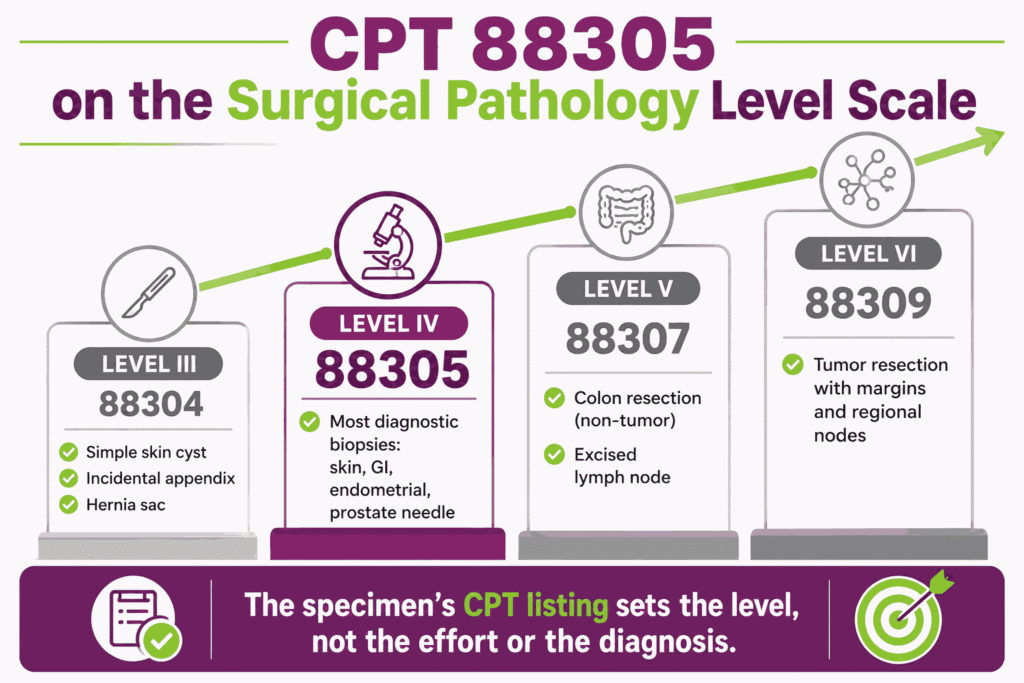
The four codes differ by specimen complexity, with each level tied to a specific CPT specimen list. Code selection follows the listed specimen, not the effort involved.
The Level III through Level VI codes break down like this:
- 88304 (Level III): lower-complexity specimens such as a simple skin cyst, an incidental appendix, or a hernia sac
- 88305 (Level IV): most diagnostic biopsies, including skin, gastrointestinal, endometrial, and prostate needle biopsies
- 88307 (Level V): more complex specimens such as a colon resection for non-tumor disease or a lymph node biopsy by excision
- 88309 (Level VI): the most complex resections, such as a tumor resection with margins and regional lymph nodes
Each specimen is coded at the single level that matches its CPT listing. Assigning a higher level than the specimen supports, such as billing 88307 when the specimen is a Level IV biopsy, produces downcoding or denial on review.
Why Medicare Requires G0416 Instead of CPT Code 88305 for Prostate Needle Biopsy
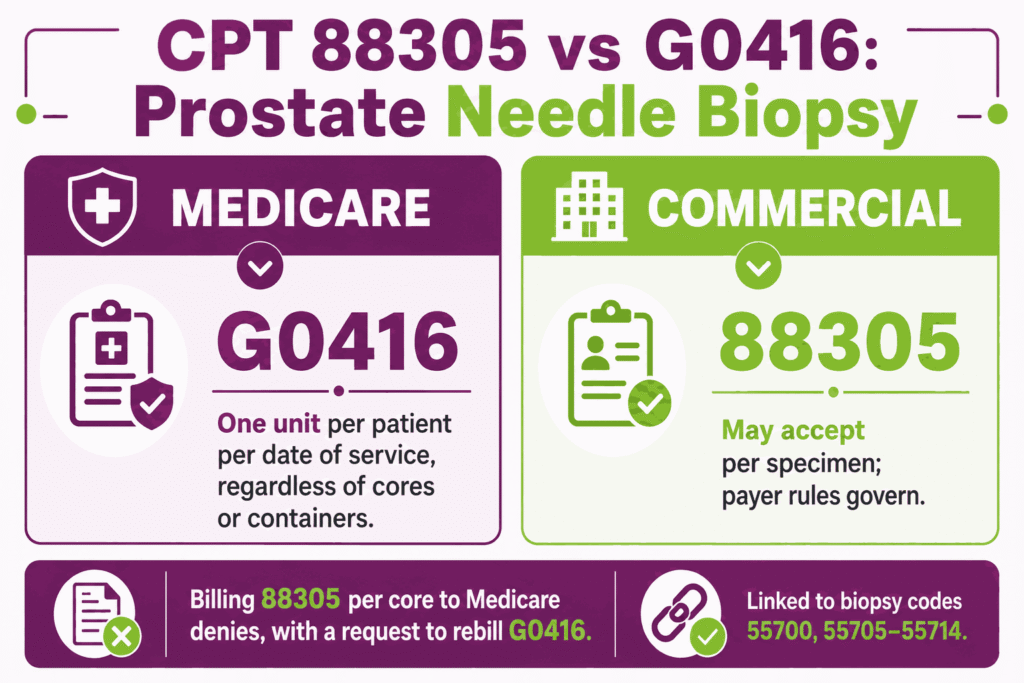
Medicare does not reimburse CPT code 88305 for prostate needle biopsy. Medicare requires HCPCS code G0416 for prostate needle biopsy specimens, regardless of the number of cores or containers submitted.
The G0416 rule has specific mechanics:
- G0416 reports surgical pathology for prostate needle biopsy by any method
- Medicare allows one unit of G0416 per patient per date of service, regardless of specimen count
- The biopsy is identified by prostate needle biopsy procedure codes such as 55700 and 55705 through 55714
- Commercial payers may still accept 88305 per specimen, so payer rules govern code choice
This substitution prevents per-core unit stacking under Medicare. Billing 88305 multiple times for a prostate needle biopsy on a Medicare claim leads to denial and a request to rebill with G0416.
Are Special Stains and Immunohistochemistry (88312/88313/88341/88342) Billed Separately From CPT Code 88305?
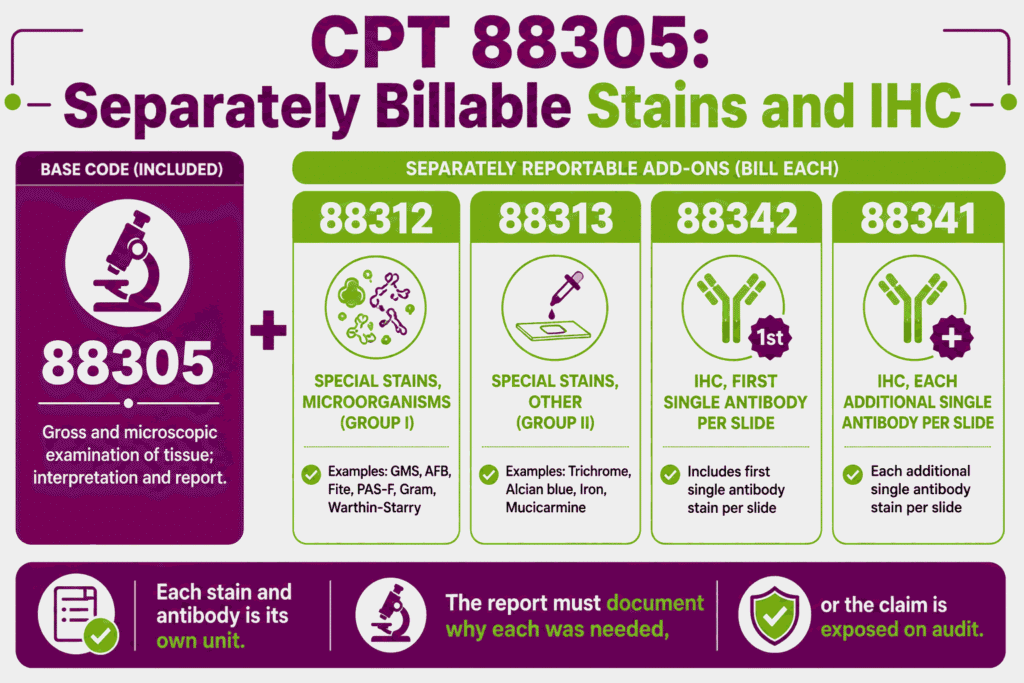
Yes, special stains and immunohistochemistry are separately reportable from CPT code 88305 when medically necessary. The base examination and the ancillary studies are distinct services with their own units.
The common ancillary codes are:
- 88312: special stains for microorganisms, group I
- 88313: special stains for other purposes, group II
- 88342: immunohistochemistry, first single antibody stain per slide
- 88341: immunohistochemistry, each additional single antibody stain per slide
Each stain or antibody is reported as its own unit under NCCI add-on rules. The pathology report must document why each stain was needed for diagnosis. Billing 88312 or 88342 without recorded medical necessity exposes the claim to denial and audit.
What ICD-10 Codes and Medical Necessity Criteria Support CPT Code 88305?
Medical necessity for CPT code 88305 rests on the diagnosis that prompted the biopsy and the clinical question the examination answers. The ordering diagnosis must support the specimen examined.
Representative supporting diagnoses include:
- Sign and symptom codes for a suspicious finding, such as R22.9 for a localized swelling or mass
- Neoplasm codes once a malignancy or benign tumor is identified, across the C and D code ranges
- Abnormal uterine bleeding codes such as N92.0 and N93.9 for an endometrial biopsy
- Screening codes such as Z12.11 for a colonoscopy that yields biopsy specimens
The pathology report and the ordering record together establish medical necessity. The specimen examination must be reasonable for diagnosis or treatment, and the diagnosis on the claim must match the specimen reported.
What are the Modifiers for CPT Code 88305?
CPT 88305 uses modifiers to show which component is billed and whether a specimen is distinct. The right modifier depends on who performed the technical and professional work.
Modifier 26: Professional Component Only
Modifier 26 reports the pathologist’s interpretation and report only, without the technical processing. Append modifier 26 to CPT code 88305 when the pathologist reads slides that another lab or hospital prepared. The record must show the professional work of microscopic analysis, diagnosis, and the signed report.
Modifier TC: Technical Component Only
Modifier TC reports the technical work only, such as accessioning, grossing, embedding, sectioning, and staining. The lab or hospital appends TC to 88305 when it prepares slides that a separate pathologist interprets. The TC claim covers laboratory work, not the interpretive service.
Modifier 59 / XS: Distinct Specimen or Separately Identifiable Service
Modifier 59, or the more specific XS, identifies a distinct specimen or separate anatomic site when an NCCI edit would otherwise bundle units. Append XS to additional units of CPT code 88305 when each specimen comes from a separate site or structure. Documentation must prove the specimens are separately accessioned and distinct.
Modifier 90: Reference (Outside) Laboratory
Modifier 90 identifies a service performed by an outside reference laboratory rather than the billing entity. Append modifier 90 to 88305 when the billing provider sends the specimen to an external lab that performs the examination. The modifier signals that an outside lab generated the result.
When Should CPT 88305 Be Billed Globally vs. With Modifier 26 or TC?
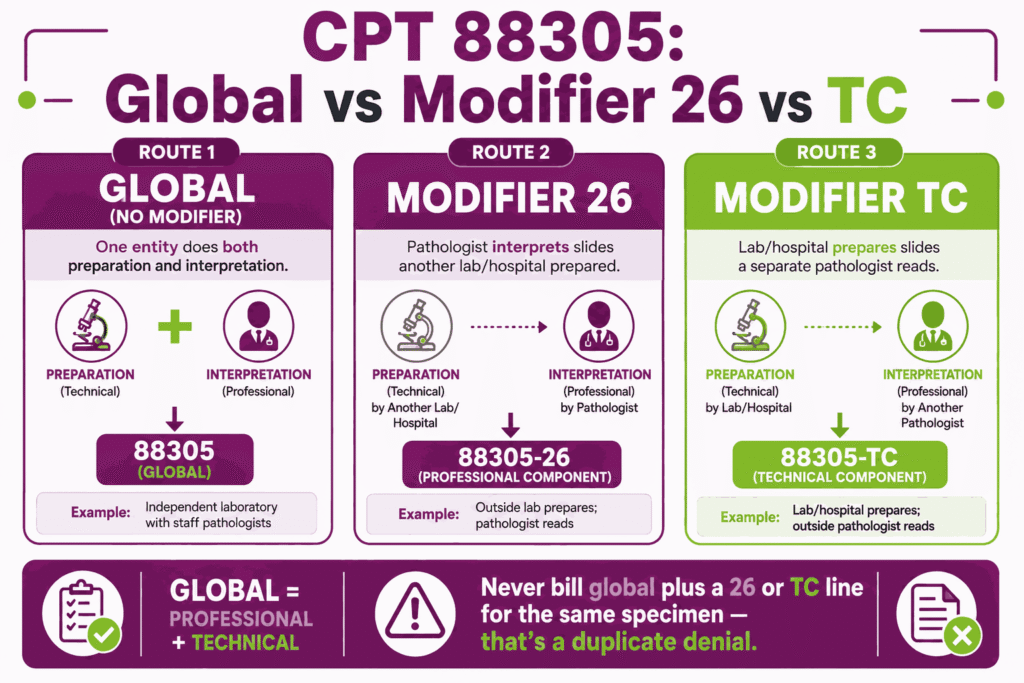
Bill CPT code 88305 globally when one entity performs both the technical processing and the professional interpretation. Split the code with modifier 26 or TC when two entities divide that work.
The billing options are:
- Global (no modifier): one entity owns both slide preparation and pathologist interpretation, such as an independent lab with staff pathologists
- Modifier 26: a pathologist interprets slides prepared by a separate hospital or lab
- Modifier TC: a lab or hospital prepares slides that a separate pathologist reads
- Never bill the global service plus a 26 or TC line for the same specimen by the same entity
The global payment equals the sum of the professional and technical components. Billing global and a component line together for one specimen creates a duplicate that payers deny.
What CLIA Certification Is Required to Bill the Technical Component of CPT Code 88305?
The technical component of CPT code 88305 requires the performing lab to hold a CLIA certificate for high-complexity testing. Surgical histopathology is classified as high-complexity under CLIA.
The CLIA requirements for the technical component are:
- The lab must hold a CLIA Certificate of Compliance or Certificate of Accreditation for high-complexity testing
- A valid CLIA certificate identification number must appear on the laboratory claim
- The provider may bill only the services the lab is CLIA-certified to perform
- Pass-through billing of lab work the entity is not certified to perform is prohibited by many payers
The professional component under modifier 26 reflects the pathologist’s interpretation and follows physician billing rules. The technical component under TC depends on the lab’s CLIA certification status.
Which Documents Are Required For CPT Code 88305?
Documentation for CPT code 88305 must connect the order, the specimen, the examination, and the final diagnosis. The record supports both the code level and the number of units billed.
The required documentation includes:
- A valid CLIA certificate number on laboratory and technical component claims
- Pathology requisition or order with the ordering provider name and NPI
- Operative or procedure note stating the specimens removed and the sites
- Specimen label and accession details, including source, laterality, and collection date
- Gross description and the block and slide inventory
- Microscopic description and final diagnosis with the pathologist signature and date
- Any special stain or immunohistochemistry orders and results referenced in the report
- For multiple specimens, proof of separate accession and distinct sites to support each unit
What is the Cost of CPT Code 88305?
The cost of CPT code 88305 depends on the payer, the component billed, and the lab setting. Medicare sets a national rate, while commercial allowed amounts run well above it.
RVUs & Medicare Payment
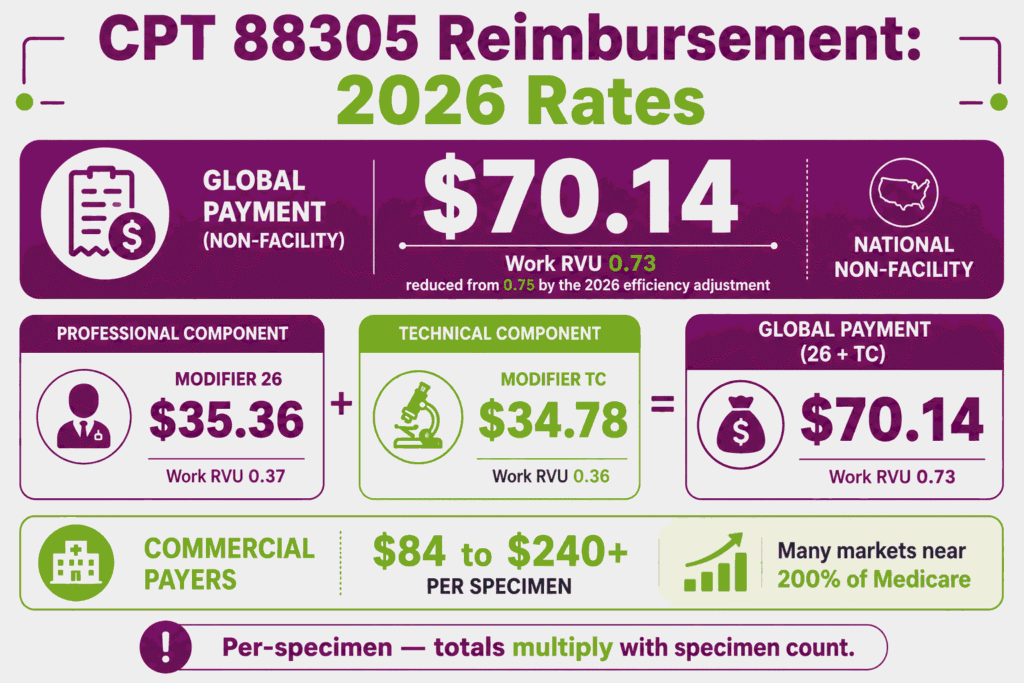
Medicare prices CPT code 88305 through the Physician Fee Schedule, splitting the global rate into professional and technical components. The CY 2026 values for the non-facility setting appear below.
| Component | Value (CY 2026) |
|---|---|
| Work RVU | 0.73 |
| Global Medicare payment | ~$70.14 |
| Professional component (modifier 26) | ~$35.36 |
| Technical component (modifier TC) | ~$34.78 |
| Conversion factor | $33.4009 |
| PC/TC indicator | 1 |
The 2026 efficiency adjustment lowered the work RVU from 0.75 to 0.73, which reduced payment for the same examination. GPCI adjustments change the final amount by locality. The global rate equals the professional component plus the technical component.
Commercial Payers
Commercial plans reimburse procedure code 88305 well above the Medicare rate. Reported negotiated amounts commonly run from roughly $84 to more than $240 per specimen, with many markets averaging near 200 percent of Medicare.
Because 88305 is billed per specimen, totals multiply quickly when several specimens are submitted. A session with four separate biopsies generates four units, so commercial reimbursement compounds across the specimen count. Contract rates vary widely, which makes fee schedule review worthwhile for high-volume pathology groups.
Place-of-Service & Lab Setting Differences
The lab setting determines which component is billed and how CPT code 88305 is reimbursed. The same code pays differently across independent labs, hospitals, and physician office labs.
Key setting differences include:
- Reference laboratory: the sending provider appends modifier 90 when an outside lab performs the work
- Independent laboratory: bills the global service or the technical component, depending on who interprets
- Hospital outpatient: the technical component is packaged into the OPPS payment for the encounter
- Physician office laboratory: bills the global service when it prepares and interprets in-house
What Are Example Clinical Scenarios or Use Cases for CPT Code 88305?
CPT code 88305 applies whenever a Level IV specimen receives gross and microscopic examination. The scenarios below show common reporting and unit patterns.
Scenario 1: Skin Biopsy for a Suspected Malignant Lesion
ICD-10: D48.5 (Neoplasm of uncertain behavior of skin)
A dermatologist performs a punch biopsy of a single suspicious skin lesion and submits one specimen. The pathologist performs gross and microscopic examination and issues a diagnosis. The practice reports CPT code 88305 as one unit for the single accessioned specimen. The level holds whether the result is benign or malignant, since the specimen type sets the code.
Scenario 2: Multiple Distinct GI Biopsies During Endoscopy With Separate Specimen Billing
ICD-10: Z12.11 (Encounter for screening for malignant neoplasm of colon)
During a colonoscopy, the gastroenterologist takes biopsies from three separate colon sites and submits them in three labeled containers. The pathologist examines each specimen separately. The practice reports CPT 88305 three times, appending modifier XS to the additional units to show distinct sites. The pathology report documents each specimen by site to support all three units.
Scenario 3: Endometrial Biopsy for Abnormal Uterine Bleeding
ICD-10: N93.9 (Abnormal uterine and vaginal bleeding, unspecified)
A gynecologist performs an endometrial biopsy for a patient with abnormal uterine bleeding and submits one specimen. The pathologist completes gross and microscopic examination and reports the findings. The practice bills CPT code 88305 as one unit. The abnormal uterine bleeding diagnosis supports the medical necessity of the specimen examination.
Scenario 4: Prostate Needle Biopsy and the Medicare G0416 Substitution
ICD-10: R97.20 (Elevated prostate specific antigen)
A urologist performs a transrectal prostate needle biopsy and submits multiple cores in several containers. For a Medicare patient, the lab reports G0416 as one unit for the prostate needle biopsy, not 88305 per core. The elevated PSA diagnosis supports the biopsy. A commercial payer may instead accept 88305 per specimen, so the payer rules determine the code.
What Are the CPT Code 88305 Rules To Ensure Successful Reimbursement?
Follow correct specimen-level coding, clear pathology reporting, and payer/NCCI guidance to ensure payment for CPT code 88305. Understanding the CPT codes meaning and usage helps providers report procedures accurately and secure proper reimbursement from insurance payers.
Bundling / NCCI / Same-Specimen Procedure Rules
NCCI rules govern what can be billed alongside CPT code 88305 for the same specimen. The code already includes both gross and microscopic examination, so component services are not billed separately.
The core bundling rules are:
- Do not bill 88300 for a gross-only examination of the same specimen reported with 88305
- Do not report more than one pathology level for a single specimen
- Special stains and immunohistochemistry remain separately reportable with documented necessity
- Check current NCCI edit pairs before submitting 88305 with other pathology codes
Units, MUEs & Per-Specimen Billing Limits
CPT code 88305 is billed one unit per separately accessioned specimen, so multiple units require multiple distinct specimens. Additional units beyond the per-specimen count require distinct-site documentation and modifier XS.
Unit and limit rules include:
- One unit per separately accessioned specimen, supported by the pathology report
- Daily unit caps vary by payer, with commercial examples near 8 units for general cases and up to 16 for prostate-related diagnoses
- Medicare substitutes G0416 for prostate needle biopsy rather than multiple 88305 units
- Confirm the per-date unit limit with each payer, since MUE values and payer caps differ
Why Specimen-Level Coding Errors (88304 vs. 88305 vs. 88307) Drive Denials and Downcoding
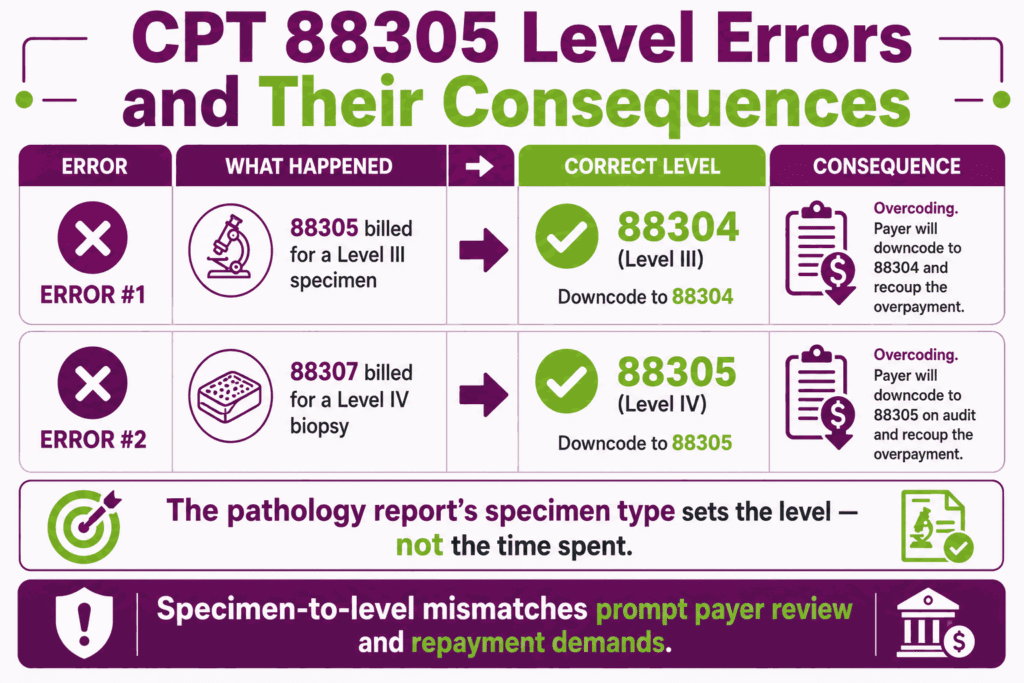
Specimen-level errors are a leading cause of denial and downcoding for CPT code 88305. Assigning a level that the specimen does not support invites payer review and recoupment.
Common level errors and their effect:
- Coding 88305 for a specimen that CPT lists at Level III invites a downcode to 88304
- Coding 88307 for a Level IV biopsy triggers downcoding to 88305 on audit
- The pathology report specimen type, not the time spent, determines the correct level
- Mismatches between the specimen and the billed level prompt payer review and repayment demands
Date-of-Service Rules for Hospital Outpatient Technical Component Billing
Under 42 CFR 414.510, the date of service for the technical component of CPT code 88305 is the date the specimen was collected. When collection spans two calendar days, the date of service is the date collection ended.
The date-of-service rules carry these effects:
- When the date of service is the collection date, the technical component is a hospital outpatient service the hospital bills, and the performing lab seeks payment from the hospital
- The 14-day rule and stored-specimen exception move the date of service to the date the test was performed only when specific conditions are met
- Molecular pathology tests and advanced diagnostic laboratory tests follow a separate date-of-service exception
- Delaying or holding orders to unbundle a test from the hospital encounter creates False Claims Act exposure
Top Reasons For Denials Specific To 88305 & Quick Remedies
- 88305 Billed to Medicare for Prostate Needle Biopsy: Prevent by reporting G0416 as one unit for Medicare prostate needle biopsy. Reserve per-specimen 88305 units for payers that accept the code.
- Multiple Units Without Distinct-Specimen Documentation: Prevent by appending modifier XS and documenting each separate site and accession in the pathology report.
- Wrong Level Selected (88304 or 88307 Instead of 88305): Prevent by coding strictly to the CPT specimen list and matching the level to the specimen type in the report.
- Global Billed When Only One Component Was Performed: Prevent by appending modifier 26 for interpretation only or TC for technical work only, so the claim matches the work done.