Nutrition billing is the process of translating clinical nutrition services into standardized medical codes, submitting claims to payers, and collecting reimbursements for those services. It covers Medical Nutrition Therapy (MNT), preventive counseling, obesity management, and disease-specific dietary interventions delivered by Registered Dietitian Nutritionists (RDNs) and qualified nutrition professionals.
Nutrition services are billed using CPT codes 97802, 97803, and 97804, along with HCPCS codes G0270 and G0271 for Medicare patients. Each code represents a specific session type, duration, and provider credential requirement. The primary payers include Medicare Part B, Medicaid, and private commercial insurers, each with distinct coverage rules.
Transcure’s nutrition billing services cover the full revenue cycle for dietitian practices and integrated care settings, from eligibility verification through claim submission, denial management, and payment posting. This guide covers the nutrition billing process, CPT and ICD-10 code sets, payer-specific rules, common denial causes, and best practices for compliant reimbursement.

How Does Nutrition Billing Differ from Other Medical Billing Specialties?
Nutrition billing operates under a distinct credentialing and coding framework not found in most other specialties. Only Registered Dietitian Nutritionists (RDNs) or qualified nutrition professionals credentialed by CMS can bill MNT codes 97802 through 97804. These codes cannot be billed by physicians or submitted as incident-to services under a supervising physician’s NPI.
Four structural differences separate nutrition billing from conventional medical billing:
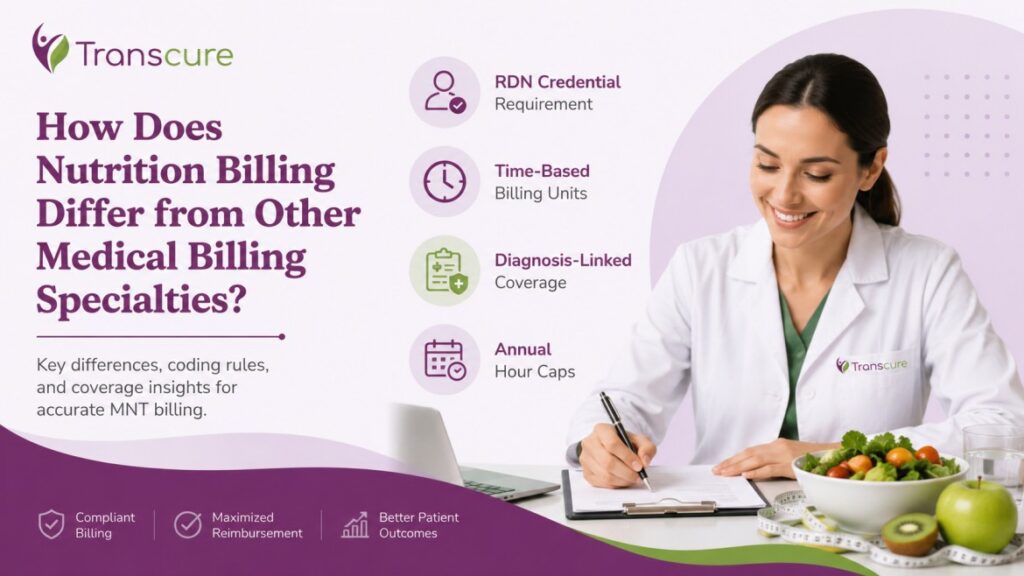
- Provider Credential Restriction: MNT codes require the RDN’s own National Provider Identifier (NPI). Physicians cannot bill 97802 or 97803 for services they did not personally deliver.
- Time-based Billing Units: Each CPT unit equals 15 minutes for individual sessions and 30 minutes for group sessions. Billing 30 minutes as one session of 97802 is non-compliant; it requires two units.
- Diagnosis-linked Coverage: Medicare covers MNT only for patients with Type 1 or Type 2 diabetes, non-dialysis chronic kidney disease (CKD with GFR under 50 mL/min), or kidney transplant within the preceding 36 months.
- Annual Hour Caps: Medicare limits MNT to 3 hours in the initial benefit year and 2 hours in subsequent years, with additional hours available only when a physician documents a change in diagnosis or treatment plan.
Private commercial insurers often expand coverage beyond Medicare’s disease-limited criteria. Many cover preventive nutrition counseling for obesity (BMI 30 or above), hyperlipidemia, hypertension, and eating disorders. Coverage terms vary by plan and state, making eligibility verification a mandatory step before every session.
How Nutrition Billing Differs from Diabetes Self-Management Training (DSMT)?
Medical Nutrition Therapy and Diabetes Self-Management Training (DSMT) are related but separately billed services. MNT focuses on individualized nutrition assessment and dietary intervention. DSMT covers broader diabetes self-management education, including blood glucose monitoring, foot care, and medication adherence.
Medicare does not reimburse both MNT and DSMT on the same date of service. Billers must track session types and dates to prevent co-billing errors that trigger automatic denials. When a patient receives both services in the same week, the two sessions must be documented on separate encounter forms with distinct diagnoses or clinical objectives noted.
What Are the Primary CPT Codes Used in Nutrition Billing?
Nutrition billing uses four core CPT codes and two HCPCS G-codes for Medicare patients. The table below provides a structured reference covering code numbers, session types, duration requirements, and billing scope.
| Code | Description | Session Type | Time Unit | Who Can Bill |
|---|---|---|---|---|
| 97802 | MNT, initial assessment and intervention | Individual | Each 15 min | RDN / qualified nutrition professional |
| 97803 | MNT, reassessment and subsequent intervention | Individual | Each 15 min | RDN / qualified nutrition professional |
| 97804 | MNT, group session (2 or more patients) | Group | Each 30 min | RDN / qualified nutrition professional |
| G0270 | MNT reassessment after second referral, individual | Individual | Each 15 min | RDN (Medicare patients only) |
| G0271 | MNT reassessment after second referral, group | Group | Each 30 min | RDN (Medicare patients only) |
| S9470 | Nutrition counseling, per session (non-MNT) | Individual | Per session | RDN / nutritionist (commercial plans) |
CPT 97802 is billed once per patient for the initial assessment. All follow-up individual sessions use 97803. The CMS National Correct Coding Initiative (NCCI) allows only one MNT code per date of service; modifiers cannot override this bundling rule.
Unit Calculation Rules for MNT Codes
Accurate unit calculation prevents underbilling and protects against audit exposure. The rule is straightforward: one unit of 97802 or 97803 equals 15 minutes of face-to-face time. A 45-minute initial session requires 3 units of 97802, not 1. A 30-minute group session billed under 97804 equals 1 unit.
- 97802 / 97803 individual sessions: 1 unit = 15 minutes (e.g., 60-minute session = 4 units)
- 97804 / G0271 group sessions: 1 unit = 30 minutes (e.g., 2-hour group = 4 units)
- G0270 individual reassessment: 1 unit = 15 minutes, billed only after a second physician referral within the same calendar year
Billing a session duration that does not match documented contact time is a leading cause of audit findings in nutrition practices. EHR timestamps or timed session notes are the clearest defense against time-mismatch denials.
What Are the Common ICD-10 Codes Used in Nutrition Billing?
ICD-10 diagnosis codes justify the medical necessity of nutrition services on every claim. Registered dietitians cannot independently diagnose medical conditions, so diagnosis codes must be drawn from a physician referral or an existing patient record. The table below lists the most frequently used ICD-10 codes in nutrition billing by category.
| ICD-10 Code | Description | Common Use Case |
|---|---|---|
| Z71.3 | Dietary counseling and surveillance | Preventive counseling for healthy patients, no specific diagnosis |
| E11.9 | Type 2 diabetes mellitus, without complications | MNT for diabetic patients (Medicare-covered diagnosis) |
| E10.9 | Type 1 diabetes mellitus, without complications | MNT for Type 1 diabetes (Medicare-covered diagnosis) |
| N18.3 | Chronic kidney disease, stage 3 | MNT for non-dialysis CKD (Medicare-covered diagnosis) |
| N18.4 | Chronic kidney disease, stage 4 | MNT for advanced CKD, pre-dialysis |
| E66.01 | Morbid (severe) obesity due to excess calories | Obesity management counseling (commercial plans, G0447) |
| E66.9 | Obesity, unspecified | General obesity counseling, behavioral interventions |
| E78.5 | Hyperlipidemia, unspecified | Dietary intervention for elevated cholesterol or triglycerides |
| I10 | Essential (primary) hypertension | Dietary sodium and weight management counseling |
| E46 | Unspecified protein-calorie malnutrition | Nutritional support assessment in hospital or long-term care |
Z codes such as Z71.3 do not require physician documentation because they are not diagnostic codes. They represent factors influencing health status and are appropriate when no active medical condition is being treated. For commercial preventive plans, Z71.3 is often required as the primary code for coverage to apply.
ICD-10 Coding for Obesity and BMI
Obesity claims require 2 ICD-10 codes on the CMS-1500 form: one for the obesity type and one for the patient’s BMI. BMI codes fall in the Z68 range and must be documented by clinical staff as part of the patient’s vital signs, not assumed from the patient’s self-report.
- E66.01 – Morbid obesity (BMI 40.0 or above, or BMI 35.0 with comorbidity)
- E66.9 – Obesity, unspecified (BMI 30.0 to 34.9)
- Z68.35 – BMI 35.0 to 35.9, adult
- Z68.41 – BMI 40.0 to 44.9, adult
Submitting an obesity code without the matching BMI code, or selecting the wrong BMI tier, produces coding mismatches that payers flag during adjudication. Both codes must appear together on every obesity-related claim.
How Does the Nutrition Billing Process Work Step by Step?
The nutrition billing cycle runs from initial patient contact through final payment reconciliation. Each step carries specific compliance requirements that, if skipped, produce downstream denials. The following workflow applies to dietitian practices, hospital outpatient nutrition departments, and integrated primary care settings.
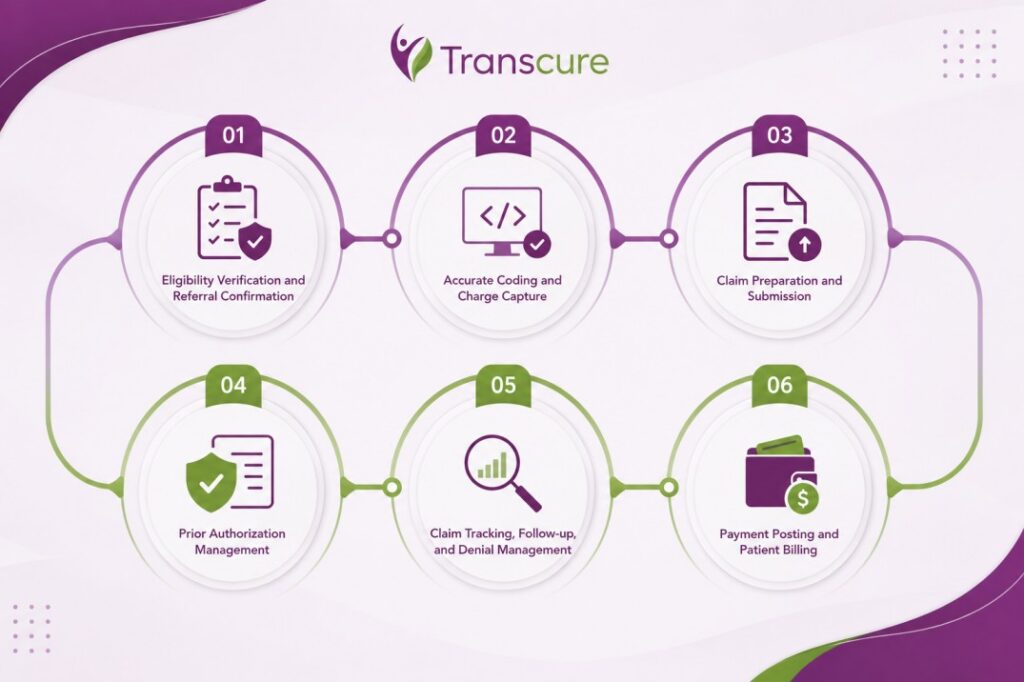
Step 1: Eligibility Verification and Referral Confirmation
Before the first session, verify the patient’s active insurance coverage for nutrition or MNT services. Confirm whether the plan requires a physician referral, what diagnoses qualify for coverage, how many sessions or hours are covered annually, and whether prior authorization is required.
For Medicare patients, confirm the presence of a qualifying diagnosis (diabetes, non-dialysis CKD, or post-kidney-transplant status within 36 months). A referral from the patient’s physician must be on file before 97802 is billed. Seeing the patient without a confirmed referral and a qualifying diagnosis results in a non-covered service denial.
Step 2: Accurate Coding and Charge Capture
After each session, assign the correct CPT code based on session type (initial vs. follow-up) and actual contact time. Calculate units by dividing documented session minutes by 15 for individual sessions or 30 for group sessions. Never round up session time to reach the next billing unit.
Pair every CPT code with the appropriate ICD-10 diagnosis code drawn from the physician’s referral. For group sessions under 97804, document the number of patients present, the session topic, and the total session duration. Payers audit group session claims frequently for attendee counts and provider involvement evidence.
Step 3: Claim Preparation and Submission
Complete the CMS-1500 claim form with the patient’s demographic data, the RDN’s individual NPI (not the practice’s group NPI alone), the referring physician’s NPI, the date of service, and all procedure and diagnosis codes. Attach supporting documentation for any session requiring clinical context, such as an elevated A1C result for a diabetes MNT claim.
- Box 17: Enter the referring physician’s name and NPI for Medicare MNT claims
- Box 21: List up to 12 ICD-10 codes; enter the most specific diagnosis code first
- Box 24D: Enter the CPT code and the correct number of units
- Box 31: Use the RDN’s individual NPI, not incident-to billing under a physician
Electronic claim submission through a clearinghouse is the standard for commercial plans. Most clearinghouses run real-time eligibility and coding checks that catch common errors before a claim reaches the payer.
Step 4: Prior Authorization Management
Several private plans require prior authorization for MNT, particularly for obesity counseling under HCPCS G0447 or for plans that cap sessions annually. Submit the authorization request with the physician’s referral, the patient’s qualifying diagnosis, and the proposed treatment plan including session frequency and duration goals.
Track authorization numbers alongside each patient’s billing record. Submitting a claim after an authorization has expired or for more sessions than the authorized quantity produces automatic denials that require appeals, not just resubmissions.
Step 5: Claim Tracking, Follow-up, and Denial Management
Monitor claim status through your practice management system or payer portals at defined intervals after submission. The most common denial categories in nutrition billing and their root causes are listed below.
| Denial Reason | Root Cause | Corrective Action |
|---|---|---|
| Non-covered diagnosis | Diagnosis not in payer’s MNT coverage list | Verify covered diagnoses before session; request medical necessity review |
| Missing physician referral | Referral absent or expired on file | Obtain signed referral before claim submission; track referral expiry dates |
| Incident-to billing error | Claim submitted under physician NPI for RDN services | Resubmit using the RDN’s individual NPI |
| Annual hour limit exceeded | More than 3 hours (initial year) or 2 hours (subsequent years) billed under Medicare | Track cumulative hours per patient per year; obtain additional referral with medical change documentation |
| MNT and DSMT on same date | Both services billed on the same date of service | Reschedule sessions on separate dates; verify no same-day overlap in billing system |
| Time-unit mismatch | Documented session time does not match billed units | Use EHR timers; document start and end time in session notes |
When a denial is received, review the Remittance Advice (RA) code to identify the specific reason. Most correctable denials require a corrected claim submission, not a formal appeal. Formal appeals are necessary when the payer disputes medical necessity or applies a blanket non-covered service determination.
Step 6: Payment Posting and Patient Billing
Post insurance payments against each patient ledger entry and calculate any remaining patient responsibility from the Explanation of Benefits (EOB). Compare the paid amount against the contracted fee schedule. If a payer pays below the contracted rate for an MNT service, submit a billing dispute with the contract reference.
Patient statements for nutrition services should itemize each session date, CPT code, billed amount, insurance payment, and balance due. Clear statements reduce patient billing inquiries and improve collection rates on patient-responsibility balances.
What Are the Medicare Guidelines for Nutrition Billing?
Medicare Part B covers MNT under a specific benefit established by the Medicare Improvements for Patients and Providers Act. Coverage applies to 3 qualifying conditions: Type 1 diabetes, Type 2 diabetes, and non-dialysis chronic kidney disease (CKD with GFR below 50 mL/min per 1.73 m²), plus kidney transplant within the preceding 36 months.
Medicare MNT Annual Hour Limits
Medicare structures MNT coverage across two benefit periods based on the patient’s enrollment year:
- Initial benefit year: 3 hours of individual MNT (12 units of 97802/97803) are covered
- Subsequent years: 2 hours per year are covered under 97803 (not 97802, which is initial-assessment only)
- Additional hours: Available only when a physician documents a change in diagnosis, medical condition, or treatment regimen, billed using G0270 or G0271
Medicare does not cover MNT separately for patients receiving maintenance dialysis. Monthly dialysis management codes 90951 through 90962 include MNT components, so submitting a separate 97802 or 97803 claim during a dialysis management month results in automatic denial.
Telehealth MNT Under Medicare
Medicare allows MNT to be delivered via telehealth using the same CPT codes (97802, 97803) and G-codes (G0270, G0271) that apply to in-person sessions. Place of Service (POS) code 02 (telehealth, patient is not at home) or POS code 10 (telehealth, patient is at home) is required on the CMS-1500 form to indicate the telehealth modality. Standard documentation requirements for session duration, patient identification, and clinical content apply identically to telehealth sessions.
What Are the Best Practices for Compliant Nutrition Billing?
Compliant nutrition billing depends on four operational disciplines: credential verification, documentation precision, session time accuracy, and denial pattern analysis. Practices that apply all four disciplines consistently reduce claim denial rates and lower audit exposure.
Credential and Enrollment Verification
Confirm that every RDN who will bill MNT codes is actively enrolled with each target payer using their individual NPI. Payer enrollment for dietitians is separate from physician enrollment. An RDN who sees patients but is not enrolled with the payer cannot receive direct reimbursement, and incident-to billing under a physician’s NPI for MNT-specific codes is a compliance violation.
Documentation Requirements Per Session
Each billed MNT session requires documentation that covers 5 elements:
- Session start time and end time (to support unit calculation)
- Referring physician’s name and the qualifying diagnosis
- Nutrition assessment findings or reassessment notes (changes from prior session)
- Specific nutrition goals set or revised during the session
- Patient education topics covered and patient response
Vague documentation such as “patient counseled on diet” without a time stamp, goals, or clinical findings is the single most common cause of MNT claim denials on post-payment audit. Structured session note templates built into the EHR reduce this risk significantly.
Annual Internal Audits
Conduct a quarterly internal audit of 20 to 30 randomly selected nutrition claims. Check each claim for correct code assignment, accurate unit count, diagnosis code specificity, and referral presence. Identify recurring denial patterns by payer. Practices that audit regularly identify systematic errors before they accumulate into large overpayment exposure during payer audits.
What Are the Common Mistakes in Nutrition Billing?
Seven coding and billing errors account for the majority of denied nutrition claims:
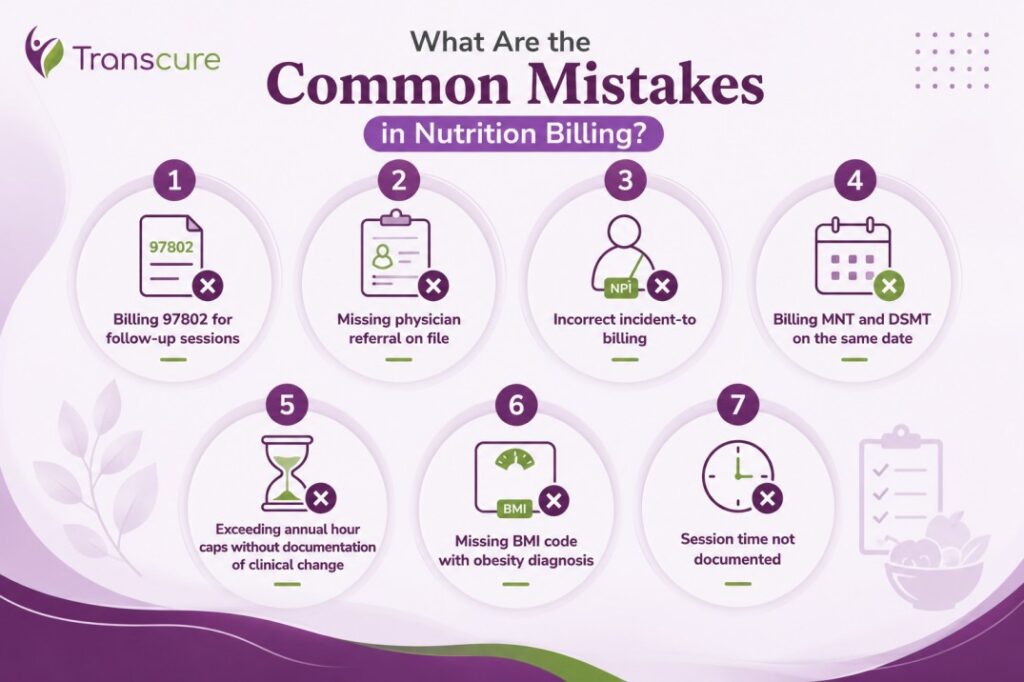
- Billing 97802 for follow-up sessions: CPT 97802 is for initial assessments only; all follow-up individual sessions use 97803
- Missing physician referral on file: Medicare requires a signed referral before MNT services begin; retroactive referrals are not accepted
- Incorrect incident-to billing: RDN services cannot be billed under a physician’s NPI as incident-to; each RDN must use their own NPI
- Billing MNT and DSMT on the same date: Medicare denies both services when billed for the same date of service
- Exceeding annual hour caps without documentation of clinical change: Additional hours require a new physician referral with documentation of a change in diagnosis or treatment plan
- Missing BMI code with obesity diagnosis: Obesity ICD-10 codes (E66 range) must be paired with the corresponding BMI Z68 code on the claim
- Session time not documented: Undocumented session duration leaves the practice unable to defend the number of billed units during an audit
How Does Nutrition Billing Relate to Patient Health Outcomes?
Accurate nutrition billing directly determines whether patients can access consistent MNT services. When claims are denied due to coding errors or missing referrals, practices reduce session frequency or ask patients to pay out of pocket. This interrupts therapeutic continuity for patients managing diabetes, CKD, and obesity, conditions where consistent dietary intervention produces measurable clinical outcomes.
Research across MNT outcome studies shows that consistent MNT for Type 2 diabetes patients reduces HbA1c by 1 to 2 percentage points over 6 months. For pre-dialysis CKD patients, structured dietary protein and phosphorus management slows GFR decline. These outcomes depend on session continuity, which depends on correct billing and consistent reimbursement.
Nutrition practices working with chronic disease populations often monitor patients’ energy balance and activity data as part of treatment planning. TDEE Calculator Kit provides a free Total Daily Energy Expenditure calculator that dietitians and patients can use to track caloric needs and energy targets between sessions, supporting the dietary goals set during MNT visits.
For patients whose MNT goals include activity-based caloric adjustments, the calories burned calculator measures energy expenditure across exercise types, which RDNs can incorporate into individualized meal plans and document as part of the therapeutic nutrition plan on file with the payer.
Frequently Asked Questions About Nutrition Billing
Can a Physician Bill CPT 97802 for Nutrition Counseling?
No, CPT codes 97802, 97803, and 97804 are designated for Registered Dietitian Nutritionists and other qualified nutrition professionals. Physicians who provide nutrition counseling to patients who are not obese or do not qualify for MNT codes use preventive counseling codes 99401 through 99404 for individual sessions or 99411 through 99412 for group sessions. These are separate code families with different documentation requirements.
Does Medicare Cover Nutrition Counseling for Obesity?
Medicare covers behavioral counseling for obesity separately from MNT under HCPCS code G0447, a 15-minute session billable by primary care physicians or their staff. G0447 is not an MNT code and does not require an RDN. For MNT-specific obesity counseling by an RDN, coverage depends on the commercial plan; Medicare Part B does not cover MNT for obesity in the same way it covers MNT for diabetes and CKD.
What Happens If an RDN Is Not Enrolled with a Payer?
Claims submitted by an unenrolled provider are denied as non-covered. The RDN must apply for payer enrollment using their individual NPI before seeing any insured patients under that plan. Enrollment timelines range from 30 to 90 days depending on the payer. Practices should initiate enrollment applications at least 60 days before the first anticipated patient visit under a new payer contract.
Can Nutrition Billing Be Submitted via Telehealth?
Yes. Both Medicare and most commercial payers allow MNT to be delivered and billed via telehealth. The same CPT codes (97802, 97803, 97804) and HCPCS G-codes apply. The claim must include the correct Place of Service code: POS 02 for telehealth where the patient is not at home, or POS 10 for telehealth where the patient is at home. Some payers also require a telehealth modifier on the procedure line.
What Is the Difference Between CPT 97803 and G0270?
Both codes cover reassessment and intervention for individual MNT patients. CPT 97803 applies to all patients in all plan types. HCPCS G0270 applies only to Medicare patients who have received a second physician referral within the same calendar year due to a documented change in diagnosis, medical condition, or treatment regimen. G0270 is used when a Medicare patient has exhausted their standard annual hour allotment and requires additional MNT based on clinical change.