
| Quick Facts — CPT 45378 | |
|---|---|
| CPT Code | 45378 |
| Short Descriptor | Colonoscopy, flexible; diagnostic, including collection of specimen(s) by brushing or washing, when performed |
| Typical Place of Service | Office, ASC, Hospital Outpatient, SNF |
| Global Period | 0 Days |
| Specialty | Gastroenterology, Internal Medicine, Colorectal Surgery |
| PC/TC Split | No (physician service only) |
| wRVU / Total RVU | ~3.69 wRVU / ~6.25 Non-Facility / ~4.01 Facility |
| Common Modifiers | 33, 52, 53, 59, PT, XS, GZ, GA |
| MUE / Usual Unit Limit | 1 unit per date of service |
| Medicare Frequency Limit | Once every 10 years (average risk screening), as medically necessary for diagnostic purposes |
| Typical Medicare Payment | ~$225–$280 Non-Facility / ~$155–$200 Facility |
Colonoscopy is one of the most frequently performed procedures across gastroenterology practices in the United States, and CPT code 45378 sits at the center of how those procedures get billed and paid. Whether a gastroenterologist sees twenty patients a week or a hundred, this code appears on claims constantly. Yet despite how common it is, billing errors tied to 45378 remain a persistent problem for GI practices, contributing to delayed reimbursements, claim denials, and compliance exposure that could have been avoided with a clearer understanding of the rules.
This guide covers everything you need to know about CPT 45378, including the official code description, what the procedure includes and excludes, and how reimbursement works under Medicare and commercial payers.
It explains which modifiers apply, when they should be used, and how to manage common clinical scenarios without creating bundling issues.
The guide also outlines documentation requirements that support accurate claims and withstand payer audits.
For practices using outsourced Gastroenterology billing services, these insights help ensure claims accurately reflect the services performed in the procedure suite, reducing denials, improving compliance, and supporting proper reimbursement.
What CPT Code 45378 Actually Describes?
The American Medical Association defines CPT code 45378 as: “Colonoscopy, flexible; diagnostic, including collection of specimen(s) by brushing or washing, when performed (separate procedure).”
Breaking that down into practical terms, 45378 applies when a physician performs a complete examination of the colon using a flexible scope, advancing from the rectum to the cecum, and does not perform any therapeutic intervention during that session. The code covers visual inspection of the entire colon and allows for minor specimen collection through brushing or washing as part of the base procedure.
What it does not cover is anything beyond that level of activity. If the physician takes a biopsy using forceps, removes a polyp using a snare, ablates a lesion, or performs any other treatment during the same session, a different CPT code must replace 45378 entirely.
CPT 45378 is the base code for colonoscopy, which means therapeutic codes supersede it. You do not report 45378 alongside a biopsy code or a polypectomy code. You replace it. Practices that bill 45378 in addition to therapeutic codes on the same claim will face NCCI bundling edits and automatic denials.
What Does the Procedure Involve Clinically?
Understanding what happens during a 45378 encounter helps coders and billers apply the code correctly, especially when operative notes are ambiguous or incomplete.
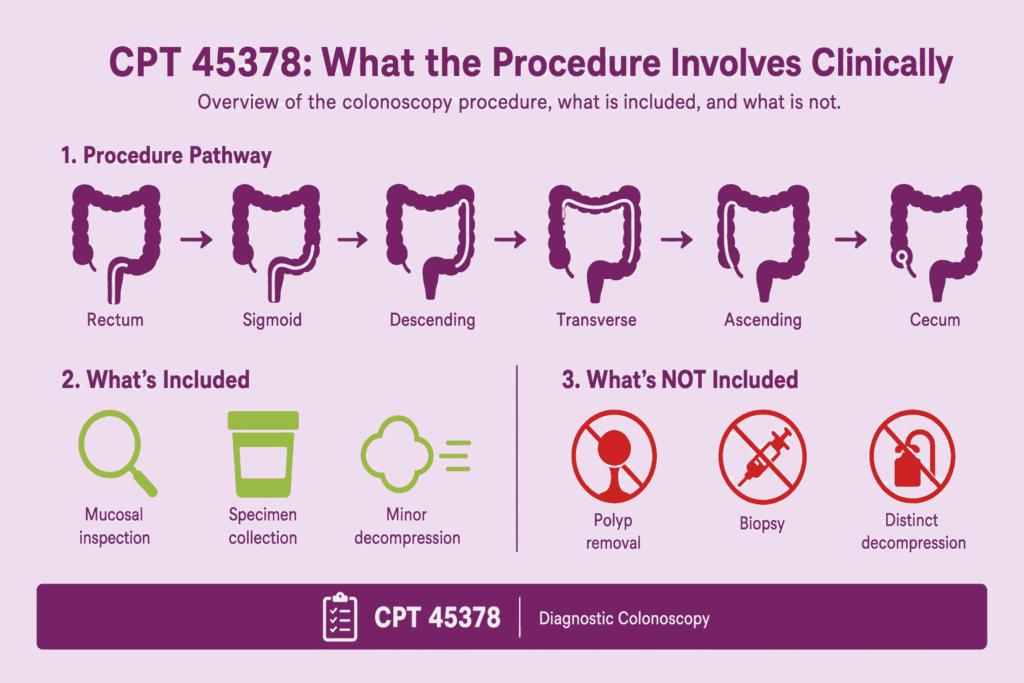
The physician inserts a flexible endoscope through the rectum and advances it through the sigmoid colon, descending colon, transverse colon, and ascending colon until reaching the cecum. Reaching the cecum is a required element of a complete colonoscopy. If the scope does not reach the cecum, the procedure is considered incomplete, and modifier use changes accordingly (discussed in a later section).
During the examination, the physician inspects the mucosal lining of the colon for abnormalities, including polyps, lesions, areas of inflammation, diverticula, and signs of bleeding. Minor decompression of the colon may occur during the procedure, and this is included in the base code unless it rises to the level of a distinct decompression procedure (CPT 45393). Specimen collection through brushing or washing is also included in 45378 when performed, meaning it does not require a separate code.
If the physician reaches the cecum, visualizes the colon thoroughly, finds no polyps or lesions requiring intervention, and takes no biopsy, the encounter codes to 45378 and nothing else.
How CPT 45378 Relates to Other Colonoscopy Codes
The CPT colonoscopy family runs from 45378 through 45398 and covers a range of procedures from basic diagnostic inspection to complex therapeutic interventions. Understanding where 45378 sits in that range prevents the most common coding errors GI practices face.
- CPT 45378 is the diagnostic base code. It covers inspection with no therapeutic action.
- CPT 45380 covers colonoscopy with biopsy using cold or hot forceps. When a physician takes a tissue sample from a lesion, 45380 replaces 45378. You cannot report both codes for the same session.
- CPT 45384 applies when a physician removes a polyp using bipolar cautery forceps, a technique distinct from snare polypectomy.
- CPT 45385 covers colonoscopy with removal of a polyp or lesion using a snare technique. This code supersedes both 45378 and 45380 when snare polypectomy occurs on the same lesion.
- CPT 45388 describes colonoscopy with ablation of a lesion using laser or argon plasma coagulation (APC).
- CPT 45386 covers a colonoscopy with dilation of a stricture.
- CPT 45398 applies when the physician performs band ligation, such as banding of internal hemorrhoids.
Each of these therapeutic codes inherits the base colonoscopy work and builds upon it. When any therapeutic procedure is performed during a colonoscopy session, the appropriate therapeutic code replaces 45378 as the primary code. The NCCI (National Correct Coding Initiative) bundles 45378 into every therapeutic colonoscopy code, which means submitting 45378 alongside a therapeutic code for the same session will result in automatic denial of one of the codes.
The exception that trips up many billing teams involves multiple procedures during a single session. When a physician biopsies a lesion in one part of the colon and removes a separate polyp in a different location using a snare, both procedures may be billable, but the coding requires modifier 59 or modifier XS to establish that the services were performed on distinct lesions in distinct anatomical sites.
For example: 45385 (snare polypectomy) and 45380-59 (biopsy of a separate lesion). Biopsy (45380) is bundled into polypectomy (45385) only when both procedures are performed on the same lesion. When they occur at separate sites, modifier 59 supports unbundling.
The Gastroenterology CPT Codes that appear most frequently alongside 45378-family claims also include anesthesia codes, pathology codes for tissue sent to the lab (88305, 88307), and moderate sedation codes when sedation is provided by the same physician performing the colonoscopy. Practices should confirm current bundling rules with their MAC, as moderate sedation billing has specific overlap restrictions depending on who administers it.
Modifiers for CPT 45378: When and How to Use Them
Modifier selection is where many GI billing errors originate. The modifiers associated with 45378 each serve a specific purpose, and misapplying them either triggers denials or results in improper patient billing.
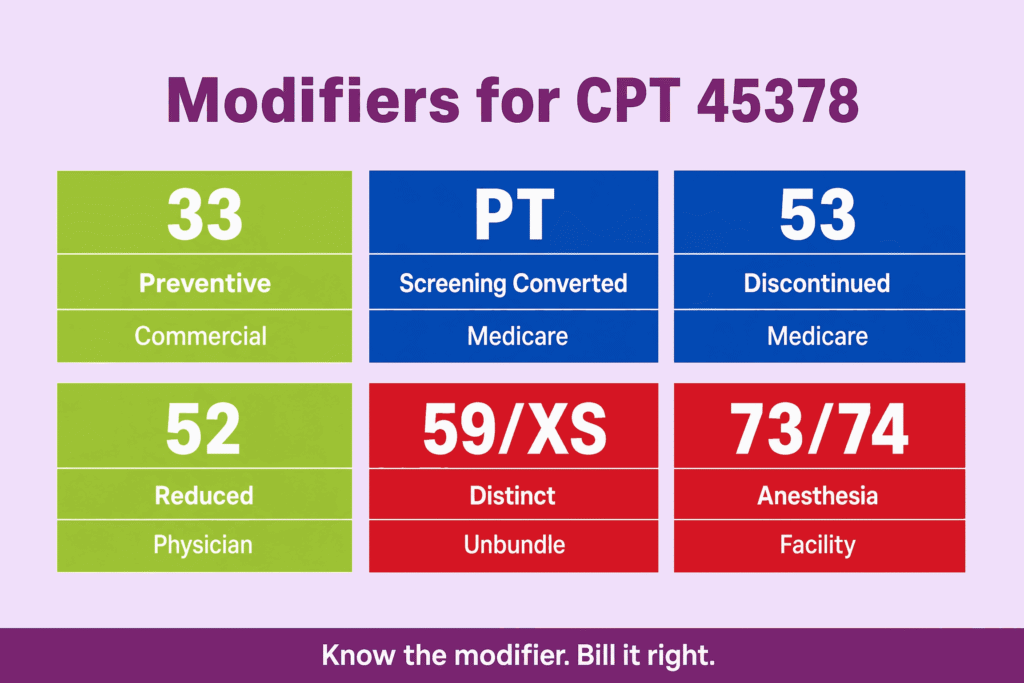
- Modifier 33 (Preventive Service): Used for commercial payer claims only. Applies when a colonoscopy is performed as a screening and the payer covers it as a preventive benefit under ACA rules. This modifier tells the payer to apply zero patient cost-sharing. It should not appear on Medicare claims.
- Modifier PT (Colorectal Cancer Screening Test Converted to Diagnostic): Used for Medicare claims only. Applies when a screening G-code encounter converts to a therapeutic CPT encounter because the physician performs an intervention. Modifier PT signals to CMS that the deductible should be waived while coinsurance applies. It should not appear on commercial claims.
- Modifier 53 (Discontinued Procedure): Applies when the physician begins a colonoscopy but cannot complete it to the cecum due to patient safety concerns or intolerance, and stops the procedure before completing the intended examination. Medicare prefers modifier 53 over modifier 52 for discontinued colonoscopies. Claims with modifier 53 receive reduced reimbursement reflecting the incomplete nature of the service.
- Modifier 52 (Reduced Services): Applies when a service is reduced at the physician’s discretion rather than due to patient safety factors. This modifier is less commonly used for colonoscopy than modifier 53, but some situations warrant it when the physician makes a clinical decision to limit the scope of the procedure without stopping due to an adverse event.
- Modifier 59 (Distinct Procedural Service) or XS (Separate Structure): Applies when two colonoscopy codes are billed in the same session for distinct procedures performed on anatomically separate lesions. This modifier unbundles codes that would otherwise be grouped by NCCI edits. Documentation must clearly identify the separate anatomical locations and the distinct nature of each intervention to support unbundling.
- Modifier 73 and 74: These apply when a procedure is discontinued before or after anesthesia administration in an ASC or facility setting. Modifier 73 applies when discontinued before anesthesia, and modifier 74 applies when discontinued after anesthesia begins. These modifiers are used on facility claims rather than the professional claim and are relevant when coordinating billing across the technical and professional components.
When multiple modifiers are required on a single claim line, the modifier that most directly affects reimbursement must be listed first. A reduced screening colonoscopy for a commercial patient, for example, would carry modifiers in the sequence 52-33 (reduced services first, then preventive designation).
ICD-10 Coding: Linking Medical Necessity to CPT 45378
Every CPT 45378 claim requires at least one ICD-10-CM diagnosis code that establishes medical necessity. Claims submitted without a supporting diagnosis code will be denied, regardless of how accurately the procedure is coded.
The ICD-10 codes that appear most frequently with 45378 fall into two categories based on whether the encounter is screening or diagnostic.
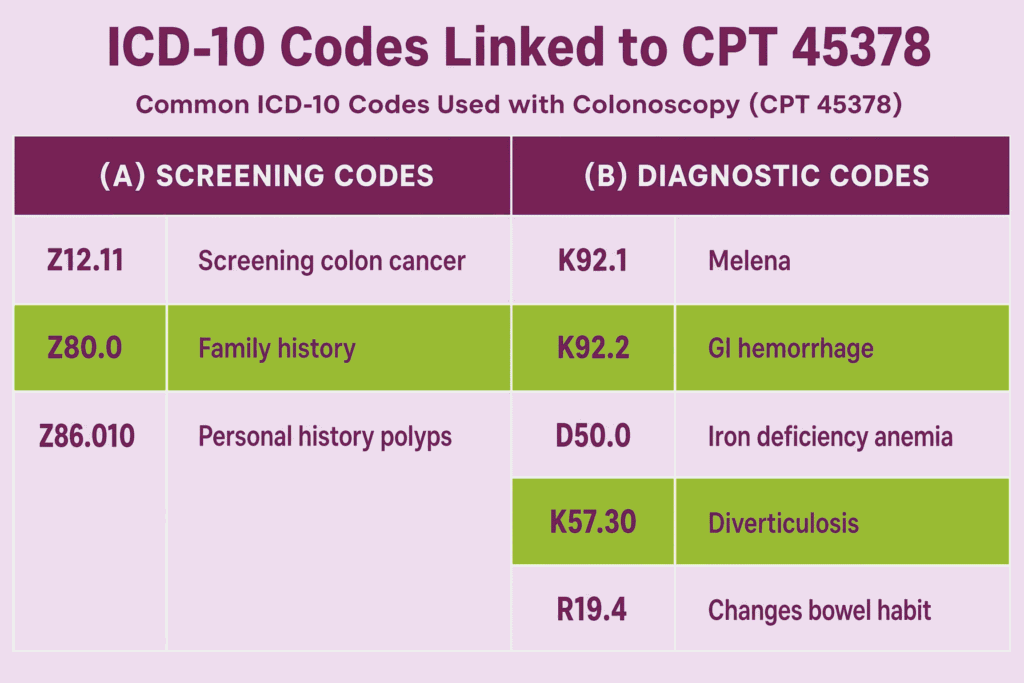
For screening encounters using 45378 on commercial plans, the primary diagnosis is typically Z12.11 (encounter for screening for malignant neoplasm of the colon). Supporting codes for high-risk patients include Z80.0 (family history of malignant neoplasm of digestive organs) and Z86.010 (personal history of colonic polyps).
For diagnostic encounters, the diagnosis code should reflect the specific symptom or condition prompting the procedure. Common diagnostic codes that support medical necessity for 45378 include:
K92.1 (Melena) or K92.2 (gastrointestinal hemorrhage, unspecified) for patients presenting with blood in stool or suspected lower GI bleeding. R19.5 (other fecal abnormalities, including positive fecal occult blood test) for follow-up after abnormal stool testing in situations where the follow-up colonoscopy does not qualify as screening under Medicare rules.
D50.0 (iron deficiency anemia secondary to blood loss) when a colonoscopy is ordered to investigate an occult bleeding source. K57.30 (diverticulosis of large intestine without perforation or abscess without bleeding) or related codes when evaluating known or suspected diverticular disease.
K59.00 through K59.09 for constipation and related bowel motility disorders requiring endoscopic evaluation. R19.4 (changes in bowel habit) when the patient presents with altered stool caliber or frequency without a confirmed diagnosis.
The clinical documentation must support whichever diagnosis code is selected. If the operative note and referring physician records describe a patient with rectal bleeding, the diagnosis code should reflect rectal bleeding or its likely source, not a generic screening code. Mismatched diagnosis codes are a frequent cause of payer audits and post-payment reviews in gastroenterology.
Documentation Requirements That Support 45378 Claims
Documentation quality determines whether CPT 45378 claims survive payer review, preauthorization scrutiny, and post-payment audits. Incomplete operative reports are one of the most preventable causes of claim denial and recoupment in gastroenterology.
1. Procedure Indication and Patient History
The procedure report for a 45378 encounter should include the following elements. The indication for the procedure must be stated clearly, identifying whether the colonoscopy is being performed for screening or for a specific diagnostic reason. Patient demographics relevant to risk stratification, including age, family history of colorectal disease, and personal history of prior polyps, should appear in the chart supporting the claim.
2. Scope Advancement and Cecal Intubation
Scope insertion, advancement, and cecal intubation should be documented with confirmation that the scope reached the cecum. Many practices include a photograph of the cecum (identified by the ileocecal valve and appendiceal orifice) as supporting documentation. Payers increasingly expect photographic evidence of cecal intubation, particularly on claims that face utilization review.
3. Findings and Specimen Collection
Findings must be described with enough detail to support the selected diagnosis codes. If the colon is normal, the report should state that explicitly. If diverticulosis, hemorrhoids, or mucosal changes are noted, each finding should be documented even if no intervention is performed. If specimen collection by brushing or washing occurs, it should be noted as included in the base procedure.
4. Withdrawal Time
Withdrawal time matters for quality metrics even when not a strict billing requirement. Many payers and credentialing bodies use average withdrawal time as a quality indicator for colonoscopy providers. A documented withdrawal time of at least six minutes reflects a thorough examination technique.
5. Intervention Status
If no biopsy or polypectomy occurs, the report should state explicitly that no intervention was performed. This statement supports the selection of 45378 over a therapeutic code and reduces the risk of a coder inadvertently upcoding based on ambiguous documentation.
6. Sedation and Recovery Notes
Sedation administration, recovery time, and any complications should also be documented. If the anesthesiologist or CRNA administers moderate sedation separately, that documentation is handled independently and does not affect the 45378 claim for the colonoscopy itself.
Reimbursement: What CPT 45378 Pays Under Medicare
Medicare reimbursement for CPT 45378 follows the standard Physician Fee Schedule (PFS) calculation, which applies a relative value unit (RVU) weighting to the procedure and multiplies it by the applicable conversion factor. For 2026, CMS finalized two separate conversion factors. Qualifying Alternative Payment Model (APM) participants use a conversion factor of $33.57, while non-qualifying APM participants use $33.40. Both figures represent increases compared to the 2025 conversion factor of $32.35.
National average Medicare payments for CPT 45378 fall in the range of $200 to $280 for the professional fee component, depending on whether the service is performed in a facility setting (lower payment due to shared overhead) or a non-facility setting (higher payment reflecting the physician practice bearing more overhead costs). Facility payments are generally lower because the facility (hospital or ASC) receives a separate APC or ASC payment for the technical component of the service.
Geographic variation affects actual payment amounts through the Geographic Practice Cost Index (GPCI), which adjusts payments based on regional cost differences. Practices in higher-cost metropolitan areas receive modestly higher payments than those in rural or lower-cost regions. For the most accurate figures specific to your locality, practices should consult the CMS Physician Fee Schedule Look-Up Tool using their MAC locality code.
Practices that regularly perform colonoscopies in hospital outpatient settings should understand that the site-of-service differential can meaningfully reduce the professional fee. Some physicians choose to perform routine diagnostic colonoscopies in their own ASC or office-based procedure suite to capture more complete reimbursement under the non-facility rate.
Clinical Scenarios: Applying CPT 45378 Correctly
Scenario-based application shows how billing rules translate into actual claim decisions. The following scenarios reflect common presentations in GI practices and the correct coding approach for each.
Scenario 1: Average-Risk Medicare Patient, Routine Screening, Normal Findings
A 68-year-old Medicare beneficiary with no personal or family history of colorectal cancer presents for a routine colonoscopy. The scope reaches the cecum, the examination is complete, no polyps or lesions are found, and no specimen collection occurs. The correct code is G0121, not 45378. Diagnosis: Z12.11. Do not report 45378 on this claim. Medicare does not recognize 45378 as a screening code, and submitting it in place of G0121 will result in denial.
Scenario 2: Commercial Insurance Patient, Screening Indication, Normal Findings
A 52-year-old patient covered by a commercial plan presents for a routine colorectal cancer screening. The scope reaches the cecum, no polyps are found, and the examination is normal. The correct code is 45378-33. Diagnosis: Z12.11. Modifier 33 ensures the payer applies the ACA preventive benefit, meaning the patient owes no cost-sharing.
Scenario 3: Commercial Insurance Patient, Screening That Finds a Polyp
A 55-year-old patient covered by a commercial plan presents for screening. During the examination, a 6mm polyp was identified in the sigmoid colon and removed using a cold snare technique. The examination is otherwise normal. The correct code is 45385-33. Modifier 33 preserves the screening classification so the patient retains ACA cost-share protections. Do not report 45378 alongside 45385. The snare polypectomy code replaces the base code.
Scenario 4: Medicare Patient, Screening That Finds and Removes a Polyp
A 71-year-old Medicare patient presents for a routine high-risk screening (prior history of polyps). The procedure begins under G0105. During the examination, a polyp is removed by hot snare in the transverse colon. The claim must switch from G0105 to 45385-PT. Modifier PT signals to Medicare that a screening converted to a therapeutic procedure, waiving the deductible but applying 15 percent coinsurance under 2026 rules.
Scenario 5: Diagnostic Colonoscopy for Rectal Bleeding
A 61-year-old Medicare patient reports intermittent rectal bleeding over three months. The physician orders a diagnostic colonoscopy to investigate. The scope reaches the cecum. No polyps are found. Diverticulosis is noted in the sigmoid colon but is not actively bleeding. No biopsy or intervention is performed. The correct code is 45378. Diagnosis: K92.1 (melena) or the most specific bleeding code supported by documentation, with K57.30 as a secondary code for the diverticulosis finding. This is a legitimate diagnostic use of 45378 under Medicare.
Scenario 6: Incomplete Colonoscopy Due to Poor Bowel Preparation
A 65-year-old Medicare patient presents for a diagnostic colonoscopy. Due to inadequate bowel preparation, the physician is unable to advance the scope beyond the splenic flexure and terminates the procedure. The correct code is 45378-53. Modifier 53 indicates that the procedure was discontinued before completion due to extenuating circumstances. Reimbursement will be reduced compared to a complete examination, and documentation must explain why the procedure was stopped.
Scenario 7: Biopsy of One Lesion and Snare Polypectomy of a Separate Lesion
A 59-year-old patient presents for a diagnostic colonoscopy. The physician identifies a 4mm flat lesion in the ascending colon and takes a cold forceps biopsy. The physician also finds a 12mm pedunculated polyp in the transverse colon and removes it using a snare. Two separate lesions in two separate anatomical sites received two separate interventions. The correct codes are 45385 (snare polypectomy, primary procedure) and 45380-59 (biopsy, separate lesion, modifier 59 supporting unbundling). Do not report 45378. Both therapeutic codes supersede the base code.
Medicare Billing Rules for CPT 45378
Medicare applies the most specific rules to colonoscopy billing, and those rules create a clear split between screening colonoscopies and diagnostic colonoscopies. CPT 45378 is a diagnostic code. Medicare does not use it for routine colorectal cancer screenings.
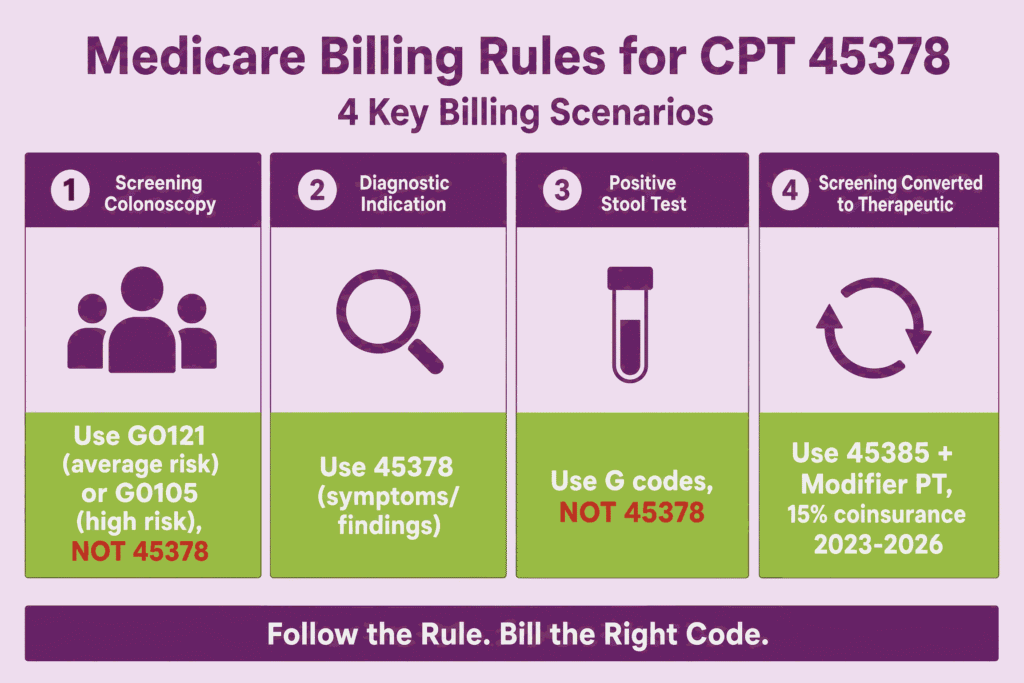
1. Screening Colonoscopy: Use G Codes, Not 45378
For a Medicare patient undergoing a routine screening colonoscopy, the correct HCPCS codes are G0121 (average risk patient) or G0105 (high risk patient, defined as someone with a personal or family history of colorectal cancer or polyps). Using CPT 45378 for a Medicare screening claim will result in denial because the G codes carry the screening benefit and the associated coverage rules.
2. When CPT 45378 Applies to Medicare Patients
CPT 45378 applies to Medicare patients only when the colonoscopy is performed for a diagnostic indication, meaning the patient presents with symptoms or findings that medically justify the procedure.
Examples include rectal bleeding, abdominal pain with suspected colonic etiology, iron-deficiency anemia with no obvious source, abnormal imaging requiring endoscopic clarification, or a positive stool-based test result that triggers a follow-up colonoscopy now classified as a screening rather than a diagnostic service.
3. Positive Stool-Based Tests and the Screening Classification
That last point reflects a significant Medicare policy shift. When a Medicare patient has a positive result from a non-invasive stool-based test, such as Cologuard or a fecal immunochemical test, the resulting colonoscopy is now treated as a screening test rather than a diagnostic one for coverage purposes. This means it falls under the G codes, not 45378.
4. Screening Converted to Therapeutic: Modifier PT and Coinsurance Rules
The conversion scenario creates another distinct situation. When a Medicare patient undergoes a screening colonoscopy (billed under G0105 or G0121) and the physician finds and removes a polyp during that same session, the claim must switch from the G code to the appropriate therapeutic CPT code (e.g., 45385 for snare polypectomy) with modifier PT appended.
Modifier PT signals to Medicare that a colorectal cancer screening test has been converted to a diagnostic service, which allows the deductible to be waived while still applying coinsurance. Under current Medicare rules, the patient owes 15 percent coinsurance for converted screening encounters for the 2023 through 2026 timeframe. By 2030, that coinsurance requirement will phase out entirely to zero.
Commercial Payer Billing Rules for CPT 45378
Private and commercial payers handle colonoscopy billing differently from Medicare, and the gap between the two systems is wide enough that billing teams must treat them as separate workflows.
For commercial payers, CPT 45378 is the appropriate code for both diagnostic and screening colonoscopies. The distinction that matters for commercial claims is whether the service qualifies as preventive under the Affordable Care Act (ACA) guidelines. When a commercial payer covers colonoscopy as a preventive service, and the procedure is performed as a routine screening, modifier 33 (Preventive Service) must be appended to ensure the patient receives the ACA-mandated $0 cost-share benefit.
When a commercial payer screening colonoscopy finds and removes a polyp, the billing team should switch from 45378 to the appropriate therapeutic CPT code (e.g., 45385) and keep modifier 33 on the claim. This preserves the preventive classification and protects the patient from unexpected cost-sharing. Some payers have specific policies about whether modifier 33 applies when a screening converts to a therapeutic procedure, so verifying each payer’s guidelines in advance prevents payment disputes.
Commercial payers typically reimburse colonoscopy procedures at rates 15 to 30 percent higher than Medicare national averages, though the actual amount depends on the payer contract, geographic market, and whether the service is performed in an office, ambulatory surgery center, or hospital outpatient department.
According to a study published using the 2021 Merative Marketscan research database, mean commercial facility fees for CPT 45378 were approximately $910 in ambulatory surgery centers and approximately $1,602 in hospital settings. Those figures reflect commercial rates and will differ from what the physician receives under the professional fee component of the claim.
Practices with significant commercial payer volume should review their contracts to confirm that colonoscopy reimbursement reflects the current complexity and resource requirements of the procedure, particularly as payer fee schedules update annually. Underpayment against contracted rates is one of the areas where gastroenterology billing oversight can identify revenue leakage that otherwise goes undetected.
Common Billing Errors and How to Avoid Them
The frequency of CPT 45378 claims in GI billing creates a corresponding frequency of errors. Knowing the most common mistakes helps practices implement pre-submission review processes that catch problems before claims go out.
- Reporting 45378 alongside a therapeutic code for the same session is the most common bundling error in colonoscopy billing. When a biopsy or polypectomy is performed, 45378 must be dropped from the claim. NCCI edits will flag the combination, but by then, the claim is already delayed.
- Using 45378 for a Medicare screening colonoscopy instead of the appropriate G code results in denial because Medicare does not recognize 45378 as a screening benefit code for its covered population. Billing staff must be trained to identify the payer and the indication before selecting a code.
- Failing to append modifier 33 on commercial screening claims results in the patient being billed incorrectly. The insurer may process the claim as diagnostic rather than preventive, applying the deductible and coinsurance where none should apply. This creates patient disputes, appeals, and administrative work that falls back on the practice.
- Not applying modifier PT when a Medicare screening converts to a therapeutic procedure results in the deductible being applied to the patient, which may violate Medicare coverage rules for preventive services. This error also generates patient complaints and potential compliance exposure.
- Submitting an incomplete procedure without modifier 53 may result in overpayment that the payer later recoups. Documentation of why the procedure was stopped, combined with the appropriate modifier, protects the practice against both underpayment and recoupment.
- Linking the wrong ICD-10 code to 45378, particularly using a screening code for a diagnostic encounter or vice versa, creates medical necessity mismatches that payers flag during claim review or retrospective audits. The diagnosis code on the claim must match what the operative report and patient record describe.
Why Accurate 45378 Billing Matters Beyond the Single Claim?
CPT code 45378 generates significant revenue volume for GI practices, and coding errors compound quickly across high-frequency billing scenarios. A practice performing even 50 colonoscopies per week at even a modest average reimbursement rate is processing millions of dollars in annual claims through the colonoscopy code family. Small error rates, whether through modifier omissions, bundling mistakes, or ICD-10 mismatches, translate into measurable revenue loss and potential compliance liability.
Beyond revenue, accurate coding protects practices from audit exposure. Both CMS and commercial payers conduct utilization reviews and probe audits of high-frequency GI codes. Practices with consistent error patterns in their colonoscopy coding, whether overcoding through failure to apply bundling rules or undercoding through missed modifier opportunities, are more likely to face additional scrutiny.
For practices without dedicated gastroenterology coding expertise, the administrative burden of staying current with NCCI edits, payer-specific modifier policies, Medicare G code requirements, and conversion factor changes is real. Working with a team that specializes in Gastroenterology billing means having coders who know when 45378 stands alone, when it must be replaced, and how to document the difference in a way that holds up across all major payer types.