According to the International Consortium of Primary Care Big Data Researchers, respiratory diseases account for more than 64 million primary care visits annually. This increases the need for accurate usage of pulmonology ICD-10 codes to reduce claim denials and support medical necessity.
Most of these codes fall under Chapter 10 (J00-J99), Diseases of the Respiratory System. However, pulmonology ICD-10 coding also extends to the neoplasm, circulatory, symptom, infectious disease, and tobacco dependence chapters.

We have divided the pulmonology ICD-10 codes into two layers for this guide. The first explains the coding principles that apply across respiratory diagnoses, including code specificity, symptom coding, and medical necessity. In the second layer, we’ve organized pulmonary conditions by category with guidance needed for accurate reporting.
What Are Pulmonology ICD-10 Codes?
Pulmonology ICD-10 codes classify diseases, disorders, symptoms, and conditions affecting the respiratory system. Although most pulmonary diagnoses fall within Chapter 10 (J00-J99), physicians also report codes from several other ICD-10 chapters depending on the patient’s condition.
You can reduce unnecessary claim denials by simply understanding where diagnoses belong in pulmonary billing and coding.
Which ICD-10 Chapter Covers Pulmonary Diagnoses?
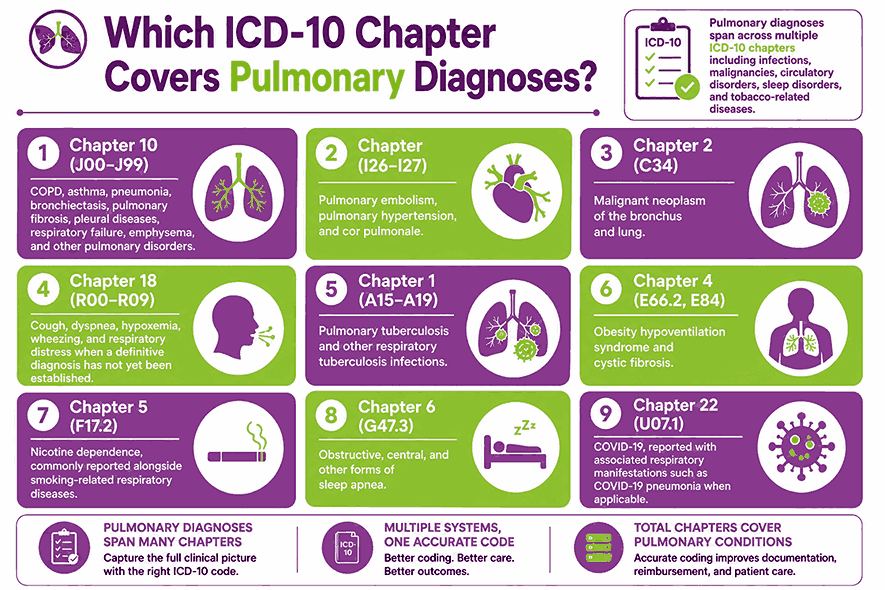
Pulmonary diagnoses span across multiple ICD-10 chapters. Respiratory conditions often involve infections, malignancies, circulatory disorders, sleep disorders, and tobacco-related diseases.
- Chapter 10 (J00-J99): COPD, asthma, pneumonia, bronchiectasis, pulmonary fibrosis, pleural diseases, respiratory failure, emphysema, and other pulmonary disorders.
- Chapter (I26-I27): Pulmonary embolism, pulmonary hypertension, and cor pulmonale.
- Chapter 2 (C34): Malignant neoplasm of the bronchus and lung.
- Chapter 18 (R00-R09): Cough, dyspnea, hypoxemia, wheezing, and respiratory distress when a definitive diagnosis has not yet been established.
- Chapter 1 (A15-A19): Pulmonary tuberculosis and other respiratory tuberculosis infections.
- Chapter 4 (E66.2, E84): Obesity hypoventilation syndrome and cystic fibrosis.
- Chapter 5 (F17.2): Nicotine dependence, commonly reported alongside smoking-related respiratory diseases.
- Chapter 6 (G47.3): Obstructive, central, and other forms of sleep apnea.
- Chapter 22 (U07.1): COVID-19, reported with associated respiratory manifestations such as COVID-19 pneumonia when applicable.
How Is a Pulmonary ICD-10 Code Structured?
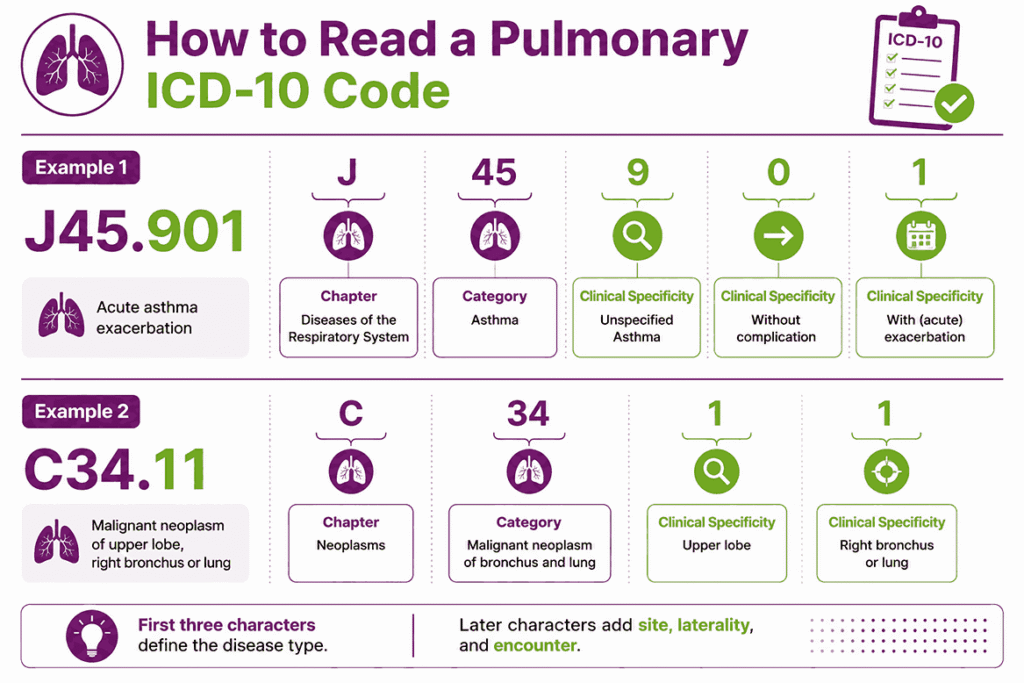
Pulmonary ICD-10 codes become more specific as additional characters are added. The first three characters describe the condition, severity, anatomical location, or other relevant clinical details.
For instance:
- J45.901 ICD-10 code reports unspecified asthma with (acute) exacerbation. The base category represents asthma, while the remaining characters indicate the asthma classification. The last characters confirm if the patient is experiencing an acute exacerbation.
- C34.11 ICD-10 code is assigned to a malignant neoplasm of the upper lobe of the right bronchus or lung. Here, the additional characters narrow the diagnosis to the tumor’s exact anatomical site.
By using the most accurate and specific codes, you can reduce claim denials and improve reimbursements. For pulmonary procedures, consulting a detailed pulmonary CPT code guide helps ensure the right codes are selected and claims are submitted with greater accuracy.
When Should Symptom Codes Be Used Instead of Definitive Diagnoses?
ICD-10-CM symptom codes are reported only when the physician has not established a definitive diagnosis by the end of the encounter. Once the underlying condition is confirmed, the diagnosis code generally replaces the symptom code.
For example, R05.9 (Cough), R06.02 (Shortness of breath), and R09.02 (Hypoxemia) may be appropriate when documenting the patient’s presenting symptoms. However, if the physician confirms conditions such as pneumonia, COPD exacerbation, or asthma during the same encounter, report the confirmed diagnosis rather than the routine symptom.
Can More Than One Pulmonology ICD-10 Code Be Reported Together?
Yes. Pulmonary patients commonly present with multiple conditions that each affect medical decision-making and treatment. When documented separately, ICD-10-CM allows multiple diagnosis codes to fully describe the patient’s clinical condition.
Take, for example, a patient who is admitted with COPD exacerbation, pneumonia, acute respiratory failure, and nicotine dependence. He may require all four diagnoses to accurately support medical necessity. Every reported code should represent a documented condition that influenced the physician’s evaluation, treatment, or management.
How Do You Code Pulmonology Diagnoses Correctly?
To code a pulmonary diagnosis correctly, review four key documentation details before submitting the claim. Determine if the condition includes an exacerbation, how respiratory failure is classified, the documented organism or exposure, and if an additional diagnosis code is required.
These details help support medical necessity and reduce claim denials. For now, let’s discuss the rules for accurate coding, and will list the appropriate ICD-10 codes later in the guide.
What Documentation Turns COPD or Asthma Into the Right Code?
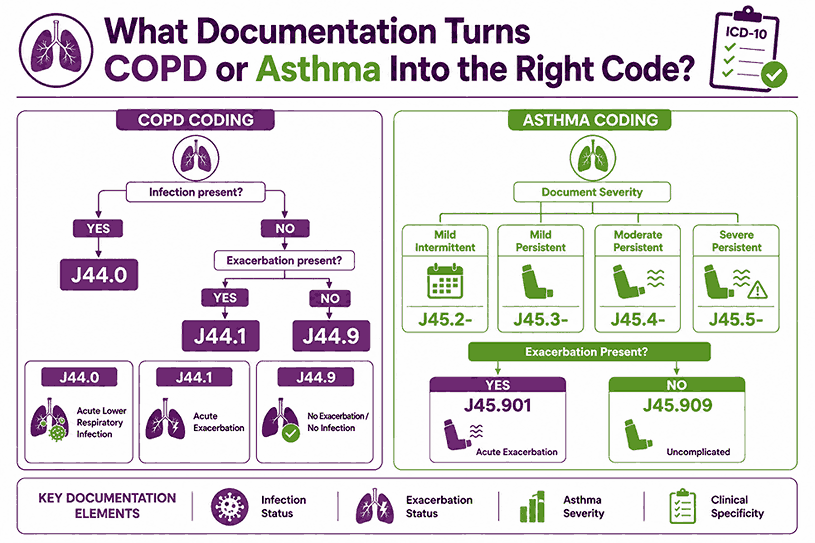
Exacerbation status and severity turn a generic airway-disease label into a billable code. COPD splits three ways on a single documented detail, which is:
- J44.9 reports COPD without exacerbation or infection.
- J44.0 reports COPD with an acute lower respiratory infection.
- J44.1 reports COPD with acute exacerbation.
Similarly, asthma codes on two documented axes: severity and control. Severity spans four categories, from mild intermittent (J45.2-) to severe persistent (J45.5-), and the final character records the exacerbation status.
J45.901 reports unspecified asthma with acute exacerbation, while J45.909 covers unspecified asthma, uncomplicated.
How Do You Classify Respiratory Failure in ICD-10?
Respiratory failure is classified based on onset and gas-exchange defect, with J96 family covering both. The table below maps the onset axis to its category before the gas-exchange character is added.
| Onset | Category | Reports |
|---|---|---|
| Acute | J96.0- | Sudden failure, hours to days |
| Chronic | J96.1- | Longstanding failure, compensated |
| Acute on Chronic | J96.2- | Acute decompensation of chronic failure |
Why Does the Documented Organism or Exposure Drive the Code?
The documented cause drives the code across two pulmonary families, pneumonia and occupational lung disease, that classify by etiology rather than symptom. Pneumonia codes by organisms across J12 through J18, including viral (J12), streptococcal (J13), and bacterial (J15) origins.
In contrast, occupational lung disease codes are based on the inhaled agent, not the fibrosis it produces. For instance, J60 reports coal workers’ pneumoconiosis, J61 covers asbestosis, J62 for silicosis, and J64 describes unspecified pneumoconiosis.
The exposure history must appear in the record because the agent is the code.
When Does a Pulmonary Diagnosis Need a Second Code?
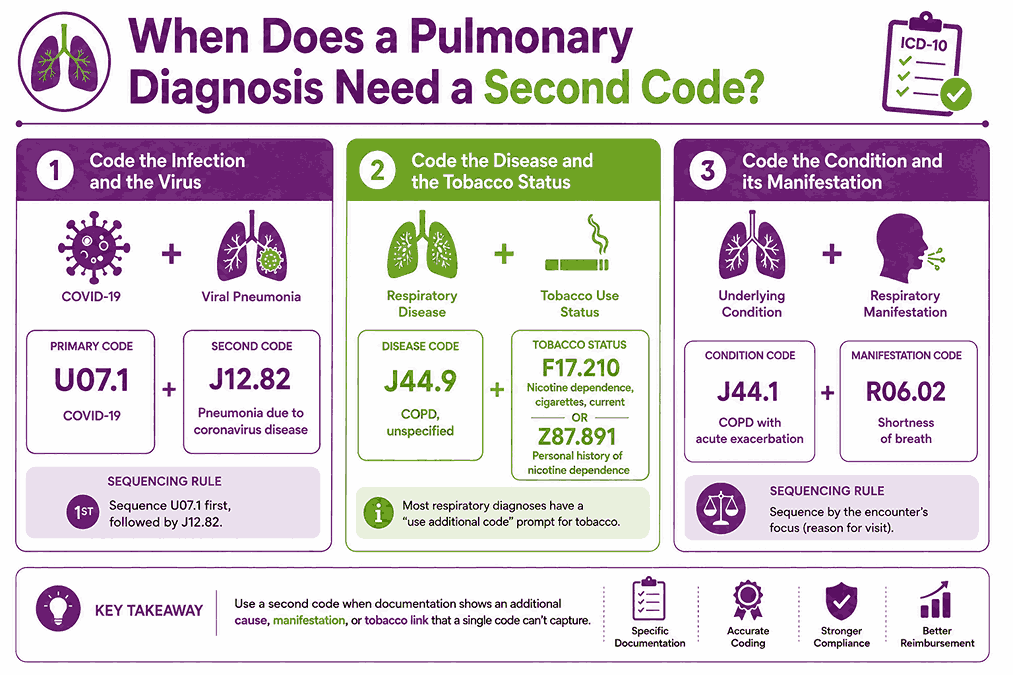
A pulmonary diagnosis requires a second code when a documented cause, manifestation, or tobacco link exceeds what a single code can capture. Three pairings recur in respiratory claims:
- Code the Infection and the Virus: COVID-19 pneumonia pairs U07.1 with J12.82, sequenced with U07.1 first.
- Code the Disease and the Tobacco Status: Most respiratory diagnoses carry a “use additional code” prompt for tobacco, satisfied by F17.210 for current nicotine dependence or Z87.891 for a history of it.
- Code the Condition and its Manifestation: An underlying disease and its respiratory manifestation each take a code, sequenced by the encounter’s focus.
Which ICD-10 Codes Cover the Most Common Pulmonary Conditions?
Respiratory diagnosis coding covers everything from infections and interstitial lung disease to pulmonary embolism, sleep apnea, lung cancer, pleural disorders, and respiratory failure. The categories below cover the diagnoses pulmonologists report most frequently, along with their primary ICD-10-CM codes.
Obstructive Airway Disease ICD-10 Codes
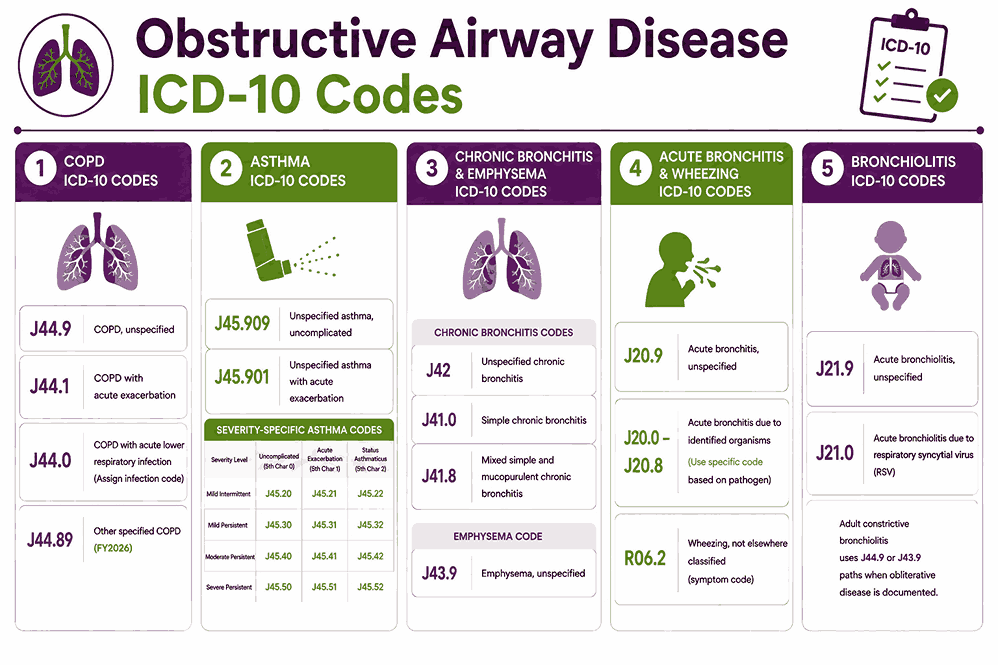
Obstructive airway disease codes fall within the J40-J47 range and are split into chronic and acute presentations. Exacerbation status separates most codes in this group.
COPD ICD-10 Codes
The COPD ICD-10 code is J44.9 for chronic obstructive pulmonary disease, unspecified. The clinical details J44.9 omits are carried by two sister codes. J44.1 reports COPD with acute exacerbation, while J44.0 covers COPD with acute lower respiratory infection; the infection is assigned a second code.
FY2026 added J44.89 for other specified COPD, providing coders with a specific option rather than the unspecified default. COPD maps to HCC 111 under CMS risk adjustment model v28, so accurate capture protects both the claim and the risk score.
Asthma ICD-10 Codes
Asthma codes fall under the J45 category and are first split by severity, then by exacerbation status. J45.909 reports unspecified asthma, uncomplicated. It is the highest-volume asthma code. Then there is J45.901 for unspecified asthma with acute exacerbation.
Here, severity-specific codes add precision. J45.20 marks mild intermittent asthma, J45.30 mild persistent, J45.40 moderate persistent, and J45.50 severe persistent. Each severity level carries a matching exacerbation code (fifth character 1) and a status asthmaticus code (fifth character 2).
Chronic Bronchitis and Emphysema ICD-10 Codes
Chronic bronchitis and emphysema share many clinical features, but ICD-10-CM classifies them differently. Unspecified chronic bronchitis is coded as J42, while J41.0 covers simple chronic bronchitis and J41.8 covers mixed simple and mucopurulent chronic bronchitis.
For emphysema, J43.9 is assigned when the condition is documented without further specification. However, once emphysema and chronic bronchitis are documented together, they are classified as COPD under the J44 category.
In addition, the FY2026 update reclassified emphysema caused by inhaled chemicals, gases, fumes, or vapors as an Excludes2 note under J44. This allows J68.4 and an appropriate J44 code to be reported together when both conditions are documented.
Acute Bronchitis and Wheezing ICD-10 Codes
Acute bronchitis and wheezing codes report short-term airway conditions. J20.9 reports acute bronchitis, unspecified, and organism-specific codes (J20.0 through J20.8) apply when the pathogen appears in the note.
R06.2 reports wheezing as a standalone symptom and is used when no airway diagnosis is established. Acute bronchitis differs from acute exacerbation of COPD, so the underlying airway status decides the code path.
Bronchiolitis ICD-10 Codes
Bronchiolitis codes report inflammation of the small airways and are coded by age group and cause. J21.9 reports acute bronchiolitis, unspecified, and J21.0 covers acute bronchiolitis due to respiratory syncytial virus (RSV).
Adult constrictive bronchiolitis uses J44.9 or J43.9 paths when obliterative disease is documented. Bronchiolitis in infants dominates the J21 category, so adult cases require careful documentation to avoid the pediatric default.
Pulmonary Infection ICD-10 Codes
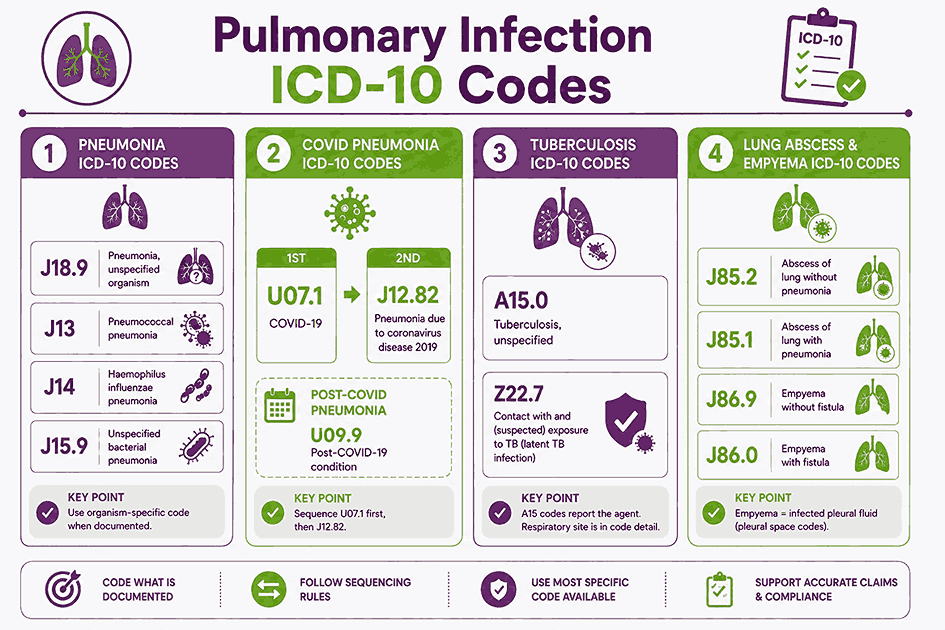
Pulmonary infection codes span the J12-J18 pneumonia range, plus cross-chapter entries for tuberculosis and fungal disease. In this ICD-10 category, the codes are based on the documented organism.
Pneumonia ICD-10 Codes
The pneumonia ICD-10 code is J18.9 for pneumonia, unspecified organism, the highest-volume pneumonia code. Organism-specific codes replace J18.9 when the pathogen appears in the note.
J13 reports pneumococcal pneumonia, J14 covers Haemophilus influenzae pneumonia, and J15.9 records unspecified bacterial pneumonia.
COVID Pneumonia ICD-10 Codes
COVID pneumonia requires two codes in a fixed order. Sequence U07.1 for COVID-19 first, then J12.82 for pneumonia due to coronavirus disease 2019. In the FY2021 update, J12.82 replaced J12.89 for confirmed SARS-CoV-2 pneumonia, so J12.89 on a COVID claim reads as a coding error.
Post-COVID pneumonia that persists after the active infection resolves is coded as U09.9 for post-COVID-19 condition.
Tuberculosis ICD-10 Codes
Tuberculosis codes fall under the A15 category, a cross-chapter entry in Chapter 1 rather than in the respiratory chapter. A15.0 reports tuberculosis, unspecified. For latent tuberculosis infection without active disease, use Z22.7.
Tuberculosis codes report the infectious agent, so the respiratory site is listed as a detail within A15. The tuberculosis code set separates active pulmonary disease from latent infection.
Lung Abscess and Empyema ICD-10 Codes
Lung abscess and empyema codes cover suppurative pulmonary infection. J85.2 is for abscess of the lung without pneumonia, and J85.1 for abscess of the lung with pneumonia. Moreover, J86.9 reports empyema without fistula, and J86.0 reports empyema with fistula. Empyema refers to infected pleural fluid, so the code maps to the pleural space category.
Interstitial and Fibrotic Lung Disease ICD-10 Codes
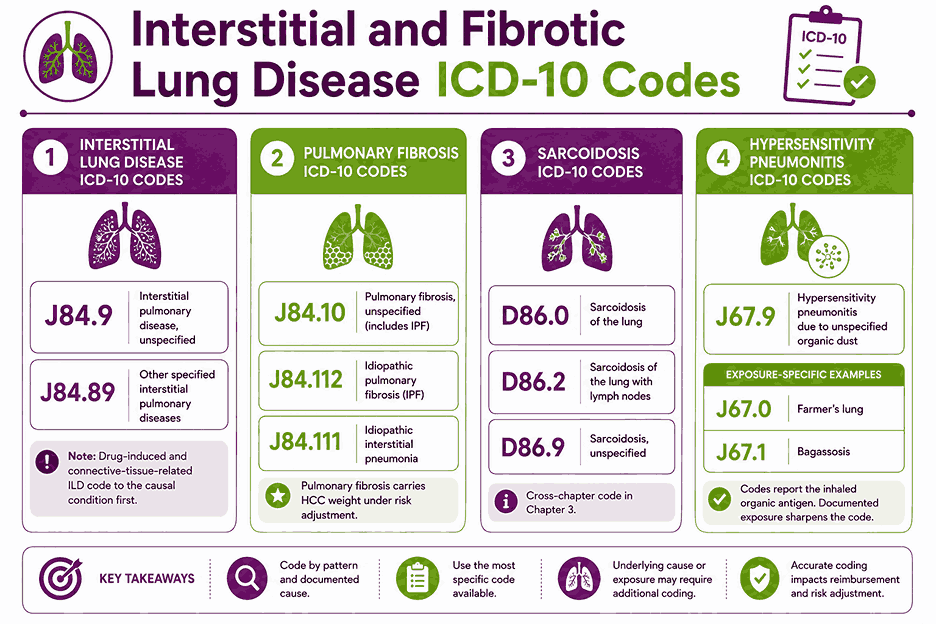
Interstitial and fibrotic lung disease codes occupy the J84 category and are coded by pattern and cause. Documented etiology, when present, redirects the code outside J84.
Interstitial Lung Disease ICD-10 Codes
The interstitial lung disease ICD-10 code is J84.9 for interstitial pulmonary disease, unspecified. For other specified interstitial pulmonary diseases, J84.89 is used, especially when the pattern is named but does not fit a dedicated code. Drug-induced and connective-tissue-related interstitial disease redirect to the causal condition first.
Pulmonary Fibrosis ICD-10 Codes
ICD-10 code for unspecified pulmonary fibrosis is J84.10, which includes idiopathic pulmonary fibrosis (IPF). To report idiopathic pulmonary fibrosis specifically, use J84.112. As for idiopathic interstitial pneumonia, use J84.111. Pulmonary fibrosis also carries HCC weight under risk adjustment, so accurate capture affects the risk score.
Sarcoidosis ICD-10 Codes
The pulmonary sarcoidosis ICD-10 code is D86.0 for sarcoidosis of the lung, a cross-chapter code in Chapter 3. In it, D86.2 reports sarcoidosis of the lung with sarcoidosis of the lymph nodes, and D86.9 covers sarcoidosis, unspecified.
Hypersensitivity Pneumonitis ICD-10 Codes
The hypersensitivity pneumonitis ICD-10 code is J67.9, due to unspecified organic dust. Exposure-specific codes name the antigen: J67/0 maps to farmer’s lung, and J67.1 maps to bagassosis. Hypersensitivity pneumonitis codes report the inhaled organic antigen, so documented exposure sharpens the code.
Pulmonary Vascular Disease ICD-10 Codes
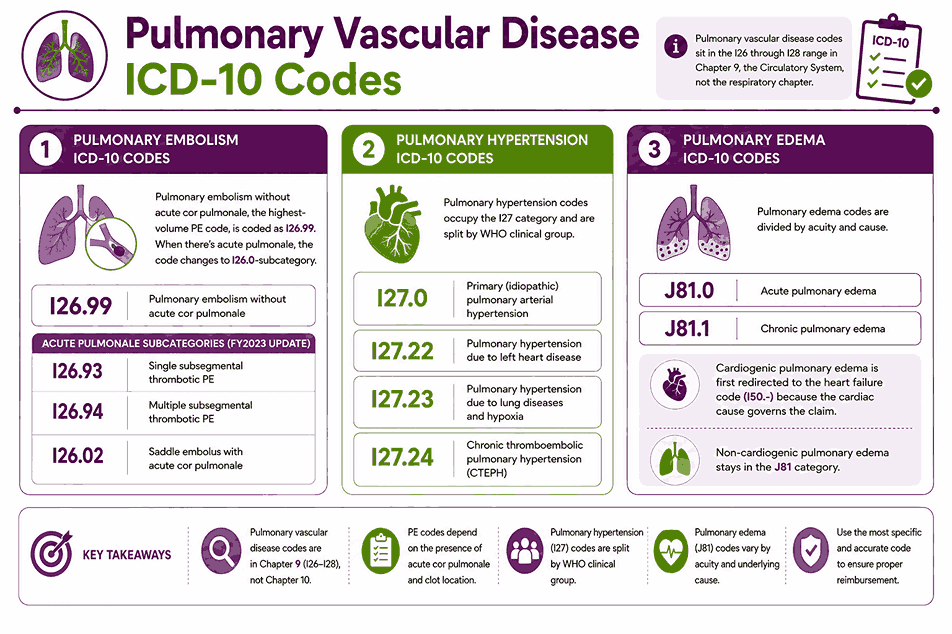
Pulmonary vascular disease codes sit in the I26 through I28 range in Chapter 9, the circulatory system, not the respiratory chapter. One of the codes is for embolism, which changes if there’s the presence of acute cor pulmonale.
Pulmonary Embolism ICD-10 Codes
Pulmonary embolism without acute cor pulmonale, the highest-volume PE code, is coded as I26.99. When there’s acute pulmonale, the code changes to I26.0-subcategory. These were divided in the FY2023 update as:
- I26.93: Single subsegmental thrombotic PE
- I26.94: Multiple subsegmental thrombotic PE
Lastly, the I26.02 code records saddle embolus with acute cor pulmonale.
Pulmonary Hypertension ICD-10 Codes
Pulmonary hypertension codes occupy the I27 category and are split by WHO clinical group. The ICD codes in this category include:
- I27.0: Primary (idiopathic) pulmonary arterial hypertension
- I27.22: Pulmonary hypertension due to left heart disease
- I27.23: Pulmonary hypertension due to lung diseases and hypoxia
- I27.24: Chronic thromboembolic pulmonary hypertension (CTEPH)
Pulmonary Edema ICD-10 Codes
Pulmonary edema codes are divided by acuity and cause. J81.0 covers acute pulmonary edema, and J81.1 reports chronic pulmonary edema. Cardiogenic pulmonary edema is first redirected to the heart failure code (I50.-) because the cardiac cause governs the claim. Non-cardiogenic pulmonary edema stays in the J81 category.
Pleural Space Disease ICD-10 Codes
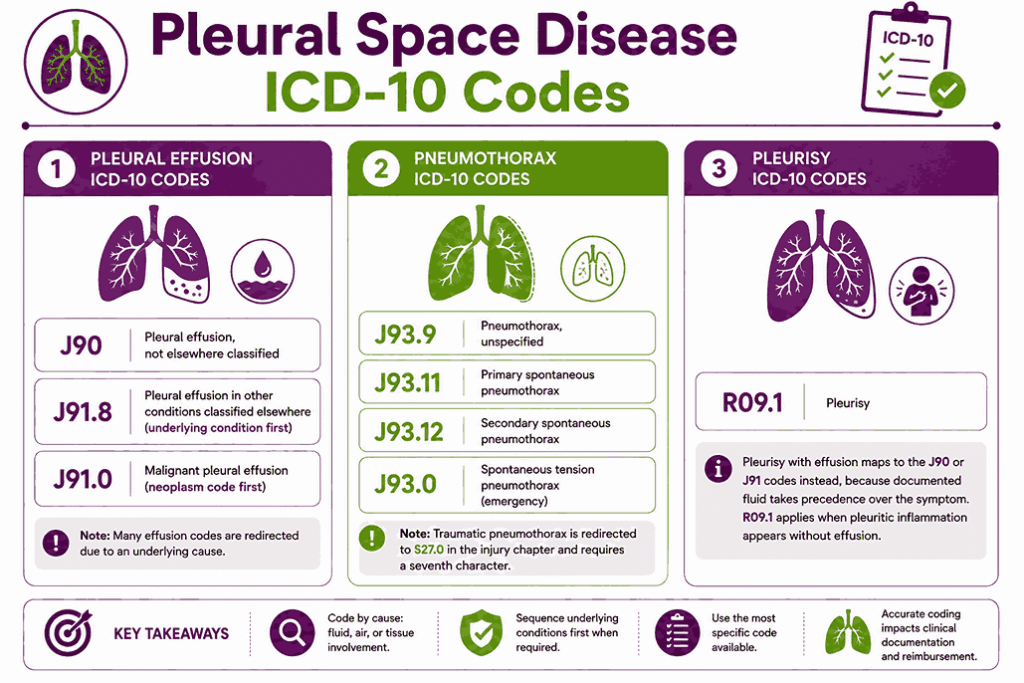
The J90 to J94 range is reserved for pleural space disease codes. These are coded on the basis of fluid, air, or tissue involvement. Many effusion codes in this range are redirected due to an underlying cause.
Pleural Effusion ICD-10 Codes
The ICD-10 code J90 corresponds to pleural effusion, not elsewhere classified. Two other codes are included in this range. The J91.8 records pleural effusion in other conditions classified elsewhere, and the underlying condition sequences first. As for J91.0, it reports malignant pleural effusion, which requires the neoplasm code to be listed first.
Pneumothorax ICD-10 Codes
Pneumothorax codes are split by cause and spontaneity. The ICD-10 codes for pneumothorax include:
- J93.9: Pneumothorax, unspecified.
- J93.11: Primary spontaneous pneumothorax
- J93.12: Secondary spontaneous pneumothorax
- J93.0: Spontaneous tension pneumothorax, the emergency presentation
In addition to these codes, traumatic pneumothorax is redirected to S27.0 in the injury chapter and requires a seventh character.
Pleurisy ICD-10 Codes
The pleurisy ICD-10 code is R09.1 for pleurisy, a symptom code in the R chapter. Pleurisy with effusion maps to the J90 or J91 codes instead, because documented fluid takes precedence over the symptom. R09.1 applies when pleuritic inflammation appears without effusion.
Acute and Critical Care Respiratory ICD-10 Codes
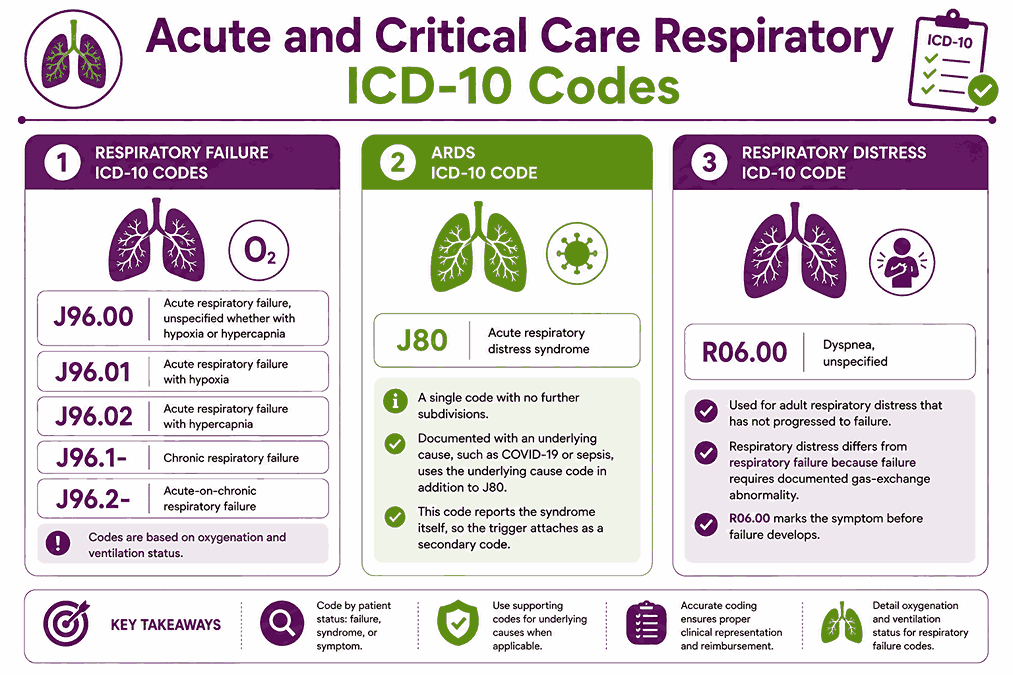
Acute and critical care respiratory codes fall under J80 and J96 and are coded by oxygenation and ventilation status. Also, acute, chronic, hypoxic, and hypercapnic detail separates the respiratory failure codes.
Respiratory Failure ICD-10 Codes
The respiratory failure ICD-10 code is J96.00 for acute respiratory failure, unspecified whether with hypoxia or hypercapnia. J96.01 reports acute respiratory failure with hypoxia, and J96.02 reports acute respiratory failure with hypercapnia. Chronic respiratory failure uses the J96.1- subcategory, and acute-on-chronic uses J96.2-.
ARDS ICD-10 Codes
J80 is the ICD-10 code for acute respiratory distress syndrome, a single code with no further subdivisions. ARDS documented with an underlying cause, such as COVID-19 or sepsis, uses the underlying cause code in addition to J80. This code reports the syndrome itself, so the trigger attaches as a secondary code.
Respiratory Distress ICD-10 Codes
The respiratory distress ICD-10 code is R06.00 for dyspnea, unspecified, used for adult respiratory distress that has not progressed to failure. Respiratory distress differs from respiratory failure because failure requires documented gas-exchange abnormality. R06.00 marks the symptom before failure develops.
Respiratory Symptom ICD-10 Codes
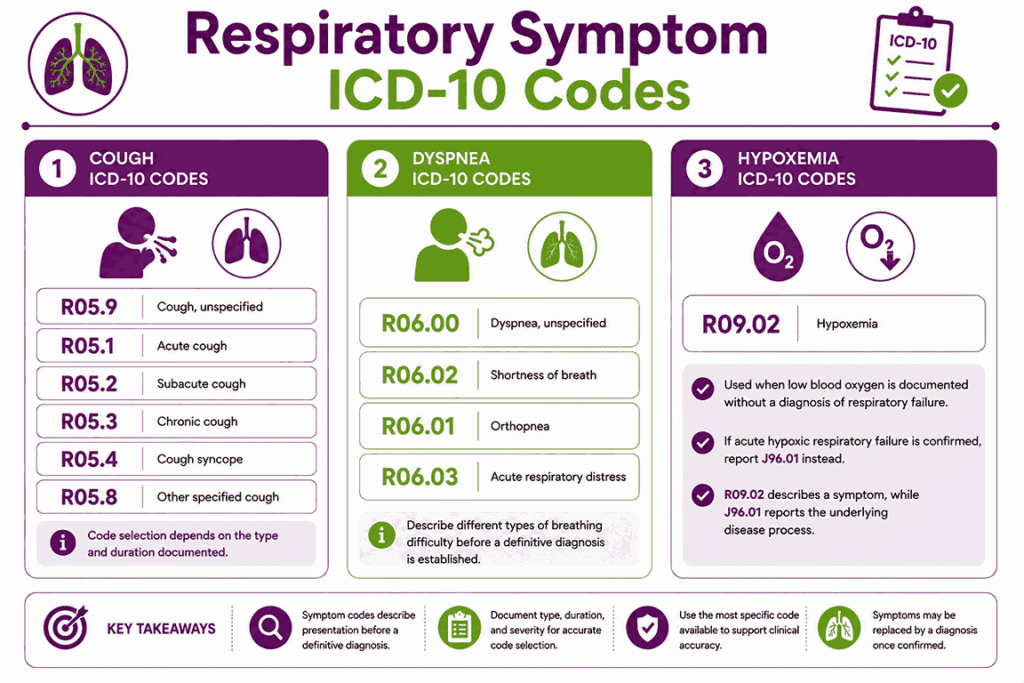
Respiratory symptom codes are found mainly in the R04-R09 range and describe a patient’s presenting signs and symptoms before a definitive diagnosis. They are commonly used during the initial diagnostic workup.
Cough ICD-10 Codes
The cough ICD-10 code depends on the type and duration documented in the medical record. R05.9 reports cough, unspecified, while R05.1, R05.2, and R05.3 distinguish acute, subacute, and chronic cough, respectively. Other options include R05.4 for cough syncope and R05.8 for other specified cough.
Dyspnea ICD-10 Codes
Dyspnea codes are reported from the R06.0- category and describe different types of breathing difficulty before a definitive diagnosis is established. R06.00 reports dyspnea, unspecified, R06.02 records shortness of breath, R06.01 reports orthopnea, and R06.03 covers acute respiratory distress.
Hypoxemia ICD-10 Codes
The hypoxemia ICD-10 code is R09.02 and is used when low blood oxygen is documented without a diagnosis of respiratory failure. If the physician confirms acute hypoxic respiratory failure, report J96.01 instead. The key distinction is that R09.02 describes a symptom, while J96.01 reports the underlying disease process.
Structural, Congenital, and Neoplastic Lung ICD-10 Codes
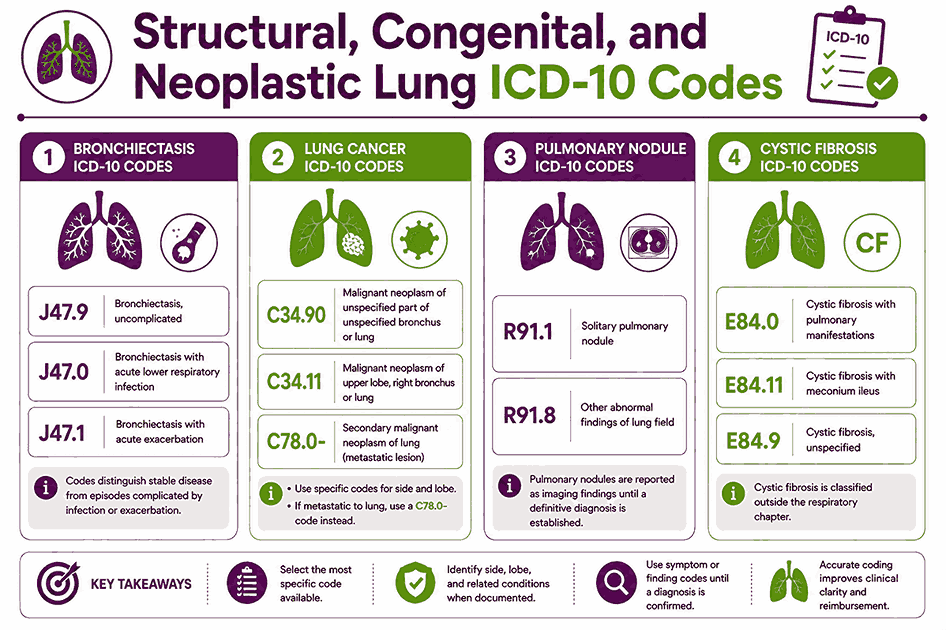
Structural lung diseases, congenital disorders, and lung neoplasms are reported across multiple ICD-10-CM chapters rather than a single respiratory category. Most conditions fall under J47, C4, Q33, E84, or related symptom codes.
Bronchiectasis ICD-10 Codes
Bronchiectasis codes distinguish stable disease from episodes complicated by infection or exacerbation. J47.9 reports uncomplicated bronchiectasis, J47.0 documents bronchiectasis with an acute lower respiratory infection, and J47.1 covers bronchiectasis with an acute exacerbation.
Lung Cancer ICD-10 Codes
Lung cancer coding requires more than identifying the malignancy. Use C34.90 for reporting a malignant neoplasm of an unspecified part of an unspecified bronchus or lung, with more specific codes identifying the side and lobe.
For instance, C34.11 reports a malignant neoplasm of the right upper lobe. If the cancer represents a metastatic lesion to the lung, use a C78.0- code instead.
Pulmonary Nodule ICD-10 Codes
Pulmonary nodules are reported as imaging findings until a definitive diagnosis is established. R91.1 reports a solitary pulmonary nodule, while R91.8 covers other abnormal findings of the lung field, including multiple nodules or pulmonary masses.
Cystic Fibrosis ICD-10 Codes
Although cystic fibrosis primarily affects the lungs, ICD-10-CM classifies it outside the respiratory chapter. E84.0 applies when pulmonary manifestations are present, E84.11 is used for cystic fibrosis with meconium ileus, and E84.9 should only be reported when the documentation does not specify the manifestation.
Sleep-Disordered Breathing ICD-10 Codes
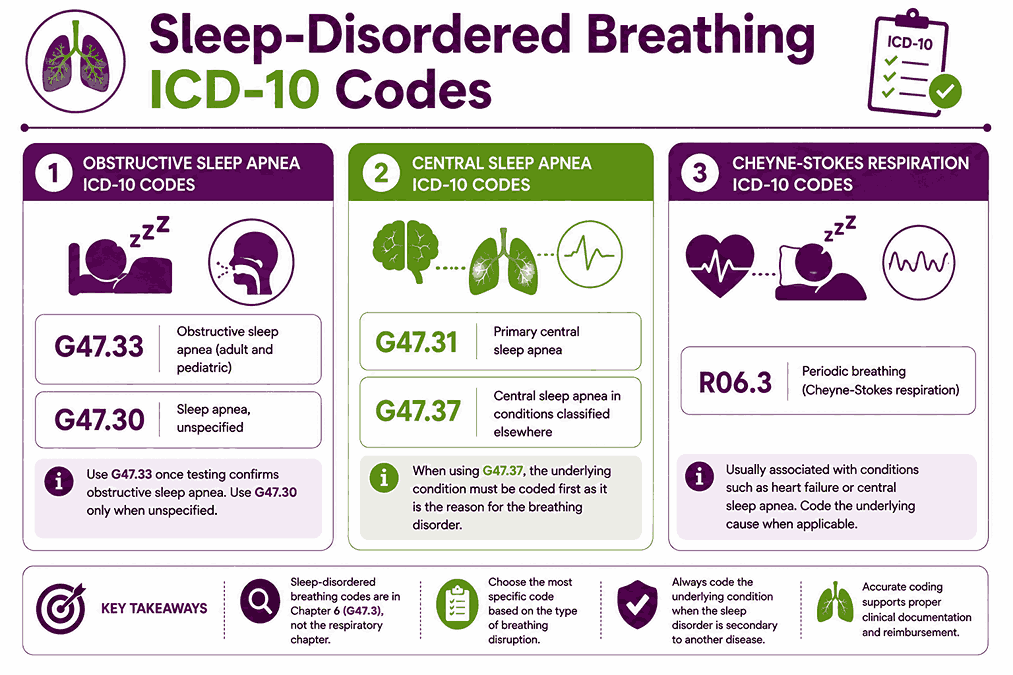
Sleep-disordered breathing conditions are classified under the G47.3 subcategory in Chapter 6 (Diseases of the Nervous System), not under the respiratory disease chapter. These codes focus on how breathing is disrupted during sleep.
Obstructive Sleep Apnea ICD-10 Codes
The ICD-10 code for obstructive sleep apnea (OSA) is G47.33. This code applies to both adults and children when a sleep study confirms that the airway repeatedly becomes blocked during sleep. Once testing identifies obstructive sleep apnea, coders should report G47.33 instead of the unspecified code, G47.30.
Central Sleep Apnea ICD-10 Codes
To document primary central sleep apnea, use G47.31. For cases of central sleep apnea due to another medical condition, coders use G47.37 (Central sleep apnea in conditions classified elsewhere). In these situations, the underlying condition must be coded first because it is the reason the breathing disorder developed.
Cheyne-Stokes Respiration ICD-10 Codes
The ICD-10 code for Cheyne-Stokes respiration is R06.3 (Periodic breathing). This condition usually appears with conditions such as heart failure or central sleep apnea. Because it may result from another health condition, coders should also report the underlying cause when applicable.
Occupational and Environmental Lung Disease ICD-10 Codes
Occupational and environmental lung diseases are classified under J60–J66 in Chapter 10 (Diseases of the Respiratory System). These codes are assigned based on the substance a person inhales, not simply the symptoms they experience.
Each ICD-10 code in the J60–J66 range identifies the specific type of dust or environmental agent responsible for the condition. The table below shows the exact condition, its corresponding ICD-10 code, and the causative agents.
| Condition | ICD-10 Code | Causative Agent |
|---|---|---|
| Coal workers’ pneumoconiosis | J60 | Coal dust |
| Asbestosis | J61 | Asbestos fibers |
| Silicosis | J62.8 | Silica and silicate dust |
| Talc pneumoconiosis | J62.0 | Talc dust |
| Pneumoconiosis, unspecified | J64 | Unspecified inorganic dust |
| Airway disease due to organic dust | J66.0 | Organic dust (such as byssinosis from textile dust exposure) |
The main rule for coding these conditions is simple: code the lung disease based on the confirmed exposure, not just the symptoms it causes. This is one of the major reasons choosing an expert pulmonology medical coding provider matters when outsourcing your billing.
Ventilator, Oxygen, and Respiratory Status ICD-10 Codes
Ventilator, oxygen, and respiratory status codes are found mainly in the Z93–Z99 range of ICD-10-CM. These codes do not describe an active lung disease. Instead, they show a patient’s ongoing need for respiratory support, medical devices, or a previous procedure.
These respiratory status codes help document long-term support requirements, such as a tracheostomy or ventilator dependence. In the table below, we have listed four main respiratory statuses, along with their ICD-10 codes and the corresponding coding rules.
| Status | ICD-10 Code | Coding Rule |
|---|---|---|
| Tracheostomy status | Z93.0 | Indicates the presence of a tracheostomy |
| Long-term ventilator dependence | Z99.11 | Reports dependence on a mechanical respirator |
| Long-term home oxygen use | Z99.81 | Reports dependence on supplemental oxygen |
| Lung transplant status | Z94.2 | Indicates the presence of a transplanted lung |
The key difference between these codes and disease codes is that status codes describe only the patient’s current condition or support needs, not the illness causing the problem.
Related Pulmonary Codes Outside Chapter 10
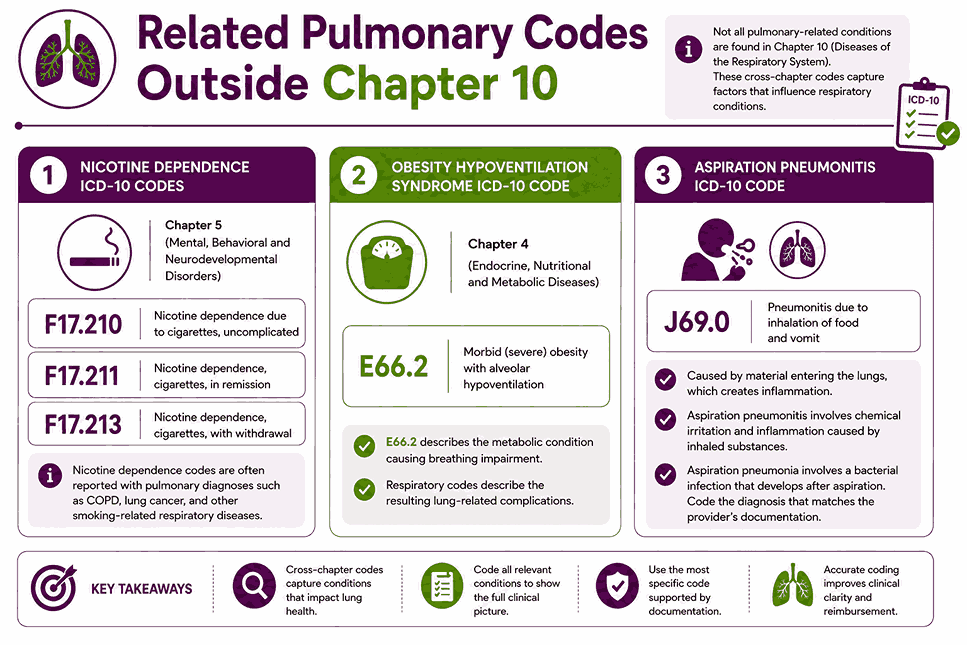
Not all pulmonary-related conditions are found in Chapter 10 (Diseases of the Respiratory System).
Some important codes come from other ICD-10 chapters and are reported alongside respiratory diagnoses when they affect a patient’s lung health. These cross-chapter codes capture factors that influence respiratory conditions.
Nicotine Dependence ICD-10 Codes
Nicotine dependence codes are classified under Chapter 5 (Mental, Behavioral and Neurodevelopmental Disorders). The ICD-10 code for nicotine dependence due to cigarettes, uncomplicated, is F17.210.
Other nicotine dependence codes identify different patient situations, such as:
- F17.211: Nicotine dependence, cigarettes, in remission
- F17.213: Nicotine dependence, cigarettes, with withdrawal
Nicotine dependence codes are often reported with pulmonary diagnoses such as COPD, lung cancer, and other smoking-related respiratory diseases.
Obesity Hypoventilation Syndrome ICD-10 Codes
The ICD-10 code for obesity hypoventilation syndrome (OHS) is E66.2, which explains Morbid (severe) obesity with alveolar hypoventilation. This code falls under Chapter 4 (Endocrine, Nutritional and Metabolic Diseases).
E66.2 describes the metabolic condition causing breathing impairment, while respiratory codes describe the resulting lung-related complications.
Aspiration Pneumonitis ICD-10 Codes
The ICD-10 code for aspiration pneumonitis is J69.0 (Pneumonitis due to inhalation of food and vomit). Unlike many respiratory codes, this condition is caused by material entering the lungs, which creates inflammation.
Aspiration pneumonitis involves chemical irritation and inflammation caused by inhaled substances. Meanwhile, aspiration pneumonia involves a bacterial infection that develops after aspiration. This is why coders must select the diagnosis that matches the provider’s documentation.
Why Do Pulmonary Claims Get Denied?
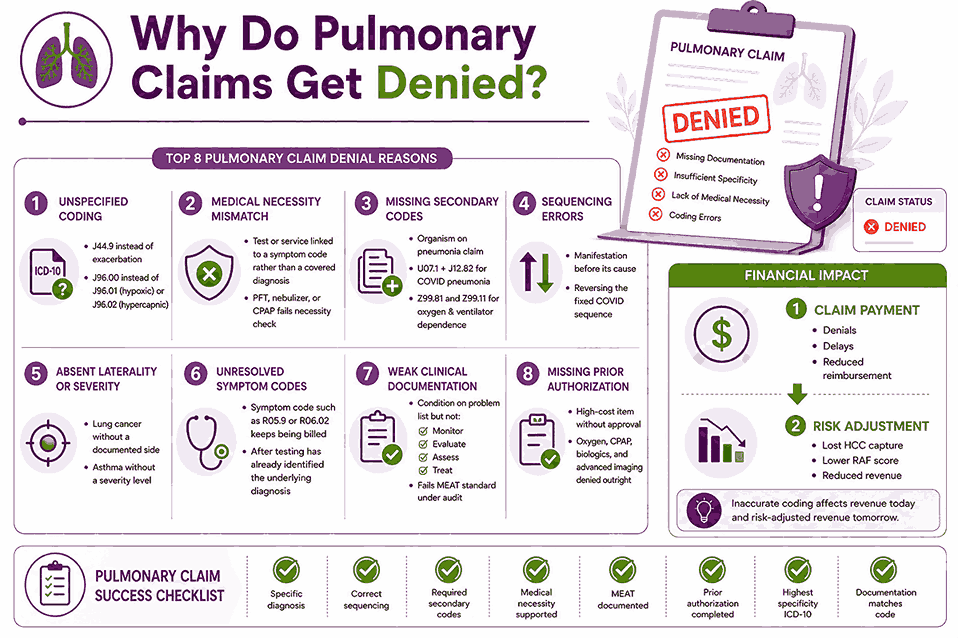
Most pulmonary claims fail because the diagnosis is not specific enough or the documentation does not support the reported code. This is why many pulmonary practices partner with expert pulmonology billing companies to improve claim accuracy.
Some common reasons why pulmonary claims get denied are:
- Unspecified Coding: A payable diagnosis gets flattened into a vague code, such as J44.9 when the note documents an exacerbation, or J96.00 when the failure is clearly hypoxic (J96.01) or hypercapnic (J96.02).
- Medical Necessity Mismatch: A test or service is linked to a symptom code rather than a covered diagnosis, so a pulmonary function test, nebulizer medication, or CPAP fails the payer’s necessity check.
- Missing Secondary Codes: A required companion code is omitted, such as the organism on a pneumonia claim, the U07.1 plus J12.82 pairing for COVID pneumonia, or Z99.81 and Z99.11 for oxygen and ventilator dependence.
- Sequencing Errors: Codes are reported in the wrong order, whether that means placing a manifestation before its cause or reversing the fixed COVID sequence.
- Absent Laterality or Severity: A code that demands specificity is filed without it, such as lung cancer without a documented side or asthma without a severity level.
- Unresolved Symptom Codes: A symptom code such as R05.9 or R06.02 continues to be billed after testing has already identified the underlying diagnosis.
- Weak Clinical Documentation: The condition appears on the problem list but is never monitored, evaluated, assessed, or treated in the encounter, so it fails the MEAT standard under audit.
- Missing Prior Authorization: A high-cost item proceeds without approval, and home oxygen, CPAP, biologics, and advanced imaging are denied outright when authorization is not obtained first.
A specific, billable diagnosis loses its value the moment it is reduced to an unspecified code or left unsupported by the record. That gap costs the practice twice, first during claim review and payment, and again during risk adjustment.
Which Pulmonary ICD-10 Codes Carry HCC Weight?
The conditions that carry HCC impact include COPD, interstitial lung disease, lung cancer, chronic respiratory failure, severe persistent asthma, oxygen dependence, and ventilator dependence.
An HCC is a category used in Medicare Advantage risk adjustment to group serious and chronic conditions. Each category has a risk adjustment factor (RAF), which helps estimate the level of care and resources a patient may need throughout the year.
For 2026, CMS uses HCC Version 28, an updated model that places more focus on accurate documentation and disease severity. The table below maps each high-value pulmonary condition to its anchor code and its risk-adjustment note.
| Condition | Anchor Code | Risk-Adjustment Note |
|---|---|---|
| Ventilator dependence | Z99.11 | ~0.879 community RAF; among the heaviest respiratory weights |
| Long-term home oxygen use | Z99.81 | ~0.486 community RAF; outweighs pulmonary fibrosis coded alone |
| Lung cancer | C34.90 | Active malignancy; high RAF while under treatment |
| Interstitial lung disease / pulmonary fibrosis | J84.10 | ~0.204 community RAF; grouped with COPD in v28 |
| Chronic respiratory failure | J96.1- | Risk-adjusted; unspecified J96.00 / J96.20 / J96.90 forfeits capture |
| COPD | J44.9 / J44.1 | Chronic lung disorder category; exacerbation coding preserves weight |
| Severe persistent asthma | J45.50 | Newly risk-adjusted under v28 after years of scoring nothing |
How Do You Reduce Pulmonary Claim Denials?
To prevent pulmonary claim denials, one effective approach is partnering with a reputable pulmonology billing services provider. If not, use the four points below to address the most common issues that cause pulmonary claims to fail.
- Code to the deepest specificity the record supports. Reach past the unspecified defaults whenever the note earns it, because J96.01, J44.1, and a named pneumonia organism all pay and score in ways their vaguer siblings never will.
- Query the provider instead of guessing. Ask for the missing laterality on lung cancer, the missing severity on asthma, or the unstated device dependence.
- Capture the status codes alongside the disease. Add ventilator dependence (Z99.11), tracheostomy status (Z93.0), and home oxygen use (Z99.81) as their own lines. It’s because these high-weight codes are separate from the disease code and are consistently dropped from claims.
- Scrub every claim before it leaves. Catch the reversed COVID sequence, the pneumonia missing its organism, the respiratory failure left unspecified, and the symptom code that should have become a diagnosis. All of these are front-end review flags before a payer sees them.
Pulmonology ICD-10 Codes FAQs
What Are the Most Common Pulmonary ICD-10 Codes?
The highest-volume pulmonary ICD-10 codes are J44.9 (COPD), J45.909 (unspecified asthma), J18.9 (pneumonia), R05.9 (cough), and J96.00 (acute respiratory failure). Rounding out the everyday set are R06.02 (shortness of breath), J20.9 (acute bronchitis), J90 (pleural effusion), J96.01 (acute respiratory failure with hypoxia), and G47.33 (obstructive sleep apnea).
Why Did Medicare Deny My Nebulizer or Inhaler Drug Claim?
Nebulizer medications get denied because the diagnosis code does not match Medicare’s covered list for that specific drug. Under Part B, nebulizer drugs like albuterol (J7611, J7613) and budesonide (J7626) are covered for obstructive conditions such as J44.9 (COPD), J45.- (asthma), and J47.9 (bronchiectasis). However, these same drugs are denied when linked to a symptom code like R06.02 or an unspecified respiratory code.
What ICD-10 Code Do You Use for a Patient on Home Oxygen?
Home oxygen use is coded with Z99.81 (dependence on supplemental oxygen). Code the lung condition that requires the oxygen first, such as J44.9 for COPD or J84.10 for pulmonary fibrosis, then add Z99.81 as a status code. Z99.81 carries roughly a 0.486 risk-adjustment weight on its own, so leaving it off under-scores the patient even when the disease is coded correctly.
Is “Nicotine Dependence” the Same Code as “History of Smoking”?
No, and mixing them up is one of the most common pulmonary coding errors. A current smoker is F17.210 (nicotine dependence, cigarettes, uncomplicated). A former smoker who quit is Z87.891 (personal history of nicotine dependence). Someone who smoked but was never dependent uses Z72.0 (tobacco use).
What’s the Code for a Cough That Has Lasted for Weeks or Months?
A cough lasting 8 weeks or longer is R05.3 (chronic cough). FY2022 split the old single-code for cough into duration-based options. R05.1 for acute cough (under 3 weeks), R05.2 for subacute cough (3 to 8 weeks), and R05.3 for chronic cough. R05.9 (cough, unspecified)
What Code is Used for Vaping-Related Lung Injury or EVALI?
Vaping lung injury is coded with U07.0 (vaping-related disorder), a code added in 2020 that many charts still miss. Code U07.0 first, then add the specific manifestation such as J68.0 for chemical bronchitis, J80 for acute respiratory distress syndrome, or J96.01 for acute hypoxic respiratory failure. EVALI does not have its own separate diagnosis code.