A PEG tube claim looks simple until the payer sends it back with a denial. Most teams expect one endoscopy, one tube, and one code, but it’s more complicated. Coders often confuse new tube placement with tube replacement, and that one mistake triggers bundling edits and lost payment.
This guide explains CPT 43246 and CPT 43762, along with related codes, modifiers, ICD-10 support, and documentation requirements. Each section shows what payers check, where claims fail, and how to fix errors before submission.
Working with an experienced Medical Billing Company also helps your team catch these problems before the claim leaves your office. Start with the two codes that confuse, then move into documentation and denial prevention.

What PEG Tube Placement Involves?
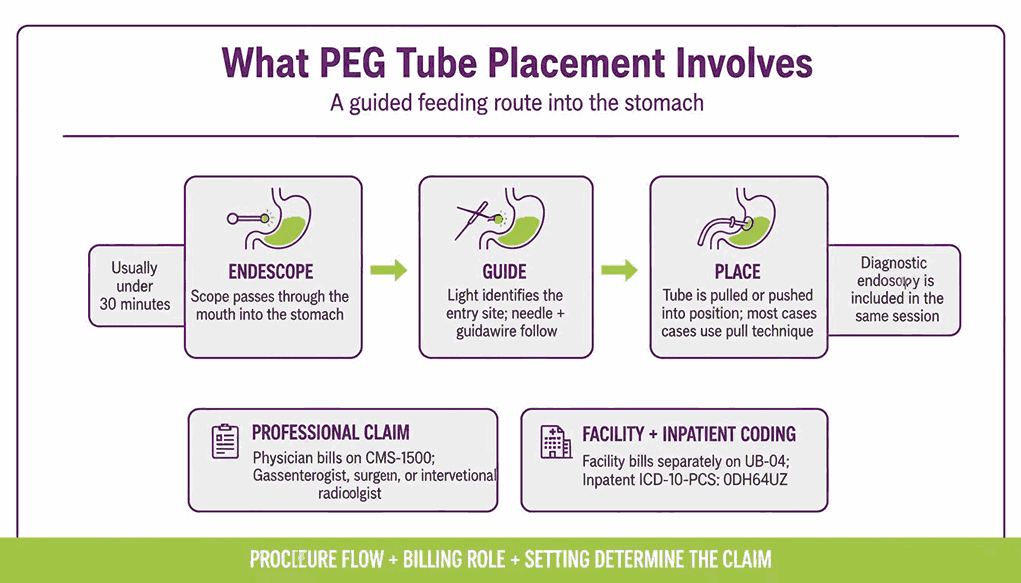
PEG stands for percutaneous endoscopic gastrostomy, a procedure that creates a feeding route into the stomach. Patients who cannot swallow safely or eat enough by mouth often need this route.
How the Procedure Works
The physician passes an endoscope through the mouth and into the stomach. Light from the scope shows through the abdominal wall at the planned entry site. The physician then places a needle and guidewire, and the tube is pulled or pushed into position. Most cases use the pull technique, and the whole session usually takes under thirty minutes. Diagnostic endoscopy is part of the same session, so it is not billed on its own.
Who Bills and Where
Gastroenterologists perform most PEG placements, though surgeons and interventional radiologists also place gastrostomy tubes. The physician bills the professional service on a CMS 1500 claim, and the facility bills separately. Hospitals bill the facility side on a UB04 for outpatient or inpatient stays. Inpatient coders also assign ICD-10-PCS code 0DH64UZ for percutaneous endoscopic insertion of a feeding device into the stomach.
Core CPT Codes for PEG Billing
Two codes anchor most PEG billing questions, and they describe very different services. Our CPT Code guide lists related endoscopy codes you may need besides these two.
| Detail | CPT 43246 | CPT 43762 |
|---|---|---|
| Descriptor | EGD with directed placement of percutaneous gastrostomy tube | Replacement of gastrostomy tube, percutaneous, without imaging or endoscopic guidance, no tract revision |
| Service type | New tube placement | Replacement through an established tract |
| Typical setting | Endoscopy unit or hospital outpatient department | Office, clinic, or hospital |
| Includes | Diagnostic EGD and tube insertion | Removal of the old tube, when performed |
| Does not include | Separate diagnostic EGD (CPT 43235) | Imaging guidance or tract revision |
| Common mistake | Billing CPT 43235 with CPT 43246 | Using CPT 43246 for a simple tube swap |
CPT 43246 in Detail
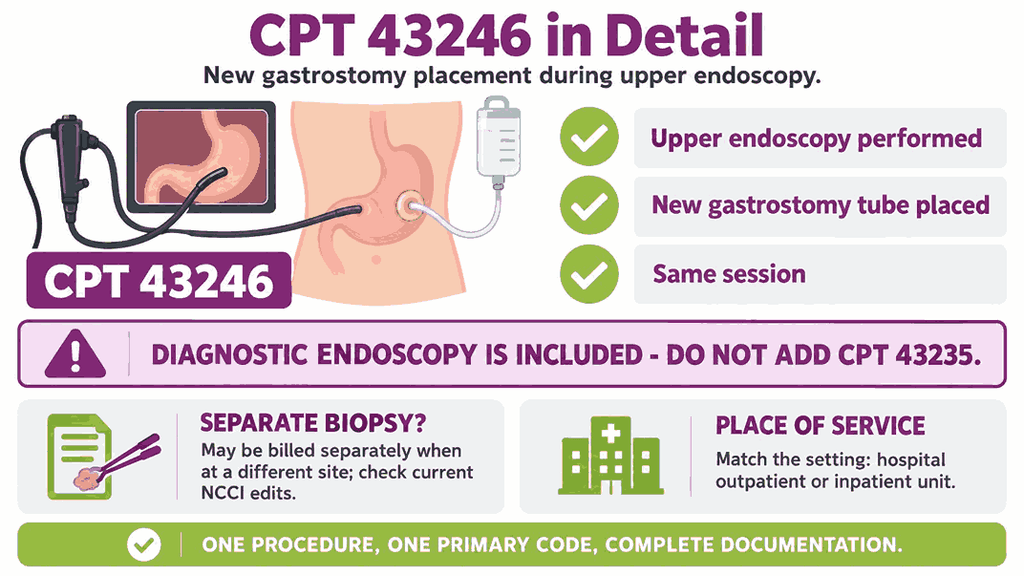
Use CPT 43246 when the physician performs an upper endoscopy and places a new gastrostomy tube during the same session. The code already includes the diagnostic endoscopy, so do not add CPT 43235. Many practices lose money here because they report both codes and trigger an NCCI edit.
A biopsy at a different site may be billed separately, but check current NCCI edits first. The place of service follows the setting, such as a hospital outpatient department or an inpatient unit.
CPT 43762 in Detail
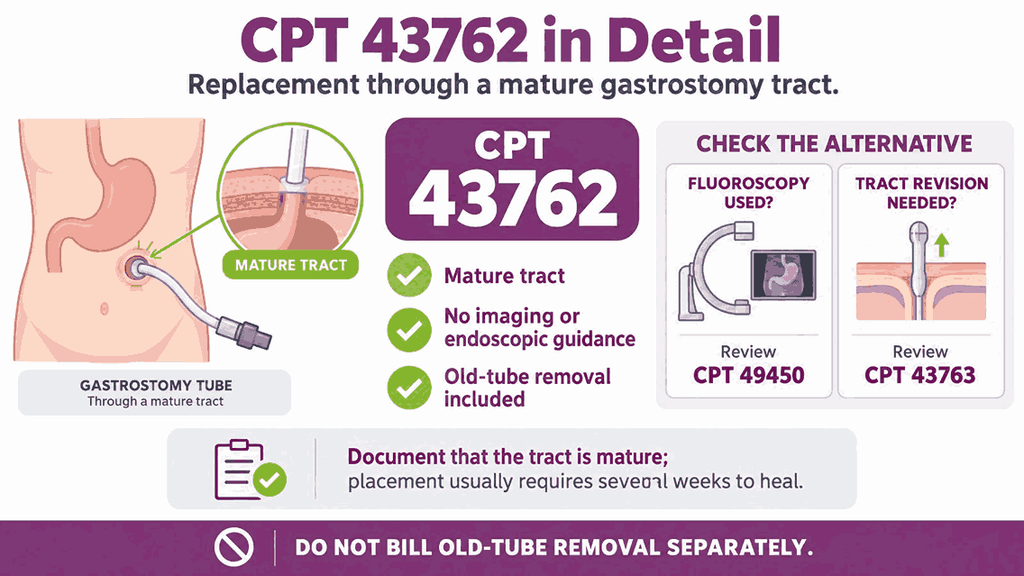
CPT 43762 applies when a clinician replaces a gastrostomy tube through a mature tract. The descriptor includes removal of the old tube, when performed, so do not bill removal separately. The code applies only when no imaging or endoscopic guidance is used.
If the clinician uses fluoroscopy for the replacement, review CPT 49450 instead of 43762. If the tract needs revision during the replacement, CPT 43763 is the better match. Payers expect notes showing the tract was mature, which usually takes several weeks after placement.
Related Codes Often Billed With or Instead of PEG
Not every feeding tube service fits those two codes, so keep this table nearby.
| CPT Code | Service | When to Use |
|---|---|---|
| 43763 | Replacement of gastrostomy tube with tract revision | Tract needs revision, no imaging guidance |
| 49440 | Percutaneous gastrostomy tube insertion under fluoroscopy | Interventional radiology placement |
| 49450 | Replacement of gastrostomy or cecostomy tube under fluoroscopy | Imaging-guided tube replacement |
| 43653 | Laparoscopic gastrostomy | Surgeon places the tube through a laparoscope |
| 43830 | Open gastrostomy | Open surgical tube placement |
| 43235 | Diagnostic EGD | Only when no tube is placed |
PEG Compared With Other Gastrostomy Methods
Choosing the correct code starts with knowing how the tube was placed. The comparison below shows how approach, guidance, and billing codes differ across common methods.
| Method | Approach | Guidance | Primary CPT | Typical Provider |
|---|---|---|---|---|
| PEG | Through the mouth and stomach wall | Endoscope | 43246 | Gastroenterologist or surgeon |
| Radiologic gastrostomy | Through the skin | Fluoroscopy | 49440 | Interventional radiologist |
| Laparoscopic gastrostomy | Small abdominal incisions | Laparoscope | 43653 | General surgeon |
| Open gastrostomy | Abdominal incision | Direct vision | 43830 | General surgeon |
Match the code to the method documented in the procedure note, not to the order or the scheduling record.
ICD-10 Codes That Support Medical Necessity
Payers approve PEG claims when the diagnosis shows why oral feeding is unsafe or insufficient. Our ICD code guide explains gastroenterology diagnosis coding in more depth for billing teams.
| ICD-10-CM Code | Description | Common Use |
|---|---|---|
| R13.10 | Dysphagia, unspecified | Swallowing problem with no documented phase |
| R13.12 | Dysphagia, oropharyngeal phase | Swallow study confirms the oropharyngeal phase |
| I69.391 | Dysphagia following cerebral infarction | Stroke-related swallowing failure |
| G12.21 | Amyotrophic lateral sclerosis | Progressive loss of swallowing function |
| E43 | Unspecified severe protein calorie malnutrition | Provider documents severe malnutrition |
| E44.0 | Moderate protein calorie malnutrition | Provider documents moderate malnutrition |
| Z43.1 | Encounter for attention to gastrostomy | Tube replacement or routine tube care |
| K94.23 | Gastrostomy malfunction | Blocked or failing tube |
Sequence the underlying condition and swallowing problem first, then malnutrition when the provider documents it. Coders cannot assign malnutrition from a dietitian note alone, because the treating provider must document it.
Modifiers Used on PEG Claims
Modifiers explain unusual circumstances, and wrong ones create denials as quickly as missing ones.
| Modifier | When It Applies | Key Requirement |
|---|---|---|
| 25 | Significant, separately identifiable E/M on the same day | Notes show work beyond routine pre-procedure review |
| 22 | Increased procedural services | Notes explain the extra time and difficulty |
| 52 | Reduced services | Planned service is reduced but still completed |
| 53 | Discontinued procedure | Physician stops because of patient risk |
| 59 or XS | Distinct procedural service | Separate site or session, and NCCI allows it |
| 78 | Unplanned return to the operating room | Related complication needs a return trip |
Global Period and Same Day Services
Both codes carry a global period, so check the current CMS Physician Fee Schedule for exact days. Use modifier 25 only when the visit stands apart from the procedure. The decision to place a tube, made during that visit, does not usually qualify by itself. Same-day office visits need modifier 25 and notes that show separate work.
Documentation Checklist
Strong procedure notes protect payment, while missing details invite denials and audit requests. Confirm that each procedure note contains the following items before you submit the claim:
- A clear indication, such as dysphagia, stroke, or head and neck cancer
- Failed or unsafe oral feeding, with the expected length of need
- Signed informed consent
- Endoscopic findings and the chosen entry site
- Technique used, tube brand, and French size
- Antibiotic prophylaxis given
- Complications, or a statement that none occurred
Endoscopy and tube placement claims carry coding rules that general billers often miss. A team that provides GI billing services already knows the NCCI edits tied to CPT 43246. It also knows which replacement records payers request most often during audits and appeals.
Extra Notes for Tube Replacements
Replacement claims need the original placement date and the reason for the change. Common reasons include blockage, leakage, a worn balloon, or accidental removal by the patient. Notes should also state the tube type, size, and whether imaging was used.
Step-by-Step Billing Workflow
- Verify coverage. Verify eligibility, benefits, and any prior authorization before the patient arrives for the procedure.
- Review the note. Read the note for the method, guidance type, and whether the tube is new or replaced.
- Select the CPT code. Pick CPT 43246 for new endoscopic placement or CPT 43762 for replacement without guidance.
- Assign diagnoses. Link ICD-10 codes that show the cause, the swallowing problem, and any documented malnutrition.
- Apply modifiers. Add modifiers only when the note supports them, and confirm each one against payer policy.
- Scrub and submit. Run NCCI and payer edits, fix flagged lines, and submit the claim within the filing limit.
- Track payment. Post payments, compare them with the contract, and work every denial within the appeal window.
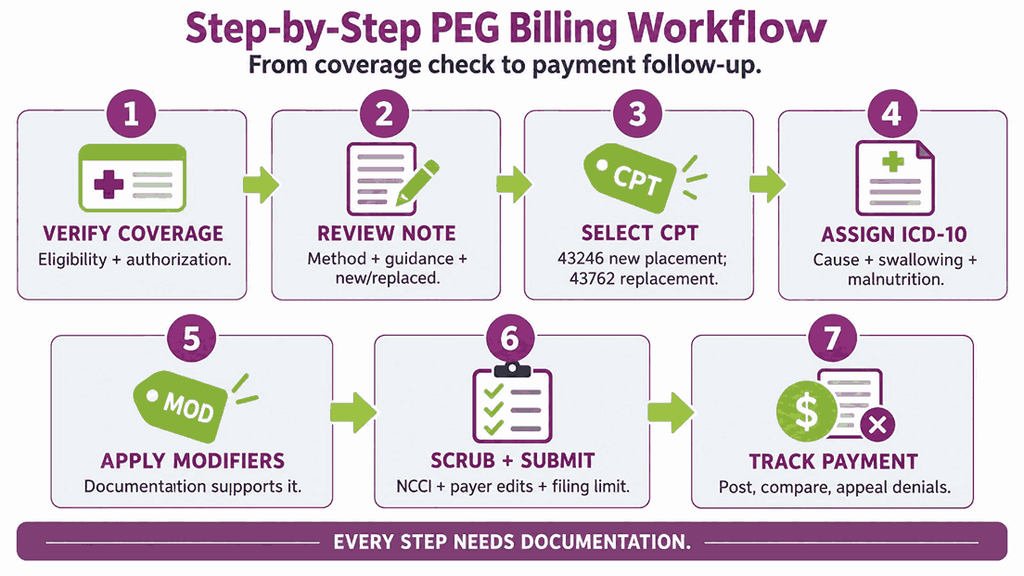
Each step in this workflow depends on the one that comes before it. A missed eligibility check often shows up weeks later as a denied claim. Practices with dependable RCM Services track every claim from registration to payment posting, so gaps close early.
Common Denials and How to Prevent Them
Gastrostomy claims fail for a handful of predictable reasons, and most are preventable at the front end.
| Denial Code | Likely Cause | Fix |
|---|---|---|
| CO 97 | CPT 43235 billed with CPT 43246 | Remove the bundled code before submission |
| CO 4 | Missing or incorrect modifier | Add a modifier supported by the note |
| CO 50 | Medical necessity not shown | Add the swallow evaluation and nutrition records |
| CO 11 | Diagnosis does not match the procedure | Link the correct ICD-10 code |
| CO 16 | Missing information | Send procedure notes, tube details, and dates |
Consider a practice that billed CPT 43235 instead of CPT 43246 on every PEG claim. The payer bundled the diagnostic code each time, and staff spent hours on appeals. One short coder training session would have prevented every one of those appeals. When appeals pile up, denial management support helps teams find patterns and fix root causes.
Payer Rules to Check
Medicare
Medicare addresses enteral nutrition in NCD 180.2, which requires a permanent impairment of the body function involved. That policy mainly governs formula and supplies, yet the medical record should still show why long-term feeding is needed. Local coverage rules from your MAC can add requirements, so review them before billing.
Commercial Payers
Commercial plans vary widely, and some require prior authorization for planned outpatient gastrostomy placement. Check current policies from UnitedHealthcare, Aetna, Cigna, and Humana before scheduling nonurgent cases. Inpatient placements during an acute admission often follow notification rules rather than separate authorization.
Tips for Cleaner PEG Claims
Clean claims start at scheduling and registration, not at the billing desk after the visit.
Set Up Scrubber Rules
Claim scrubbers catch repeat errors faster than manual review, so build these rules once.
| Rule Trigger | Action |
|---|---|
| CPT 43235 and CPT 43246 on the same date | Hold the claim and remove CPT 43235 |
| CPT 43762 with no original placement date on file | Request the placement record before billing |
| CPT 43762 and CPT 49450 on the same date | Confirm which guidance method was used |
| CPT 43246 with no dysphagia or malnutrition diagnosis | Return to the coder for diagnosis review |
| Modifier 25 with no separate E/M note | Send a query to the provider |
Track Tube Changes by Patient
Payers question replacements that occur too often, so keep a simple log for each gastrostomy patient. Record the placement date, each replacement date, tube type, French size, and the reason for every change. This log supports CPT 43762 claims and answers audit questions about tract maturity and replacement frequency.
Check Supply Billing Separately
The tube itself may be a separate supply item, depending on the payer and the setting. Review whether HCPCS B4087 or B4088 is payable beside the procedure code. Facility settings often include the tube in the facility payment, so avoid duplicate supply charges.
Match Professional and Facility Claims
Hospital and physician claims for the same PEG should agree on date, diagnosis, and procedure. Mismatches between the two claims can trigger payer reviews and slow payment.
Prepare Appeal Packets Early
Medical necessity denials are resolved faster when a standard appeal packet is ready in advance. Include these items:
- Swallow study or speech pathology report
- Dietitian assessment with weight history
- Physician letter stating the expected length of tube feeding
- Procedure note with tube details
Audit Your Own Claims
Pull a small sample of CPT 43246 and CPT 43762 claims each quarter. Compare the note, the code, the diagnosis, and the payment on each one. Repeated findings point to a training need, a template gap, or a payer policy change.
What is the CPT code for PEG tube placement?
CPT 43246 describes upper endoscopy with directed placement of a percutaneous gastrostomy tube. It includes the diagnostic endoscopy, so you don’t bill CPT 43235 separately.
Is CPT 43762 Used For PEG tube placement?
No, CPT 43762 describes replacement of an existing tube through a mature tract. New placement uses CPT 43246, 49440, 43653, or 43830, depending on the method.
Can I bill 43235 with 43246?
No, because the diagnostic endoscopy is already included in CPT 43246 and NCCI bundles the two.
Does Medicare Cover PEG Tube Placement?
Medicare generally covers medically necessary PEG placement when notes show a clear need for long-term enteral feeding. Local coverage rules from your MAC can add requirements, so review them before billing.
Which Modifier Applies When a PEG Procedure is Stopped Early?
Modifier 53 applies when the physician stops the procedure because of patient risk. Modifier 52 applies when the planned service is reduced, but the procedure is still completed.
How can a Practice Reduce PEG-related Denials?
Start with correct code selection, matching diagnosis codes, and complete procedure notes. Add NCCI edit checks and a monthly denial review to catch repeat errors early.