New Jersey Medicaid billing is the process of submitting, tracking, and collecting claims for services delivered to NJ FamilyCare members. Total Medicaid spending in New Jersey is $23.4 billion, with the federal government paying 60%. Most claims route to one of five managed care organizations, while a smaller set stays with the state’s fee-for-service program. That fee-for-service schedule is thin: New Jersey’s Medicaid-to-Medicare fee index was 0.61 in 2024, against a national average of 0.75.
Each pathway has its own filing deadlines, authorization rules, and appeal routes. A claim that is clean for one payer can deny at another, so providers that treat NJ Medicaid as a single payer lose revenue to avoidable rework and missed deadlines. The exposure is greatest with complex members: people ages 65+ and people with disabilities are 18% of enrollees but account for 58% of spending.
Transcure handles NJ Medicaid claims for ambulatory surgery centers, physician groups, and health systems. This guide covers the full claim path, from provider enrollment, eligibility checks, and submission rules to prior authorization, crossover claims, reimbursement rates, denial prevention, appeals, and audit exposure. Use it as a working reference for your billing team.
How New Jersey Medicaid Is Structured for Billing
New Jersey Medicaid is branded NJ FamilyCare in member and provider communications. The program covers Medicaid and the Children’s Health Insurance Program (CHIP) under one name. The state’s Division of Medical Assistance and Health Services (DMAHS), part of the Department of Human Services, administers it.
Enrollment reached 1,791,141 members in September 2026, according to DMAHS data. Non-disabled children account for 810,550 of those members, and non-disabled adults account for 675,382. Billing teams should treat NJ Medicaid and NJ FamilyCare as one payer family.
Fee-for-Service vs. Managed Care
New Jersey began moving Medicaid beneficiaries into managed care in 1995. Under that model, members enroll in a managed care organization (MCO) that pays claims and coordinates care. Fee-for-service, where providers bill the state fiscal agent directly, still applies to a narrower group.
Fee-for-service billing to the state still applies in limited cases, such as:
- Members excluded from MCO enrollment, including some waiver participants
- Services carved out of MCO benefits in the NJ Administrative Code, such as nursing facility care and personal care assistant services
- Dates of service before a member’s MCO enrollment takes effect
Carve-outs change over time. Confirm the current list in the NJMMIS provider manual before building payer rules around it.
| Pathway | Who Pays | Where Claims Go | Key Billing Implication |
|---|---|---|---|
| Fee-for-service | State Medicaid program | Fiscal agent Gainwell Technologies through NJMMIS | One-year filing window for most non-institutional claims |
| Managed care | One of five MCOs | The member’s MCO, through its clearinghouse or portal | 180-day filing window, plus plan-specific authorization and appeal rules |
| Medicare crossover | Medicare first, then Medicaid for cost sharing | Medicare, then automatic crossover or direct billing | Allow 45 days before rebilling a crossover claim |
The Five NJ FamilyCare MCOs
DMAHS contracts with five managed care organizations for NJ FamilyCare. Each plan has its own provider manual, portal, and payer ID. Billing teams should keep a current payer matrix for all five.
- Aetna Better Health of New Jersey
- Fidelis Care (formerly WellCare)
- Horizon NJ Health, the NJ FamilyCare plan from Horizon Blue Cross Blue Shield of New Jersey
- UnitedHealthcare Community Plan
- Wellpoint (formerly Amerigroup)
Rebrands change payer IDs, portals, and manuals. Wellpoint replaced the Amerigroup name on January 1, 2024. Confirm the current roster on the DMAHS health plans page, since contracts can change. For broader payer friction in the state, see our guide to medical billing challenges in New Jersey.

NJ Medicaid Provider Enrollment and Credentialing
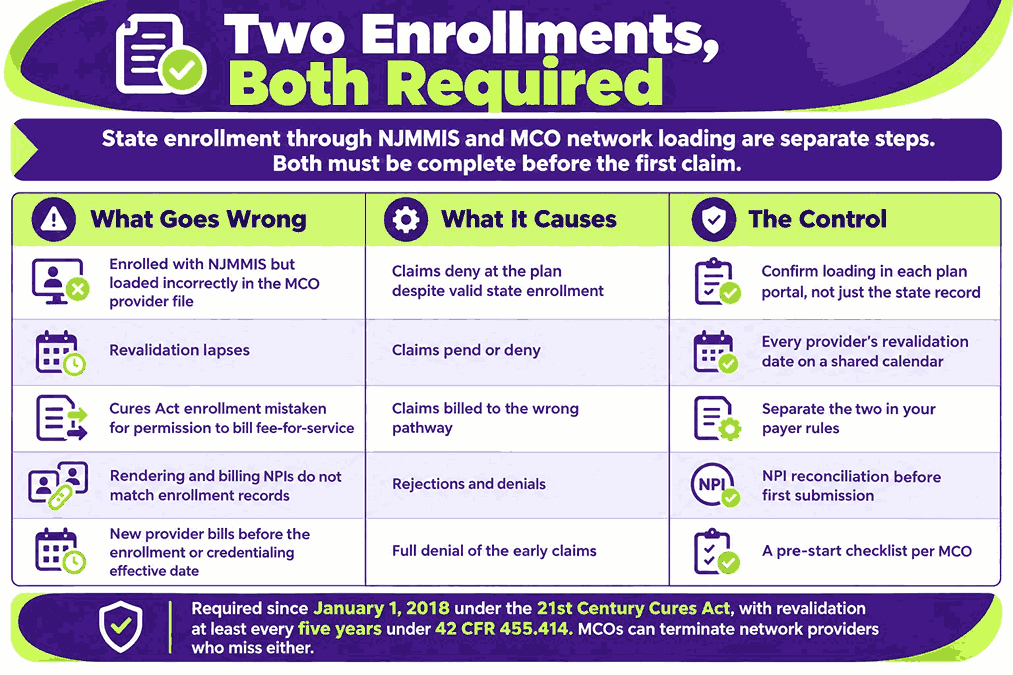
Enrolling with the state and joining an MCO network are two separate steps, and both must be complete. NJMMIS, the state’s Medicaid Management Information System, handles state enrollment. Gainwell Technologies operates NJMMIS as the fiscal agent and issues each provider a seven-digit Medicaid ID.
The 21st Century Cures Act has required Medicaid managed care network providers to enroll with the state Medicaid program since January 1, 2018. Federal rule 42 CFR 455.414 also requires revalidation at least every five years. MCOs can terminate network providers that miss either requirement.
Where Enrollment Breaks Claims
- A provider is enrolled with NJMMIS but loaded incorrectly in the MCO’s provider file
- Revalidation lapses cause claims to pend or deny
- Cures Act enrollment is mistaken for permission to bill fee-for-service Medicaid
- Rendering and billing NPIs on the claim do not match enrollment records
- New providers bill before the effective date of enrollment or credentialing
In practice, a new physician joining an ambulatory surgery center often starts seeing Medicaid patients before MCO loading is complete. Those claims deny, and the practice finds the gap weeks later. A pre-start checklist for each MCO prevents most of these denials.
CMS directed states in April 2026 to expand provider revalidation, according to state and legal summaries. Expect more revalidation requests from Gainwell. A missed packet can cause claims to pend or deny. Put every provider’s revalidation date on a shared calendar.
Eligibility Verification and Member Plan Complexity
Eligibility errors rank among the most preventable causes of Medicaid denials. DMAHS tells providers to confirm NJ FamilyCare eligibility every month. Providers must also confirm the member’s health plan and an active authorization. Best practice is to verify before every visit.
Providers check eligibility in the Medicaid Eligibility Verification System (eMEVS) through the NJMMIS website. It returns date-specific eligibility, which reduces eligibility denials. MCO portals then confirm plan assignment and authorization status. Both checks belong in the pre-visit workflow, not at claim submission.
An Eligibility Workflow That Works
- Run eMEVS for the date of service to confirm active coverage and program type.
- Identify the member’s MCO and confirm assignment in the plan portal.
- Check the member for Medicare, commercial, or other third-party coverage.
- Confirm any authorization is active under the member’s current MCO.
- Record the verification date and result in the patient account.
Coverage Churn From Federal Changes
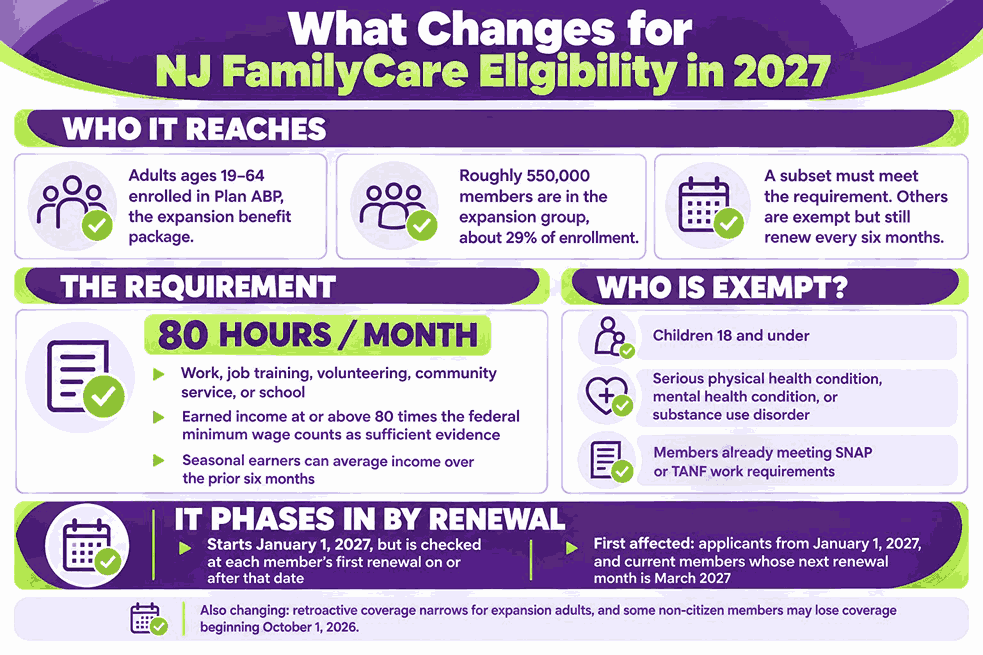
Federal changes in the One Big Beautiful Bill Act are reshaping NJ FamilyCare eligibility. Beginning January 1, 2027, expansion adults ages 19 to 64 must meet an 80-hour monthly work or activity requirement. Most will also renew every six months instead of annually.
- State guidance estimates about 540,000 expansion adults are affected
- Retroactive coverage for expansion adults narrows to the month before application
- Some non-citizen members may lose coverage starting October 1, 2026
Expect more coverage gaps and more denials for inactive coverage. Recheck eligibility at every visit for expansion adults. Ask patients to keep their mailing address current with NJ FamilyCare, since missed renewal notices cause coverage loss.
NJ Medicaid Claim Submission Mechanics
Providers submit NJ Medicaid claims electronically in most cases. Professional claims use the 837P transaction or the CMS-1500 form. Facility claims use the 837I or the UB-04. State rules require automated data exchange unless a claim needs an attachment.
Clearinghouse routing differs by payer. Fee-for-service claims go to the fiscal agent, and each MCO publishes its own payer ID and portal. State rules make providers responsible for reconciling submissions against the remittance advice and resubmitting any claim that is missing.
Timely Filing and Resubmission Windows
| Pathway | Claim Type | Deadline |
|---|---|---|
| Fee-for-service | Non-institutional claims (physicians, most ambulatory providers) | One year from the date of service |
| Fee-for-service | Hospital outpatient and home health | One year from the date of service |
| Fee-for-service | Hospital inpatient | One year from the date of discharge |
| Fee-for-service | EPSDT and HealthStart services | 30 days from the service |
| Fee-for-service | Resubmission of a timely denied claim | Later of one year from service or 30 days from adjudication |
| MCO | Initial claims | 180 calendar days from the date of service |
| MCO | Corrected claims | 365 days from the date of service |
| MCO | Coordination of benefits claims | 60 days from the primary EOB or 180 days from service, whichever is later |
Verify before you rely on it: MCO contracts can set different windows. Confirm each plan’s current provider manual before building billing rules. Missed windows return CARC 29, so track the clock from the first submission.
Coding and Modifier Requirements
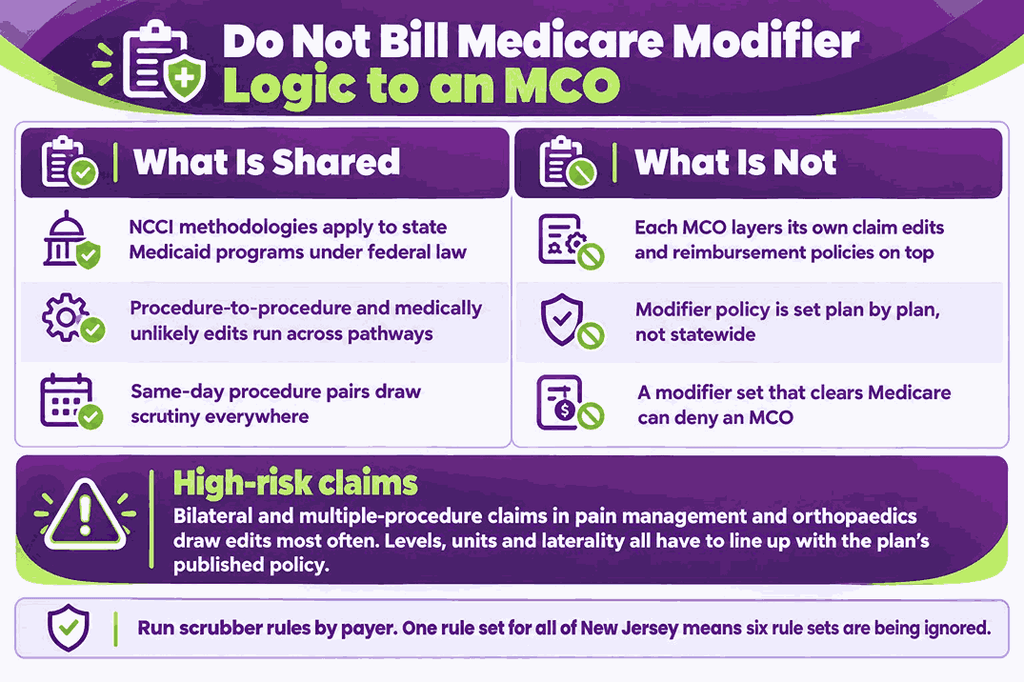
State Medicaid programs apply National Correct Coding Initiative (NCCI) methodologies under federal law. MCOs add their own claim edits and reimbursement policies on top. Modifier use must match each payer’s policy, especially for procedures billed on the same day.
Pain management and orthopaedic claims with bilateral or multiple procedures often draw edits. A common mistake is billing a Medicare-style modifier set to an MCO that publishes different rules. Run scrubber rules by payer rather than one rule set for all of New Jersey.
Prior Authorization and Utilization Management
Prior authorization rules sit with each MCO, not the state. The Health Claims Authorization, Processing and Payment Act (HCAPPA) governs the process. Non-emergency prior authorization decisions are due within 14 calendar days, and denials must be issued in writing.
The authorization must match the claim. Mismatched codes, rendering providers, dates, or units cause denials even when an approval exists. Providers must also contact the plan about authorization updates when a member changes MCOs.
| Specialty | Services That Often Need Review | Billing Watch-Out |
|---|---|---|
| Pain management | Epidural and facet injections, radiofrequency ablation, implantable devices | Levels and units must match the authorization |
| Nephrology | Vascular access procedures, selected dialysis-related services | Dual eligible members need crossover handling |
| Psychiatry | Higher levels of behavioral health care, selected testing | Level of care and visit counts must match |
| Cardiology | Advanced imaging, stress testing, selected procedures | Place of service must match the approved site |
| Orthopaedics | Advanced imaging, joint procedures, DME | Facility and surgeon authorizations must line up |
Requirements vary by MCO and change often. Use each plan’s authorization lookup tool by procedure code before scheduling, not after a denial.
Auth-to-Claim Matching Errors
- The billed CPT code differs from the authorized code
- The date of service falls outside the authorized window
- Billed units exceed approved units
- The rendering or facility NPI differs from the authorization record
Most of these errors start at scheduling. The front desk books a procedure, and the authorization covers a different code. A pre-service check that compares the schedule to the authorization closes this gap.
Medicaid as Secondary Payer: Dual Eligibles and Third-Party Liability
Medicaid is the payer of last resort. Other coverage pays first, including Medicare, commercial plans, and liability insurance. MCOs must coordinate benefits and exhaust other payment sources before NJ FamilyCare pays. When the primary is a state-regulated commercial plan and the provider is out of network, the NJ Out-of-Network Consumer Protection Act can govern balance billing and arbitration on that claim before Medicaid sees it.
Dual eligible members have both Medicare and Medicaid. Medicare processes the claim first. Medicaid then considers payment toward Medicare cost sharing, which includes deductibles, coinsurance, and copayments.
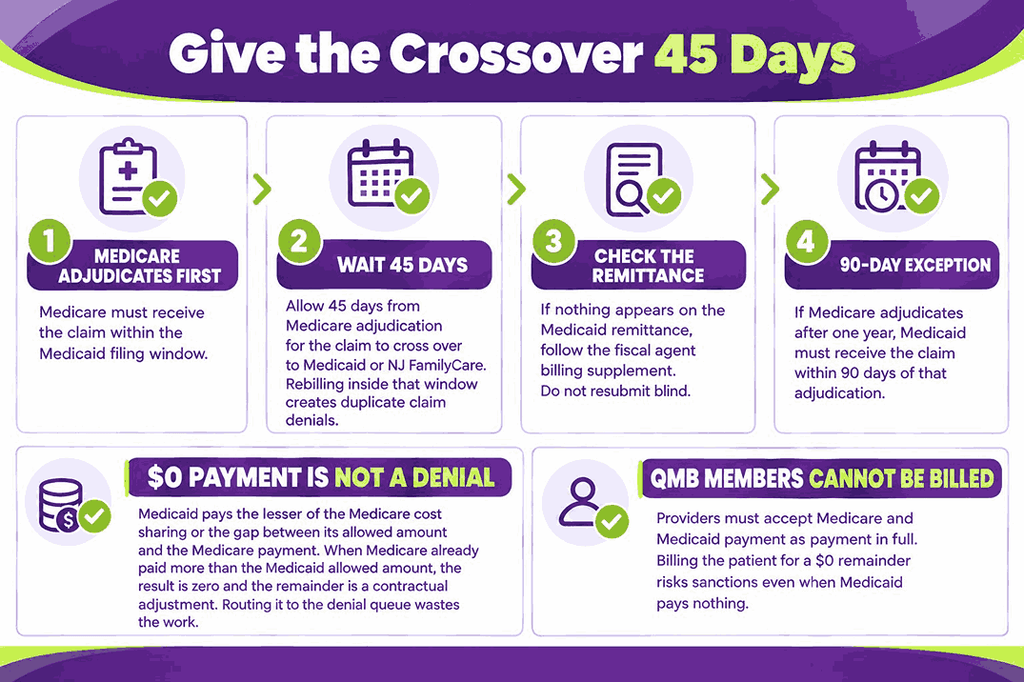
Crossover Claim Rules
- Allow 45 days from Medicare adjudication for the claim to cross over to Medicaid or NJ FamilyCare
- Rebilling inside that window creates duplicate claim denials
- If no crossover appears on the Medicaid remittance after 45 days, follow the fiscal agent billing supplement
- Medicare must receive the claim within the Medicaid filing window
- If Medicare adjudicates after one year, Medicaid must receive the claim within 90 days of that adjudication
Why Medicaid Pays $0 on Some Crossovers
Many Medicaid programs use lesser-of logic on crossover claims. Medicaid pays the lesser of the Medicare cost sharing or the gap between its own allowed amount and the Medicare payment. When Medicare already paid more than the Medicaid allowed amount, the result is zero.
| Illustrative Example | Amount |
|---|---|
| Medicare allowed amount | $100 |
| Medicare payment (80 percent) | $80 |
| Medicare coinsurance | $20 |
| Medicaid allowed amount | $75 |
| Medicaid allowed minus Medicare paid | Negative, so $0 |
This example uses round numbers, not NJ rates. Teams that post the $0 as a denial send it to the wrong queue. It is a valid adjudication, and the remainder is a contractual adjustment.
QMB Billing Restrictions
Qualified Medicare Beneficiary (QMB) status adds a federal billing restriction. Providers must accept Medicare and Medicaid payment as payment in full for QMB patients. Billing the patient for a $0 remainder risks sanctions, even when Medicaid pays nothing.
NJ Medicaid Reimbursement: How Rates Work
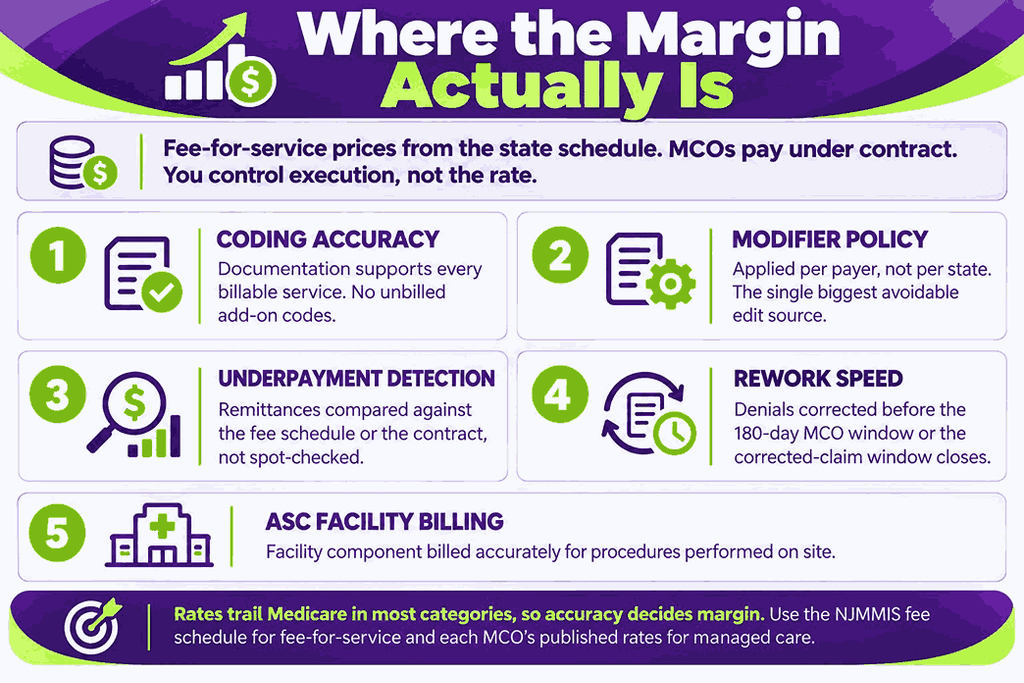
Fee-for-service claims price from the state fee schedule. MCOs pay under their provider contracts, which reference state schedules and plan agreements. Rates vary by provider type, place of service, and contract.
The Urban Institute’s Medicaid-to-Medicare fee index, published through KFF, shows how New Jersey compares. The 2024 index measures fee-for-service physician fees only.
| Service Category | NJ Medicaid Fees as a Share of Medicare (2024) |
|---|---|
| All services | 61 percent |
| Primary care | 48 percent |
| Obstetric care | 89 percent |
| Other services | 56 percent |
Rates trail Medicare in most categories, so billing accuracy decides margin. Missed modifiers, unbilled add-on codes, and uncorrected underpayments erode revenue that is already thin.
Where Reimbursement Lift Is Realistic
- Coding accuracy and documentation that supports every billable service
- Correct modifier use under each payer’s policy
- Underpayment detection by comparing remittances to the fee schedule or contract
- Faster denial rework before filing windows close
- Accurate ambulatory surgery center facility billing for procedures done on site
This page does not publish specific NJ Medicaid rates because schedules change. Use the official NJMMIS fee schedule for fee-for-service claims. Use each MCO’s published rates for managed care claims.
Top NJ Medicaid Denial Reasons and How to Prevent Them
Denial management starts with root cause, not rework. Each denial category points to a process failure upstream. Fixing the process lowers denial rates more than reworking claims one at a time.
Track denials by Claim Adjustment Reason Code (CARC) and by payer. Timely filing denials return CARC 29. Patterns by MCO show which plan rule your team keeps missing.
| Denial Category | Root Cause | Prevention | Rework Path |
|---|---|---|---|
| Inactive or wrong coverage | Eligibility unchecked or member switched MCOs | Verify eligibility and MCO on the date of service | Rebill the correct payer inside its filing window |
| Authorization missing or mismatched | No approval, or codes, units, or dates differ | Use the plan lookup tool and match authorization to schedule | Request retro authorization if allowed, or appeal with clinicals |
| Timely filing | Late submission or missed corrected-claim deadline | Work aging buckets and track 180-day clocks | Submit proof of timely filing and request review |
| Enrollment or provider ID mismatch | Provider not loaded at the MCO, or revalidation lapsed | Run a pre-start checklist and a revalidation calendar | Correct the provider record, then resubmit |
| Duplicate claim | Early rebilling or crossover not given 45 days | Wait out the crossover window and check claim status | Confirm the original adjudication before resubmitting |
| COB or TPL error | Missing primary EOB or wrong payer order | Collect other coverage at intake and attach the EOB | Resubmit with the EOB inside the COB window |
| Coding or modifier conflict | NCCI edit or missing modifier | Scrub claims by payer rules | Submit a corrected claim inside the correction window |
Process measures matter more than lists. Review denial trends weekly by payer, root cause, and dollar value. Assign every claim aged past 60 days an owner and a deadline.
Appeals and Dispute Resolution
MCO Claim Appeals
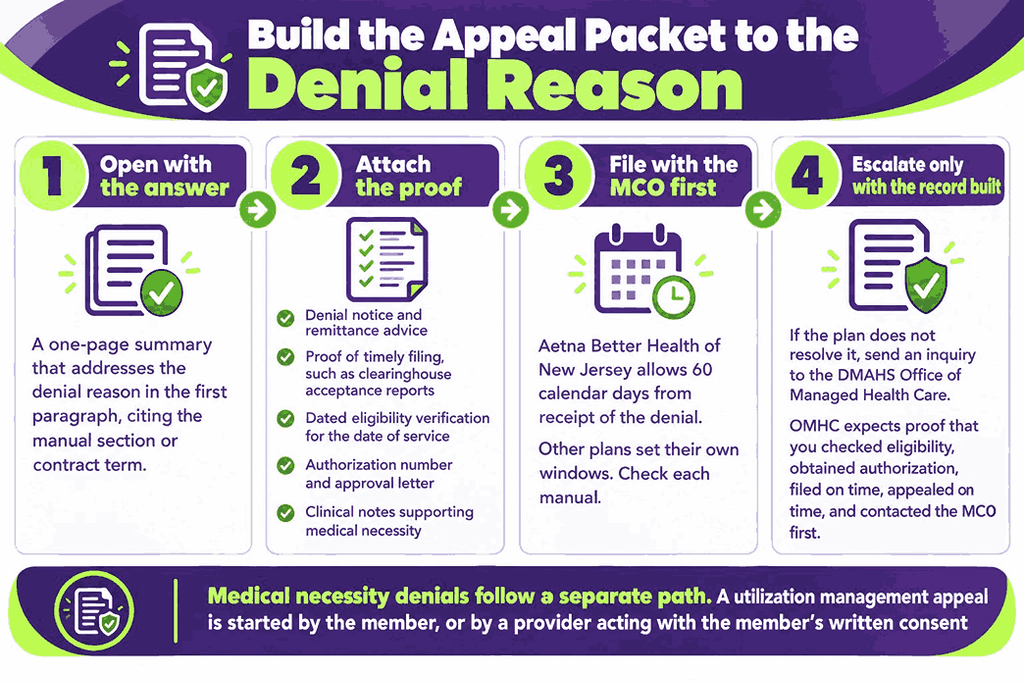
Claim payment appeals go to the MCO first. Aetna Better Health of New Jersey gives providers 60 calendar days from receipt of a denial to appeal. Other plans set their own windows, so check each manual.
If the MCO does not resolve the dispute, providers can send an inquiry to the DMAHS Office of Managed Health Care (OMHC). OMHC expects proof that the provider checked eligibility, obtained authorization, filed on time, appealed on time, and contacted the MCO first.
Check your contract: HCAPPA also created a claims payment arbitration route for some payer disputes. Confirm whether it applies to your MCO agreement.
Utilization Management Appeals
Medical necessity denials follow a separate path. A utilization management (UM) appeal is started by the member, or by a provider acting with the member’s written consent. External review through an Independent Utilization Review Organization (IURO) applies across NJ FamilyCare plan types.
The Medicaid fair hearing applies to NJ FamilyCare A and ABP members. It is not available to members in plans B, C, and D. Providers should check the member’s plan type before promising any appeal route.
Fee-for-Service Resubmission
Fee-for-service providers can resubmit a timely denied claim within one year of the date of service or 30 days of the remittance advice date. The later date controls. Late claims receive no payment, and inquiries about late claims are also barred.
Documentation That Wins Appeals
- The denial notice and remittance advice
- Proof of timely filing, such as clearinghouse acceptance reports
- A dated eligibility verification for the date of service
- The authorization number and approval letter
- Clinical notes that support medical necessity
- A one-page summary citing the payer policy or contract term
Appeals succeed when the packet answers the denial reason in the first paragraph. Cite the manual or contract section. Track every appeal deadline on a shared calendar.
Compliance and Audit Exposure
Medicaid program rules sit inside a wider set of New Jersey billing laws that govern payer payment timelines, patient balances, and out-of-network disputes. Several bodies administer or oversee NJ Medicaid, including DMAHS, the Office of the State Comptroller, the Medicaid Fraud Control Unit, and the Medicaid Fraud Division. MCOs also run their own program integrity units. Providers face review from several directions at once.
Audit risk follows documentation gaps, upcoding, and balance billing. Post-payment review can lead to recoupment of paid claims. Aetna Better Health of New Jersey states that balance billing can trigger referral to the NJ Medicaid Fraud Division.
- Documentation that supports each billed code and unit
- Monthly eligibility checks and exclusion screening
- A written policy against balance billing
- Retention of remittance advice and authorizations
- Access controls and audit logs for billing staff
Collections practices matter here too. The Louisa Carman Medical Debt Relief Act affects how providers handle patient balances, so align your statement and collections workflow with it, especially for members who move between Medicaid and other coverage.
HIPAA and Outsourced Billing
Outsourcing NJ Medicaid billing requires a HIPAA business associate agreement (BAA). A billing company handles protected health information, so access controls, audit logs, and breach notification terms matter. Ask vendors for security attestations before signing.
In-House vs. Outsourced NJ Medicaid Billing
The right model depends on payer mix, MCO count, and denial rate. Five MCOs plus fee-for-service means six rule sets and a state portal. Small teams struggle to keep payer-specific knowledge current.
When comparing New Jersey billing companies, ask for denial rates and days in A/R broken out by MCO, not a blended Medicaid average. A vendor that can’t show payer-specific rules for all five plans plus fee-for-service is carrying the same knowledge gap your team has.
| Decision Factor | Favors In-House | Favors Outsourcing |
|---|---|---|
| Medicaid share of payer mix | Low and stable | High or growing |
| Staff expertise | Dedicated NJ Medicaid billers | Turnover or one-person billing |
| Denial rate | At or under target | Rising or above target |
| Days in A/R | Within benchmark | Climbing |
| Enrollment workload | Few new providers | Frequent onboarding or acquisitions |
| Policy change exposure | Capacity to track updates | Limited bandwidth for new rules |
Track these KPIs by payer, because Medicaid MCOs perform differently than commercial plans:
- Clean claim rate
- First-pass denial rate
- Days in A/R
- Net collection rate
- Appeal overturn rate
If two or three factors in the table point to outsourcing, run a denial analysis before deciding. It shows how much revenue sits in preventable denials.
How Transcure Handles NJ Medicaid Billing
Transcure’s New Jersey billing services run NJ Medicaid billing as one workflow with payer-specific rules at each step. The same team owns the claim from eligibility to appeal. That removes the handoffs where denials often start.
| Step | What Happens | Output |
|---|---|---|
| Eligibility | eMEVS and MCO portal checks before the visit | Verified plan and coverage record |
| Authorization | Lookup tool check and schedule-to-authorization match | Authorization on file matches the claim |
| Coding QA | Payer-specific modifier and NCCI review | Clean claim before submission |
| Submission | Clearinghouse routing with per-MCO payer rules | Claims accepted inside filing windows |
| Denial management | Root-cause coding by CARC and payer | Weekly denial trend report |
| Appeals | Packet built to the denial reason inside the appeal window | Tracked appeal outcomes |
Transcure reviews a sample of your denied and underpaid claims by MCO and shows where revenue leaks.
FAQs About New Jersey Medicaid Billing
Does NJ Medicaid require prior authorization for specialty procedures?
Often, yes. Requirements vary by MCO, procedure code, and place of service. Injections, advanced imaging, and selected surgical procedures commonly need review. Check each plan’s authorization lookup tool before scheduling. State guidance requires non-emergency authorization decisions within 14 calendar days.
What is the timely filing limit for NJ Medicaid claims?
Fee-for-service claims generally have one year from the date of service. MCO claims have 180 calendar days, and corrected claims have 365 days. Coordination of benefits claims have 60 days from the primary EOB or 180 days from service, whichever is later. Confirm plan contracts.
Is NJ FamilyCare the same as NJ Medicaid?
Yes. NJ FamilyCare is the name New Jersey uses for Medicaid in member and provider communications. The program also includes CHIP. Managed care contracts and manuals use NJ FamilyCare, while billing rules cite Medicaid. Treat both terms as one payer family.
How do I bill NJ Medicaid as a secondary payer?
Bill the primary payer first and wait for its explanation of benefits. For Medicare crossovers, allow 45 days for the claim to cross over before rebilling. For commercial primaries, submit the Medicaid claim with the primary EOB inside the plan’s coordination of benefits window.
How do I appeal a denied NJ Medicaid claim?
For MCO denials, file the plan’s provider claim appeal before its deadline. Aetna Better Health of New Jersey allows 60 calendar days from the denial. Include the denial, proof of timely filing, and supporting records. If the plan does not resolve it, send an inquiry to DMAHS’s Office of Managed Health Care.
Can I bill NJ Medicaid members for denied services?
Generally no. Balance billing members for covered services is prohibited. A member may be billed only when the member knowingly agreed to a non-covered service. QMB patients cannot be billed for Medicare cost sharing. Violations can lead to referral to the Medicaid Fraud Division.
How long does NJ Medicaid take to pay a claim?
CAPPA’s payment-timing rules, covered in our guide to the New Jersey Prompt Pay Law, set payment deadlines of 30 days for electronic claims and 40 days for other claims, and DMAHS requires MCOs to follow them. Pended claims, missing authorizations, and enrollment problems extend payment time. Track claims by aging bucket and escalate at 30 days.