Colorado surprise billing law bars balance billing for emergency care and in-network facility visits. Passed in 2019, HB 19-1174 protects patients with Division of Insurance-regulated health plans. Other plans fall under the federal No Surprises Act, effective since January 1, 2022.
Polis signed HB 22-1284 on June 8, 2022, to align Colorado with federal rules. Ground ambulance rides sit outside federal protection, and Colorado covers private emergency ambulances only. HB 25-1088 would have covered public ambulances, but Polis vetoed it May 29, 2025.

The Colorado Division of Insurance published HB 19-1174 reports on out-of-network claims and arbitrations. CMS explains federal rights and runs the No Surprises Help Desk for Colorado consumers. This guide explains surprise billing in Colorado for providers and patients using official sources.
What Is the Colorado Surprise Billing Law and No Surprises Act?
Together, the state law and the No Surprises Act block most unexpected out-of-network bills. State-regulated plans follow the Colorado surprise billing law, and other plans follow federal law. Additional medical billing laws in Colorado cover compliance rules beyond surprise billing for providers.
What Is Surprise Billing and Balance Billing?
Balance billing occurs when an out-of-network provider bills the gap between charges and payment. Surprise billing is an unexpected balance bill, usually from care the patient never chose. Out-of-network providers and facilities have not signed a contract with the patient’s health plan.
Billed charges often exceed the plan’s allowed amount, and the gap becomes a bill. Those extra charges may not count toward the in-network deductible or annual out-of-pocket limit. KFF estimates 1 in 5 privately insured emergency room visits produce an out-of-network bill.
Which Law Applies to Your Health Plan?
A CO-DOI mark on the health insurance ID card signals Colorado law protections apply. Plans without that mark, such as out-of-state plans, follow the federal No Surprises Act. Colorado protections also apply only when patients receive the covered care inside Colorado’s borders.
Five plan types and their governing surprise billing laws appear in the table below.
| Plan type | Law that applies |
|---|---|
| State-regulated Plan Marked CO-DOI | Colorado law (HB 19-1174 and HB 22-1284) |
| Plan without CO-DOI, such as Many Self-funded Employer Plans | Federal No Surprises Act |
| Plan Issued Outside Colorado | Federal No Surprises Act |
| Uninsured or Self-pay Patient | Federal good faith estimate rules |
| Health First Colorado (Medicaid) Member | Medicaid billing rules and C.R.S. 25.5-4-301 |
Employers with self-funded plans fall outside Division of Insurance regulation, so federal rules apply. Members confirm plan type by calling the number printed on their insurance ID card. Medicaid member billing rules appear in the full Colorado Medicaid billing guide for providers.
What Does Colorado’s Surprise Billing Law Protect?
Coverage under Colorado’s HB 19-1174 reaches patients on Division of Insurance-regulated health plans. Effective January 1, 2020, the law covers emergency care, facility visits, and private ambulances.
Which Services Are Protected?
Emergency services at an out-of-network provider or facility are protected under the state law. Non-emergency covered care from an out-of-network provider at an in-network facility is also protected. State protection extends to private ground ambulances, and air ambulances fall under federal law.
How Much Can Patients Owe?
Patients owe only their plan’s in-network cost sharing such as copayments, coinsurance, and deductibles. Insurers pay out-of-network providers and facilities directly under payment formulas set by HB 19-1174.
Amounts patients pay for these services count toward the in-network deductible and out-of-pocket maximum. Explanation of benefits statements show the in-network cost-sharing amount used to calculate the bill.
What Changed With HB 22-1284?
Signed June 8, 2022, HB 22-1284 aligned state surprise billing law with federal rules. Insurance regulators worked with the General Assembly to adopt many No Surprises Act protections. Federal rules added post-stabilization protection and bar some providers from balance billing despite consent. Payment formulas and the Division arbitration process stay in place for out-of-network provider disputes.
What Does the Federal No Surprises Act Cover in Colorado?
Congress passed the federal No Surprises Act in December 2020, effective January 1, 2022. Group and individual health plans fall under the act, including plans outside state regulation.
Which Services Does the Federal Act Protect?
Four categories of covered services receive federal balance billing protection in Colorado and nationwide.
- Covered emergency care from out-of-network providers or facilities carries only in-network cost-sharing liability.
- Post-stabilization care following an emergency also falls under the same federal balance billing ban.
- At in-network hospitals and surgical centers, out-of-network providers cannot balance bill for most services.
- Providers of air ambulance services outside the plan network cannot balance bill covered transport.
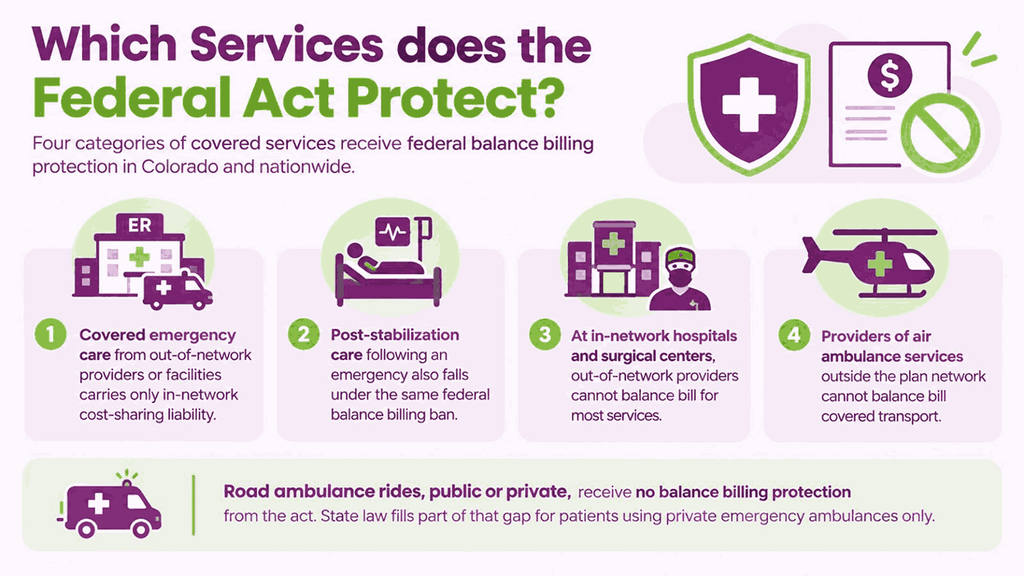
Road ambulance rides, public or private, receive no balance billing protection from the act. State law fills part of that gap for patients using private emergency ambulances only.
Which Providers Cannot Ask Patients to Waive Protections?
Anesthesiologists, pathologists, radiologists, emergency medicine providers, and assistant surgeons, among others, cannot request waivers. These providers cannot balance bill patients regardless of any consent under the federal act. Nothing ever requires patients to waive protections or accept out-of-network care under federal law.
Notice and consent lets certain out-of-network providers bill above in-network rates for some services. Written notices state the out-of-network status and include a good faith estimate of charges. Colorado’s surprise billing law limits the circumstances in which providers may request patient waivers.
How Does the Act Protect Uninsured and Self-Pay Patients?
Self-pay patients get a good faith estimate once care is scheduled or on request. Hospitals and clinics owe uninsured patients this written estimate under federal law since 2022. Estimates cover the primary service plus related items and services other providers may furnish.
Bills that exceed the estimate by $400 or more qualify for patient-provider dispute resolution. Filing deadlines for the dispute run 120 days from the date on the bill. Insured patients who choose to pay out of pocket also qualify for these estimates.
How Do the Colorado and Federal Surprise Billing Laws Compare?
Both laws block balance bills for emergency and in-network facility care but differ elsewhere. Six topics in the table below show exactly where state and federal rules diverge.
| Topic | Colorado law (HB 19-1174 and HB 22-1284) | Federal No Surprises Act |
|---|---|---|
| Covered Plans | Division of Insurance regulated plans marked CO-DOI | Group and individual health plans, including plans outside state regulation |
| Ground Ambulance | Private emergency ground ambulances covered, while publicly funded fire agencies and non-emergency transfers are excluded | Not covered |
| Air Ambulance | Governed by federal law | Out-of-network air ambulance providers covered |
| Payment Standard | Statutory formulas using in-network medians and the Colorado All-Payer Claims Database, or a negotiated rate | Negotiation between insurer and provider, then independent dispute resolution |
| Dispute Process | Arbitration managed by the Division of Insurance | Federal independent dispute resolution with no patient involvement |
| Enforcement and Complaints | Division of Insurance at 303-894-7490 or 1-800-930-3745 | CMS No Surprises Help Desk at 1-800-985-3059 |
Plan type decides which column applies, so providers verify CO-DOI status before billing patients. Copays, coinsurance, and deductibles stay at in-network levels for emergency care under either law. Formulas and arbitration steps for out-of-network payment disputes appear in the next guide section.
How Are Out-of-Network Payments and Disputes Resolved?
Colorado law sets out-of-network payment formulas and a state Division of Insurance arbitration process. Federal law instead sends unresolved payment disputes to independent dispute resolution, known as IDR. Neither process involves the patient, because each settles payment between insurers and out-of-network providers.
How Does Colorado Set Out-of-Network Payment?
Under HB 19-1174, carriers pay out-of-network providers the greatest of three possible payment amounts. Facilities receive three-option formulas as well, and Denver Health follows its own emergency formula. Insurance Regulation 4-2-66 sets the ground ambulance formula for non-contracted private emergency ambulance agencies.
Four formulas appear in the table below for providers, facilities, Denver Health, and ambulances.
| Claim type | Formula options |
|---|---|
| Out-of-network Provider | Greater of 110% of the carrier’s median in-network rate, the 60th percentile rate from the Colorado All-Payer Claims Database (APCD), or a negotiated rate |
| Out-of-network Facility | Greater of 105% of the carrier’s median in-network rate, the prior-year median APCD in-network rate, or a negotiated rate |
| Denver Health Emergency Services | Greater of the carrier’s median in-network rate, 250% of Medicare, the prior-year median APCD rate, or a negotiated rate |
| Non-contracted Emergency Ground Ambulance | 325% of Medicare including mileage, or a negotiated rate |
APCD benchmarks use prior-year claims from the Colorado All-Payer Claims Database by geographic area. In 2022, Colorado carriers reported paying 34,729 provider claims using the 60th percentile formula. Negotiated rates settled 38,511 of the 72,190 non-Denver Health facility claims reported for 2022.
How Does Colorado Arbitration Work?
Providers and facilities request arbitration when a carrier’s payment seems insufficient for the services. Five steps move each request through the Division of Insurance to a written decision.
- An Arbitration Request Form reaches the Division and carrier within 90 days of payment.
- Optional informal settlement teleconferences may occur before the Commissioner of Insurance appoints an arbitrator.
- Absent a teleconference, the Commissioner appoints an arbitrator within 30 days of the request.
- Both sides submit final offers and reasoning within 30 calendar days of the appointment.
- Arbitrators decide within 45 days of appointment, and the losing offer’s side pays fees.
Claim readjudication follows within 30 calendar days when the decision requires additional carrier payment. Patients stay protected after arbitration, since providers cannot bill beyond deductible, coinsurance, or copayment. Refunds for any overpayment reach the covered person within 60 days of provider notice.
The Division received 91 arbitration requests in 2022, and 17 went to formal arbitration. Carriers won 5 of those 17 arbitrations, and providers won the remaining 12 cases. Final payments in provider wins averaged roughly 450% above the carrier’s original offer amount.
How Does Federal Independent Dispute Resolution Work?
IDR settles payment disputes between out-of-network providers and health plans under the federal act. Either the insurer or the provider may start IDR once the negotiation period ends. Consumers take no part in the federal process and owe only in-network cost sharing.
Federally certified IDR entities decide the final payment amount for each disputed out-of-network claim. State-regulated health plans use Colorado arbitration, and other plans use the federal IDR process. CMS publishes IDR guidance for providers and insurers on its official No Surprises website.
What Must Colorado Providers and Facilities Do to Stay Compliant?
Compliance starts with clear notices, plan checks, correct patient billing, and timely dispute filings. Since 2020, Colorado law under C.R.S. 12-30-113 prohibits providers from sending protected balance bills. The Division of Insurance oversees carriers, licensing boards oversee providers, and CDPHE oversees facilities.
Which Disclosures Are Required?
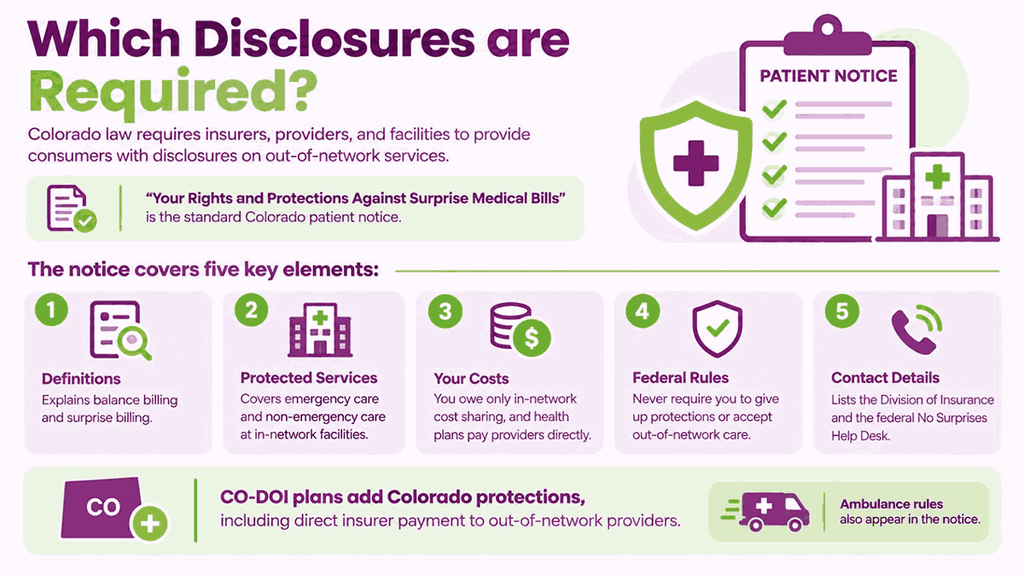
Colorado law requires insurers, providers, and facilities to provide consumers with disclosures on out-of-network services. “Your Rights and Protections Against Surprise Medical Bills” is the standard Colorado patient notice. Hospitals such as AdventHealth and Children’s Hospital Colorado publish this notice on their websites.
Complete notices cover five elements that help patients understand their rights against out-of-network bills.
- Definitions of balance billing and surprise billing explain when out-of-network charges become unexpected bills.
- Protected services include emergency care and non-emergency care at in-network hospitals or surgery centers.
- Patients owe only in-network cost sharing, and their health plans pay out-of-network providers directly.
- Federal rules never require patients to give up any protections or accept out-of-network care.
- Contact details list the Division of Insurance and the federal No Surprises Help Desk.
Notices for CO-DOI plans add Colorado protections, including direct insurer payment to out-of-network providers. Ambulance rules appear in the notice too, and the ambulance section below explains them.
How Should Billing Teams Handle Out-of-Network Claims?
Billing teams follow five steps whenever an out-of-network claim involves emergency or facility-based care.
- Check the member’s plan type on the insurance card for CO-DOI marking before billing.
- Confirm the service qualifies as emergency care or non-emergency care at an in-network facility.
- Bill the carrier first, then charge patients only in-network copayment, coinsurance, and deductible amounts.
- Never send balances above in-network cost sharing to patients, billing statements, or collection agencies.
- File arbitration within 90 days of payment, or use federal IDR for other plans.
Refund overpayments owed to patients within 60 days after the provider receives overpayment notice. Itemized bills and explanation of benefits statements document the in-network cost-sharing amount patients owe.
How Do Ground Ambulance Rules Differ?
Private emergency ground ambulance companies fall under Colorado balance billing protections in HB 19-1174. Publicly funded fire agencies and non-emergency interfacility transfers fall outside those state law protections. The federal No Surprises Act excludes ground ambulances yet covers out-of-network air ambulance providers.
Four ambulance types appear in the table below with their balance billing protection status.
| Ambulance type | Colorado law | Federal law |
|---|---|---|
| Private Emergency Ground Ambulance | Covered | Not covered |
| Publicly Funded Fire Agency Emergency Ground Ambulance | Excluded | Not covered |
| Non-emergency Interfacility Ground Transfer | Excluded | Not covered |
| Air Ambulance | Governed by federal law | Covered |
HB 25-1088 would have extended balance billing protection to public ambulances and interfacility transfers. Polis vetoed the bill on May 29, 2025, over premium costs and enforcement concerns. Public ambulances remained outside state protections after that veto, so teams verify agency type.
What Should Patients Do If They Receive a Surprise Bill in Colorado?
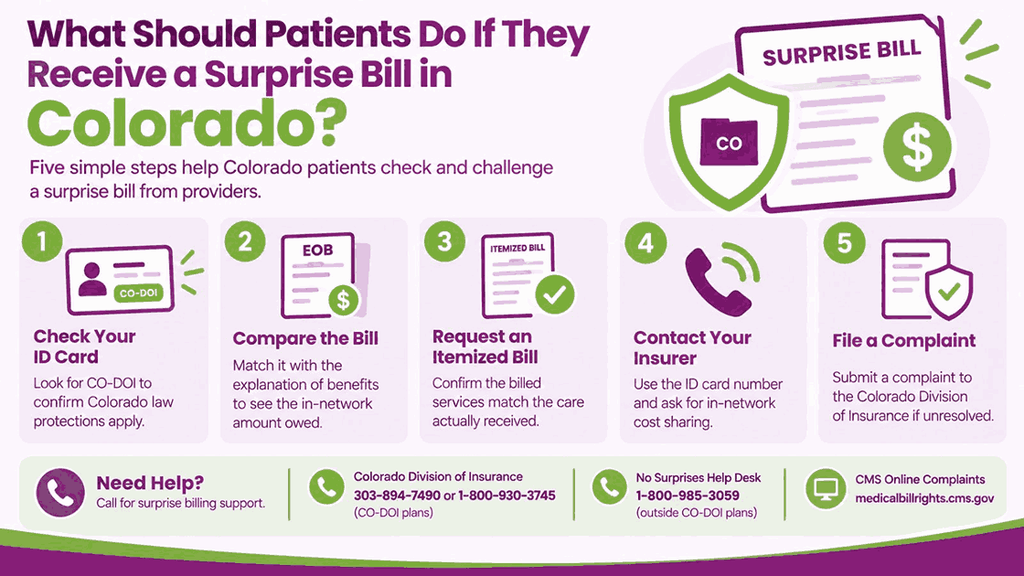
Five ordered steps help Colorado patients check and challenge a surprise bill from providers.
- Look for CO-DOI on the ID card to confirm Colorado state law protections apply.
- Compare the bill with the explanation of benefits to see the in-network amount owed.
- Request an itemized bill, then confirm the billed services match the care actually received.
- Contact the insurer at the ID card number and ask for in-network cost sharing.
- Submit a complaint to the Colorado Division of Insurance if the bill stays unresolved.
Callers can reach the Division of Insurance at 303-894-7490 or 1-800-930-3745 for surprise billing help. Members of plans outside CO-DOI call the federal No Surprises Help Desk at 1-800-985-3059. CMS also accepts online surprise billing complaints through its official medical bill rights website.
How Can a Medical Billing Company Help With Surprise Billing Compliance?
A medical billing company turns surprise billing rules into daily claim checks and deadlines. Among the top medical billing companies in Colorado, Transcure (founded in 2002) applies state and federal rules. Our team of 1,100+ certified billers and coders works inside the practice’s existing EMR.
Six Colorado surprise billing tasks sit inside our daily workflow for each client practice.
| Task | How we handle it |
|---|---|
| Plan Type Verification | CO-DOI card checks and benefit lookups to separate state and federal protection |
| Protected Service Flagging | Emergency and in-network facility claims flagged before patient statements go out |
| Patient Balance Control | In-network cost sharing only, with protected balances held from statements and collections |
| Underpayment Review | Carrier payments reviewed against Colorado payment formulas and negotiated rates |
| Dispute Deadlines | 90-day arbitration windows and federal IDR timelines tracked per claim |
| Patient Refunds | Overpayments identified and refunded within 60 days of notice |
ELIXA, our AI eligibility agent, confirms coverage and plan details before each patient visit. CLAIR, our AI claim-scrubbing agent, checks every out-of-network claim against payer rules before submission. DEXA, our AI denial agent, flags denial patterns so our team corrects root causes.
First-pass clean claims reach 98% across our client accounts under this front-end scrubbing process. Pricing for Colorado practices stays at 5% of collected revenue with no setup cost. Practices seeking surprise billing compliance support can also review Transcure’s full Colorado billing services.
Frequently Asked Questions
What Is the Colorado Surprise Billing Law?
Colorado’s HB 19-1174 bans most balance bills for emergency care and in-network facility visits. It protects patients with Division of Insurance-regulated health plans, effective January 1, 2020.
Does the No Surprises Act Apply in Colorado?
Yes, the federal No Surprises Act applies to group and individual health plans nationwide. State-regulated health plans follow Colorado law, and the remaining health plans follow federal rules.
How Do You Know If Colorado’s Surprise Billing Law Covers Your Health Plan?
Look for CO-DOI printed on your health insurance ID card to confirm state coverage. Health plans without that marking, such as out-of-state plans, follow the federal act instead.
Are Ground Ambulance Rides Covered by Surprise Billing Protections in Colorado?
Private emergency ground ambulances fall under Colorado protections, but public fire agencies are excluded. Federal law excludes ground ambulances, and the vetoed HB 25-1088 would have changed this.
Where Do You File a Surprise Billing Complaint in Colorado?
Patients with CO-DOI plans file surprise bill complaints online with the Division of Insurance. Members of other plans call the federal No Surprises Help Desk toll-free at 1-800-985-3059.