The ESRD Quality Incentive Program ties dialysis facility payment to measured quality performance. CMS created it to hold renal care accountable through a pay-for-performance model. Nephrology practices and dialysis facilities that misunderstand the program risk real Medicare payment reductions.
Reporting accuracy drives everything in QIP. A missed data field or a coding gap can lower a facility’s Total Performance Score before anyone notices the trend. That score then determines whether Medicare payment gets reduced for the following payment year.
This guide covers how QIP works, who it applies to, and how scoring is calculated. It breaks down the measure domains, the Total Performance Score formula, and the exact percentage weight each domain carries.
What Is the ESRD Quality Incentive Program (QIP)?
The ESRD QIP is a Medicare value-based purchasing program for dialysis facilities. CMS created it as the first federal pay-for-performance program, and it remains one of the longest-running examples of that model. The program links a share of facility payment to measured quality outcomes rather than volume alone.
CMS assesses every renal dialysis facility on a defined set of quality measures each payment year. Facilities that fall below the minimum score face a Medicare payment reduction. The maximum reduction any facility can receive is two percent of its Medicare payments for that year.
- Applies to renal dialysis facilities, not individual physicians
- Uses a fixed measure set assigned to each payment year
- Produces a Total Performance Score (TPS) between 0 and 100
- Reduces payment on a sliding scale below the minimum TPS
- Publicly reports facility results for transparency
Why Did CMS Establish the ESRD QIP?
Congress created the legal foundation for ESRD QIP through the Medicare Improvements for Patients and Providers Act (MIPPA) of 2008. Section 153(c) of MIPPA amended Section 1881(h) of the Social Security Act. That amendment directed CMS to build a quality measurement and payment-reduction system specifically for dialysis care.
CMS designed the program around two goals. The first goal is improving dialysis quality across clinical care, safety, and patient experience. The second goal is creating financial accountability, so facilities have a direct incentive to close performance gaps.
How Does the ESRD QIP Work?
The program follows a repeatable annual cycle. CMS collects performance data during a defined period, scores each measure, combines those scores into a single TPS, and applies a payment adjustment based on where that score lands.
The QIP cycle in order:
- Performance period begins, and data collection starts
- Facilities submit clinical and reporting measure data
- CMS calculates individual measure scores
- Measure scores are weighted and combined into a Total Performance Score
- CMS compares TPS to the minimum Total Performance Score (mTPS)
- A payment reduction is applied if TPS falls below the mTPS
- Facility results are published for public reporting
CMS pulls scoring data from several systems rather than one single source. Primary sources include Medicare claims, the ESRD Quality Reporting System (EQRS), and the CDC’s National Healthcare Safety Network (NHSN). Each source feeds a different set of measures.
| Data Source | Primary Use |
|---|---|
| Medicare claims | Hospitalization, readmission, and transfusion measures |
| EQRS | Clinical measure reporting and facility data submission |
| NHSN | Bloodstream infection and vaccination reporting measures |
| ICH CAHPS Survey | Patient experience scoring |
Who Does the ESRD QIP Apply To?
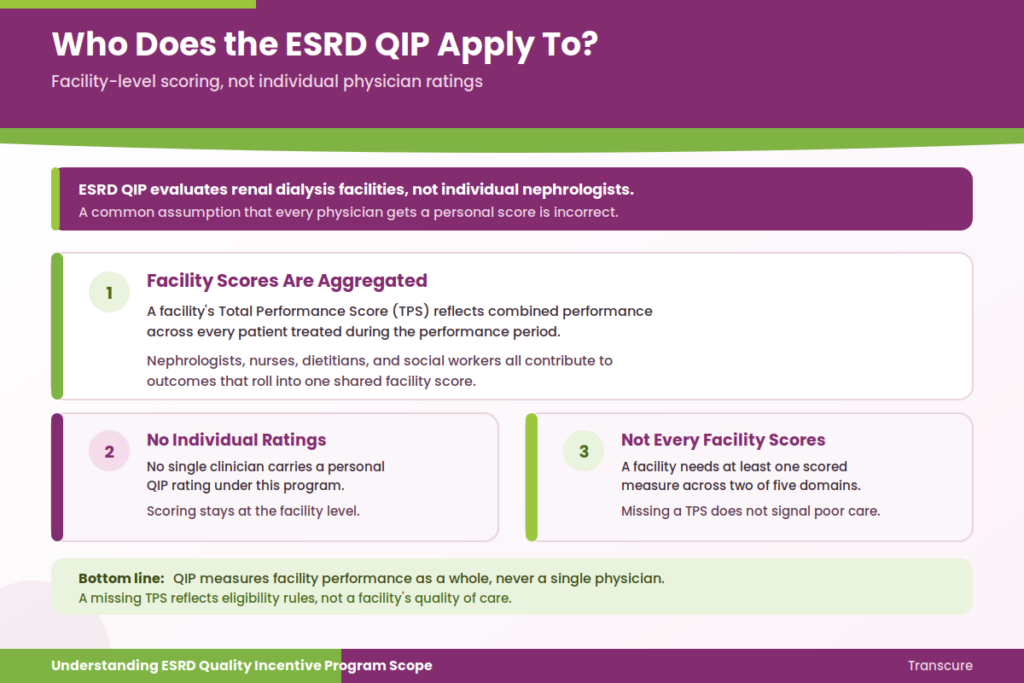
ESRD QIP evaluates renal dialysis facilities, not individual nephrologists. This distinction matters because many readers assume every physician receives a personal QIP score. That assumption is incorrect.
A facility’s TPS reflects aggregated performance across every patient it treats during the performance period. Nephrologists, nurses, dietitians, and social workers all contribute to outcomes that roll up into the facility score. No single clinician carries an individual QIP rating.
Not every facility receives a TPS each year. A facility must be eligible for a score on at least one measure across two of the five measure domains. Facilities with too few qualifying patients may not receive a TPS at all, which does not imply poor care quality.
What Are the ESRD QIP Quality Measures?
CMS organizes ESRD QIP measures into five domains. Each domain groups measures that assess a related aspect of dialysis care, from clinical outcomes to data completeness.
Clinical Care Measures
The Clinical Care domain evaluates core dialysis treatment quality. For payment years 2027 and 2028, this domain includes three measure topics.
- Kt/V Dialysis Adequacy Measure Topic: Evaluates whether patients received an adequate dose of dialysis, split into adult HD, adult PD, pediatric HD, and pediatric PD components
- Long-Term Catheter Rate: Tracks the percentage of hemodialysis patient-months using a catheter for three months or longer
- Standardized Transfusion Ratio (STrR): Measures red blood cell transfusion events on a risk-adjusted basis
Care Coordination Measures
The Care Coordination domain measures how well a facility manages patients across hospital stays, transplant access, and mental health screening.
- Standardized Readmission Ratio (SRR)
- Standardized Hospitalization Ratio (SHR)
- Percentage of Prevalent Patients Waitlisted (PPPW)
- Clinical Depression Screening and Follow-Up
Patient and Family Engagement Measures
This domain contains a single measure, the ICH CAHPS Survey. It captures self-reported patient experience of care, and higher survey scores raise a facility’s domain score.
Safety Measures
The Safety domain also contains one measure, the NHSN Bloodstream Infection (BSI) in Hemodialysis Patients measure. Facilities that skip required quarterly NHSN reporting receive zero points on this measure regardless of actual infection rates.
Reporting Measures
Reporting measures check whether facilities submitted required data completely, rather than scoring clinical outcomes directly. Current reporting measures include:
- Hypercalcemia
- Medication Reconciliation (MedRec)
- COVID-19 Vaccination Coverage Among Healthcare Personnel
Note: The measure set changes by payment year. CMS removed the Standardized Fistula Rate measure beginning with PY 2026 and removed three health equity and Social Drivers of Health reporting measures beginning with PY 2027. Always confirm the current measure set against the CMS fact sheet for the applicable payment year before relying on it.
What Is the ESRD QIP Total Performance Score (TPS)?
The Total Performance Score is the single number that determines a facility’s payment outcome. CMS defines it as the aggregate, weighted score of a facility’s results across every applicable measure for a given payment year.
TPS matters because it is the only figure tied directly to reimbursement. A facility can perform well on some measures and poorly on others, yet still avoid a payment reduction if the weighted combination clears the minimum threshold.
Every measure score contributes to TPS according to its assigned domain weight and individual measure weight. CMS sets a minimum Total Performance Score, called the mTPS, for each payment year. Facilities scoring below the mTPS receive a Medicare payment reduction.
How Is the ESRD QIP TPS Calculated?
CMS does not use one fixed formula across every payment year, since measure sets and weights shift. The general calculation process follows the same three steps every year.
- Score each individual measure using achievement or improvement scoring
- Multiply each measure score by its assigned weight
- Sum the weighted scores and multiply by 10 to produce a TPS between 0 and 100
CMS scores clinical measures using both achievement and improvement methods, then applies whichever result is higher to the final measure score.
ESRD QIP Achievement vs. Improvement Scoring
CMS scores most clinical measures two different ways, then keeps the better result. Understanding both methods clarifies why two facilities with different histories can land at the same measure score.
What Is Achievement Scoring?
Achievement scoring compares a facility’s current performance against national benchmarks set during a baseline period. The achievement threshold sits at the 15th percentile of facilities nationally, and the benchmark sits at the 90th percentile.
What Is Improvement Scoring?
Improvement scoring compares a facility’s current performance against its own prior results from an earlier improvement period. This method rewards facilities that raise their own baseline, even if they still trail the national benchmark.
Which Score Is Used?
CMS calculates both the achievement score and the improvement score for each eligible clinical measure. The facility receives whichever score is higher. This approach protects facilities that are improving quickly but have not yet reached national benchmark levels.
| Term | Definition |
|---|---|
| Achievement threshold | 15th percentile of national facility performance in the baseline period |
| Benchmark | 90th percentile of national facility performance in the baseline period |
| Improvement threshold | The facility’s own performance rate during the improvement period |
| Measure score | The higher of the achievement score or improvement score |
What Is the ESRD QIP Minimum Total Performance Score (mTPS)?
The mTPS is the passing threshold CMS sets for each payment year. A facility scoring at or above the mTPS receives full Medicare payment. A facility scoring below it faces a reduction on a sliding scale.
CMS recalculates the mTPS for every payment year using baseline performance data and policy updates from the current ESRD PPS final rule. That means the mTPS is not a fixed number across time.
Do not treat one payment year’s mTPS as permanent. Recent CMS fact sheets show the mTPS at 53 for PY 2026, 51 for PY 2027, and 57 for PY 2028. Always confirm the mTPS against the current CMS fact sheet before applying it to a specific claim or facility decision.
How Does ESRD QIP Affect Medicare Payments?
QIP performance connects directly to facility-wide Medicare reimbursement. A facility with a TPS below the mTPS receives a payment reduction that applies to every Medicare payment for services rendered in that payment year, not to a single claim.
CMS applies the reduction on a sliding scale rather than an all-or-nothing basis. Lower TPS results in a steeper reduction, up to the two percent statutory maximum.
| Total Performance Score | Payment Reduction |
|---|---|
| 100–51 | No reduction |
| 50–41 | 0.5% |
| 40–31 | 1.0% |
| 30–21 | 1.5% |
| 20–0 | 2.0% |
ESRD QIP Payment Reduction vs. Claim Denial
A QIP payment reduction is not the same event as a claim denial. A claim denial concerns one specific transaction, usually tied to coding, documentation, or eligibility issues on that claim alone.
A QIP payment reduction works at the facility level. It applies a flat percentage cut across all Medicare payments for the applicable year, regardless of whether individual claims were coded correctly. Billing teams need to track both issues separately, since fixing claim-level denials will not correct a facility-level TPS problem.
What Data Does CMS Use for ESRD QIP?
CMS pulls ESRD QIP scoring data from several administrative systems rather than a single database. Accurate documentation across every source directly affects the resulting measure scores.
- Medicare claims data
- ESRD Quality Reporting System (EQRS)
- CDC’s National Healthcare Safety Network (NHSN)
- ICH CAHPS Survey results
- Organ Procurement and Transplant Network (OPTN) data
- CMS Medical Evidence Forms and Enrollment Database records
Incomplete or inconsistent data submission across these systems creates downstream scoring errors. A facility can have strong clinical care and still score poorly if its data pipeline into EQRS or NHSN has gaps.
What Is EQRS and How Does It Relate to ESRD QIP?
The ESRD Quality Reporting System (EQRS) is the primary platform facilities use to submit clinical and administrative data for QIP scoring. CMS uses EQRS data to calculate most clinical and reporting measure scores.
EQRS also hosts the Performance Score Reports that facilities use to review their results. Facilities access both a Preview Performance Score Report and a Final Performance Score Report through the EQRS interface before scores go public.
What Are ESRD QIP Performance Score Reports (PSRs)?
CMS issues two versions of the Performance Score Report each payment year. The Preview PSR gives facilities a chance to review results before public release. The Final PSR reflects the locked scores used for payment adjustment and public reporting.
Both reports include measure-level rates, the calculated TPS, and the resulting payment reduction, if any applies.
What Should a Dialysis Facility Review in Its PSR?
- Individual measure rates for accuracy against internal records
- Measure scores and the weighting applied to each
- The calculated Total Performance Score
- Any missing or flagged data submissions
- Unexpected drops compared to prior payment years
- The projected payment reduction, if the score falls below mTPS
Can a Dialysis Facility Challenge an ESRD QIP Score?
Yes. CMS provides a preview period, typically around 30 calendar days, during which facilities can submit inquiries about their scores. Facilities can raise concerns about data accuracy or calculation errors during this window.
The preview period exists specifically to catch mistakes before they become permanent public records tied to a payment reduction. Facilities that skip this review lose their best opportunity to correct an error before it affects reimbursement.
What Are the ESRD QIP Reporting Requirements?
Reporting requirements vary by measure and by payment year. Clinical measures generally require complete data submission through claims and EQRS across the full performance period. Reporting measures, like NHSN-based vaccination tracking, require specific submission windows tied to CDC deadlines.
Facilities that miss a reporting deadline typically receive zero points on that specific measure, even if the underlying clinical performance was strong. Confirm exact deadlines against the current CMS technical specifications, since these dates shift by calendar year.
Common ESRD QIP Compliance Challenges for Dialysis Facilities
Most facility scoring problems trace back to a small set of recurring issues rather than clinical failures.
- Incomplete or inaccurate data submitted to EQRS or NHSN
- Missed CDC reporting deadlines for infection or vaccination data
- Below-benchmark dialysis adequacy performance
- Rising catheter use instead of permanent vascular access
- Preventable hospitalizations or readmissions
- Gaps in medication reconciliation documentation
- Documentation inconsistencies between clinical and billing records
- Failure to monitor measures throughout the performance period
- Skipping the Preview PSR review window
How Can Nephrology Practices Improve ESRD QIP Performance?
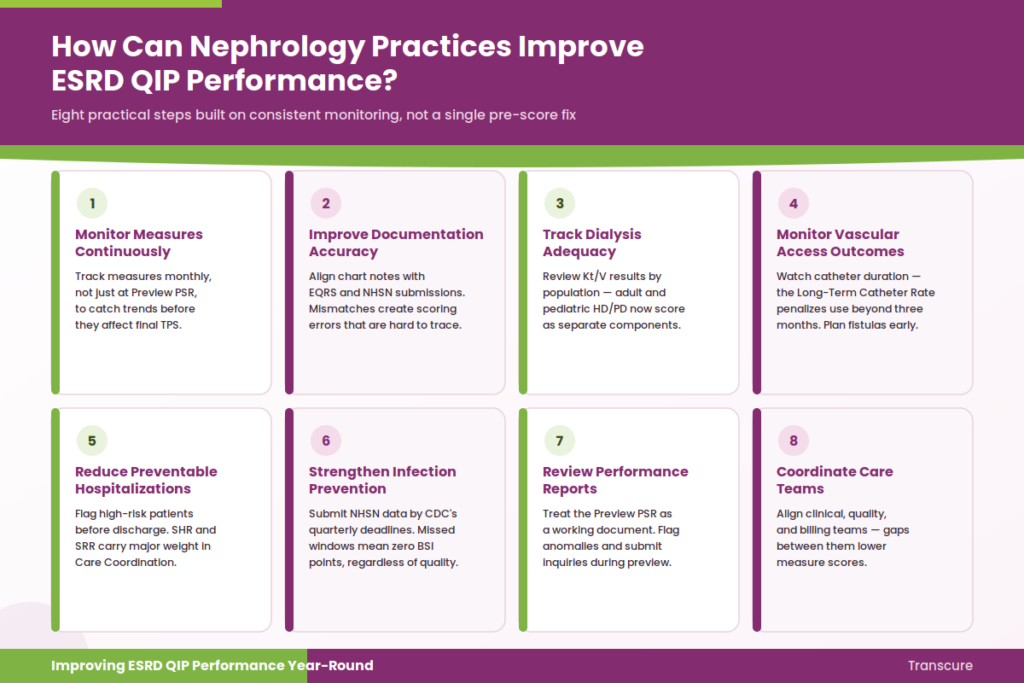
Improving QIP performance depends on consistent monitoring and documentation discipline across the full performance period, not a single fix applied before scores lock.
Monitor QIP Measures Throughout the Performance Period
Track measure-level performance monthly rather than waiting for the annual Preview PSR. Early detection gives a facility time to correct a trend before it affects the final TPS.
Improve Documentation and Data Accuracy
Align clinical documentation with what gets submitted to EQRS and NHSN. Mismatches between chart notes and reported data create measure scoring errors that are difficult to trace after the fact.
Track Dialysis Adequacy
Review Kt/V results by patient population, since adult HD, adult PD, pediatric HD, and pediatric PD are now scored as separate components under the same measure topic.
Monitor Vascular Access Outcomes
Watch catheter duration closely, since the Long-Term Catheter Rate measure penalizes catheter use beyond three months. Early fistula or graft planning reduces long-term catheter exposure.
Reduce Preventable Hospitalizations and Readmissions
Coordinate with hospital-based care teams to flag high-risk patients before discharge. Both SHR and SRR carry meaningful weight in the Care Coordination domain.
Strengthen Infection Prevention and Reporting
Submit NHSN data according to the CDC’s quarterly deadlines without exception. A facility that misses the submission window receives zero points on the BSI measure regardless of actual infection control quality.
Review QIP Performance Reports
Use the Preview PSR as a working document, not a formality. Flag anomalies immediately and submit inquiries during the preview window rather than after scores are finalized.
Coordinate Clinical, Administrative, and Billing Teams
Quality reporting, clinical documentation, and claims processing all draw from the same underlying patient records. Disconnected teams create the data gaps that lower measure scores.
How Medical Billing and RCM Support ESRD QIP Compliance
Billing and revenue cycle management do not directly control clinical outcomes, and no RCM process can guarantee a specific QIP score. What nephrology billing services can support is the administrative infrastructure that keeps CMS data sources accurate and complete.
- Accurate claim submission with correct patient and insurance information
- Timely claims processing that keeps Medicare claims data current
- Documentation consistency between clinical charts and billed services
- Denial management that catches coding errors before they compound
- Payment reconciliation that flags discrepancies early
- Coordination between billing staff and clinical staff on reporting deadlines
- Ongoing revenue-cycle monitoring that surfaces data gaps before scoring periods close
Strong RCM does not replace clinical quality improvement. It supports the data pipeline that CMS relies on to score that quality accurately, which is why top nephrology billing companies treat QIP reporting as a core part of the revenue cycle rather than a side task.
ESRD QIP vs. Other Medicare Quality Programs
Facilities and billing teams sometimes confuse ESRD QIP with other CMS value-based programs. Each program targets a different care setting and evaluates a different entity, and practices juggling both MIPS and QIP reporting often turn to MIPS consulting services to keep the two programs separate.
| Program | Primary Focus | Who Is Evaluated | Payment Connection |
|---|---|---|---|
| ESRD QIP | Dialysis quality | Dialysis facilities | Yes |
| MIPS | Clinician performance | Eligible clinicians | Yes |
| Hospital VBP | Hospital quality | Hospitals | Yes |
| HRRP | Readmissions | Hospitals | Yes |
ESRD QIP Payment Years vs. Calendar Years: What’s the Difference?
CMS uses two different year references throughout ESRD QIP rulemaking, and confusing them leads to real reporting mistakes. The Calendar Year (CY) refers to the year named in the ESRD PPS final rule title. The Payment Year (PY) refers to the year in which a payment reduction actually applies.
A single CY final rule frequently establishes policy for more than one future PY. For example, the CY 2024 ESRD PPS final rule established measure requirements for both PY 2026 and PY 2027. The performance period used to score a given PY also sits two years earlier than the PY itself.
Key relationships to remember:
- Performance period occurs roughly two years before the payment year
- The baseline period for achievement thresholds sits two years before the performance year
- One CY final rule can govern more than one PY
- The CY named in a rule title does not equal the PY it governs
ESRD QIP Updates for 2026–2028
The ESRD QIP measure set is not static, and facilities should confirm current requirements every payment year rather than relying on older guidance.
| Payment Year | Key Changes | Minimum TPS | Major Measure Changes |
|---|---|---|---|
| PY 2026 | Standardized Fistula Rate removed from measure set | 53 | Vascular Access domain narrowed to Long-Term Catheter Rate |
| PY 2027 | Three health equity and SDOH reporting measures removed; Kt/V split into four sub-measures | 51 | Comprehensive Kt/V replaced by adult/pediatric HD/PD topic |
| PY 2028 | ICH CAHPS survey shortened from 62 to 39 questions; measure set reduced to 12 total | 57 | Patient survey burden reduction; continued removal of SDOH reporting measures |
Domain weights have held steady across these payment years at Clinical Care 35%, Care Coordination 30%, Patient & Family Engagement 15%, Safety 10%, and Reporting 10%. Verify every figure in this table against the current CMS ESRD QIP fact sheet before publishing or acting on it, since CMS updates these numbers through annual rulemaking.
ESRD QIP Scoring Criteria: Domain Weights and Calculation
CMS assigns each of the five measure domains a fixed percentage of the Total Performance Score. For PY 2027, the weights break down as follows.
| Measure Domain | Weight as % of TPS |
|---|---|
| Clinical Care | 35% |
| Care Coordination | 30% |
| Patient & Family Engagement | 15% |
| Safety | 10% |
| Reporting | 10% |
Within each domain, individual measures split that domain’s weight, sometimes unevenly. The table below shows PY 2027 individual measure weights as a percentage of the full TPS.
| Domain | Measure | Weight as % of Domain | Weight as % of TPS |
|---|---|---|---|
| Care Coordination (30%) | SRR | 25.00% | 7.50% |
| Care Coordination (30%) | SHR | 25.00% | 7.50% |
| Care Coordination (30%) | PPPW | 25.00% | 7.50% |
| Care Coordination (30%) | Clinical Depression Screening and Follow-Up | 25.00% | 7.50% |
| Clinical Care (35%) | Kt/V Dialysis Adequacy Topic | 31.43% | 11.00% |
| Clinical Care (35%) | Long-Term Catheter Rate | 34.29% | 12.00% |
| Clinical Care (35%) | STrR | 34.29% | 12.00% |
| Patient & Family Engagement (15%) | ICH CAHPS Survey | 100.00% | 15.00% |
| Safety (10%) | NHSN BSI in Hemodialysis Patients | 100.00% | 10.00% |
| Reporting (10%) | Hypercalcemia | 16.67% | 1.67% |
| Reporting (10%) | Medication Reconciliation (MedRec) | 16.67% | 1.67% |
| Reporting (10%) | COVID-19 HCP Vaccination | 16.67% | 1.67% |
How the TPS Gets Calculated from These Weights
- Each measure receives a raw score between 0 and 10 points, using achievement or improvement scoring, whichever is higher
- That raw score is multiplied by the measure’s weight as a percentage of TPS
- The weighted scores from every measure are added together
- The sum is multiplied by 10 to produce a final TPS on a 0–100 scale
If a facility does not qualify for scoring on a measure, or on an entire domain, CMS redistributes that weight evenly across the remaining eligible domains and measures. This prevents a single missing measure from artificially capping a facility’s maximum possible score.
Note on weight stability: Domain-level weights (35/30/15/10/10) have remained consistent across PY 2026 through PY 2028. Individual measure weights within Clinical Care and Reporting shift slightly year to year as CMS adds or removes specific measures. Confirm the current year’s measure-level breakdown against the applicable CMS ESRD QIP fact sheet before applying these percentages to a live scoring calculation.
Frequently Asked Questions About ESRD QIP
What is the ESRD QIP?
The ESRD QIP is a Medicare value-based purchasing program that ties dialysis facility payment to measured quality performance across five domains of care.
Who is Subject to ESRD QIP?
Renal dialysis facilities are subject to ESRD QIP scoring, not individual nephrologists or physicians. Facility-level results roll up performance across the entire care team.
What is the Maximum ESRD QIP Payment Reduction?
CMS caps the maximum ESRD QIP payment reduction at two percent of Medicare payments for the applicable payment year.
What is the ESRD QIP Total Performance Score?
The Total Performance Score is the weighted, aggregated result of a facility’s scores across every applicable measure, expressed on a 0–100 scale.
How is the ESRD QIP Score Calculated?
CMS scores each measure, applies its assigned weight, sums the weighted scores across all measures, and multiplies the total by 10 to produce the final TPS.
What is the ESRD QIP Minimum TPS?
The minimum TPS, or mTPS, is the passing threshold set for each payment year. It has been 53 for PY 2026, 51 for PY 2027, and 57 for PY 2028.
What Measures are Included in ESRD QIP?
Current measures span five domains: Clinical Care, Care Coordination, Patient & Family Engagement, Safety, and Reporting. The exact measure list changes by payment year.
What Is EQRS in ESRD QIP?
EQRS is the ESRD Quality Reporting System, the primary platform facilities use to submit data for QIP scoring and to access Performance Score Reports.
How Can a Dialysis Facility Review its QIP Score?
Facilities review scores through the Preview and Final Performance Score Reports available in EQRS, which include measure rates, TPS, and any payment reduction.
Can a Facility Challenge an ESRD QIP Score?
Yes. CMS provides an approximately 30-day preview period during which facilities can submit inquiries about scoring or data accuracy before results become final.
Does ESRD QIP Apply to Individual Nephrologists?
No. ESRD QIP evaluates dialysis facilities as a whole rather than scoring individual physicians directly.
How Does ESRD QIP Affect Medicare Reimbursement?
A facility scoring below the mTPS receives a payment reduction on all Medicare payments for services rendered in that payment year, up to a two percent maximum cut.