
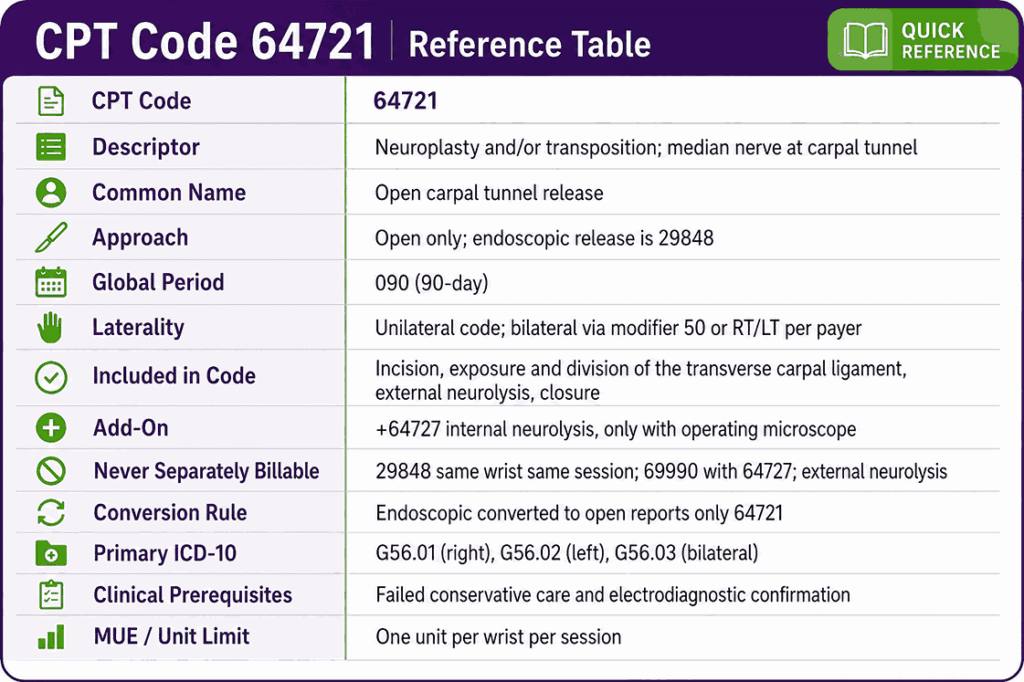
CPT code 64721 reports open carpal tunnel release. The American Medical Association defines it as neuroplasty and/or transposition of the median nerve at the carpal tunnel. It is a unilateral code carrying a 90-day global period.
The code describes the open approach only. Endoscopic release maps to 29848, and CPT 2026 added 64728 for percutaneous balloon decompression with ultrasound guidance. Approach drives code selection, not scheduling or surgeon preference.
Carpal tunnel release is one of the most frequent upper-extremity procedures in the United States, with more than 600,000 cases performed each year. At that volume, small coding errors compound fast, and few hand surgery CPT codes carry as many approach-specific bundling traps as this one.
This guide covers the 64721 descriptor, bundling edits, modifiers, 2026 Medicare payment, clinical scenarios, and the denial patterns specific to this code.
What Is the Description of CPT Code 64721?
The American Medical Association 64721 CPT code description is “Neuroplasty and/or transposition; median nerve at carpal tunnel.” It sits in the neuroplasty family of the CPT surgery section, covering exploration, neurolysis, and nerve decompression.
Neuroplasty means freeing the nerve from compressive tissue. Transposition means moving the nerve. Either action at the carpal tunnel, through an open incision, maps to 64721.
What Does CPT Code 64721 Include, and Which Surgical Steps Are Bundled Into It?
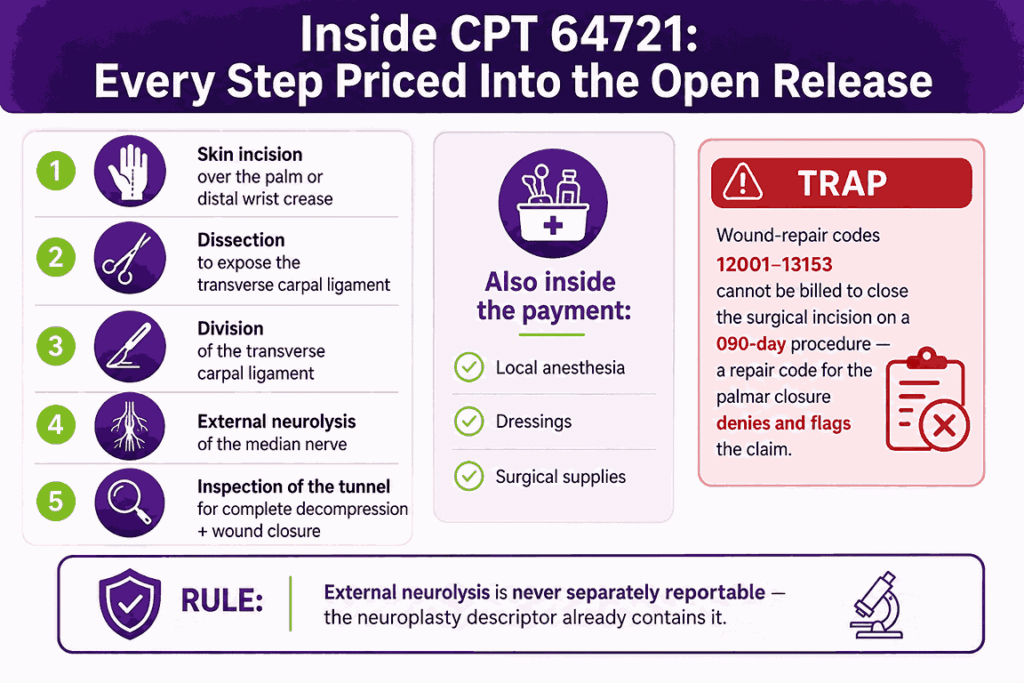
Every step required to complete the release is priced into the code. None of these are separately reportable:
- The skin incision over the palm or distal wrist crease
- Dissection down to expose the transverse carpal ligament
- Division of the transverse carpal ligament
- External neurolysis of the median nerve
- Inspection of the tunnel for complete decompression
- Wound closure
Local anesthesia, dressings, and surgical supplies are also inside the payment. The NCCI Policy Manual states that payment for a surgical procedure includes these items, and that wound repair codes 12001 to 13153 cannot be billed to close a surgical incision on a 090-day procedure.
A common mistake here is billing a repair code for the palmar closure. It will deny, and it flags the claim for review.
Why CPT 64721 Is an Open-Approach Code and How It Differs From Endoscopic Release (29848)
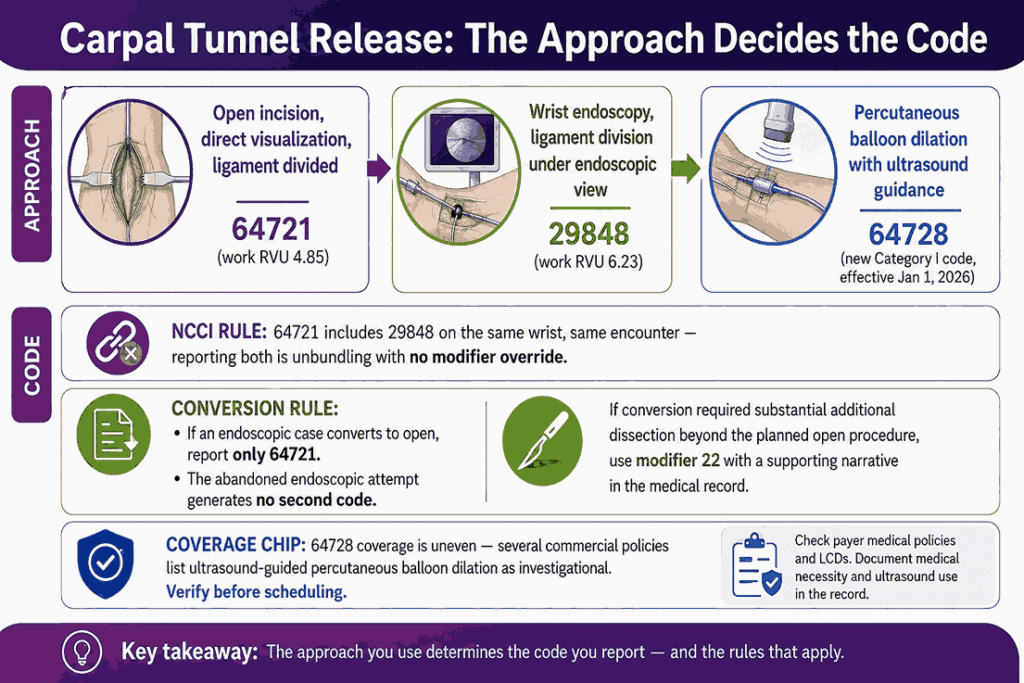
Chapter VIII of the NCCI Policy Manual for Medicare Services addresses this pair directly. CMS states that 64721 includes open release of the transverse carpal ligament, and that 64721 includes the procedure described by 29848 when both are performed on the same wrist at the same patient encounter.
The two codes are alternative routes to the same anatomic objective. Reporting both for one wrist in one session is an unbundling error with no modifier override.
| Code | Approach | What the operative note must show | 2026 Work RVU |
|---|---|---|---|
| 64721 | Open | Open incision, direct visualization, division of transverse carpal ligament | 4.85 |
| 29848 | Endoscopic | Wrist endoscopy, ligament division under endoscopic visualization | 6.23 |
| 64728 | Percutaneous, ultrasound-guided | Balloon dilation of the carpal tunnel with ultrasound guidance | New for 2026 |
CPT 64728 became effective January 1, 2026, as a Category I code. Coverage is uneven. Several commercial policies, including Premera, currently list ultrasound-guided percutaneous intracarpal tunnel balloon dilation as investigational. Verify the policy before scheduling. Approach-specific code splits like this one recur across the hand and upper-extremity CPT codes, where technique rather than anatomy separates the options.
The Conversion Rule: When an Endoscopic Release Becomes an Open Release
CMS is explicit. If an endoscopic procedure is converted to an open procedure, only the open procedure may be reported.
The abandoned endoscopic attempt does not generate a second code, and it does not support a distinct-service modifier. Report 64721 alone. If the conversion added substantial dissection time, modifier 22 is the correct instrument, supported by a narrative in the operative note.
When Is Add-On Code 64727 Separately Reportable With CPT 64721?
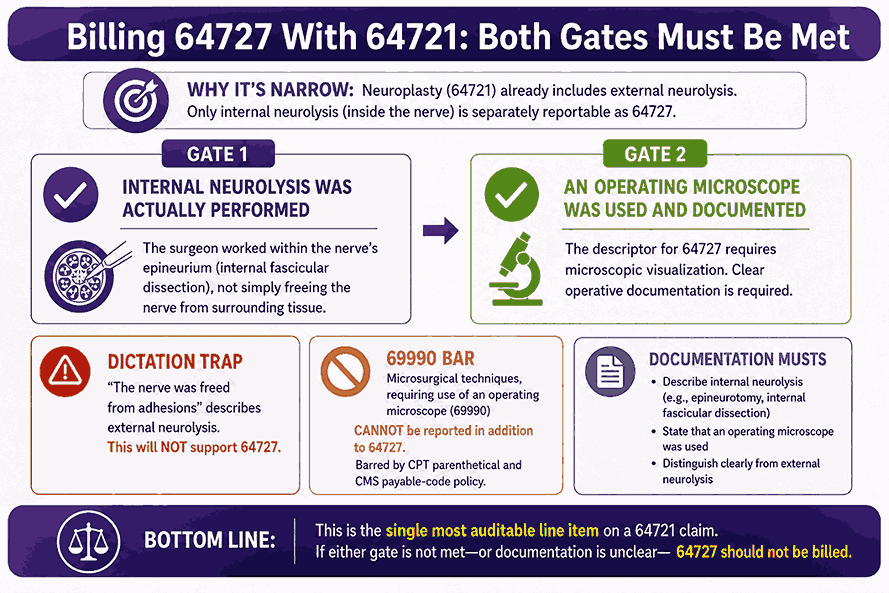
Add-on code 64727 describes internal neurolysis requiring use of an operating microscope. Its parenthetical carries a key phrase: neuroplasty includes external neurolysis.
That phrase does the work. Because 64721 already contains external neurolysis, only internal neurolysis is separately reportable. Two conditions must both be met before 64727 goes on the claim.
- Internal neurolysis was actually performed, not external freeing of the nerve from surrounding tissue.
- An operating microscope was used and documented, since the descriptor requires it.
A second parenthetical bars reporting 69990 in addition to 64727. CMS policy reinforces this from another direction. Chapter VIII limits separate payment for 69990 to a defined list of code ranges, and 64727 is not on that list. NCCI bundles 69990 into all other surgical procedures, and most of those edits do not permit a bypass modifier.
How Does CPT Code 64721 Differ From Carpal Tunnel Injection (20526) and Ulnar Nerve Decompression (64719)?
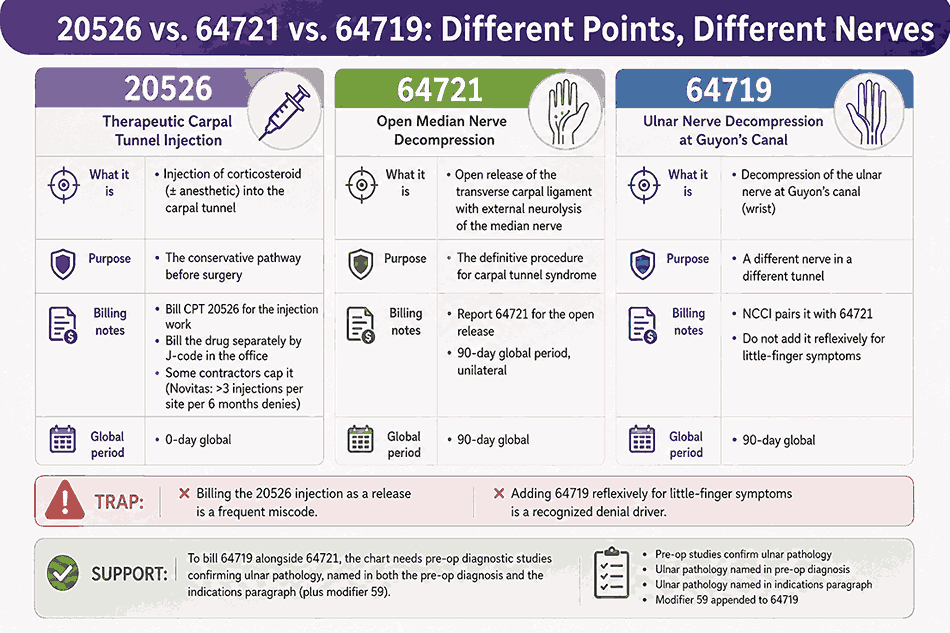
These three codes describe different points on the treatment pathway and different nerves. Coders conflate them regularly.
| Code | Descriptor | Clinical role | Billing note |
|---|---|---|---|
| 20526 | Injection, therapeutic (eg, local anesthetic, corticosteroid), carpal tunnel | Conservative treatment before surgery | Bill the drug separately by J-code in the office setting |
| 64721 | Neuroplasty and/or transposition; median nerve at carpal tunnel | Definitive open decompression of the median nerve | 90-day global, unilateral |
| 64719 | Neuroplasty and/or transposition; ulnar nerve at wrist | Ulnar nerve decompression at Guyon’s canal | NCCI pairs it with 64721 and it needs its own documented indication |
The 20526 injection is the conservative pathway, and billing it as a release is a frequent miscode. Some contractors also cap utilization. Novitas Solutions, for example, denies more than three injections per anatomic site in a six-month period.
CPT 64719 addresses a different nerve in a different tunnel. Adding it reflexively because the patient mentioned little-finger symptoms is a recognized denial driver. To support 64719 alongside 64721, the chart needs pre-operative diagnostic studies confirming ulnar nerve pathology, named in both the pre-operative diagnosis and the indications paragraph.
What ICD-10 Codes and Medical Necessity Criteria Support CPT Code 64721?
Carpal tunnel syndrome codes to the G56.0- subcategory, and a fifth character is required. The diagnosis must match the laterality on the procedure line.
| ICD-10-CM Code | Description | Use with |
|---|---|---|
| G56.00 | Carpal tunnel syndrome, unspecified upper limb | Avoid on surgical claims |
| G56.01 | Carpal tunnel syndrome, right upper limb | 64721-RT |
| G56.02 | Carpal tunnel syndrome, left upper limb | 64721-LT |
| G56.03 | Carpal tunnel syndrome, bilateral upper limbs | 64721-50 or RT and LT lines |
Submitting G56.00 against a laterality-modified procedure line creates a contradiction inside the claim. The modifier says right wrist, the diagnosis says unknown limb. Payers reject that pairing, and the fix is an operative note that names the side. Fifth-character laterality requirements like the G56.0- series run throughout orthopedic ICD-10 selection, where an unspecified code contradicts a lateralized procedure line.
What Are the Conservative Treatment and Electrodiagnostic Requirements Before CPT 64721 Can Be Authorized?
Most commercial and Medicare Advantage plans build prior authorization on two pillars: a documented conservative care trial and objective confirmation of median neuropathy at the wrist.
Typical conservative elements include night splinting, anti-inflammatory therapy, activity modification, and often a corticosteroid injection. Anthem’s clinical guideline for carpal tunnel decompression, for example, references six weeks of hand or wrist immobilization as one qualifying trial.
Payers accept exceptions for severe disease. Thenar atrophy or electrodiagnostic evidence of axonal loss generally shortcuts the conservative requirement.
Do not assume every payer requires a nerve conduction study. Policy language is moving. Premera’s February 2026 interim review allows either electrodiagnostic confirmation or a Carpal Tunnel Symptom Scale (CTS-6) score above 12. Anthem’s criteria read “history, physical exam and/or confirmatory electrodiagnostic testing.” Confirm the specific plan language rather than defaulting to EMG in every case.
Which Documents Are Required For CPT Code 64721?
The pre-authorization packet and the post-service audit defense are the same set of records. Assemble these:
- Operative note stating the open approach explicitly, with no endoscope used
- Laterality named in the note and matched to the claim modifier
- Description of division of the transverse carpal ligament
- Any transposition performed, and any internal neurolysis with microscope use
- Pre-operative electrodiagnostic report or validated clinical score
- Conservative care record with dates and duration
- Symptom history including functional limits such as grip, typing, or sleep disturbance
What is the Cost of CPT Code 64721?
Payment for 64721 splits into a professional component under the Physician Fee Schedule and a facility component that varies sharply by site of service. Both changed for 2026.
RVUs and Medicare Payment for CPT Code 64721
CMS finalized two conversion factors for CY 2026 for the first time. Qualifying Advanced APM participants use $33.57, and nonqualifying participants use $33.40, up from $32.35 in 2025.
| Component | 2026 Value |
|---|---|
| Work RVU | 4.85 |
| Practice expense RVU (non-facility) | 8.61 |
| Malpractice RVU | 0.99 |
| Total RVU (non-facility) | 14.45 |
| Medicare national average, non-facility | $482.64 |
| Medicare national average, facility | $423.19 |
| Global period | 90 days |
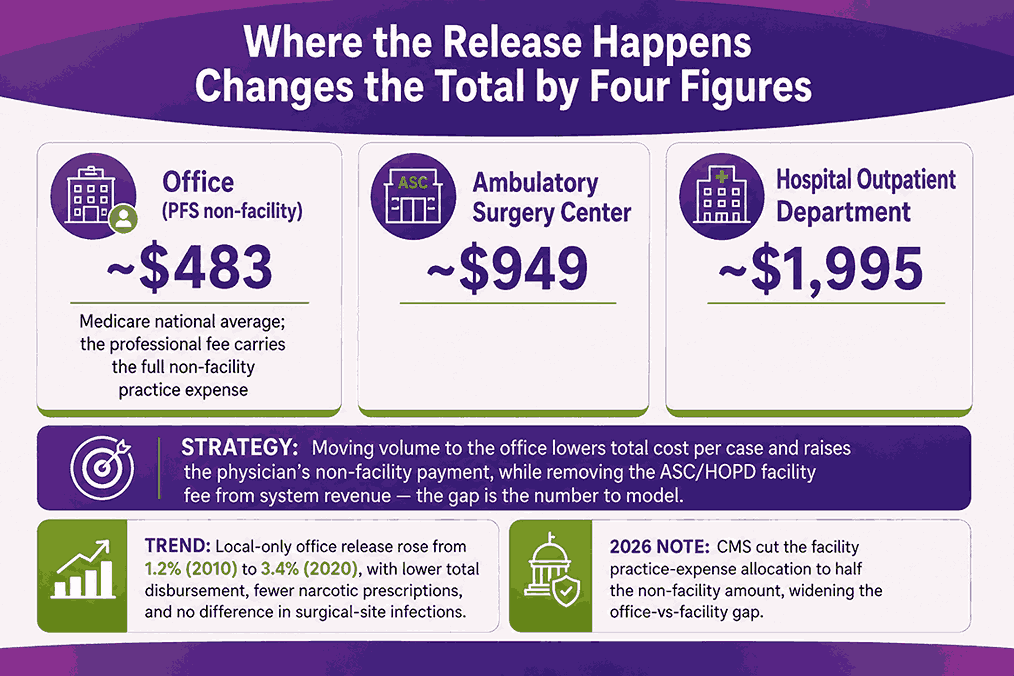
Two 2026 policy changes matter for modeling. CMS applied a 2.5% efficiency adjustment to work RVUs for non-time-based services, which pulls the work value down. CMS also cut the portion of facility practice expense RVUs allocated on work RVUs to half the non-facility amount, widening the gap between office and facility payment.
Site of Service Differences Across ASC, Hospital Outpatient, and Office-Based Release
The professional fee is the smaller half of the story. Facility payment moves the total by more than a thousand dollars.
| Setting | 2026 Medicare national average |
|---|---|
| Office, PFS non-facility | $482.64 |
| Ambulatory surgery center | approximately $949 |
| Hospital outpatient department | approximately $1,995 |
Office-based release under local anesthesia is growing, but the base is small. A PearlDiver analysis of local-only carpal tunnel operations found the office share rose from 1.2% in 2010 to 3.4% in 2020. The same study found lower total disbursement in the office, fewer narcotic prescriptions, and no difference in surgical site infections.
For a surgery center or health system running a site-of-service strategy, that gap is the number to model. Moving volume to the office lowers total cost per case and raises the physician’s non-facility payment, while removing the ASC or HOPD facility fee from the system’s revenue. Rebuilding fee schedules and re-checking payer site-of-service policy after that shift is standard work for orthopedic revenue cycle teams, and skipping it is how practices migrate volume into a lower net collection.
Commercial Payers and Prior Authorization Requirements
Commercial allowables typically sit above Medicare, but access is gated. Expect prior authorization on most commercial and Medicare Advantage plans.
Three variables drive commercial behavior on this code:
- Conservative care duration, commonly six weeks to three months for mild or moderate disease
- Site of service policy, with several plans steering non-facility or ASC placement over HOPD
- Technique coverage, since percutaneous and ultrasound-guided approaches remain investigational under multiple policies
What Are Example Clinical Scenarios or Use Cases for CPT Code 64721?
Four case patterns cover most of the coding decisions a hand surgery practice will face.
Scenario 1: Electrodiagnostically Confirmed Moderate Carpal Tunnel Syndrome After Failed Conservative Management
A 58-year-old patient reports eight months of right-hand numbness disturbing sleep. Night splinting and NSAIDs over ten weeks produced no lasting relief. Nerve conduction study shows prolonged distal motor latency consistent with moderate median neuropathy at the wrist.
The surgeon performs an open release under local anesthesia in the ASC.
Coding: 64721-RT with G56.01. No add-on codes. The E/M visit that established the surgical decision, if on the same date, carries modifier 57.
Scenario 2: Endoscopic Release Converted to Open Release Intraoperatively
The surgeon begins an endoscopic release. Visualization is poor because of anatomic variation, so the case converts to an open approach, and the ligament is divided under direct vision.
Coding: 64721 only. The endoscopic attempt is not separately reported, and 29848 stays off the claim entirely. If the conversion required significantly extended dissection, append modifier 22 and document the added work in the operative note.
Scenario 3: Bilateral Carpal Tunnel Syndrome Treated in a Single Operative Session
Both wrists are released in one session under WALANT. Diagnosis is G56.03.
Coding for a practitioner claim: 64721-50 with one unit of service on a single line. CMS requires practitioners and outpatient hospitals to report bilateral surgical procedures this way.
Coding for an ASC claim: two lines, one unit each, with RT on one and LT on the other. The single-line modifier 50 requirement does not apply to ASCs. ASC billing services have to encode as a payer-and-setting rule rather than a global one, since the same case coded the practitioner way will reject.
Commercial payers vary. Some reject modifier 50 and require the two-line RT/LT format. Confirm before submission rather than reworking the denial.
Scenario 4: Revision Carpal Tunnel Release Through a Previously Operated Field
A patient returns 14 months after an index release with recurrent symptoms. The revision requires dissection through dense scar, careful identification of the median nerve, and release of residual distal ligament.
Coding: 64721 with modifier 22, plus the laterality modifier. Modifier 22 claims without a narrative are routinely ignored. The note must quantify the additional work: scarring, adhesions, added operative time, and the technical difficulty encountered.
What Are the CPT Code 64721 Rules To Ensure Successful Reimbursement?
Clean payment on this code comes down to four disciplines: correct approach coding, correct laterality mechanics, respect for the global period, and documentation that separates internal from external neurolysis.
Bundling and NCCI Rules for CPT Code 64721
Three bundles account for most of the edit-driven denials on this code.
| Bundled pair | Rule | Override available |
|---|---|---|
| 64721 and 29848, same wrist, same encounter | 64721 includes 29848 per NCCI Chapter VIII | No |
| 64727 and 69990 | CPT parenthetical bars it; 64727 is not on the CMS 69990 payable list | No |
| 64721 and 64719 | Ulnar decompression at the wrist is paired with the open median release | Yes, with documented ulnar pathology and modifier 59 |
External neurolysis is never separately reportable, because the neuroplasty descriptor already contains it.
Same-session procedures on other digits are a different matter. NCCI does not bundle trigger finger release (26055) with 64721. Report 26055 as the secondary procedure with modifier 51, and expect payment at 50% of the fee schedule amount for the second procedure. Finger modifiers FA and F1 through F9 identify the specific digit, and RT or LT separate the wrist work from the digital work.
Units, Bilateral Billing, and Laterality Requirements
CPT 64721 is a unilateral code. One wrist equals one unit.
The Medicare Claims Processing Manual requires practitioners and outpatient hospitals to report bilateral surgical procedures with modifier 50 and one unit of service on a single claim line. ASCs report bilateral procedures on two lines, one unit each, using RT and LT. 64721 sits on the ASC covered procedures list, and like most ASC CPT codes, it is paid under the ASC fee schedule on a claim the facility submits independently of the professional fee.
Reporting two units on one line is the error to watch for. It trips the Medically Unlikely Edit and produces a line-level rejection rather than a payable bilateral claim.
90-Day Global Period and Post-Operative Billing Rules
The 090 global period covers the pre-operative visit on the day before or day of surgery, the procedure, and routine post-operative care through day 90.
Inside the global and not separately payable:
- Routine wound checks
- Suture removal
- Dressing changes
- Treatment of post-operative pain by the operating surgeon
- Post-operative control of bleeding not requiring a return to the operating room
Outside the global, with the right modifier:
- Unrelated E/M during the global period, modifier 24
- Staged or related procedure, including the contralateral wrist scheduled inside the first side’s global, modifier 58
- Unplanned return to the operating room for a related complication, modifier 78
- Unrelated procedure during the global period, modifier 79
Documentation That Distinguishes Internal From External Neurolysis
This is the single most auditable line item on a 64721 claim. The base code already contains external neurolysis, so an unsupported 64727 is a straightforward add-on denial.
The operative note must record two specific facts: that an operating microscope was used, and that the neurolysis was internal, meaning the surgeon worked within the nerve’s epineurium rather than freeing it from surrounding tissue. Dictation that says “the nerve was freed from adhesions” describes external neurolysis and will not support 64727.
Top Reasons For Denials For 64721
The following table outlines the key denial triggers for CPT 64721 and the practical steps to resolve them.
| Denial trigger | Quick Fix |
|---|---|
| 29848 unbundled on the same wrist | Report only the code matching the documented approach; no modifier bypasses this edit |
| 64727 billed without documented microscope use | Add microscope confirmation and internal neurolysis technique to the operative note, or drop the add-on |
| 69990 appended to 64727 | Remove 69990; it is barred by CPT parenthetical and by CMS payable-code policy |
| Unsupported 64719 added for ulnar symptoms | Attach pre-operative studies confirming ulnar pathology and name it in the indications paragraph |
| G56.00 against a laterality-modified line | Recode to G56.01, G56.02, or G56.03 based on the operative note |
| Electrodiagnostic confirmation absent | Submit the NCS or EMG report, or the validated clinical score if the plan accepts one |
| Conservative care period not documented | Produce dated records of splinting, medication, therapy, or injection |
| Prior authorization not obtained | Verify plan requirements before scheduling; retro-authorization is rarely granted |
| Bilateral case billed as two units on one line | Rebill as modifier 50 with one unit, or two RT/LT lines for an ASC claim |
Denials on this code are predictable, which makes them preventable. The chart either shows an open approach, a named side, a documented conservative pathway, and objective confirmation, or it does not. Practices that build those four checks into pre-submission review see the 64721 denial rate drop without touching the clinical workflow.