Peroral endoscopic myotomy changed how gastroenterologists treat achalasia. Moreover, it changed how billers approach esophageal procedure coding. Most practices still code POEM the way they did before 2022. That habit costs money.
CPT created a dedicated code for POEM in January 2022. Instead of updating their workflow, many billing teams kept the old process in place. They keep defaulting to the unlisted procedure code out of habit or uncertainty. This guide breaks down what changed, what payers actually require, and where claims fail. Besides the coding mechanics, it also covers documentation habits that protect practices during audit.
Practices building out a broader revenue cycle strategy should treat POEM as one piece of a larger system. Strong gastroenterology billing services catch these code transitions early, before they turn into a backlog of denied claims.
What POEM Involves
POEM treats esophageal achalasia and related motility disorders. The physician creates a submucosal tunnel through the esophageal lining. A myotomy is then performed on the lower esophageal sphincter muscle. The approach is transoral, meaning no external incisions are needed.
This matters for coding because the procedure combines elements of endoscopy and myotomy. Before 2022, no single code captured that combination. Instead, billers had to choose between codes built for open or laparoscopic approaches. None of them fit the transoral technique well.
The 2022 Code Change Practices Still Miss
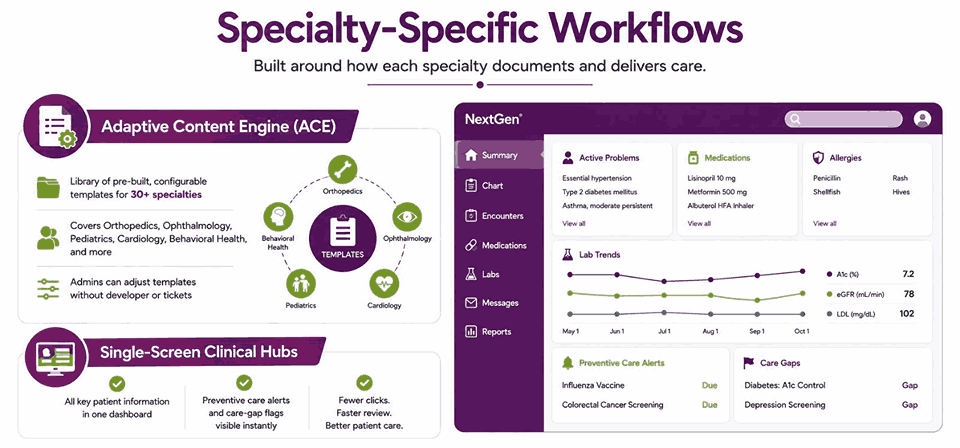
CPT 43497 became effective January 1, 2022. Its description reads: lower esophageal myotomy, transoral, including peroral endoscopic myotomy. This code replaced the workaround of billing 43499, the unlisted esophagus procedure code.
Before this change, three codes described esophagomyotomy through other approaches. Code 32665 covered the thoracotomy approach. Code 43279 covered laparoscopy. Code 43330 covered open abdominal incision. None fit the peroral technique.
Practices that started performing POEM before 2022 built billing habits around 43499. That code required manual pricing, payer-specific documentation, and frequent appeals. Most importantly, some billing teams never migrated to 43497 once it became available, and that gap is still visible in claims today.
This creates two problems. First, claims using 43499 for esophageal POEM after 2022 face denials for outdated coding. Second, claims correctly using 43497 sometimes get rejected because staff attach documentation formatted for unlisted procedure review. That mismatch slows payment even when the code itself is correct.
Check your claim scrubber settings. If 43499 is still flagged as the default for POEM in your system, that configuration needs correction immediately. A quick review against a current gastroenterology CPT codes reference can confirm whether your system rules are current.
When 43499 Still Applies
Unlisted coding has not disappeared entirely from POEM billing. It remains necessary in one specific scenario.
Gastric POEM, known as G-POEM, treats gastroparesis rather than achalasia. This procedure targets the pylorus instead of the esophagus. CPT 43497 explicitly does not cover this indication.
G-POEM should be billed with 43999, the unlisted procedure code for the stomach. Some coders reference 43497 in documentation to explain technique, since the tunneling method is similar. However, the actual billed code stays 43999, not 43497.
Confusing these two procedures is a common denial cause. Confirm the operative note states the anatomic target clearly. Esophagus and gastroesophageal junction procedures point to 43497. Meanwhile, pyloric procedures point to 43999. Getting this distinction wrong even once can trigger a pattern of denials across a practice’s entire G-POEM volume.
Bundling Rules and Exclusions
CPT 43497 comes with specific bundling restrictions. These were built into the code definition when it launched.
The code cannot be reported alongside a myotomy performed via thoracotomy, code 32665. It also excludes reporting with diagnostic esophagoscopy codes 43191, 43197, and 43200. Diagnostic esophagogastroduodenoscopy, code 43235, is excluded as well.
The logic here is straightforward. POEM already includes endoscopic visualization of the esophagus as part of the procedure. Therefore, billing a separate diagnostic scope on the same date duplicates work already captured in 43497.
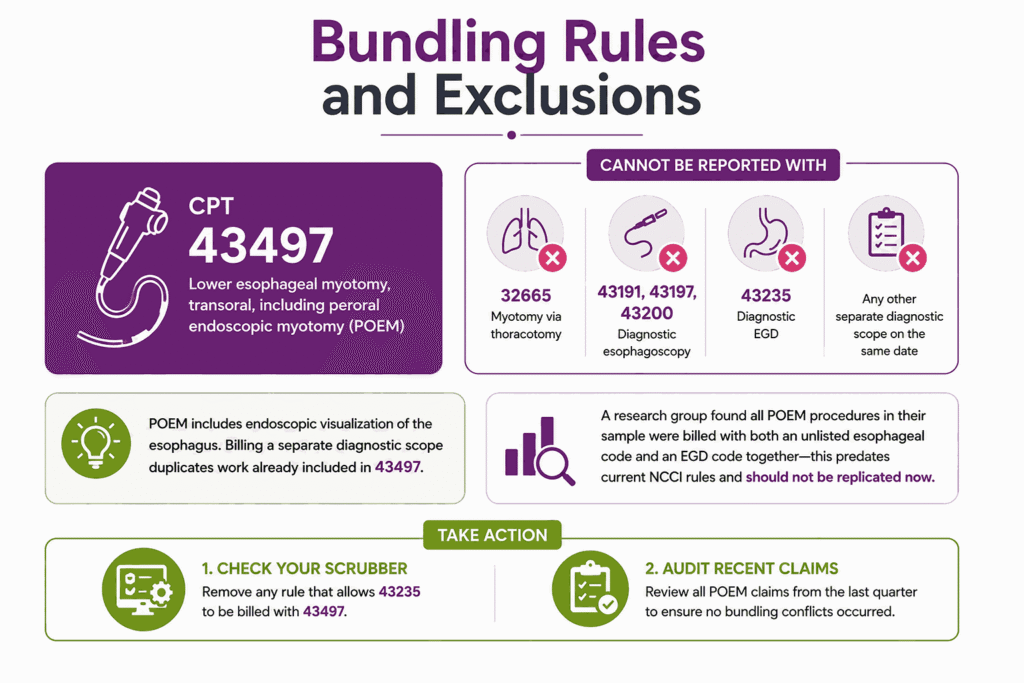
One research group tracked payer behavior before this exclusion clarity existed. Their study found all POEM procedures in their sample were billed with both the unlisted esophageal code and a standard EGD code together. That dual-billing pattern predates the current NCCI structure and should not be replicated under current rules.
Review your claim scrubber for any rule still permitting 43235 alongside 43497. If found, that rule needs removal before it generates avoidable denials. Besides the scrubber check, run a manual audit on any POEM claim submitted in the last quarter to confirm no bundling conflicts slipped through.
ICD-10 Coding for Medical Necessity
Diagnosis coding drives medical necessity review for POEM claims. Payers expect specific codes tied to documented findings, not general esophageal disorder codes.
The primary diagnosis for classic achalasia is K22.0, achalasia of cardia. Supporting or alternative codes include K22.2 for esophageal obstruction, K22.4 for dyskinesia of esophagus, K22.89 for other specified esophageal disease, and K22.9 for unspecified esophageal disease.
Payer medical policies list these codes explicitly as covered diagnoses. Using an unrelated GI code, even one that seems close, triggers automatic medical necessity denial. Instead, the diagnosis must match the achalasia subtype documented in the manometry report. A practice-wide gastroenterology ICD 10 guide kept current with payer updates helps coders avoid this mismatch entirely.
Achalasia has three recognized subtypes based on manometric patterns. Type I shows minimal esophageal pressure. Type II shows panesophageal pressurization. Type III shows premature spastic contractions. Payer criteria often specify which subtype qualifies for POEM versus alternative treatment.
Coders should confirm the subtype appears in the physician note before submitting the claim. Missing subtype documentation is a frequent cause of prior authorization delay, not just claim denial.
Prior Authorization Requirements
Nearly every commercial and Medicaid payer requires prior authorization before POEM. This is not optional paperwork. It determines whether the claim gets paid at all.
Standard medical necessity criteria across payers include a confirmed achalasia diagnosis through high-resolution esophageal manometry. Besides that, many policies also require documented failure of a previous treatment, such as botulinum toxin injection or pneumatic dilation, before approving POEM.
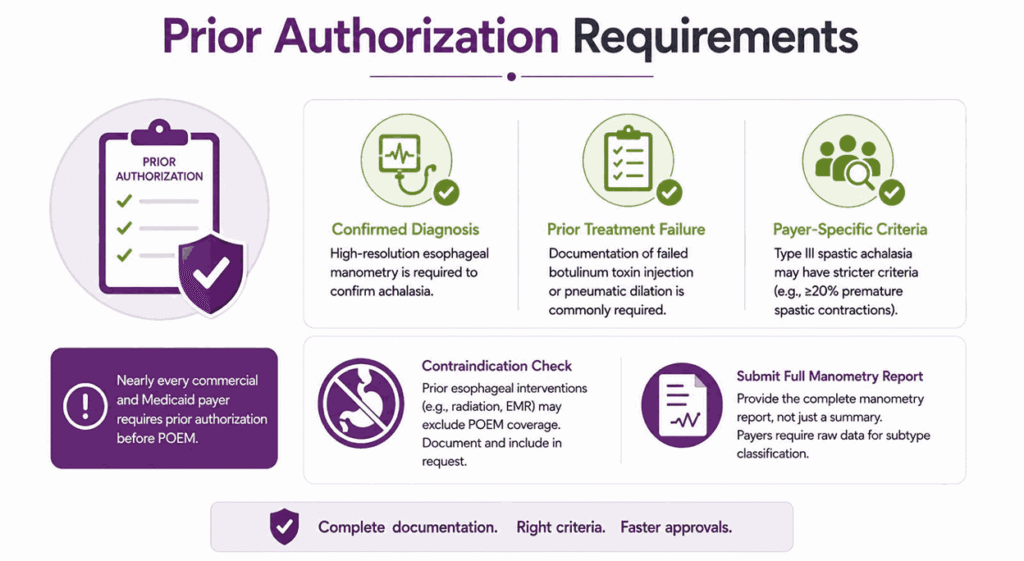
Some payers restrict coverage further. Type III spastic achalasia often has stricter criteria, sometimes requiring twenty percent or more of swallows to show premature spastic contractions on manometry. Practices treating multiple achalasia subtypes need payer-specific checklists, not a single generic prior authorization template.
Contraindication documentation matters too. Prior esophageal interventions that compromise submucosal integrity, such as radiation or endoscopic mucosal resection, can disqualify a patient from POEM coverage under certain policies. Confirm these exclusions are addressed in the authorization request before submission.
Submit the manometry report itself, not just a summary. Payers reviewing prior authorization requests want the raw diagnostic data supporting subtype classification. A physician letter alone is rarely sufficient.
Documentation That Supports the Claim
Operative notes for POEM need specific elements to withstand both prior authorization review and post-payment audit. Missing detail in any of these areas increases denial risk.
The note should describe all four procedural steps clearly. These are mucosal incision and submucosal entry, submucosal tunnel creation, the myotomy itself, and closure of the mucosal incision. Documenting each step supports both the code selection and the work value assigned to 43497.
Include the specific anatomic extent of the myotomy. Length of the myotomy, extension into the gastric cardia if performed, and total procedure time all support medical necessity. Additionally, they help defend against downcoding requests during payer review.
Document any complications or extended technical difficulty explicitly. This becomes relevant if modifier 22 is being considered.
Modifier Use on POEM Claims
Modifier 22 applies when the procedure requires substantially more work than the code typically describes. This might include unusually difficult anatomy, prolonged tunnel creation, or management of an intraprocedural complication.
Do not attach modifier 22 routinely. Payers scrutinize this modifier closely and require a separate letter explaining why the case exceeded typical difficulty. Attach that letter every time the modifier is used. Otherwise, claims with modifier 22 and no supporting narrative get denied at a much higher rate than claims without the modifier at all.
Reimbursement Data Practices Should Know
Understanding actual payment levels helps practices set expectations and catch underpayment. Recent facility pricing data lists CPT 43497 with a work RVU of 13.29 and a total facility RVU near 23.49. Hospital outpatient facility payment runs close to seven hundred sixty-nine dollars. While ambulatory surgical center facility payment runs significantly higher, near five thousand four hundred thirty dollars.
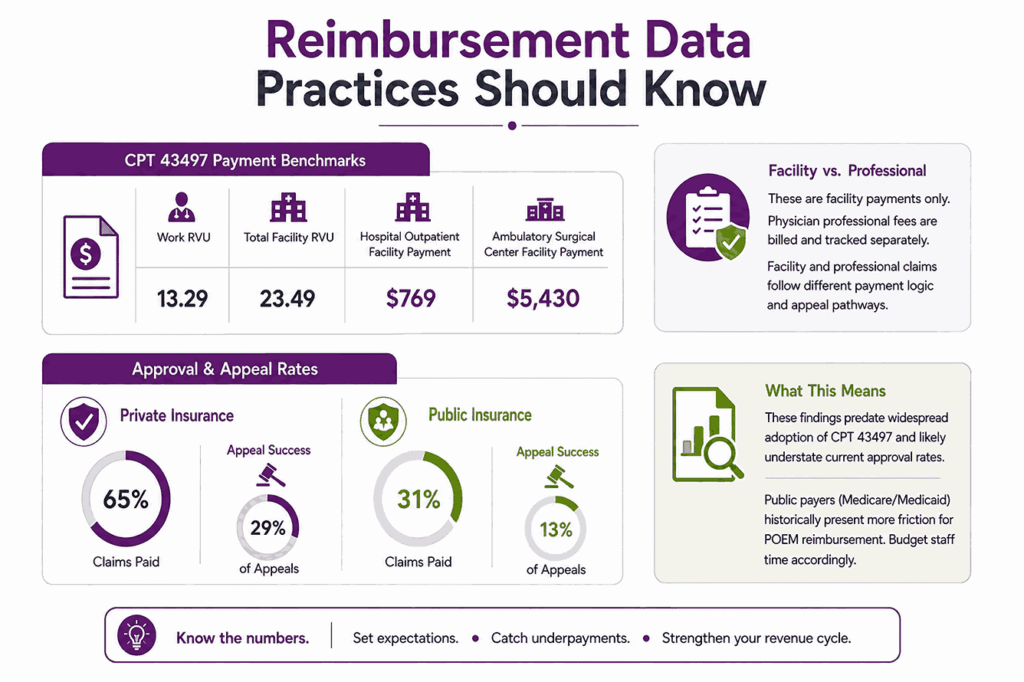
These figures represent facility-side payment, not physician professional fees, which are billed and tracked separately. Confirm your revenue cycle system separates these correctly. Facility and professional claims for the same POEM procedure follow different payment logic and different appeal pathways.
Payer type affects approval rates significantly, even under the current dedicated code. Research tracking claims billed under the older unlisted code framework found private insurance paid roughly sixty-five percent of claims compared to thirty-one percent for public insurance. Appeals fared poorly across both payer types, succeeding in only twenty-nine percent of private insurance appeals and thirteen percent of public insurance appeals.
These numbers predate widespread adoption of 43497 and likely understate current approval rates. Still, they show public payers historically present more friction for POEM reimbursement. Budget staff time accordingly when Medicaid or Medicare claims are involved.
Common Denial Reasons and How to Fix Them
Most POEM denials fall into a handful of repeatable categories. Knowing them in advance saves time on every future claim.
Outdated code selection is the most frequent issue. Billing 43499 for an esophageal case after 2022 signals an outdated process to the payer, and it slows adjudication even when the underlying medical necessity is clear.
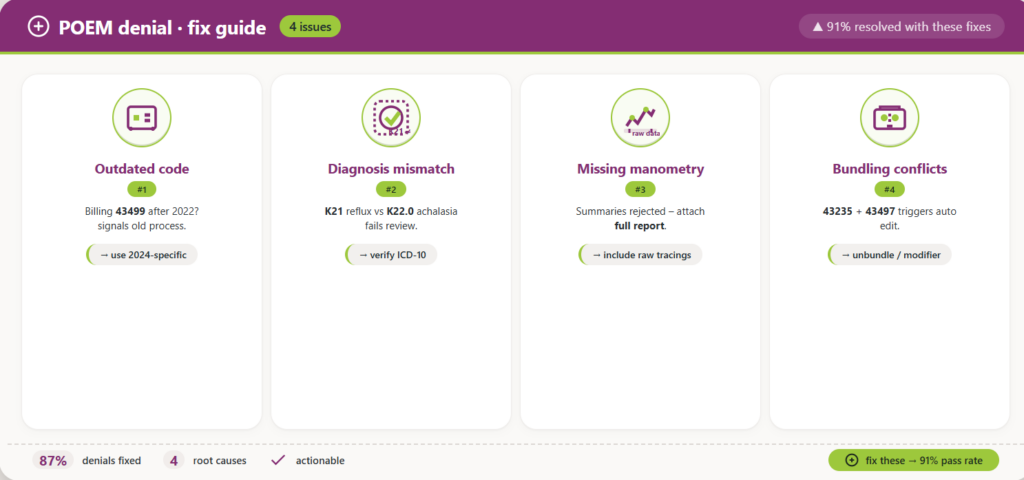
Diagnosis mismatch ranks second. A K21 reflux code submitted instead of K22.0 for achalasia will not pass medical necessity review, regardless of how strong the rest of the claim looks.
Missing manometry data ranks third. Prior authorization requests summarizing the manometry findings instead of attaching the full report face higher rejection rates. Payers want the raw data, not an interpretation of it.
Bundling conflicts round out the list. A same-date 43235 charge alongside 43497 will trigger an automatic edit at most payers, regardless of documentation quality.
Fixing these four issues resolves the overwhelming majority of POEM denials seen across practices nationally.
Building a Denial Prevention Checklist
Practices billing POEM regularly benefit from a standardized pre-submission checklist. This reduces the manual review burden on coders handling less common procedures.
Confirm the correct CPT code based on anatomic target, either 43497 for esophageal POEM or 43999 for G-POEM. Confirm the ICD-10 code matches the documented achalasia subtype or esophageal condition. Confirm no excluded diagnostic codes appear on the same claim, including 43235, 43191, 43197, or 43200.
Verify prior authorization was obtained and matches the payer’s specific medical necessity language. Confirm the manometry report is attached, not summarized. Confirm the operative note documents all four procedural steps and includes myotomy length and extent.
If modifier 22 is used, confirm a supporting letter is attached. If the claim involves Medicaid or Medicare, flag it for closer monitoring given historically lower first-pass approval rates.
Practices without an internal team to run this checklist consistently often lean on outside expertise. A dedicated gastroenterology billing guide or an experienced billing partner can standardize this process across every provider in the group, not just the ones who happen to remember the 2022 code change.
Where Practices Still Lose Money
The biggest financial risk in POEM billing right now is not the payer. It is an internal workflow lag. Practices that migrated fully to 43497 after 2022 see faster payment and fewer appeals. Practices still defaulting to 43499 for esophageal cases are working harder for worse outcomes.
Audit your last twelve months of POEM claims. Identify how many used 43499 versus 43497 for esophageal indications. Any 43499 claim for an esophageal target after January 2022 represents a coding correction opportunity, and possibly a resubmission opportunity if timely filing limits allow.
POEM billing is not inherently complicated. It became complicated because coding habits outlasted the code changes meant to simplify them. Updating those habits, along with staying current on payer-specific documentation demands, is the single highest-value action a billing team can take on this procedure today.