Every normal delivery in a hospital or birthing center generates a billable professional service, and most practices collect only part of it. CPT 99460 covers initial hospital or birthing center care, per day, for evaluation and management of a normal newborn infant. CPT code 99460 looks like one of the simplest codes in the E/M chapter.
Newborn claims fail for reasons unrelated to clinical work, i.e the infant carries no insurance ID yet, the wrong Z38 code sits on the claim, or the encounter qualifies as 99463 instead. One busy labor and delivery unit produces 200 to 400 newborn claims per month. According to the American Academy of Pediatrics, the average claim denial rate for pediatricians reaches 13%, substantially exceeding the healthcare industry’s overall denial rate of 5-10%.
This guide covers the full 99460 CPT code description, the complete newborn care code family, correct ICD-10 pairing, documentation requirements, modifier logic, and the 8 denial patterns that damage pediatric and hospitalist collections. Use this complete reference for pediatrics CPT codes to audit newborn billing against this guide before a payer audits it first.

What Is CPT Code 99460?
CPT code 99460 reports initial hospital or birthing center care, per day, for the evaluation and management of a normal newborn infant. The American Medical Association maintains CPT 99460 within the Newborn Care Services family, range 99460 to 99463. CPT 99460 applies to infants from birth through 28 days of age.
Every word inside the CPT 99460 descriptor carries billing consequences. The following table breaks the official descriptor into its enforceable components:
| Descriptor Element | Billing Meaning | Common Error |
|---|---|---|
| Initial | Reported once, on the first day of provider care | Billing 99460 on day two instead of 99462 |
| Hospital or birthing center | Restricts place of service to inpatient hospital or birthing center | Billing 99460 for a home or office newborn visit |
| Per day | One unit per calendar date of service | Billing multiple units for multiple visits |
| Evaluation and management | Requires history, exam, and medical decision making | Documenting a nursing note only |
| Normal newborn | No abnormal condition and no active treatment | Billing 99460 with a clinical diagnosis attached |
| Infant | Birth through 28 days of age | Billing 99460 for an infant older than 28 days |
Two descriptor elements drive the majority of CPT 99460 denials: “normal newborn” and “initial.” A newborn under active treatment falls outside the code. A second-day encounter falls outside the code.
What Does CPT Code 99460 Include?
CPT 99460 includes 5 bundled service components performed during the first day of newborn care. Payment for CPT code 99460 covers all 5 components as a single per-day unit.
- Review the maternal, fetal, and newborn history, including prenatal labs and delivery events.
- Perform a complete newborn physical examination covering all body systems.
- Order diagnostic tests, screenings, and treatments, including bilirubin, hearing screen, and metabolic panel.
- Deliver anticipatory guidance to the parents on feeding, sleep position, jaundice signs, and follow-up.
- Document all findings, orders, and counseling in the hospital medical record.
CPT 99460 carries a 0-day global period. Procedures performed on the same date remain separately reportable, including circumcision codes 54150 and 54160.
Which CPT Codes Belong to the Newborn Care Family?
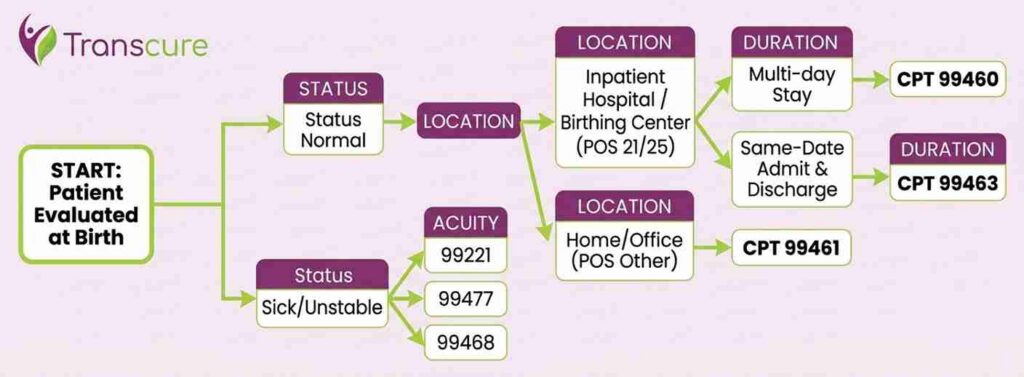
The newborn care family contains 6 primary CPT codes plus 2 discharge codes and 4 escalation codes. Correct selection depends on 3 variables: place of service, encounter day, and newborn acuity.
The following table maps the complete newborn coding set used alongside CPT 99460:
| CPT Code | Descriptor Summary | When to Report |
|---|---|---|
| 99460 | Initial hospital or birthing center care, per day, normal newborn | First day of care, multi-day stay |
| 99461 | Initial care, per day, normal newborn, other than hospital or birthing center | Home or office initial newborn visit |
| 99462 | Subsequent hospital care, per day, normal newborn | Day 2 and each additional day |
| 99463 | Initial hospital or birthing center care, normal newborn, admitted and discharged same date | Admit and discharge on one calendar date |
| 99464 | Attendance at delivery and initial stabilization of newborn | Delivering physician requests attendance |
| 99465 | Delivery or birthing room resuscitation, positive pressure ventilation and chest compressions | Acute inadequate ventilation or cardiac output |
| 99238 | Hospital discharge day management, 30 minutes or less | Discharge on a date after the initial encounter |
| 99239 | Hospital discharge day management, more than 30 minutes | Extended discharge counseling, time documented |
| 99221 to 99223 | Initial hospital inpatient care | Sick newborn below intensive care threshold |
| 99477 to 99480 | Neonatal intensive care, initial and subsequent | Intensive observation and frequent intervention |
| 99468 to 99469 | Neonatal critical care, initial and subsequent | Critically ill neonate, 28 days or younger |
Codes 99460 through 99463 apply exclusively to normal newborns. The moment active treatment begins, coding shifts to 99221 through 99223, 99477 through 99480, or 99468 through 99469 based on documented acuity.
When Is a Newborn “Normal” for CPT 99460 Purposes?
A newborn qualifies as normal when the infant transitions to extrauterine life without abnormal medical conditions and without treatment beyond routine monitoring. The definition is clinical, not administrative, and payers audit against the medical record rather than the claim.
5 Conditions That Confirm Normal Newborn Status:
- Stable vital signs throughout the observation period
- Absence of respiratory distress requiring intervention
- Absence of congenital anomalies requiring evaluation or treatment
- Absence of prematurity complications requiring management
- Absence of any diagnosis other than a Z38 liveborn code
6 Findings That Disqualify CPT 99460:
- Respiratory distress requiring supplemental oxygen or positive pressure
- Hyperbilirubinemia requiring phototherapy
- Suspected or confirmed sepsis requiring antibiotics
- Hypoglycemia requiring glucose intervention
- Neonatal abstinence syndrome requiring scoring and treatment
- Congenital anomaly requiring consultation or diagnostic workup
A newborn evaluated as normal on day one and diagnosed with a condition on day two supports CPT 99460 for day one. Day two shifts to the appropriate sick newborn or intensive care code based on documented findings.
Which ICD-10 Codes Pair With CPT 99460?
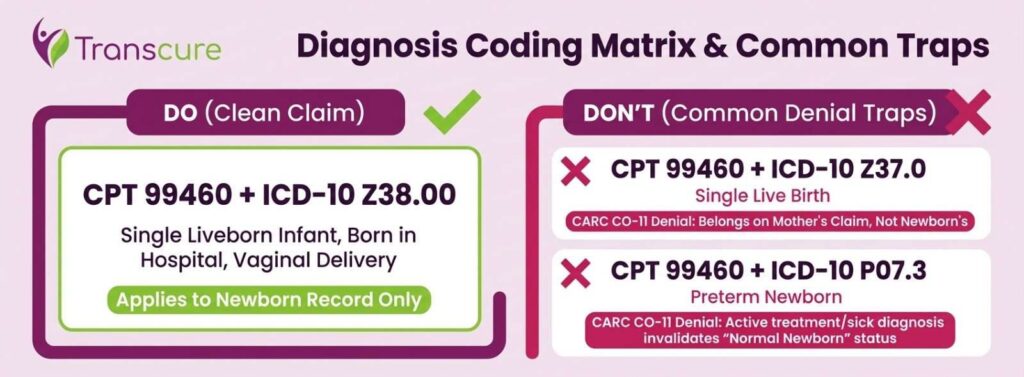
CPT 99460 pairs exclusively with an ICD-10-CM code from the Z38 category (Liveborn infants according to place of birth and type of delivery), as referenced in our pediatrics ICD-10 Codes guide. A Z38 code appears on the newborn record only, and only on the date of birth admission.
The following table lists the Z38 codes used with 99460 CPT code:
| ICD-10 Code | Description |
|---|---|
| Z38.00 | Single liveborn infant, born in hospital, delivered vaginally |
| Z38.01 | Single liveborn infant, born in hospital, delivered by cesarean |
| Z38.1 | Single liveborn infant, born outside hospital |
| Z38.2 | Single liveborn infant, unspecified as to place of birth |
| Z38.30 | Twin liveborn infant, born in hospital, delivered vaginally |
| Z38.31 | Twin liveborn infant, born in hospital, delivered by cesarean |
| Z38.4 | Twin liveborn infant, born outside hospital |
| Z38.5 | Twin liveborn infant, unspecified as to place of birth |
| Z38.61 to Z38.69 | Other multiple liveborn infant, born in hospital |
| Z38.7 | Other multiple liveborn infant, born outside hospital |
| Z38.8 | Other multiple liveborn infant, unspecified as to place of birth |
Two diagnosis errors dominate newborn denials. The first error attaches Z37.0, Single live birth, which belongs on the maternal record and not the newborn record. The second error attaches a clinical diagnosis alongside Z38, which contradicts the “normal newborn” requirement inside the CPT 99460 descriptor.
What Documentation Does CPT 99460 Require?
CPT 99460 requires documentation of 6 elements inside the newborn hospital record. Payers deny CPT code 99460 for missing documentation more often than for any reason other than eligibility.
| Documentation Element | Required Content | Audit Risk if Missing |
|---|---|---|
| Maternal and prenatal history | Prenatal labs, GBS status, maternal conditions, delivery complications | Medical necessity denial |
| Delivery details | Delivery date, time, route, gestational age, Apgar scores | Date-of-service mismatch |
| Newborn physical exam | Complete system-by-system examination findings | E/M level unsupported |
| Normal status attestation | Explicit statement that the newborn is normal and stable | Code selection challenged |
| Orders and screenings | Bilirubin, hearing screen, metabolic screen, feeding orders | Bundled service dispute |
| Parental counseling | Feeding guidance, jaundice warning signs, follow-up timing | Incomplete service denial |
The strongest audit defense is an explicit normal newborn attestation inside the note. A record that documents a complete exam without stating normal status leaves code selection open to payer interpretation.
Which Modifiers Apply to CPT 99460?
Modifier 25 is the primary modifier applied to CPT 99460. CPT code 99460 requires no modifier in a standard newborn encounter with no same-day procedure.
| Modifier | Definition | Application to CPT 99460 |
|---|---|---|
| 25 | Significant, separately identifiable E/M service on the same date as a procedure | Append to 99460 when circumcision 54150 or 54160 is performed on the same date |
| 59 | Distinct procedural service | Rarely applicable, procedure-level modifier not E/M |
| 32 | Mandated service | Append when a payer or agency mandates the newborn evaluation |
| 24 | Unrelated E/M during a postoperative period | Not applicable, 99460 carries a 0-day global |
| 95 | Synchronous telemedicine | Not applicable, 99460 requires in-person evaluation |
Modifier 25 usage on newborn claims draws payer scrutiny. Support every modifier 25 appended with a separately documented E/M note that stands independent of the procedure note.
How Is CPT 99460 Reimbursed?
CPT 99460 is reimbursed almost entirely through Medicaid and commercial payers. The code covers initial hospital or birthing center care for a normal newborn, billed per day. Newborn patients almost never hold Medicare coverage, so the Medicare Physician Fee Schedule is a weak benchmark for CPT 99460 revenue planning.
Three variables set the actual allowable: the payer the newborn is enrolled with, whether that enrollment is active on the date of service, and the state fee schedule that governs the claim. Payer mix moves the blended rate for this code far more than coding choices do.
How Do Commercial Payers Reimburse CPT 99460?
Commercial insurers pay 99460 at the highest allowable of any payer class. Most plans extend coverage to the newborn under the mother’s policy for the first 30 to 31 days after birth. Full payment under the newborn’s own member ID still requires the parent to complete enrollment.
That two-track structure is where revenue leaks. Claims submitted under the mother’s ID may process as a courtesy and later reverse. Claims held for the newborn’s ID may age past the timely filing window. Self-funded ERISA plans are not bound by state newborn coverage mandates, so the rule varies by contract.
How Does Medicaid Managed Care Pay for CPT 99460?
Medicaid managed care plans reimburse 99460 under state-specific fee schedules, and this pathway carries the lowest allowable among covered payer types. Documentation requirements are the strictest of any payer class, so the claim needs to be clean at first submission rather than corrected on appeal.
Expect the MCO to look for the newborn’s own member ID, the birth date matching the date of service, and a normal newborn diagnosis such as Z38.00 or Z38.01. Missing gestational age or birth weight detail also triggers preventable denials.
How Does Medicaid Fee-for-Service Handle Newborn Claims?
Fee-for-service Medicaid covers 99460 through deemed newborn eligibility, which most states grant automatically when the mother is Medicaid-enrolled on the delivery date. Payment becomes predictable once the claim is accepted, since the state fee schedule is published and does not move mid-year.
The friction is timing rather than rate. Eligibility can take weeks to post to the state system, and claims submitted before the newborn record exists will be rejected as no-coverage. Rebilling after eligibility posts recovers most of this revenue.
Does Medicare Reimburse CPT 99460?
Medicare is effectively never applicable to newborn patients, because eligibility requires age 65, 24 months of disability entitlement, or ESRD. No newborn meets those criteria at birth. Medicare volume for 99460 should be modeled at zero.
The Medicare relative values still matter indirectly. Many commercial and Medicaid schedules are priced as a percentage of the Medicare RBRVS, so the relative value of 99460 remains a live input for contract negotiation. The distinction is that Medicare sets the reference, not the payment.
How Is CPT 99460 Billed as Self-Pay?
Self-pay claims bill at the practice’s standard rate and are collected from the maternal guarantor. This category carries the highest write-off exposure of any pathway, since the balance lands on a family in the immediate postpartum period.
Point-of-service collection at discharge outperforms post-discharge statements for this population. Practices that verify maternal coverage before delivery convert a meaningful share of these accounts to Medicaid or commercial claims instead.
Why Do CPT 99460 Claims Get Denied?
CPT 99460 claims are denied for 8 recurring reasons. Eligibility and code substitution account for the largest share of lost newborn revenue.
| Denial Reason | Typical CARC | Root Cause | Fix |
|---|---|---|---|
| Member not eligible | CO-31 | Newborn lacks a member ID at submission | Hold claim, verify enrollment, bill under maternal policy where permitted |
| Diagnosis inconsistent with procedure | CO-11 | Clinical diagnosis attached instead of Z38 | Attach a Z38 code only |
| Duplicate claim | CO-18 | Two providers billed 99460 for one newborn | Report 99460 once per newborn per stay |
| Missing or invalid information | CO-16 | Incomplete birth date, delivery data, or condition code | Correct claim data, resubmit |
| Service bundled | CO-97 | 99460 billed alongside 99463 or a discharge code | Report one initial code per date |
| Invalid code for same-date admit and discharge | Payer-specific | 99460 billed when 99463 applies | Resubmit as 99463 |
| Modifier missing or invalid | CO-4 | Circumcision billed same date without modifier 25 | Append modifier 25 with supporting note |
| Age or benefit mismatch | Payer-specific | Newborn code billed beyond 28 days | Transition to standard E/M codes |
Denials CO-31 and CO-11 alone account for the bulk of newborn A/R aging past 90 days. A submission hold rule tied to newborn enrollment status resolves most of it.
Which Services Can Be Billed Alongside CPT 99460?
CPT 99460 supports 5 separately reportable same-day services. Newborn care codes carry a 0-day global period, which keeps same-date procedures billable.
| Companion Code | Service | Billing Note |
|---|---|---|
| 54150 | Circumcision using clamp or other device with block | Separately reportable, append modifier 25 to 99460 |
| 54160 | Circumcision, surgical excision, neonate 28 days or less | Separately reportable, append modifier 25 to 99460 |
| 99464 | Attendance at delivery and initial stabilization | Reportable with 99460 when the delivering physician requests attendance |
| 99465 | Delivery or birthing room resuscitation | Reportable with 99460 when resuscitation is documented |
| 99477 | Initial neonatal intensive care | Not reportable with 99460 on the same date, acuity codes replace 99460 |
Codes 99464 and 99465 represent the most frequently missed newborn revenue. Attendance and resuscitation services performed in the delivery room go unbilled when documentation lives in the delivery note rather than the newborn note.
How Do You Reduce CPT 99460 Denials?
A newborn billing workflow reduces CPT 99460 denials through 7 controls applied before claim submission, making it an essential component of reliable pediatric billing services.
- Verify newborn enrollment status and hold claims until a member ID exists.
- Reconcile admit and discharge dates on every 99460 claim to confirm 99463 does not apply.
- Filter all Z38 claims monthly and confirm each maps only to 99460, 99461, 99462, or 99463.
- Flag any newborn claim carrying both a Z38 code and a clinical diagnosis.
- Confirm place of service 21 or 25 on every 99460 line.
- Capture delivery room attendance and resuscitation services from the delivery note.
- Audit 30 newborn charts per quarter against documentation requirements.
Practices that apply these 7 controls recover newborn revenue that otherwise ages out unworked.
Frequently Asked Questions About CPT 99460
Can CPT 99460 and 99463 be Billed Together?
No, as many types of CPT codes are mutually exclusive, like CPT 99460 and CPT 99463. CPT 99460 applies to a multi-day stay. CPT 99463 applies when the provider admits and discharges the normal newborn on the same calendar date.
Can Two Providers Each Bill CPT 99460 for the Same Newborn?
No. CPT 99460 reports once per newborn per hospital stay. The provider who performs the initial newborn evaluation reports 99460. A second provider seeing the newborn on a later date reports 99462.
What Diagnosis Code Goes with CPT 99460?
A Z38 category code goes with CPT 99460, such as Z38.00 for a single liveborn infant born in hospital and delivered vaginally. Z37.0 belongs on the maternal record and produces a denial on a newborn claim.
Can CPT 99460 and 99238 be Billed on the Same Day?
No. CPT 99460 and CPT 99238 are not reportable on the same date by the same provider. When the provider performs initial newborn care and discharge on one calendar date, CPT 99463 replaces both codes.
Is Circumcision Included in CPT 99460?
No. Circumcision codes 54150 and 54160 are separately reportable with CPT 99460. CPT 99460 carries a 0-day global period. Append modifier 25 to CPT 99460 and document the E/M service separately from the procedure.
What Happens When a Normal Newborn Becomes Sick During the Stay?
CPT 99460 remains valid for day one when the newborn met normal criteria at the initial evaluation. Subsequent days shift to the appropriate acuity code, including 99221 through 99223, 99477 through 99480, or 99468 through 99469.