The ICD-10 code for unspecified cardiac arrhythmia is I49.9. Coding splits across I47 (paroxysmal tachycardias) and I49 (other arrhythmias). Effective October 1, 2026, I49.8 becomes a non-billable header, and four new codes arrive: I47.22, I49.81, I49.82, and I49.89.
Cardiac arrhythmia covers any disturbance in the rate, rhythm, or conduction sequence of the heartbeat. The diagnosis spans emergency presentations, ambulatory monitoring findings, and lifelong device management. Each pathway depends on naming the specific rhythm rather than defaulting to the unspecified code.
Arrhythmia codes also carry weight beyond the claim line. Supraventricular tachycardia maps to a Hierarchical Condition Category, and the category group drives MS-DRG 308 through 310 for inpatient stays. Accurate cardiology RCM services depend on identifying the correct category before selecting the code.
This guide covers the cardiac arrhythmia ICD-10 codes across I47 and I49. The guide explains the category gate, every billable code, the conditions coded outside these categories, and the FY2027 changes. The FY2027 ICD-10-CM edition takes effect October 1, 2026.
What Are the ICD-10 Codes for Cardiac Arrhythmia?
The ICD-10 code for unspecified cardiac arrhythmia is I49.9. Arrhythmia coding does not sit in a single category. Two categories in Chapter 9 carry the diagnoses, and both fall within the block I30 to I5A alongside the cardiology ICD-10 codes for hypertension, heart failure, and cardiomyopathy.
The table below maps every billable code across both categories, effective October 1, 2026.
| ICD-10 Code | Description | Category |
|---|---|---|
| I47.0 | Re-entry ventricular arrhythmia | Paroxysmal tachycardia |
| I47.10 | Supraventricular tachycardia, unspecified | Paroxysmal tachycardia |
| I47.11 | Inappropriate sinus tachycardia, so stated | Paroxysmal tachycardia |
| I47.19 | Other supraventricular tachycardia | Paroxysmal tachycardia |
| I47.20 | Ventricular tachycardia, unspecified | Paroxysmal tachycardia |
| I47.21 | Torsades de pointes | Paroxysmal tachycardia |
| I47.22 | Catecholaminergic or familial polymorphic ventricular tachycardia (CPVT/FPVT) | Paroxysmal tachycardia |
| I47.29 | Other ventricular tachycardia | Paroxysmal tachycardia |
| I47.9 | Paroxysmal tachycardia, unspecified | Paroxysmal tachycardia |
| I49.01 | Ventricular fibrillation | Other arrhythmias |
| I49.02 | Ventricular flutter | Other arrhythmias |
| I49.1 | Atrial premature depolarization | Other arrhythmias |
| I49.2 | Junctional premature depolarization | Other arrhythmias |
| I49.3 | Ventricular premature depolarization | Other arrhythmias |
| I49.40 | Unspecified premature depolarization | Other arrhythmias |
| I49.49 | Other premature depolarization | Other arrhythmias |
| I49.5 | Sick sinus syndrome | Other arrhythmias |
| I49.81 | Brugada syndrome | Other arrhythmias |
| I49.82 | Ventricular bigeminy | Other arrhythmias |
| I49.89 | Other specified cardiac arrhythmias not elsewhere classified | Other arrhythmias |
| I49.9 | Cardiac arrhythmia, unspecified | Other arrhythmias |
Twenty-one billable codes span the two categories. Seven further entries function as headers only.
Which Category Applies: I47, I49, I48, or R00?
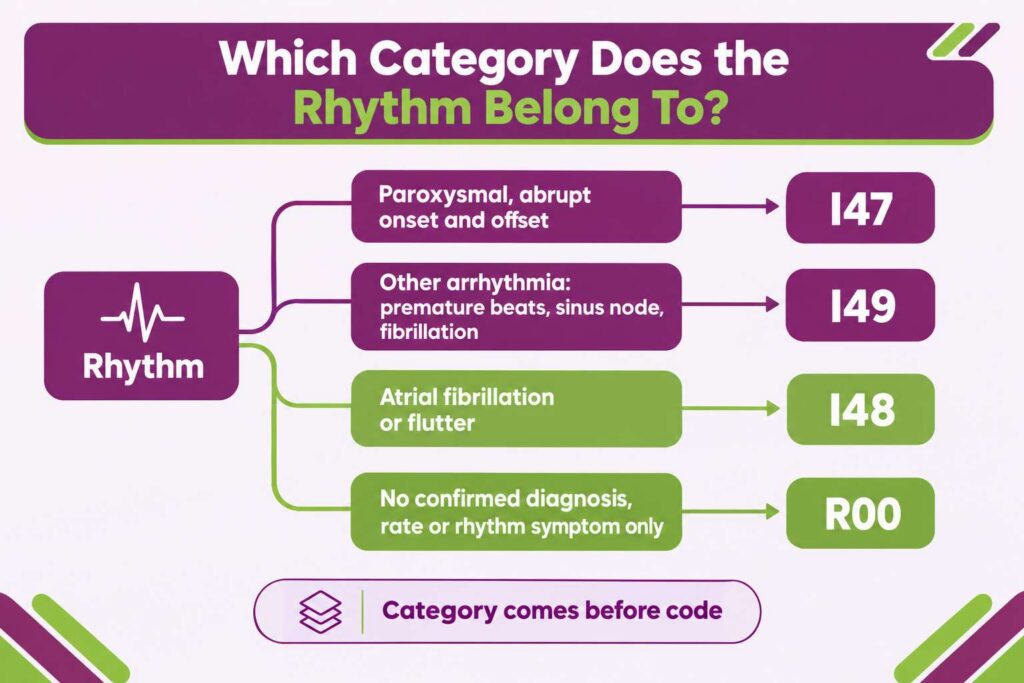
Arrhythmia coding starts with a four-way category decision. The documented rhythm decides which category applies before any code is selected. The list below states each path.
- I47 covers paroxysmal tachycardias, meaning rapid rhythms with abrupt onset and offset.
- I49 covers other cardiac arrhythmias, including premature beats, sick sinus syndrome, and ventricular fibrillation.
- I48 covers atrial fibrillation and atrial flutter, which never code to I47 or I49.
- R00 covers rate and rhythm symptoms with no confirmed arrhythmia diagnosis.
A note reading supraventricular tachycardia routes to I47. Also, a note reading premature ventricular contractions routes to I49. A note reading fast heart rate with no diagnosis routes to R00.0.
Which Arrhythmia Codes Are Not Billable?
Seven entries across the two categories are headers rather than billable codes. Each requires a further character. The list below names all seven as of October 1, 2026.
- I47 heads the paroxysmal tachycardia category.
- I47.1 heads supraventricular tachycardia.
- I47.2 heads ventricular tachycardia.
- I49 heads the other cardiac arrhythmias category.
- I49.0 heads ventricular fibrillation and flutter.
- I49.4 heads other and unspecified premature depolarization.
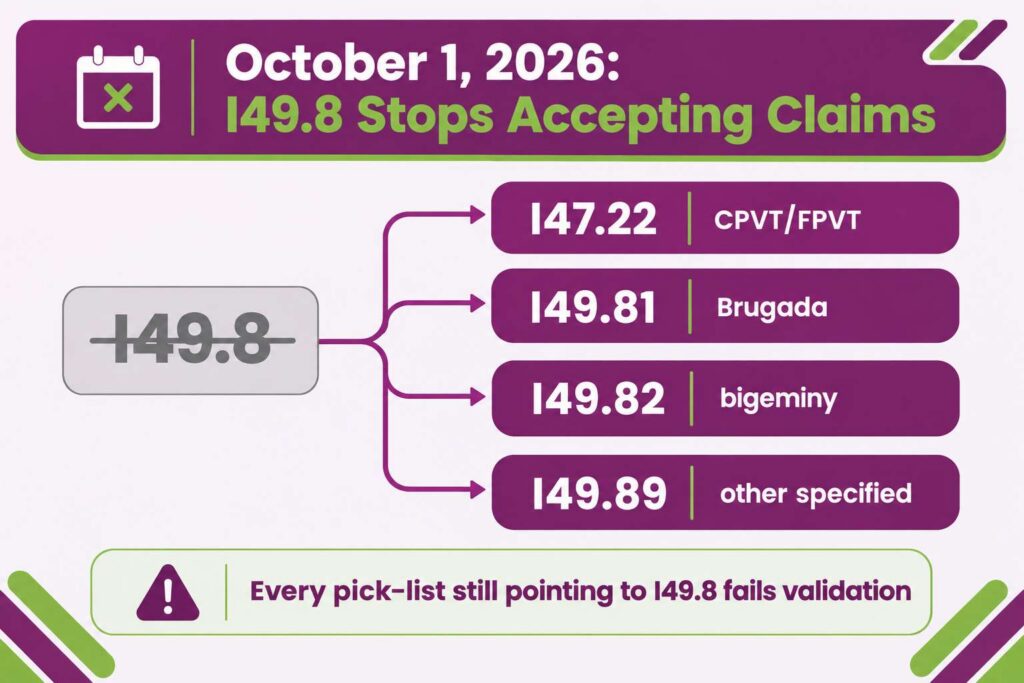
- I49.8 heads other specified cardiac arrhythmias, new for FY2027.
A claim submitted with any of these rejects. I49.8 is the one to watch, since it accepted claims through September 30, 2026.
Why Does Arrhythmia Specificity Affect Risk Adjustment?
Specificity affects risk adjustment because only some arrhythmia codes carry weight. Supraventricular tachycardia maps to a Hierarchical Condition Category and contributes RAF value. The unspecified code I49.9 tells the payer that a rhythm disturbance exists without naming it.
Inpatient payment follows a similar pattern. Arrhythmia diagnoses group to MS-DRG 308, 309, and 310, where the presence of complications and comorbidities drives the assignment.
What Changes for Arrhythmia Coding on October 1, 2026?
The FY2027 update adds four codes to the arrhythmia categories and converts one billable code into a header. The National Center for Health Statistics and CMS publish the annual code set. These changes take effect October 1, 2026.
Which Four Codes Are New for FY2027?
Four new codes carve out conditions that previously fell to less specific parents. The table below lists each one.
| New Code | Description | Previously Coded To |
|---|---|---|
| I47.22 | Catecholaminergic or familial polymorphic ventricular tachycardia (CPVT/FPVT) | I47.29 |
| I49.81 | Brugada syndrome | I49.8 |
| I49.82 | Ventricular bigeminy | No dedicated code before FY2027; assigned by pattern, most often under I49.3 |
| I49.89 | Other specified cardiac arrhythmias not elsewhere classified | I49.8 |
Three of the four sit under I49.8, which is why that code changes status.
Why Does I49.8 Becoming a Header Break Existing Pick-Lists?
I49.8 becoming a header breaks pick-lists because the code stops accepting claims rather than simply becoming less specific. Every EHR favorite, superbill line, and saved problem-list entry pointing to I49.8 fails validation from October 1, 2026, forward.
This differs from a routine specificity change. A claim carrying I49.8 after the cutover is rejected outright, regardless of how well the encounter is documented.
Where Do I49.8 Terms Land After the Cutover?
Six documented terms previously indexed to I49.8. Each one now routes to a different code, and five of the six converge on the same catch-all, which makes I49.89 the single busiest landing spot in this update.
| Documented Term | New Code |
|---|---|
| Brugada syndrome | I49.81 |
| Ventricular bigeminy | I49.82 |
| Sinus arrhythmia | I49.89 |
| Sinus node dysfunction | I49.89 |
| Bradyarrhythmia, cardiac | I49.89 |
| Coronary sinus, ectopic, or nodal rhythm disorder | I49.89 |
| Arrhythmia, specified NEC | I49.89 |
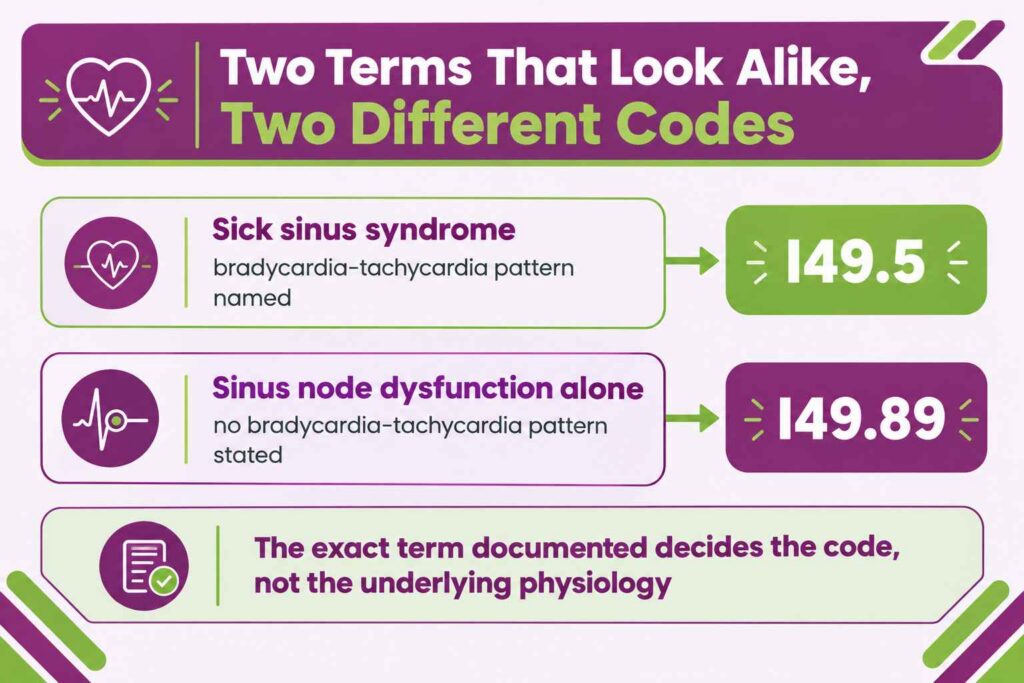
Sinus node dysfunction is the trap in this list. It reads as a near-synonym for sick sinus syndrome, which stays at I49.5. But ICD-10-CM indexes the two terms separately: sick sinus syndrome codes to I49.5, while a note reading only sinus node dysfunction, with no bradycardia-tachycardia pattern named, routes to I49.89. The distinction rests on the exact term documented, not the underlying physiology.
I49.82 also carries a new instructional note: coders add a code for dizziness (R42) or syncope (R55) when the encounter documents either symptom alongside the bigeminy diagnosis.
What Are the Paroxysmal Tachycardia Codes? (I47)
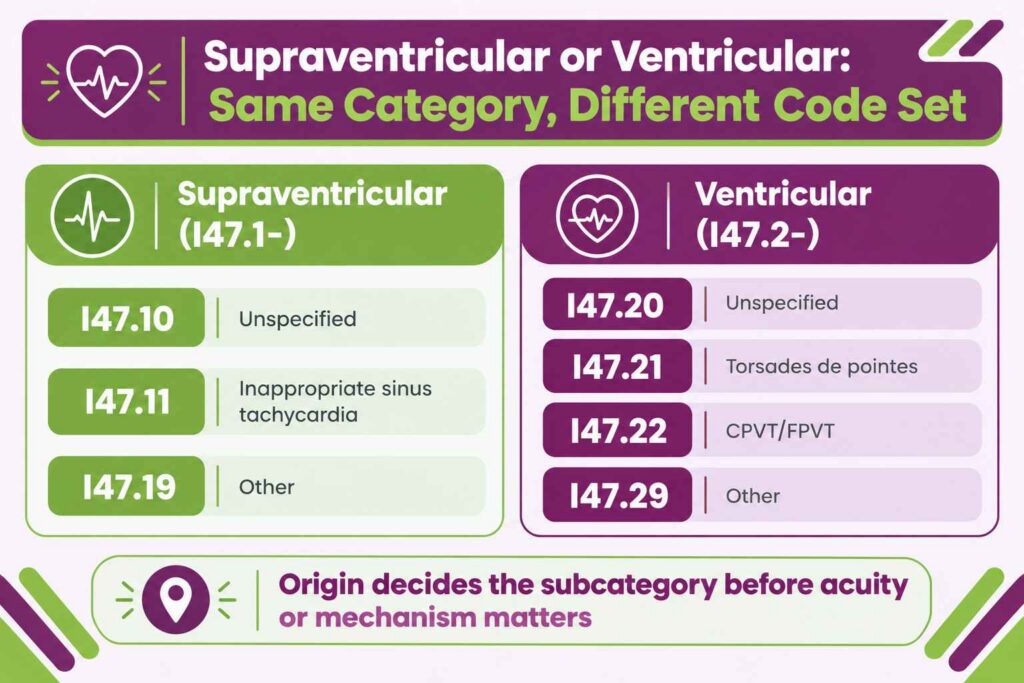
Category I47 covers paroxysmal tachycardias, rapid heart rhythms that begin and end abruptly. The category splits by the origin of the rhythm, supraventricular or ventricular. Both subcategories are headers requiring a fifth character.
What Is the ICD-10 Code for Supraventricular Tachycardia? (I47.10)
The ICD-10 code for supraventricular tachycardia is I47.10, supraventricular tachycardia unspecified. SVT originates above the ventricles and produces a rapid, regular rhythm. I47.1 itself is a header and never appears on a claim.
The table below lists the three supraventricular codes.
| ICD-10 Code | Description | When It Applies |
|---|---|---|
| I47.10 | Supraventricular tachycardia, unspecified | SVT documented with no further type |
| I47.11 | Inappropriate sinus tachycardia, so stated | Provider states inappropriate sinus tachycardia |
| I47.19 | Other supraventricular tachycardia | AVNRT, AVRT, atrial tachycardia |
Paroxysmal supraventricular tachycardia, often documented as PSVT, codes to I47.10 when no mechanism is named. A note identifying AV nodal reentrant tachycardia or an accessory pathway supports I47.19.
Code I47.11 requires the phrase in the record. The descriptor reads so stated, meaning the coder cannot infer inappropriate sinus tachycardia from a rapid sinus rhythm alone.
What Are the Ventricular Tachycardia Codes? (I47.2-)
Ventricular tachycardia codes to the I47.2- subcategory, which carries four codes from October 1, 2026. VT originates in the ventricles and carries higher clinical urgency than SVT. The table below lists each code.
| ICD-10 Code | Description | When It Applies |
|---|---|---|
| I47.20 | Ventricular tachycardia, unspecified | VT documented with no further type |
| I47.21 | Torsades de pointes | Polymorphic VT with QT prolongation |
| I47.22 | Catecholaminergic or familial polymorphic ventricular tachycardia (CPVT/FPVT) | Inherited CPVT or FPVT, new for FY2027 |
| I47.29 | Other ventricular tachycardia | Sustained, nonsustained, other named types |
Torsades de pointes requires the provider to name it. The rhythm is a distinct polymorphic pattern associated with QT prolongation, and I47.21 applies only when the record states it.
CPVT and its familial form, FPVT, are inherited arrhythmia syndromes triggered by exertion or emotional stress. Both previously fell to I47.29, and both gain the dedicated code I47.22 at the cutover.
What Is I47.0 (Re-entry Ventricular Arrhythmia)?
I47.0 codes re-entry ventricular arrhythmia, a rhythm sustained by a circular conduction circuit in the ventricle. The code applies when the provider documents the re-entry mechanism specifically. A general ventricular tachycardia diagnosis without the mechanism routes to I47.20 instead.
What Is I47.9 (Paroxysmal Tachycardia, Unspecified)?
I47.9 codes paroxysmal tachycardia, unspecified, where the record documents an abrupt-onset rapid rhythm without identifying the origin. The code is the residual for the I47 category. A note distinguishing supraventricular from ventricular origin moves the coding to I47.1- or I47.2-.
What Are the Other Cardiac Arrhythmia Codes? (I49)
Category I49 covers arrhythmias outside the paroxysmal tachycardias and atrial fibrillation. The category holds premature beats, sinus node dysfunction, ventricular fibrillation, and the residual codes. Most ambulatory arrhythmia findings land here.
What Is the ICD-10 Code for Premature Ventricular Contractions? (I49.3)
The ICD-10 code for premature ventricular contractions is I49.3, ventricular premature depolarization. PVCs are extra beats arising in the ventricles, and they are among the most common findings on ambulatory monitoring. The code is billable with no further character required.
Documentation naming premature ventricular contractions, PVCs, or ventricular ectopy supports I49.3. A pattern documented as ventricular bigeminy moves to I49.82 from October 1, 2026.
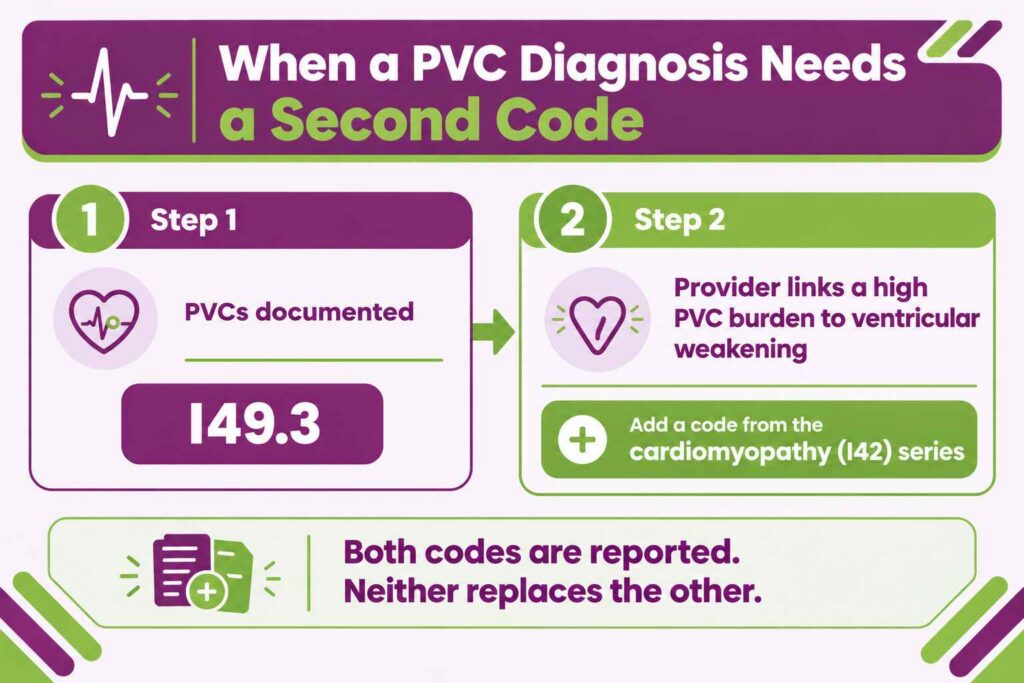
A high PVC burden can weaken the ventricle over time. When the provider documents that link, the record carries both codes. The arrhythmia code stays, and a code from the ICD-10 guide for cardiomyopathy set captures the resulting myocardial disease.
What Are the Other Premature Depolarization Codes? (I49.1, I49.2, I49.40, I49.49)
Four codes cover premature beats arising outside the ventricles or with no stated origin. Each one names a different site or level of detail.
- I49.1 codes atrial premature depolarization, documented as premature atrial contractions or PACs.
- I49.2 codes junctional premature depolarization, arising at the AV junction.
- I49.40 codes unspecified premature depolarization, where the site is not documented.
- I49.49 codes other premature depolarization, including named patterns without a dedicated code.
I49.4 is a header and never appears on a claim. Ventricular trigeminy continues to route to I49.49, while ventricular bigeminy moves to its own code at the FY2027 cutover.
What Is the ICD-10 Code for Sick Sinus Syndrome? (I49.5)
The ICD-10 code for sick sinus syndrome is I49.5. Sick sinus syndrome describes sinus node dysfunction producing inappropriately slow rates, pauses, or alternating fast and slow rhythms. Tachycardia-bradycardia syndrome indexes to the same code.
A note documenting only sinus node dysfunction, without the sick sinus syndrome label or a bradycardia-tachycardia pattern, indexes to I49.89 rather than I49.5. See the term-mapping table above.
The diagnosis frequently precedes pacemaker placement, so I49.5 commonly appears alongside device implantation and interrogation claims. Sinus bradycardia alone does not support I49.5, since that finding codes to R00.1 as a symptom.
What Are the Ventricular Fibrillation and Flutter Codes? (I49.01 and I49.02)
Ventricular fibrillation and flutter code to the I49.0- subcategory. Both are life-threatening ventricular rhythms. I49.01 codes ventricular fibrillation, and I49.02 codes ventricular flutter. The parent I49.0 is a header.
Ventricular fibrillation stays distinct from cardiac arrest. A documented arrest codes to the I46.- category, and both codes may appear when the record supports each diagnosis.
What Is I49.9 (Cardiac Arrhythmia, Unspecified)?
I49.9 codes cardiac arrhythmia, unspecified, the broadest code across both categories. Terms such as irregular heartbeat and abnormal heart rhythm index here when no specific rhythm is confirmed. The code is billable, but heavy reliance on it signals thin documentation to payers and auditors.
Which Rhythm Conditions Are Coded Outside I47 and I49?
Several rhythm conditions carry codes outside both categories. Each belongs to a different category or chapter. The table below maps each one.
| Condition | ICD-10 Code | Category Note |
|---|---|---|
| Atrial fibrillation and flutter | I48.- | Separate category |
| Tachycardia, unspecified | R00.0 | Symptom, no diagnosis established |
| Bradycardia, unspecified | R00.1 | Excludes2 at I49 |
| Palpitations | R00.2 | Symptom, no diagnosis established |
| Neonatal cardiac dysrhythmia | P29.1- | Excludes2 at I49 |
| Cardiac arrest | I46.- | Separate category |
None of these conditions belongs in I47 or I49, regardless of how the arrhythmia presents.
Why Does Atrial Fibrillation Never Code to I47 or I49?
Atrial fibrillation never codes to I47 or I49 because ICD-10-CM assigns it a dedicated category at I48. The category covers paroxysmal, persistent, chronic, and permanent atrial fibrillation, along with typical and atypical atrial flutter.
When Do You Code R00.0, R00.1, or R00.2 Instead?
The R00 codes apply when the record documents a rate or rhythm finding without a confirmed arrhythmia. Tachycardia with no named rhythm codes to R00.0. Bradycardia with no named cause codes to R00.1. Palpitations code to R00.2.
Bradycardia carries an Excludes2 note at I49. That designation means the conditions are separate, so a patient may carry both R00.1 and an I49 code when the record documents each independently. Sinus bradycardia, sinoatrial bradycardia, and vagal bradycardia all index to R00.1 rather than to an arrhythmia code.
Which Conditions Are Sequenced Before an I49 Code?
Two obstetric situations carry a code-first instruction ahead of the I49 code, drawn from the pregnancy and childbirth chapter rather than the cardiology set of ICD-10 codes. The instruction is mandatory and easy to miss.
- Cardiac arrhythmia complicating abortion, ectopic, or molar pregnancy codes to O00 through O07 or O08.8 first.
- Cardiac arrhythmia following obstetric surgery and procedures codes to O75.4 first.
What Is the ICD-10 Code for History of Arrhythmia?
Most arrhythmias are chronic or recurrent, so the active code applies whenever the current encounter documents the condition. A personal history code fits only when the arrhythmia has fully resolved with no ongoing management. Coders assign the active I47 or I49 code rather than a history code for patients under continued monitoring.
What Documentation Supports an Arrhythmia ICD-10 Claim?
Documentation supports an arrhythmia claim when the note names the rhythm, its origin, and the confirming study. The record decides both the category and the code within it.
What Clinical Elements Must the Provider’s Note Contain?
The provider note contains five elements for a clean arrhythmia claim. Each element resolves one coding decision.
- Named rhythm: supraventricular tachycardia, PVCs, sick sinus syndrome, or another specific term.
- Origin: supraventricular or ventricular, for tachycardia diagnoses.
- Confirming study: ECG, Holter, extended monitor, or electrophysiology study.
- Pattern detail: bigeminy, trigeminy, sustained, or nonsustained where documented.
- Diagnostic status: confirmed arrhythmia versus a symptom still under evaluation.
How Does the ECG or Monitor Report Select the Code?
The monitor report supports the code but does not select it alone. A tracing showing frequent ventricular ectopy points toward I49.3. The provider must state the diagnosis in the assessment before the coder assigns it.
A report describing an irregular rhythm with no provider interpretation does not support an I49 code. That finding stays a symptom until the provider names the arrhythmia.
What Are the MEAT Criteria for Arrhythmia HCC Recapture?
MEAT criteria are Monitor, Evaluate, Assess, and Treat. Arrhythmia diagnoses that map to a Hierarchical Condition Category require fresh documentation each calendar year. Monitoring includes rhythm and symptom review. Evaluating includes ECG or monitor interpretation. Assessing includes rhythm confirmation. Treating includes medication, ablation, or device management.
Which CPT and HCPCS Codes Pair With Arrhythmia ICD-10 Codes?
Arrhythmia codes pair with rhythm monitoring, device, and ablation codes. The pairing set reflects a diagnosis confirmed by tracing and managed through medication or procedure. Correct pairing supports medical necessity for extended monitoring.
Which Diagnostic and Procedural CPT Codes Are Billed With I47 and I49?
The table below lists the CPT codes most billed across both categories.
| CPT | Description | Common ICD-10 Pairing |
|---|---|---|
| 93000, 93005, 93010 | Electrocardiogram, complete and components | I49.9, I49.3, I47.10 |
| 93224-93227 | External ECG monitoring up to 48 hours (Holter) | I49.3, I49.5, I47.10 |
| 93241-93248 | External ECG monitoring, more than 48 hours to 15 days | I49.3, I49.9 |
| 93268-93272 | External patient-activated event monitoring, 30 days | I47.10, I49.9 |
| 93279-93296 | Cardiac device evaluation and interrogation | I49.5, I47.20 |
| 93653-93656 | Electrophysiologic study with ablation | I47.19, I47.29, I49.3 |
| 33208 | Pacemaker insertion, atrial and ventricular | I49.5 |
| 33249 | Implantable defibrillator insertion | I47.20, I49.01 |
Extended monitoring carries the highest claim volume, since most arrhythmias are intermittent and require capture over days. The broader CPT code set for cardiology covers the full electrophysiology and device range.
Which HCPCS Codes Apply to Arrhythmia Management?
Three HCPCS Level II codes appear regularly on arrhythmia claims. Each covers a device or service outside the CPT set.
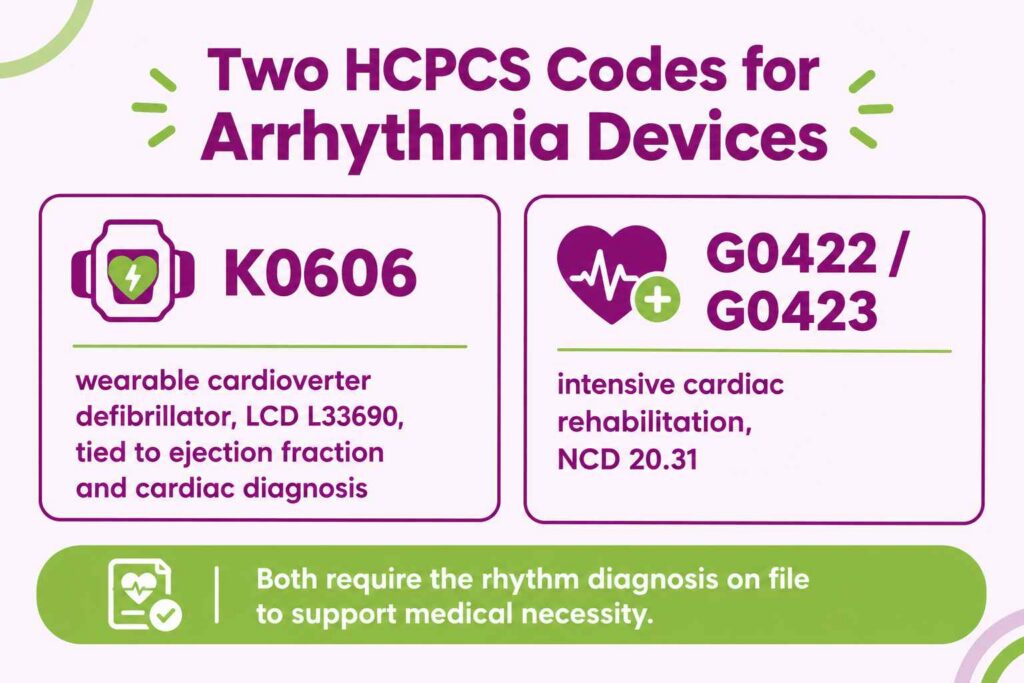
- K0606 reports a wearable cardioverter defibrillator. Medicare coverage under local coverage determination L33690 sets criteria tied to ejection fraction and underlying cardiac diagnosis.
- G0422 and G0423 report intensive cardiac rehabilitation under National Coverage Determination 20.31.
Device claims carry documentation requirements tied to the rhythm diagnosis. Practices report devices and supplies through the broader cardiology HCPCS reference.
What Are the Most Common Arrhythmia Coding Denials, and How Do You Prevent Them?
The most common arrhythmia denials come from retired codes, unspecified coding, header submission, and symptom-plus-diagnosis pairing. Each pattern has a clear prevention path.
Why Will I49.8 Claims Deny After October 1, 2026?
I49.8 claims deny after the cutover because the code becomes a non-billable header. The code accepted claims through September 30, 2026, and stops on October 1. Coders replace it with I49.81 for Brugada syndrome, I49.82 for ventricular bigeminy, or I49.89 for the other five reindexed terms.
Why Is I49.9 Denied When the Rhythm Is Documented?
I49.9 is denied when the record names a specific rhythm. Payers compare the submitted code against the monitor report and the assessment. A chart documenting PVCs with I49.9 on the claim understates the record.
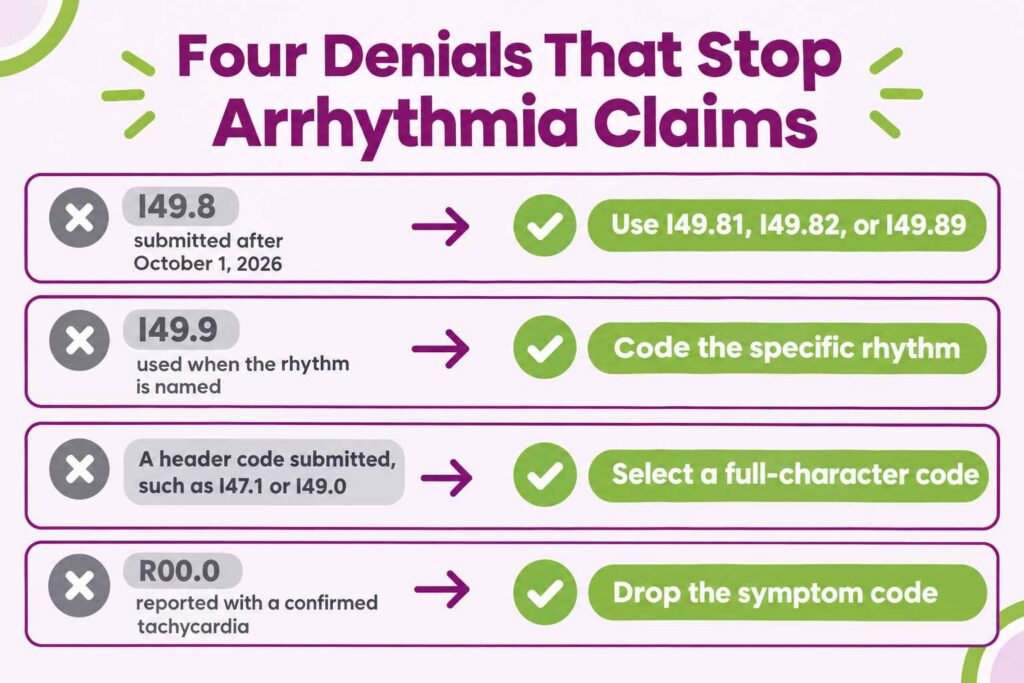
Why Are Header Codes Rejected Outright?
Header codes are rejected because they lack billable status. Seven entries across I47 and I49 are headers as of the FY2027 cutover. Coders select a full-character code such as I47.10 rather than the I47.1 header.
Why Are R00 Codes Denied Alongside a Confirmed Arrhythmia?
R00 codes are denied alongside a confirmed arrhythmia because the symptom is integral to the diagnosis. A claim carrying both I47.10 and R00.0 reports the rapid rate twice. The exception is bradycardia, where the Excludes2 note permits both codes when each condition is documented independently.
How Do Payer-Specific Rules Change Arrhythmia Reimbursement?
Each payer applies its own rules to arrhythmia coding and monitoring. The table below summarizes common payer positions.
| Payer | Common Rule |
|---|---|
| Medicare | Extended ECG monitoring subject to frequency and medical necessity limits |
| BCBS plans | Monitor report documentation reviewed against the submitted rhythm code |
| UnitedHealthcare | Prior authorization common for ablation and device implantation |
| Aetna | Medical necessity required for repeat extended monitoring within a coverage window |
| Medicare Advantage | Annual MEAT recapture required for HCC-mapped arrhythmia diagnoses |
Payers share one pattern. A named rhythm, a confirming tracing, and a current code carry the claim across plans.
How Should Practices Prepare for the October 2026 Cutover?
Preparation centers on the diagnosis pick-list audit. Practices search their EHR favorites, superbills, and problem lists for I49.8 and replace each instance with the correct new code. Templates carrying sinus arrhythmia, sinus node dysfunction, Brugada syndrome, or ventricular bigeminy need review before the cutover date.
Frequently Asked Questions About Arrhythmia ICD-10 Coding
What Is the ICD-10 Code for Cardiac Arrhythmia?
The ICD-10 code for unspecified cardiac arrhythmia is I49.9. A named rhythm moves the coding to a specific code in I47 or I49.
What Is the ICD-10 Code for SVT?
The ICD-10 code for supraventricular tachycardia is I47.10. A documented mechanism such as AV nodal reentrant tachycardia supports I47.19 instead.
What Is the ICD-10 Code for PVCs?
The ICD-10 code for premature ventricular contractions is I49.3, ventricular premature depolarization. Ventricular bigeminy moves to I49.82 on October 1, 2026.
What Is the ICD-10 Code for Sick Sinus Syndrome?
The ICD-10 code for sick sinus syndrome is I49.5. Tachycardia-bradycardia syndrome indexes to the same code. Sinus node dysfunction alone, without that pattern, indexes to I49.89.
What Is the ICD-10 Code for Ventricular Fibrillation?
The ICD-10 code for ventricular fibrillation is I49.01. Ventricular flutter codes to I49.02, and the parent I49.0 is a header.
What Is the ICD-10 Code for Sinus Arrhythmia?
Sinus arrhythmia codes to I49.89 from October 1, 2026. The condition was previously coded to I49.8, which becomes a non-billable header on that date.
What Is the ICD-10 Code for Brugada Syndrome?
The ICD-10 code for Brugada syndrome is I49.81, effective October 1, 2026. The condition was previously coded to I49.8.
Is I49.8 Still a Billable Code?
I49.8 is billable through September 30, 2026, and becomes a non-billable header on October 1, 2026. Claims carrying it after that date will be rejected.
Can Atrial Fibrillation Be Coded to I49?
No, atrial fibrillation and atrial flutter have a dedicated category at I48. Neither condition codes to I47 or I49.
What Is the ICD-10 Code for Ventricular Tachycardia?
The ICD-10 code for unspecified ventricular tachycardia is I47.20. Torsades de pointes codes to I47.21, and catecholaminergic or familial polymorphic ventricular tachycardia codes to I47.22, effective October 1, 2026.