Your practice sent the claim on time, and the payer confirmed receipt, yet no payment arrived. You are not alone, since the American Hospital Association estimates hospitals spent $43 billion in 2025 chasing insurer payments for care already delivered. Experian Health reports that 41% of providers now see more than 10% of their claims denied.
Georgia law gives billing teams a tool many of them never use. On electronic claims, insurers must pay or explain in writing within 15 working days, or owe 12 percent interest. This guide covers deadlines, interest math, a sample demand letter, and a follow-up calendar for your team.

What Is the Georgia Prompt Pay Law?
The Georgia prompt pay law for health claims sits in O.C.G.A. § 33-24-59.14. This Georgia billing law applies to insurers and plan administrators that handle claims under health benefit plans. It covers HMOs, accident and sickness insurers, and nonprofit hospital and medical service corporations.
Do not confuse it with the Georgia Prompt Pay Act for construction, found in O.C.G.A. § 13-11-1. That separate act governs payments among owners, contractors, and subcontractors on construction projects. Many online results mix the two laws, so confirm which statute a source describes.
The rule is simple: the insurer must pay the claim or explain in writing why it will not.
Georgia Claim Payment Deadlines
An insurer must act within 15 working days after receiving an electronic claim. Paper claims allow the insurer 30 calendar days from the date of receipt. Within that window, the insurer must send payment or a written notice explaining why it has not paid.
| Claim Type | Insurer Deadline | Required Action |
|---|---|---|
| Electronic claim | 15 working days | Pay, or send written reasons and an itemized list of missing items |
| Paper claim | 30 calendar days | Pay, or send written reasons and an itemized list of missing items |
| Claim with missing information | Same period, after all listed items arrive | Pay, or send a written denial with reasons |
| Partly disputed claim | Same period | Pay the undisputed portion |
Working days normally exclude weekends and holidays. An electronic claim received on a Monday is due roughly three weeks later. Calendar days count every day, so paper claims follow a simpler count.
The notice must state why the claim is unpaid and list every document still needed. Keep that written list, because it proves what the insurer asked for and when. A vague request for records does not match what the statute describes.
The clock restarts only when the insurer receives every document on that written list. After that, the insurer gets a fresh 15 working days or 30 calendar days. If the insurer disputes only part of a claim, it must still pay the undisputed portion.
Receipt by a company that processes claims for the insurer counts as receipt by the insurer. Save your clearinghouse reports for every submission, because receipt dates decide when the clock starts.
The 12 Percent Interest Rule
Insurers that miss the deadline owe the provider 12 percent interest per year on the benefits due. The statute states an annual rate and does not spell out a daily calculation method. The table below shows simple interest estimates for common allowed amounts at 30 and 90 days late.
| Allowed Amount | Interest at 30 Days Late | Interest at 90 Days Late |
|---|---|---|
| $500 | $4.93 | $14.79 |
| $2,000 | $19.73 | $59.18 |
| $10,000 | $98.63 | $295.89 |
Confirm the exact method with the payer contract before you request the interest amount. Interest on one claim is small, but a pattern of late claims gives you strong evidence.
A group with 400 claims averaging $800, each paid 30 days past due, is owed about $3,156. That money often goes unclaimed because no one on the billing team tracks the due date. A written statutory demand tends to move a claim faster than a general queue does.
What Penalties Can Insurers Face?
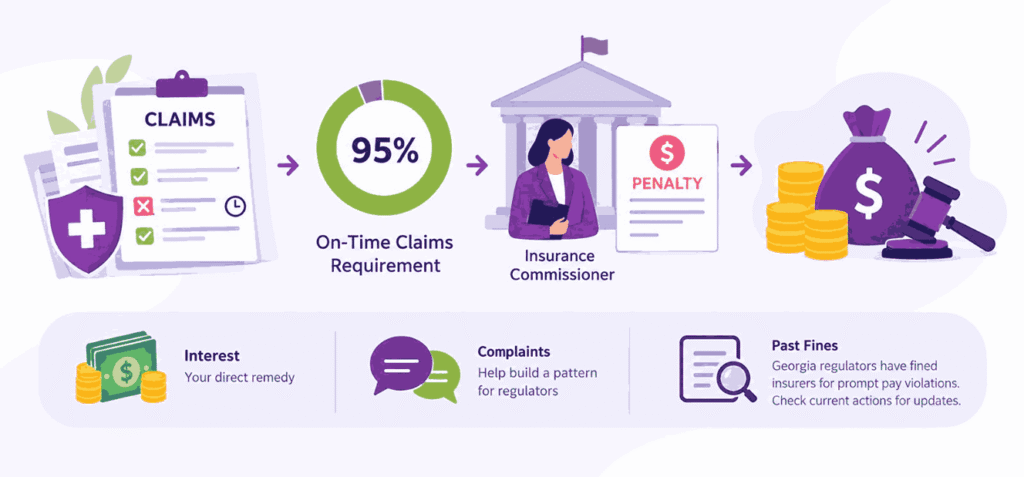
The Insurance Commissioner can assess an administrative penalty against an insurer in limited cases. The trigger is processing fewer than 95 percent of claims on time during a financial quarter. The penalty rests on data the Commissioner collects, not on one provider’s single late claim.
This means interest is your direct remedy, while complaints help build a pattern for regulators.
Georgia regulators have fined insurers for prompt pay violations, and the history is public record. In January 2002, Humana Employers Health Care of Georgia received a $400,000 fine, then the largest HMO fine in Georgia. In 2000 and 2001, a dozen health insurers paid fines totaling about one million dollars. Those cases are old, so check current Georgia Department of Insurance actions before citing them.
Which Plans Does the Law Cover?
Not every plan on your payer list follows this statute, so check coverage before you demand interest. The law applies when an insurer adjudicates claims for its fully insured business or acts as a third-party administrator. It excludes limited benefit policies such as accident-only, fixed indemnity, long-term care, and specified disease plans.
| Plan Type | State Law Applies? | Notes |
|---|---|---|
| Fully insured commercial plans | Yes | Examples include Anthem Blue Cross Blue Shield, Aetna, Cigna, and UnitedHealthcare |
| Insurer acting as third party administrator | Yes | Statute names this business line directly |
| HMOs and nonprofit service corporations | Yes | Included in the insurer definition |
| Limited benefit policies | No | Statute excludes them by name |
| Self-funded employer plans | Often no | Federal law often limits state rules; check the plan documents |
| Medicare Advantage | Usually no | Federal rules and contract terms usually control |
| Georgia Medicaid managed care | Varies | Contract terms and Medicaid rules apply; some policies cite state code |
Check the plan type on the card, the eligibility response, and the payer contract. Many Georgia employers self-fund their health plans, so the same payer name can follow different rules. Two Aetna members can fall under different rules if one plan is self-funded.
Medicare Advantage plans usually follow federal rules and your contract terms, not this state statute. Some CareSource Georgia Medicaid policies reference state prompt pay code sections when paying interest. Read each Medicaid plan policy carefully before you request interest on a late claim.
Why Georgia Claims Miss the Deadline
Most late claims share a short list of causes, and fixing them early saves more than chasing payment.
| Cause | What It Looks Like | Billing Team Fix |
|---|---|---|
| Payer says claim was not received | No record in the payer portal | Keep the clearinghouse acceptance report and 277CA response |
| Records request without a list | Claim shows “pending review” | Ask for the written itemization the statute requires |
| Wrong payer ID or address | Claim rejects or reroutes | Verify the payer ID during eligibility checks |
| Coordination of benefits hold | Payer waits on other insurance | Update secondary coverage with the patient before submission |
| Authorization mismatch | Denial for missing authorization | Match the authorization number to each billed CPT code |
Many of these errors start before submission, at registration and eligibility checks. Well-run RCM Services connect front-end eligibility checks with back-end denial management, so errors surface early.
Specialty claims carry their own delays. A screening colonoscopy billed as CPT 45378 with modifier 33 may pend for review if the diagnosis code does not match. Oncology claims for CPT 96413 plus a drug HCPCS code can pend while the payer checks drug units.
For every pended claim, ask whether the payer sent a written reason and itemized list on time. If the answer is no, the statute may support your written demand for payment.
A Follow-Up Calendar for Electronic Claims
Consistent follow-up beats occasional escalation, and the table below counts working days from submission.
| Working Day | Action | Proof to Keep |
|---|---|---|
| 1 | Submit the claim through your clearinghouse | Batch ID and submission date |
| 2 | Confirm 999 and 277CA acceptance | Acceptance report |
| 5 | Check status through the 276/277 transaction or portal | Status screenshot with date |
| 10 | Call the payer and ask for the adjudication date | Call reference number and representative name |
| 13 | Send a written inquiry that cites the statute | Dated copy of the letter |
| 16 | Send an interest demand once the deadline passes | Letter and proof of delivery |
| 25 | Prepare a complaint file if late claims form a pattern | Claim list, letters, and call logs |
Paper claims use 30 calendar days, so move each step later but keep the same order.
Assign one person to own the calendar, because shared ownership usually means no ownership. A weekly aging report sorted by days since submission keeps every claim visible. If your team lacks time, a Medical Billing Company can own this calendar and report aging weekly.
A Sample Georgia Prompt Pay Demand Letter
Use short, factual language and include the claim number, patient identifier, date of service, CPT codes, and billed amount. Adapt the wording below to match your payer contract and claim details.
Our practice submitted this claim electronically on [date], and your system confirmed receipt on [date].
Under O.C.G.A. § 33-24-59.14, you must pay or send a written itemization within 15 working days. We have received neither payment nor a written itemization of the missing information.
Please pay the benefits due, plus interest at 12 percent per year, within ten business days. If you need additional documents, send a written list of each item today.
Contact [name] at [phone] or [email] with the expected payment date for this claim.
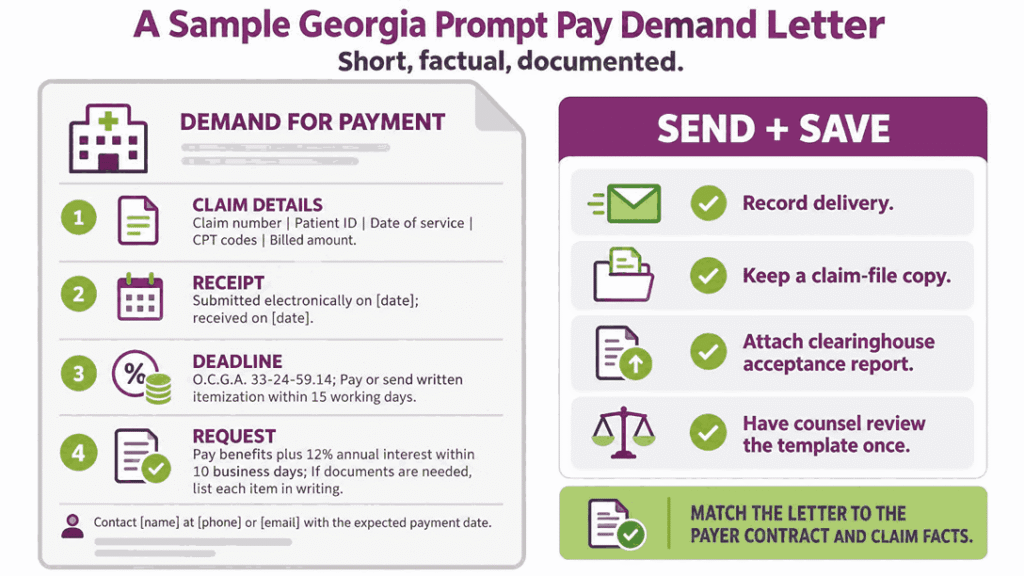
Send the letter by a method that records delivery, and keep a copy with the claim file. Attach the clearinghouse acceptance report to prove the submission date. Have a healthcare attorney review your template once, since small wording errors can weaken a demand.
How to Escalate in Georgia
Escalate in steps and document each one, because skipped steps weaken your record.
- Call provider relations and request a named contact with direct authority over claim payment.
- Send the written demand letter with proof of the electronic submission date.
- Review your payer contract for dispute resolution terms, including notice periods and arbitration clauses.
- File a complaint with the Georgia Office of Insurance and Safety Fire Commissioner, and attach your claim log.
- Consult a healthcare attorney when unpaid balances are large, or delays repeat across many claims.
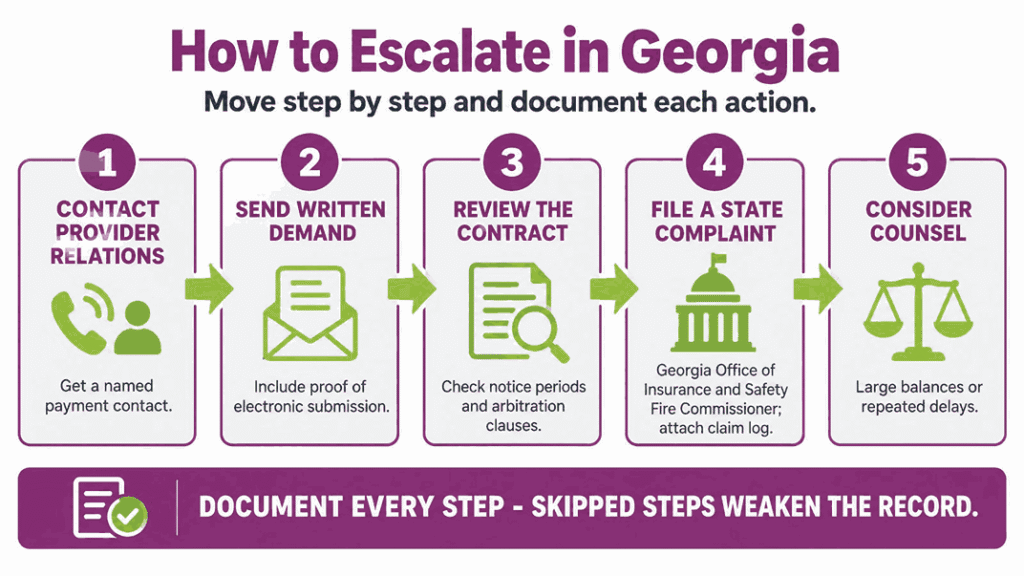
A complaint about one claim is easy to dismiss, but sixty documented claims are harder to ignore. Build the file as you go, not after the problem has grown large.
Remember the 95 percent threshold, because regulators look at data across many claims. Your records help show whether a payer fails that standard across your practice.
Where Late Payments Cost Georgia Practices the Most
Delays hurt every specialty, but high-cost claims create the largest cash flow gaps.
| Specialty | Typical Claim | Why Delay Costs More |
|---|---|---|
| Oncology | CPT 96413 infusion with drug HCPCS code | The practice often buys the drug before payment arrives |
| Gastroenterology | CPT 45378 or CPT 43235 | Facility and professional claims pend for diagnosis and modifier checks |
| Urology | CPT 52000 cystourethroscopy | Authorization errors turn timely claims into denials |
Georgia practices in Atlanta, Savannah, Augusta, and smaller markets face the same rule. Payer deadlines do not change by city, so your follow-up discipline decides whether you collect on time. Practices that want local payer knowledge can review Medical billing services in Georgia built around Georgia payer rules.
Frequently Asked Questions
How Many Days Does a Georgia Insurer Have to Pay an Electronic Claim?
The insurer has 15 working days after receipt to pay or send a written explanation. The count starts at receipt, so keep proof of the date the payer received the claim.
Can a Provider Collect Interest on Late Claims in Georgia?
Yes. The statute sets interest at 12 percent per year on the benefits due. Request it in writing, and cite the statute along with the claim details.
What Happens When the Insurer Asks For More Records?
The insurer must send a written list of the documents it needs. The clock restarts when the insurer receives every listed item, so respond quickly and keep proof of delivery.
Does the Law Apply to Medicare and Medicaid Claims?
Medicare Advantage plans usually follow federal rules and contract terms. Georgia Medicaid managed care depends on the plan contract and Medicaid rules. Review each payer policy before you cite the state statute.
Can a Payer Contract Change These Deadlines?
Contracts may address payment timing, and terms vary by payer. Ask a healthcare attorney whether your agreement changes your rights under the statute before you send a demand.