Gallstones affect an estimated 20 million adults in the United States, and surgeons perform roughly one million cholecystectomies each year to treat them. That volume makes accurate diagnosis coding a daily concern for billing teams.
On paper, the task looks simple, since the provider documents stones and the coder assigns a code. In practice, category K80 in ICD-10-CM branches into roughly 40 billable codes, and one wrong turn can trigger a denial or a medical necessity mismatch.
This guide walks through the K80 family from the top. You will see how stone location, inflammation, and obstruction drive the choice among ICD-10 codes, which scenarios trip up experienced coders, and how diagnoses connect to procedures such as cholecystectomy and ERCP.
What Cholelithiasis Means in ICD-10-CM
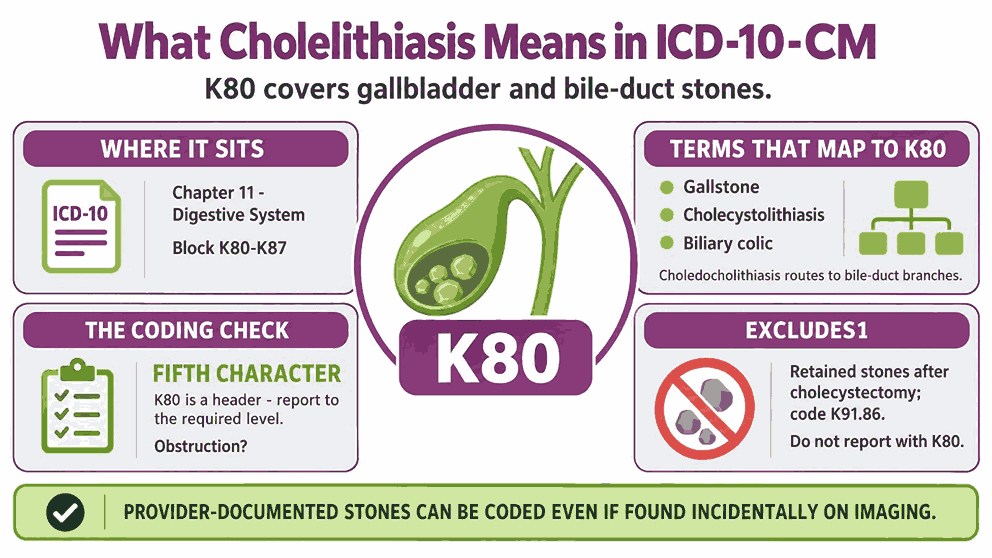
Cholelithiasis is the clinical term for stones in the gallbladder. ICD-10-CM stretches the category a little further, so K80 also holds stones found in the bile ducts. The Alphabetic Index points several everyday terms to the same place, including gallstone, cholecystolithiasis, and biliary colic. Choledocholithiasis, the term for a stone in the common bile duct, routes to the bile duct branches.
Gallstones are common. Prevalence estimates among adults in the United States often fall between 10 and 15 percent, and many people never develop symptoms. That fact shapes coding, because a stone found by chance on imaging still earns a K80 code once the provider documents it as a diagnosis.
Where K80 Sits in the Classification
K80 belongs to Chapter 11, Diseases of the Digestive System. It opens the block for disorders of the gallbladder, biliary tract, and pancreas, which runs from K80 to K87. Neighboring categories matter because several of them carry Excludes1 notes that point straight back to K80.
Why K80 Cannot Be Reported by Itself
K80 is a header, and so are K80.0 through K80.8. Payers reject a claim that carries a header, since the diagnosis must reach the fifth character. Under K80, that fifth character almost always answers one question: is there obstruction?
The category also carries an Excludes1 note for retained cholelithiasis following cholecystectomy, which belongs to K91.86. An Excludes1 note means the two conditions should not be reported together. Stones left behind after gallbladder removal therefore never take a K80 code.
Three Questions That Decide Every K80 Code
Strip away the long descriptors and every K80 code answers the same three questions. Ask them in order and the correct branch appears quickly.
- Where are the stones? They may sit in the gallbladder, in the bile ducts, or in both. This choice selects the fourth character group.
- Is there inflammation? Cholecystitis involves the gallbladder, while cholangitis involves the bile ducts. Acuity also counts: acute, chronic, acute and chronic together, or unspecified.
- Is obstruction documented? This choice selects the final character.
Here is a pattern that saves time. Across the whole K80 family, an even final digit means without obstruction and an odd final digit means with obstruction. K80.00 is without, and K80.01 is with. K80.36 is without, and K80.37 is with. Once you know the branch, the last digit takes seconds.
K80 Code Family at a Glance
The table below maps each subcategory to its stone location and associated condition. Use it as a quick routing tool before you open the full Tabular List.
| Subcategory | Stone Location | Associated Condition | Billable Codes |
|---|---|---|---|
| K80.0 | Gallbladder | Acute cholecystitis | K80.00, K80.01 |
| K80.1 | Gallbladder | Chronic, acute and chronic, or other cholecystitis | K80.10, K80.11, K80.12, K80.13, K80.18, K80.19 |
| K80.2 | Gallbladder | No cholecystitis | K80.20, K80.21 |
| K80.3 | Bile duct | Cholangitis | K80.30 to K80.37 |
| K80.4 | Bile duct | Cholecystitis | K80.40 to K80.47 |
| K80.5 | Bile duct | No cholangitis or cholecystitis | K80.50, K80.51 |
| K80.6 | Gallbladder and bile duct | Cholecystitis | K80.60 to K80.67 |
| K80.7 | Gallbladder and bile duct | No cholecystitis | K80.70, K80.71 |
| K80.8 | Other cholelithiasis | Not applicable | K80.80, K80.81 |
Notice that K80.3, K80.4, and K80.6 each contain eight codes. These are the branches where acuity splits into unspecified, acute, chronic, and acute with chronic, each paired with the obstruction digit.
Gallbladder Stones: K80.0 to K80.2
Most outpatient and inpatient gallstone encounters land in this group. The three subcategories differ only in how the provider describes the gallbladder wall.
K80.0x: Acute Cholecystitis With Stones
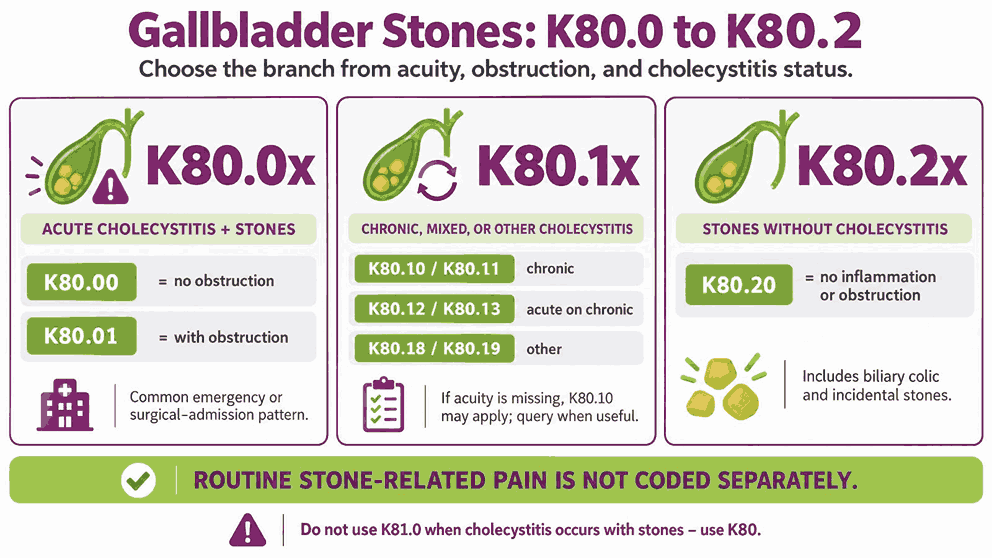
K80.00 covers a gallbladder stone with acute cholecystitis and no obstruction. K80.01 applies when the provider documents obstruction as well. This is the typical emergency department and surgical admission picture, with right upper quadrant pain, fever, and a positive ultrasound.
Coders sometimes reach for K81.0, acute cholecystitis, because the word cholecystitis dominates the note. That choice is wrong when stones are present. K81 carries an Excludes1 note for cholecystitis with cholelithiasis, which sends the code to K80.
K80.1x: Chronic, Mixed, and Other Cholecystitis
This subcategory holds six billable codes. K80.10 and K80.11 describe chronic cholecystitis with stones. K80.12 and K80.13 describe acute and chronic cholecystitis together, which providers often document as acute on chronic. K80.18 and K80.19 cover other forms of cholecystitis.
K80.10 also carries an inclusion term for cholelithiasis with cholecystitis not otherwise specified. When a provider writes only “cholecystitis with gallstones” and gives no acuity, K80.10 is the correct landing spot. A query for acuity is still worthwhile, since a more specific code supports the record better.
K80.2x: Stones Without Cholecystitis
K80.20 is the code most people mean when they search for the ICD-10 code for gallstones. It covers stones in the gallbladder without inflammation or obstruction. Biliary colic is indexed here, and so are stones discovered incidentally during imaging for another reason.
Pain that comes from the stone is part of the disease process. Under the Official Guidelines, signs and symptoms that are routinely associated with a condition should not be coded separately. Report K80.20 and leave the abdominal pain code off the claim.
Bile Duct Stones: K80.3 to K80.5
Stones in the ducts behave differently from stones in the gallbladder. They can block bile flow, which raises the risk of infection and pancreatitis, so documentation here tends to be more detailed.
K80.3x: Duct Stones With Cholangitis
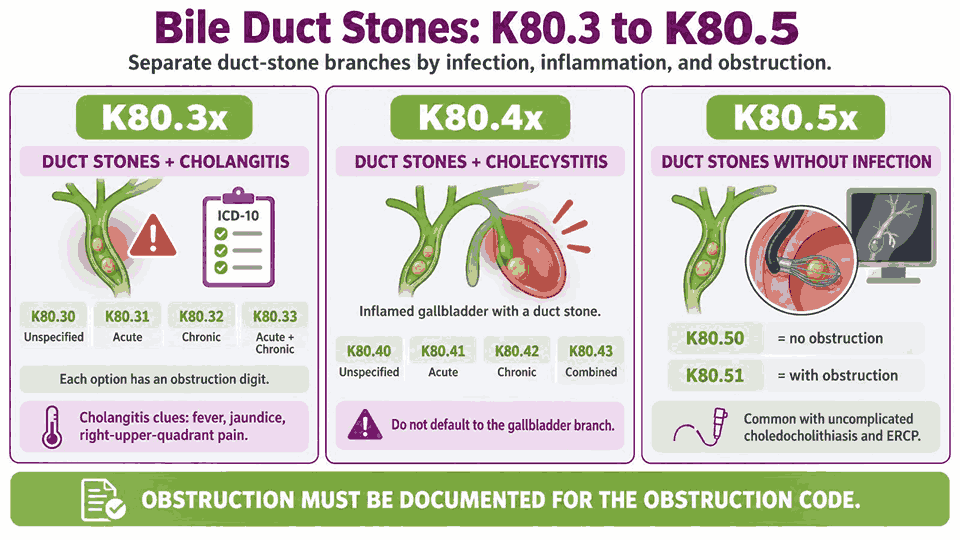
Cholangitis is an infection or inflammation of the bile ducts, and the classic presentation includes fever, jaundice, and right upper quadrant pain. K80.3 gives you four acuity options, each with an obstruction digit.
- K80.30 and K80.31 for cholangitis not specified as acute or chronic
- K80.32 and K80.33 for acute cholangitis
- K80.34 and K80.35 for chronic cholangitis
- K80.36 and K80.37 for acute and chronic cholangitis together
K80.4x: Duct Stones With Cholecystitis
This branch applies when the stone sits in a bile duct, but the gallbladder is inflamed. The structure mirrors K80.3, with unspecified, acute, chronic, and combined options. It appears less often in practice, so coders sometimes overlook it and default to the gallbladder branch.
K80.5x: Duct Stones Without Cholangitis or Cholecystitis
K80.50 and K80.51 serve uncomplicated choledocholithiasis. These codes commonly appear with ERCP claims, where the provider removes a duct stone, and the record shows no infection. K80.51 requires explicit provider documentation of obstruction.
Combined and Other Forms: K80.6 to K80.8
Some patients have stones in both the gallbladder and a bile duct. K80.6 covers that combination with cholecystitis, using the same eight-code structure as K80.4. K80.7 covers the combination without cholecystitis and has just two codes, K80.70 and K80.71.
K80.8, other cholelithiasis, produces K80.80 and K80.81. It should be rare. If a coder reaches for it often, the documentation probably describes a location or inflammation that fits another branch better, and a quick review will usually find it.
What Counts as Obstruction
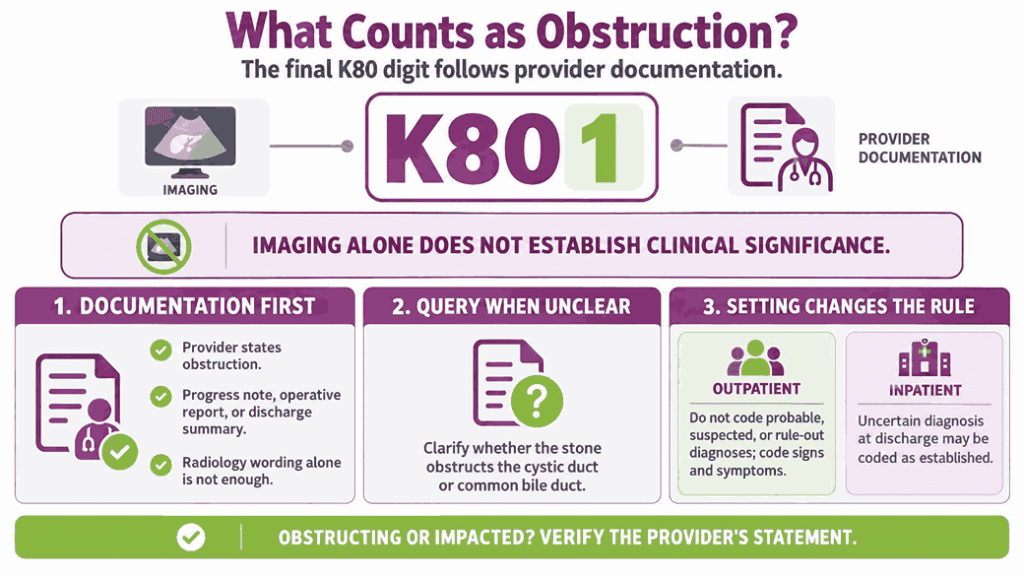
The final digit creates more audit risk than any other part of K80. ICD-10-CM does not define a clinical threshold for obstruction in this category. Coders follow the provider’s diagnostic statement, and the Official Guidelines state that abnormal imaging findings are not coded unless the provider indicates their clinical significance.
That rule has practical consequences. A radiology report that mentions an obstructing stone does not, on its own, justify an odd final digit. The attending or surgeon must carry that language into the progress note, operative report, or discharge summary. Practices that configure structured fields inside their Gastroenterology EMRs for stone location, inflammation type, and obstruction status make this carryover far more reliable.
Terms such as obstructing or impacted usually point toward obstruction, yet they should prompt a query rather than an assumption. A short compliant query might read: “Please clarify whether the documented stone is causing obstruction of the cystic duct or common bile duct.”
Setting matters as well. In outpatient coding, diagnoses described as probable, suspected, or rule out are not coded, so a note that says “possible gallstones” calls for a symptom code instead. Inpatient rules differ, since uncertain diagnoses documented at discharge may be coded as if established.
Coding Scenarios From Real Documentation
The table below shows how the three questions work on typical notes. Each row assumes the documentation matches the description exactly.
| Documentation | Code | Reason |
|---|---|---|
| Ultrasound confirms gallstone; patient has biliary colic, no inflammation noted | K80.20 | Gallbladder stones without cholecystitis or obstruction |
| Gallstones with acute cholecystitis, no obstruction documented | K80.00 | Acute branch, even digit |
| Acute cholecystitis with stone, provider documents cystic duct obstruction | K80.01 | Acute branch, odd digit |
| “Cholecystitis with gallstones,” no acuity stated | K80.10 | Inclusion term for cholecystitis not otherwise specified |
| Acute on chronic cholecystitis with stones, no obstruction | K80.12 | Combined acuity, even digit |
| Common bile duct stone with acute cholangitis and documented obstruction | K80.33 | Duct stone, acute cholangitis, odd digit |
| Stones in gallbladder and common bile duct, no inflammation, no obstruction | K80.70 | Combined location without cholecystitis |
| Stone remains in bile duct after gallbladder removal | K91.86 | Excludes1 note redirects away from K80 |
| Gallstone pancreatitis without necrosis or infection | K85.10 plus stone code if documented | Biliary pancreatitis has its own category |
Related Codes and Excludes Traps
Several codes sit close to K80 and cause predictable mistakes. Knowing where each one belongs prevents most of them. A dedicated GI billing guide can help your team cover the wider set of digestive system diagnoses beyond gallstone disease.
- K91.86 applies to retained cholelithiasis following cholecystectomy. It replaces K80 entirely.
- K81.0 to K81.9 describe cholecystitis without stones. Use them only when no calculus is documented.
- K83.0 covers cholangitis without a documented stone, while K80.3 covers cholangitis with one.
- K85.1 represents biliary acute pancreatitis, often called gallstone pancreatitis. Review the Tabular List instructions and the provider’s wording before adding a K80 code beside it.
- K56.3 describes gallstone ileus, a bowel obstruction caused by a migrated stone. It is a separate condition, not a K80 variation.
- Z90.49 reports acquired absence of other specified parts of the digestive tract and is commonly used after cholecystectomy.
Linking K80 Codes to Procedures
Diagnosis codes exist to justify services. A payer reviewing a cholecystectomy claim expects the K80 code to support medical necessity, and a vague or mismatched diagnosis invites a records request. A reliable CPT code guide is a useful companion here, since procedure selection and diagnosis selection must agree on every claim.
| Service | CPT Code | Diagnosis Support to Review |
|---|---|---|
| Laparoscopic cholecystectomy | 47562 | K80.0x, K80.1x, K80.2x |
| Laparoscopic cholecystectomy with cholangiography | 47563 | Stone or duct concern documented |
| Laparoscopic cholecystectomy with common duct exploration | 47564 | K80.6x, K80.7x |
| Open cholecystectomy | 47600 | Same K80 groups, with the reason for the open approach |
| ERCP with removal of calculi or debris from the ducts | 43264 | K80.3x, K80.5x |
| Limited abdominal ultrasound | 76705 | Symptom code before confirmation, K80.20 after |
Payer policies vary, so check local coverage rules before assuming a pairing is accepted. The ultrasound row deserves a note of its own. Before the scan confirms stones, the claim should carry the presenting symptom. After the result is documented by the provider, K80.20 becomes appropriate for later encounters.
Common Denial Triggers and Fixes
Most K80 denials trace back to a short list of causes. A review before billing that checks each one catches the majority of problems. Practices without the staff for that level of review often turn to gastroenterology billing services for specialty coding and denial management, since GI claims combine office visits, endoscopy, and imaging in ways that general billers may not handle well.
- Header codes on the claim. K80, K80.0, K80.1, and the other four-character codes are not billable. Always reach the fifth character.
- Unspecified defaults used out of habit. If the chart describes cholecystitis, K80.20 understates the case. Query for acuity.
- K81.0 reported with stones. The Excludes1 edit will fire. Move the claim to the K80.0 branch.
- Obstruction assumed from imaging. Without provider documentation, use the even digit.
- K80 reported after gallbladder removal. Retained stones belong to K91.86.
- Uncertain wording coded in an outpatient setting. Terms such as possible or suspected should lead to symptom coding.
- Outdated code set. Annual updates take effect October 1, and interim updates can arrive in April. Confirm your encoder reflects the right version.
Quick Answers on K80 Coding
What is the default ICD-10 code for gallstones?
K80.20, calculus of gallbladder without cholecystitis without obstruction, is the default when a provider documents gallstones with no inflammation or blockage. Biliary colic also indexes to this code.
Is K80 a billable code?
No. K80 is a header category. You must select a code that reaches the fifth character, such as K80.20 or K80.00.
Which code applies to gallstones with acute cholecystitis?
K80.00 applies when no obstruction is documented. K80.01 applies when the provider documents obstruction.
Which code applies to stones left in the bile duct after cholecystectomy?
K91.86. The Excludes1 note under K80 prevents reporting retained stones with a K80 code.
Final Thoughts
K80 rewards coders who ask the same three questions every time: where are the stones, is there inflammation, and is there obstruction. The even and odd digit pattern turns the last step into a quick check, while the Excludes1 notes protect you from the two most common errors, K81.0 with stones and K80 after surgery.
Strong K80 coding starts before the claim reaches your desk. Providers who document stone location, inflammation type, and obstruction status in plain language make accurate code selection almost automatic.
Share the scenario table with surgeons and gastroenterologists, and denials in this category tend to drop within a few billing cycles. For practices that want to remove this workload from internal staff, dependable medical billing services can carry coding, claim submission, and appeals so clinicians can stay focused on patients.