A patient visits an in-network hospital for surgery and later receives a large bill. The anesthesiologist, it turns out, never joined the patient’s insurance network and billed the full charge. That is a surprise bill, and New York has limited them by law since 2015.
This post explains what the law covers, how patients are protected, and how payment disputes get settled. It also covers the 2026 changes to the dispute process, which affect providers and insurers across the state.

What Is the New York State Surprise Bill Law?
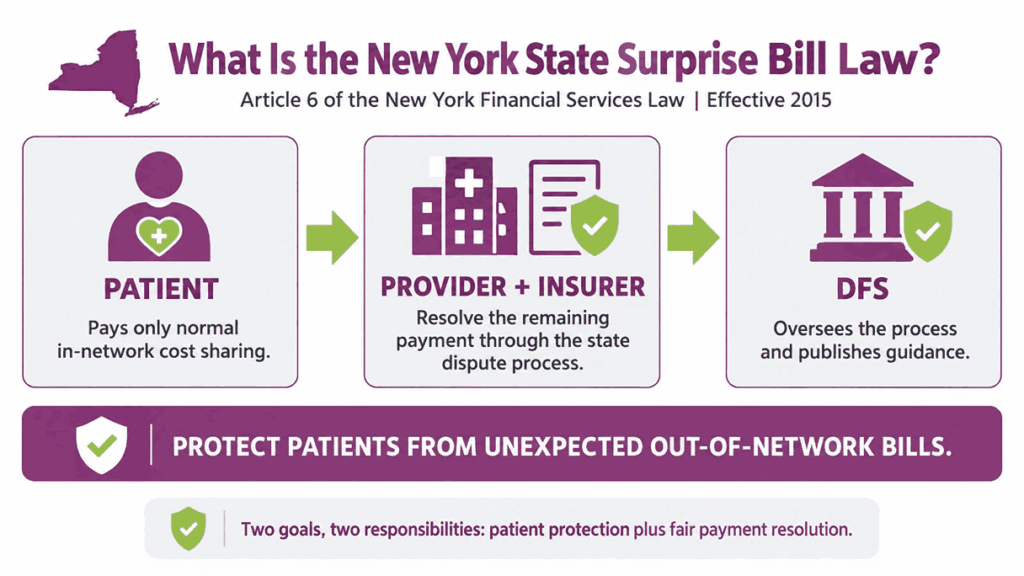
The law is Article 6 of the New York Financial Services Law. It took effect in 2015 and protects patients from unexpected bills for out-of-network care. The law pursues two goals, and each one targets a different party in the billing chain.
- Patients pay only their normal in-network share for a surprise bill.
- Providers and insurers settle the rest through a state-run dispute process.
The Department of Financial Services, or DFS, oversees the process and publishes guidance for both sides. DFS received about 10,000 patient complaints about out-of-network charges between 2008 and 2015. The surprise bill rules sit alongside other New York medical billing laws that shape claim handling.
What Counts as a Surprise Bill?
Not every out-of-network bill qualifies, so the definition matters before anyone pays or disputes a charge.
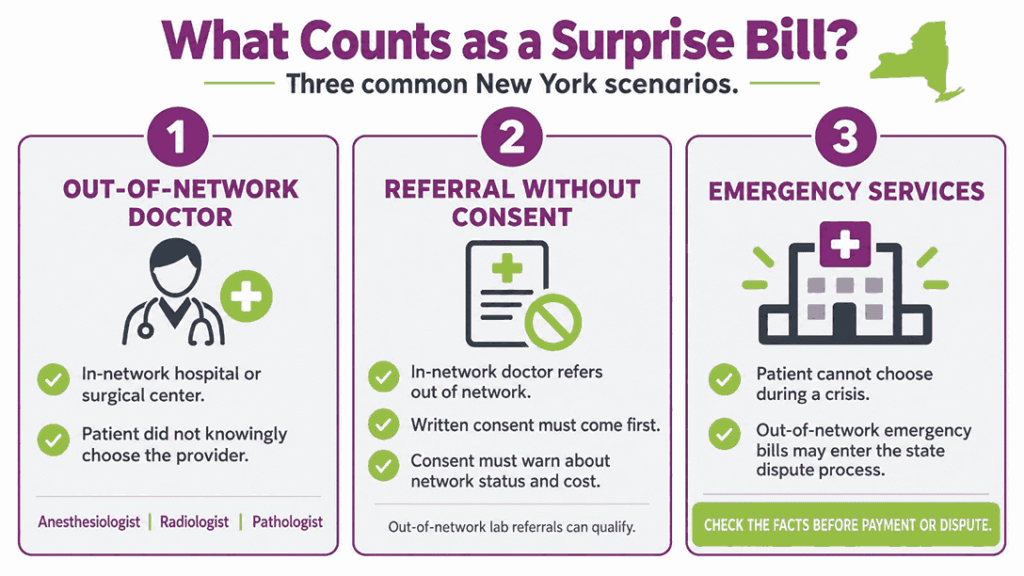
Out-of-network doctor at an in-network facility
A bill is a surprise bill when a nonparticipating doctor treats you at a participating hospital. The same applies at a participating surgical center when an in-network doctor was not available.
It also applies when the out-of-network doctor treated you without your knowledge. Common examples include anesthesiologists, radiologists, pathologists, and assistant surgeons you never chose.
Referral without written consent
Your in-network doctor may refer you to an out-of-network provider. That referral creates a surprise bill unless you give written consent first. The consent must state that the provider is out-of-network and that costs may not be covered. DFS also clarified that a specimen sent to an out-of-network lab counts as a referral.
Emergency services
Emergency care is treated differently because patients cannot choose a provider during a crisis. Bills for emergency services from out-of-network providers are also eligible for the state dispute process.
The table below shows how common situations are treated under the law.
| Situation | Surprise bill? | Reason |
|---|---|---|
| Out-of-network anesthesiologist at an in-network hospital | Yes | The patient did not choose the provider |
| Referral to an out-of-network specialist with signed consent | No | The patient accepted out-of-network status in writing |
| Referral to an out-of-network specialist without consent | Yes | The required written consent is missing |
| Specimen sent to an out-of-network lab by your doctor | Yes, without consent | DFS treats it as a referral |
| Emergency visit with an out-of-network doctor | Eligible | Emergency services fall under the dispute process |
| Planned visit to an out-of-network doctor you chose | No | The patient knowingly chose out-of-network care |
Patient Protections Under the Law
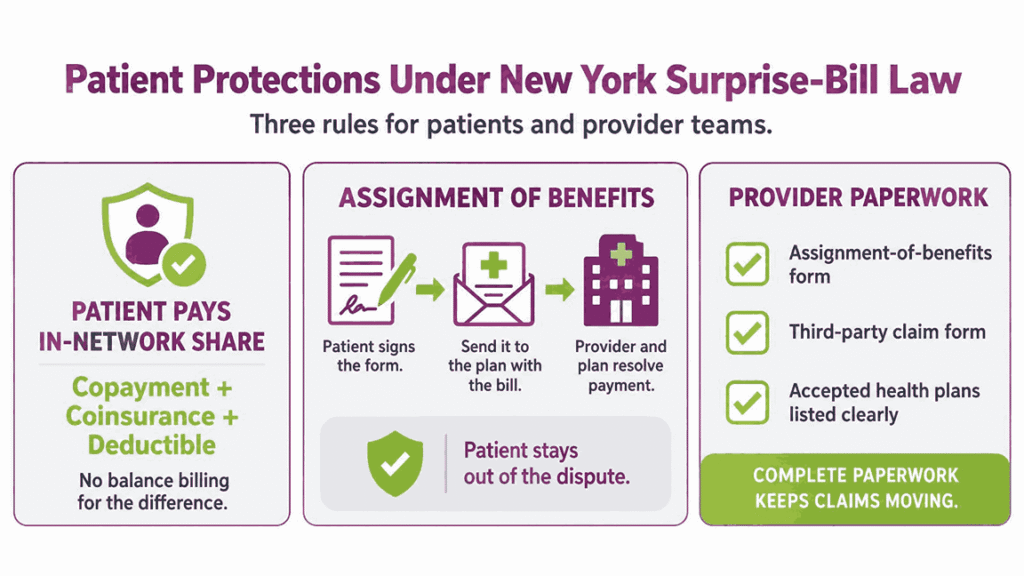
You pay only the in-network amount
If you receive a surprise bill, your cost is limited to in-network cost sharing. That means your usual copayment, coinsurance, or deductible applies, and the provider cannot bill you for the difference.
The assignment of benefits form
To receive this protection, you sign an assignment of benefits form that lets the provider seek payment from your plan. Send the form to your plan with a copy of the bill. Your health plan then pays the provider an amount it considers reasonable. After that, the provider may dispute the amount, but the patient stays out of the fight.
What providers must do?
Providers who send a possible surprise bill must include the assignment of benefits form. They must also include a claim form for third-party payers with the same bill. Providers also owe patients clear information about which health plans they accept. Missing paperwork can stall a claim, so front desk teams need a clear checklist.
How Independent Dispute Resolution Works
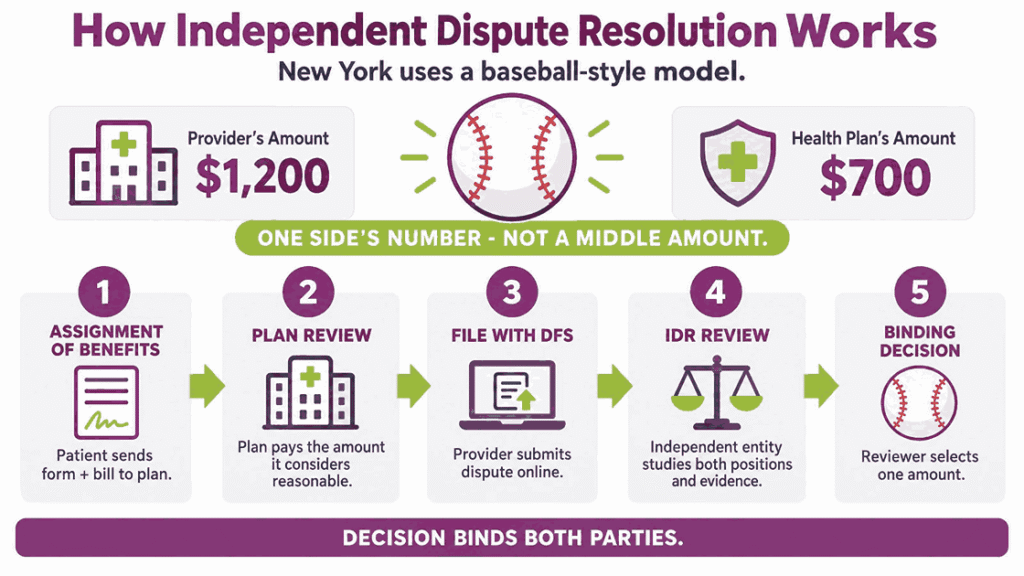
When a plan and a provider disagree on payment, either side can use independent dispute resolution, or IDR. New York uses a baseball-style model, so the reviewer picks one side’s number, not a middle amount.
The steps
- The patient signs the assignment of benefits form and sends it with the bill to the plan.
- The health plan reviews the claim and pays the provider an amount it considers reasonable.
- If the provider disagrees, it files a dispute through the DFS online portal.
- An independent reviewer, called an IDR entity, studies both payment positions and the supporting evidence.
- The reviewer selects one amount, and that decision is binding on both parties.
What reviewers weigh
The reviewer examines several facts about the service before choosing between the two payment amounts.
- The usual and customary cost of the service, based on a benchmarking database.
- The provider’s usual charge for similar services given to patients in plans where it does not participate.
- The provider’s training and experience, plus the patient’s condition and the complexity of the case.
- Any contracted rate the provider and plan previously agreed on, when one exists.
Strong documentation of these facts often decides which amount the reviewer selects.
2026 Changes to the IDR Process
New York changed its dispute process in 2026, and the updates matter for billing teams. Governor Hochul signed the legislation on May 28, as part of the fiscal 2027 budget. Some changes began on May 28, and others began on August 26, 2026.
| Change | What it means |
|---|---|
| Medicaid Managed Care removed | Disputes filed on or after May 28 no longer use IDR |
| State plans added | The Empire Plan and Student Employee Health Plan join IDR for disputes filed on or after August 26 |
| Benchmark for state plan disputes | The reviewer picks the amount closest to the 50th percentile of allowed amounts in the same area |
| Contract exclusion | No award when the insurer had a contract with the provider for the same service and location |
| Prior authorization exclusion | No award when a qualifying prior authorization identified the service as out of network |
| Fee payment | Both sides pay the full IDR entity fee when they submit or respond |
| Fee handling | Fees sit in a separate account and are refunded within 30 days to the prevailing party |
| Decision time | 45 business days, up from 30 business days |
DFS said it would adopt the matching regulation on an emergency basis on August 26. Final rule text may change, so providers should check DFS guidance before filing any dispute.
Paying the full fee upfront changes the math on low-value claims, so billing teams should weigh costs first. Practices can assign dispute filing to medical billing services, since the new fee rules raise the cost of mistakes. The 45-business-day decision window also means payment for disputed claims may arrive later than before.
How the Federal No Surprises Act Fits In
The federal No Surprises Act took effect on January 1, 2022, and it works alongside the state law. New York law generally governs fully insured plans regulated by the state. Self-funded employer plans fall under federal rules instead, because states cannot regulate them.
| Feature | New York law | Federal No Surprises Act |
|---|---|---|
| Plans covered | Fully insured plans regulated by New York | Most group and individual plans, including self-funded employer plans |
| Dispute process | State IDR through DFS | Federal IDR after a 30-business-day negotiation period |
| Payment model | Baseball style, one amount selected | Baseball style, one offer selected |
| Oversight | DFS | Federal agencies |
Billing teams should confirm which plan type applies before choosing a dispute route.
What the Law Means for Providers
Many surprise bill problems start at the front desk, long before any dispute begins.
Check network status before every visit.
Verify each provider’s network status with the patient’s plan before the service date. Facility-based specialists such as anesthesiologists and radiologists need extra attention because patients rarely choose them. A Medical Billing Company that monitors plan networks can catch these gaps before a claim goes out.
Collect consent the right way.
Written consent protects the provider when a referral leads to out-of-network care. Keep a signed copy that identifies the referral and states that costs may not be covered. Store consent forms where billing staff can retrieve them during a dispute.
Build a dispute file early.
Strong IDR cases rely on evidence gathered before the claim ever reaches the plan.
- A copy of the bill, the assignment of benefits form, and the plan’s payment notice.
- Records that show the provider’s usual charge for comparable services outside the plan.
- Benchmark data that supports the usual and customary cost of the service.
- Clinical notes that show the complexity of the case and the provider’s skill.
Reliable RCM Services keep this evidence organized from patient intake through final payment.
Track payment differences and denials
Underpayments on surprise bill claims can look like ordinary denials in the billing system. Teams need a way to flag them so the right appeal path starts quickly. Dedicated denial management support helps staff separate a true denial from a payment dispute.
Stay current with state rules.
State rules shift often enough that billing teams should review updates at least each quarter. The 2026 amendments show how quickly fees, deadlines, and covered plans can change.
Common Mistakes That Lead to Disputes
These four mistakes can turn a routine claim into a dispute, and each has a simple fix.
| Mistake | Result | Fix |
|---|---|---|
| Wrong network status on file | The patient receives an unexpected bill | Verify status before the service date |
| Missing consent form | A referral becomes a surprise bill | Collect signed consent before the referral |
| No assignment of benefits form | The patient stays exposed to the charge | Send the form with every possible surprise bill |
| Late or incomplete dispute filing | The dispute may be rejected as ineligible | Track filing details in the DFS portal |
Practical Steps for Patients
Patients can protect themselves with a few simple habits.
- Ask whether every provider on your care team is in network before a planned procedure.
- Read every consent form closely before signing one that mentions out-of-network care.
- Pause before paying an unexpected bill and check whether it qualifies as a surprise bill.
- Sign the assignment of benefits form and send it to your plan with the bill.
- Keep copies of every form, bill, and plan notice in one folder.
- Contact DFS if the provider keeps billing you after you submit the form.
Patients on self-funded employer plans should ask their plan administrator which rules apply.
Conclusion
The New York surprise bill law protects patients first and gives providers a structured way to dispute payment. Patients pay only their in-network share, and the payment fight moves to the provider and plan. The 2026 amendments change who can use IDR, how fees work, and how long decisions take.
Providers that verify network status, collect consent, and document charges stand on firmer ground. Practices that want local support can work with medical billing services in New York.
Frequently Asked Questions
What is a surprise bill in New York?
A surprise bill is an unexpected charge from an out-of-network provider the patient did not knowingly choose. It often occurs at in-network hospitals or after a referral without written consent.
Can a Provider Bill me for the Difference?
If the bill qualifies and you sign the assignment of benefits form, you owe only in-network cost sharing. The provider must then pursue the rest of the payment from your health plan.
Does the Law Cover Emergency Care?
Yes, bills for emergency services from out-of-network providers are eligible for the state dispute process. Patients should still review the bill and send the required forms to their health plan.
Does the State Law Apply to Self-funded Employer Plans?
Generally, no, because federal rules usually govern self-funded employer plans instead. The federal No Surprises Act offers similar patient protections and its own dispute process.
Who Decides a Payment Dispute Between a Provider and a Plan?
An independent IDR entity approved by DFS reviews the dispute and selects one payment amount.
What Changed in the IDR Process in 2026?
The 2026 law removed Medicaid Managed Care disputes and added the Empire Plan and Student Employee Health Plan. It also requires upfront fee payment and extends the decision time to 45 business days.