HCPCS code A6196 reports a sterile alginate or other fiber gelling wound cover with a pad size of 16 square inches or less, billed per dressing. It is a surgical dressing billed to the DME MAC, not a physician service.
A6196 is covered only on a qualifying wound, meaning a surgical wound or a wound that has been debrided. The same pad that pays when it goes home with the patient pays nothing when a practitioner applies it during an office visit.
Those two boundaries, plus the LCD’s frequency and combination limits, account for most denials on alginate claims. They are the details wound care billing services check before a supply order ships.
What Is the Description of HCPCS Code A6196?
The A6196 HCPCS code descriptor as defined by CMS is: “Alginate or other fiber gelling dressing, wound cover, sterile, pad size 16 sq. in. or less, each dressing.”
This code reports a single absorptive wound cover that forms a gel on contact with exudate. HCPCS code A6196 is billed per dressing, so each pad applied or dispensed is one unit.
The code is often searched as a CPT code, but it is a HCPCS Level II supply code. A6196 is paid under the Medicare surgical dressing benefit through the DMEPOS fee schedule, which means the pricing, the claim jurisdiction, and the coverage rules all differ from physician procedures.
What Dressing Does HCPCS Code A6196 Represent?
HCPCS code A6196 represents a sterile alginate or fiber gelling pad used as a wound cover. Alginates are derived from seaweed, and fiber gelling dressings use similar hydrophilic fibers that absorb fluid and convert to a soft gel.
The defining features are:
- A sterile pad that absorbs moderate to heavy wound exudate
- Gel formation on contact with drainage, which maintains a moist wound bed
- A pad size of 16 square inches or less, which separates it from the larger cover codes
- Use as a wound cover, as distinct from the rope or ribbon filler form
The pad size sets the code, not the wound size alone. A 4 by 4 inch pad is 16 square inches and bills as A6196, while a 4.25 by 4.25 inch pad exceeds 16 square inches and moves to A6197.
What Counts as a Qualifying Wound for A6196?
A qualifying wound is the gate on every A6196 claim. Policy Article A54563 recognizes only two definitions.
The qualifying wound definitions are:
- A wound caused by, or treated by, a surgical procedure
- A wound after debridement, regardless of the debridement technique
- The procedure or debridement must be performed by a treating practitioner or other healthcare professional, to the extent permitted under state law
- Debridement may be surgical, mechanical, chemical, or autolytic
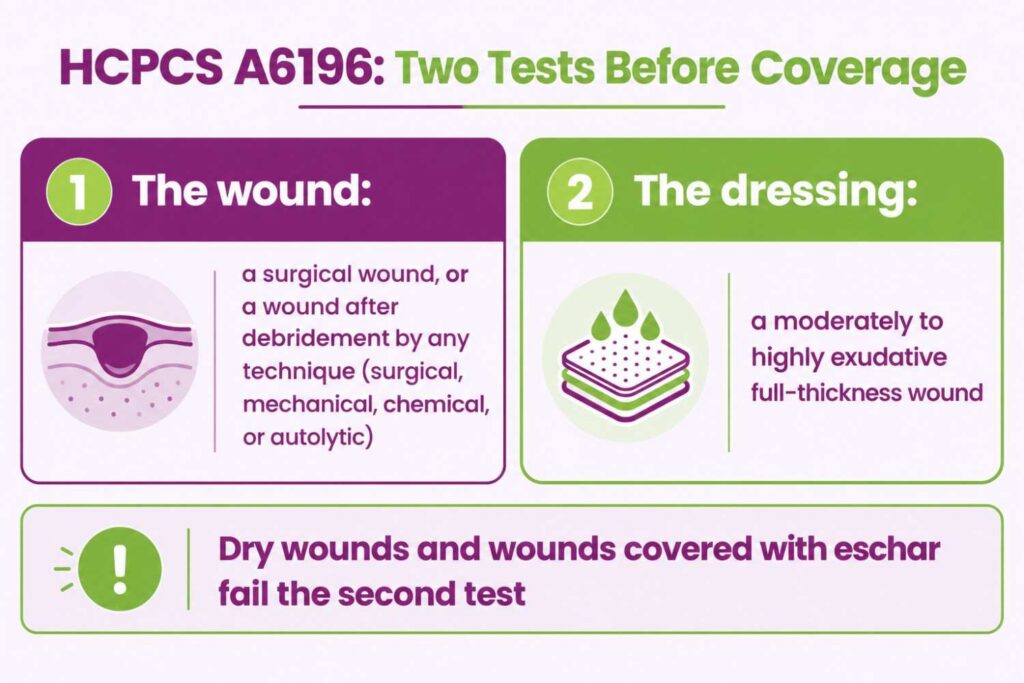
A qualifying wound alone does not establish coverage for this specific product. LCD L33831 covers alginate covers for moderately to highly exudative full-thickness wounds, such as stage 3 or 4 ulcers, and states they are not reasonable and necessary on dry wounds or wounds covered with eschar. The exudate level recorded in the chart is what proves an alginate was the right dressing.
How Does A6196 Differ From A6197, A6198, and Alginate Filler A6199?
The alginate family divides by form and size. Three codes describe wound covers by pad area, and one describes filler by length.
The alginate codes break down as follows:
- A6196 wound cover, pad size 16 sq in or less, each dressing
- A6197 wound cover, pad size more than 16 sq in but 48 sq in or less, each dressing
- A6198 wound cover, pad size more than 48 sq in, each dressing
- A6199 wound filler, sterile, per 6 inches of rope or ribbon
Covers lie over the wound, while filler packs a wound cavity. LCD L33831 allows one wound cover sheet of approximately the wound’s size, or up to two units of filler, at each change, where one unit equals 6 inches of alginate rope. Dressing size must be based on and appropriate to the size of the wound. The alginate family is one group within the podiatry HCPCS code set, alongside the other surgical dressing categories a foot and ankle practice orders.
When Is A6196 a Primary Dressing and When Is It a Secondary Dressing?
A primary dressing contacts the wound surface, and a secondary dressing covers the primary. A6196 is usually the primary dressing, and alginate holds a named exception that allows a second cover over it.
The primary and secondary rules are:
- Using more than one type of wound cover or more than one type of wound filler on a single wound is not reasonable and necessary
- The exception is an alginate or other fiber gelling dressing wound cover, or a saline, water, or hydrogel impregnated gauze, which might need an additional wound cover
- That exception is what makes alginate one of the few products routinely paired with a secondary dressing on the same claim
- When a wound cover with an adhesive border is used, no other dressing is needed on top of it
The record must state which role each dressing plays. Without that, a reviewer sees two covers on one wound and applies the general prohibition rather than the alginate exception.
Which ICD-10 Codes Support Medical Necessity for A6196?
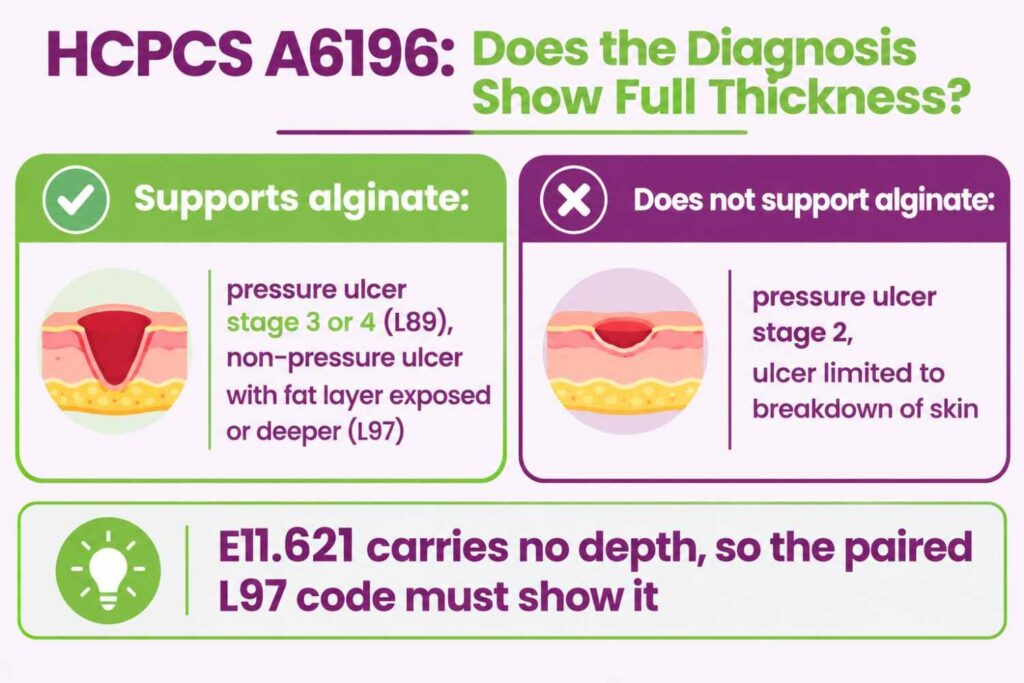
The diagnosis must establish a full-thickness, exudative wound to match the coverage criteria for HCPCS code A6196. Four diagnosis families account for most alginate orders, and in each one a stage or depth character carries the proof.
Pressure Ulcers at Stage 3 or Stage 4 (L89)
L89 codes identify the pressure ulcer by anatomic site and stage. Stage 3 and stage 4 describe full-thickness tissue loss, which is exactly the wound type the alginate criteria name, so codes such as L89.153 and L89.154 for the sacral region support A6196 directly.
A stage 2 pressure ulcer is partial thickness. Pairing it with an alginate order contradicts the coverage criteria even when the wound is draining.
Non-Pressure Chronic Ulcers of the Lower Limb (L97)
L97 codes identify the ulcer by site and laterality, and the sixth character encodes depth: limited to breakdown of skin, fat layer exposed, necrosis of muscle, or necrosis of bone. A wound with the fat layer exposed or deeper is full thickness and fits the alginate criteria. An ulcer limited to breakdown of skin does not.
The same depth logic governs the foot ulcer ICD-10 codes at L97.4 and L97.5, where the heel and midfoot are coded separately from other parts of the foot on each side. Choosing the right subcategory matters because the claim’s diagnosis has to describe the same wound the dressing order describes.
Diabetic Foot Ulcers (E11.621 With the L97 Site Code)
A diabetic foot ulcer takes two codes. E11.621 for type 2 diabetes mellitus with foot ulcer is sequenced first, and the L97 site code follows with the location, side, and depth.
The diabetic foot ulcer code E11.621 identifies the diabetes complication but carries no depth information, so it cannot establish a full-thickness wound on its own. The paired L97 code does that work, and a diabetic claim that omits it leaves the alginate order without depth support.
Venous Stasis Ulcers
Venous ulcers are coded with the varicose vein with ulcer category, I83.0-, or the chronic venous hypertension with ulcer category, I87.31-, together with the corresponding L97 site code. These wounds are often heavily exudative, which makes them a common alginate indication.
The venous code explains why the ulcer exists. The L97 depth character still decides whether the wound qualifies as full thickness for the dressing.
All four families sit within the podiatry ICD-10 codes used across foot and ankle practices, and one rule holds throughout: the stage or depth character must describe the wound the dressing order describes.
Which CPT Codes Are Billed in Relation to A6196?
The debridement CPT codes create the qualifying wound that makes A6196 coverable. They never appear on the same claim line, and often not on the same claim.
The related CPT codes are:
- 97597 and 97598 for selective debridement by surface area
- 11042 through 11047 for surgical debridement by depth, with CPT 11045 reporting each additional 20 sq cm of subcutaneous tissue
- 97602 for non-selective debridement, which also qualifies the wound under the any-technique rule
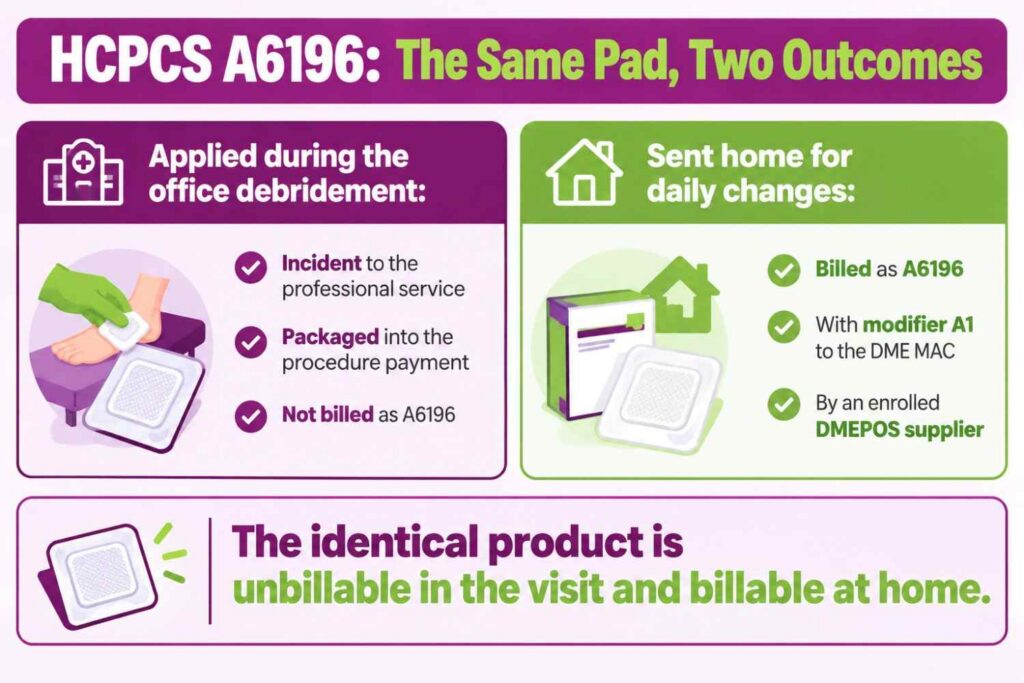
The billing boundary is what matters. When a practitioner applies dressings as part of a professional service billed to Medicare, the dressings are incident to that service and not separately payable, since dressing costs are packaged into the procedure or visit payment. Dressings sent home with the patient for ongoing changes may be claimed under the surgical dressing benefit. The full set of podiatry debridement and wound care CPT codes maps which procedure created the qualifying wound.
What Are the Modifiers for HCPCS Code A6196?
HCPCS code A6196 uses wound-count modifiers on every covered claim, plus one modifier that signals a statutory non-coverage denial.
Modifiers A1–A9: Number of Wounds the Dressing Is Used On
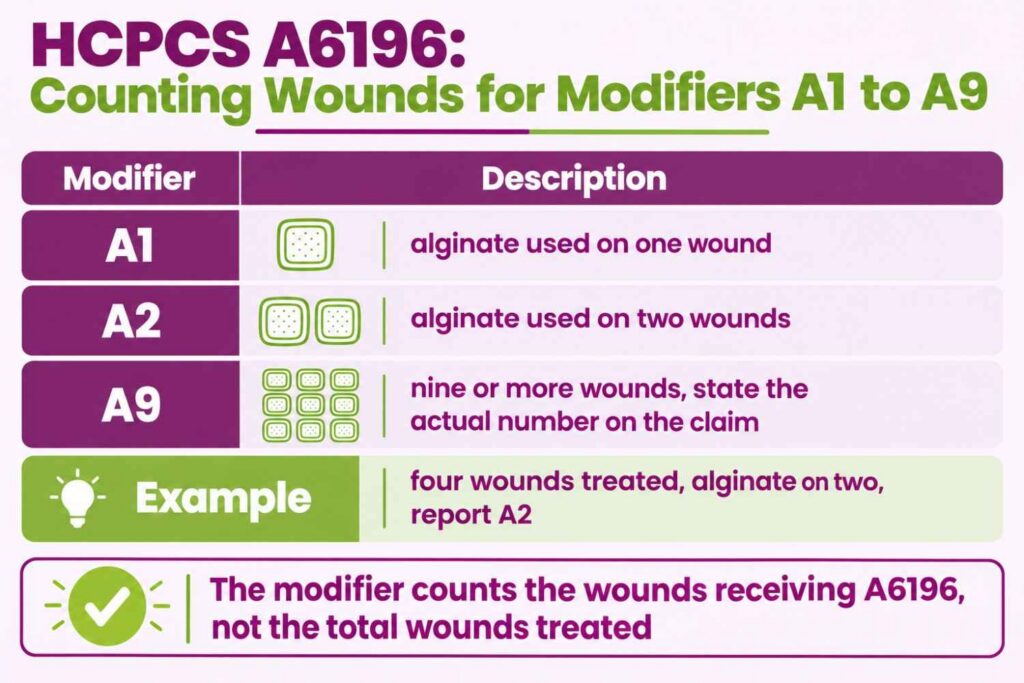
Modifiers A1 through A9 indicate the number of wounds on which this specific dressing is used, from A1 for one wound to A9 for nine or more. The modifier counts the wounds that receive A6196, not the total wounds being treated. A patient with four wounds and alginate on two of them is reported with A2. When A9 is billed, the claim must state the actual number of wounds. If the dressing is not being used as a primary or secondary dressing on a surgical or debrided wound, the A modifiers are not used at all.
Modifier GY: No Qualifying Wound, Statutorily Non-Covered
Modifier GY indicates an item that is statutorily non-covered or does not meet the definition of any Medicare benefit. Dressings used for conditions other than a qualifying wound are denied as statutorily non-covered, no benefit. Append GY to A6196 in that situation, which signals the denial type for secondary payers and establishes patient liability without relying on an ABN.
Which Documents Are Required For HCPCS Code A6196?
Documentation for HCPCS code A6196 must establish the qualifying wound, the dressing’s role, and the quantity ordered. A generic order for alginate dressings fails on its face.
The required documentation includes:
- An initial wound evaluation recording the type of qualifying wound, its location, number, and size
- Whether each dressing is primary, secondary, or for a non-covered use such as wound cleansing
- The exudate level, which supports alginate over other dressing categories
- An order specifying dressing type, size, number per change, change frequency, and number of wounds
- A new order whenever a dressing is added or the quantity increases
- Serial wound measurements, with records updated at least monthly, supporting continued supply
- Proof of delivery and records showing the supplier monitored actual usage
What Is the Cost of HCPCS Code A6196?
The cost of HCPCS code A6196 is low per unit and meaningful per month. Daily changes across a full month turn a ten-dollar dressing into a recurring supply line.
DMEPOS Fee Schedule Payment for A6196
Medicare pays A6196 through the DMEPOS fee schedule under the surgical dressing category. The current national allowed amount is $10.55 per dressing.
| Element | Amount |
|---|---|
| Medicare allowed, national | $10.55 |
| Medicare pays, 80 percent | About $8.44 |
| Patient coinsurance, 20 percent | About $2.11 |
| January 2026 amount | $10.49 |
Medicare pays 80 percent of the lower of the supplier’s actual charge or the fee schedule amount, after the Part B deductible. The difference between the January figure and the current figure reflects the quarterly update cycle, so verify the amount against the current DMEPOS fee schedule file before quoting it.
Why Statewide Fees, National Ceilings, and Floors Set the Allowed Amount
Surgical dressing fees are calculated on a statewide basis and then limited by national ceilings and floors. That structure is why A6196 pays a narrow range across the country.
The pricing mechanics are:
- Each state has its own fee schedule amount for the code
- The national ceiling equals the median of all statewide fee schedule amounts
- The national floor equals 85 percent of that median
- A statewide amount above the ceiling is cut to the ceiling, and one below the floor is raised to the floor
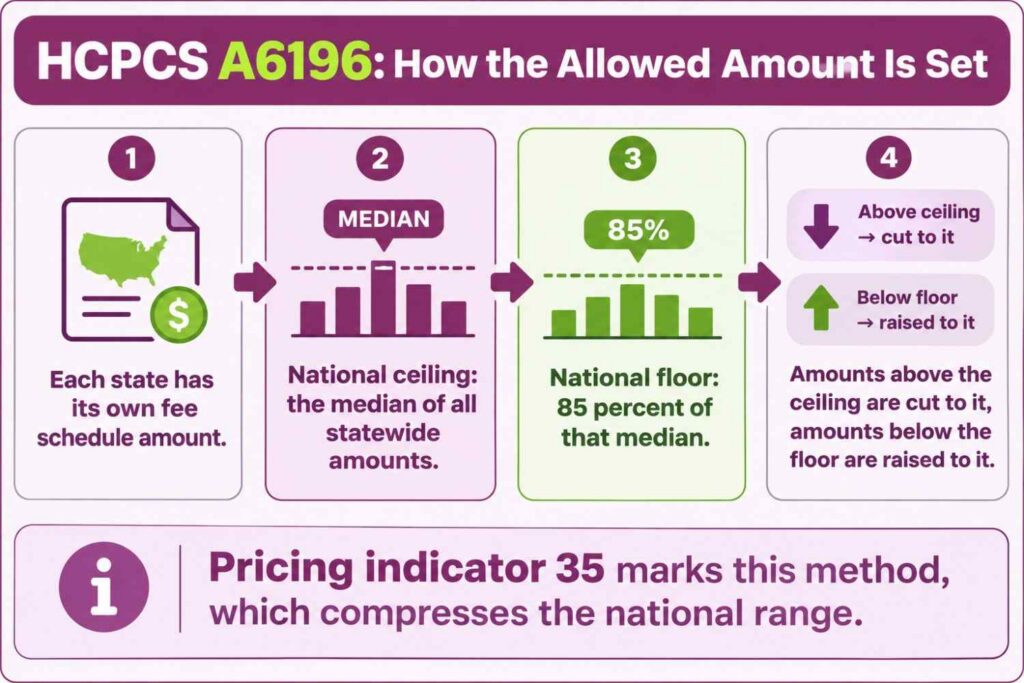
The result is a compressed range rather than wide regional variation. Pricing indicator 35 on the HCPCS file identifies exactly this methodology for surgical dressings.
Commercial Payers and Medicaid Coverage
Commercial plans and Medicaid programs set their own terms for HCPCS code A6196, and many borrow heavily from the Medicare surgical dressing policy.
Coverage considerations include:
- Many commercial policies adopt the same qualifying-wound definition and the same alginate exudate criteria
- Some plans cover dressings only through a home care agency or contracted supplier rather than any enrolled DME supplier
- State Medicaid programs set their own rates, and several index directly to the Medicare amount
- Quantity limits and authorization requirements vary, so confirm the plan’s supply rules before shipping a monthly order
Patient Coinsurance and Monthly Supply Cost
The patient’s share of A6196 is small per dressing and accumulates across a month of daily changes. Planning for that total matters for adherence.
At the maximum change frequency of once per day, one wound for 30 days works out as follows:
| Element | Monthly amount |
|---|---|
| Total allowed, 30 dressings | $316.50 |
| Medicare pays | About $253.20 |
| Patient coinsurance | About $63.30 |
Each additional wound treated with A6196 adds the same amount again. A patient with alginate on two wounds at daily changes carries roughly $126.60 in monthly coinsurance, before any secondary dressing is added.
What Are Example Clinical Scenarios or Use Cases for HCPCS Code A6196?
HCPCS code A6196 appears on exudative pressure ulcers, multi-wound patients, office-versus-home dressing decisions, and wounds that fail the coverage test. The scenarios below show each.
Scenario 1: Stage 3 Sacral Pressure Ulcer With Heavy Exudate After Debridement
ICD-10: L89.153 (Pressure ulcer of sacral region, stage 3)
A patient with a stage 3 sacral pressure ulcer undergoes selective debridement, which establishes a qualifying wound. The wound is full thickness with heavy exudate and measures about 3 by 3 inches. The treating practitioner orders a 4 by 4 inch alginate pad changed daily, with a secondary cover. The supplier bills HCPCS code A6196 with modifier A1, 30 units for a one-month supply, and bills the secondary cover on its own line.
Scenario 2: Alginate Used on Two of Four Wounds and How the A2 Modifier Applies
ICD-10: E11.621 (Type 2 diabetes mellitus with foot ulcer) with the corresponding L97 site codes
A patient has four debrided foot ulcers. Two are heavily exudative and receive alginate pads, while the other two are minimally draining and receive a different dressing. The supplier bills A6196 with modifier A2, since the modifier counts the wounds receiving this dressing rather than the four wounds treated. At daily changes on both wounds, the monthly quantity is 60 units.
Scenario 3: Dressing Applied During an Office Debridement Versus Dressings Sent Home
ICD-10: L97.512 (Non-pressure chronic ulcer of other part of right foot with fat layer exposed)
A podiatrist debrides a foot ulcer in the office and applies an alginate pad before the patient leaves. That pad is incident to the professional service and is not separately billable, because its cost is packaged into the procedure payment. The same practice then sends the patient home with a month of alginate pads for daily changes. Those dispensed pads may be claimed as HCPCS code A6196 with modifier A1, billed to the DME MAC by an enrolled DMEPOS supplier.
This is the clearest example of the code’s central boundary. The identical product is unbillable when applied during the visit and billable when the change supply goes home with the patient.
Scenario 4: Dry Heel Wound With Stable Eschar and No Debridement
ICD-10: L89.613 (Pressure ulcer of right heel, stage 3)
A patient has a heel wound covered with dry, stable eschar, and the practitioner elects not to debride it. Two coverage tests fail at once. Without debridement or a surgical procedure, the wound is not a qualifying wound, and alginate is not reasonable and necessary on a dry wound or one covered with eschar. A claim for A6196 here is denied, and modifier GY applies when the dressing is supplied for a non-qualifying wound.
What Are the HCPCS Code A6196 Rules To Ensure Successful Reimbursement?
Follow the frequency and sizing rules, avoid prohibited combinations, keep practitioner-applied dressings off the claim, and respect episode bundling. Meeting these rules protects HCPCS code A6196 claims from denial and recoupment.
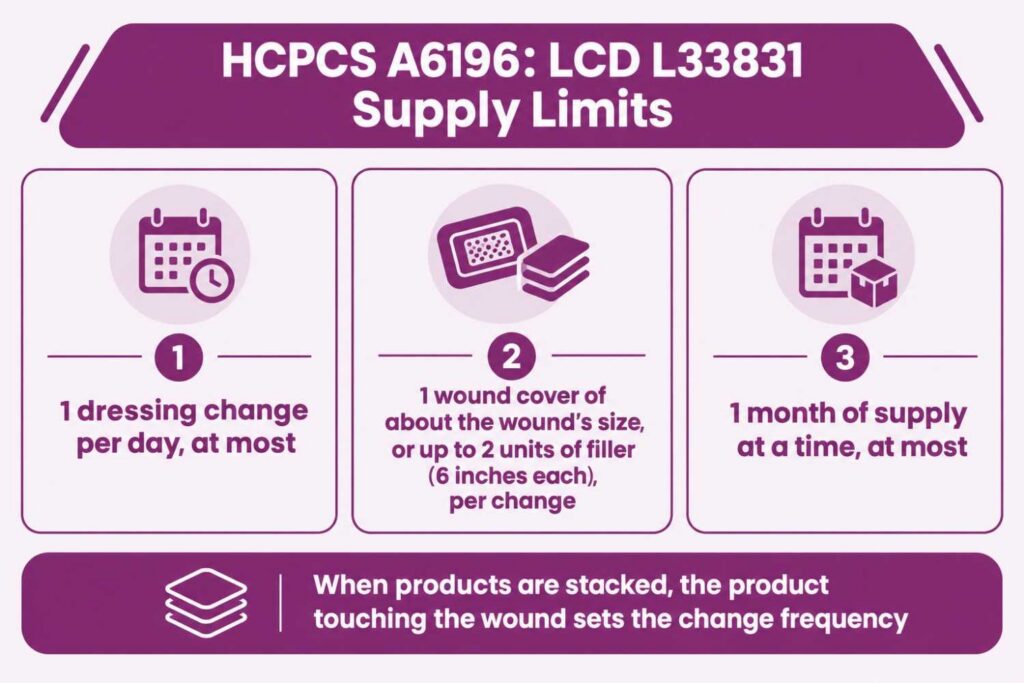
Frequency, Quantity, and Sizing Rules Under LCD L33831
LCD L33831 sets the change frequency and quantity for alginate dressings. The supply on the claim must track those limits and the patient’s actual use.
The frequency and sizing rules are:
- Dressing change is up to once per day
- One wound cover sheet of approximately the wound’s size, or up to two units of filler, is used at each change
- When primary, secondary, and filler products are combined, the product in contact with the wound sets the change frequency for the whole dressing stack
- Using a secondary dressing with a weekly change frequency over a primary dressing changed daily is not reasonable and necessary
- No more than one month’s supply may be provided at one time, absent documentation supporting a larger quantity
- Suppliers must not dispense more than the patient’s expected utilization, and must monitor actual use and adjust accordingly
Which Dressing Combinations Are Not Reasonable and Necessary
Some dressing pairings contradict each other clinically, and the LCD treats them as not reasonable and necessary.
The combination rules are:
- Combining a hydrating dressing with an absorptive dressing on the same wound at the same time, such as hydrogel with alginate, is not appropriate
- More than one type of wound cover or more than one type of wound filler on a single wound is not reasonable and necessary, outside the alginate secondary-cover exception
- A secondary dressing must share a compatible change frequency with the alginate beneath it
- A wound cover with an adhesive border needs no additional dressing on top
The hydrogel and alginate prohibition alone prevents a common supply-order denial. One dressing adds moisture and the other absorbs it, so the pairing works against itself.
Why Dressings Applied by a Practitioner Are Not Separately Billable
When a practitioner applies dressings during a professional service billed to Medicare, the dressings are incident to that service. Their cost is packaged into the procedure or visit payment.
The practical rules are:
- Dressings applied during an office visit or procedure are not billed as A6196
- Dressings dispensed for the patient’s own use at home may be billed under the surgical dressing benefit
- A practice dispensing dressings for home use must be enrolled as a DMEPOS supplier and bill the DME MAC
- An ABN is not appropriate for a dressing change, since its cost is already packaged into other billed services
The procedure claim goes to the A/B MAC and the supply claim goes to the DME MAC, so coordinating both is routine work within podiatry billing services.
Home Health and Skilled Nursing Facility Bundling Rules
Surgical dressings are bundled into home health and skilled nursing facility Part A payments while those episodes are active. This is a frequent supplier denial, and it sits outside the LCD itself.
The bundling rules are:
- During an active home health plan of care, the agency’s episode payment includes surgical dressings
- A DME supplier cannot bill A6196 for a patient under an active home health episode
- During a covered SNF Part A stay, the facility must supply dressings as part of its prospective payment
- After the Part A stay ends, dressings may be billed under Part B if the qualifying-wound criteria are met
Check the patient’s home health and SNF status before every monthly shipment. An episode that starts mid-month converts an otherwise valid supply order into a denied one.
Top Reasons For Denials Specific To A6196 & Quick Remedies
- No Qualifying Wound Documented: Prevent by recording the surgical procedure or the debridement that created the wound, since dressings for any other condition are statutorily non-covered.
- Alginate on a Dry Wound or Eschar: Prevent by documenting moderate to heavy exudate on a full-thickness wound, since alginate is not reasonable and necessary on dry wounds or eschar.
- Wrong A Modifier: Prevent by counting only the wounds receiving HCPCS code A6196, not the total wounds treated, and stating the wound count when A9 is used.
- Practitioner-Applied Dressing Billed: Prevent by billing only dressings sent home for ongoing changes, since dressings applied during a professional service are packaged into that payment.
- Hydrogel and Alginate on the Same Wound: Prevent by selecting one moisture strategy per wound, since a hydrating and absorptive dressing together is not appropriate.
- Excess Quantity or Active Home Health Episode: Prevent by limiting supply to expected use and one month, and by confirming no home health or SNF Part A episode is active before shipping.