Diabetes, thyroid disease, bone health, and hormone care each rely on a different mix of CPT codes. This guide covers 100 of them, from office visits and glucose monitoring to thyroid procedures and care management. With 299 new codes in the CPT 2027 code set, an up-to-date reference keeps every claim accurate.
Medicare’s 2027 payment rules also change how several endocrine services get paid. Clear medical necessity, diabetes complication linkage, correct modifiers, and supporting notes help each claim qualify for payment.

After reading this guide, endocrinology CPT codes will no longer slow your claims, because we put everything in one place. You’ll find 100 CPT codes with descriptors and modifiers, then a closer look at the codes that matter most in the specialty.
Even teams that work with endocrinology billing providers can keep this list as a handy reference.
Endocrinology CPT Codes Cheat Sheet for 2027 (90+ Codes)
The table below is a quick overview of the endocrinology CPT codes you’ll use in 2027, with short descriptors, categories, and common modifiers.
| Code | Descriptor | Category | Common Modifier |
|---|---|---|---|
| 99202 | Office visit, new patient, straightforward MDM | Evaluation and Management | 25 / 95 |
| 99203 | Office visit, new patient, low MDM | Evaluation and Management | 25 / 95 |
| 99204 | Office visit, new patient, moderate MDM | Evaluation and Management | 25 / 95 |
| 99205 | Office visit, new patient, high MDM | Evaluation and Management | 25 / 95 |
| 99211 | Office visit, established patient, nurse visit | Evaluation and Management | 25 |
| 99212 | Office visit, established patient, straightforward MDM | Evaluation and Management | 25 / 95 |
| 99213 | Office visit, established patient, low MDM | Evaluation and Management | 25 / 95 |
| 99214 | Office visit, established patient, moderate MDM | Evaluation and Management | 25 / 95 |
| 99215 | Office visit, established patient, high MDM | Evaluation and Management | 25 / 95 |
| 99417 | Prolonged visit time, each added 15 minutes (add-on) | Evaluation and Management | – |
| 99221 | Initial hospital or observation care, straightforward or low MDM | Hospital Care | 25 |
| 99222 | Initial hospital or observation care, moderate MDM | Hospital Care | 25 |
| 99223 | Initial hospital or observation care, high MDM | Hospital Care | 25 |
| 99231 | Subsequent hospital care, straightforward or low MDM | Hospital Care | 25 |
| 99232 | Subsequent hospital care, moderate MDM | Hospital Care | 25 |
| 99233 | Subsequent hospital care, high MDM | Hospital Care | 25 |
| 99238 | Hospital discharge, 30 minutes or less | Hospital Care | – |
| 99239 | Hospital discharge, more than 30 minutes | Hospital Care | – |
| 95249 | CGM hookup, training, and data, patient-owned device | Continuous Glucose Monitoring | – |
| 95250 | CGM hookup, training, and data, practice-owned device | Continuous Glucose Monitoring | – |
| 95251 | CGM data analysis and report, 72 hours or more | Continuous Glucose Monitoring | 26 / TC |
| 99091 | Physiologic data review, 30 minutes per 30 days | Remote Monitoring | – |
| 99453 | Remote monitoring setup and patient education | Remote Monitoring | – |
| 99454 | Remote monitoring device supply, 16 to 30 days of data | Remote Monitoring | – |
| 99445 | Remote monitoring device supply, 2 to 15 days of data | Remote Monitoring | – |
| 99457 | Remote monitoring management, first 20 minutes | Remote Monitoring | – |
| 99458 | Remote monitoring management, each added 20 minutes (add-on) | Remote Monitoring | – |
| 99470 | Remote monitoring management, first 10 minutes | Remote Monitoring | – |
| 97802 | Medical nutrition therapy, initial, individual | Nutrition Therapy | – |
| 97803 | Medical nutrition therapy, follow-up, individual | Nutrition Therapy | – |
| 97804 | Medical nutrition therapy, group | Nutrition Therapy | – |
| 83036 | Hemoglobin A1c | Diabetes Lab | QW |
| 83037 | Hemoglobin A1c by home-use device | Diabetes Lab | QW |
| 82947 | Glucose, blood, quantitative | Diabetes Lab | – |
| 82962 | Glucose by home-use monitoring device | Diabetes Lab | QW |
| 82951 | Glucose tolerance test, three specimens | Diabetes Lab | – |
| 82952 | Glucose tolerance test, each added specimen | Diabetes Lab | – |
| 82985 | Fructosamine (glycated protein) | Diabetes Lab | – |
| 82043 | Urine albumin, quantitative | Diabetes Lab | – |
| 82570 | Creatinine, urine | Diabetes Lab | – |
| 83525 | Insulin, total | Diabetes Lab | – |
| 84681 | C-peptide | Diabetes Lab | – |
| 84443 | TSH | Thyroid Lab | – |
| 84439 | Free thyroxine (free T4) | Thyroid Lab | – |
| 84436 | Total thyroxine (total T4) | Thyroid Lab | – |
| 84480 | Total triiodothyronine (total T3) | Thyroid Lab | – |
| 84481 | Free triiodothyronine (free T3) | Thyroid Lab | – |
| 84432 | Thyroglobulin | Thyroid Lab | – |
| 84445 | Thyroid stimulating immune globulin | Thyroid Lab | – |
| 86376 | Thyroid peroxidase (microsomal) antibody | Thyroid Lab | – |
| 86800 | Thyroglobulin antibody | Thyroid Lab | – |
| 82308 | Calcitonin | Thyroid Lab | – |
| 76536 | Soft tissue ultrasound of the head and neck, such as thyroid, real time with images | Thyroid Imaging | 26 / TC |
| 10005 | Fine needle aspiration with ultrasound guidance, first lesion | Thyroid Procedure | – |
| 10006 | Fine needle aspiration with ultrasound guidance, each added lesion (add-on) | Thyroid Procedure | – |
| 10021 | Fine needle aspiration without imaging guidance | Thyroid Procedure | – |
| 60100 | Percutaneous core needle biopsy of thyroid | Thyroid Procedure | – |
| 76942 | Ultrasound guidance for needle placement | Thyroid Imaging | 26 / TC |
| 88172 | Cytopathology, immediate adequacy check | Pathology | 26 / TC |
| 88173 | Cytopathology, interpretation and report of aspirate | Pathology | 26 / TC |
| 78012 | Thyroid uptake, single measurement | Nuclear Medicine | 26 / TC |
| 78014 | Thyroid imaging with uptake | Nuclear Medicine | 26 / TC |
| 77080 | DXA bone density, axial skeleton | Bone Density | 26 / TC |
| 77081 | DXA bone density, peripheral sites | Bone Density | 26 / TC |
| 77085 | DXA bone density with vertebral fracture assessment | Bone Density | 26 / TC |
| 82310 | Calcium, total | Bone and Parathyroid Lab | – |
| 83970 | Parathyroid hormone | Bone and Parathyroid Lab | – |
| 82306 | Vitamin D, 25-hydroxy | Bone and Parathyroid Lab | – |
| 82652 | Vitamin D, 1,25-dihydroxy | Bone and Parathyroid Lab | – |
| 82533 | Cortisol, total | Hormone Lab | – |
| 82024 | ACTH | Hormone Lab | – |
| 82088 | Aldosterone | Hormone Lab | – |
| 84244 | Renin | Hormone Lab | – |
| 83835 | Metanephrines | Hormone Lab | – |
| 84403 | Testosterone, total | Hormone Lab | – |
| 84402 | Testosterone, free | Hormone Lab | – |
| 82670 | Estradiol | Hormone Lab | – |
| 83001 | FSH | Hormone Lab | – |
| 83002 | LH | Hormone Lab | – |
| 84146 | Prolactin | Hormone Lab | – |
| 83003 | Growth hormone | Hormone Lab | – |
| 84305 | IGF-1 (somatomedin) | Hormone Lab | – |
| 84270 | Sex hormone-binding globulin | Hormone Lab | – |
| 82627 | DHEA sulfate | Hormone Lab | – |
| 80061 | Lipid panel | Metabolic Panel | QW |
| 84478 | Triglycerides | Metabolic Panel | – |
| 80048 | Basic metabolic panel | Metabolic Panel | – |
| 80053 | Comprehensive metabolic panel | Metabolic Panel | – |
| 99490 | Chronic care management, first 20 minutes of staff time | Care Management | – |
| 99439 | Chronic care management, each additional 20 minutes (add-on) | Care Management | – |
| 99491 | Chronic care management, 30 minutes by the physician | Care Management | – |
| 99495 | Transitional care, moderate complexity | Care Management | – |
| 99496 | Transitional care, high complexity | Care Management | – |
| 96372 | Therapeutic injection, subcutaneous or intramuscular | Injection | – |
What Are the Evaluation and Management CPT Codes for Endocrinology?
E/M codes report the visits where an endocrinologist listens, examines, thinks through the problem, and decides what comes next.
Diabetes, thyroid disease, and hormone conditions need many follow-ups, so these are the codes you will use most. They pay for the physician’s decision-making rather than a single test, so the note matters as much as the appointment.
Two methods set the level of an office visit: medical decision-making (MDM) or total time on the date of service.
Choose one method per visit and avoid mixing them. MDM rests on three parts: the problems addressed, the data reviewed, and the risk of the chosen treatment. A visit reaches a level when two of those parts support it.
New Patient Office Visit Codes (99202–99205)
Patients count as new when neither you nor a same-specialty colleague in your group has seen them in three years. First visits for a thyroid nodule, newly found diabetes, or abnormal hormone labs fit these codes. Record review often stretches these appointments, so total time is usually a practical method to document.
| CPT Code | Minimum Total Time | MDM Level | What It Can Look Like in Endocrinology |
|---|---|---|---|
| 99202 | 15 minutes | Straightforward | A single minor concern, which is uncommon in endocrinology |
| 99203 | 30 minutes | Low | One stable chronic condition, such as stable hypothyroidism with a lab review |
| 99204 | 45 minutes | Moderate | A new thyroid nodule workup, or new diabetes with treatment started |
| 99205 | 60 minutes | High | A severe or life-threatening problem needing hospital-level decisions |
Time belongs to the physician or other qualified provider on the day you see the patient. That includes reviewing results, taking the history, examining, counseling, ordering, and documenting. Clinical staff minutes stay out of the count.
Established Patient Office Visit Codes (99211–99215)
Established patients are ones seen by you, or by a same-specialty colleague in your group, within the last 36 months. Most endocrine visits fall here, because chronic conditions call for regular follow-up. Pick the code based on the thinking the visit required, not on how long the patient has been on your schedule.
| CPT Code | Minimum Total Time | MDM Level | What It Can Look Like in Endocrinology |
|---|---|---|---|
| 99211 | N/A | Minimal service | A staff blood pressure check or insulin injection technique review |
| 99212 | 10 minutes | Straightforward | A brief check on one minor issue |
| 99213 | 20 minutes | Low | Stable diabetes or thyroid follow-up with no medication change |
| 99214 | 30 minutes | Moderate | Diabetes above goal with an insulin change, or two stable conditions managed together |
| 99215 | 40 minutes | High | A severe flare that threatens life or bodily function |
CPT 99211 is a nurse or clinical staff visit that does not require the physician to be present. Blood pressure checks and insulin injection technique reviews are common examples. Levels 99212 through 99215 involve the physician or other qualified provider.
When you bill a glucose monitor interpretation the same day, keep its time and data separate. Minutes and data used for that service cannot count toward the visit total. If a procedure or injection happens at the same visit, add modifier 25 to the E/M only when the note shows distinct work.
CPT 99214 for Moderate Complexity Chronic Visits
Among endocrinologists, CPT 99214 is the most commonly billed service in Medicare data. This code fits chronic follow-ups where treatment changes.
Moderate complexity means a worsening or off-target chronic condition, at least two stable chronic conditions managed together, or prescription drug management. Typical endocrine examples include a diabetes medication adjustment, thyroid medication titration, and a review of lab trends.
You can then use supporting diagnoses from endocrinology ICD-10 codes to back up each level you choose.
Picture a patient whose A1c has climbed on current therapy. The physician reviews recent labs, changes the insulin dose, and schedules a recheck. Progressing disease and prescription drug management put two of the three MDM parts at moderate, which supports 99214 here.
Stable conditions with no treatment change usually support 99213. Severe flares that threaten life or bodily function, such as a decision about hospital admission, can support 99215.
CPT 99417 for Prolonged Visits
Add-on code 99417 captures extra time once a visit passes the top level. Only 99205 and 99215 can carry it, and it relies on time alone, never on MDM. Report one unit for each full 15 minutes past the threshold, which is 55 minutes for CPT 99215 and 75 minutes for 99205.
Long endocrine visits happen, for example, when a new patient needs a detailed record review, an insulin pump plan, and extensive counseling. Document total time and the activities that filled it, ideally with start and stop times.
Separately billed services keep their own minutes, and 99417 never pairs with 99212 through 99214. Medicare uses its own add-on code with different time thresholds, so check each payer’s rule first.
Which CPT Codes Cover Continuous Glucose Monitoring?
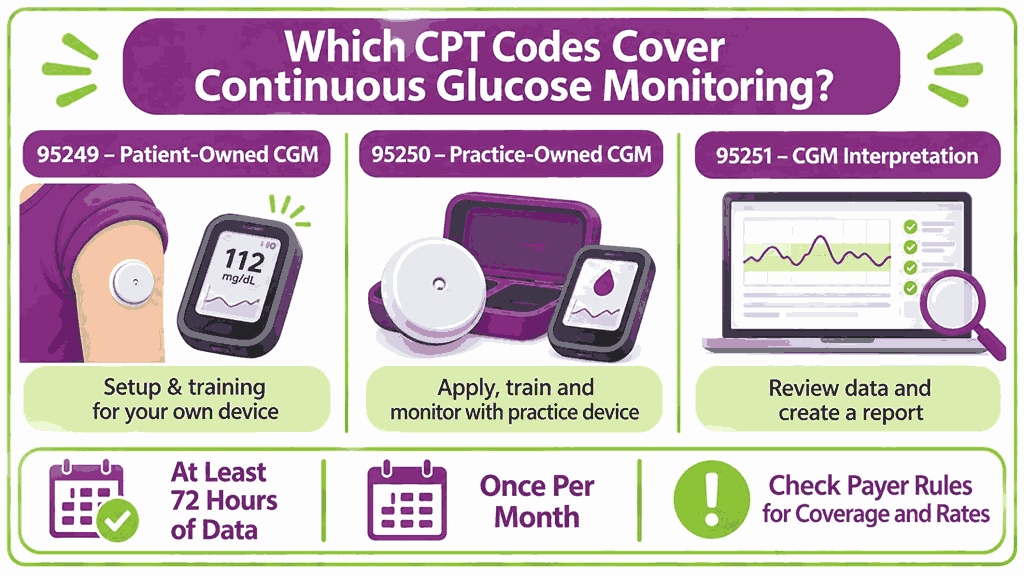
Continuous glucose monitoring (CGM) has changed how endocrinologists manage diabetes, and CPT gives you three codes to report that care. Each code covers a different service, so the right choice depends on who owns the device and who provides the hands-on care.
Here are the three CPT codes that cover CGM.
CPT 95249 for Patient-Owned CGM
Setup and training for a patient’s own CGM fall under CPT 95249. Starting the system, setting it up, training the patient, and providing a printout all qualify. Many sensors are now applied at home, so bill 95249 only when your team actually performs the setup and teaching.
Payers allow it once per month, not each time the patient comes in. Your note should name the device brand, the start date, the training given, and the patient’s ability to use the device. Confirm ownership of the device before billing 95249 or 95250.
CPT 95250 for Practice-Owned CGM
Practice-owned equipment moves the same hands-on work to CPT 95250. Staff place the sensor, calibrate the monitor, train the patient, remove the sensor, and print the recording. Short diagnostic tests on practice-owned systems help when a glucose pattern is unclear, or hypoglycemia needs evaluation.
Qualifying tests run for at least 72 hours. Bill 95250 or 95249 for a monitoring period, never both. Notes should record the device, the dates worn, the reason for testing, and who removed the sensor. Because the practice owns the supplies, track their cost against what payers allow.
CPT 95251 for CGM Interpretation
Interpretation of the glucose data and the written report fall under CPT 95251. Billing requires at least 72 hours of data, and payers allow it once per month. Reviewing patterns such as time in range, highs and lows, and overnight trends turns raw data into treatment decisions.
A missing CGM interpretation note is a common documentation gap, so signed reports belong in the chart every time. Modifier 26 applies when only the professional interpretation is billed. Review time used here cannot count again toward the visit’s time.
Published commercial rates for 95251 vary widely by payer and state, from roughly $45 to just over $100. Sampled New York, California, and Oklahoma rates range from about $45 to about $105. Before billing remote monitoring and CGM codes for the same data, check the payer’s policy.
What Are the Remote Patient Monitoring CPT Codes for Endocrinology?
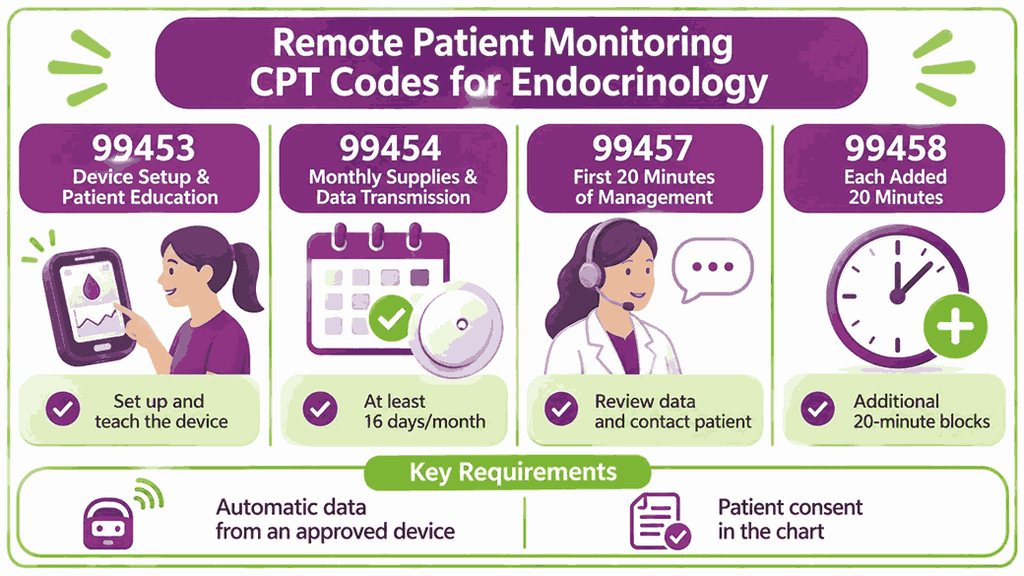
Remote patient monitoring (RPM) keeps an endocrine practice connected to patients at home. Connected devices send blood glucose, blood pressure, or weight readings to the practice, where staff review them and act. Four codes cover the work, and each one has its own rules.
Federal auditors have paid close attention to remote monitoring billing, so clean notes protect your revenue. Here, Endocrinology billing support can review RPM notes before each submission.
Every RPM code shares two requirements. Readings must transmit automatically from an approved device, and patient consent belongs in the chart too; verbal consent is usually acceptable.
CPT 99453 for Device Setup and Patient Education
Connecting the device and teaching the patient to use it fall under 99453. Once monitoring begins, report it once, not monthly. The chart needs the date, the device, and what the patient learned. Beginning a fresh episode on a different device can justify another report if the payer agrees.
CPT 99454 for Monthly Device Supply and Data Transmission
Supply of the device and daily transmission of readings fall under 99454. Sixteen days of readings within every 30 days is the usual minimum. Missing a single day below that threshold stops the claim for that period.
One supply payment applies to every 30 days, even when a patient uses several devices. Records should list the device, the first and last reading dates, and the count of days with readings.
CPT 99457 for the First 20 Minutes of Treatment Management
Management time spent reviewing the data and contacting the patient is reported with 99457 for the first 20 minutes. Calls can happen as often as needed, yet only one claim line goes out for the entire billing cycle. At least one live two-way conversation with the patient or caregiver must take place before you bill.
Data review without patient contact falls short. Log the minutes, the contact dates, what you found, and what you changed. Qualified team members can deliver this time under the payer’s rules, so confirm who qualifies.
CPT 99458 for Each Added 20 Minutes of Management
Further blocks of 20 minutes add units of 99458, up to the payer’s limit. Counting follows the calendar month, the same as with 99457. Standing alone is not an option for 99458, because 99457 must anchor the same claim.
Complete 20-minute blocks earn an extra unit, while partial blocks do not. Track cumulative minutes for the month so the units match the notes. Overlap with chronic care management or another service is not allowed for the same time block.
Which CPT Codes Are Used for Thyroid Nodule Workup?
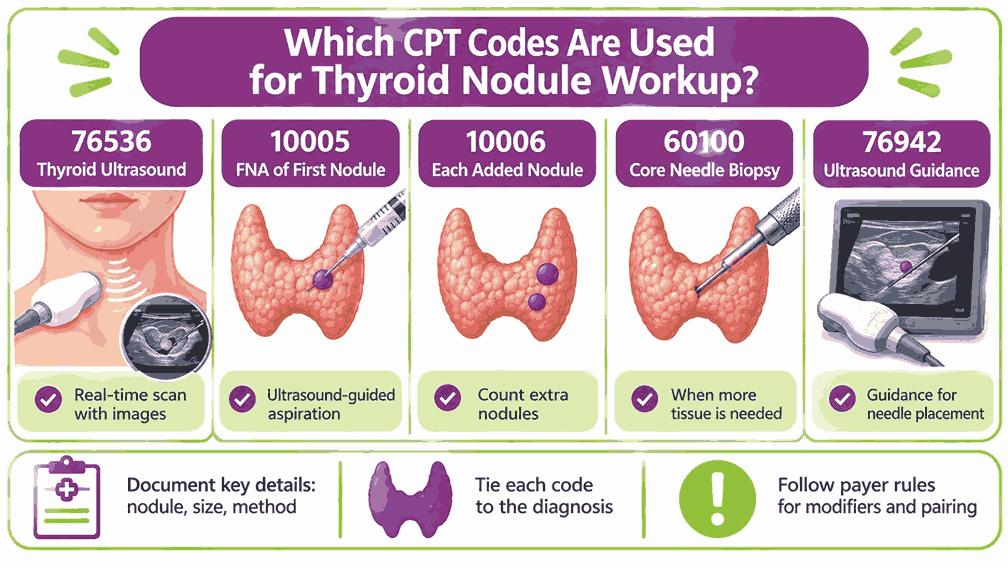
Thyroid nodules bring many patients to an endocrinologist, and the workup follows a clear sequence. Ultrasound examines the nodule, needle aspiration samples it, and a core biopsy steps in when the sample is not enough.
Five codes cover these steps, and each one is explained in turn. Pathologists bill the cytology codes for reading the sample, not the endocrinologist.
CPT 76536 for Thyroid and Neck Ultrasound
Soft tissue ultrasound of the neck, including the thyroid and parathyroid, falls under 76536. Real-time scanning with saved images is what the code requires. Permanent images and a written report must be kept in the record.
Owning the equipment and performing the scan allows billing of both parts. Reporting only the interpretation or only the technical part calls for modifier 26 or TC. Tie each scan to its diagnosis, such as a nodule or goiter, and explain why repeat imaging was needed.
CPT 10005 for Ultrasound-Guided Needle Aspiration
Ultrasound-guided needle aspiration of the first lesion is reported with 10005. Guidance is built into the code, so 76942 should not be added. Separate nodules count as separate lesions, while extra passes into the same nodule count once.
Documentation names the side, the nodule, its size, and the number of passes. Aspiration without imaging belongs to 10021 instead.
CPT 10006 for Each Added Nodule Aspirated
Added nodules sampled under ultrasound are each reported with 10006. Like 10005, this add-on never stands alone. Counts of added lesions set the units, up to what the payer allows. Label every nodule in the report so each added unit has support.
CPT 60100 for Core Needle Biopsy of the Thyroid
Core needle biopsy of the thyroid is reported with 60100. Physicians use it when aspiration results are unclear, or the sample is too small. Imaging guidance is not included, so 76942 is reported separately.
Explain in the note why a core sample was needed and describe the technique. The reading lab bills pathology review of the tissue.
CPT 76942 for Ultrasound Guidance of Needle Placement
Guided needle placement under ultrasound is reported with 76942. Pairing is allowed with 60100 and with injections or localizations, never with aspiration codes that include guidance.
Saved images showing the needle in place must be stored with the study. Modifiers 26 and TC divide the professional and technical parts when two parties split the billing.
Which Lab and Bone Density CPT Codes Do Endocrinologists Bill Most?
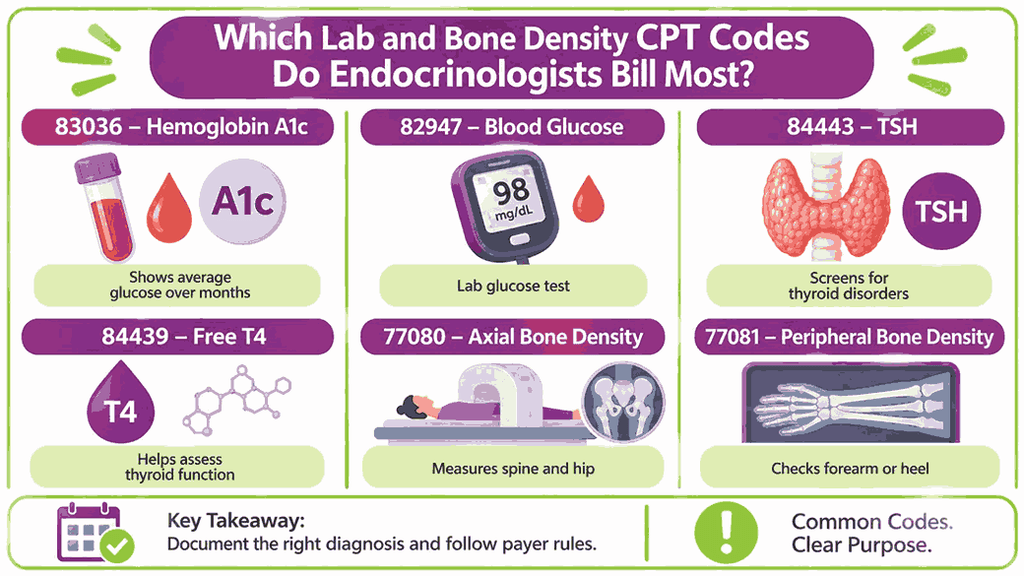
Labs and bone scans round out endocrine care, and a few codes show up often. The lab that runs the test decides who bills it, because reference labs bill for themselves. Six codes below cover the tests and scans endocrinologists order again and again.
CPT 83036 for Hemoglobin A1c
Hemoglobin A1c is reported with 83036. Average glucose over the past few months shows up in this test, which anchors diabetes monitoring. Minimum gaps between tests apply under many payer policies, often about three months, unless the note explains an early repeat.
Point-of-care analyzers with a CLIA waiver usually need modifier QW. Connect the result to the diabetes diagnosis and note any treatment change it prompted.
CPT 82947 for Blood Glucose
Quantitative blood glucose from a lab analyzer is reported with 82947. Glucose from a home-use style meter at the point of care uses code 82962.
Metabolic panels 80048 and 80053 already include glucose, so adding 82947 on top counts as unbundling. Reasons for the test, such as symptoms, monitoring, or a treatment change, belong in the note.
CPT 84443 for TSH
TSH is reported with 84443. Workups for thyroid disease usually start here, and results guide replacement dosing.
Diagnoses such as hypothyroidism, hyperthyroidism, or a nodule support medical necessity. Screening without symptoms is often not covered, so document the clinical reason. Reference labs often run this test and bill for it directly.
CPT 84439 for Free T4
Free thyroxine, often called free T4, is reported with 84439. Abnormal TSH results often prompt it, and it helps when TSH may be misleading, such as in pituitary disease.
Careful selection matters, since 84436 reports total thyroxine and 84481 reports free T3. Some payers cover it only after an abnormal TSH, so check before ordering the pair.
CPT 77080 for Axial Bone Density
DXA of the spine and hip (the axial skeleton) is reported with 77080. Eligible patients include those with primary hyperparathyroidism, long-term steroid use, or checks on osteoporosis drug response. Payment generally allows one scan every 24 months unless the note shows a medical reason for a repeat within that window.
Scanner ownership sets the modifier, with 26 and TC dividing the work when another site owns the machine. Indication, sites scanned, and key findings belong in the report.
CPT 77081 for Peripheral Bone Density
Peripheral DXA, such as the forearm or heel, is reported with 77081. Forearm scanning matters in primary hyperparathyroidism, so 77080 and 77081 can both be justified. Outside those conditions, a second scan type needs a documented rationale. Both scans fall under the same 24-month clock.
What Are the Care Management CPT Codes for Endocrinology?
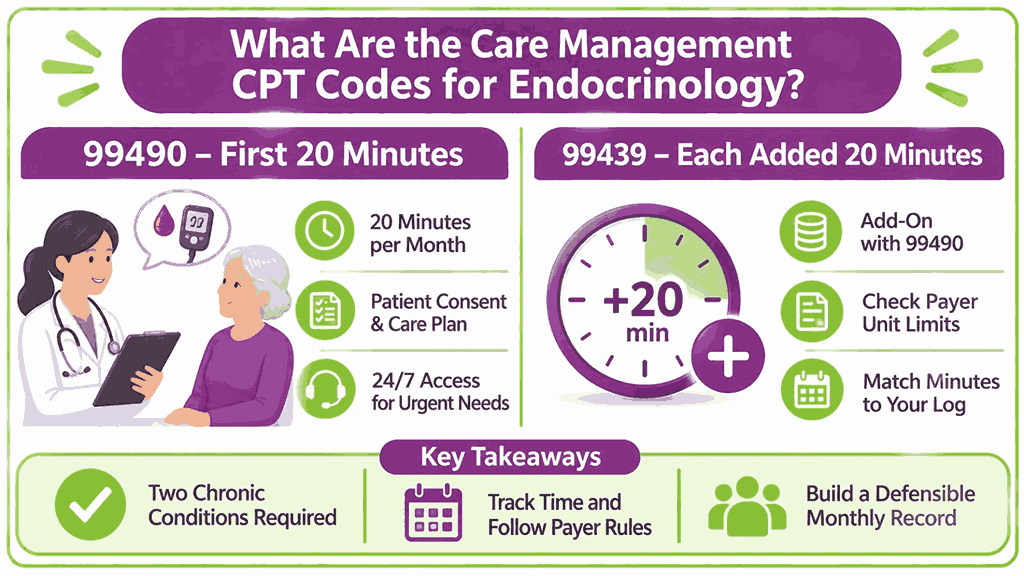
Endocrine patients often live with several long-term conditions, which makes care management between visits a natural fit.
Chronic care management (CCM) uses two codes for this ongoing work, one for the first 20 minutes and one for time beyond that. Qualification requires at least two chronic conditions expected to last a year, such as diabetes with hypertension.
CPT 99490 for the First 20 Minutes of Care Management
Twenty minutes of staff time in a calendar month, directed by the physician, is reported with 99490. Documented patient consent and a comprehensive care plan must be in place before the first bill goes out. Round-the-clock access to a care team member for urgent needs is expected.
Overlapping tasks cannot also support remote monitoring or transitional care on the same dates. Monthly logs of minutes, tasks, and who performed them keep the claim defensible.
Practices that struggle to keep those logs current can lean on endocrinology billing support to track minutes and consent for every enrolled patient.
CPT 99439 for Each Added 20 Minutes of Care Management
Extra 20-minute blocks in the same month are reported with 99439. Think of it as an add-on that rides with 99490 in every case.
Caps on extra units vary by payer, so confirm the ceiling with each contract. Total minutes across both codes should match the log unit-to-unit.
What Are the CPT Code Updates for Endocrinology Billing?
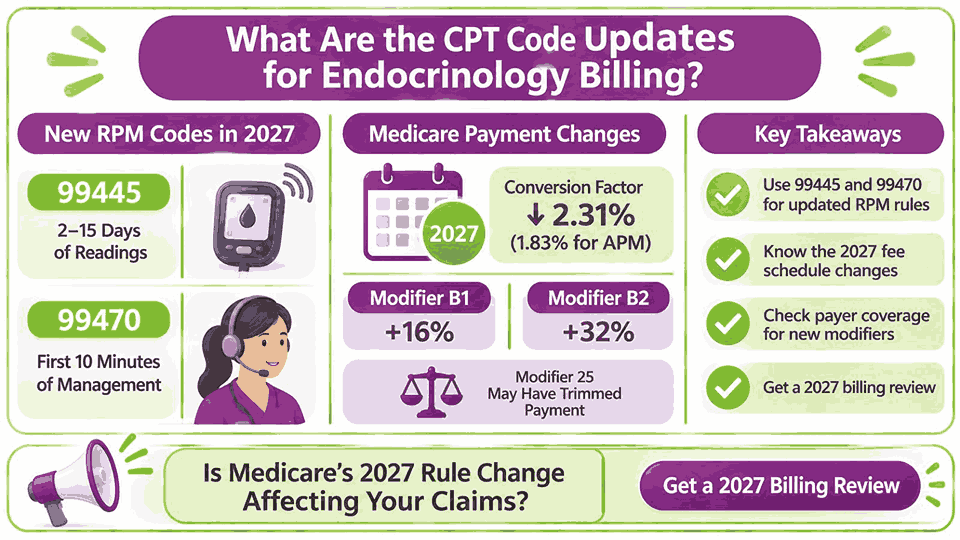
The 2027 CPT code set adds 299 codes, and two remote monitoring additions matter most to endocrine practices. Fee schedule rules for 2027 matter just as much, so both appear in this section.
CPT 99445 for Short Remote Monitoring Device Supply
Device supply for 2 to 15 days of readings within 30 days is reported with 99445. Brief monitoring periods, such as a mid-cycle start, can now be billed even when 16 days are not reached.
Periods allow one supply code only, so pick the code that matches your data days. Other RPM rules still apply, including device, consent, and management time standards.
CPT 99470 for the First 10 Minutes of Remote Monitoring Management
Ten minutes of RPM management in a calendar month are reported with 99470. Contacts that fall below the 20-minute mark now qualify for payment. Interactive communication with the patient or caregiver is still a must.
Logs of minutes and contact dates should mirror your records for standard oversight. Adoption of these newer codes differs by payer, so confirm coverage before starting.
Medicare Payment Changes for 2027
CMS issued the final 2027 fee schedule on November 4, 2026. Conversion factors fall 2.31% for most clinicians and 1.83% for qualifying alternative payment model participants.
Visit complexity is now reported through modifier B1, which replaces the old add-on and raises the E/M payment by 16%. Clinicians in the Medicare Shared Savings Program or the LEAD Model can use B2 for a 32% increase.
Same-day visits billed with modifier 25 face trimmed payment in some cases, though CMS softened its proposal. Monitoring services now need a separately reportable initiating visit before they begin.
In-person or telehealth both work, and the visit need not focus only on monitoring, though monitoring must come up. No time limit separates that visit from the first reading.
Contracting with outside monitoring vendors stays allowed through December 31, 2028 if incident-to rules are met.
Telehealth flexibilities continue through December 31, 2027. Each of these changes ripples through endocrinology billing, from visit coding to monitoring claims, so practices should update their workflows before the new year begins.
Quick Overview of Common Endocrinology Modifiers
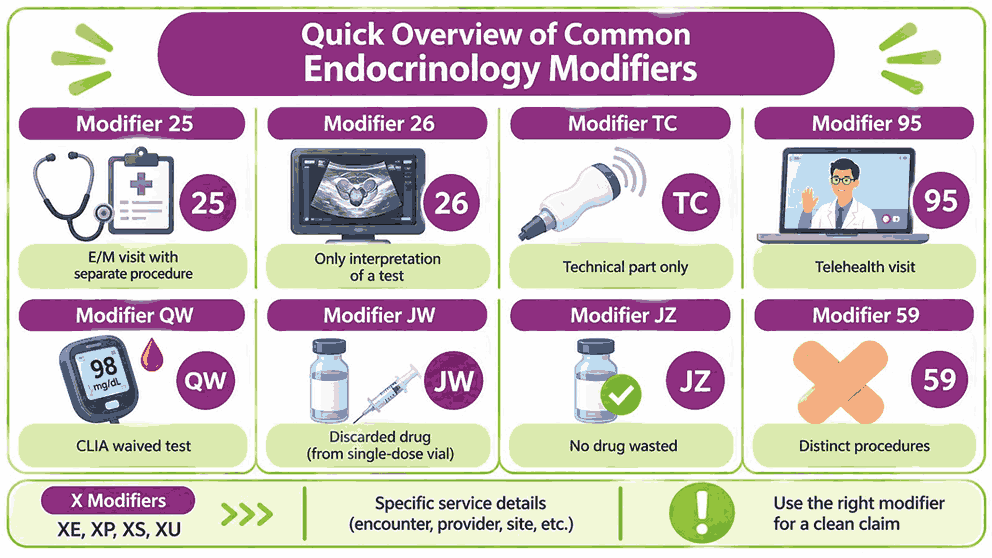
Small tags called modifiers attach to a CPT code and add detail about how the service was performed, without changing the code itself. Choosing correctly keeps a clean claim from turning into a denial.
Modifier 25
Add 25 to an E/M visit when it is significant and separately identifiable from a procedure or service done the same day.
Fine needle aspirations and injections are common examples in endocrine clinics. Evidence of work beyond the usual pre-procedure care must appear in the documentation. Trimmed payment applies to some same-day combinations in 2027, so track the effect.
Modifier 26
Use 26 when you provide only the interpretation of a diagnostic test. CGM reports, thyroid ultrasounds, and DXA scans all qualify when another site supplies the equipment. The modifier represents your signed and dated read.
Modifier TC
TC reports only the technical part, meaning the equipment, supplies, and staff effort. Owners of a scanner who do not interpret the images usually append it to the claim line. Global billing, with neither modifier, applies when one party does everything.
Modifier 95
Live visits held by audio and video carry 95 for payers that ask for this tag. Medication adjustments and lab reviews often suit this format. Place of service coding and the modifier should match each payer’s instructions.
Modifier QW
QW marks a test as CLIA waived, such as a point-of-care A1c or glucose. Certificates of waiver must be on file for the modifier to apply. Tests run by a reference lab do not carry it, since the lab files claims independently.
Modifier JW
JW reports the amount of drug thrown away from a single-dose vial. Whenever part of a vial is discarded, Medicare expects it with the injection. Drug billing codes are outside this cheat sheet, but the modifier still matters when you inject.
Modifier JZ
JZ confirms that none of the drug in a single-dose container was discarded. Medicare claims require zero waste for single-dose containers. The outcome of the vial decides which of the two fits.
Modifier 59
Bundled procedures that are truly distinct carry 59. Different sites, sessions, or reasons support its use. Overuse draws attention from payers, so keep the story straight.
X Modifiers (XE, XP, XS, and XU)
XE, XP, XS, and XU are precise stand-ins for the broad modifier. Encounters, practitioners, structures, and unusual non-overlapping services map to XE, XP, XS, and XU in that order. Preference varies by payer, so read each payer’s manual.
Common Endocrinology Coding Errors (with Solutions)
Denials in endocrinology usually trace back to a small set of repeat mistakes. Fixes sit beside every mistake in the table below, ready to apply right away. Steady endocrine billing depends on fixing these repeats for good.
| Coding Error | Why It Happens | How to Fix It |
|---|---|---|
| Diabetes billed without complication linkage | The diagnosis is coded without the documented complication | Link each documented complication to the visit |
| Wrong CGM code | 95249, 95250, and 95251 get confused | Match the code to device ownership and the work done |
| Missing CGM interpretation note | Data is reviewed but not written up | Sign a dated report whenever 95251 is billed |
| Billing 95251 more than once a month | The frequency limit is overlooked | Track the last billed date for each patient |
| Adding 76942 to 10005 | Guidance is already built into the aspiration code | Report the aspiration code alone |
| Billing glucose on top of a panel | 82947 is added to 80048 or 80053 | Let the panel stand alone |
| Missing modifier 25 | A same-day procedure and visit are billed without it | Add 25 only when the note shows separate work |
| RPM billed too early | Reading days or minutes are not counted first | Confirm 16 days and 20 minutes before billing |
| Skipping the RPM initiating visit | Monitoring starts without a qualifying visit | Hold a documented visit that covers monitoring first |
| Wrong E/M level | The level does not match MDM or time | Choose the code from documented MDM or total time |