The Centers for Medicare & Medicaid Services released the Calendar Year 2027 Ambulatory Surgical Center Payment Rule on July 2, 2026. CMS finalized it on November 4, 2026 as CMS-1850-F. The rule sets Medicare payment policy for roughly 6,400 ambulatory surgical centers starting January 1, 2027.
CMS finalized a 2.3% payment increase for ASCs that meet quality reporting rules. It also added 619 procedures to the ASC Covered Procedures List. Quality measure changes and an interim payment path for software-based services appear in the same rule.
This guide covers the payment update, the procedure list changes, and the quality reporting revisions. It also covers the smaller provisions that affect ASC operations. CMS issued the final rule on November 4, 2026, and published it in the Federal Register on November 6, 2026. Final policies take effect January 1, 2027.
What Is the CMS 2027 ASC Payment Rule?
CMS-1850-F is the Calendar Year 2027 Hospital Outpatient Prospective Payment System and Ambulatory Surgical Center Payment Rule. CMS proposed it on July 2, 2026 and finalized it on November 4, 2026. The final rule appeared in the Federal Register on November 6, 2026. The rule updates Medicare payment rates for hospital outpatient departments and ambulatory surgical centers together.
The rule affects close to 3,500 hospitals and about 6,400 ambulatory surgical centers. Both facility types share the same annual rulemaking cycle. CMS finalizes ASC-specific provisions inside the same document each year.
Key Dates for the 2027 ASC Rule
| Date | Event |
|---|---|
| July 2, 2026 | CMS releases the proposed rule (CMS-1850-P) |
| July 7, 2026 | CMS publishes the rule in the Federal Register |
| August 31, 2026 | Public comment period closes |
| November 4, 2026 | CMS issues the final rule (CMS-1850-F) |
| November 6, 2026 | CMS publishes the final rule in the Federal Register |
| January 1, 2027 | Final policies take effect |
This guide reflects the final rule. Where CMS changed a provision between the proposal and the final rule, the section says so.
Why OPPS and ASC Payment Move Together
CMS pays hospital outpatient departments through the Hospital Outpatient Prospective Payment System, known as OPPS. It pays ambulatory surgical centers through a separate but related system. Both systems use the same annual proposed rule and comment cycle.
The two systems share several structural elements:
- The same procedure code sets across CPT and HCPCS
- The same quality reporting infrastructure and comment cycle
- Payment groups that carry relative weights tied to the OPPS ambulatory payment classification
A procedure removed from the Inpatient Only List typically becomes payable under both OPPS and the ASC Covered Procedures List. This linkage means an ASC payment change often traces back to an OPPS policy decision made in the same rule.
How Much Will ASC Payment Rates Increase in 2027?
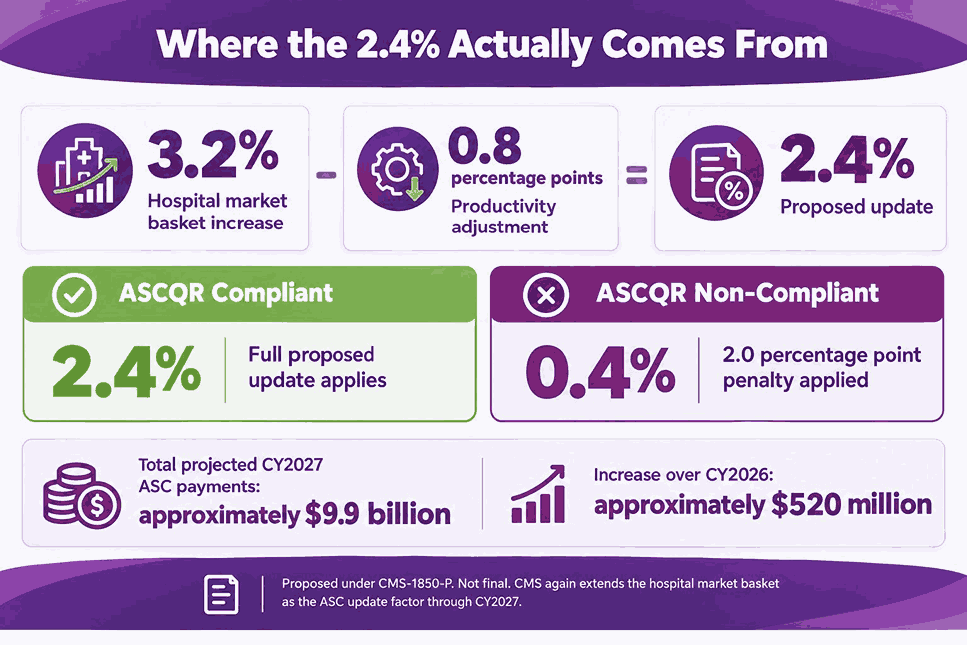
CMS finalized a 2.3% payment increase for ASCs that meet quality reporting requirements. This figure comes from a 3.2% hospital market basket increase. CMS then subtracts a 0.9 percentage point productivity adjustment. The proposal was 2.4%, built on a 0.8 point adjustment.
ASCs that fail to meet Ambulatory Surgical Center Quality Reporting Program rules face a 2 percentage point penalty. Their net update falls to roughly 0.3%. This penalty applies every year a facility misses required data submission.
What Drives the 2.3% Update
- Hospital market basket increase: 3.2%, reflecting projected growth in input costs like labor and supplies
- Productivity adjustment: minus 0.9 percentage points, a statutory requirement tied to economy-wide productivity trends
- ASCQR compliance: the full 2.3% update applies only to facilities that report required quality data
- Non-compliance penalty: a 2 percentage point reduction, dropping the net update to roughly 0.3%
CMS is extending the hospital market basket as the ASC update factor through CY2027. ASC-specific market basket data has not been available, so CMS continues borrowing from the hospital index for one more year. This extension has repeated for several consecutive rulemaking cycles now.
CMS also proposes extending the hospital market basket as the ASC update factor through CY2027. ASC-specific market basket data has not been available, so CMS continues borrowing from the hospital index for one more year. This extension has repeated for several consecutive rulemaking cycles now.
Bottom line: most compliant ASCs will see a net 2.3% rate increase, not the full market basket figure, once quality reporting status is factored in.
How ASC Rates Compare to Hospital Outpatient Rates
Medicare typically pays ASCs less than hospital outpatient departments for the same procedure. CMS applies a different conversion factor and a different set of relative weights to the ASC payment system. The gap reflects lower assumed overhead in a freestanding surgical center.
Geographic wage adjustments also differ between the two systems. A hospital outpatient department in a high-wage area sees a larger location adjustment than an ASC in the same market. Facilities operating both site types should model each payment separately rather than assuming a fixed ratio.
| Factor | Hospital Outpatient (OPPS) | Ambulatory Surgical Center |
|---|---|---|
| Base rate structure | Higher assumed overhead | Lower assumed overhead |
| Wage index adjustment | Full hospital wage index | Separate, smaller adjustment |
| Update factor for 2027 | 2.3% (proposed) | 2.3% (proposed) |
| Quality penalty for non-reporting | 2.0 percentage points | 2.0 percentage points |
Which Procedures Are Moving to the ASC Setting in 2027?
This is the section with the biggest operational impact for ASC case mix and revenue planning. CMS pairs two related actions in the same rule. It removes procedures from the Inpatient Only List, and it adds procedures to the ASC Covered Procedures List.
The Inpatient-Only List Phase-Out
The Inpatient Only List identifies procedures Medicare covers only in the hospital inpatient setting. CMS created the list in 2000 to protect patients needing extended recovery or intensive monitoring. Around 1,438 procedures remained on the list heading into CY2027.
CMS built the list around three original criteria:
- Invasiveness of the procedure itself
- The patient’s expected condition immediately after surgery
- Safety concerns tied to the need for extended recovery or monitoring
Those criteria have not changed, but CMS now argues fewer procedures still meet them. CMS finalized the removal of 637 procedures from the Inpatient Only List for CY2027. These removals span 11 clinical families, including auditory, digestive, endocrine, respiratory, and urinary procedures. The remaining 801 procedures move off the list in CY2028.
| Phase | Year | Procedures Removed | Status |
|---|---|---|---|
| Year 1 | CY2026 | First group removed | Completed |
| Year 2 | CY2027 (final) | 637 procedures | Finalized November 4, 2026 |
| Year 3 | CY2028 | Remaining 801 procedures | Planned |
| Full phase-out | January 1, 2029 | Inpatient Only List eliminated | Target completion |
CMS says advances in surgical technique and recovery protocols reduced the need for mandatory inpatient stays for many procedures. The agency believes clinical judgment, not a fixed list, should decide the setting for most surgical cases now.
New Additions to the ASC Covered Procedures List
CMS finalized adding 619 codes to the ASC Covered Procedures List for CY2027: the 618 it proposed, plus CPT 64629 (basivertebral nerve ablation, each additional vertebral body), which commenters recommended. Most of these codes correspond to procedures leaving the Inpatient Only List. This marks the largest single-year addition since the phase-out began.
The added procedures represent a step up in clinical complexity compared to CY2026 additions. Notable examples include laparoscopic colectomy, partial nephrectomy, and sleeve lobectomy. Prostatectomy procedures are also among the additions.
| Procedure | Specialty | Clinical Note |
|---|---|---|
| Laparoscopic colectomy | General surgery / colorectal | Removes part of the colon through small incisions |
| Partial nephrectomy | Urology | Removes part of a diseased or damaged kidney |
| Sleeve lobectomy | Thoracic surgery | Removes a lung lobe with a bronchial sleeve resection |
| Prostatectomy | Urology | Removes all or part of the prostate gland |
These procedures carry longer operative times and more complex anesthesia needs than typical ASC cases. A center adding sleeve lobectomy to its schedule needs different equipment and staffing than a center running routine colonoscopies.
What This Means for ASC Case Mix and Revenue
ASCs that add these procedures to their case mix need updated CPT and HCPCS coding workflows. Higher-acuity cases also raise anesthesia, staffing, and post-operative monitoring requirements. Revenue cycle teams should model reimbursement before scheduling new procedure types.
Physician-owned centers stand to gain the most from this expansion. Facility fees that once flowed only to hospitals become accessible once a procedure lands on the ASC Covered Procedures List. This shifts where major surgical revenue can land inside a health system or physician group.
Margin check: a center adding two or three sleeve lobectomy cases per month takes on a higher facility fee per case. It also takes on higher staffing, equipment, and recovery-time cost. Model both sides before scheduling the first case.
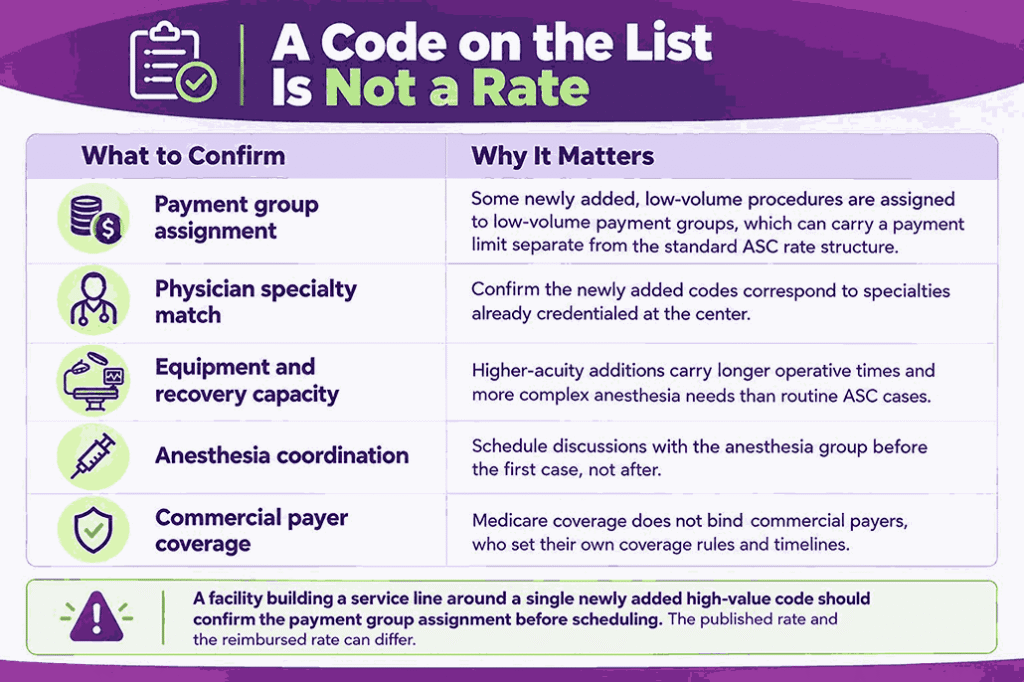
- Confirm which newly added codes match existing physician specialties on staff
- Check equipment and recovery-room capacity against the acuity of new procedures
- Model payer contracts separately from Medicare, since commercial payers set their own coverage rules
- Coordinate with anesthesia groups before scheduling higher-complexity cases
Getting this reimbursement math right before the first case is scheduled is standard due diligence for ASC billing services working through a specialty-mix shift like this.
What’s Changing in ASC Quality Reporting for 2027?
The Ambulatory Surgical Center Quality Reporting Program, known as ASCQR, links payment to quality data submission. ASCs that skip required reporting lose 2 percentage points from their annual update. CMS finalized one measure change for CY2027.
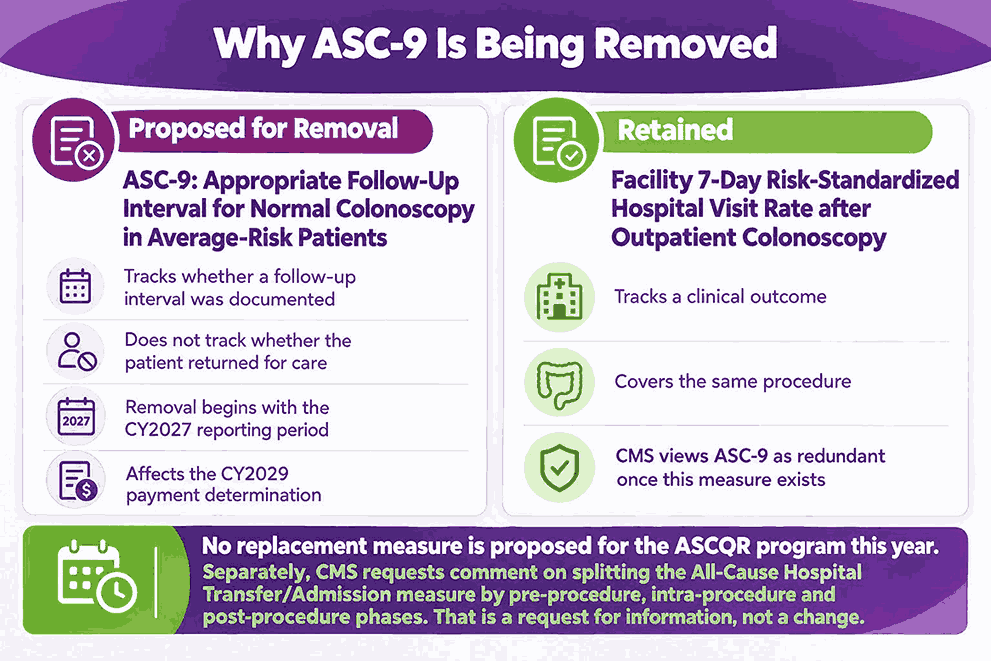
CMS finalized removing the Appropriate Follow-Up Interval for Normal Colonoscopy in Average-Risk Patients measure, known as ASC-9. The removal begins with the CY2027 reporting period. It affects the CY2029 payment determination.
Why CMS Wants to Remove ASC-9
- ASC-9 tracks whether a follow-up interval was documented, not whether the patient actually returned for care
- A separate measure, the Facility 7-Day Risk-Standardized Hospital Visit Rate after Outpatient Colonoscopy, already tracks a real clinical outcome
- CMS views ASC-9 as redundant once an outcome-based measure covers the same procedure
- CMS finalized no other ASCQR changes and added no replacement measure
CMS also requests comment on the All-Cause Hospital Transfer/Admission measure. The agency wants to split this measure by pre-procedure, intra-procedure, and post-procedure phases. This request for information does not change the measure yet.
A phase-based version would show which stage of care carries the most transfer risk. ASCs handling higher-acuity cases from the new Covered Procedures List additions may see this measure evolve first.
Watch this measure. ASCs are taking on more complex cases from the expanded procedures list. CMS is likely to tighten how transfer risk gets tracked in future rulemaking cycles.
How the ASCQR Penalty Actually Works
The ASCQR Program operates on a pay-for-reporting basis, not pay-for-performance. Facilities do not need to hit specific quality scores. They only need to submit the required data on time each reporting period.
Missing a submission deadline triggers the full 2 percentage point penalty regardless of the facility’s actual quality performance. This makes reporting compliance a pure administrative task with a large financial consequence attached.
What Facilities Still Need to Report
- Facility-level data on the remaining outpatient colonoscopy outcome measure
- Any hospital transfer or admission events tied to ASC procedures
- Standard administrative measures CMS carries forward from prior years
- Any measure-specific attestations CMS requires during the reporting window
None of these requirements change for CY2027 beyond the ASC-9 removal. Facilities already meeting current ASCQR deadlines should not see new administrative work from this rule.
Other Provisions ASCs Should Track
CMS-1850-P includes several provisions outside the core payment and quality sections. Most target hospitals directly, but a few carry indirect effects for ASCs. Hospital-affiliated and off-campus ASCs should read these sections closely.
The 340B Drug Payment Cut
CMS finalized cutting payment for 340B-acquired drugs from average sales price plus 6% to average sales price minus 28%, based on a drug acquisition cost survey CMS ran from January 1 to April 7, 2026. The proposal was ASP minus 33.4%. This change mainly affects hospitals enrolled in the 340B Drug Pricing Program. CMS also finalized accelerating recovery of prior 340B remedy payments.
CMS finalized raising the OPPS conversion factor reduction tied to the 340B remedy offset from 0.5% to 2%, not the 3% it proposed. It starts in CY2027, excludes hospitals that enrolled in Medicare after January 1, 2018, and continues until recovery reaches $7.8 billion, which CMS estimates will occur in CY2031. Facilities working through remaining remedy repayments would see those repayments recouped faster.
| Provision | What It Does | Who It Affects Most |
|---|---|---|
| 340B drug payment cut | Lowers payment for 340B-acquired drugs to ASP minus 28% | Hospitals in the 340B Drug Pricing Program |
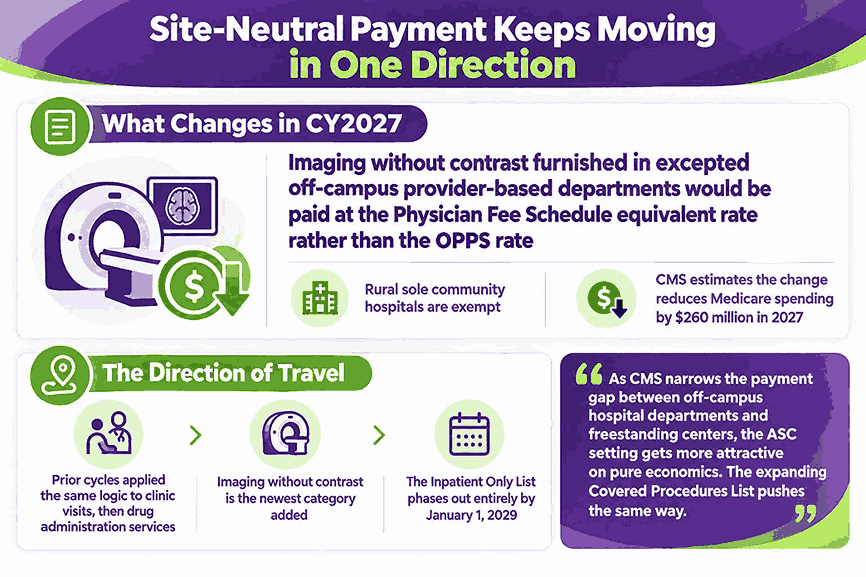
| Site-neutral payment expansion | Pays imaging without contrast at the Physician Fee Schedule rate at off-campus departments. Rural sole community hospitals are exempt | Off-campus hospital outpatient departments |
| Software as a Medical Service framework | Assigns software-based services to New Technology APCs as an interim step | Hospitals and ASCs using AI-driven software |
| Prior authorization expansion | Adds eight botulinum toxin injection codes to the hospital outpatient prior authorization list | Hospital outpatient departments |
CMS renamed Software as a Service (SaaS) to Software as a Medical Service (SaMS) and finalized an interim policy assigning these services to New Technology APCs. CMS describes it as an interim step toward a broader payment policy.
Rural sole community hospitals get exemptions from some of these changes. CMS carved out these exemptions to limit financial disruption in low-volume markets.
Requests for Information (Not Yet Proposals)
- Standardizing hospital price transparency data across facilities and reporting formats
- Expanding domestic procurement requirements for personal protective equipment and essential medicines
CMS also finalized allowing hospital accrediting organizations with deeming authority to assess compliance with EMTALA’s administrative requirements (42 CFR 489.20) during routine surveys.
Requests for information do not carry the force of a proposal. CMS uses them to gather industry feedback before writing a future rule. ASCs affiliated with hospitals may want to submit comments on these topics during future comment windows.
Why Site-Neutral Payment Keeps Expanding
CMS has expanded site-neutral payment policy for several consecutive rulemaking cycles. The goal is paying the same rate for the same service, regardless of where a hospital system performs it. Imaging without contrast is the newest service category added to this policy.
This trend matters for ASC strategy beyond the imaging provision itself. As CMS narrows the payment gap between off-campus hospital departments and freestanding centers, the ASC setting becomes more attractive on pure economics. Growth in the ASC Covered Procedures List reinforces the same direction.
How the Rule Affects Different ASC Specialties
The finalized changes do not land evenly across specialties. Some specialties gain new procedure access. Others face quality measure changes or payment pressure from unrelated 340B provisions if hospital-affiliated.
| Specialty | Main Impact from CY2027 Rule | Action Item |
|---|---|---|
| Orthopedics | Continued Inpatient Only List removals expand joint and spine case access | Confirm surgeon credentialing for newly eligible procedures |
| Gastroenterology | ASC-9 removal simplifies colonoscopy quality reporting | Update reporting workflows. The final rule removes ASC-9 beginning with the CY2027 reporting period. |
| Urology | New ASC-CPL additions include partial nephrectomy and prostatectomy | Model reimbursement and staffing for higher-acuity urologic cases |
| General surgery / colorectal | Laparoscopic colectomy moves onto the ASC-CPL | Assess anesthesia and recovery-room capacity before scheduling |
| Thoracic surgery | Sleeve lobectomy becomes ASC-payable | Evaluate equipment needs against current center capabilities |
Pain management and ophthalmology see fewer direct changes in this specific rule. Their ASCQR measures and payment update follow the same 2.3% path as every other specialty. Facilities in these specialties should still confirm reporting status ahead of the deadline.
What Should ASCs Do Now?
The rule is final and takes effect January 1, 2027. Facilities should act on these provisions now.
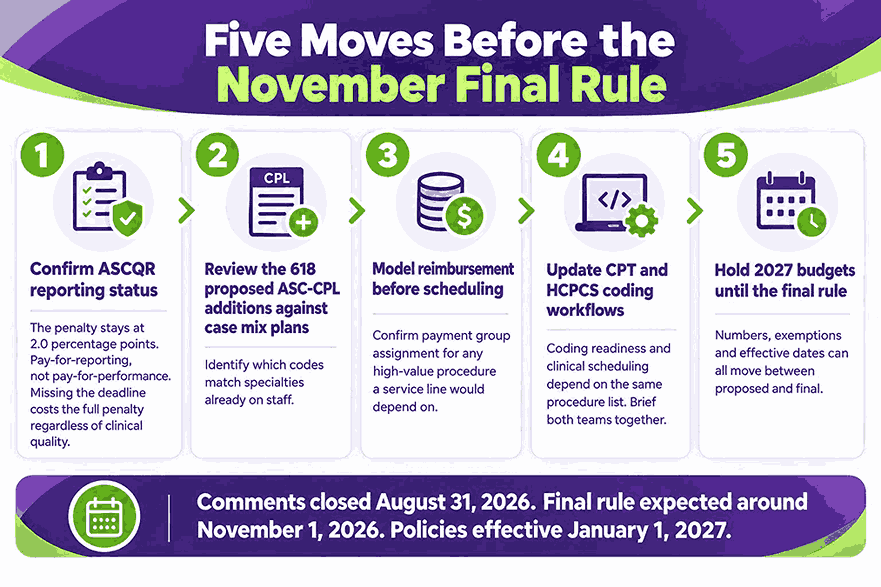
- Confirm ASCQR reporting status now, since the penalty stays at 2 percentage points
- Review the 619 ASC Covered Procedures List additions against current case mix plans
- Model reimbursement for laparoscopic colectomy, partial nephrectomy, sleeve lobectomy, and prostatectomy if these procedures fit the facility’s specialty mix
- Update coding workflows for new CPT and HCPCS codes tied to the added procedures
- Build 2027 budgets from the final Addendum AA rates, not the market basket update alone
Facilities that skip these steps risk two problems. They may miss the ASCQR reporting deadline and lose 2 percentage points of payment. They may also under-prepare for the higher-acuity cases moving into the ASC setting.
Revenue cycle teams and clinical leadership should review this list together. Coding readiness and clinical scheduling depend on the same set of procedure additions, so both teams need the same information at the same time. Facilities managing several of these transitions at once often loop in ASC billing companies early, since ASCQR penalty exposure and new-code reimbursement modeling both land in the same reporting window.
Frequently Asked Questions
Is the CMS 2027 ASC payment rule final?
Yes. CMS released the proposed rule on July 2, 2026 and issued the final rule on November 4, 2026. The Federal Register published it on November 6, 2026, and final policies take effect January 1, 2027.
What is CMS-1850-F?
CMS-1850-F is the official designation of the final Calendar Year 2027 Hospital Outpatient Prospective Payment System and Ambulatory Surgical Center Payment Rule. It sets Medicare payment policy for hospitals and ASCs together. CMS proposed it as CMS-1850-P.
How many procedures are moving from the Inpatient Only List to ASCs in 2027?
CMS finalized removing 637 procedures from the Inpatient Only List for CY2027. It added 619 codes to the ASC Covered Procedures List in the same rule. Most of these codes correspond directly to the removed inpatient-only procedures.
Is ASC-9 being removed from quality reporting?
Yes. CMS finalized removing the Appropriate Follow-Up Interval for Normal Colonoscopy measure beginning with the CY2027 reporting period. The change affects the CY2029 payment determination. CMS added no replacement measure.
How much will overall ASC payments rates increase in 2027?
CMS finalized a 2.3% ASC payment update for facilities that meet quality reporting requirements. Actual facility-level results depend on specialty mix, procedure weights, and reporting status.
What happens if an ASC does not submit required quality data?
The facility loses 2 percentage points from its annual payment update. Its net update falls to roughly 0.3% instead of the full 2.3%. This penalty applies regardless of the facility’s actual clinical quality performance.
When does the Inpatient Only List phase-out finish?
CMS plans to remove the remaining 801 procedures in CY2028. Full elimination of the Inpatient Only List is scheduled for January 1, 2029. CY2027 represents the second year of the three-year phase-out.
What is the ASC Covered Procedures List?
It is the official list of procedures Medicare will pay for when performed in an ambulatory surgical center. CMS adds and removes codes from this list every year. The CY2027 final rule adds 619 codes, largely tied to the Inpatient Only List phase-out.
Does this rule change commercial payer reimbursement too?
Not directly. CMS-1850-F only sets Medicare payment policy. Commercial payers often reference CMS coverage and coding decisions when updating their own policies, but each payer sets its own timeline and rates.