Current Dental Terminology (CDT) codes are a standardized set of alphanumeric codes used across dental billing and insurance claims. Each CDT code begins with the letter “D” and consists of five characters that identify a specific dental procedure. Dental providers, insurance companies, and electronic health record (EHR) systems all rely on CDT codes to document, report, and process dental care accurately.
The American Dental Association (ADA) develops and maintains the CDT code set and updates it annually to reflect new procedures, technology, and clinical standards. CDT codes fall under HIPAA as the official standard code set for dental claims. The main categories covered include diagnostic, preventive, restorative, endodontic, periodontic, prosthodontic, oral surgery, orthodontic, and adjunctive services.
This article covers what CDT codes are, who maintains them, the major types, the 2026 code updates, and how CDT codes are applied in dental billing services and insurance claims.
What are CDT Codes?
CDT codes, short for Current Dental Terminology codes, are a standardized dental coding system published by the American Dental Association. Each code in this system consists of five characters starting with the letter “D,” followed by four digits that indicate the procedure category and specific treatment performed. For example, D0120 represents a periodic oral evaluation, while D1110 represents an adult prophylaxis dental cleaning.
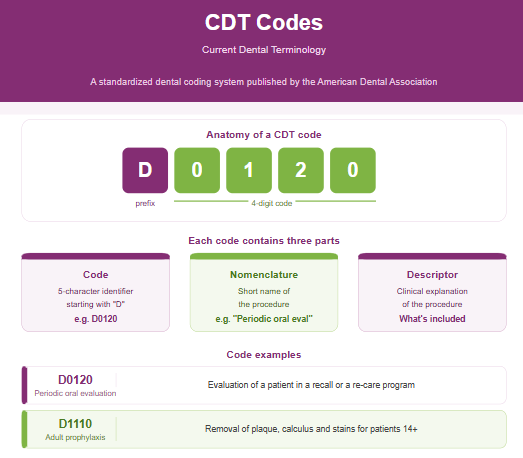
In medical coding, CDT codes go beyond simple billing labels. Each code comes with a nomenclature (the short name of the procedure) and a descriptor (a clinical explanation of what the procedure includes). This structured format allows dentists, dental billers, insurance companies, and EHR systems to communicate about clinical services in a consistent and legally recognized way.
Under HIPAA, CDT codes are the legally required standard code set for dental procedure reporting on insurance claims. Using a CDT code lookup or the ADA CDT code book allows dental offices to find accurate codes for every procedure they perform.
Who Maintains CDT Codes?
The American Dental Association (ADA) is the official governing body responsible for developing, maintaining, and overseeing CDT codes used in dental billing and procedure reporting across the United States. The ADA established the CDT code set to create a standardized language for dental claim submission and clinical documentation.
The ADA makes sure that CDT codes provide uniform reporting for dental procedures, helping standardize communication between dental providers and insurance payers. This uniformity reduces claim errors, supports accurate reimbursement, and maintains consistent patient records across all practice settings.
| ADA Role | Description |
|---|---|
| Code Development | Creates new codes to reflect emerging dental procedures and technologies |
| Annual Review | Reviews the full CDT code set each year and publishes updates effective January 1 |
| Revision & Clarification | Modifies existing code descriptions to improve billing accuracy and clinical clarity |
| Retirement of Codes | Removes codes that are no longer applicable to the current dental practice |
| HIPAA Compliance Oversight | Maintains CDT as the HIPAA-designated standard code set for all dental claims |
CDT codes are reviewed and updated annually to incorporate advances in dental practices, new procedures, and evolving clinical standards. Because CDT codes are recognized under HIPAA as the standard code set for dental procedures, all dental practices and insurance payers must adopt the latest code set on schedule to maintain federal compliance.
What are the Types of CDT Codes?
CDT codes are organized into distinct categories, each covering a specific area of dental care. These categories help dental offices, payers, and EHR systems classify and process procedures consistently. The categories range from basic diagnostic visits and preventive cleanings to complex surgical interventions and orthodontic treatments.
| Type | Code Format | Example Code | Procedure |
|---|---|---|---|
| Diagnostic Procedures | D0100–D0999 | D0120 | Periodic oral evaluation |
| Preventive Services | D1000-D1999 | D1110 | Adult prophylaxis dental cleaning |
| Restorative Treatments | D2000-D2999 | D2740 | Crown, porcelain/ceramic |
| Endodontic Procedures | D3000-D3999 | D3221 | Pulpal debridement |
| Periodontic Services | D4000-D4999 | D4341 | Scaling and root planing |
| Prosthodontics, Removable | D5000-D5999 | D5110 | Complete denture, maxillary |
| Prosthodontics, Fixed | D6000-D6999 | D6010 | Implant placement |
| Oral And Maxillofacial Surgery | D7000-D7999 | D7210 | Surgical extraction |
| Orthodontics | D8000-D8999 | D8080 | Comprehensive ortho, adolescent |
| Adjunctive General Services | D9000-D9999 | D9230 | Nitrous oxide sedation |
Diagnostic Codes
Diagnostic CDT codes are used for documenting dental examinations and assessments. They provide a standardized way to record the patient’s oral health status at the time of a visit. These codes are assigned to the initial stage of patient care and form the basis for developing appropriate treatment plans.
Such CDT codes cover oral evaluations, dental X-rays, diagnostic imaging, and other assessments performed to identify dental conditions. Diagnostic coding helps dentists detect oral diseases, cavities, gum conditions, and structural problems, supporting sound clinical decision-making. Common diagnostic codes include:
- D0120: Periodic oral evaluation for an established patient
- D0150: Comprehensive oral dental evaluation for a new or established patient
- D0210: Complete intraoral radiographic images (FMX)
- D0274: Bitewing four radiographic images
- D0330: Panoramic radiographic image (pano)
Preventive Codes
Preventive CDT codes cover services aimed at maintaining oral health and preventing the onset of dental diseases, supporting long-term patient well-being. These codes document services performed to monitor and maintain the patient’s oral health before problems progress.
Preventive codes include dental cleanings, fluoride treatments, sealants, and routine checkups. Preventive dentistry reduces long-term oral health issues and healthcare costs by encouraging routine care and early detection. The CDT codes for preventive procedures include:
- D1110: Prophylaxis, adult (dental cleaning)
- D1120: Prophylaxis, child
- D1206: Topical fluoride varnish application
- D1354: Caries arresting medicament (silver diamine fluoride, SDF)
- D1330: Oral hygiene instructions
Restorative Codes
Restorative CDT codes cover treatments aimed at repairing damaged or decayed teeth, helping maintain oral health and prevent further complications. Proper restorative care enables patients to chew, speak, and maintain oral function normally, supporting their overall quality of life.
These codes include dental fillings, crowns, and other tooth restoration procedures designed to restore tooth structure and function. Restorative treatments strengthen teeth and improve appearance after damage or decay.
The CDT code D2740 covers porcelain/ceramic crowns, while D2391 and D2392 cover resin-based composite fillings. On the other hand, the CDT code D2950 addresses core build-up procedures that support crown placement.
Endodontic Codes
Endodontic CDT codes cover treatments involving the dental pulp and root canal systems, essential for addressing internal tooth health issues. Endodontic care aims to preserve the natural tooth by treating infection or inflammation within the pulp, preventing tooth loss.
These codes include root canal therapy (root canal DCT code), pulp capping, and other procedures designed to treat infected or damaged pulp tissue. Endodontic procedures eliminate infection and alleviate severe tooth pain, improving patient comfort and oral health outcomes.
The CDT code for pulpotomy (D3220) and pulpectomy are common pediatric endodontic procedures, while D3310-D3330 cover root canal treatment by tooth type.
Periodontic Codes
Periodontic CDT codes cover procedures addressing conditions affecting the gums and supporting bone structures, essential for long-term oral health. These treatments aim to prevent or control gingivitis and periodontitis, reducing the risk of tooth loss and systemic complications.
These codes include scaling and root planing (SRP cdt code), periodontal maintenance, and gum surgeries to manage and treat gum disease. Research links periodontal disease to systemic conditions, including heart disease and diabetes. Some common examples of the periodontic CDT codes are added in the following table:
| Code | Procedure | Clinical Context |
|---|---|---|
| D4341 | Scaling and root planing, 1-3 teeth per quadrant | Active periodontal disease treatment |
| D4346 | Scaling for generalized moderate or severe gingival inflammation | Gingivitis with heavy plaque/calculus |
| D4355 | Full mouth debridement | Prerequisite for comprehensive evaluation |
| D4910 | Periodontal maintenance | After active therapy, every 3-4 months |
| D4210 or D4211 | Gingivectomy/Gingivoplasty | Surgical gum reshaping |
Prosthodontic Codes
Prosthodontic CDT codes cover treatments for replacing missing teeth using artificial prosthetics, helping restore oral function and aesthetics. Prosthodontic care restores chewing ability, speech, and facial structure, improving patients’ quality of life and oral health.
These codes include dentures (dentures cdt code), bridges (bridge cdt code), and implant-supported restorations designed to replace one or more missing teeth. These procedures support long-term dental rehabilitation.
The CDT code D6010 represents the surgical placement of a dental implant body, and D6057 covers the custom abutment. Flipper CDT code and partial denture CDT code fall within the removable prosthodontic category.
Oral and Maxillofacial Surgery Codes
Oral and maxillofacial surgery CDT codes cover surgical interventions involving the mouth, jaw, and facial structures to treat medical and dental conditions. These procedures often require advanced surgical training and may involve anesthesia or sedation due to their complexity.
These codes include tooth extractions (extraction CDT code), impacted tooth removals, surgical biopsies, and jaw-related surgeries. Most common examples include:
- D7140: Simple tooth extraction
- D7210: Surgical extraction of an erupted tooth
- D7230-D7240: Removal of impacted teeth (wisdom tooth extraction)
- D7953: Bone replacement graft (bone graft cdt code)
- D7250: Surgical removal of residual tooth roots
Orthodontic Codes
Orthodontic CDT codes cover treatments aimed at correcting misaligned teeth and jaw positioning, improving both function and aesthetics. These codes include braces, clear aligners such as Invisalign (Invisalign CDT code), retainers, and periodic adjustments to gradually correct alignment issues.
Orthodontic care addresses malocclusion and bite problems, which can affect chewing efficiency and long-term dental outcomes. These procedures typically require ongoing care over months or years to achieve optimal results. A key distinction in orthodontic coding is the difference between D8080 and D8090, covered in detail in the FAQ section below.
Adjunctive General Services Codes
Adjunctive CDT codes cover procedures that support or accompany other dental treatments, ensuring comprehensive and effective patient care. These are not primary treatments themselves but provide essential clinical and administrative support.
Adjunctive codes include sedation (nitrous oxide CDT code D9230, IV sedation), anesthesia (CDT code D9248 for non-intravenous conscious sedation), palliative treatments, consultations, and case management services. The CDT code for local anesthesia is D9930, and D9310 covers the dental consultation when a formal referral consultation is documented.
What are the 2026 CDT Code Updates?
CDT codes are reviewed and updated yearly by the American Dental Association to reflect changes in dental procedures, emerging technologies, and evolving treatment standards. The 2026 CDT code updates took effect January 1, 2026, and dental practices were required to adopt them promptly for accurate claim processing and insurance reimbursement.
The 2026 edition of the CDT code set represents one of the more significant update cycles in recent years, with a total of 60 code changes, including 31 additions, 14 revisions, 6 deletions, and several editorial updates. Some major changes applied to CDT codes are as follows:
| Category | Code(s) | Update Type | What Changed | Impact on Billing |
|---|---|---|---|---|
| Restorative Code Revision | D2391 | Revised | Removed dentin penetration requirement; now applies regardless of lesion depth | Expands usage; improves coding consistency and reduces confusion |
| Preventive Code | D1352 | Deleted | Code removed; previously used when dentin involvement was unclear | Must now use updated D2391; using old code leads to denial |
| Anesthesia Codes | Multiple | Revised & New | New codes added and existing codes updated to reflect modern sedation practices | More accurate documentation and improved reimbursement alignment |
| COVID-19 Vaccine Codes | D1705, D1706, D1707, D1712 | Deleted | Pandemic-related vaccine administration codes removed | Claims using these codes will be rejected |
Newly added 2026 CDT codes represent modern dental practices and procedures not previously captured in the code set. Some existing codes received revised descriptions or expanded clinical applications to improve billing clarity and accuracy. Retired codes that no longer reflect current dental practice were removed from the active code set.
Code updates directly affect claim submission accuracy, reimbursement rates, and compliance with federal and payer regulations. Dental practices that continue using retired or outdated codes risk claim denials, delayed reimbursements, and potential compliance issues.
How CDT Codes Are Used for Medical Billing?
CDT codes are used for dental medical billing by following a structured process that connects clinical documentation with insurance claim submission. Each step in the workflow depends on selecting the correct CDT code to ensure accurate reimbursement. The best dental billing companies, like Transcure, use CDT codes as follows:
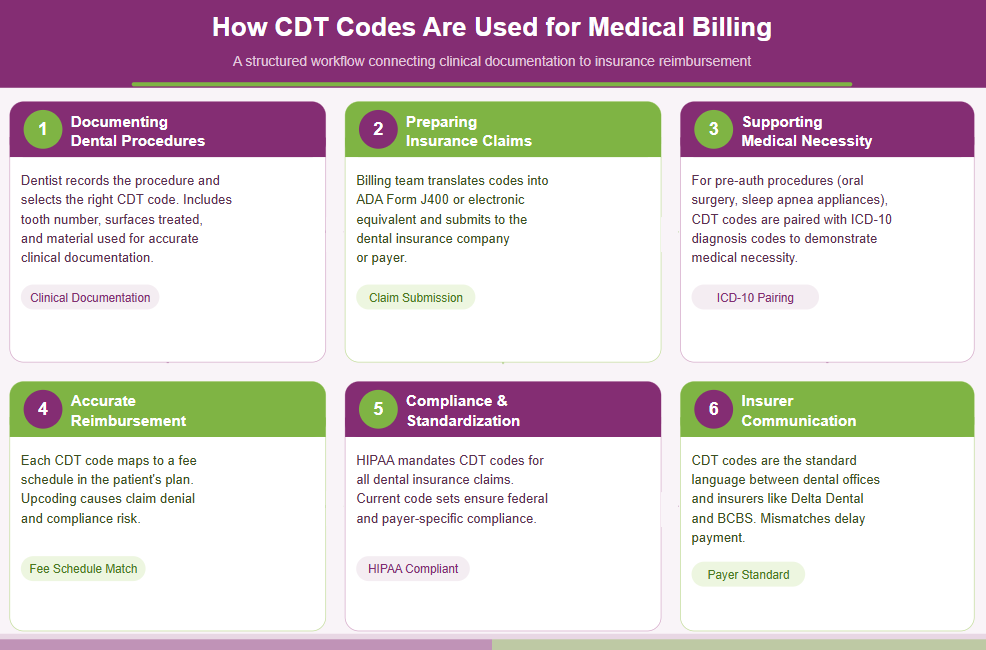
- Documenting Dental Procedures: The treating dentist records the procedure performed and selects the appropriate CDT code. Restorative CDT codes, for example, require identifying the tooth number, surfaces treated, and material used to support accurate documentation.
- Preparing Insurance Claims: The billing team translates coded procedure documentation into a standard dental claim form (ADA Form J400 or electronic equivalent) and submits it to the dental insurance company or payer.
- Supporting Medical Necessity: For procedures that require pre-authorization or cross into medical billing territory, such as oral surgery or sleep apnea appliances, the CDT code is paired with ICD-10 diagnosis codes to demonstrate medical necessity.
- Performing Accurate Reimbursement: Each CDT code corresponds to a specific fee schedule amount within the patient’s dental plan. Selecting the wrong code, such as using a higher-complexity code for a simpler procedure (upcoding), leads to claim denial or compliance risk.
- Maintaining Compliance and Standardization: HIPAA requires the use of CDT codes for all dental claims submitted to insurance. Using the current CDT code set ensures compliance with federal reporting requirements and payer-specific guidelines.
- Facilitating Communication with Insurance Providers: CDT codes serve as the standard language between dental offices and insurance providers. Delta Dental, BCBS, and other major insurers process claims based on CDT codes, and any mismatch triggers a cdt code mismatch error that delays payment.
What is the Difference Between a CDT Code and a CPT Code?
CDT (Current Dental Terminology) codes and CPT (Current Procedural Terminology) codes are both standardized medical billing codes, but they serve different practice areas and are governed by different organizations.
| Attribute | CDT Codes | CPT Codes |
|---|---|---|
| Full name | Current Dental Terminology | Current Procedural Terminology |
| Governing body | American Dental Association (ADA) | American Medical Association (AMA) |
| Primary use | Dental procedures and services | Medical and surgical procedures |
| Who uses it | Dentists and dental specialists | Physicians, hospitals, healthcare providers |
| Insurance type | Submitted to dental insurance plans | Submitted to medical insurance plans |
| Code format | “D” + 4 digits (e.g., D4341) | 5-digit numeric (e.g., 99213) |
| HIPAA designation | Standard code set for dental claims | Standard code set for medical claims |
In practice, most dental procedures use CDT codes exclusively. Some procedures fall into a gray area, such as oral surgery related to trauma, medically necessary dental treatment, or sleep apnea appliances, where CPT codes may need to be submitted to medical insurance alongside CDT codes for dental insurance.
What is the Difference Between D8080 and D8090?
D8080 and D8090 are both comprehensive orthodontic treatment codes within the CDT code system. The primary distinction is the stage of dentition and the patient’s age category at the time of treatment.
| Code | Name | Patient Type | Key Clinical Difference |
|---|---|---|---|
| D8080 | Comprehensive orthodontic treatment of adolescent dentition | Adolescents (typically 12-17 years) | Mixed or developing permanent dentition, growth modification may be possible |
| D8090 | Comprehensive orthodontic treatment of adult dentition | Adults (18+ or fully developed dentition) | Fully erupted permanent teeth; no skeletal growth modification expected |
Both codes represent comprehensive orthodontic correction using braces, clear aligners, or other orthodontic appliances over a full treatment period. Adolescents may experience ongoing skeletal growth during treatment, which affects the clinical approach. Adults have fully developed dentition, and treatment planning does not account for skeletal modification.
Insurance plans often categorize orthodontic benefits differently for adolescents and adults, which is why separate CDT codes exist. Dental offices must select the correct code based on the patient’s dentition stage and clinical classification at the time of initial appliance placement, not simply by chronological age.
How are Restorative CDT Codes Applied in Dental Treatment Documentation?
Restorative CDT codes are applied in dental treatment documentation by following a structured workflow that links the clinical procedure to the insurance claim and the patient record.
- Documenting the Performed Procedure: The dentist records the specific restorative treatment in the patient’s chart, including the material used (composite filling CDT code vs. amalgam), the type of restoration, and any special circumstances such as a protective restoration CDT code (D2940).
- Identifying the Tooth and Surfaces: Restorative codes require specifying the tooth number and the number of surfaces restored. For example, D2391 is a one-surface resin composite for a posterior tooth, while D2392 covers two surfaces, and so on.
- Supporting Clinical Notes: The provider adds clinical notes that justify the procedure, including radiographic findings, cavity depth, and the patient’s presenting symptoms. This documentation supports claim approval and protects against audit.
- Linking Codes to Insurance Claims: The billing team translates the clinical documentation into claim form fields, selecting the precise CDT code for each restorative procedure. Incorrect codes, such as applying a crown CDT code when a filling was placed, result in claim rejection.
- Compliance and Standardization: All restorative CDT codes must match the procedure performed on the date of service. EHR systems store these codes alongside the procedure record, supporting audit trails and HIPAA compliance.
What are the Consequences of Using Incorrect CDT Codes on Insurance Claims?
The consequences of using incorrect CDT codes on insurance claims are significant and can affect both the dental practice’s finances and its legal standing.
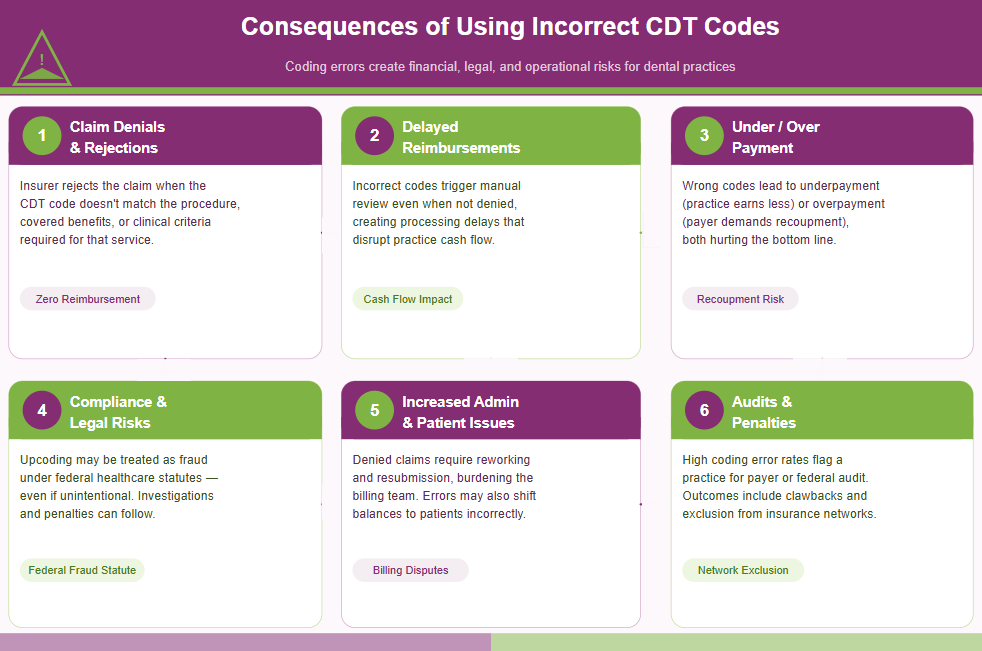
- Claim Denials or Rejections: The insurance company rejects the claim when the CDT code does not match the documented procedure, the patient’s covered benefits, or the clinical criteria required for that service.
- Delayed Reimbursements: Even when claims are not outright denied, incorrect codes trigger manual review, creating processing delays that impact cash flow for the dentists.
- Underpayment or Overpayment: An incorrect code that does not accurately represent the procedure performed results in either underpayment (the practice receives less than it should) or overpayment (the practice is overpaid and may face recoupment demands from the payer).
- Compliance and Legal Risks: Consistently submitting incorrect codes, especially upcoding (billing a higher-complexity code than what was performed), may be treated as fraudulent billing under federal healthcare fraud statutes. This applies regardless of whether the error was intentional.
- Increased Administrative Work: Every denied or rejected claim requires reworking, resubmission, and follow-up with the payer, adding administrative burden to the billing team.
- Patient Billing Issues: When insurance denies a claim due to coding errors, the balance may be incorrectly passed to the patient, creating billing disputes.
- Audits and Penalties: Practices with a high rate of coding errors may be flagged for audit by insurance payers or federal healthcare programs, leading to formal investigations, clawbacks, and potential exclusion from insurance networks.
How Often are CDT Codes Reviewed and Revised?
The ADA conducts a yearly review of CDT codes to ensure they remain current, accurate, and reflective of contemporary dental practices. This annual cycle is a core commitment of the ADA’s dental coding governance responsibility.
Revisions incorporate updates in dental technology, evolving clinical practices, and changes in regulatory requirements. The review process includes adding new codes for emerging procedures, revising existing codes for clarity, and retiring obsolete codes no longer applicable to modern dentistry.
Each update cycle follows a formal editorial process with input from dental specialists, payers, and healthcare administrators. Usually, code revisions include:
- New codes are added to cover innovative techniques and materials not previously represented.
- Existing codes are revised when descriptions no longer precisely match how procedures are performed in practice.
- Codes are retired when the procedures they describe have been replaced or are no longer used.
- All changes take effect on January 1 of the following year, giving practices time to update their systems.
How are CDT Codes Used Alongside Other Medical Billing Codes In EHRs?
CDT codes are used alongside other medical billing codes in the top dental EHRs by functioning as part of an interconnected documentation and billing system that captures the full clinical and financial picture of patient care.
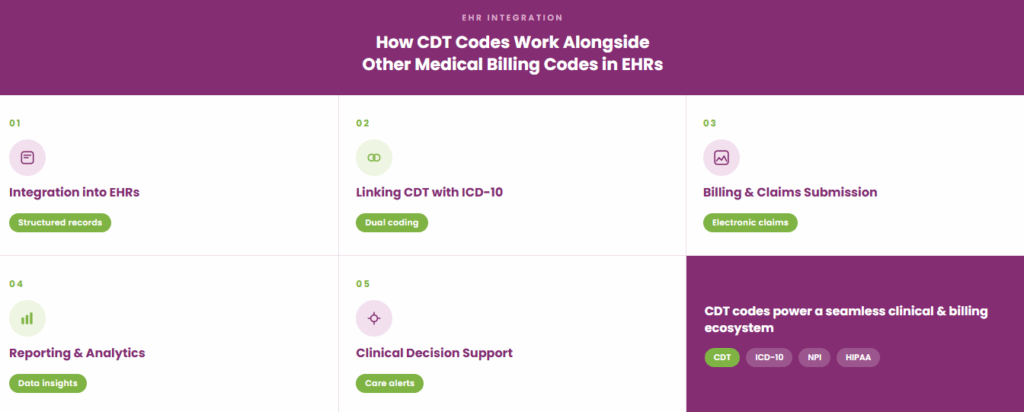
- Integrating into EHRs: CDT codes are stored within dental EHR systems as part of the procedure record for each patient visit. When a procedure is charted, the corresponding CDT code is associated with the encounter, creating a structured clinical record.
- Linking CDT Codes with ICD-10: For medically necessary dental procedures, CDT codes are paired with ICD-10 diagnosis codes to support medical insurance billing. For example, a bone graft CDT code (D7953) submitted to medical insurance requires supporting ICD-10 codes documenting the medical condition that necessitated the surgery.
- Billing and Claims Submission: EHR systems generate insurance claims by pulling the stored CDT codes alongside patient demographics, provider NPI numbers, and fee schedule data. These claims are submitted electronically in HIPAA-compliant formats.
- Reporting and Analytics: Practice management and EHR platforms use CDT code data to generate reports on procedure frequency, revenue by service type, and payer mix. This data informs practice management decisions and helps identify coding patterns that may warrant review.
- Clinical Decision Support: Some EHR platforms use CDT code history to flag potential gaps in care, such as a patient who has not had a preventive cleaning (D1110 adult prophylaxis) within the recommended interval.
How Do CDT Codes Support Compliance With HIPAA and Other Medical Billing Regulations?
CDT codes support compliance with HIPAA and other medical billing regulations by serving as the federally designated standard for dental procedure reporting.
- Standardization of Dental Procedure Reporting: HIPAA’s electronic transaction standards require all dental claims to use CDT codes when submitting procedures to insurance. This removes ambiguity and ensures that every claim contains structured, machine-readable procedure data.
- HIPAA Compliance: Under HIPAA Transaction and Code Set rules, CDT codes are the only accepted code set for dental procedure claims. Using any non-standard code set or omitting required codes makes a claim non-compliant and subject to rejection.
- Accurate Documentation and Audit Trails: CDT codes create a consistent record of services rendered that supports compliance audits. When an insurance company or federal program audits a dental practice, CDT-coded records provide clear evidence of what was performed and when.
- Integration with Other Regulatory Requirements: Dental practices participating in Medicaid, Medicare Advantage dental plans, or federal employee health programs must follow program-specific CDT coding guidelines. Accurate CDT coding makes sure that the practice meets both federal payer requirements and ADA standards simultaneously.
- Supporting EHR Compliance Features: EHR systems built for dental practices include CDT code libraries that are updated annually. Using current CDT codes within a compliant EHR system helps practices meet both HIPAA documentation standards and payer-specific billing requirements.
You have to stay current with CDT codes to submit insurance claims, maintain compliant EHR records, or avoid illegal dental billing practices. Using the correct CDT code for every documented dental procedure protects the practice from claim denials, audit exposure, and reimbursement issues.