
CPT code 11045 is an add-on code reporting each additional 20 square centimeters, or part thereof, of subcutaneous tissue debridement beyond the first 20 sq cm covered by 11042. It is never reported alone.
CPT 11045 pays per unit, so the area measurement drives the claim. Two rules govern that measurement, and both are routinely misapplied: area is measured after debridement, and depth is set by the tissue actually removed rather than the tissue exposed.
Getting either wrong changes the code family, not just the unit count. That is the work an experienced podiatry billing team catches before the claim leaves.
What Is the Description of CPT Code 11045?
The 11045 CPT code description, as defined by the AMA, is: “Debridement, subcutaneous tissue (includes epidermis and dermis, if performed); each additional 20 sq cm, or part thereof (List separately in addition to code for primary procedure).”
This add-on captures the incremental work when subcutaneous debridement extends past the 20 sq cm reported under 11042. CPT code 11045 follows the depth of its primary code, so it applies only where subcutaneous tissue was the deepest layer removed.
The parenthetical in the descriptor is the operative rule. Procedure code 11045 is listed separately in addition to a primary procedure, which means a claim carrying it without 11042 has nothing for it to attach to.
How Is Surface Area Measured and Units Calculated for CPT Code 11045?
Area is the surface area actually debrided, measured after debridement. Pre-debridement measurement routinely understates the area, because excision enlarges the wound bed.
The measurement rules are:
- Measure length by width in centimeters after the debridement is complete
- Code on the post-debridement area, not the pre-debridement wound size
- 11042 covers the first 20 sq cm, and each additional 20 sq cm or part thereof is one unit of 11045
- Sum the area of all wounds debrided to the same depth in the same session before calculating units
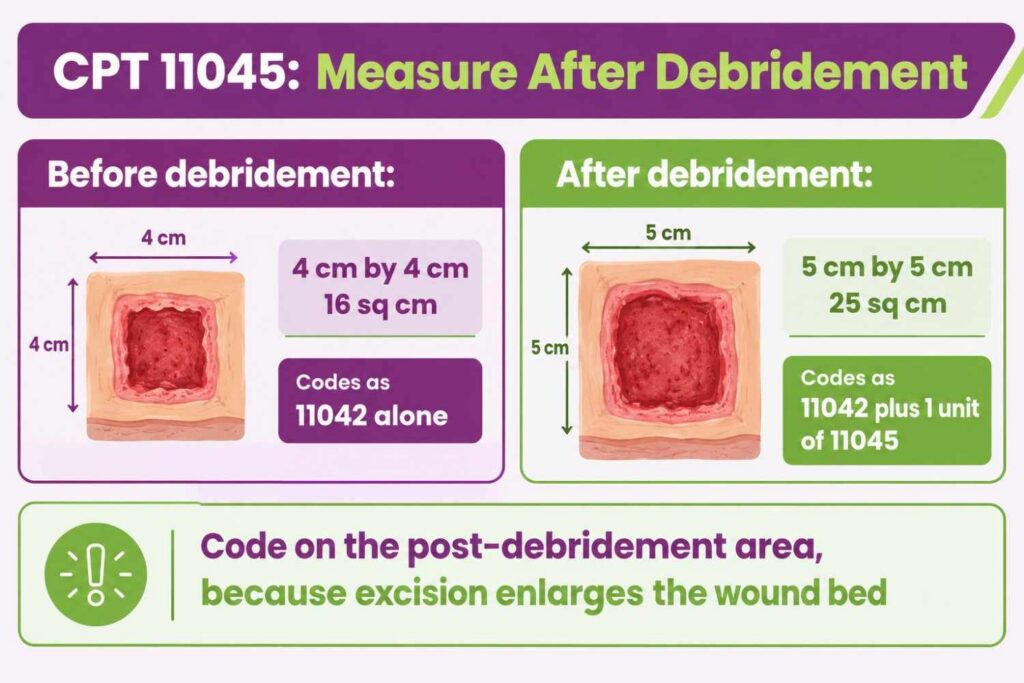
The cleanest illustration comes from a 4 by 4 cm ulcer measuring 16 sq cm before debridement. After excision, it measures 5 by 5 cm, or 25 sq cm. Coded on 25 sq cm, that wound produces 11042 plus one unit of CPT 11045, where the pre-debridement figure would have produced 11042 alone.
How Does CPT Code 11045 Relate to Primary Code 11042?
CPT code 11045 is reportable only when 11042 is billed for the same encounter. The two codes share a depth classification and must describe the same subcutaneous debridement.
The relationship works as follows:
- 11042 reports subcutaneous debridement of the first 20 sq cm or less
- 11045 extends that reporting for each additional 20 sq cm increment
- Without 11042 on the claim, 11045 is denied outright
- Both codes must reflect the same wound, or the combined area of same-depth wounds in that session
Both belong to the wound care and debridement section of the podiatry CPT code set, and the add-on carries no independent value. Its payment exists only as an extension of the primary code’s work.
How Does CPT 11045 Differ From Add-On Codes 11046, 11047, and 97598?
Each debridement depth has exactly one add-on code, and the add-on always follows the depth of its primary. Selective debridement has its own separate add-on.
The add-on codes break down as follows:
- 11045 follows 11042, subcutaneous tissue
- 11046 follows 11043, muscle and fascia
- 11047 follows 11044, bone
- 97598 follows 97597, selective debridement of epidermis and dermis only
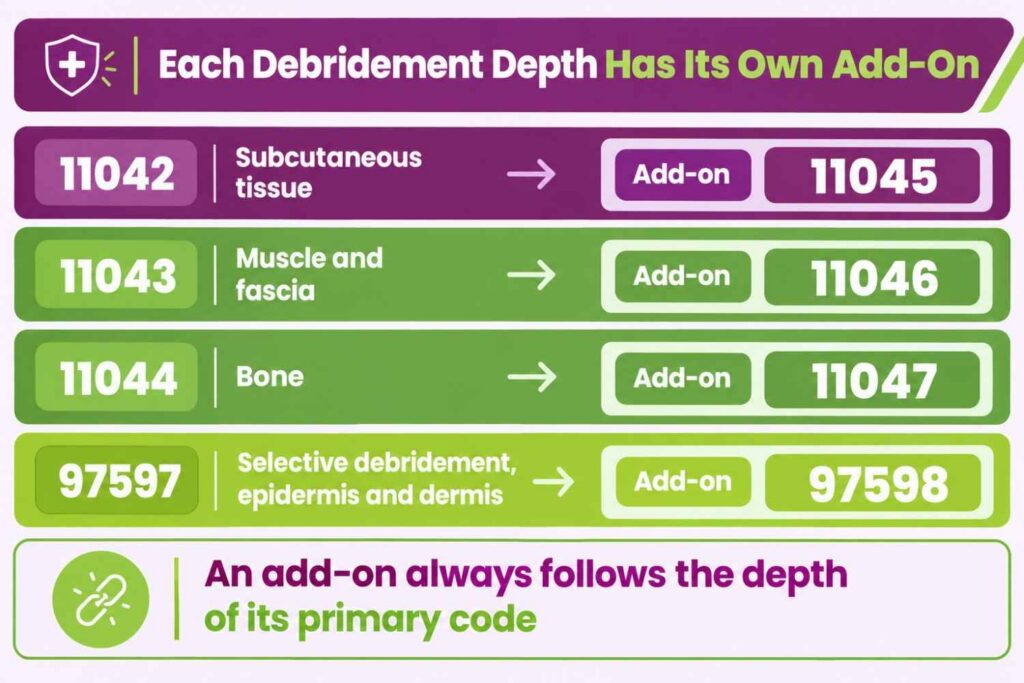
The common error is attaching 11045 to 11043 because the extra area was only subcutaneous. When the deepest layer removed is muscle, the whole same-depth area follows the muscle family, so the additional area reports as 11046 rather than CPT code 11045. Depth is set per wound by the deepest tissue removed, and the add-on inherits it.
Which HCPCS Codes Are Billed in Relation to CPT Code 11045?
CPT code 11045 connects to HCPCS Level II codes through two channels: the surgical dressings a debrided wound qualifies for, and the skin substitute products sometimes applied to the same wound. Neither is billed on the same line as the debridement, but both depend on it.
The surgical dressing relationship works as follows:
- Medicare’s surgical dressing policy defines a qualifying wound as one treated by a surgical procedure or one that has been debrided, regardless of the debridement technique
- Subcutaneous debridement under 11042 and 11045 therefore establishes eligibility for dressings such as the foam dressing codes A6209 through A6215
- Dressings for home use are furnished by a DMEPOS supplier and billed to the DME MAC under the surgical dressing benefit
- Dressings applied at the debridement visit are not separately reimbursed, since dressing costs are packaged into the procedure payment
The skin substitute relationship works as follows:
- Skin substitute products are reported with HCPCS Q4 product codes alongside application codes 15271 through 15278, not alongside 11045
- Debridement that prepares the wound bed for the graft is included in the application code for that wound on that date
- Separate 11042 and 11045 reporting is supportable only for a distinct wound, with modifier 59 or XS, or when the debridement is performed on a different date
Those product and supply codes sit within the wider set of podiatry HCPCS codes, and the debridement note is what supports them. Recorded wound depth, area, and exudate after debridement are the facts a dressing supplier needs to justify the dressing type and quantity.
What ICD-10 Codes and Medical Necessity Criteria Support CPT Code 11045?
Sequence the systemic condition first, then the site-specific ulcer code. For a diabetic foot ulcer, that means E11.621 followed by the matching L97 code.
The diagnosis structure works as follows:
- Report the systemic condition first, such as E11.621 for type 2 diabetes mellitus with foot ulcer
- Report the L97 foot ulcer code second, specifying site, laterality, and depth
- The L97 sixth character encodes depth: 1 limited to breakdown of skin, 2 fat layer exposed, 3 necrosis of muscle, 4 necrosis of bone
- Match the sixth character to the debridement depth billed
That last match is a documentation finding in its own right. A sixth character of 2, fat layer exposed, supports subcutaneous debridement under 11042 and 11045. A sixth character of 3, necrosis of muscle, supports 11043 instead, so a claim pairing a muscle-depth ulcer code with CPT 11045 reads as internally inconsistent to a reviewer. Ulcer coding is one part of the wider podiatry ICD-10 code set, where site, laterality, and severity characters determine which procedures a diagnosis can support.
What Are the Modifiers for CPT Code 11045?
CPT 11045 takes few modifiers, and the distinct-service modifiers apply in one specific situation: multiple wounds debrided to different depths in the same session.
Modifier 25: Significant, Separately Identifiable E/M on Same Day
Modifier 25 is appended to the evaluation and management code, not to code CPT 11045, when a significant and separately identifiable E/M service occurs on the same day. The surgical debridement already includes the pre-debridement wound assessment, so the E/M must address a problem or decision beyond the wound itself.
Modifier 59: Distinct Procedural Service
Modifier 59 applies when multiple wounds are debrided to different depths in the same session. Report the deepest debridement first, and append modifier 59 to the shallower primary code. When that shallower primary is 11042, its 11045 add-on follows on the same claim without needing the modifier itself.
Modifier XS: Separate Structure
Modifier XS is the more specific alternative to modifier 59 for the same multi-depth situation. XS is valid here because separate wounds are separate anatomic sites, unlike the midline-structure cases where a single structure cannot be split. Append XS to the shallower primary code when the payer accepts the X-modifier subset and the documentation identifies each wound’s location.
Modifier LT/RT: Left Side / Right Side
Modifiers LT and RT identify the laterality of the wound when debridement is performed on an extremity. Apply them where payer policy requires laterality for wound care services. The laterality must also agree with the sixth-level laterality encoded in the L97 diagnosis.
Which Documents Are Required For CPT Code 11045?
Documentation for CPT 11045 code must support the depth, the area, and the technique. Each of those three elements independently decides whether the units survive review.
The required documentation includes:
- Provider signature with the date of service
- Pre-debridement and post-debridement wound measurements in centimeters, both required
- The tissue actually removed, named specifically, not merely the tissue exposed
- The instrument used, since sharp excision with a scalpel, curette, or scissors is what separates 11042 from 97597
- Each wound’s location and laterality
- The total combined area when multiple same-depth wounds are aggregated, with the arithmetic shown
- Description of the devitalized, necrotic, or infected tissue necessitating debridement
- The linked systemic and ulcer diagnosis codes
What Is the Cost of CPT Code 11045?
The cost of CPT code 11045 is set per unit, so the total depends on how many 20 sq cm increments the debridement covers. The office setting pays nearly twice the facility rate.
RVUs & Medicare Payment Per Unit
11045 code CPT has Medicare prices through the Physician Fee Schedule. The CY 2026 values per unit appear below.
| Component | Facility | Non-Facility |
|---|---|---|
| Work RVU | 0.49 | 0.49 |
| Practice Expense RVU | 0.10 | 0.69 |
| Malpractice RVU | 0.07 | 0.07 |
| Total RVU | 0.66 | 1.25 |
| Payment per unit | $22.04 | $41.75 |
These amounts apply the CY 2026 nonqualifying APM conversion factor of $33.4009. The 2026 efficiency adjustment reduced the work RVU of non-time-based services by 2.5 percent, and it applies to 11045 because the code is valued by area rather than time.
The per-unit structure scales the claim quickly. Two units of 11045 in the office pay $83.50 on top of the primary 11042, and the twelve-unit MUE ceiling would reach $501 in additional payment on a very large wound.
Commercial Payers
Commercial reimbursement for procedure code 11045 is contract-specific. Rates are often benchmarked to a percentage of the Medicare fee schedule, which makes the Medicare per-unit amount the practical reference point for evaluating a contract.
Payer policy differences matter more than rates on this code. Commercial plans vary on whether pre-debridement or post-debridement measurement controls, on frequency expectations across a course of care, and on whether the X-modifier subset is accepted in place of modifier 59. Tracking those differences across a panel of chronic wound patients is routine work for wound care revenue cycle management.
Place-of-Service & Geographic Adjustments
Non-facility (office) rates are higher than facility rates for podiatry code11045 due to the practice expense differential. The office rate exceeds the facility rate because of the practice expense differential. The non-facility practice expense of 0.69 RVU covers supplies, instruments, and overhead the practice absorbs, against 0.10 in the facility setting.
Facility rates apply when debridement is performed in a hospital outpatient department or ambulatory surgery center, where the facility bills separately for equipment and supply costs. GPCI values then adjust the work, practice expense, and malpractice components of CPT 11045 by locality.
What Are Example Clinical Scenarios or Use Cases for CPT Code 11045?
11045 CPT code applies whenever subcutaneous debridement extends past the first 20 sq cm. The scenarios below show the standard case, aggregation, the multi-depth case, and the most common depth error.
Scenario 1: Large Diabetic Foot Ulcer Debrided to Subcutaneous Tissue
ICD-10: E11.621 (Type 2 diabetes mellitus with foot ulcer) and L97.512 (Non-pressure chronic ulcer of other part of right foot with fat layer exposed)
A patient with type 2 diabetes presents with a non-healing ulcer of the right forefoot. The provider performs sharp excisional debridement of necrotic subcutaneous tissue with a curette and measures the wound at 46 sq cm afterward. The claim reports 11042 for the first 20 sq cm and CPT code 11045 for two units, one for the next 20 sq cm and one for the remaining 6 sq cm. The E11.621 diabetic foot ulcer code leads, with L97.512 confirming the fat-layer depth that supports subcutaneous debridement.
A large stage 3 pressure ulcer debrided to subcutaneous tissue produces the same claim construction, with the appropriate L89 pressure ulcer code in place of the diabetic pairing.
Scenario 2: Multiple Same-Depth Wounds Aggregated in One Session
ICD-10: S81.802A (Unspecified open wound of left lower leg, initial encounter)
A patient presents after a traumatic injury with two open wounds on the left lower leg, measuring 22 sq cm and 18 sq cm after debridement. Both are debrided to subcutaneous tissue in the same session. The provider sums the same-depth areas to 40 sq cm and reports 11042 for the first 20 sq cm plus one unit of 11045 for the remaining 20 sq cm. Separate 11042 and 11045 sets for each wound would be incorrect, since same-depth wounds aggregate.
Scenario 3: Wounds at Different Depths in the Same Session
ICD-10: E11.621, L97.513 (Non-pressure chronic ulcer of other part of right foot with necrosis of muscle), and L97.412 (Non-pressure chronic ulcer of right heel and midfoot with fat layer exposed)
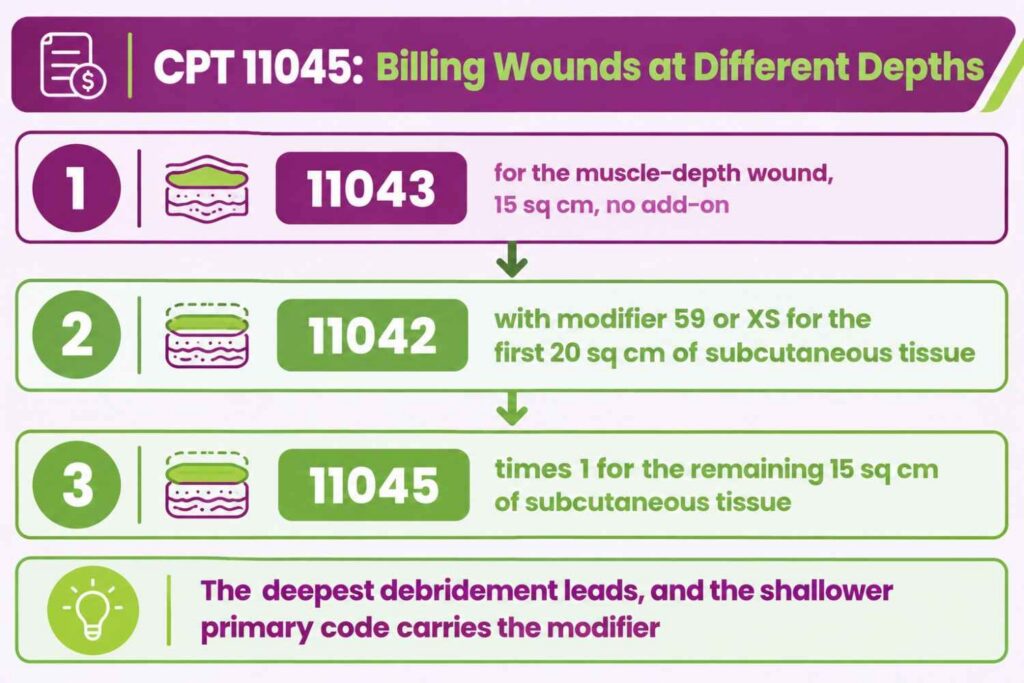
A patient has one wound debrided to muscle at 15 sq cm and two other wounds debrided to subcutaneous tissue totaling 35 sq cm. Different depths never aggregate, so each depth bills under its own family.
The claim construction is:
- 11043 first, for the muscle-depth wound at 15 sq cm, with no add-on since it stays under 20 sq cm
- 11042 with modifier 59 or XS, for the first 20 sq cm of subcutaneous debridement
- CPT code 11045 for one unit, covering the remaining 15 sq cm of subcutaneous debridement
This is the only situation where the distinct-service modifier belongs on this claim. The deepest debridement leads, and the shallower primary carries the modifier.
Scenario 4: Bone Exposed but Only Subcutaneous Tissue Removed
ICD-10: E11.621 and L97.512 (Non-pressure chronic ulcer of other part of right foot with fat layer exposed)
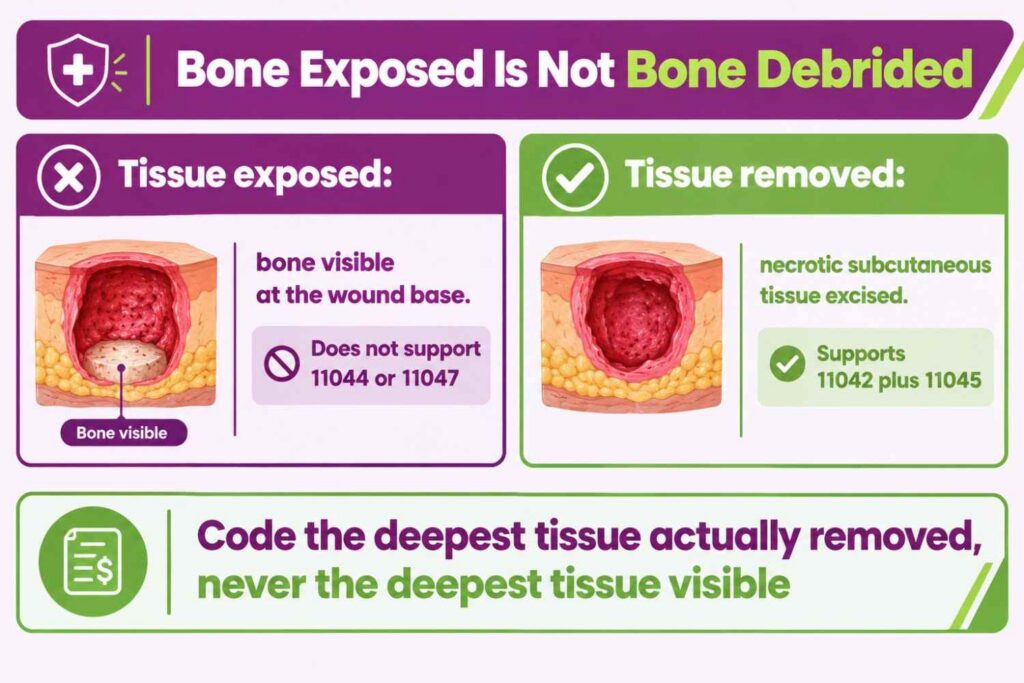
A wound has bone visible at its base, but the provider excises only necrotic subcutaneous tissue and does not remove any bone. The correct codes are 11042 and 11045, not 11044 and 11047.
This is the highest-value correction on the page, because the upcoding error is common and the rule is unambiguous. Code selection follows the deepest tissue actually removed, never the deepest tissue visible or exposed. A note stating that bone was exposed supports nothing about bone debridement, since auditors look specifically for documentation that bone was removed.
What Are the CPT Code 11045 Rules To Ensure Successful Reimbursement?
Follow the add-on and bundling rules, the mutual exclusivity rule with selective debridement, the unit limits, and the serial documentation expectation. Meeting these rules protects CPT code 11045 claims from denial and recoupment.
Bundling / NCCI / Same-Day Procedure Rules
CPT 11045 is an add-on code, so it cannot be reported without 11042 on the same claim. If 11042 is absent or denied, 11045 is denied with it.
The bundling rules are:
- Report 11045 only alongside 11042 for subcutaneous debridement
- When deeper tissue is debrided, the additional area follows 11046 or 11047, never 11045
- Debridement superficial to, but within the surgical field of, a musculoskeletal procedure is not separately reportable
- Debridement at the site of an open fracture or dislocation is reported with 11010 through 11012 instead, rather than the depth-based family
The surgical-field rule catches orthopedic cases in particular. Subcutaneous debridement performed as part of accessing a musculoskeletal procedure site is included in that procedure and does not support 11042 or CPT code 11045.
Why 11042–11047 and 97597–97602 Cannot Be Reported for the Same Wound
The surgical debridement family and the active wound care family are mutually exclusive for the same wound on the same date. One wound receives one technique.
The exclusivity rules are:
- 11042 through 11047 are not reported with 97597, 97598, or 97602 for the same wound
- The surgical codes describe excisional debridement, while the active wound care codes describe selective or non-selective removal
- A distinct-service modifier is appropriate only when separate wounds genuinely received different techniques
- Billing 11045 with 97597 on the same wound denies both and invites an unbundling review
The instrument and the tissue removed decide which family applies. Sharp excision of subcutaneous tissue is 11042 and 11045, while selective removal of devitalized epidermis and dermis is 97597 and 97598.
Units, MUEs & Add-On Code Billing Rules
CPT 11045 is billed in units, each representing one additional 20 sq cm increment or part thereof. The MUE is 12 units per date of service.
The unit rules are:
- Combine all wounds debrided to the same subcutaneous depth in the same session before calculating units
- Never bill separate 11042 and 11045 sets for individual wounds of the same depth
- Bill wounds of different depths under their own primary and add-on codes, never aggregated into one subcutaneous claim
- Document the total area with the arithmetic shown, since payers audit unit counts against recorded measurements
- MUE values update quarterly, so confirm the current figure before submitting quantities near the ceiling
Debridement Frequency and Serial Documentation Under LCD L35125
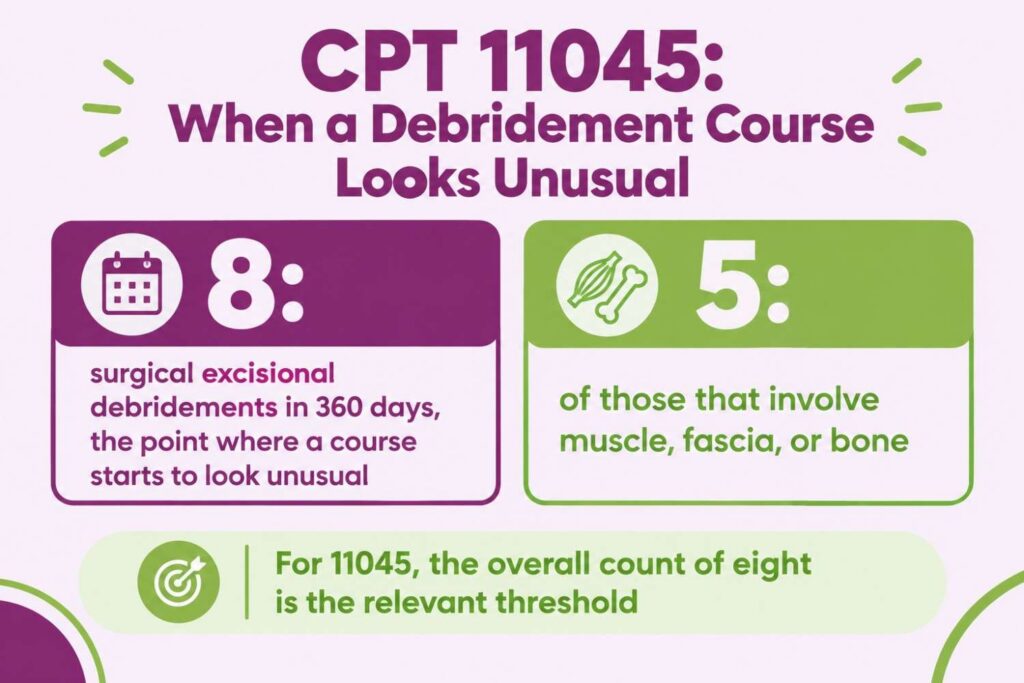
LCD L35125 does not impose strictly defined frequency limitations on wound care debridements. It does describe the point at which a course of care starts to look unusual.
The LCD’s expectation is:
- Only a minority of beneficiaries appear to require more than eight total surgical excisional debridements in a 360-day period
- That count covers debridements involving subcutaneous tissue, muscle, fascia, or bone
- Within it, the LCD expects no more than five to involve removal of muscle, fascia, or bone
- Courses exceeding those expectations need documentation showing why continued debridement serves the treatment plan
For CPT code 11045, the relevant threshold is the overall count of eight, since the five-debridement figure applies specifically to the deeper muscle and bone codes. Debridement frequency is expected to decrease over time as the wound responds.
Each session needs its own measurements rather than a copied note, and prolonged courses benefit from serial measurements and, where useful, photographs documenting the trajectory. Other contractors publish different thresholds, so confirm the governing LCD for the jurisdiction.
Top Reasons For Denials Specific To 11045 & Quick Remedies
- Missing Primary Code 11042: Prevent by always pairing CPT code 11045 with 11042 on the same claim, since the add-on cannot stand alone.
- 11045 Attached to 11043 or 11044: Prevent by using the add-on matching the primary depth, 11046 after 11043 and 11047 after 11044, since the whole same-depth area follows the deepest layer.
- Coded to Exposed Rather Than Removed Depth: Prevent by selecting depth from the tissue actually excised, so a wound with visible bone and only subcutaneous excision bills 11042 and 11045.
- Billed With 97597 on the Same Wound: Prevent by choosing one technique per wound, since the surgical and active wound care families are mutually exclusive for the same wound.
- L97 Depth Character Inconsistent With Debridement Depth: Prevent by matching the sixth character to the depth billed, so fat layer exposed supports subcutaneous debridement and necrosis of muscle supports 11043.
- Repetitive Debridement With No Measurable Progress: Prevent by recording pre- and post-debridement measurements at every session, showing the wound trajectory across the course of care.
Is CPT Code 11045 Considered a Standalone Code or Part of a Broader Coding System?
CPT code 11045 is an add-on code that is never reported alone. It exists only as an extension of 11042, within a larger classification that divides debridement by depth and by technique.
Understanding what medical CPT codes are at a foundational level clarifies why debridement is broken into separate codes by tissue type. Each depth carries its own primary and its own add-on, so each represents a distinct billable service rather than a variation of one procedure.