
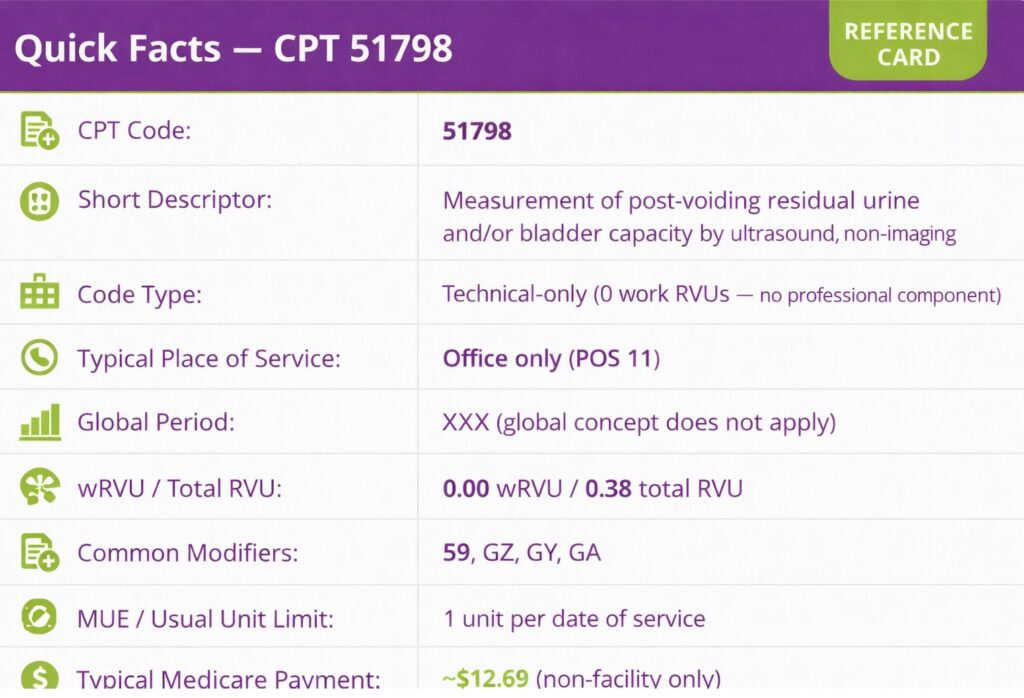
CPT code 51798 is a technical-only urodynamic code used to report the measurement of post-voiding residual urine and/or bladder capacity using a non-imaging ultrasound device. It applies when a handheld bladder scanner is used to quantify urine remaining in the bladder after a patient has voided, without producing or storing diagnostic ultrasound images. This code is used primarily in urology and urogynecology office settings by technical staff under general physician supervision to evaluate bladder emptying disorders, urinary retention, and conditions affecting lower urinary tract function.
What Is the Description of CPT Code 51798?
51798 CPT code is defined by the AMA as: “Measurement of post-voiding residual urine and/or bladder capacity by ultrasound, non-imaging.”
This code captures a urodynamic measurement procedure in which a handheld, battery-powered bladder scanner is placed over the suprapubic area to calculate post-void residual (PVR) urine volume. The device’s built-in software automatically calculates and displays the result. No diagnostic ultrasound image is produced, stored, or interpreted.
What Makes CPT Code 51798 a Non-Imaging Ultrasound?
CPT code 51798 is designated non-imaging because the bladder scanner used to perform it does not produce, display, or archive a sonographic image for physician review and interpretation. The device outputs only a numerical volume measurement, typically in milliliters, derived from automated internal calculations.
This distinguishes it from diagnostic ultrasound procedures such as CPT code 76857 (ultrasound, pelvic, limited), which require the production and storage of images and a separately billable physician interpretation. If formal ultrasound images are obtained during the encounter, the CPT 51798 code is no longer the correct code.
What Are the Modifiers for CPT Code 51798?
CPT code 51798 accepts a limited set of modifiers reflecting distinct procedural circumstances or Medicare coverage determinations.
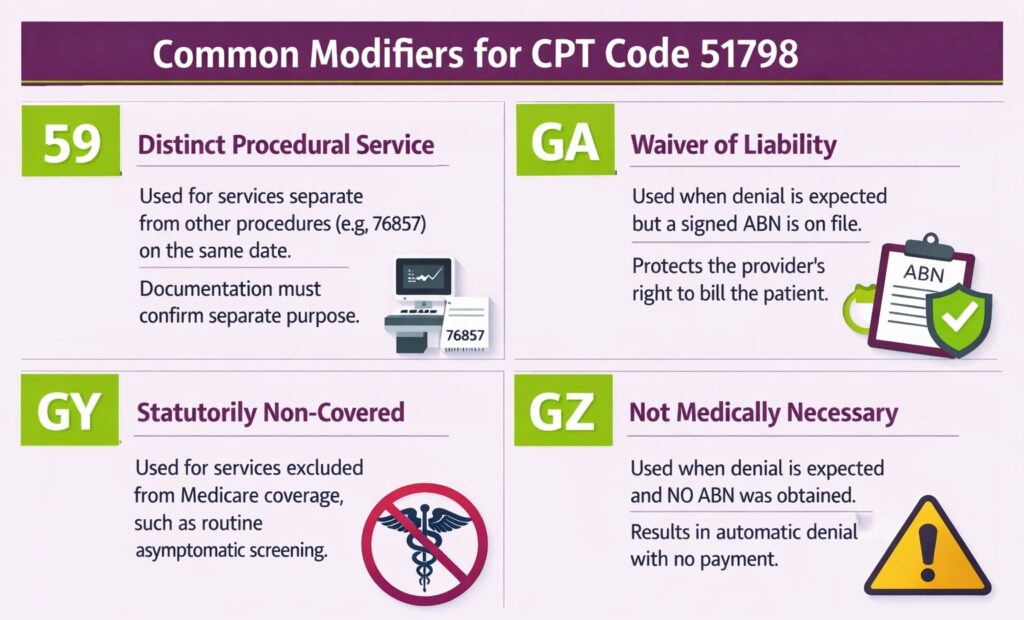
Modifier 59: Distinct Procedural Service
Modifier 59 is used when CPT 51798 is performed as a distinct service separate from another procedure on the same date that would otherwise trigger NCCI bundling, most commonly CPT 76857. Documentation must confirm that the services were separate in purpose or technique.
Modifier GZ: Item or Service Expected to Be Denied as Not Medically Necessary
Modifier GZ is used when the provider expects Medicare to deny CPT 51798 as not medically necessary, and no Advance Beneficiary Notice (ABN) has been obtained from the patient. Services submitted with modifier GZ are automatically denied, and no payment is made.
Modifier GY: Statutorily Non-Covered Service
Modifier GY is used when CPT 51798 is a service that is statutorily excluded from Medicare coverage. For example, when performed for routine asymptomatic screening without a covered clinical indication. Claims submitted with modifier GY are automatically denied.
Modifier GA: Waiver of Liability Statement on File
Modifier GA is used when the provider expects Medicare to deny CPT 51798 as not medically necessary, but has obtained a signed ABN from the patient prior to the service. Modifier GA protects the provider’s right to bill the patient if Medicare denies the claim.
Can CPT Code 51798 Be Billed With an E/M Service?
Yes. Code CPT 51798 carries a global indicator of XXX, meaning the global surgery concept does not apply. An E/M service performed on the same date as 51798 is separately billable when the physician’s encounter addresses a distinct clinical problem or involves decision-making beyond the bladder scan itself.
Because 51798 has no global period and is a technical-only service, modifier 25 is not strictly required on the E/M under CPT and Medicare rules. However, some commercial payers and MACs do require modifier 25 on the E/M when billed same-day.
Which Documents Are Required For CPT Code 51798?
Documentation for CPT code 51798 must establish medical necessity for the post-void residual measurement and record the result as part of the patient’s permanent medical record.
Required documents checklist:
- Clinical indication documenting the symptom or diagnosis necessitating PVR measurement (e.g., urinary retention, incomplete emptying, lower urinary tract symptoms)
- Documentation that the procedure was performed using a non-imaging ultrasound device
- Recorded PVR result in milliliters, whether from a device printout or a separately dictated note within the visit record
- Confirmation that the scan was a non-imaging measurement, not a diagnostic sonogram producing stored images
- Ordering the provider’s assessment, linking the PVR result to the patient’s clinical management
- Signed and dated office visit record supporting medical necessity per LCD L34085
- Accurate place-of-service designation (POS 11 (office), for Medicare reimbursement)
What Is the Cost of CPT Code 51798?
The cost of CPT code 51798 is among the lowest of any billable procedure, reflecting its zero work RVU structure and practice-expense-only payment basis.
Why Is CPT Code 51798 a Technical-Only Code With Zero Work RVUs?
CPT code 51798 carries zero work RVUs because it involves no physician cognitive work, clinical judgment, or professional interpretation. The procedure is performed by technical staff under the physician’s general supervision, meaning the physician’s presence is not required during or at the time of the scan.
Payment is based solely on the practice expense RVU component, reflecting the cost of the equipment and staff time involved in performing the measurement. Because there is no professional component, modifiers 26 and TC cannot be appended to CPT 51798. The Medicare fee schedule does not split this code into separate professional and technical components.
RVUs & Medicare Payment
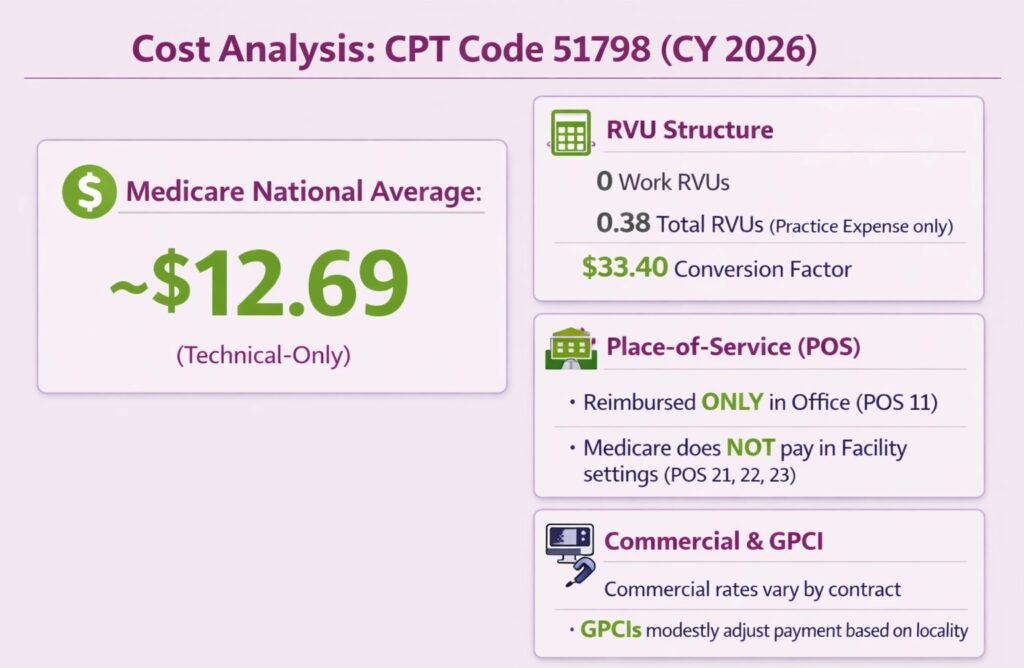
CPT code 51798 carries 0 work RVUs as it has no physician work component. The code’s total RVU value is 0.38, consisting entirely of the practice expense component. For CY-2026, the national average Medicare payment is $12.69, calculated as 0.38 total RVUs × the $33.40 conversion factor.
CPT 51798 is only reimbursed by Medicare when billed under POS 11 (office). Medicare does not pay code CPT 51798 when submitted under POS 21 (inpatient), POS 22 (hospital outpatient), or POS 23 (emergency department).
Commercial Payers
Commercial payers generally reimburse CPT 51798 at rates that vary by contract, network, and region. Given the code’s low RVU value and technical-only classification, commercial allowed amounts are typically modest.
Place-of-Service & Geographic Adjustments
CPT 51798 is effectively an office-setting-only code for Medicare billing. Medicare does not reimburse CPT 51798 in facility-based settings (POS 21, 22, or 23) because the non-facility practice expense RVU, the sole payment driver, is designated not applicable in those settings.
GPCI adjustments apply to the practice expense component and will modestly increase or decrease the $12.69 national average depending on locality. High-cost metropolitan areas carry practice expense GPCIs above 1.0, resulting in slightly higher payments.
What Are Example Clinical Scenarios or Use Cases for CPT Code 51798?
CPT code 51798 is used whenever a non-imaging bladder scan is performed to measure post-void residual urine volume or bladder capacity in a clinically indicated outpatient encounter.
Scenario 1: Benign Prostatic Hyperplasia with Urinary Retention
ICD-10: N40.1 (Benign prostatic hyperplasia with lower urinary tract symptoms)
A male patient presents with a weak urine stream, incomplete emptying sensation, and nocturia. The urologist performs a post-void residual measurement using a handheld non-imaging bladder scanner placed over the suprapubic area. The device displays a PVR of 210 mL, confirming significant urinary retention. The result is documented in the visit note, guiding the decision to initiate alpha-blocker therapy and schedule follow-up PVR monitoring. CPT 51798 is reported for the measurement.
Scenario 2: Neurogenic Bladder with Incomplete Emptying
ICD-10: N31.9 (Neuromuscular dysfunction of bladder, unspecified)
A patient with a history of multiple sclerosis presents for follow-up reporting urinary urgency and a sensation of incomplete voiding. A non-imaging bladder scan is performed after voiding to quantify residual urine volume. The PVR result of 175 mL supports a clinical decision to initiate clean intermittent catheterization. The scanner printout is retained as part of the medical record. CPT 51798 is reported for the post-void residual measurement.
Scenario 3: Post-Void Residual Monitoring in Overactive Bladder on Anticholinergic Therapy
ICD-10: N32.81 (Overactive bladder)
A female patient on anticholinergic medication for an overactive bladder returns for a monitoring visit. The provider orders a non-imaging bladder scan to assess whether the medication is causing elevated post-void residual as a side effect. The scan is performed by clinical staff in the office and returns a PVR of 95 mL, documented in the visit note. The physician uses the result in medical decision-making to determine whether to continue, adjust, or discontinue anticholinergic therapy. CPT 51798 is reported for the measurement.
What Are the CPT Code 51798 Rules To Ensure Successful Reimbursement?
Follow payer and policy rules for documentation, coding, bundling, place-of-service, and frequency. Meeting these rules reduces denials and ensures correct payment.
Bundling / NCCI / Same-Day Procedure Rules
CPT 51798 code has a confirmed NCCI/CCI bundling relationship with CPT 76857 (ultrasound, pelvic, limited or follow-up). The two codes cannot be billed together without documentation confirming they were distinct services. In most cases, if a formal imaging ultrasound with stored images was performed, CPT 76857 is the correct code, and 51798 should not be reported at all.
Apply modifier 59 to 51798 only when clinical documentation clearly supports that a non-imaging PVR measurement was performed as a separate and distinct service. Additionally, using both CPT 51798 and catheterization (51701) to determine post-void residual on the same date is not considered medically necessary, and payers will deny one of the two services.
Units, MUEs & Place-of-Service Restrictions
CPT 51798 is billed as 1 unit per day. Per CMS LCD article A57050, the service should not be performed more than once per day.
- CPT 51798 is not payable by Medicare under POS 21 (inpatient), POS 22 (hospital outpatient), or POS 23 (emergency department) .
- Modifiers 26 and TC are not applicable. So, do not append them to CPT 51798 under any circumstance.
- Routine, asymptomatic screening without a documented covered clinical indication does not meet medical necessity and will be denied.
When to Use CPT 51798 vs CPT 76857 (Imaging Ultrasound)
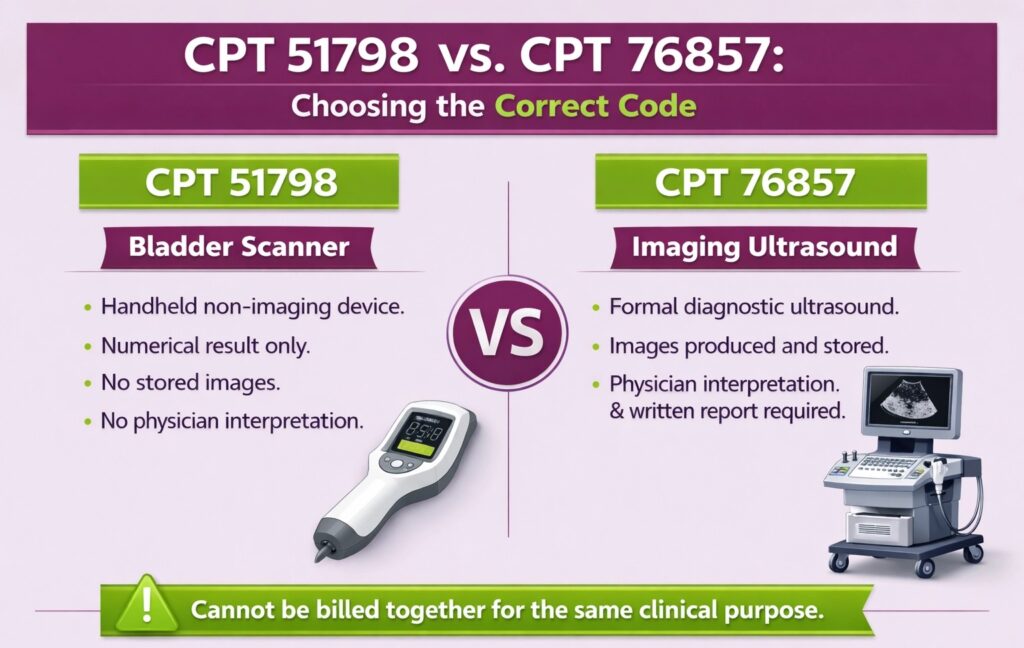
The distinction between 51798 and 76857 is determined by whether the device produces stored diagnostic images and whether physician interpretation is performed. Remember, the two codes cannot be billed together for the same clinical purpose.
Use CPT 51798 when a handheld non-imaging bladder scanner is used solely to measure post-void residual urine volume or bladder capacity, the device outputs a numerical result only, no diagnostic ultrasound image is produced or stored, and no physician interpretation is rendered.
Use CPT 76857 when a formal diagnostic ultrasound of the pelvis or bladder is performed, images are produced and stored as part of the permanent record, and a physician interprets and documents findings in a separate written report.
Top Reasons For Denials Specific To 51798 & Quick Remedies
- Billed Under Facility POS (21, 22, or 23): Prevent by submitting CPT 51798 only under POS 11. Medicare does not pay this code in facility settings.
- Bundled With CPT 76857 Without Modifier 59: Prevent by confirming that only one of the two codes is appropriate for the encounter. If both were genuinely distinct services, apply modifier 59 with clear supporting documentation.
- Billed Same Day as Catheterization for Same Purpose: Prevent by not billing 51798 and 51701 on the same date to measure the same residual urine. Payers consider this duplication and will deny one service.
- Modifier 26 or TC Appended in Error: Prevent by confirming that 51798 is not split into professional and technical components on the Medicare fee schedule and removing those modifiers before submission.
Is CPT 51798 an Unusual Code Compared to Other Diagnostic Procedure Codes?
It is. Within the categories of CPT codes, most diagnostic procedure codes carry both a professional and technical component with measurable physician work attached. But 51798 is a technical-only code with zero work RVUs, which places it in a distinct subset that directly affects who can bill for it and under what circumstances.