
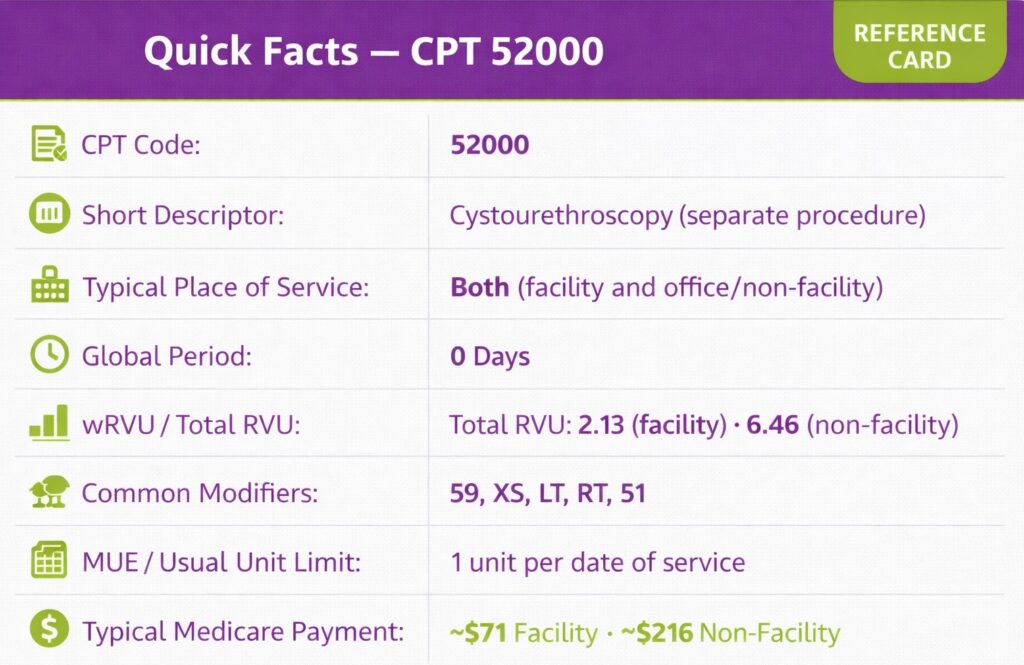
CPT code 52000 is a diagnostic procedure code used to report cystourethroscopy performed as a standalone examination of the urethra and bladder using a cystoscope. It is designated as a “separate procedure” under CPT guidelines, meaning it is bundled into any more comprehensive cystourethroscopic service performed on the same date and may only be reported independently when no other cystoscopic procedure is performed during the same encounter. This code is used in both facility and office-based settings for diagnostic evaluation of lower urinary tract symptoms, hematuria, and other bladder and urethral conditions.
What Is the Description of CPT Code 52000?
52000 CPT code is defined by the AMA as: “Cystourethroscopy (separate procedure).”
It covers a complete endoscopic examination of the urethra and bladder without any additional therapeutic or diagnostic interventions. The parenthetical designation “(separate procedure)” is a CPT editorial note that governs when this code may be independently reported.
What Does the Cystourethroscopy Procedure Include for CPT Code 52000?
The procedure reported under CPT code 52000 involves insertion of a rigid or flexible cystoscope through the urethra into the bladder under direct visualization. The physician examines the entire urethra, bladder neck, trigone, ureteral orifices, and bladder mucosa. Irrigation used during the procedure is included.
No biopsy, fulguration, catheterization, stent placement, or therapeutic intervention is performed. If any additional procedure is performed through the cystoscope, a more specific code replaces CPT code 52000.
What Does “Separate Procedure” Designation Mean for CPT Code 52000?
The “(separate procedure)” designation in the CPT descriptor of CPT code 52000 indicates that cystourethroscopy is a component of many more comprehensive urological procedures. When CPT code 52000 is performed as an integral part of another cystourethroscopic service, for example, as part of CPT 52204 (cystourethroscopy with biopsy), it is bundled and must not be billed separately.
CPT code 52000 may only be reported independently when diagnostic cystourethroscopy is the sole procedure performed during the encounter, with no additional interventional or diagnostic cystoscopic service performed on the same date by the same provider.
How Does CPT Code 52000 Differ From CPT 52001, 52204, and 52332?
These codes cover cystourethroscopy with additional services and replace CPT code 52000 when those services are performed:
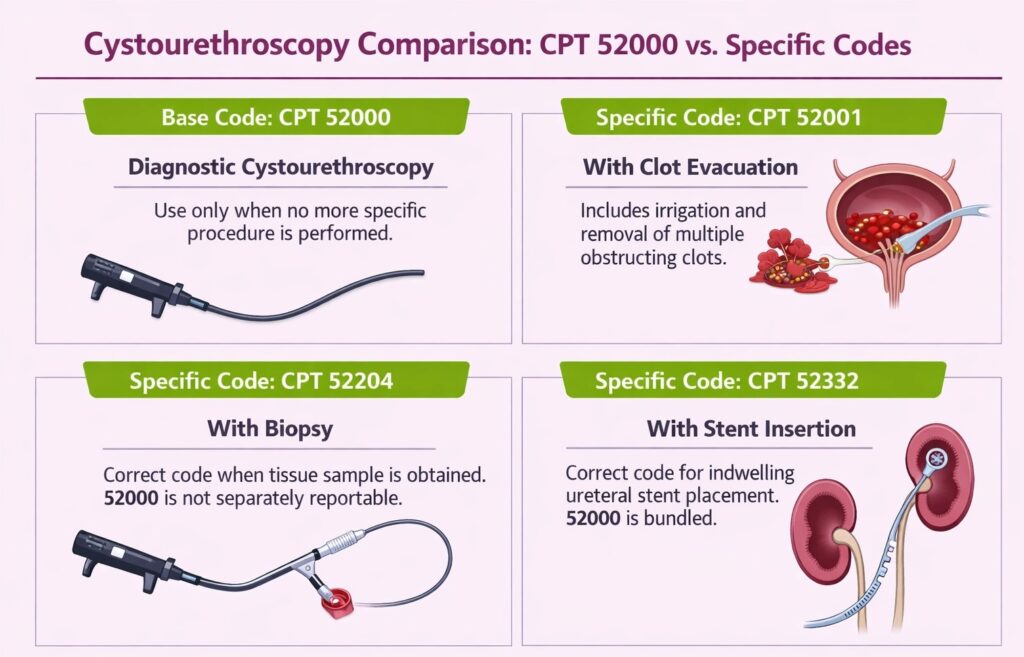
- CPT 52001: Cystourethroscopy with irrigation and evacuation of multiple obstructing clots; includes the additional step of clot evacuation, which is not covered by 52000
- CPT 52204: Cystourethroscopy with biopsy(s); when a biopsy is obtained, 52204 is the correct code, and 52000 is not separately reportable for the same encounter
- CPT 52332: Cystourethroscopy with insertion of an indwelling ureteral stent; when a stent is placed, 52332 is the correct code, and 52000 is bundled into that service
In all cases where a more specific cystourethroscopic code applies, CPT code 52000 must not be additionally reported on the same claim for the same ureter or bladder encounter.
What Are the Modifiers for CPT Code 52000?
CPT code 52000 is reported with modifiers only in circumstances where it is performed as a distinct service separate from another procedure on the same date.
Modifier 59: Distinct Procedural Service
Modifier 59 is used when CPT code 52000 is performed as a distinct and separately identifiable service from another procedure on the same date. Given its “separate procedure” designation, this modifier is applied only when documentation clearly establishes that the cystourethroscopy was independent of and not part of the concurrent procedure. Append modifier 59 only when NCCI edits would otherwise bundle 52000, and the operative documentation supports the separate service.
Modifier XS: Separate Structure
Modifier XS is a more specific alternative to modifier 59, used when the cystourethroscopy is performed on a separate anatomical structure from the primary procedure on the same date. It provides greater specificity than modifier 59 and is preferred by some payers. Append modifier XS to CPT code 52000 when applicable to avoid an NCCI bundling denial.
Modifier LT: Left Side
Modifier LT is not routinely required for CPT code 52000, as cystourethroscopy is a bilateral anatomy procedure. However, some payers may require a laterality modifier when the procedure is performed in a context requiring side identification. Append modifier LT only when required by payer-specific instruction.
Modifier RT: Right Side
Modifier RT applies under the same limited payer-specific circumstances as modifier LT. Append modifier RT to CPT code 52000 only when a payer explicitly requires laterality identification for this code.
Modifier 51: Multiple Procedures
Modifier 51 is used when CPT code 52000 is performed alongside a primary procedure on the same date, and the payer requires it to be identified as a secondary procedure. The primary procedure is listed without modifier 51. CPT code 52000, as the lower-valued service receives modifier 51.
Which Documents Are Required For CPT Code 52000?
Documentation for CPT code 52000 must support the diagnostic indication and confirm that no additional cystourethroscopic interventions were performed.
Required documents checklist:
- Procedure note documenting cystourethroscopic examination with findings of the urethra, bladder neck, trigone, ureteral orifices, and bladder mucosa
- Clinical indication for the examination (hematuria, lower urinary tract symptoms, follow-up surveillance, etc.)
- Explicit statement that no additional procedures were performed during the same encounter
- Patient consent for the procedure
- Equipment used (rigid vs. flexible cystoscope)
- Anesthesia or sedation type, if applicable
- Post-procedure instructions and follow-up plan
What is the Cost of CPT Code 52000?
The cost of CPT code 52000 varies by place of service, payer, and geographic location.
RVUs & Medicare Payment
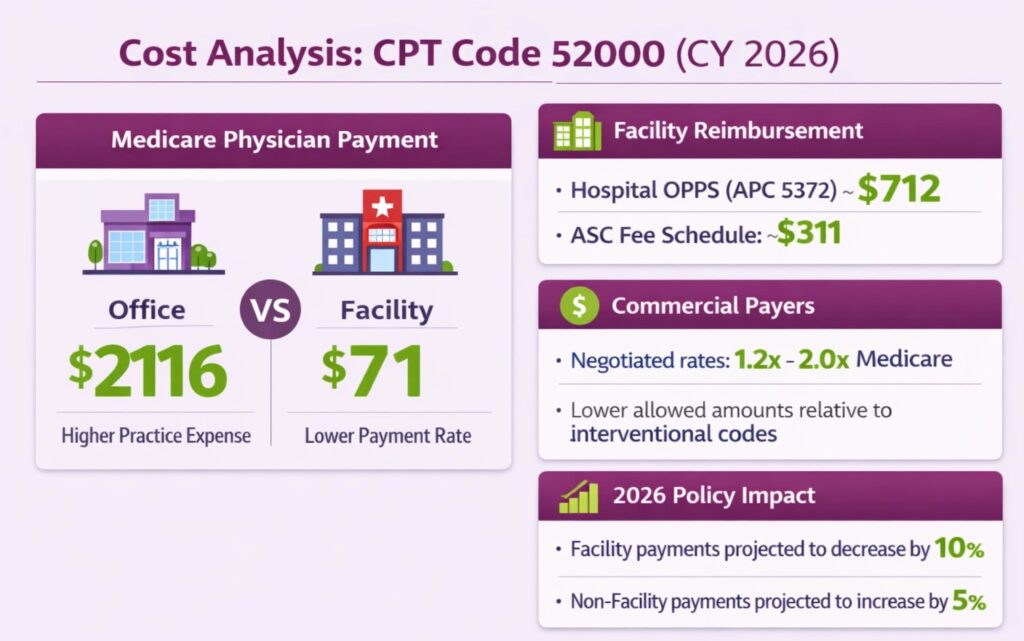
CPT code 52000 has a total facility-based RVU of 2.13 and a total non-facility (office) RVU of 6.46 for CY 2026, per CMS-1832-F (PFS Addendum B, RVU24D file, October 2025 release). Using the CY 2026 non-QP conversion factor of $33.4009, the Medicare national average physician payment is approximately $71 in the facility setting and $216 in the non-facility (office) setting.
The facility also receives a separate Medicare OPPS payment of approximately $712 (APC 5372) for hospital outpatient procedures, and approximately $311 under the ASC fee schedule.
Commercial Payers
Commercial payers typically reimburse CPT code 52000 at rates exceeding Medicare by 1.2× to 2×, depending on contract terms, network status, and geographic market. As a low-complexity diagnostic procedure, 52000 generally reflects lower allowed amounts relative to interventional cystoscopic codes.
Place-of-Service & Geographic Adjustments
CPT code 52000 is reimbursed at a substantially higher rate in the non-facility (office) setting, approximately $216 versus $71 in the facility setting. This is due to the practice expense RVUs allocated to equipment and supplies provided by the physician in non-facility environments. GPCIs adjust all three RVU components by locality.
The CY 2026 policy changes finalized by CMS are projected to decrease facility-based urology payments by approximately 10% and increase non-facility payments by approximately 5%, impacting the relative value of performing CPT code 52000 in office-based versus hospital outpatient settings.
What Are Example Clinical Scenarios or Use Cases for CPT Code 52000?
CPT code 52000 applies when diagnostic cystourethroscopy is the sole procedure performed, and no biopsy, stent placement, or therapeutic intervention is conducted during the same encounter.
Scenario 1: Hematuria Evaluation with No Identified Lesion
ICD-10: R31.9 (Hematuria, unspecified)
The patient presents with gross hematuria. Imaging is unremarkable, and prior urine cytology is negative. The urologist performs diagnostic cystourethroscopy, which reveals no identifiable bladder lesion, tumor, or source of bleeding. No intervention is performed. CPT code 52000 is reported as the sole procedure for this encounter.
Scenario 2: Recurrent Urinary Tract Infections Requiring Bladder Inspection
ICD-10: N30.00 (Acute cystitis without hematuria)
The patient has a history of multiple recurrent urinary tract infections unresponsive to antibiotic therapy. The urologist performs cystourethroscopy to evaluate for anatomical abnormalities, foreign bodies, or bladder pathology contributing to recurrent infection. Examination reveals mild bladder trabeculation with no discrete lesion. No additional procedures are performed, supporting CPT code 52000 as the sole reported service.
Scenario 3: Intraoperative Cystoscopy to Confirm Ureteral Integrity
ICD-10: Z48.89 (Encounter for other specified surgical aftercare)
Following pelvic surgery performed by a gynecologic surgeon, the urologist performs a confirmatory cystourethroscopy to verify ureteral integrity and rule out inadvertent injury. No therapeutic intervention is performed. When this is the only cystourethroscopic service provided, and when it is a distinct, separately documented service not integral to the primary surgical procedure, CPT code 52000 may be reported with modifier 59 to support separate reimbursement.
What Are the CPT Code 52000 Rules To Ensure Successful Reimbursement?
Follow payer and policy rules for bundling, frequency, separate procedure designation, and documentation. Meeting these rules reduces denials and ensures correct payment.
Bundling / NCCI / Same-Day Procedure Rules
CPT 52000 code is designated as a “separate procedure” and is bundled by NCCI into virtually all other cystourethroscopic codes. It must not be reported on the same claim as CPT 52204, 52214, 52224, 52332, or any other cystourethroscopic code performed on the same date in the same anatomical context.
Modifier 59 or XS may be used to override bundling only when the cystourethroscopy is a genuinely distinct and separately documented service, not simply the introductory step of another cystoscopic procedure. NCCI edits for CPT 52000 should be verified prior to any multi-procedure claim submission.
Units, MUEs & Frequency Rules
CPT code 52000 is billed as one unit per date of service per provider.
- Medicare will not separately reimburse CPT code 52000 when a more comprehensive cystourethroscopic procedure is performed on the same date.
- CPT code 52000 carries a 0-day global period, meaning no postoperative visits are bundled. Follow-up evaluation is separately billable after the date of service
- Repeat diagnostic cystourethroscopy within a short interval may require supporting documentation of a new clinical indication to avoid medical necessity denials, particularly for Medicare and managed care payers
- Payers may apply frequency edits limiting the number of diagnostic cystourethroscopies reimbursable per rolling 12-month period without prior authorization
When CPT 52000 Cannot Be Billed Separately and What to Use Instead
CPT code 52000 cannot be separately reported in the following circumstances:
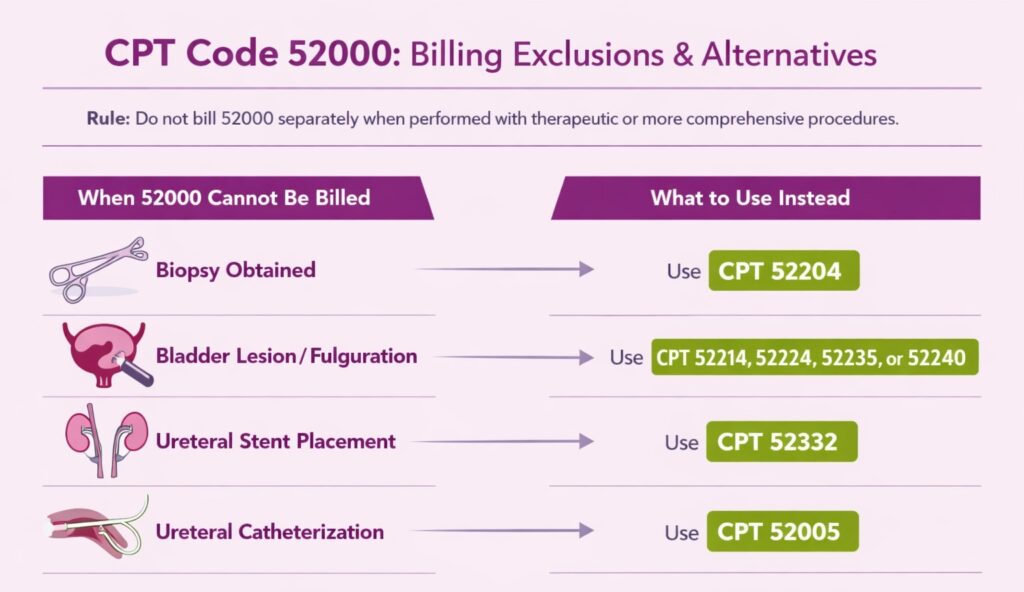
- When cystourethroscopy is performed in the same session as any therapeutic or additional diagnostic cystourethroscopic procedure, report the more comprehensive code only
- When a biopsy is obtained, use CPT 52204 (cystourethroscopy with biopsy)
- When fulguration or treatment of a bladder lesion is performed, use the appropriate 52214, 52224, 52234, 52235, or 52240 code
- When a ureteral stent is placed, use CPT 52332
- When ureteral catheterization is performed, use CPT 52005
Top Reasons For Denials Specific To 52000 & Quick Remedies
- Billed Alongside a More Comprehensive Cystourethroscopic Code: Prevent by confirming no other cystourethroscopic procedure was performed on the same date before reporting 52000.
- Modifier 59 or XS Applied Without Supporting Documentation: Prevent by ensuring the procedure note explicitly identifies the distinct clinical indication and anatomical separation before appending these modifiers to override an NCCI edit.
- Frequency Limitation Exceeded: Prevent by verifying payer-specific frequency policies before scheduling repeat procedures and obtaining prior authorization when required.
- Place-of-Service Mismatch: Prevent by ensuring the place-of-service code on the claim matches the setting where the procedure was performed. Office-based procedures reported with a facility POS code will be reimbursed at the lower facility rate.
Does the “Separate Procedure” Designation Apply Beyond CPT 52000?
Yes, as it is a system-wide billing rule, not specific to cystourethroscopy. Across the CPT code set, any code carrying this designation is subject to the same bundling logic: it cannot be billed independently when performed as part of a larger, related procedure on the same date. This is one of several CPT guidelines for billing that apply universally across code categories, making it essential to understand the rule at a foundational level.